How much money an ordinary person makes in a lifetime depends less on ability than on how many pitfalls they fall into.
This systematic “harvesting machine” covers every stage of our lives — from childhood to old age, from workplace to retirement. It isn’t one company doing evil; it’s an entire business logic designed around anxiety, information asymmetry, and human weaknesses. Seeing through these traps matters more than grinding overtime.
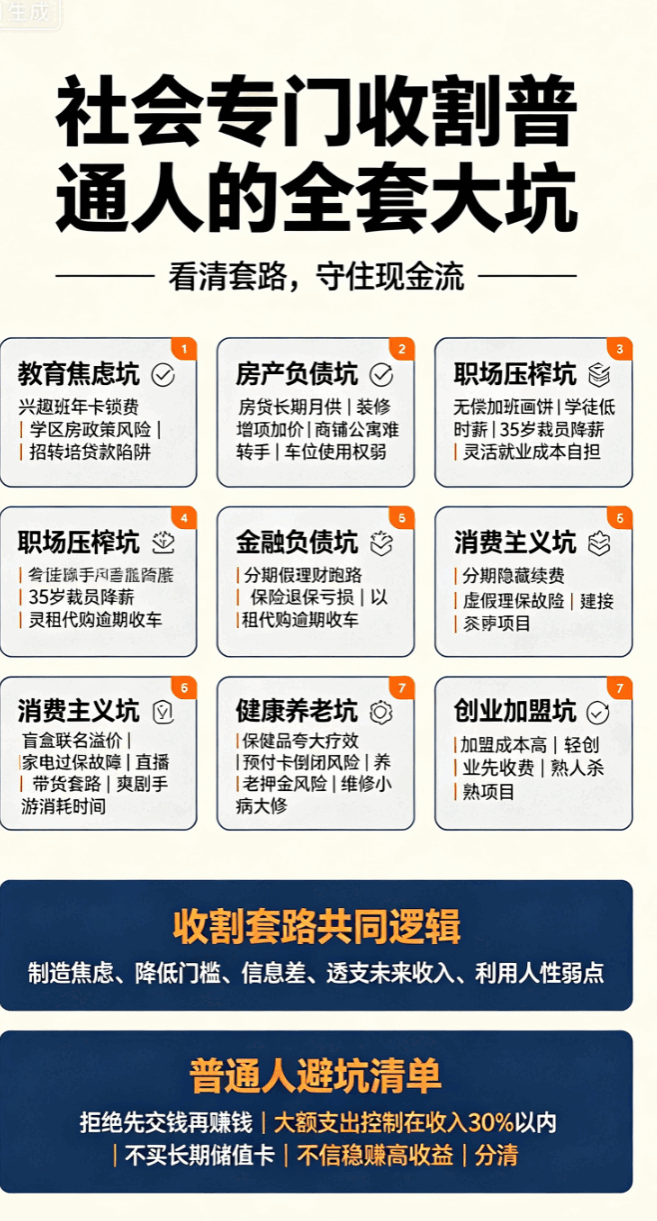
1. The Education-Anxiety Pit: A Whole Family Bleeding Money
1. Children’s enrichment classes
Painting, basketball, swimming, piano, coding, Lego… virtually every enrichment class sells the same concept: don’t let your child lose at the starting line.
The playbook is very mature: first lure parents in with trial classes at 9.9 or 19.9 yuan, then have parents watch their child “showcase results” while consultants strike while the iron is hot, pushing annual packages, private lessons, grading exams, and intensive camps. After you pay, equipment, costumes, and competition entry fees are all extra.
The truth: for 90% of kids it’s only a short-lived interest — it won’t become a bonus point for school admission, nor turn into a professional skill. Tens of thousands of yuan spent, and all that’s left is a few grading certificates and a pile of idle gear. What stings more is that refunds are nearly impossible: once class hours are locked in, the money can’t be pried back out.
2. The school-district housing trap
For their children, parents will pay hundreds of thousands — even millions — extra for school-district housing. But district policies change at a moment’s notice: one document comes down, districts are redrawn, the overpriced house instantly depreciates, while the decades of monthly payments don’t shrink one bit.
The essence of school-district housing: betting your family balance sheet on an uncertain education resource. Bet wrong, and the house loses value, the loan remains, and the family’s cash flow is locked dead.
3. Getting harvested by certification courses and paid knowledge
“Learn video editing from zero, earn 10,000+ a month,” “Get your accounting certificate in 30 days,” “AI monetization bootcamp” — what these courses sell isn’t knowledge, it’s the fantasy of turning your life around.
The courses are usually outdated, with no hands-on practice and no follow-up service. After paying thousands or tens of thousands in tuition, all you get is a pile of recorded videos and a muted WeChat group. Certificates chased by trend? HR won’t even glance at them when you job-hunt.
4. Recruitment-bait training / training loans
This is the hardest-hit zone for fresh graduates and career changers. Job sites advertise “high-paid operations role,” “starting at 8K/month”; in the interview, HR first tears down your abilities, then “kindly” recommends internal training, inducing you to take out a loan for tens of thousands in tuition.
After the training, either no job is arranged, or the arranged job pays far below what was promised. What you learned is worthless, but you’re left carrying high-interest micro-installment debt.
2. The Real-Estate Debt Pit: Locking Up Half a Lifetime of Income
1. Long-term mortgage bondage
Empty all six wallets for the down payment, then shoulder a 30-year mortgage. Total interest nearly equals the principal; every month your salary lands and the mortgage takes first bite — whatever’s left is yours to spend.
This isn’t buying a house; it’s trading thirty years of future choices for one property. No courage to quit, to get sick, to switch careers, to start a business — life’s possibilities compressed to the minimum by the monthly payment.
2. The chain trap of “luxury-fitted” homes and renovations
Developers’ pre-fitted homes are often “spec-reduced versions,” with problems surfacing constantly after delivery. Renovation companies’ cheap packages are even more dangerous: after signing, add-on items never stop, and the final price can run 30%-100% above the contract; materials are substandard passed off as quality, after-sales blame-shifting abounds, and repairs cost money again and again.
3. The shopfront and apartment pit
“Buy and rent out immediately, stable rental income, high returns” — these lines are aimed specifically at people who don’t understand commercial real estate. In reality, shopfronts and apartments require high down payments, are hard to resell, and carry eye-watering taxes and fees; many sit vacant for years, with rent not even covering the loan interest.
4. Bundled parking-space sales
No parking space, no parking allowed — so you spend over a hundred thousand on a space that grants usage rights only and can’t be traded. This expense drains cash in one shot yet has virtually zero liquidity.
3. The Workplace Over-Extraction Pit: Trading Time for Cheap Wages
1. “Blessing-style” unpaid overtime
996, alternating work weeks, “voluntary” weekend overtime — no overtime pay, only the “room for growth” written into PPTs. Your health is drawn down, your hourly rate diluted, and your raises never catch up with the labor you put in.
2. Cheap part-time jobs / apprentice schemes
Milk-tea shop clerks, short-video “apprentices,” e-commerce operations assistants — the ads say “lots of learning opportunities,” but the reality is unpaid overtime, wage skimming, and rock-bottom hourly pay. Young people trade time for “experience” and get back only discounted labor.
3. Age-35 discrimination and the rat race
After a mid-life layoff, re-employment usually means a pay cut. In the anxiety, people are forced to pay for courses or start businesses out of pocket — and fall into a second pit. This isn’t a personal-ability problem; it’s structural harvesting by the labor market.
4. “Flexible employment” harvesting
Food delivery, courier work, ride-hailing look like “the more you work, the more you earn,” but platform algorithms keep cutting prices, social insurance is on you, and vehicle charging, repairs, and insurance are all out of pocket. Do the math and the hourly rate is pitiful, while the body is severely overdrawn.
4. The Financial Debt Trap: Borrowing Against Future Income
1. Buy-now-pay-later installments
Huabei, credit cards, phone installments, Baitiao — the ads say “0 interest,” but the fees, annualized, often exceed 15%. Pay only the minimum and interest compounds on interest; your salary goes to debt repayment first, and you can never save a cent.
2. Ponzi schemes and fake wealth management
Forex, crypto, “insider” private funds, stock tips in paid groups — first they flash fake profit screenshots, then let you make a small withdrawal to taste the sweetness, then induce a large deposit; the platform vanishes overnight and your savings go to zero.
3. Insurance harvesting
Return-type critical illness policies, dividend insurance, universal insurance — expensive premiums, meager coverage. Decades of payments in, and surrendering midway loses most of the principal. Agents exploit your anxiety about aging and disease to sell you long-term bundled policies.
4. Car loans and lease-to-own
Car installment interest is often not low; lease-to-own is even more dangerous — the vehicle never belongs to you, and once you miss a payment, the car gets repossessed while your down payment and monthly payments all go down the drain.
5. Consumerism’s Invisible Harvest: Manufacturing Fake Needs
1. IP, designer toys, blind boxes, and “affordable luxury” markups
Blind boxes, collab apparel, influencer merch that cost a few yuan to make are sold to you at dozens of times the price. Short videos keep “planting grass” in your head, and under the banner of “emotional value” you hoard piles of useless things.
2. Planned-obsolescence electronics
Phones and appliances break right after the warranty expires; repair quotes approach half the price of a new machine, forcing you to keep replacing them. This is no coincidence — it’s a consumption cycle designed into the industry chain.
3. Livestream shopping schemes
The cheap traffic-bait items are always out of stock; what’s really being pushed is high-markup no-name goods, mixed with fake discounts, near-expiry products, and counterfeits. After an impulsive order you find returns are difficult, and you can only swallow your losses.
4. “Tittytainment” — cheap thrills
Short videos, mindless power-fantasy dramas, mobile games — free, yet they devour huge amounts of your time. They don’t charge you directly, but they erode your ability to think, make you give up self-improvement, and trap you in a bottom-layer loop for life.
6. The Health, Eldercare, and Life-Services Pits
1. Wellness therapies and health supplements for the middle-aged and elderly
Exaggerated curative claims; supplements, massage cards, and moxibustion packages costing thousands or tens of thousands, sold specifically to old people afraid of death and to dutiful children. Plenty of money spent, virtually no effect.
2. Cosmetic procedures and gym annual memberships
Cheap trial experiences lure you in, then they push cosmetic packages costing tens of thousands and “lifetime” gym cards. When the store goes bust or changes hands, your prepaid money simply can’t be recovered.
3. Retirement-apartment scams
Prepay a deposit of over a hundred thousand to “lock in a bed,” with promises of high rebates. Once the cash chain breaks, both the money and the room vanish together.
4. Repair industries charging sky-high prices
Appliance, plumbing, and phone repairs: a cheap house-call fee first, then price hikes after disassembly; minor faults turned into major repairs, billed at several times the rate. Ordinary people don’t understand the technology and can only be fleeced.
7. Startup and Franchise Get-Rich Scams: The Turnaround-Dream Trap
1. Influencer snack and milk-tea franchises
Franchise fees start at tens of thousands, and you must also buy ingredients at inflated prices. Bad locations, fabricated foot traffic — many stores don’t last half a year before folding, losing rent, labor, and the franchise fee.
2. Short-video selling, unmanned vending, “AI light entrepreneurship”
They tout “zero-cost passive income,” collect service fees, sourcing fees, and training fees up front — and in the end there are no orders, no support, just a mess left on the floor.
3. Acquaintance-exploitation projects
Relatives and friends pull you into investments or co-opened shops, using trust to drain your savings. Between acquaintances, saving face gets in the way of signing contracts; in the end the money is gone and so is the relationship.
The Common Underlying Logic of Every Harvesting Scheme
- Manufacture anxiety: parenting anxiety, retirement anxiety, poverty anxiety, falling-behind anxiety — then sell you the “solution.”
- Lower the barrier to entry: cheap trials, zero down payment, installments — pull you into the water first, then keep charging.
- Information asymmetry: you don’t understand finance, law, or industry insiders; merchants hold all the rules.
- Borrow against long-term value: spend small money now to lock up your income for the next decade-plus — mortgages, long-term insurance, installment loans.
- Exploit human weaknesses: greed for quick money, love of face, fear of falling behind, blind trust in acquaintances.
Simple Core Principles for Avoiding the Pits
- Any job or project that asks you to pay money before earning money — refuse, without exception.
- For large long-term expenses (mortgages, training, insurance), monthly or annual outlay should not exceed 30% of household income.
- Refuse all large prepaid stored-value cards and multi-year packages.
- Stay away from any investment promising “guaranteed profit, passive income, high returns.”
- Distinguish must-have spending from emotional-premium spending; don’t spend for face, don’t follow the crowd, don’t borrow against the future.
Final Thoughts
These pits are not accidental scams but an entire system designed around ordinary people. What truly helps you fall into fewer pits isn’t working harder to earn more — it’s recognizing the rules earlier, controlling your desires, and guarding your cash flow.
Money can be earned slowly, but one fall into a big pit can take ten years to climb out of.
评论
0 条评论