A few days ago I cancelled the only credit card I had left. A China Merchants Bank card.
I couldn’t even find the physical card. If I had, I’d have cut it up — not as a performance for anyone. I just don’t want it lying in that drawer. Even lying down, it’s still an entrance.
Let me lay the books open
- I was laid off early this year. The severance came to 180,000 yuan. I put just over 60,000 of it into the mortgage, to get the debt down.
- This month I prepaid another 20,000. Now, whenever I scrape together anything at all, I feed it to the loan. I still owe 600,000.
- On the equal-principal schedule I have 18 years left, 4,000 yuan a month, stepping down every month. Follow the contract’s own rhythm and I’ll be past fifty when the last payment clears. Every one of these numbers was calculated in advance — by them, not by me.
- My housing provident fund fell from just over 5,000 a month to just over 1,000. It used to cover the mortgage outright and leave a surplus. Now I have to add 3,000 of salary to the payment every month.
- My wife was pushed out of her job at the end of August. Her company owes her a year of wages plus compensation — over 200,000 yuan. Not a cent paid, and I doubt the day it arrives is coming soon.
- The flat we bought in 2019 for 2 million yuan is worth 1.6 million now. An unrealised loss of over 400,000.
- After the mortgage comes out, a few thousand yuan is left in my hands. Enough to eat.
That is the “now” in which I cancelled the card.
Why the card went before the grocery budget
Because I want to cut off their consumption — and I have no money to consume with anyway. You cut off my income, so not spending is the only protest I still have. Besides, I have never once put that card on instalments. I paid every bill in full, every month: no instalments, no spending beyond what I had. Because I got burned before — straight out of university, the highest penalty interest they charged me was five ten-thousandths a day. Banks beg you to take a credit card out for a reason: they have ways of making money off you.
China Merchants Bank writes it themselves, in their own instalment terms: the overdraft rate is five ten-thousandths a day, which they state as an annualised 18.25%. Their own arithmetic, simple interest, and compounding monthly pushes it higher. And their revolving credit charges interest from the day the transaction posts, on the full amount you spent — not from the due date, not on the balance you didn’t repay.
My mortgage? The provident-fund rate was cut 0.25 points on 8 May 2025, bringing a first-home loan of over five years to 2.6%, and my existing loan moved automatically to that rate on 1 January 2026.
18.25% against 2.6%. The gap is 15.65 percentage points.
That 15.65 is exactly the difference in how the world treats you depending on which debt you carry:
- Owe them at 2.6% and they want you to keep owing. Prepayment needs an appointment, a queue, sometimes a penalty fee. You walk in to hand them money and the counter looks at you like you’re wrecking their business.
- Owe them at 18.25% and they don’t have to ask. They raise your limit, they offer “interest-free” bill instalments (no interest, the fee is still there in full), they hand you a government subsidy.
They don’t care what you buy. They care whether you’re still in debt tomorrow. Because only while you’re still in debt is there money to be made off you.
That one-point subsidy is buying your next loan
The Ministry of Finance issued the Implementation Plan for Fiscal Interest Subsidies on Personal Consumer Loans in August 2025, live from 1 September: a subsidy of 1 percentage point a year, capped at 3,000 yuan per borrower per institution. In January 2026 the Ministry of Finance, the central bank and the financial regulator extended it to 31 December 2026 and casually added credit-card bill instalments to the list of eligible uses.
A 3,000 yuan cap at one point implies — they will subsidise up to 300,000 yuan of your spending.
What does 300,000 cost at 18.25%? After their one point, you still pay 17.25%.
Reading that policy taught me one thing: that point isn’t a gift to me, it’s a payment for “me swiping tomorrow.” If I take it, I finish their deal for them. I won’t.
The Beijing News ran a true story last September: someone opened a CMB card in 2019 with a 48,000 yuan limit. Six years later she had paid over 36,000 yuan in interest and fees, of which more than 20,000 was pure interest and penalties. The headline called it an “interest assassin”. She wasn’t splurging. She just chose the minimum repayment, every month, for six years.
“Minimum repayment” is the cruelest four words consumerism owns. It makes you believe you’re paying it off while the principal doesn’t move and the interest accrues. What they sell you was never the product. It’s your cash flow for the next several years.
I didn’t take the 600 yuan a month
People tell me: 4,000 a month is heavy, switch to equal instalments and it drops to 3,400.
So I ran my own numbers before answering. At 2.6%, with 216 payments left:
- Equal instalments (annuity): a flat 3,415 every month. Payment one, payment 216, same number. Total interest 149,000 yuan.
- Equal principal: first month 4,000, then it falls by a few dozen each month until the last payment is 2,731. Averages 3,365 a month. Total interest 138,000 yuan.
Which means: for the first eight years I pay about 600 yuan more each month, then it flips, and for the last years I pay 600+ less, and altogether I hand over a little over 10,000 less in interest.
That “drop to 3,400” isn’t paying less. It’s moving money from the front of the loan to the back — out of the years I can still absorb it, into my forties, when I may not even be able to get an outsourcing gig any more.
I won’t switch. What I want isn’t a smaller-looking payment. What I want is a shorter sentence. Those are different products: one is designed for someone planning to stay in debt, the other for someone trying to get out.
You think I want to be an outsourced body?
I job-hunted for six months. Nothing suitable. Nothing even at the same salary. At my age a permanent post at a big company is out of the question, and the small firms pay so badly they don’t even contribute to the provident fund. In the end I took a 50% pay cut to work as an outsourced contractor inside a big internet company. And if you think anyone can get an outsourcing job these days, you’re wrong — plenty of bachelor’s and master’s graduates are doing it now, the bar for those roles has risen with them, the pay is low and the demands are high. Plainly put: there are too many of us.
If none of this weight were on me, I’d rather have stayed in my gap year and learned something new. I absolutely did not want this.
While sending CVs I also looked for another way out. I actually went and learned food service — breakfast stalls. After the fieldwork I found that this road doesn’t suit me, at least not for now. Doing business is genuinely hard these days; after watching that Douyin account Yong Ge Talks Restaurant Business (勇哥说餐饮), I reckoned a complete novice like me walking in would most likely lose his shirt and the shirt underneath.
And the money in my hand and the weight on my back no longer allow another attempt. There’s a child to raise and a mortgage to pay. Middle-aged people have fewer options than young ones to begin with, and they’re carrying debt.
An outsourcing firm earns money on headcount and money for taking the client’s risk. The client can return me to my agency at any time. I have zero standing in front of them, and the conditions are so unequal that two pay scales sit in the same office. This job could end any day — that isn’t pessimism, that’s the job description.
It isn’t my effort
- China’s class of 2026 graduates is 12.7 million, 48,000 more than last year (Ministry of Education).
- Over ten million people need to be soothed, given hope, given jobs.
- And housing? At end-2025 the outstanding balance of personal mortgages in China was 37.01 trillion yuan, down 1.8% year on year; total real-estate loans fell by 963.6 billion over the year (PBOC).
Middle-aged buyers are already in. Young people aren’t. So room has to be made for the young to get on the ladder — otherwise who buys the flats? Hangzhou’s Future Sci-Tech City still has enormous tracts of empty land. Where does that room come from? It comes out of the positions middle-aged people currently hold.
Don’t tell me the age-35 wall is just folklore bias. It was in official documents. Civil-service exams drew the line at 35 for decades and only in October 2025 raised it to 38 (43 for fresh master’s and PhD graduates). Caixin reported that the same exam shrunk its hiring for the first time in seven years. The National Development and Reform Commission’s own website reprinted an article whose headline was literally “Is 30 the New Hiring Ceiling? Don’t Let Age Discrimination Block Employment.”
The rules moved by three years. On the corporate side the wall had already moved down to 30.
From a cost-efficiency standpoint: a younger person can do this job too, for half the money — why hire you? This is structural, not psychological. You’re 35, your kid is in school, your parents need doctors, you’ve paid social insurance for fifteen years — you can’t stop and you won’t stop. So your exit cost is the highest. Employers have always picked off the people with the highest exit cost first, because those are the easiest to squeeze.
Look back at previous technological revolutions: the wave in front always gets smashed on the beach — cars replaced horses, new tech replaced old. I accept that law; I never said I didn’t. Middle-aged people are willing to learn new technology and have every motivation to. But this society won’t hand you a ticket any more: it screens on age, it screens on degree.
Another China, inside my WeChat feed
I scroll through Moments. Plenty of people have been cut. Those with no wife and no mortgage take their severance and fly — today England, tomorrow Turkey, the day after Japan, running all over the world.
Honestly, I envy them.
If I didn’t carry what I carry, I’d do it too. The difference is one line: he’s alone and debt-free; I’m three people and eighteen years of mortgage.
Here’s the face of it: when they want you to have children you’re “the future”; when you’re paying a mortgage you’re “domestic demand”; when you apply for a job you’re over age and, married with kids, a liability. They say “have children” while the posting says under 35. They say “consume” while cutting your income in half. On one side, young people with no job and no future in sight; on the other, old people on a pension of ten-thousand-odd yuan a month flying round the country to sightsee; and in between, the middle-aged, wedged, going neither up nor down.
There’s a line going round that puts these three far more brutally: the morning commuter train “is full of glowing old people off to travel, listless young people off to work, and middle-aged people who would rather be dead than alive.” A viral essay in 2024 — “Now the streets are full of three kinds of people” — split that cohort into “listless young people” and “middle-aged people who would rather be dead than alive”, and the portrait it drew of the middle-aged might as well have been me: the 35-to-40 year olds born in the countryside who clawed their way into the city through exams, carrying “a mortgaged flat, a sick mother, a stay-at-home wife, and three kids”.
Mine isn’t three kids, and my wife isn’t a housewife — she lost her job, and her company still owes her a year’s wages. But the first two items on that list I own outright: the mortgaged flat, and my own body — which I can less and less afford to let fail me.
Three populations, three sets of books, all printed on the same statistics release:
- The young. The NBS’s age-broken-down figures for September 2026: national urban surveyed unemployment 5.2%, but 18.0% for 16–24 year olds (excluding students) and 7.4% for 25–29. That’s 3.5 times the national rate. Listlessness isn’t an attitude problem — it’s sending CVs into a void with no echo coming back.
- The old. Retirees who spend their money travelling the country: they exist. My parents on just over 200 yuan a month in rural resident pension: that exists too. In 2024 the average urban employee pension was about 3,825 yuan a month; the average rural resident pension was about 246 yuan — a gap of 14.6 times. Same “Chinese citizen”, two different pools. I ran that calculation in my last post; I’m only putting it back on that morning train: the old people you see flying around the world are mostly not drawn from the 246-yuan pool.
- The middle-aged. Written down as my own line items, that group is three numbers: pension-drawing parents above me, a tuition-billing child below me, and my 4,000-yuan mortgage payment right in the middle.
And about those words “would rather be dead than alive” — I won’t get dramatic. I’ll just tell you the one honest optimism I have left: right now, I can still afford to pay.
The four traps I actually fell into — young people, don’t touch them
People ask what I’d tell the younger generation now. I thought about it for a long time, and it comes down to one line: no online lending, no car loans, no mortgage on your head, and don’t rush into the next generation.
These four aren’t “consumption”. They’re major consumption. Each one has a good name pasted on the front — respectability, family, responsibility, the future. And I’m not preaching from outside: I stepped into all four.
Online lending: it sells you years you haven’t earned yet
Online lending gives you nothing. It simply hands you money you were supposed to earn after tomorrow, then collects it back from your future with interest. The 18.25% on my CMB card was a licensed institution, written in a contract, a presentable rate. Online lending sits above that.
In April 2025 the financial regulator issued the Notice on Strengthening the Management of Internet Lending-Assistance Business of Commercial Banks (Jin Gui [2025] No. 9), in force from 1 October 2025. Two core demands: a borrower’s total cost of financing must be held under 24% a year, and platform and credit-enhancement partners must be run off a whitelist — no business with anyone off it.
Taste the subtext: something needs a regulation to be pushed under 24%. What was it before the regulation? 24% against my mortgage’s 2.6% is more than nine times. When a line of business is profitable enough that the regulator has to step in, nobody is being charitable. They are buying the next few years of your life.
The funniest thing is still on the shelf. Today there’s a product category generally called a “social-insurance loan” — another name I’ve heard for it is 社银贷, a “social-security-bank loan” — and every pitch is the same sentence: show us your social-insurance and housing-fund contribution record and we’ll approve you a limit. I genuinely cannot figure out how something this magical exists. Online lending is already bad enough; this one, don’t go near it.
Let me be exact about why it’s worse. Social insurance was supposed to be the proof of what you collect when you’re old — a record of fifteen-odd years of your labour paid in month by month. Now that same statement is being read as proof of how much more you’re allowed to borrow. One piece of paper, two readers: one writes your old age on it, the other writes your credit limit.
And it reads only one of the two columns. My own contribution base has been cut by more than half in these two years — housing fund from five-odd thousand a month to just over a thousand — so in a bank’s scoring model the amount I’m “eligible” for shrank right along with it. It uses what you paid in to judge whether you’re worth lending to. It never uses what you have left to judge whether you can afford to pay it back.
There’s a further joke underneath. Social insurance is itself something an employer can simply not pay. My wife’s company still owes her more than two hundred thousand yuan, and I haven’t even checked whether her contributions went in over these last few months. “We lend against your social insurance” rests on somebody else having paid it in for you. The moment that premise gives way, you aren’t even eligible to be lent to.
I won’t guess at the rate these carry. I’ll only point at one thing: that 2025 notice was written to squeeze the lending-assistance chain, and a document that has to say out loud “keep the all-in financing cost under 24% annualised“ is itself the proof that nobody on that chain ever quoted you an honest price. 24% is more than nine times my mortgage and 1.3 times the CMB card I’ve already cancelled. Taking on another 24% debt because you pay social insurance means pledging your own retirement record as collateral — in exchange for the very money that makes it harder to go on paying it in.
The car: it starts depreciating the day it leaves the lot
I bought mine in 2020. 170,000 yuan driving out. That purchase was never about me — our child was about to be born and my wife couldn’t get to her check-ups conveniently. Otherwise I genuinely would not have bought one.
- After three years I took it into a dealer for a valuation. They offered 50,000. Three-year residual: 29%. The China Automobile Dealers Association puts the average three-year residual for petrol cars in the first half of 2026 at 46.07%, and EVs at 43.35%. I couldn’t even hold the average.
- It’s nearly at 100,000 km now, and I know what it’s worth: 10,000 or 20,000 at most.
- Running it costs an average of 2,000 yuan a month. Over six-odd years that’s 150-160 thousand — I have paid for a second identical car, in instalments, and gotten nothing for it.
- And to park that lump of iron I had to buy a parking space. The space cost another hundred-thousand-plus.
- Meanwhile the model churn is absurd. Be honest about what “upgrading” means now: it’s all software — a bigger screen, a smarter voice assistant, two more cameras. The hardware didn’t change, but a new model launches at a lower price and your car is sentenced on the spot.
Buy in at 170,000, add a parking space over a hundred thousand, feed it 2,000 a month, and six years later you hold 10,000-20,000. An “investment” down more than 90% that also bills you every month — put it in any finance app and the risk banner at the top of the page would be red. But this one is called “a normal part of adult life”. Of course it was never an investment. It’s a consumption good.
The mortgage: I don’t even like this city
Honestly, I never wanted to buy in Hangzhou. I don’t like this city. All year it’s either muggy or damp and cold, and there’s no central heating in winter — my flat is colder than sitting over the fire barrel back in my parents’ village.
If it hadn’t been for the marriage — if my mother-in-law hadn’t required a flat — I truly would not have bought one. And the location is bad, the district is bad.
- We paid 2 million. The same flat is worth 1.6 million now. Over 400,000 gone.
- Two years of not eating and not spending, and all of it was for nothing.
That is the real reason I pour every yuan into the mortgage, and it isn’t saving 2.6% of interest. I paid in over 80,000 this year while the property lost several hundred thousand more — I am indeed repaying a debt on an asset that is evaporating. But I’ve thought it through: this debt is the only thing in my life I can still control. I can’t control the price of the flat. I can’t control when the client returns me to my agency. I can’t collect the 200,000 my wife is owed. Only this number — I can push that down a little every month.
The official line still offers you a step to stand on. Hangzhou’s second-hand home prices were down 4.0% year on year in June 2026 and 3.4% in July, with the month-on-month fall narrowed to 0.1%, and the headlines call it “the decline is narrowing” and “a turning-point signal”. What does narrowing do for me? I bought on the 2019 summit. If the mountain isn’t lifted, “narrowing” just means I slide down more slowly.
The next generation: the joy is real, and so is the bill
I don’t care much about carrying on the family line. My parents do. Having a child was our choice, and our kid really has brought this house a lot of joy and life — that’s sincere, it isn’t a setup for the paragraph below.
But raising a child is genuinely expensive. It stopped being an era where food and warm clothes were enough. When we were small, our parents gave us something to eat and the rest was feral growth. Now the competition is brutal, every other kid is in class after class, and you sign up for one or two yourself, surely — that’s tens of thousands of yuan a year.
Put my numbers next to the national ones and you’ll see what “one or two classes” actually costs:
- In the first three quarters of 2026, national per-capita household consumption was 22,354 yuan, of which education, culture and recreation was 2,647 yuan, up 4.6% (National Bureau of Statistics). So an average person in China spends under 4,000 yuan a year on all of it. The single child I am paying tuition for costs me roughly ten times that.
- Yuwa Population Research calculated it: the average Chinese household spends 538,000 yuan raising a child from 0 to 17, 680,000 through a bachelor’s degree, and close to a million in the big cities.
This is where the money goes. This is what eats your cash flow — not the bubble tea, not the cinema ticket.
On return on investment, one example is enough: the drawing class. Those teachers — one graduate from this university, one from that. Look at them and you’ll understand: people who got a bachelor’s and a master’s now only get hired to teach kids how to draw.
The Ministry of Education announced on 24 November 2025 that applications for the 2026 national postgraduate entrance exam came to 3.43 million, 450,000 fewer than the previous year, falling for three straight years from the 2023 peak, a cumulative loss of 1.31 million applicants, back to the level of around 2020.
Even the graduates themselves no longer believe that three more years of school buys them a job. So you drive your child all the way to a bachelor’s, then a master’s — and you think they’ll find work paying 10,000 a month?
This isn’t “education is useless”. It’s signal inflation. When everyone holds a ticket, nobody does. What your tens of thousands bought wasn’t ability; it was half a place ahead in the queue — and that queue is being reshuffled by 12.7 million new graduates.
Things are supposed to serve people. Now it runs the other way
Everything that gets made is supposed to serve a person. But a lot of companies have reversed the order: they want to use the least cost and the fewest people to make the most things, then sell those things to more people, so their own profit gets bigger.
Is that actually realistic?
One look at a sales sheet answers it. In 2025 China’s car production and sales both passed 34 million units — it sounds like a golden age. That same year the top fifteen automakers sold 31.74 million between them, and the top three alone took 36.6%. Which leaves the remaining dozens upon dozens of brands sharing less than a tenth of what’s left. So a pile of cars must be sitting in this market whose launch day was also the highest point of their lifetime sales. I’ve seen exactly the kind I mean: several new models a year, one press conference after another, and then the year-end sheet comes out — a few dozen units. Those aren’t products. That’s a slideware deck cast in metal, built to be reported upward.
Price cuts are the other end of the same machine. On the CPCA’s figures, 177 car models were discounted during 2025, and the year before that had even more: 219. Over a hundred and seventy models cutting price in one year — that is how my car, worth 29% of what I paid after three years, lost its value. I didn’t drive it into the ground. Those 177 later models queued up and pushed it down.
Phones are the same script run a second time. China’s CAICT counts 286 new handset models launched domestically in the first nine months of 2026 — some thirty “new products” a month. Yet in September alone domestic handset shipments were 21.86 million units, down 21.7% year on year, and even the model count is falling, down 28.1%. The makers have done the arithmetic themselves and flinched first. On the user side it’s blunter still: trackers put the average Chinese replacement cycle at 24–25 months back in 2020, while the CAICT had it at 33 months by the first half of 2025. Factories schedule for an annual swap; people live on a three-year one. Those two rhythms stopped meeting each other a while ago.
So the so-called new model is old wine in a new bottle. On phones it’s one more camera, a bezel shaved another millimetre, and the letters “AI” printed on the poster. On cars I already wrote it in the last chapter: a bigger screen, a slightly smarter voice assistant, two extra cameras. The hardware hasn’t moved an inch, so the launch has to be staged like a concert.
Society right now is restless and bloated — day after day, several new cars a year. Here is my own change, said plainly: I am tired of this consumerism. I’m immune to that advertising now.
Immunity isn’t enlightenment. It’s an organ that grows on you once there’s no money in your pocket. When you have worked out that whatever you order today will certainly be cheaper this time next year, no drumbeat out of a launch hall lifts your pulse. Companies call that “consumer appetite still needs lifting”. They call it “the user’s mindset isn’t developed yet”. They never write “I priced it too high”, and they never write “I cut the people”.
Except my immunity cures nothing. I don’t buy, and some kid who just graduates buys it on instalments in my place; I skip this year, and next year another hundred-odd cars queue up to be discounted. In this entire ledger the only number still under my hand is the one I push down into the mortgage each month.
You cut my income, so I cut your consumption
That’s my strategy for the next few years, in one line: since you cut off my income, I’ll cut off your consumption.
- The card is cancelled. The only one I had.
- Cash goes into the mortgage. All of it.
- The mortgage is now my only debt. At the rate I’m pouring money in, I have a few more working years before it’s done — sometime in my forties. Follow the contract instead and I’ll be repaying it into my fifties.
I think that’s only fair.
These days every company is cutting costs — this quarter it’s headcount, next quarter it’s a department, always “efficiency”. It does save money. AI really has made work faster. But once you’re more productive — who are you going to sell to?
Who consumes your product? If everybody’s pay is low and nobody has any money, who’s going to buy? Who can afford it? Who do you sell what you make to? You could build a car that flies into space, and if nobody can afford it, what was the point?
That ledger has two columns, and in two years I’ve been entered in both of them. On the company spreadsheet I’m the cost line. In the speech they broadcast in the evening I’m domestic demand. Same man, same month: cut on one side, called upon on the other. The cutting is quick. The calling is loud.
Economics has a name for this — a shortfall of effective demand. In plain speech: what one person saves on cost is exactly income that disappears from somebody else’s account. The day you finish cutting your costs is the day you finish cutting your customers. The worker AI replaced and the person who spent that salary into the market every month were the same body of flesh — one payslip, two entries in the books, and the boss only ever reads the left column.
And this is the line that ends up on paper: in the first three quarters of 2026, retail sales of goods and services grew 2.6% year on year, and goods retail on its own grew 1.0%. When the goods don’t move, the report calls it “weak consumption”, calls it “a confidence problem”, calls it a dozen words that ask you to examine your own attitude — it just won’t call it “the salary you cut”.
So I won’t be the man who spends against the cycle. The card stays cancelled. If you want my purchasing power, hand my income back. If you won’t, I vote by not buying.
I used to believe a saying: pressure creates drive.
Bullshit.
Don’t give yourself pressure. Those lines were written and spread by the people who want to exploit you, aimed at the people being exploited — because as long as you volunteer to carry it, carrying it costs them nothing.
If you don’t buy a flat, don’t marry, don’t have children, life is genuinely easy: feed yourself and you’re done. Add those three and life gets very hard. That isn’t a theory. It’s my cash flow these last two years.
What I’m saying is measure yourself — not “don’t have children”
Let me be clear: I am not telling anyone not to buy a flat, not to marry, not to have children. I’m telling you to measure yourself.
Because if your family starts with nothing much, then in all likelihood your children won’t start much higher either. That’s ugly to hear, and I don’t enjoy saying it. But it’s the oldest line in our villages: dragons beget dragons, phoenixes beget phoenixes, and a rat’s young learns to dig holes. That rule hasn’t changed in ten thousand years. A man from the bottom who wants to break through needs heaven’s timing, the ground under him and the people behind him — and most people don’t hold so much as one of the three.
I hold none of them, and I can name all three.
- The ground is where you’re born. On the NBS’s figures for the first three quarters of 2026, urban residents’ per-capita disposable income was 44,945 yuan, and the urban-to-rural income ratio (rural = 1) was 2.39. You are entered into one of those two rows on the day you’re born, and you don’t get to pick. The ratio shrinks by 0.04 a year, and the official word for that is “the gap is narrowing”. At that speed, closing it takes more years than I have left.
- The people behind you is whether your family can catch you when you fall. I laid my parents’ two-hundred-yuan pension out earlier; I’ll use only its conclusion here: when they’re old they won’t have money to help me — they won’t have enough to keep themselves old.
- Heaven’s timing is whether the jobs exist in the year you show up. In a year when tens of millions push in at once, they don’t. I did that arithmetic too, and I won’t do it twice.
And the one ladder everybody points at — the exams — is emptying out under its own weight. The numbers are in an earlier chapter. What they mean isn’t that studying is useless. It’s that once everyone is queuing on the same single bridge, the bridge stops leading to the far side and only leads to the back of the queue.
As for how the people who write the rules see us, one sentence is enough: the men who own the capital use you as cannon fodder, and once you’re squeezed dry they throw you out. They discard you at thirty-five and call it “graduating”; they discard you again at forty and call it “delivering talent to society”. While you’re useful you’re “headcount”. Afterwards they don’t even leave you the word.
So: measure yourself. Translated into cash flow that’s one line — work out how many years you can actually carry before you decide what to carry.
The ones who fell into the trap are the people making the goods
If you never fall into their trap, you live very easily.
Back in my village the old men and women went to town maybe twice in their lives — farmed, fed the chickens, went to market, minded the grandchildren — and still got to seventy, eighty. Look at the city instead: today some programmer drops dead at his desk, tomorrow another one goes down on the way home from work. Their pay is high, but it was bought on overdraft — not because they’re cleverer than anyone. How good they are at earning is a separate question; that money is drawn out of a body under pressure, and it can’t be drawn for long, and it won’t survive a second withdrawal.
It isn’t only the employees who get squeezed dry. A few years back, the graduate-exam coach who was held up for a whole generation of young people as a model of success — the man who pointed millions of them down roads — ended up squeezing himself dry in front of a camera. Even the man whose job was teaching people how to win never beat the shift roster.
Bosses burn themselves the same way. From outside they look like they’ve made it; inside they’re on overdraft every single day, because the cash flow in the books makes their decisions for them. I’ll put it kindly: an employer is a component in this machine too — only when his component wears out, nobody files a work-injury claim for him.
This society is frantic, and the grinding-against-each-other has reached a pitch where it serves no purpose at all. The consumerism I mean was never only the half about you buying things — the people who make the things have fallen into the same trap. Vendors compete against one another, the goods they grind out don’t sell, and they go on making them anyway, because whoever stops first dies first. That’s the other face of the knot from the last chapter: “the fewest people making the most things” ends up invoicing the people making them.
In fairness, productive capacity stopped being the problem decades ago. Everything a person in the 1960s wouldn’t have dared imagine — an air conditioner, a phone, a car that runs, a meal with meat in it — most people in this country already have it. What we can already produce is enough for people to live well. What has ever been short is not capacity. It’s how it gets distributed, and how much desire is allowed to be manufactured in you.
Desire keeps inflating and never stops: today you have A, tomorrow you want B; buy B, and the day after they’ll tell you B is obsolete and what people want now is C. That is their cheapest printing press — they don’t need you to earn more, only to go on feeling that one more thing is missing. So sometimes you have to pull your own wanting back in. My method is unsophisticated, three lines: cancel the card; pour the cash into the mortgage; and before I buy anything for my kid, ask whether this is the thing I want him to have, or the thing he actually needs.
From the top floor to the basement
My wife and I used to save tens of thousands a month between us. Our provident fund paid in just over 5,000 a month and basically covered the mortgage. We lived comfortably enough. We genuinely expected more from the future.
The year I turned 35, I fell from the top floor straight to the basement.
In 2025, per-capita household consumption spending in China was 29,476 yuan, and final consumption contributed 52.0% of GDP growth. In the first three quarters of 2026, retail of goods and services grew 2.6% year on year, of which goods retail grew only 1.0%; meanwhile per-capita disposable income was 34,230 yuan, and the median was 28,388 — just 82.9% of the average.
They broadcast “consumption drove over half of growth” as good news while the median sank under the mean. They want you to spend. They don’t ask what you have left.
The National Institution for Finance and Development said it plainly in a July 2025 note on early mortgage repayment: the main reason households prepay is that the real interest rate is too high. In human words: it isn’t that you don’t want to spend, it’s that you did the maths and can’t afford to. And the numbers published around it: the stock of credit and combined-lending cards fell to 696 million at end-Q4 2025 — under 700 million for the first time, down three years running from the Q3 2022 peak — while household leverage deleveraged for several consecutive quarters from late 2025, and the macro leverage ratio posted its first quarterly decline since 2022 in Q2 2026.
I’m not someone who had an epiphany. I’m one of tens of millions of Chinese simultaneously shrinking their own balance sheet.
Only, most of them are still writing justifications. I already cancelled the card.
I wrote myself an app called “Buy My Ass”
I wrote a piece of software for myself. It’s called 「买个der」, which is about as close as it gets to “buy my ass” — and its logic is one line: before you buy anything, check whether your income qualifies you this month.
It won’t let you ask “can I afford this”. First it makes you build the base ledger: what the family owes (the mortgage payment goes into fixed outflow — skip that step and your balance is a lie), your income and your working hours (so a price can be converted into how many days of your life it costs), how much household spending you ring-fence each month, and an unlock threshold — until your free cash reaches that number, the shopping function stays locked.
Once the ledger stands, it shows you the month. My screen reads: income in 0, mortgage 4,065, household budget 3,000, housing fund locked 1,000 — and what’s left that you may freely spend: minus 8,064.73 yuan.
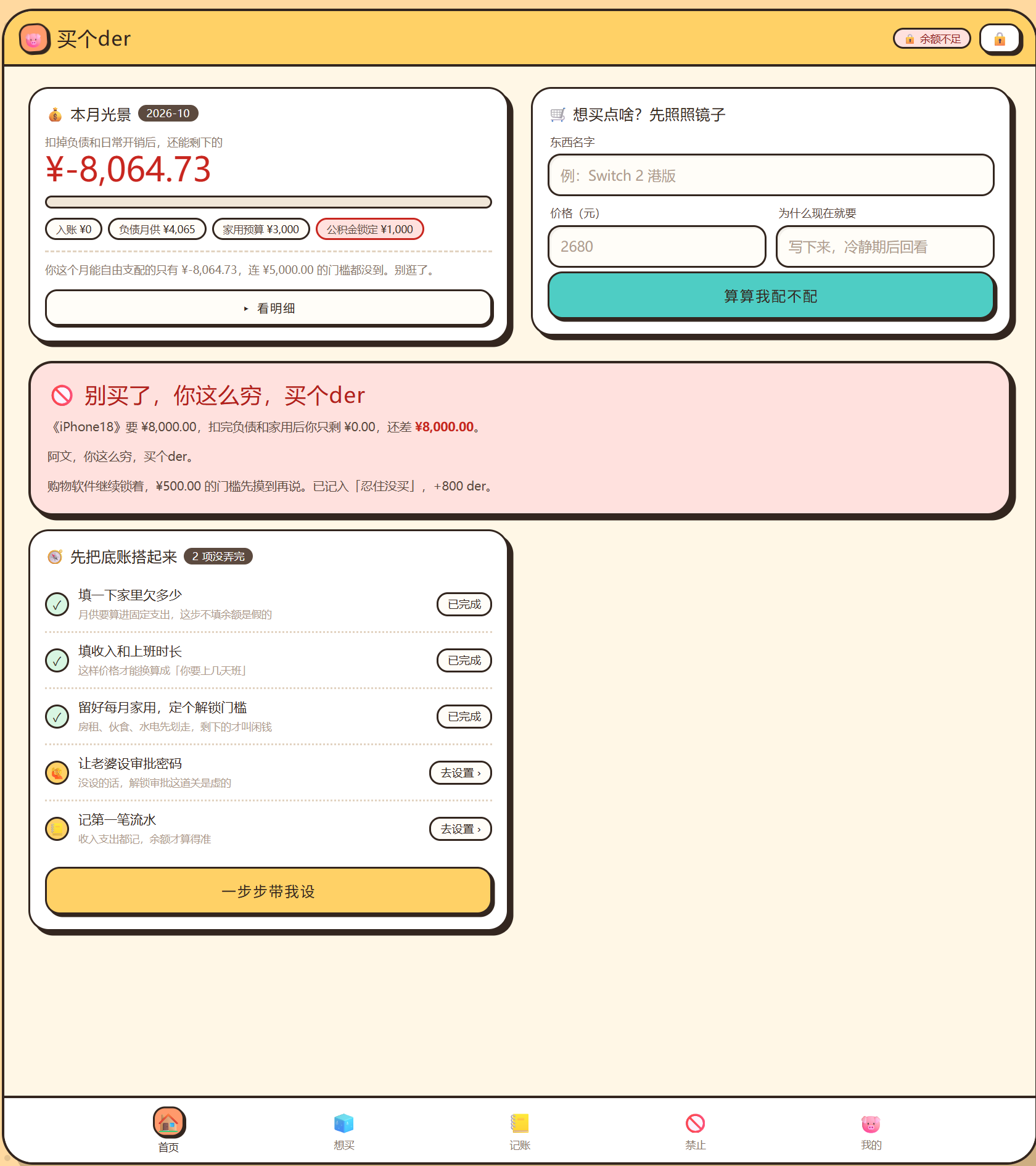
Then every “I want” you submit gets refused. The entry in the screenshot is one it logged for me: an iPhone 18 costs 8,000; after debt and household spending you have 0 left, short by 8,000. What it said back to me was — “don’t buy it, you’re this broke — buy my ass.” Then it records “resisted” and pays me 800 der. Der cannot be spent. That is the whole point of the software: it never hands you money, it only takes back the fantasy you were about to spend.
The last setting asks: when you can’t afford it, how would you like to be insulted? Three levels — gentler, normal, brutal. I picked brutal. The line it previews for me is:
I’d suggest uninstalling the shopping app. You can’t afford anything anyway — stop pretending to be an adult.
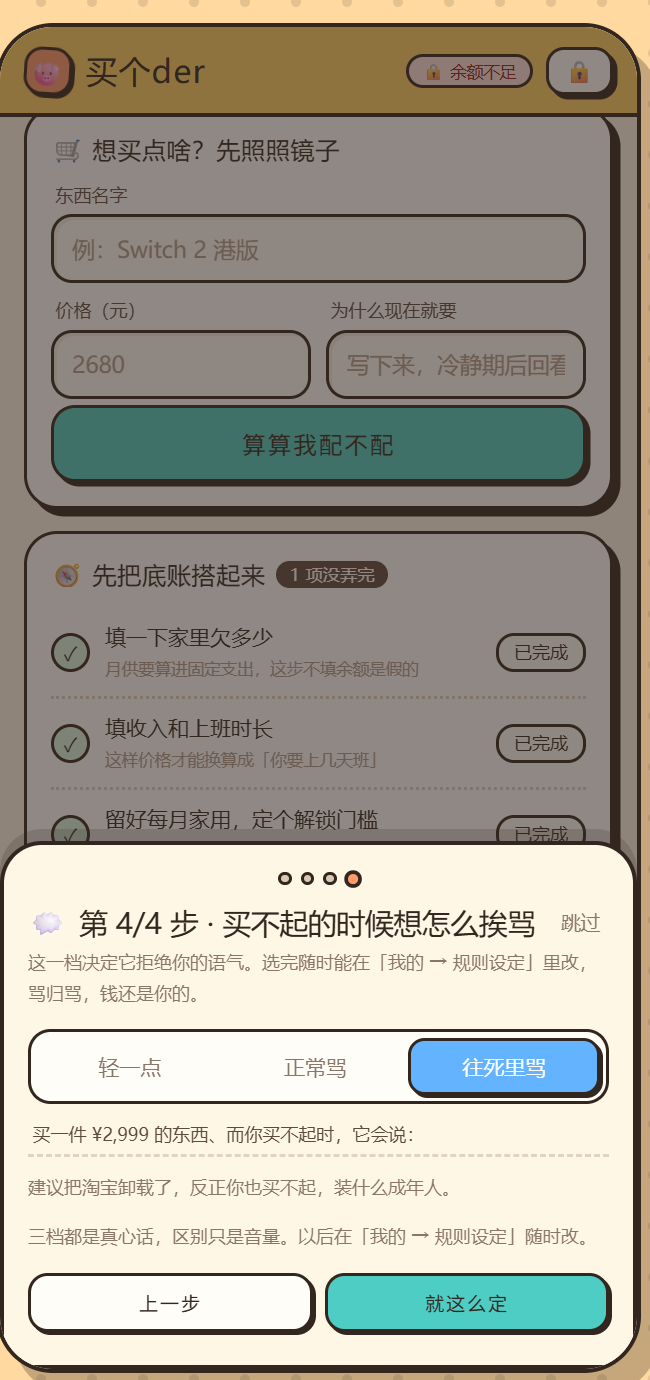
All three levels are honest. They differ only in volume. Afterwards the money is still mine.
The app solves nothing. It doesn’t add a cent to my income and it won’t pay off a yuan of my mortgage. It does exactly one thing: it moves “I can’t afford it” out of my head and onto a screen, so that every impulse has to look at it first. One look, one fewer purchase.
Last thing
I still have one debt left, eighteen years. Clearing it is far off.
But I’ve changed direction. Before, I saved money in order to live better. Now I save money in order to stop making this deal sooner.
The cleverest thing about consumerism is that it never forces you. It only makes you feel: you’re worth it.
I’m not buying those four words any more. What I’m worth is something concrete: a mortgage paid-in-full certificate from the bank, the year I turn forty.
If this article could somehow reach my 2019 self, I’d say one sentence: those four things — online lending, a car, a flat, a child — don’t sign early unless you truly have to. Sign a year later and you work for it three years less.
And I’m not telling anyone not to have children. I’m telling you to do the arithmetic before you decide, and not to take the pen that’s handed to you in a moment of feeling — “you’re at the age”, “everyone does it”, “give the kid a complete family”. That’s consumerism’s best trick: it never forces you. It just waits until you’re moved, and you press your own thumbprint.
评论
0 条评论