This salary-calculator mini app is something I wrote myself.
Today I typed 20,000 into it. It gave back a single line: total employer cost, 27,560.
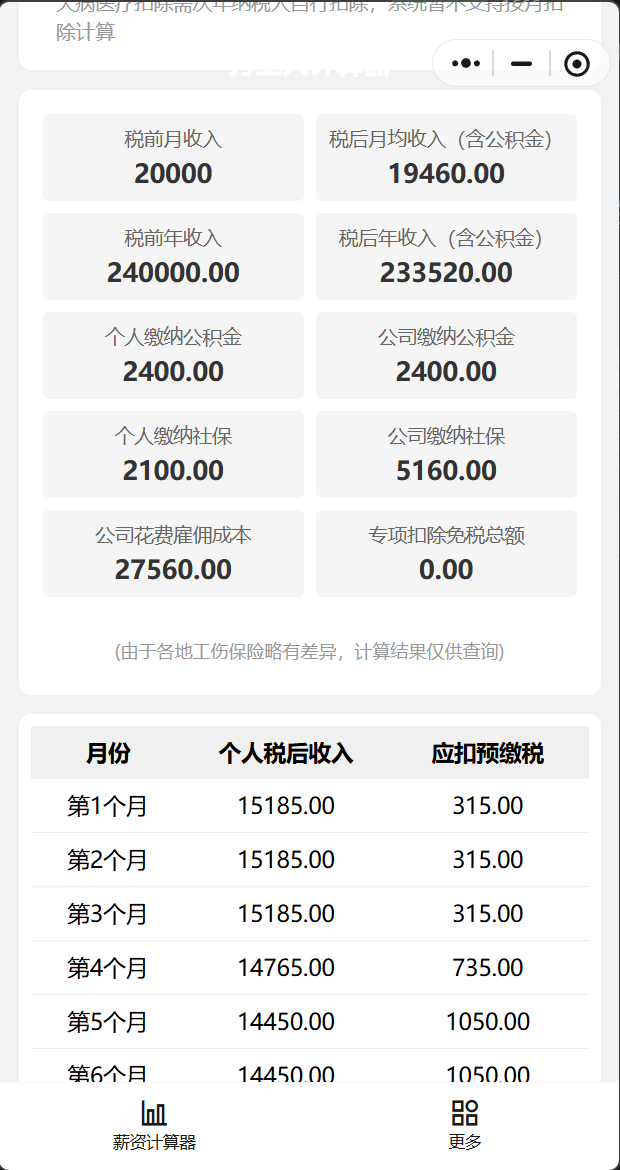
Let’s do the arithmetic
For a 20,000-yuan monthly salary, a company spends 330,720 on you in a year.
- Taken out of your own pay: 2,100 social insurance + 2,400 housing fund — 4,500 a month
- Paid by the company on your behalf: 5,160 social insurance + 2,400 housing fund — 7,560 a month
- You take home 15,185. In month one. It falls from there.
- Income tax for the year: 10,080
What actually lands in your bank account over a year: 175,920.
The company pays a hundred. You get fifty-three.
The rest doesn’t vanish. It just stops being yours. Both halves of the housing fund — 4,800 a month — do stay in your name; you can withdraw it or put it toward a mortgage. The pension personal account (1,600) and the medical personal account (400) are technically yours too, you simply can’t touch them. What really disappears is the pooling portion: the 5,160 the company pays never enters your account, and neither does the 100 you pay for unemployment.
That’s 63,120 a year, close to a fifth of what you cost. It doesn’t reach your card, and it isn’t in your name either.
We’re used to hearing “the individual pays 8%, the employer 16%,” as if that 16% were the company treating you to dinner. It isn’t. That 16% was computed from you, and it’s written into what you cost. The lines your payslip doesn’t print, the company has already paid somewhere else — paid to whom is the rest of this post.
My mother’s 200-odd yuan
My mother lives in the countryside. She’s on the urban-and-rural residents’ pension — the scheme for people who were never handed a labor contract. A little over 200 yuan a month.
In 2026, the national minimum basic pension for that scheme went from 143 to 163 yuan. Up 20 yuan. Two hundred and forty yuan a year.
I’ve put these numbers side by side more than once, and I pause every time:
- In 2024, the average urban employee pension was about 3,825 yuan a month; the average resident pension, about 246. A gap of 14.6 times.
- In 2023, residents contributed on average 38 yuan a month; employees, counting both halves, 1,175. A gap of 31 times.
- Even inside the city there are two tiers: enterprise retirees average about 3,100 a month; retirees from government bodies and public institutions, about 6,150.
So that 200 yuan isn’t “farmers paid in less, so they get out less.” The system never gave them a slot to pay in more. Thirty-eight yuan a month for fifteen years — you don’t need an actuarial report to know what that buys.
They aren’t being kept from retirement. There’s no retirement to be kept from.
In 2022, Shanghai and other cities issued what the trade press called an “age-out order” for construction: men over 60 and women over 50 were barred from working on building sites. The stated reason was safety.
Where were those people then “gently reassigned”? Cleaning, security, warehouse.
Same people. Yesterday: too dangerous to work. Today: only fit for the cheap jobs.
The National Development and Reform Commission republished an article on its own website about it. The headline said we must not simply “phase out the over-age migrant workers and be done with it.”
Before forty, they were “peasant workers,” the hardest part of “our own people.” Past sixty, one document takes them off the scaffolding, and there is nothing underneath to catch them.
Used, then set down
These thirty years of urbanization were built by farmers, and theirs is the contribution that got recorded the least.
The statistics bureau’s own figures: in 2025 there were 301 million migrant workers in China, and 131 million of them were still living in towns and cities at year’s end. Yet the gap between urbanization counted by residence and urbanization counted by household registration has held at around 18 percentage points — that is 250 million people who live in a city, pay school fees there for their children, sweep its streets, raise its towers, and do not belong to it on paper.
The forms recognition actually takes are concrete, and none of them is a compliment: do you get the hukou, do you get an establishment post, do you get seniority, do you get to have such a thing as retirement when you’re old. Not one of them.
They get used, and then they get set down.
My job title now is “outsourced.” Two sets of books inside one building: same floor, same discipline, same work — but the bonus, the benefits, the severance, the access rights to internal systems, none of it touches me. The project ends, the contract ends, and I was never a character in any of this company’s stories.
I didn’t have to learn this logic. I watched my parents live it from the time I was small.
Outsourcing isn’t some new invention. It is the office-tower version of how migrant labor has always been hired: take the labor, decline the life attached to it. I came out of the village, got into the city, paid into the employee scheme for years, and what I ended up with is a contract built on the same design as my parents’.
With one difference: my 5,160 at least gets entered in a ledger. They were never worth a line in one.
Pools
China’s basic pension is, in the account books, three pools: government and public institutions; urban employees; urban and rural residents. Three pools, separate ledgers, and the money does not move between them.
What decides which pool you land in is not how long you worked or how much you paid in. It’s which household register you’re on, and who you signed a labor contract with.
Two old people, both rural. One outside Shanghai collects over 1,500. One in a farm county in the central-west collects 163. The difference isn’t the person. It’s the patch of ground they stand on, and what that ground’s government can afford.
So my mother’s 200 and my 5,160 were never in the same book. And they will never be placed side by side for comparison — comparison is something outsiders do. Inside a ledger, nothing ever gets compared.
“One of us” is a word for mobilizing you
Every moment you get called “one of us” is a moment you’re needed for something.
Migrant workers built the towers. The “frontline heroes” are one of us. Exports are “Made in China.” Getting laid off is called 输送人才 — delivering talent out into society. When they need you to spend, you’re called “domestic demand.”
By the time it’s time to split the money, the vocabulary goes back to technical parameters: hukou, insurance category, pooling level, dependency ratio. Not one of those words has room in it for “one of us.”
So who takes care of us
I was born in the nineties. I’ve worked out which year I retire.
The Chinese Academy of Social Sciences’ actuarial report on pensions, 2019–2050:
- In 2019, roughly two contributors per retiree. By 2050, almost one to one.
- The cumulative balance peaks in 2027 at 6.99 trillion yuan, first turns negative year-on-year in 2028, runs out around 2035, and by 2050 the annual shortfall is −11.28 trillion.
- Births in 2025: 7.92 million. People over 60: 323 million.
The parameters around that have already been rewritten: the gradual retirement-age extension took effect on 1 January 2025; from 1 January 2030 the minimum contribution years needed to draw a pension rise from 15 to 20, six months at a time; the annual across-the-board pension increase, which used to run near 10%, came down to 2% in 2025.
Put those together and the conclusion isn’t hard to find: our generation is the last one that still believed an institution would take care of us, and the first to be told in writing to take care of ourselves. The rules change before your retirement date. The cost lands on you. The benefit landed on the generation ahead.
But “running out” doesn’t mean “not being paid,” and I’m not going to lie to myself about that. A pay-as-you-go system doesn’t go bankrupt. It adjusts parameters — replacement rate down, retirement age back, contribution years longer. Dilution makes no sound, and nobody has to answer for it.
The tax layer is even more blunt
My salary is taxed progressively at 3%–45%, taken off the top every month. The threshold is 5,000 yuan. It hasn’t moved since October 2018. Eight years.
Now the rest of it:
- Capital gains on A-shares sold by individuals: exempt from income tax. Exempt since 1994, still exempt.
- Dividends, held longer than a year: exempt.
- A house that went up by a few million: exempt if it’s the family’s only home held five years. Holding it costs nothing — there is no nationwide property tax.
- Inheritance tax, gift tax: never enacted.
China Merchants Bank’s private wealth report: 3.16 million individuals each hold more than 10 million yuan in investable assets. Their average holding is about 31.83 million yuan. Together: 101 trillion. National per-capita disposable income in 2024 was 41,314 yuan.
One rich person’s investable money equals an ordinary person working 770 years and eating nothing. Those 3.16 million people are 0.22% of the population.
So the rule is written out plainly: labor income is taxed progressively; capital gains are largely untaxed; existing wealth is untaxed; transfer between generations is untaxed.
My money is cut away line by line. Their money is never cut at all — and it passes to their children whole.
Last
People who are weak have no voice, and when they do find one, nobody cares and nobody is watching. The people with power and money are all inside the system. They hold the microphone by default, so they take the largest share. That isn’t just my rant — those three numbers are the evidence: 6,150, 3,100, 246. Whoever sets the rules benefits. Whoever benefits sets the rules.
“Common prosperity” has been shouted for years. Prosperity for who? All I can see is labor losing value, assets going untaxed, and debt staying fixed. I have all three, and none of the upside.
Every month my mother goes into town to collect that 200-odd yuan. She has worked most of her life in the village, and she is still working.
Every month 5,160 is taken out for me, and not one yuan of it reaches her hand.
We’re all Chinese, apparently. When they need you, you’re one of us. When it’s time to split the money, you’re in another pool.
评论
0 条评论