The graduation photo
One image. The headline across the top: “He never expected lighters to appear after graduation.” The smaller line beneath: “Graduation keepsake — Fire-Drilling by Hand, Class One.” In the photo stands a group of early humans, shoulder to shoulder, with the stiff faces people make in group pictures.

Everyone gets the joke. You spend four years mastering the drill-by-hand technique — posture correct, method to standard, an official stamp on your certificate — and then you walk outside and every person in sight has a lighter, five mao, one click and it’s lit.
The image spread because it isn’t funny. It spread because too many people recognised themselves in it: the major is real, the skill is real, and the only empty row in the table is “market demand”.
We started the same day; he left, I stayed
My department had an intern, a master’s student from a 211 university, who joined on the same day as me.
After a few months, he wasn’t converted, so he resigned.
The block, as far as I can tell, was his first degree. To convert an intern, the approval has to pass through +1, +2 and +3, and all three have to nod.
Let me be clear first: it wasn’t that he lacked ability. He finished the work he was given, he delivered what he was supposed to deliver, and he never caused trouble with colleagues. The real reason is a sentence that will never appear in any email — we don’t need this many people.
There was one headcount and two people in line, so a reason had to be found. Who goes and who stays stopped being a question of who fits long ago.
First-degree screening is the cheapest sieve when supply is glutted
The phrase “first degree”, when supply exceeds demand, is not a standard. It is the lowest-cost filter available.
Officially it’s banned. In November 2024 the Ministry of Education reissued the “three strict prohibitions” for campus recruiting, and the first of them forbids any job advertisement that names 985 or 211 universities — a rule first stated back in 2013. But the ban governs the job advertisement. It doesn’t reach the dropdown box inside the approval system. And nowadays the machine does the sorting anyway: an AI decides go or stay from context, and nobody has to pull that dropdown.
So it changed shape. Nothing written in the JD; the interviews go well; and at the last step somebody glances at your undergraduate institution and signs “hold for now”. You never get a reason in writing, because a written reason is called degree discrimination. Unwritten, it is called “holistic evaluation”.
The cheaper the sieve, the handier it is. Three seconds scanning a CV is cheaper than three rounds of interviews; one glance at your undergraduate school is cheaper than assessing what a person can actually do. Oversupply means exactly this: the cost of filtering can be pushed down until there’s no need to look at people at all.
My kind of “stability”, as a contractor
Here’s the twist: the master’s graduate went, and I — the outsourced contractor — stayed.
“Stability” needs quotation marks here.
I’m stable not because I’m important, but because I’m cheap, replaceable, and not worth touching. If the paperwork to cut a role costs more than keeping it, that role survives in a very odd way — undignified, but still there.
So don’t read “I wasn’t laid off” as an evaluation of me. It only says the blade didn’t land on my neck this round. Where it lands next is decided by the rate card, not the performance review.
Whoever is cheaper stays
Quote low enough and you get to stay. What survives in this market isn’t the most capable — it’s the best value per yuan. That’s how Pinduoduo grew: same goods, cheaper, cheap enough that you stop minding everything else about it.
And cheapness is never in short supply. What this land has never lacked is workers with no connections and no leverage. They’ve been trampled and squeezed, and from antiquity to today they have genuinely never stood up. The slogans about having “stood up” are official language, boilerplate, said for outside consumption.
My mother earns 3,000 a month and even that gets withheld. My wife graduated from a 211 university, was owed a full year’s salary, was eventually forced out, and to this day hasn’t seen a cent — and probably won’t. I put in nearly six years at my previous company, was named an outstanding employee three years running, and was laid off in the end anyway.
So what did it all amount to? In the end it was one afternoon’s business: a meeting with you, a signature, pack your things, leave. Six years, three years of “outstanding employee”, undone by one afternoon.
Capital has no human warmth, but it demands yours: sacrifice, dedication, professionalism, reliability, emotional stability. You hand over every one of those; in return you may expect nothing from it — no raise, no better terms.
Its bookkeeping is just as blunt: this year 10 million, next year 8 million, and that’s a loss. Nobody treats “earning 2 million less” as a neutral fact; the moment quarter-on-quarter figures drop, the explanation always ends up in headcount. So a layoff doesn’t mean there’s no money; it means there wasn’t enough.
Rewarding you or punishing you, both are instruments for extracting more out of you. “Outstanding employee” isn’t a talisman; it only proves you’re still usable and you don’t complain.
Not touching you for now just means you’re already cheap enough — removing you might mean they can’t find someone cheaper and easier to use.
People-centred. While people live without dignity.
Last year my CV said Dify and Coze; this year it has to say harness
Last year my CV read: can do Dify, can do Coze.
Send it out this year and if you don’t write “harness”, you probably won’t even get the interview.
One year.
A harness is, plainly, the shell around the model: how tools get attached, how the loop runs, how context is trimmed, how results are verified. Dify and Coze were also selling a shell back then — only theirs was assembled from drag-and-drop nodes, and a harness’s shell is written in code. The shell is always needed; the way you build a big one changed.
This isn’t skills expiring. It’s tools turning over faster than a CV can be refreshed. We wrote about Coze shutting its enterprise tier not long ago: what got shut down wasn’t the workflows, it was the business model of “packaging workflows into per-seat subscriptions”. Tools close, skills void, certificates expire — pull last year’s line out today and it isn’t a bonus, it’s evidence that this person stopped last year.
Only one thing hasn’t been replaced: knowing what to do with these tools. Unfortunately that’s the hardest thing to put on a CV, and the hardest to prove inside a thirty-minute interview.
My job today is two input-method shortcuts
So what do I actually do all day?
I wrote a set of skills across this scatter of data sources and packaged them into a CLI. To look something up before, I had to wander between several systems; now it’s one command, plus an agent, and the problem is basically solved.
Which means my daily operation is typing two custom shortcodes into Sogou Pinyin:
cwt, short for “query this problem” — the expansion reads “look into this problem: xxxx”zjfq, meaning “summarise and send it to the group”
Type cwt, paste the problem, Enter. Type zjfq, send to the group. Once in a while a meeting in between, a couple of sentences to the customer.
That is the entire technical content of my job. No wonder it’s an outsourced seat.
I wrote my own role out of existence
Those skills are mine, the CLI is mine, the agent is mine. The day I finished it I was pleased: the repetitive labour was gone and throughput went up.
A few days later it hit me: what I optimised wasn’t a process — it was my own position.
This job used to pay because “knowing how to look things up” needed a person. Now “knowing how to look things up” is compressed into a single command, and the two things that still need a person are: knowing what to look up, and knowing whether the answer is right. Those two genuinely can’t be outsourced — but they can’t hold up a headcount either, especially not on a rate card billed per body.
Look at the market this year: day-rate gigs, three-month contracts, outsourced seats everywhere; permanent roles are rare, and if you land one you probably won’t last the year. Because layoffs have gone monthly — it used to be quarterly forced ranking, now it comes every month. Three-month contracts against monthly reviews: the word “headcount” stopped meaning anything here a long time ago.
This isn’t only about me. At Foxconn’s shareholders’ meeting in June 2018, Terry Gou was asked about overtime, and said Hon Hai had “decided ten years ago to replace manpower with robots”, with a plan to remove 80% of the operators within five years — and if five years wasn’t enough, ten. The screenshot I saw comes from an AI-generated video account, and I won’t vouch for that 80% figure on their behalf; but the direction doesn’t need my vouching. A decision handed down in a meeting a decade ago is only a question of how far execution has got today.

So when I say this seat probably won’t survive a few more months, that isn’t self-mockery. It’s my own calculation. My work is to delete my own name from the process — only slowly.
What school teaches is the drill-by-hand motion
Back to that image. “What I studied and what the world uses are completely disconnected” — most people read that as the school teaching too little.
It isn’t too little. It’s that what was being taught happened to change generations on the day of graduation.
School assesses whether the motion is correct: are the steps right, is the report formatted right, how many characters off the reference answer is mine. Hiring assesses whether the outcome is useful: was the problem solved, what did it cost, who covers it when it breaks.
There’s another layer missing in between. What school hands you is called homework — question, given conditions, answer, marking scheme; only then may you start. What work hands you is called a problem: nobody tells you where “solved” ends, nobody gives you a reference answer, and you first have to define, yourself, what done means. The fire-drilling class doesn’t teach that layer, because it can’t be turned into a multiple-choice question.
What the fire-drilling class taught was never wrong in the age of drilling for fire. The trouble is that the day the certificate was handed out, lighters went on sale. And the question “when should you throw away the stick in your hand” simply doesn’t exist in the school’s assessment system — it isn’t tested, so it isn’t taught.
That’s the sharpest part of the phrase “employment class”, too: it promises that mastery means a job, but what it teaches is fire-drilling, and it charges tuition prices from the lighter era.
“Pick the wrong major and you’ve picked the wrong life” — I half believe it
I half believe that sentence.
Your major decides where you stand in the first queue; it doesn’t decide your life. But the first job decides the ticket for the second one, and the ticket decides which queue you’re in. The longer the queue, the higher the cost of changing it — and today’s queue is the longest in decades: 12.7 million graduates in the class of 2026, 480,000 more than last year.
I laid that number out in Short of Jobs, Not People; here I’ll only take its conclusion: the jobs that could absorb this cohort are shrinking, and the jobs that do want people are changing their threshold. Not the competence threshold — the queuing threshold.
No job and nobody cares; miss a mortgage payment and somebody certainly does
I’ve stopped having expectations of this world. It belongs to people with power and connections. When they encourage childbirth, it’s never for your sake — it’s to keep feeding this machine an endless stream of cheap nourishment.
Look at my parents. They raised their children at terrible cost and paid thousands a month into social insurance, and that money went to other people’s parents. When their own retirement came, it was a little over two hundred a month.
Look at education. Everything spent on tuition, tutoring and materials, and after raising one person you think there’s something ahead — you go outside and there’s no job, so it’s gig work instead: delivering food, running parcels, no base pay, no protection. Making a living is out of the question; raising the next generation even more so.
Some say a person with ambition, with self-drive, will end up different. Same. What waits for them is the mortgage: thirty years of cash flow locked, in exchange for a flat of no assured quality, and with bad luck an unfinished skeleton of a building; the same flat listed at two million this year and one million next; a job market where you can carry the payment today and be replaced by AI tomorrow.
So one thing I worked out long ago: having no job is fine, nobody cares; not paying your mortgage — then somebody definitely cares.
Day rate
I’m thirty-five, outsourced, sitting at a desk, finishing the work with two shortcuts a day.
I don’t intend to use the word “regret”. I treat this job as a day rate: one day worked, one day counted; whether this desk is still here tomorrow isn’t for me to decide. Outsourcing is billed by person-day, and a person-day buys the client the time I sit there, not the machinery in my head. So the client wants a temp, and what I hand over is a temp’s craft — not because I’m stingy with more, but because there’s no line on the rate card where “more” could be entered.
To keep that thought visible, I wrote myself a small widget called “Wage Work Has No Future”.
The settings page asks for very little: monthly salary, hours per day, commute, days per week, start and end times. The hourly rate is computed on the statutory 21.75 paid days per month, and the money ticks upward, cent by cent, with time. What I have entered is 10,000 a month, 10 hours a day, a one-hour commute, five days, 10:00 to 20:00.

The card on my desktop looks like this: today 0.00, with “haven’t clocked in yet” in the corner, and along the bottom “3 hours 47 minutes to work · ¥5,671 still short this month”. The upper half says the income hasn’t started; the lower half says how much the month still owes.
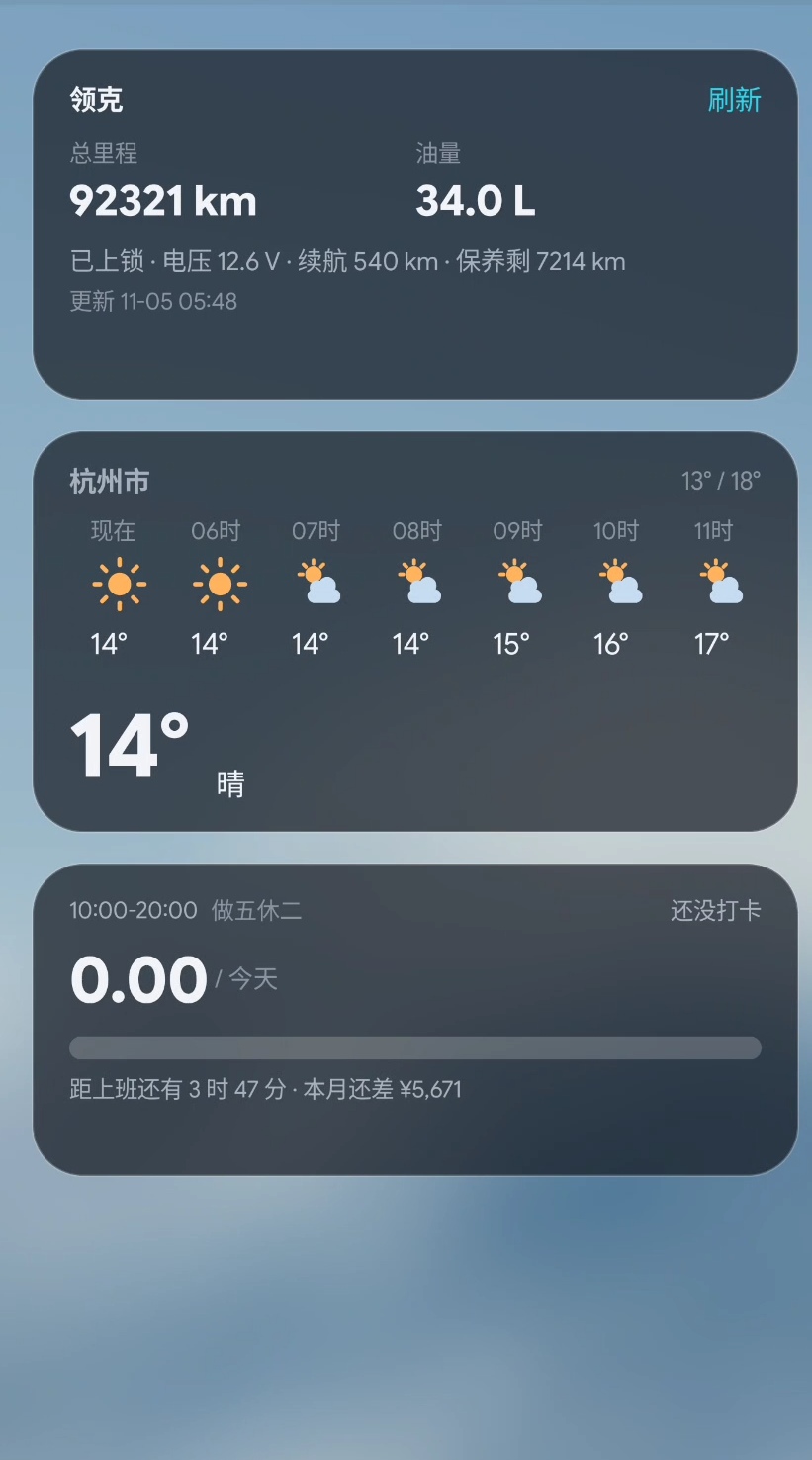
None of this money is actually paid out. The number on screen climbs while the bank account stays empty — it computes what’s owed, not what’s sent. Fold the one-hour commute into it and I’m worth 41.8 yuan an hour: hold an hour-long meeting and forty-two yuan is gone.
Income can vanish; expenditure won’t. Five or six thousand a month is unavoidable — 4,000 of mortgage, plus a child to raise. So I do this job as a day rate, one day at a time, and that widget is the stopwatch for it.
I looked at that graduation photo for a long time. Those people in it aren’t me. But the one standing at the edge, head down, gripping a stick — that looks like me.
On the day the lighters appeared, the fire-drilling class had done nothing wrong. It had simply taught a true thing into a year where it had stopped being true.
I’m not spending another four years learning the next fire-drilling. What I want to learn is how to recognise fire — and, on the day the lighter appears, to put the stick down.
评论
0 条评论