The sharpest line in the announcement
Coze is retiring its enterprise plans. The notice is dated October 29 and sets three deadlines: the Standard and Flagship enterprise plans stop accepting new customers on November 30; legacy plans bought through Volcano Engine (old Personal Pro, old Enterprise, old Team) go fully offline on December 31, with any unused balance refunded automatically; and the new enterprise plans go offline on December 31, 2027.

Headlines said “Coze is shutting down.” Group chats said “they killed workflows.” Neither is right. Coze’s own 3.0 FAQ says it plainly: Coze Programming has not been discontinued, it remains an independent product, and anyone who wants to build or manage workflows, agents and other more complex artifacts should go there.
So what was withdrawn is the enterprise plan as something for sale, not workflow as a capability. Merge the two and every argument downstream ends up aimed at the wrong target.
The line in the notice that deserves attention reads least like a highlight. The FAQ asks how users should export and back up existing conversations, memory, files, programming projects and low-code workflows. The answer: “We will clarify the relevant arrangements in a follow-up announcement.” At the moment the notice went out, there was no export tool and no date for one.
Three details nobody reported. Refunds for legacy plans go to your Volcano Engine account, not back to your payment method. A plan can be renewed within 14 days of expiry before it counts as a new purchase. And the enterprise billing page already lists “seat fees” and “agent invocation fees” with “(discontinued)” printed beside them.
The loudest argument is aimed at the wrong target
The post that traveled furthest came from Cang Shu (@Sither_V). He worked on Coze’s Workflow engine at ByteDance, and his profile still reads “Coze Workflow Engine Developer.” Reposted many times over, it comes down to three claims:
Workflow wasn’t killed by AI; it was killed by models that plan for themselves. All those drag-and-drop nodes we busted ourselves building were really us paying for the model’s clumsiness — a transitional pattern carried over from low-code platforms, a middle-child product. Business know-how is the thing that matters; the skill of wiring up workflows has been swallowed whole by agents and is now worthless.
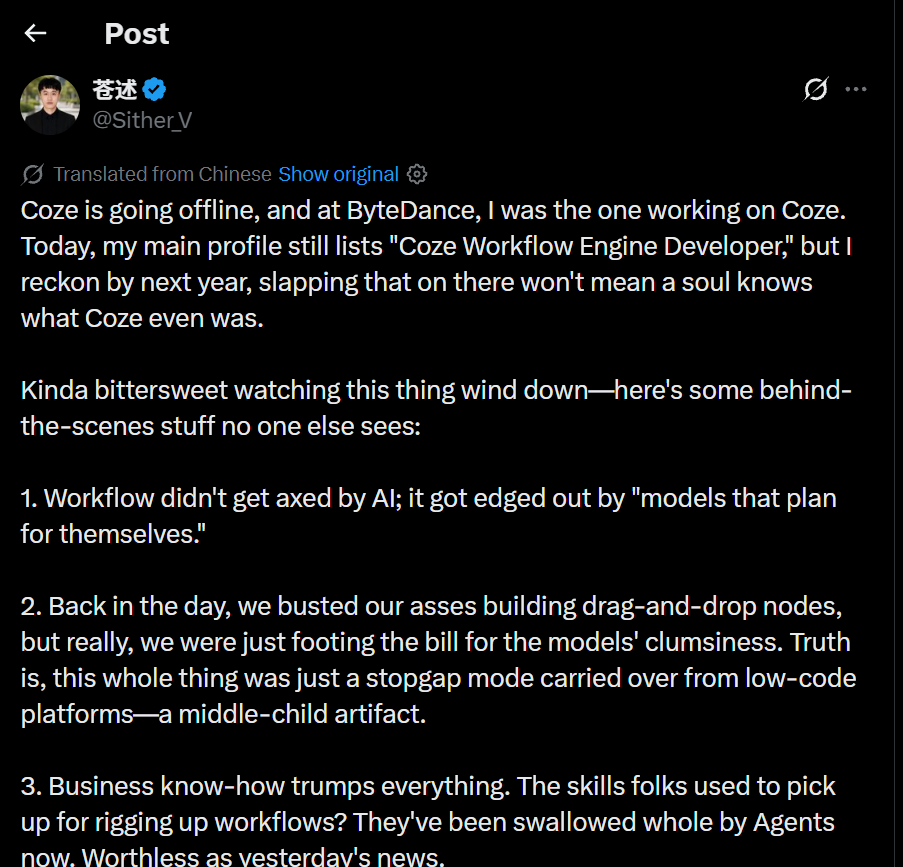
It spread because the person saying it actually held that machinery in his hands, rather than commentating from the outside. I largely agree with the first two. Node orchestration assumes a human thinks the process through and locks it into a DAG. Once a model can decompose a task and change course on its own, that graph stops being a product and turns into a chore — it demands that a person make the model’s decisions in advance. That is how middle products die, too: not beaten by a better version of themselves, but solved incidentally when the layer above catches up.
The third claim doesn’t get you to “workflows are useless.” The strongest counter-argument is about enterprise requirements — determinism, auditability, predictable cost, not a model freelancing. Tencent Cloud’s ADP comparison page lays that case out most completely, walking down a list of triggers, long-term memory, multi-agent, logs, evaluation, collaboration, file box and voice, ticking off what Coze is losing. That page was written by a competitor whose whole point is to pick up the customers, so discount it before reading.
The two sides aren’t arguing about the same thing. He is saying workflows no longer justify being sold as a standalone product. The other side is saying enterprises need workflow-shaped capabilities. The official FAQ sits between them: workflows still exist, they just don’t retire along with the enterprise plan.
So that fight can run until dawn without a winner. What was shut down wasn’t workflow; it was the business model of packaging workflow into a per-seat plan. In the reposts, the two got written as one.
Second argument: a tide going out, or a consolidation?
Coze wasn’t the only platform closing that month. Tencent’s Yuanqi stops service on November 9. QClaw stops on December 24. The agent features inside Doubao, Qwen and Yuanbao went offline around July 15, when the Interim Measures for the Administration of AI Anthropomorphic Interaction Services took effect (issued by five ministries on April 10). iHeima called it “the first generation of low-barrier agent-building platforms entering a collective contraction.”
But “tide going out” and “consolidation” are two different sentences. 36Kr offers the consolidation version: in August the TRAE and Coze teams were folded into Doubao, and at the end of July the Feishu product team went the same way. Office work goes to “Doubao Work,” developer work returns to Coze Programming, and the enterprise base goes to Volcano Engine. Two lines from that piece are worth quoting outright: “A product is no longer just a standalone entity that makes money; it is consumable material for validating strategic direction,” and “Squeezed in the middle, the enterprise edition of Coze lost the organizational soil to exist independently.”
Both lines hold for the platform. They don’t hold for users. The platform treats products as consumables; users treat platforms as landlords. The cost of a landlord demolishing a building and the cost of a tenant moving are never on the same scale.
Third argument, the one almost nobody took seriously: what did users actually lose?
Going through every thread I could find, the most concrete evidence in this whole discussion sits on the user side, and it is all small and specific.
On linux.do, in a thread dated June 24, the poster’s account was this: accounts registered that day could no longer see the old node-based workflow or agent-building entry points at all, while accounts registered before June could still find “back to the old version.” He later added that the entry hadn’t been deleted — you just had to type a specific URL by hand — “if a beginner doesn’t know that URL, they can’t find the traditional low-code workflow platform,” and “a lot of people in the official group are reporting this.” The best and most painful line in that thread: “Speechless. I put over five thousand yuan into an enterprise membership.”
The V2EX thread was blunter: “After Coze Programming launched, workflow dropped to second tier; now they’re pushing the Chaosheng agent, so workflow is third tier — old users only, new users get redirected.” Same thread, on the shift in method: “It’s all agent-oriented development now — the user side owns skills, the code side does the skills and the man-in-the-loop management.” And the poster who wanted to self-host hit a very practical wall: “I had Dify set up already, but dify cloud isn’t reachable from mainland China.” Open source is not the same as available.
The two lines from the Juejin piece are the clearest thinking in that genre: “The problem with platform agents is that they’re so convenient you forget they can disappear at any moment.” “Capability in your own hands matters more than anything.”
But the clearest measure of whether this exit had any decency is the comparison with a peer. Tencent’s Yuanqi notice on October 8 shipped an export tool, kept a “data export console” open until January 9, 2027, and refunded to the original payment method. Coze’s counterpart is “we’ll clarify later,” with refunds landing in a Volcano Engine account. Being shut down isn’t the problem; whether there is an export tool in your hand when it happens is.
The numbers deserve a mention too. IDC figures, cited by both 36Kr and iHeima: in 2025 the public-cloud market for agent development platforms in China was about 250 million yuan, with Coze first at 19.3% share, implying platform product revenue of roughly 48 million yuan. 36Kr attached its own caveat — the estimate is based on market size, excludes model calls and cloud resources, and is not ByteDance financials. Read on those terms: the market leader, under 50 million a year. So “consolidation” isn’t a strategic victory; it’s cutting losses.
A few numbers I won’t sign. Eight million agents created on Coze, and 26 million monthly actives for Doubao agents — both come from user advocacy material and are unconfirmed by the company. 36Kr’s claim that OpenAI’s ChatGPT Atlas and Agent Builder were retired within a year of launch has no primary announcement I could find. And the dates on the coze.com feature removals contradict each other across retellings — one review site notes that its release notes stop at September 2025 — so I’ll only write “around September 2025, with scattered primary records.”
The thing nobody argued about
I searched Hacker News by keyword and by date; nothing meaningful about any of this. No relevant thread on Reddit. No dedicated posts on Jike, Dianya or Sspai. Zhihu blocks scraping. The comment section under 36Kr’s original piece: no comments.
So “the industry was in uproar” was the article’s own phrasing, not the comment section’s.
A platform that is number one in China by share closed its doors, and English-language tech produced not a single discussion thread. That silence isn’t content, but it tells you where the content is: Coze’s users are all behind the wall, and its life or death carries no signal for the world outside.
One reversal is worth recording. In July, when Doubao’s agents were taken offline, users were posting daily countdowns (“day 53 of opposing the shutdown”) and accusing the company of “using compliance as cover for a traffic transfer” — and Coze was untouched. Business selling “2026’s latest 300+ agents plus Coze tutorials” was brisk on Weibo, and Coze was treated as a refuge. At the end of October, the refuge sunsetted its own enterprise plans. The word “refuge” only holds until the next closure.
So what should be asked?
Not “will workflows die.” That argument can’t resolve, because the two sides aren’t talking about the same thing.
Three questions that can actually be checked.
One: did it raise prices and then withdraw? On January 18 it set the Professional plan to be discontinued on May 30. From March to October, five batches of models were delisted. On June 30 it stopped allowing new OpenClaw projects, with the official reason “high deployment and operations cost.” On July 1 the Doubao-channel publishing entry came down for “service stability.” On July 14 enterprise plans went from 498 to 980 and 5,980 to 8,980 yuan a month. On October 29, the discontinuation notice. On November 5, credits were re-based at 25 to 1. On November 12, personal plans were repriced. Those three months in the middle were time held open to sell renewals.
Two: was there an export tool at shutdown. Whether there was matters a thousand times more than how politely the notice was written.
Three: where did refunds go. Back the way they came, or into the company’s own account, waiting for you to spend it there again.
Those three are more useful than any piece on whether agents will replace workflows. Cang Shu’s line about “paying for the model’s clumsiness” applies to any middle product, including whichever platform someone pitches you next. But the thing users can actually take away isn’t that judgment — it’s their own data. Whether the data can leave is the only thing that ends up in your own name.
评论
0 条评论