Over the past two days I finished, one after the other, The Working Poor (《有工作的穷人》) and Ruan Yifeng’s Survivors of the Future World (《未来世界的幸存者》). The former talks about how globalization dismantled “standard employment” into temp work, outsourcing, and gig work, trapping workers in a poverty pit of “having a job but no security.” The latter, from a technology and career angle, predicts AI’s systematic elimination of white-collar positions. Put the two books together and the puzzle is finally complete — AI isn’t here to save the poor; it’s bolting a turbocharger onto the whole system of precarious employment.
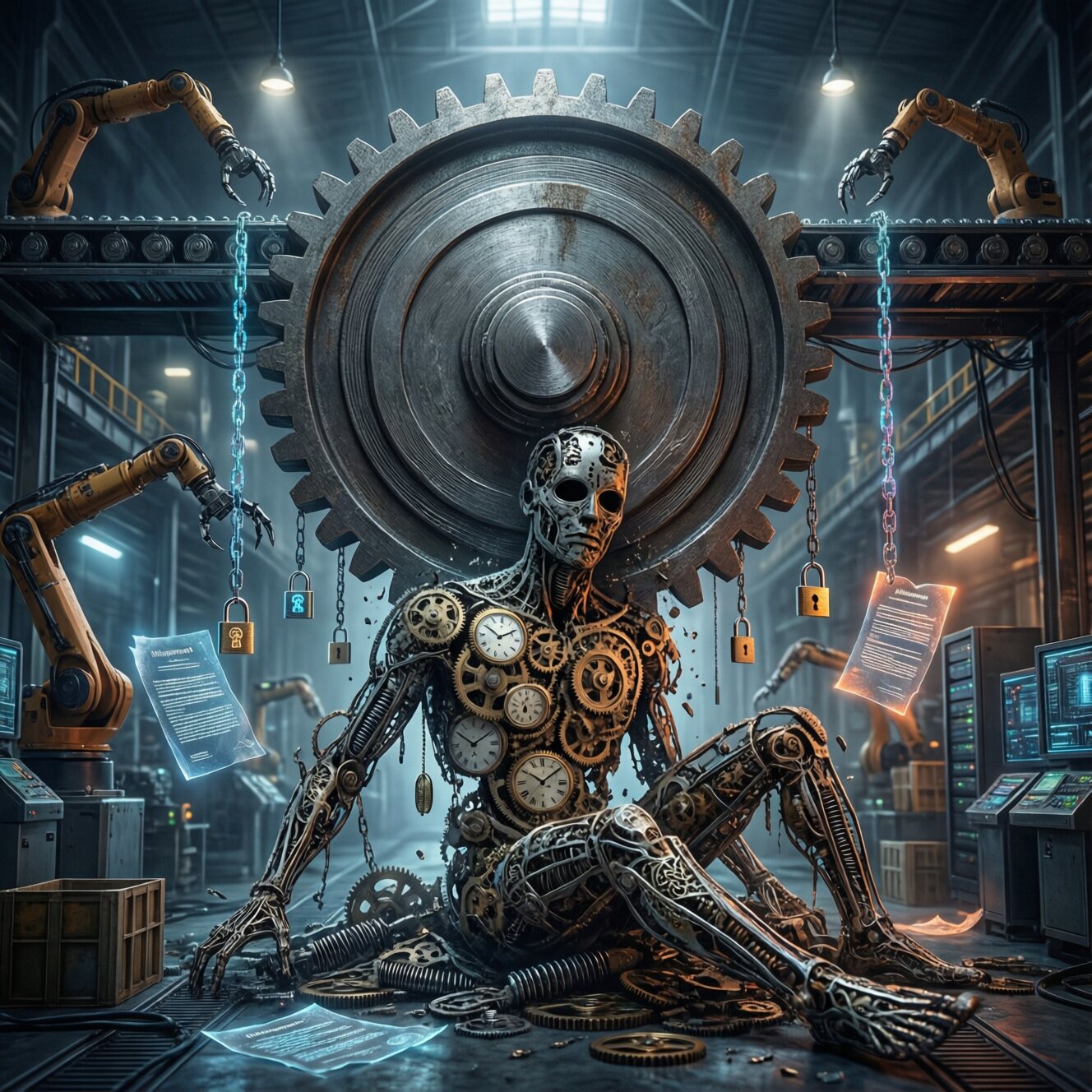
1. From Fordism to AI: A History of the Death of Standard Work
In the Fordist era, “standard employment” had a clear outline: a full-time permanent post, a fixed salary, comprehensive benefits, and long-term employment. This was the result of bargaining between labor and capital and of political struggle — security that workers won through their organizing power.
But capital never stopped searching for ever more “flexible” ways of employing people. Globalization moved production lines to developing countries, replacing domestic workers with cheap labor. AI goes one step further — it doesn’t need a factory, doesn’t need social insurance, won’t strike, and won’t take sick leave.
The book quotes a viewpoint from Žižek: “Being able to land a job that is long-term, stable, and squeezed by interests has now, on the contrary, become a kind of privilege.” This line is even more jarring in the age of AI. Large numbers of mid-level white-collar, clerical, and basic technical positions are being replaced or compressed by AI. Companies no longer need to keep a pile of full-time employees on the payroll; they’ve switched to a model of “AI + a small core of people + a large volume of gig and outsourced labor.”
This reminds me of Jack Ma’s line that “996 is a blessing.” At the time the public outcry was universal, but looking back now, Žižek and Jack Ma are actually saying the same thing — when “the qualification to be squeezed by interests” itself becomes scarce, what workers are fighting over is no longer “not being squeezed by interests,” but “who has the qualification to be squeezed by interests.” Is 996 a blessing? To the people in the gig economy who don’t even have the option of 996, it really is a privilege.
Ruan Yifeng gives a telling example in the book: the Flash engineer. Over a decade ago, Flash was one of the hottest technologies, and every major internet company had dedicated Flash engineers who were well paid. But the technological iteration came out of nowhere — Jobs announced that the iPhone wouldn’t support Flash, HTML5 rose, and the entire industry crumbled within a few years. Those experts who had drilled into the craft for years suddenly found their skills and knowledge worthless. The scary thing isn’t that your job is gone — it’s that your entire industry is gone.
He puts it bluntly: hoping to stay competitively employable through “lifelong learning” isn’t very realistic for most people. How many times can a single human life afford to start over from zero?
2. AI Deepens the Bifurcation of the Labor Market
The Working Poor points out that precarious employment has produced a dual structure in the labor market: an inside of protected, formal workers and an outside of abandoned, informal workers. AI is digging this chasm ever deeper.
Ruan Yifeng quotes Yuval Noah Harari’s prediction in Sapiens (《人类简史》): in the future humanity will split into two main strata — a brand-new advanced elite class, very smart and very wealthy; and a vast useless proletariat, who will grow poorer and poorer as they wait to die. This isn’t being unemployed — it’s being unemployable. The low-skill jobs have all been automated, the high-skill jobs require years of grueling investment, and those who can’t find work are too young to retire and too old to start over from scratch.
He offers a more concrete framework: in the future there will be only two kinds of work — work above the API and work below the API. Above the API are the people who make the rules and issue the commands; below the API are the people who take instructions from software and do the work. Food-delivery riders are a classic example of work below the API: no boss, they take orders directly from the system and report back to the system when done. Even scarier, the API won’t give you career training and won’t care about your career path — “once a software layer is introduced between management and the rank-and-file employees, there’s no longer any clear upward path.”
People are sorted directly into two categories:
- The top tier: those who control AI models, algorithms, capital, and industry decision-making power, using AI to amplify capacity and harvest profit, with wealth accumulating at an accelerating rate;
- The bottom tier: those displaced by AI, who can only flood into gig, part-time, and informal jobs, with wages pushed down, skills devalued, trapped in the predicament of “having a job but staying poor forever.”
What’s even crueler is that this chasm has almost no crossing path. The book mentions that workers from poor rural backgrounds have weak basic skills, with no channel to improve their skills after leaving school or during gaps, falling into a closed loop of “low skill → low wage → hard to climb out.” AI has sped up this loop tenfold — a skill you spent three hard years learning, AI can replace in three months.
Not long ago I did my own in-depth survey on the employment situation of workers aged 35 and above in China, and the data is colder than I imagined. Zhaopin’s 2024 report shows that 62.3% of publicly advertised positions set an upper age limit, of which the “under 35” restriction accounts for 36.8%. The age structure of the internet industry is even more extreme — among Tencent’s 116,000 employees, only 429 are over 50 (0.4%); among Kuaishou’s 24,000 employees, only 16 are over 50 (0.1%). Programmers over 35 make up less than 10% of the industry’s total headcount. This isn’t the preference of individual companies — it’s a systematic age-based eviction.
3. The Employment System Was Designed to Disadvantage Workers from the Start
The Working Poor analyzes the underlying logic of precarious employment, while Survivors of the Future World points to a deeper problem: the employment system itself is biased — in favor of capital, against labor.
The interests of capital and labor are opposed: the less the worker takes, the more the boss earns. But that isn’t even the key point. The real problem is that the two sides stand on unequal footing, and it’s always capital that makes the decisions. If the company earns 1 million, how much does the worker get? Uncertain — it depends on the boss’s mood. If the company loses 1 million, the boss’s decision is simple: fire you and save on wage costs. You’re miserable being unemployed, but the shareholders are happy, because the stock is worth more.
More insidiously, the reason big-company work is so dull and mind-numbing is actually a deliberate institutional design of the company. Management’s goal is to make it so that “it doesn’t matter who leaves,” so they slice departments up very finely and give each person something very narrow to be responsible for. Once things are processized, employees’ work becomes monotonous with little creativity. Creativity, reliability, and stability are all handled by designated specialists; you just need to follow the manual and do your slice. This way, the company doesn’t depend on any individual, while the individual depends entirely on the company.
From the worker’s standpoint, you simply have no power to break free of this system. You know it works against you, but you have to beg others to employ you, and once you have a job you still live in dread of losing it. The “working poor” the book describes are precisely a group of people trapped inside this system — it isn’t that they aren’t hardworking; it’s that the structure of the system determines they can’t climb out.
4. The Working Poor and the “Downward-Mobile Elderly”: Poverty Is Becoming a Normal Fate
The Working Poor mentions that poverty in Asia is tightly bound to precarious employment. And Survivors of the Future World lays out this trend with even more naked data:
“In 1993, among urban residents in the low-income bracket, 43% were able to climb upward by 1995. By contrast, among urban residents in the low-income bracket in 2011, only 20% had shed the bottom-tier label by 2013.”
If you’re poor, there’s an 80% chance you’ll still be poor later; if you’re rich, there’s an 84% chance you’ll still be rich later.
Ruan Yifeng mentions the Hong Kong reality show Rich Poor Game (《穷富翁大作战》): after billionaire Tin Pak-chuen spent two days experiencing life as a cleaner, his viewpoint flipped 180 degrees, and he told the camera: “This society punishes, extremely harshly, those who have no means to study. A poor person will never in their lifetime become rich.”
Why? Because the poor are busy working every day, working themselves to death, and yet still poor. People with no degree and no skills, just to survive, can only live in cage homes and work until the middle of the night. For them, the most important thing is what to eat next — how could they possibly have the time and energy to think about the future?
This is the definition of the “working poor”: working busily every day and yet still unable to escape poverty. And this condition is spreading from bottom-tier manual laborers up into the white-collar ranks. My own survey data confirms this too: the re-employment rate of internet-industry workers over 35 is under 40%, their average job-search cycle is 2–3 times longer than that of young people, their interview pass rate is only 1/3 that of young people, and most have to accept a 20%–30% pay cut.
Even scarier, breaking into the white-collar class doesn’t mean you’re safe. Ruan Yifeng mentions in the book the 2017 rumor that Huawei was “clearing out employees over 34.” True or not, it struck a chord with an industry consensus: IT is a young person’s industry. A person’s physical and intellectual peak is between 20 and 30; past that age, the body simply can’t take years upon years of overtime. And technological iteration moves faster than human aging — what you learned graduating college at 22 is basically all useless 10 years later, and you have to stand at the same starting line as fresh graduates and learn from scratch all over again.
Worse still is wage inversion. Veteran employees are paid several times more than newcomers, but they have no advantage in ability, so companies naturally choose to cut the old and keep the new. Ruan Yifeng puts it bluntly: “Get promoted to mid-level before 34, get promoted to senior management before 45, otherwise forced retirement — this will become the norm in the IT industry.” Jack Ma also said at Hupan University: “The success or failure of a big company lies in what kind of people you fire. Big companies have lots of old ‘white rabbits’ who don’t do the work and gradually infect more and more people.”
Technological progress lets humans live longer and healthier lives, but it also makes us less useful in the workplace. Ruan Yifeng writes: “In the future, maybe everyone will have to choose their life twice — once when they graduate college and look for a job, and again at 45 when they have no job.”
And then, if you haven’t completed the leap before 45, what’s waiting for you? My own survey uncovered an even crueler institutional contradiction: between the age-35 employment threshold and delayed retirement at 63, there exists an “institutional gap” stretching 28 years. During those 28 years, you’re excluded from the employment market yet can’t draw a pension, left to fend for yourself. And looking at health data, the average number of healthy working years after 50 is only 6.87 — meaning most people, after 57, will have to keep working until 63 in a not-fully-healthy state. Ruan Yifeng quotes Japanese sociologist Takahashi Fujita’s survey: many elderly people earned middle-class salaries when they were young but have now sunk to the bottom of society, living extremely hard lives. He calls these people “downward-mobile elderly” (下流老人), and predicts Japan’s downward-mobile elderly could reach 100 million.
“Impoverished youth, quicksand middle age, downward-mobile old age” — this is the inevitable fate awaiting most people.
Large-population countries in Asia turn directly into reservoirs of precarious employment in the age of AI. The book mentions a feature of the East Asian welfare system: the degree of welfare decommodification is extremely low, and livelihood security is tightly bound to labor-market status. This means that once you lose your “formal” status, you lose not only your wage but also every point of entry to healthcare, pensions, and unemployment protection.
In “Why Pensions Can’t Be Relied On” (《为什么退休金是靠不住的》), Ruan Yifeng does an even colder calculation: pensions operate on a pay-as-you-go system — using the contributions of today’s young people to support today’s elderly. But the national pension’s average payment capacity is only 17 months, provinces like Heilongjiang are under 10 months, and 6 provinces already have current-period income that can’t cover current-period spending. As the young and middle-aged labor force keeps shrinking and the elderly population keeps growing, this gap will only get wider. Delayed retirement isn’t a multiple-choice question — it’s an inevitable result. The essence of postponing retirement is paying out less pension and collecting more premiums. The traditional path of “hang on until retirement, draw a pension, and live out your years in peace” has already failed.
Poverty is no longer a temporary state — it has become locked in across generations. Having a job doesn’t mean escaping poverty; employment can only slightly lower the risk of poverty, and can’t bring a stable, predictable life.
5. What Can We Do?
The solution The Working Poor offers is: governments should rebuild the social safety net and reform to fit a diversified labor market. Survivors of the Future World emphasizes more the individual’s direction for breaking out — not how to scrape by under the employment system, but how to survive after leaving it.
For the individual, seeing reality clearly matters more than blind optimism. In the survey report I compiled there’s a core judgment: “Impoverished youth, quicksand middle age, downward-mobile old age” is not fear-mongering — it’s a chain of fate backed by data. The following recommendations come from three books, two perspectives, and one 20,000-word survey:
Don’t superstitiously believe “skill upgrading” can save you. When the speed of skill devaluation outpaces the speed of learning, the single-skill path is no longer enough. Ruan Yifeng puts it bluntly: in the technology industry, experience is sometimes not a help but an obstacle, because the old playbook no longer works.
The stability of household income matters far more than the height of one person’s salary. The logic the book emphasizes still holds in the age of AI — one person’s high salary is not as good as a whole family having multiple stable sources of income.
Be wary of the rhetorical packaging of “flexible employment.” Freelancing, remote work, platform gig-taking — at their core these may just be precarious employment after benefits have been stripped away. You think it’s freedom, but in fact you’ve been squeezed into a dead-end alley with no security.
Cultivate, as early as possible, abilities that machines find hard to replace. Wu Xiaobo calls the abilities hard for machines to replace “soft abilities.” Right now there look to be three kinds: humanization and personal charisma, creativity, and decision-making and leadership. These are the core competencies above the API.
Give up the fantasy of “hanging on until retirement,” and build passive income as early as possible. Ruan Yifeng proposes a concrete idea in the book: according to the 4% rule, if your total assets generate annual returns that can cover 4% of your living expenses, you’ve achieved financial independence. This means you need to strictly control spending, accumulate assets, and build passive income sources (rent, royalties, interest, etc.), rather than betting everything on one salary and one uncertain pension. Since you might be unemployed at 35, forced to retire at 45, and your pension might not be reliable, the only way out is to make your assets work for you, rather than working for your assets forever.
There’s a line in the book that impressed me deeply: “The traditional formal/informal, self-employed/employed binary division can no longer explain today’s complex employment forms.” Employment forms in the age of AI will only become more blurred and more fragmented.
Seeing this logic clearly isn’t about selling anxiety — it’s about, in this era, at least knowing where you stand. Ruan Yifeng writes at the end of the book: “The world is changing violently; the old models simply no longer work. The flood is not far off — prepare your escape route early.”
This isn’t fear-mongering. This is two books, two perspectives, pointing to the same conclusion.
评论
0 条评论