Statement on this article: This report was produced collaboratively by the Kimi K2.6 Agent cluster. Through multi-Agent parallel research, cross-validated data, and intelligent writing, this in-depth analysis report of roughly 20,000 words was generated. The content is for reference only; the data comes from public channels, and the cited sources are marked in the body text.
In-Depth Analysis Report on the Employment Situation of Workers Aged 35 and Above in China
Executive Summary
Core Findings
China’s labor market is undergoing a dual transformation of “contracting supply and structural aging.” The working-age population has fallen continuously from its 2012 peak of 930 million to 853 million in 2025 (Hexun) , the share of people aged 45–64 in the working-age population has risen to 41.91% (Hexun) , and the average age of the labor force has reached 39.72 (Sina Finance) . Data from the Seventh National Population Census shows that employed people aged 35 and above account for 54.7% of total employment, forming the absolute majority of the labor market. Yet a 2024 Zhaopin report shows that 62.3% of publicly advertised jobs set an upper age limit, of which the “under 35” restriction accounts for 36.8% (Sina Finance) , making 35 the core anchor of systemic employment discrimination. This anchor can be traced back to the age-35 application threshold first set by the 1994 Interim Provisions on the Recruitment of State Civil Servants, which enterprises then widely imitated (Renmin University Reprint Materials) . Research by Peking University’s National School of Development shows that, after controlling for productivity factors, the share of workers aged 35 and above who lose their jobs for employer-side reasons rises by 35.34% due to age discrimination (Peking University National School of Development) .
The structural gap in the legal system is the root cause of the spread of discrimination. Article 12 of the Labor Law of the People’s Republic of China lists only four types of discrimination — ethnicity, race, gender, and religious belief — and age is not included (Renmin University Reprint Materials) ; the Employment Promotion Law included an “age” clause in its 2007 legislative draft but deleted it in the official version, and a 2017 revision draft tried again without success (Renmin University Reprint Materials) . In the absence of explicit legal constraints, enterprises face no cost for setting age thresholds, creating a “tacit approval effect” for age discrimination. The 2025 Opinions on Further Standardizing Enterprise Recruitment Behavior require that “recruitment information must not contain age-discriminatory content” (Caixin) , marking a positive signal of administrative oversight, but the document’s legal rank and enforceability are both weaker than dedicated legislation.
Civil-service recruitment policy reached a landmark turning point in 2025–2026. The 2026 national civil-service exam relaxed the application age for general posts from 35 to 38, and for fresh master’s and doctoral graduates from 40 to 43 (ifeng) ; provincial exams in Henan, Shandong, Sichuan and elsewhere have generally relaxed to 40, with some posts for highly skilled talent further relaxed to 45 (Chinanews Hebei) . But the demonstration effect has a “weathervane paradox”: after civil servants set the age-35 threshold in 1994, enterprises quickly followed, whereas after civil servants relaxed it in 2024–2025, the enterprise side did not respond in kind (Sina Finance) . Discriminatory standards spread easily, while inclusive standards are hard to diffuse; relying on civil-service reform alone is not enough to solve age discrimination on the enterprise side.
The plight of key groups shows structural differentiation. Programmers aged 35 and above make up only 9.4%–15.4% of the internet industry (CSDN Blog) . Female workers face the triple squeeze of “age discrimination + marriage-and-childbearing discrimination + caregiving burden,” with negative age effects appearing as early as around 30 (Huxiu) . Among migrant workers, those aged 50 and above number about 96 million (Caixin) , many localities in construction have imposed “over-age clearance orders” (Hexun) , and the pension-insurance participation rate is only 21.1% (Hexun) . Flexible employment is often seen as an outlet for older workers, but those aged 50 and above make up less than 5% of it (Sina Finance) , and the overall social-insurance participation rate of flexibly employed workers is under 40% (Sina Finance) , making it hard to absorb older workers effectively.
Technological change and the delayed-retirement policy further intensify institutional tension. Only 26.3% of workers aged 50 and above master basic office software (WeChat Official Account Platform) , facing the triple overlap of the skills gap, the digital divide, and the intelligence divide. The progressive delayed-retirement policy implemented from 2025 will gradually extend the retirement age to 63 (for men) (China.com.cn) , forming a 28-year “institutional gap” with the age-35 employment threshold. Within this gap, large numbers of workers face the plight of “neither able to get a new job nor able to retire on time.”
Policy Recommendations
This report puts forward the following core policy directions: First, amend the Labor Law and the Employment Promotion Law to include age among the legally prohibited types of discrimination, enact an Anti-Employment-Discrimination Law, and establish mechanisms for receiving reports, investigating, determining, and punishing age discrimination. Second, civil-service recruitment should continue to take the lead in relaxing age limits, while giving social-insurance subsidies or tax breaks to enterprises that proactively remove age limits, and incorporating age inclusiveness into corporate social responsibility evaluations. Third, establish a policy-coordination mechanism between delayed retirement and anti-age-discrimination to fill the institutional gap between 35 and 63 and avoid the double squeeze on older workers. Fourth, build a lifelong skills-training system for older workers, using government subsidies to cover digital-skills and AI-tool training, breaking the vicious cycle of insufficient skills and restricted employment. Fifth, design a dedicated employment-security plan for the 96 million migrant workers aged 50 and above, develop experience-based and community-service “silver jobs,” put their pension-insurance participation on the policy priority agenda, and turn older workers from “those cleared out” into “those who can keep contributing.”
1. The Historical Context and Macro Portrait of Older-Worker Employment
1.1 Structural Changes in China’s Labor Market
1.1.1 The Working-Age Population Keeps Contracting
China’s labor market is undergoing a profound structural transformation — the working-age population (16–59) has shifted from a period of growth into a channel of continuous contraction. In 2012, the national working-age population reached a historic peak of 930 million, and has declined year by year since, falling to about 860 million by 2023 (Hexun) . The baseline-scenario forecast from the Macroeconomic Research Institute of the National Development and Reform Commission shows this trend will continue for decades: 853 million in 2025, further down to 787 million in 2035, and only 601 million by 2050 (Hexun) . In less than 40 years, the working-age population will shrink by more than 320 million, a decline of about 35%.
The trend in total employment is basically in sync with the contraction of the working-age population. National Bureau of Statistics data shows that at the end of 2023 the national employed population was 740.41 million, falling to 734.39 million at the end of 2024 and further to 725.04 million at the end of 2025 (Hexun) . Over two years, total employment fell by 15.37 million. The Macroeconomic Research Institute of the NDRC estimates that the employed population will fall from 740.41 million in 2023 to 669.50 million in 2035, an average annual decline of 5.91 million (Hexun) . Against the backdrop of a shrinking total labor supply, how to fully develop and use the existing stock of older labor resources has become an unavoidable issue for maintaining the economy’s potential growth rate.
1.1.2 The Share of Older Workers Keeps Climbing
Alongside the contraction in total numbers is a marked aging of the internal age structure of the labor force. The share of people aged 45–64 in the working-age population has climbed from 27.3% in 2000 to 41.91% in 2022, an average annual increase of about 0.66 percentage points (Hexun) . This means that of every five working-age people, two are in the “older” bracket of 45 and above. At the same time, the replenishment of reserve labor is weakening: the share of the population aged 0–15 in the non-retired population fell from 38.61% in 1985 to 22.71% in 2023, while the share of those aged 46 to retirement age doubled from 10.44% to 23.80% (Hexun) . The continued decline in the share of reserve labor foreshadows that over the coming decades the age structure of the labor force will shift further toward the older end.
1.1.3 The Average Age of the Labor Force Approaches 40
The average age of the labor force is a core indicator for measuring the degree of labor-force aging. The China Human Capital Report 2025 released by the Center for Human Capital and Labor Market Research at Central University of Finance and Economics shows that between 1985 and 2023, the national average age of the labor force rose from 32.25 to 39.66, an increase of 7.41 years over 38 years (Hexun) . Figure 1 presents the three change trajectories for the nation, urban areas, and rural areas. Among them, the average age of the urban labor force rose from 33.03 to 39.25, and the rural from 31.99 to 40.54 (Hexun) . Worth noting, after 2010 the average age of the rural labor force has consistently exceeded the urban, and the gap has gradually widened — in 2023 the two differed by 1.29 years. The cause of this “age inversion” is the large transfer of young labor from the countryside to towns and cities, which accelerates the aging of rural age structures and poses new challenges for agricultural modernization and rural industrial revitalization.
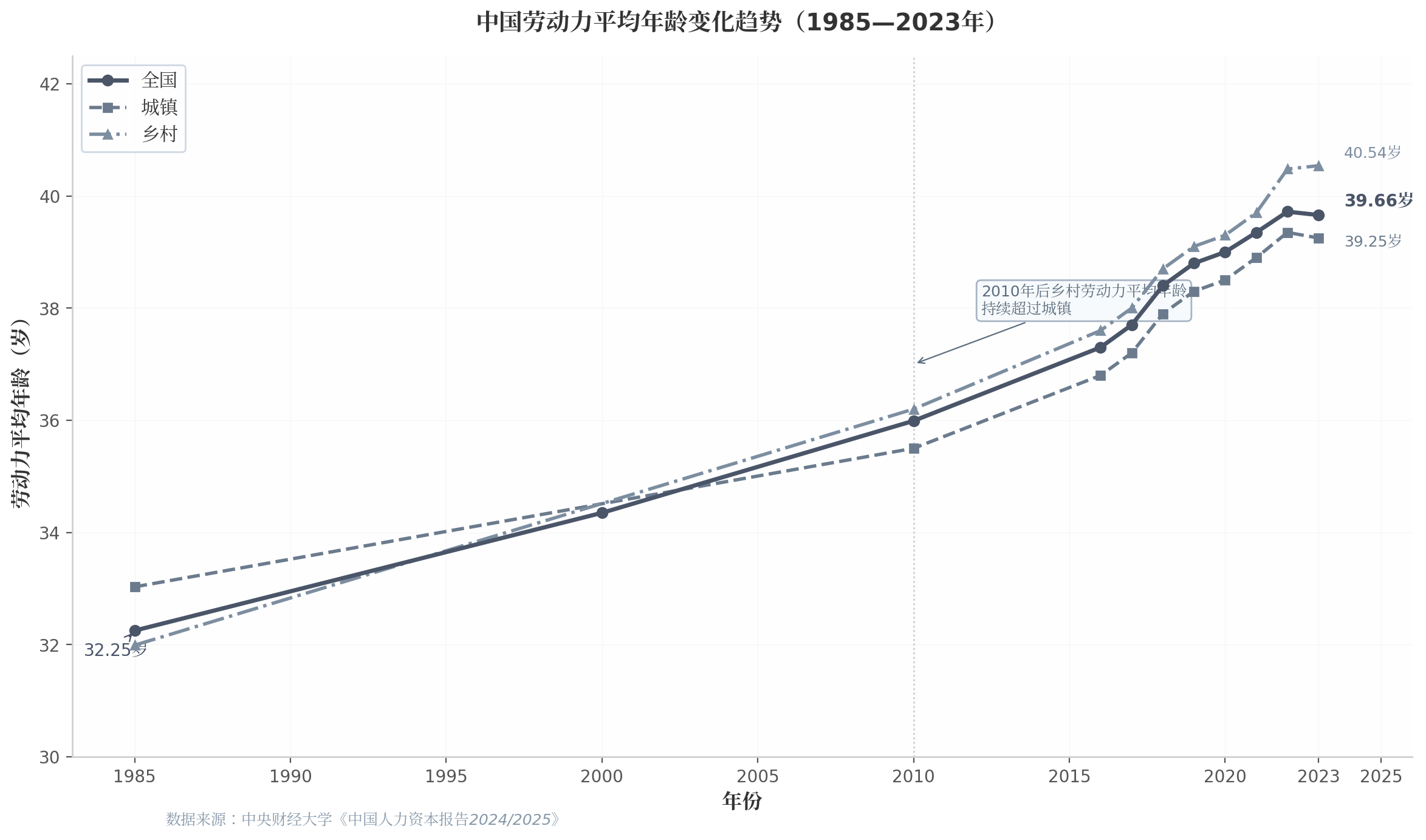
Figure 1 Trend in the average age of China’s labor force (1985–2023)
From the gender dimension, in 2023 the average age of the rural male labor force was highest at 41.60; next were urban males (40.26), rural females (39.06), and urban females (38.07) (Hexun) . The aging of the rural male labor force is most pronounced, closely related to the reality that men migrate out for work while the labor force left behind in the countryside is mainly middle-aged and older.
1.2 Scale and Distribution of Older Workers
1.2.1 Employed People Aged 35 and Above Are Now the Absolute Majority
Long-form data from the Seventh National Population Census shows that among the national employed population, those under 30 account for 17.7%, 30–39 for 27.6%, 40–49 for 25.1%, 50–59 for 20.8%, and 60 and above for 8.8% (Hexun) . By this estimate, employed people aged 35 and above account for about 54.7%, of which those aged 40 and above reach 54.7% (25.1%+20.8%+8.8%). This means that more than half of China’s employed population has entered the “older” ranks; older workers are no longer a marginal group in the labor market but the absolute mainstay forming the employment base.
In terms of employment stability, older workers show a marked advantage. National Bureau of Statistics unemployment data by age group shows that in December 2024, the national urban unemployment rate for the 30–59 labor force excluding students was 3.9%, significantly lower than the 6.6% for the 25–29 group and 15.7% for the 16–24 group (Hexun) . The unemployment rate of the older group has long been stable in the 3.8%–4.2% range, far below the 14%–18% fluctuation range of the youth group. This “employment safety cushion” effect partly stems from older workers being more inclined to keep their existing jobs rather than proactively job-hop, and it also reflects the greater difficulty they face in re-entering the labor market after leaving it.
1.2.2 The Logic of Stock Development Against a Shrinking Employment Total
As noted above, the national total employed population fell from 740.41 million in 2023 to 725.04 million in 2025, an average annual contraction of about 7.68 million (Hexun) . Against this background of a contracting total, relying only on newly added labor can no longer support economic growth’s demand for human resources, and stock development of older labor becomes ever more important. Data from Central University of Finance and Economics’ China Human Capital Report 2025 corroborates this from another angle: although the average age of the labor force has risen and its numbers declined, the total human capital of the labor force, calculated at current-year value, grew from 886.1 trillion yuan in 2022 to 1,126.11 trillion yuan in 2023, an increase of 27.1% (Hexun) . The continued growth in total human capital mainly stems from the rising overall education level of the labor force — the national average years of education of the labor force rose from 6.14 years in 1985 to 11.03 years in 2023 (Hexun) . The average human capital of newly added labor is higher than that of the older workers exiting the labor market, forming a partial substitution of the “quality dividend” for the “quantity dividend.”
1.2.3 Regional Differences: The Polarization of Northeast Aging and Southern Rejuvenation
The severity of the older-employment problem varies markedly by region. The three northeastern provinces, affected by the combined impact of continuous outflow of young people and local aging, have the most pronounced labor-force aging. Table 1 presents the polarized pattern of the average age of the labor force across provinces.
Table 1 Ranking of the average age of the labor force by province in 2023 (top and bottom five provinces)
| Rank | Province | Average age of labor force (years) | Characteristic |
|---|---|---|---|
| 1 (highest) | Inner Mongolia | 41.19 | Rural labor force average age reaches 42.94 (Hexun) |
| 2 | Heilongjiang | 40.84 | Rural labor force average age in all three provinces exceeds 42 (Hexun) |
| 3 | Liaoning | 40.74 | Population aged 65 and above accounts for 21.90%, the nation’s first severely aged province (Hexun) |
| 4 | Jilin | 40.69 | Elderly population accounts for 19.41%, aging level among the nation’s highest (Hexun) |
| 5 | Sichuan | ~40.3 | Major labor-exporting province, severe outflow of young and middle-aged people |
| … | … | … | … |
| (lower) | Guizhou | 37.74 | Relatively high birth rate, younger population structure |
| Guangdong | 37.93 | Large scale of inflow from other provinces with a young structure (Hexun) | |
| Tibet | ~37.8 | Relatively high natural population growth rate | |
| Hainan | ~37.9 | A province with migration inflow | |
| Lowest | Xinjiang | 37.49 | Natural population growth rate among the nation’s highest (Hexun) |
The data in the table above reveals the dual logic behind the regional differentiation of the labor force’s age structure. Severely aged regions such as the three northeastern provinces and Inner Mongolia generally face the double pressure of net outflow of young labor and a sluggish local natural population growth rate; whereas rejuvenating regions such as Guangdong, Xinjiang, and Hainan benefit from higher birth rates or continuous net inflow of young labor. Guangdong’s births reached 1.13 million in 2024, ranking first nationally for seven consecutive years; the continuous inflow of young people and a relatively high willingness to marry and have children are key factors keeping its population structure relatively young (Hexun) .
From the perspective of matching human-capital stock with age structure, in 2023 the top five provinces by total labor-force human capital were Guangdong, Jiangsu, Shandong, Zhejiang, and Henan, while the three northeastern provinces with the highest average age had already dropped out of the top ranks in total human capital (Hexun) . This cycle of “aging — human-capital loss — slowing economic growth” poses a deep challenge to coordinated regional development.
1.3 Industry Distribution and Employment Forms
1.3.1 The Industry-Clustering Characteristics of Older Workers
Older workers show a marked “experience-friendly” clustering in their industry distribution. According to the China Population Census Yearbook 2020 and labor statistical yearbook data, agriculture/forestry/animal husbandry/fishery, traditional manufacturing, construction, and wholesale and retail absorb the most older practitioners. Table 2 presents the industry distribution ranked by the share of employed people aged 35 and above.
Table 2 Age structure of employed people in major national industries (ranked by share aged 35 and above)
| Industry category | Share under 35 (%) | Share 35 and above (%) | Of which 50 and above (%) | Industry characteristic |
|---|---|---|---|---|
| Information transmission, software and IT services | 64.6 | 35.4 | <5 | Fast technological iteration, prefers young labor (WeChat Official Account Platform) |
| Internet and related services | 70.0 | 30.0 | <3 | The industry with the strictest “age-35 threshold” (WeChat Official Account Platform) |
| Scientific research and technical services | ~58 | ~42 | ~7 | High education threshold, moderate age sensitivity |
| Finance | ~55 | ~45 | ~8 | Some posts value experience (CSDN Blog) |
| Culture, sports and entertainment | ~57 | ~43 | ~6 | Creativity-oriented, prefers young practitioners |
| Manufacturing (overall) | ~52 | ~48 | ~15 | Large variation across sub-industries (Hexun) |
| Construction | ~48 | ~52 | ~18 | High physical demands, rising share of older workers (Caixin) |
| Wholesale and retail | ~45 | ~55 | ~20 | Experience-accumulation type, high inclusiveness |
| Transport, warehousing and postal services | ~43 | ~57 | ~22 | More skill-based posts |
| Accommodation and catering | ~42 | ~58 | ~24 | Low entry threshold |
| Agriculture, forestry, animal husbandry and fishery | ~30 | ~70 | ~35 | The most concentrated older practitioners (Hexun) |
As Table 2 shows, the differentiation of age structure across industries is very pronounced. In information transmission, software and IT services, those under 35 account for 64.6%, whereas in agriculture/forestry/animal husbandry/fishery, those aged 35 and above account for as much as about 70%. This differentiation reflects the differing demands of industries for technological iteration speed, physical requirements, and learning ability. Technology-driven industries tend to recruit young employees to cope with a fast-changing technological environment, while traditional services and agriculture rely more on accumulated experience and are relatively more inclusive of older workers.
1.3.2 The “Age-35 Phenomenon” in the Internet and Tech Industries
The internet and IT services industry is where the age-35 employment threshold is most pronounced. Liepin’s 2023 Annual Employment Trend Data Report shows that among technical-post recruitment in the internet industry, posts explicitly requiring “under 35” account for as much as 72% (WeChat Official Account Platform) . Zhaopin data also shows that in the internet/IT industry, employees under 35 account for 70.4% (CSDN Blog) . CSDN platform data indicates that programmers aged 35 and above make up only 9.4%–15.4% of all technical practitioners (CSDN Blog) .
That technology-driven industries have become the “disaster zone” of age discrimination is closely related to industry characteristics. An empirical study by Shanghai University of Finance and Economics, based on tens of millions of job postings in 2021, found that strongly technology-driven industries such as the internet, telecom/network equipment, and electronics/semiconductors/integrated circuits show a significant “downward breakpoint” after 35 — that is, employers’ willingness to communicate with applicants drops significantly after the age-35 node (Peking University National School of Development) . Enterprises commonly set age thresholds on the grounds of “fast technological iteration” and “needing young people,” but the actual effect of this practice runs counter to their expectations: the same study also found that for every 1% increase in age discrimination, total factor productivity falls by 0.114%–0.119% and human-capital investment falls by 0.134%–0.233% (Peking University National School of Development) .
1.3.3 The Industry-Mobility Paths of Older Workers
Table 3 comprehensively presents the industry-distribution characteristics of employed people across different age groups and different hukou (household-registration) types.
Table 3 Industry distribution and employment-form characteristics of older workers
| Dimension | Core data | Trend characteristic |
|---|---|---|
| Migrant-worker group | In 2023 the average age of migrant workers was 43.1, with those 50 and above accounting for 30.6% (about 96 million) (Caixin) | The share aged 50 and above rose from 24.6% in 2019 to 30.6% in 2023, an average annual increase of 1.5 percentage points |
| Concentrated industries | In agriculture/forestry/animal husbandry/fishery, those 50 and above account for 16.6%; in manufacturing, 7.7% (Hexun) | Among practitioners aged 60–64, 56.2% are concentrated in agriculture/forestry/animal husbandry/fishery (Hexun) |
| Manufacturing breakdown | In manufacturing, ages 35–39 account for 17.9%, 40–44 for 12.2%, 45–49 for 10.8% (Hexun) | The older the age, the lower the share in manufacturing, declining in a stair-step fashion |
| Gender difference | The average age of the urban female labor force is 38.07, 2.19 years lower than males (Hexun) | Women exit the labor market earlier, due to differences in the retirement-age system |
| Unemployment risk | After 35, the share losing jobs for employer-side reasons rises from 0.397% to 0.537%, an increase of 35.34% (Peking University National School of Development) | PKU NSD’s regression-discontinuity analysis confirms systemic discrimination at 35 |
Table 3 reveals the multiple vulnerabilities of older workers in the labor market. The migrant-worker group deserves particular attention — of nearly 300 million migrant workers, about 96 million are over 50 (Caixin) . They face multiple pressures including declining physical strength, lack of social insurance, and construction “clearance orders” in some regions, yet in public discussion they belong to the “silent majority.” From the industry-mobility trajectory, as workers age they show a tendency to shift from manufacturing to agriculture/forestry/animal husbandry/fishery: among practitioners aged 60–64, 56.2% are concentrated in agriculture/forestry/animal husbandry/fishery, whereas for ages 16–19 the proportion is only 20.7% (Hexun) . This “backward mobility” both reflects the absorbing function of agriculture/forestry/animal husbandry/fishery, which has lower age requirements, and mirrors the continual narrowing of older workers’ employment options in the formal sector.
At the same time, older workers also face a wage discount. Zhaopin data shows that for the same post, silver-haired employees’ wage level is generally 15%–20% lower than that of young employees (Sina Finance) , and age discrimination overlaps with the skills fault line brought by rapid digital transformation, forming more complex market barriers. In 2024, 62.3% of publicly advertised jobs set an upper age limit, of which the “under 35” restriction accounted for 36.8% (Sina Finance) . In this market environment, job seekers aged 35 and above submit on average 47% more résumés than the 25–34 group, yet their interview conversion rate is 23 percentage points lower (Sina Finance) ; “many applications, few conversions” has become the common plight of older job seekers.
In sum, China’s labor market is in a dual transition period of “contracting supply + structural aging.” The working-age population keeps falling from its peak, the average age of the labor force approaches 40, and employed people aged 35 and above account for more than half. Against this macro backdrop, age-35 employment discrimination is not only a matter of social equity but also a question of economic efficiency — under the constraint of a shrinking total labor force, excluding workers aged 35 and above amounts to voluntarily giving up the largest pool of available human resources, and its policy cost will keep climbing as the population structure changes.
2. The “Age-35 Threshold”: Institutional Origins and Legal Predicament
2.1 Historical Tracing of the Age-35 Threshold
2.1.1 Civil-Service Recruitment: The Institutional Source
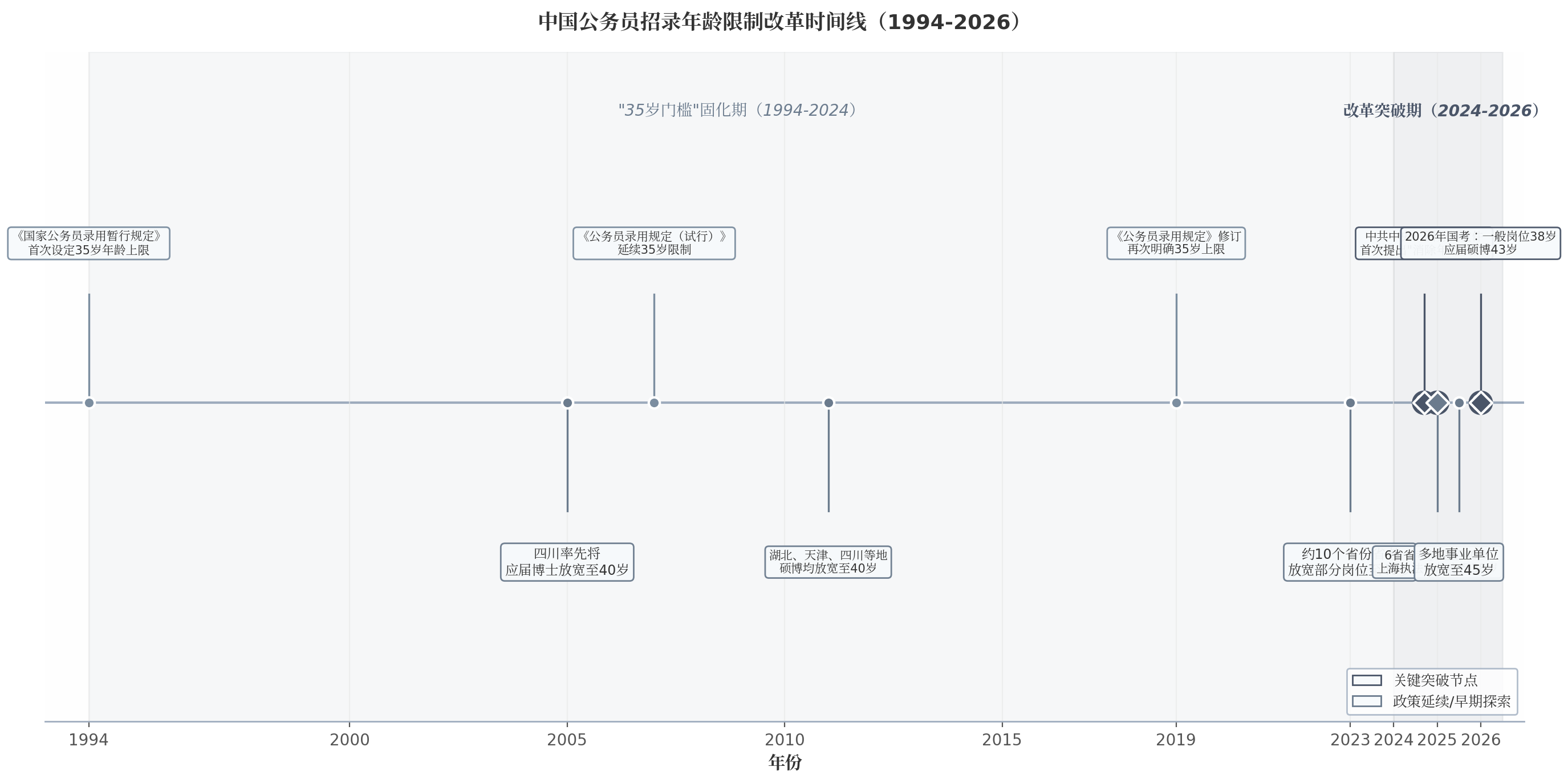
The institutional source of the “age-35 threshold” in China’s job market can be traced back to 1994. That year, the State Council’s personnel department issued the Interim Provisions on the Recruitment of State Civil Servants, which explicitly set the age condition for applying to be a civil servant at “under 35” (Renmin University Reprint Materials) . The original legislative consideration behind this provision lay in the training and growth cycle of the civil-service ranks — from grassroots recruitment to growing into a cadre capable of handling matters independently requires a fairly long career-development window. Setting an age-35 ceiling was meant to ensure that newly recruited civil servants had enough room for career development.
In 2007, the Organization Department of the CPC Central Committee and the Ministry of Personnel formulated the Provisions on the Recruitment of Civil Servants, formally setting the application-age requirement at “18 or above, under 35” (WeChat Official Account (Shandong Trade Union)) , further institutionalizing this threshold. Notably, the Civil Servant Law, as the higher-level law, only requires applicants to be “18 or above” and sets no upper age limit; the addition of the “under 35” restriction in the Provisions on the Recruitment of Civil Servants is disputed at the jurisprudential level as exceeding the authorization scope of the higher-level law (Renmin University Reprint Materials) . Although the 2019 revision of the Provisions on the Recruitment of Civil Servants added a flexible clause — with approval from civil-service authorities at the provincial level or above, the age condition may be adjusted appropriately — the basic framework of 35 was not shaken (WeChat Official Account (Shandong Trade Union)) .
2.1.2 Emulation from the Top Down: From Institutional Requirement to Industry Unwritten Rule
Civil-service recruitment standards have a strong demonstration effect on the social employment market. After civil servants set the age-35 threshold in 1994, enterprises and public institutionsone after another imitated it, making “under 35” the default recruitment condition (WeChat Official Account (Tax Lecture Hall)) . The formation of this transmission mechanism has its deep logic: civil-service posts are seen as the “gold standard,” and their hiring conditions are taken by default as a reasonable and replicable industry convention. As the supply-demand relationship of the labor market changed, enterprises gradually internalized the age threshold in recruitment from a “reference standard” into a “screening tool,” and 35 evolved from an institutional requirement into a taken-for-granted industry unwritten rule.
Zhaopin’s Analysis Report on the Current State of Middle-Aged and Older Employment released in 2024 shows that among posts openly advertised to society, those setting an upper age limit account for as much as 62.3%, of which the “under 35” restriction accounts for 36.8%, “under 40” for 18.7%, and “under 45” for 6.8% (Sina Finance) . This means more than 60% of openly advertised jobs are effectively closed to job seekers in specific age brackets. More alarming, the age restriction has expanded from an initial few posts to a near-universal practice across almost all industries, with the internet, finance, and education sectors becoming the disaster zones.
2.1.3 Empirical Verification: The Discrimination Effect Revealed by Regression Discontinuity
The National School of Development at Peking University used a Regression Discontinuity Design (RDD) to rigorously test the causal effect of age discrimination. Based on a big-data sample of over 100 million job postings between 2016 and 2024, and after controlling for productivity-related factors, the study found a significant “breakpoint effect” at the age-35 node: the share of workers aged 35 and above who lose their jobs for employer-side reasons jumps from 0.397% to 0.537%, an increase of 35.3% (Peking University National School of Development) . By comparing the employment outcomes of near-identical individuals on either side of the breakpoint, regression discontinuity can rule out the interference of confounding factors and come closer to identifying causation.
The study further found that employers hold six typical stereotypes about older workers: poorer health, poorer creativity, poorer adaptability, poorer learning ability, poorer ability to master new technology — while simultaneously acknowledging their richer experience (Peking University National School of Development) . The empirical study by Shanghai University of Finance and Economics, based on tens of millions of job postings in 2021, verified this effect at the enterprise level: for every 1% increase in the degree of age discrimination, an enterprise’s human-capital investment falls by about 0.134% to 0.233%, and total factor productivity falls by 0.114% to 0.119% (Peking University National School of Development) . While pursuing short-term “cost reduction,” enterprises actually pay the price of long-term “inefficiency.”
2.2 The Structural Gap in the Legal System
2.2.1 The Closed Enumeration of the Labor Law
Article 12 of the Labor Law, promulgated in 1994, provides: “Workers shall not be discriminated against in employment on the basis of differences in ethnicity, race, gender, or religious belief.” This article uses a closed-enumeration approach; the explicitly listed types of employment discrimination include only the four cases of ethnicity, race, gender, and religious belief, and age is explicitly excluded (Renmin University Reprint Materials) . This legislative choice was not accidental under the historical conditions of the time: in the 1990s, China’s labor market was in the early stage of transition from a planned to a market economy, and legislators were mainly concerned with the then most prominent problems of status-based and gender-based discrimination; age discrimination had not yet entered the legislative field of vision.
However, this closed-enumeration legislative technique has produced profound institutional consequences. In the absence of an explicit legal prohibition on age discrimination, enterprises’ age-screening behavior lacks any cost of illegality, and age discrimination is “tacitly approved” at the legal level as a lawful hiring strategy. Fan Wei, associate research fellow at the Institute of Law of the Chinese Academy of Social Sciences, points out that the current legal provisions on anti-employment-discrimination are “rather crude,” lacking clear constitutive standards and operational guidance (Renmin University Reprint Materials) .
2.2.2 Two Failed Legislative Attempts in the Employment Promotion Law
The legislative process of the Employment Promotion Lawconcentratedly reflects the efforts and setbacks of bringing age within the scope of anti-discrimination protection. In the draft law for public consultation published in March 2007, Article 5, paragraph 2, had added “age” discrimination (Renmin University Reprint Materials) , but it was deleted in the law text formally passed in August of the same year, ultimately adding only a catch-all character “etc.” Shen Jianfeng, director of the academic committee of the Law School of China University of Labor Relations, points out that “this character ‘etc.’ in fact provides a legal basis for prohibiting age discrimination in employment,” but “such a provision is rather crude,” lacking clear constitutive standards (Renmin University Reprint Materials) .
In 2017, during the revision of the Employment Promotion Law, there was again an attempt to explicitly include age among the prohibited types of discrimination, but it likewise failed to survive in the official version (Guancha) . The consecutive failure of the two legislative attempts reflects the deep resistance faced at the institutional level in advancing anti-age-discrimination protection — both concern over enterprises’ autonomy in hiring and an excessive prioritization of labor-market “efficiency.”
2.2.3 The Systemic Silence of the Labor Contract Law
The Labor Contract Law, promulgated in 2007, maintained a systemic silence on anti-employment-discrimination. The law makes no special regulation of discriminatory behavior at the recruitment stage; its focus centers on the conclusion, performance, modification, and termination of labor contracts. This means that enterprises’ behavior of setting age thresholds in recruitment advertisements and eliminating candidates on grounds of age during résumé screening falls in a regulatory vacuum (Renmin University Reprint Materials) .
China’s provisions on anti-employment-discrimination are scattered across the Constitution, the Labor Law, and the Employment Promotion Law, and have not formed an institutionalized system; moreover, such provisions are mostly principle-based clauses, lacking specific operational guidance against age discrimination (Renmin University Reprint Materials) . Employers accordingly believe that, since the law does not explicitly prohibit it, age screening falls within the reasonable scope of hiring autonomy. This “tacit approval effect” of the legal gap is the deep institutional root of age-35 discrimination spreading from the civil-service system to the whole of society.
2.3 Enforcement and Judicial-Remedy Predicaments
2.3.1 The Enforcement Vacuum of Labor-Security Inspection
The absence of legal provisions transmits directly to the enforcement level. Labor-security inspection departments currently face the predicament of “having no law to rely on”: because the Labor Law and the Employment Promotion Law do not list age discrimination as a statutory case of employment discrimination, labor inspection departments lack a clear enforcement basis and power to punish (Renmin University Reprint Materials) . In practice, enforcement resources are highly concentrated on “hard” violations such as recovering wage arrears, social-insurance contributions, and labor safety, while supervision of employment-discrimination cases is almost entirely blank.
During the 2025 Two Sessions, NPC deputy Meng Yuan pointed out that “labor-security enforcement mainly keeps an eye on wage arrears and protecting workers’ basic rights, and doesn’t pay much attention to age discrimination in employment” (Renmin University Reprint Materials) . Fan Wei, associate research fellow at the Institute of Law of the Chinese Academy of Social Sciences, further suggested that age discrimination in employment should be brought within the scope of labor-inspection enforcement, that a review mechanism for recruitment advertisements be established, that violating enterprises be publicly named and punished, and that the standard of damages be raised to increase employers’ cost of illegality (Renmin University Reprint Materials) .
2.3.2 Judicial Remedy: Low Win Rate, Difficult Burden of Proof, Low Compensation
At the level of judicial remedy, victims of age discrimination face a “triple predicament.” An empirical study by China University of Political Science and Law found that in litigation involving employment discrimination over the past five years, workers’ overall win rate was under 15% (Renmin University Reprint Materials) . Unlike gender-discrimination cases, where a reversal of the burden of proof can apply, victims of age discrimination often lose because of the difficulty of proof — workers must themselves prove that the enterprise had age bias in its recruitment or dismissal decision, while enterprises usually evade responsibility with reasons like “job requirements” or “capability mismatch,” and it is nearly impossible for workers to obtain the enterprise’s internal decision-making information as evidence.
Even when they win, the compensation is extremely limited. Under the current legal framework, compensation for employment discrimination mostly takes the form of solatium for mental distress, usually under 10,000 yuan — trivial compared with the labor costs an enterprise saves through age discrimination, and hard-pressed to form effective legal deterrence (Renmin University Reprint Materials) .
In December 2018, the Supreme People’s Court added the cause of action “disputes over the right to equal employment,” providing victims of employment discrimination an independent channel for defending their rights. Yet constrained by the structural obstacles of difficult proof and low compensation, the practical effect of this institutional innovation remains limited.
2.3.3 Breakthroughs and Limits in Judicial Practice
Despite the harsh overall rights-protection environment, recent judicial practice has seen several landmark individual-case breakthroughs. The table below outlines typical age-discrimination lawsuits and their outcomes.
Table 2-1 Typical age-discrimination lawsuits and outcomes
| Case | Year | Case summary | Point of dispute | Outcome | Landmark significance |
|---|---|---|---|---|---|
| Yang Shijian v. Ministry of Personnel | 2005 | A 36-year-old examinee refused the civil-service application for being over age and filed an administrative lawsuit | Whether civil-service recruitment age limits fall within the scope of administrative litigation | The court dismissed the suit on the grounds that it “does not fall within the scope of administrative litigation” | Established the precedent that disputes over civil-service recruitment age conditions are hard to remedy through administrative litigation |
| A Hangzhou tech company’s recruitment-discrimination case | 2022 | The company set a rule in its recruitment system to “automatically mark age >40 as low priority”; a 45-year-old applicant was rejected | Whether age screening in a recruitment algorithm constitutes employment discrimination | Judgment: the company to pay 8,000 yuan in solatium for mental distress | The first time algorithmic age discrimination was brought within judicial review |
| A Beijing tech company’s dismissal case | 2023 | A 45-year-old engineer was dismissed by the company for “business adjustment”; the worker claimed age discrimination | Whether dismissal for business adjustment masks age discrimination | The court applied a “reversal of the burden of proof,” requiring the enterprise to prove it committed no discrimination | The first time a reversal of the burden of proof was applied in an age-discrimination case |
The three cases presented above span nearly twenty years, reflecting the evolutionary trajectory and deep predicaments of China’s anti-age-discrimination judicial remedy. The Yang Shijian case (2005) established the judicial rule of “non-acceptance” for the administrative-litigation route regarding civil-service recruitment age limits, excluding this largest and most demonstrative area of age discrimination from judicial review (Renmin University Reprint Materials) . The Hangzhou tech company case (2022) was the first to touch on algorithmic discrimination in digital recruitment — the enterprise set automatic screening rules in its recruitment system to downweight candidates over 40, and the court held this behavior constituted employment discrimination. The case reveals the risk of technological empowerment in amplifying discriminatory effects: when discrimination is embedded in an algorithm, both its scale and its concealment far exceed the traditional practice of “stating an age requirement in a recruitment advertisement” (Sina Finance) . The Beijing tech company case (2023) was the first attempt to break through the general rule of “he who asserts must prove,” partially shifting the burden of proof to the employer and requiring the enterprise to prove its decision involved no age bias in a dismissal dispute. This approach resembles the burden-of-proof allocation mechanism established by the U.S. Age Discrimination in Employment Act (ADEA), but its scope of application and stability remain to be confirmed by subsequent case law.
Overall, breakthroughs in individual judicial cases are not yet enough to make up for the structural defects at the institutional level. Age limits in civil-service recruitment remain a blind spot of judicial review, and current compensation standards are hard-pressed to form effective deterrence. From an international comparison, the United States passed the Age Discrimination in Employment Act (ADEA) as early as 1967 to establish a systematic protection framework; the EU promulgated the Employment Equality Directive (2000/78/EC) in 2000; and Japan in 2007 upgraded recruitment age limits from a “best-efforts obligation” to a “prohibition” (Renmin University Reprint Materials) . China has a gap of nearly twenty years in these legislative areas, and this gap is increasingly highlighting its institutional cost as the labor market ages rapidly and the delayed-retirement policy is implemented.
3. Civil-Service Recruitment Reform: The Policy Turning Point and Demonstration Effect
In 1994, the Interim Provisions on the Recruitment of State Civil Servants first listed “under 35” as a basic application condition (Sina Finance) . This provision went through multiple revisions over the following thirty-plus years but was never changed — the 2007 Provisions on the Recruitment of Civil Servants (Trial) continued the clause, and the 2019 revision confirmed it again (Renmin University Reprint Materials) . The age-35 threshold not only solidified as the “iron rule” of civil-service recruitment, but through institutional demonstration spread to the recruitment practices of state-owned enterprises, public institutions, and even private enterprises, becoming the structural source of age discrimination in China’s labor market. Between 2024 and 2026, a series of coordinated adjustments — from central documents to the national exam to provincial exams — marked a historic loosening of this thirty-year institutional barrier.
3.1 From 35 to 38: The Historic Breakthrough of the National Exam Reform
3.1.1 The Policy Meaning of the 2026 National Exam Age Adjustment
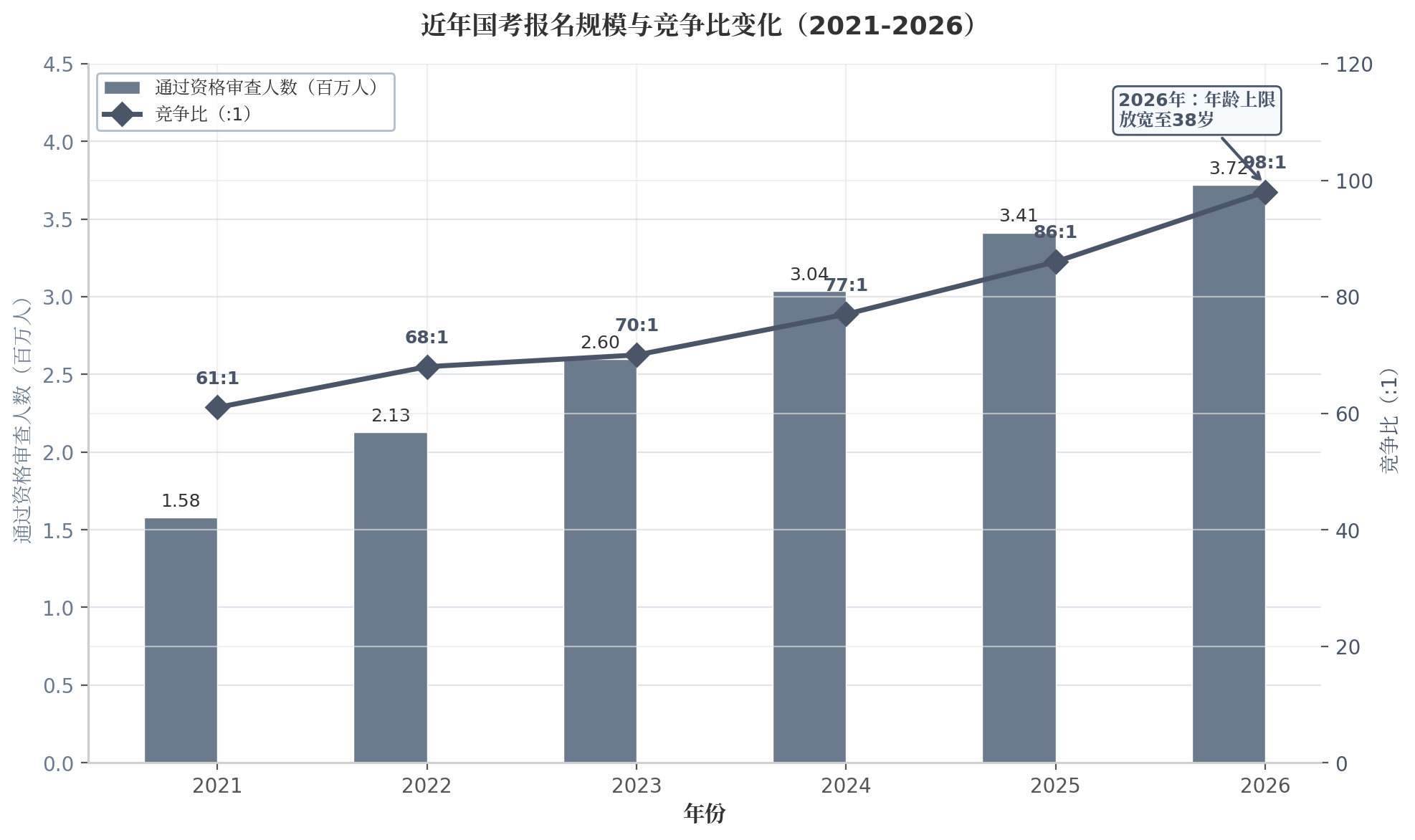
In October 2025, the State Bureau of Civil Servants released the 2026 national civil-service exam announcement, adjusting the upper application age for general posts from 35 to under 38 (those born between October 1986 and October 2007), and relaxing the upper age for fresh master’s and doctoral graduates from 40 to under 43 (ccswf.org.tw) . This is the first general upward adjustment of the age threshold for general posts since the civil-service examination and recruitment system was established in 1994, directly benefiting a potential applicant pool of about 30 million to 50 million born between 1986 and 1989 (ccswf.org.tw) .
In terms of recruitment scale, the 2026 national exam plans to recruit 38,100 people, about 1,602 fewer than in 2025, the first contraction since 2019 (ccswf.org.tw) . Yet the number of applicants rose rather than fell — a total of 3.718 million passed the qualification review, with a ratio of about 98:1 between those passing review and the recruitment plan, and the most popular post drew over 7,000 competitors (ccswf.org.tw) . The actual number of examinees reached 2.831 million, an exam-to-recruitment ratio of about 74:1 (ccswf.org.tw) . The simultaneous rise in application scale and competition intensity shows that relaxing the age significantly expanded the coverage of talent selection but did not ease the overall competitive pressure of civil-service recruitment.
3.1.2 Policy-Linkage Logic: Institutional Coordination Between Delayed Retirement and Equal Employment
The 2026 national-exam age adjustment is not an isolated policy change but is embedded in a broader institutional framework. In September 2024, the CPC Central Committee and the State Council issued the Opinions on Implementing the Employment-Priority Strategy and Promoting High-Quality Full Employment, which for the first time at the national level explicitly proposed “eliminating unreasonable restrictions and employment discrimination affecting equal employment based on region, status, gender, age, etc.” (WeChat Official Account Platform) . This was the first time a central document placed “age” alongside region, status, and gender as a type of employment discrimination to be eliminated, providing top-level policy basis for subsequent recruitment-system reform.
Zhao Zhong, dean of the School of Labor and Human Resources at Renmin University of China, points out that, at the institutional level, relaxing the age in the national exam is a measure adapted to the reform of progressively delaying the statutory retirement age. From 2025, China formally implements the progressive delayed-retirement policy: the male retirement age will be gradually delayed from 60 to 63, and the female from 50 or 55 to 55 or 58. Against this backdrop, if the recruitment side keeps the age-35 threshold while the retirement side is extended to 63, workers will face a 28-year “mid-career blank” — neither able to enter the public sector nor yet decades from retirement. Zhao Zhong believes that recruitment-related conditions should be adjusted accordingly to achieve logical consistency between the two ends of policy (ccswf.org.tw) .
3.1.3 Provincial Exams Leading the Exploration in 2025: Local Trials Paving the Way for National Reform
Before a unified national adjustment, some provinces had already taken the lead in exploring. In the 2025 provincial exams, six provinces — Shanghai, Zhejiang, Jiangsu, Tianjin, Shandong, and Sichuan — explicitly relaxed the upper age for some posts to 40 (Journal of Wuhan University (Humanities and Social Sciences)) . Shanghai’s exploration was quite innovative: the law-enforcement civil-service recruitment announcement released in August 2025 relaxed the age to under 38, nearly two months ahead of the unified national adjustment, becoming the first law-enforcement civil-service recruitment case to break the age-35 threshold (ajcass.com) .
The relaxation conditions across provinces show differentiated characteristics. Zhejiang relaxed the recruitment age to 40 for fresh master’s-and-above graduates and outstanding village cadres (CSDN Blog) ; Jiangsu relaxed to under 40 for posts recruiting fresh graduate students and outstanding village (community) party-organization secretaries (CSDN Blog) ; Hunan, for targeted recruitment posts aimed at village (community) party-organization secretaries, raised the ceiling even further to under 45 (Peking University National School of Development) ; and Xinjiang, as early as 2024, had already relaxed the age to 45 for fresh master’s and doctoral graduates for county (city, district) and below agency posts (WeChat Official Account Platform) . These local practices accumulated operational experience for a unified national adjustment and verified the feasibility of relaxing the age ceiling at the level of recruitment organization.
3.2 Public Institutions and Social Exams Following Suit
3.2.1 Some Provinces Relax Public Institutions to Under 45
The weathervane of civil-service recruitment reform quickly transmitted to the public-institution recruitment sphere. In January 2025, the Sichuan Provincial Department of Human Resources and Social Security released the Implementation Opinions on Further Deepening Reform in the Employment Field and Promoting High-Quality Full Employment (Draft for Comment), proposing to support public institutions in appropriately relaxing recruitment age conditions and encouraging enterprises to relax hiring age limits (Hexun) . After the policy was released, Meishan, Suining, and other places in Sichuan, in the second half of 2025, adjusted the age requirement for bachelor’s-degree recruitment in public institutions to under 38 and relaxed graduate-degree recruitment to under 43 (Hexun) .
More groundbreaking were provinces such as Shandong, Xinjiang, and Guizhou. Xinhua reported in June 2025 that these regions had already relaxed the upper age for some public-institution posts to under 45 (ajcass.com) . Some posts at the Guangzhou Pharmaceutical Group relaxed the upper age even to 50 (Hexun) , and the health commission system of Lin’an District, Hangzhou, in its 2025 recruitment of high-level, scarce professional-technical talent, explicitly stated that “the age for especially outstanding talent may be relaxed to 50” (Peking University National School of Development) . The flexibility of public-institution recruitment on age limits is generally higher than for civil servants, closely related to the characteristics of the posts — professional-technical posts’ demand for experience and seniority makes age a factor that in some fields actually constitutes an advantage.
3.2.2 The Differentiated Trend of Relaxation by Post Type
Looking at the geographic distribution of reforms already implemented, age relaxation is not a “one-size-fits-all” uniform lowering but shows differentiated characteristics tied to post type and talent level. Professional-technical posts have the largest relaxation, management posts next, and worker-skill posts are relatively conservative. Targeted recruitment aimed at grassroots work experience (such as village party secretaries and community cadres) generally sets more lenient age ceilings, reflecting policy designers’ recognition of the value of grassroots governance experience. Highly educated talent (master’s and doctoral) benefits most broadly across all relaxation categories; almost every province’s relaxation policy lists them as a priority group. This “tiered and classified” relaxation strategy both responds to social concerns and, to a certain extent, maintains the screening function of recruitment.
3.3 The Limits of the Demonstration Effect
3.3.1 The “Weathervane Paradox”: The Asymmetry of the Transmission Mechanism
Civil-service recruitment policy has long been seen as the “weathervane” of China’s labor market. After civil servants set the age-35 threshold in 1994, the standard was quickly imitated by state-owned enterprises, public institutions, and private enterprises, gradually evolving into the “baseline” of all industries (Journal of Wuhan University (Humanities and Social Sciences)) . However, this transmission mechanism shows marked asymmetry in the direction of reform: discriminatory standards easily spread “from the top down,” while inclusive standards are hard to diffuse “from the bottom up.”
Between 2024 and 2025, many provinces’ civil-service and public-institution recruitment had already relaxed the upper age to 40 to 45, but the enterprise-side response was extremely limited. Zhaopin’s Analysis Report on the Current State of Middle-Aged and Older Employment released in 2024 shows that among jobs openly advertised to society, those setting an upper age limit still account for as much as 62.3%, of which the “under 35” restriction accounts for 36.8%, “under 40” for 18.7%, and “under 45” for 6.8% (Huxiu) . This means more than 60% of openly advertised jobs are effectively closed to job seekers over 45. Notably, the data-collection period of this report was precisely 2024, when civil-service relaxation reforms were being intensively advanced, indicating that public-sector reform had not yet significantly changed enterprise recruitment behavior.
Cheng Yang, senior partner at Beijing Lantai Law Firm, analyzes that enterprises’ considerations in setting age thresholds have multiple dimensions: on the one hand, age limits in civil-service and state-owned-enterprise recruitment do have a demonstration effect; on the other hand, enterprises take controlling labor costs as their core goal, and “older workers may come with higher salary expectations, medical expenses, and retirement-benefit costs” (ajcass.com) . Li Yuhui, professor at the School of Labor and Human Resources of Renmin University of China, further points out that enterprises’ pursuit of the “youth dividend” is an important cause of the age-35 threshold — in common perception, young people have more energy for work, especially in industries with a high proportion of new technology (ajcass.com) . When the “demonstration” of the public sector meets the “cost calculation” logic of enterprises, the latter often takes the lead.
3.3.2 Civil Servants vs. Enterprises: A Comparison of Age-Limit Changes
The table below compares the trends in age limits between the civil-service system and enterprise recruitment during 2024-2026:
| Dimension | Civil-service system (2024-2026) | Enterprise recruitment (2024-2025) |
|---|---|---|
| Upper age for general posts | From 35 → 38 (national exam); some provincial exams 40-45 | 62.3% of posts still set an upper age limit, 36.8% require under 35 (Huxiu) |
| Relaxation for highly educated talent | Fresh master’s/doctoral from 40 → 43 (national exam); some provincial exams 45 | 72% of internet-company technical posts require under 35 (WeChat Official Account Platform) |
| Professional-technical posts | Some public-institution posts relaxed to 45-50 (ajcass.com) | Traditional industries (manufacturing, finance) have relatively higher tolerance (Shanghai University of Finance and Economics Journal) |
| Speed of reform | 2024 central document → 2025 provincial exams → 2026 national exam, a triple jump within two years | Individual enterprises respond; the industry as a whole shows no systemic change |
| Typical cases | Shanghai law-enforcement 38, Xinjiang county-and-below agencies 45, Sichuan public institutions 38/43 | Great Wall Motors’ “35+ Program,” a Beijing SOE 45, Guangzhou Pharmaceutical Group 50 (ajcass.com) |
| Regional differences | Only a few provinces such as Beijing, Shaanxi, Fujian, and Jiangxi have not relaxed (ccswf.org.tw) | Universally present nationwide; regional differences not significant |
The comparison above reveals a structural contradiction: public-sector reform transmits with relatively high efficiency along the vertical dimension (central-provincial-municipal), but its diffusion capacity along the horizontal dimension (public sector-enterprise) is markedly insufficient. The enterprise-side reform response shows a “case-by-case” character — Great Wall Motors launched its “35+ Program” in July 2025 to recruit talent over 35 globally (ajcass.com) , a Beijing state-owned cultural-tech enterprise relaxed the age requirement to under 45 (ajcass.com) , and a corporate recruitment announcement issued by the Anshan High-Tech Industrial Development Zone in Liaoning relaxed the age to under 45 (ajcass.com) . Although symbolically meaningful, these cases are far from forming a scale effect.
More alarming, even within the civil-service system, reform faces hidden barriers. Civil servants who join at 38 face a promotion “ceiling” — starting as a clerk, under the general trend of cadre rejuvenation, it is hard to gain an age advantage, and by retirement they may still struggle to be promoted to the section level (ccswf.org.tw) . In addition, according to the pension principle of “pay more, get more; pay longer, get more,” those who join at 38 accumulate 13 fewer years in their personal accounts than those who join at 25, resulting in a significant gap in retirement benefits (ccswf.org.tw) . The institutional inertia in these subsequent links may weaken the actual effect of relaxation on the recruitment side.
From a deeper logic, the fundamental driver of relaxing the civil-service recruitment age is not the endogenous demand of the labor market, but the external pressure of retirement-policy reform. Once the linkage needs of the delayed-retirement policy are met in stages, whether the recruitment side has the motivation to continue relaxing to 40 or even higher remains uncertain. On the enterprise side, anti-age-discrimination lacks legal enforceability — the current Article 12 of the Labor Law explicitly lists only four types of employment discrimination: ethnicity, race, gender, and religious belief, and does not include age (Renmin University Reprint Materials) . The “tacit approval effect” of the legal gap means that even if civil-service recruitment completely abolishes age limits, enterprises still have ample institutional room to maintain their existing age-screening strategies. The historic significance of civil-service reform as a “policy turning point” should not be underestimated, but its “demonstration effect” on the whole of society still requires the joint push of legislative guarantees, economic incentives, and population-structure changes to be fully released.
4. The Plight of Key Groups: Internet Practitioners, Women, and Migrant Workers
Workers of different ages, genders, and hukou backgrounds face markedly different obstacles in the labor market. Internet practitioners endure the double squeeze of technological iteration and a “youth dividend” culture; female workers lose competitiveness prematurely at the triple intersection of age, gender, and marriage-and-childbearing responsibility; and tens of millions of older migrant workers are caught between town and country, unable to advance or retreat. The plights of the three groups share commonalities — all are constrained by the institutional spread of age discrimination — but each has its own characteristics, reflecting the differentiating effects of industrial structure, social division of labor, and policy coverage. Each is analyzed separately below.
4.1 The “Age-35 Phenomenon” in the Internet Industry
4.1.1 Industry Age Structure: A Young Person’s Industry
The age structure of China’s internet industry shows extreme youth. According to Seventh National Population Census data, in internet and related services, employees under 35 account for as much as 70.4%, and in software and IT services 69.1%, whereas among the national employed population those under 35 account for only 32.9% — the former more than double the latter (Sina) . This gap is not short-term fluctuation but the structural result of the industry’s long-term preference for young labor.
At the level of specific enterprises, the age distribution is even more concentrated. Maimai Gaopin Talent Think Tank’s 2024 report shows that the median age of employees at big tech ranges from Pinduoduo at 29.6, ByteDance at 30.6, NetEase at 30.8, Baidu at 30.0, Alibaba at 31.0, to JD at 33.6 — all below the “employment threshold” of 35 (hanspub.org) . Even JD, with the highest median age (including a large number of logistics and delivery staff), is only 33.6. And in Maimai’s 2021 data, both Tencent and Xiaomi were at 29.0, the lowest among BAT (Sohu) .
The 2025 ESG reports provide more precise age-structure data. As of the end of 2025, Tencent’s group-caliber headcount was 115,849 (including consolidated companies such as Tencent Music and China Literature), of which 34,911 were under 30 (30.1%), 52,072 were 30-50 (44.9%), and only 429 were over 50 (0.4%); calculated on the basis of 87,412 formal headquarters employees, those over 50 also account for only 0.5% (Tencent 2025 ESG Report). Kuaishou in the same period had 24,202 full-time employees, with 14,017 under 30 (57.9%), 10,169 aged 30-50 (42.0%), and only 16 over 50 (0.1%) (Kuaishou 2025 ESG Report). Baidu had about 35,900 employees at the end of 2024, with about 46.8% under 30, about 46.7% aged 31-40, and only about 7.0% over 41 (Baidu 2024 ESG Report). Alibaba’s total employees in fiscal year 2025 were 128,197, a decrease of 66,123 from 194,320 in the same period of 2024 (due to the sale of Sun Art Retail and Intime Commercial); although it did not disclose a detailed age distribution, employees under 35 account for 70% (Alibaba FY2025 Annual Report).
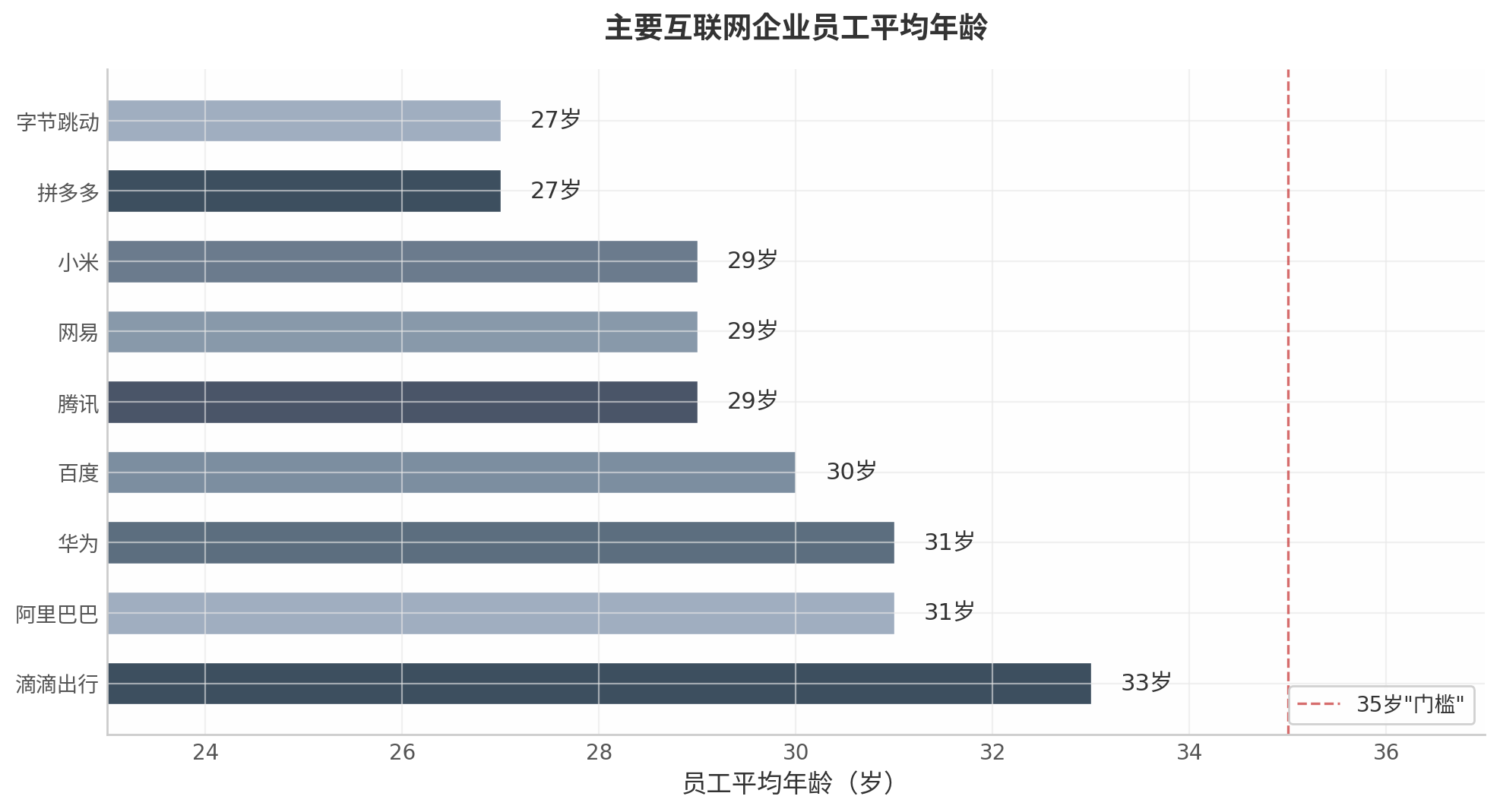
Table 1-1: Detailed comparison of employee age structure in 2025 ESG reports of listed internet companies
| Company | Statistical time | Total employees | Under 30 | 30-50 | Over 50 | Data source |
|---|---|---|---|---|---|---|
| Tencent (group caliber) | End of 2025 | 115,849 | 34,911 (30.1%) | 52,072 (44.9%) | 429 (0.4%) | 2025 ESG Report (Tencent 2025 ESG Report) |
| Tencent (headquarters caliber) | End of 2025 | 87,412 | 34,911 (39.9%) | 52,072 (59.6%) | 429 (0.5%) | 2025 ESG Report (Tencent 2025 ESG Report) |
| Kuaishou | End of 2025 | 24,202 | 14,017 (57.9%) | 10,169 (42.0%) | 16 (0.1%) | 2025 ESG Report (Kuaishou 2025 ESG Report) |
| Baidu | End of 2024 | ~35,900 | ~46.8% | ~46.7% (31-40) | ~7.0% (41+) | 2024 ESG Report (Baidu 2024 ESG Report) |
The table above reveals an alarming fact: in the Tencent group with 116,000 employees, only 429 are over 50 (group caliber), a share of 0.4%; and among Kuaishou’s 24,000 employees, only 16 are over 50, a share of 0.1%. Even at Baidu, where the share of employees over 41 is relatively higher, that group accounts for only 7.0% (including 46.7% in the 31-40 bracket). By contrast, among China’s employed population, those over 50 account for 29.6% (Seventh Census data), giving a glimpse of the degree of age exclusion in the internet industry. Companies such as Alibaba, JD, Xiaomi, Meituan, Pinduoduo, and ByteDance do not disclose a detailed employee age distribution in their annual or ESG reports — this information-disclosure gap itself also reflects the industry’s insufficient attention to the issue of age diversity.
Programmers over 35 make up a very limited share of the industry. The 2025 Programmer Happiness Index Survey Report shows that programmers over 35 account for only 15.4%, with nearly 80% concentrated in the 18-35 age bracket (NetEase Mobile) . CSDN’s tech community estimates further that programmers over 35 make up less than 10% of the industry’s total headcount, and only about 9.4% domestically (CSDN Blog) . Stack Overflow’s global survey shows that overseas, programmers over 35 account for 25.7% of the total, and the proportion is increasing year by year; in Japan, it is very common for engineers in their 40s and 50s to work full-time on the front line (Michael Page) . By contrast, the internet industry in China has markedly low tolerance for older technical staff.
4.1.2 The Big-Tech “Optimization” Wave: Those Over 35 as the Focus of Layoffs
Since 2024, the scale of layoffs at large internet companies has drawn wide attention. Alibaba’s FY2025 annual report shows total employees fell from 194,320 to 128,197, a decrease of 66,123 (mainly due to the sale of Sun Art Retail and Intime Commercial); Baidu’s 2024 ESG-caliber headcount was about 35,900, a reduction of about 10% from the previous year; and Meituan cut 5,831 in 2024 (Tencent News) (Alibaba FY2025 Annual Report) (Baidu 2024 ESG Report). Although Tencent, Pinduoduo, JD and others added staff in the same period, the industry’s overall “optimization” tendency was clear: the average age of laid-off employees was 34.6, and among the retained employees over 35, 83% belonged to three special groups — executives, core technical staff, or values benchmarks (Toutiao) . In one leading e-commerce company’s 2024 layoffs, employees over 35 accounted for as much as 40%, far exceeding their actual share of the workforce (Juejin) .
Table 1: Changes in employee numbers at major internet companies in 2024
| Company | 2024 employee change | Direction |
|---|---|---|
| Alibaba | Reduced by 66,123 (sale of Sun Art Retail and Intime) | Decrease |
| Baidu | Reduced by about 10% (2024 ESG caliber 35,900) | Decrease |
| Meituan | Reduced by 5,831 | Decrease |
| Kuaishou | Reduced by 1,614 | Decrease |
| Bilibili | Reduced by 713 | Decrease |
| Tencent | Increased to 115,849 (group caliber) | Increase |
| Pinduoduo | Increased by 6,062 | Increase |
| JD | Over 900,000 (including delivery staff) | Increase |
| Xiaomi | About 49,021 (R&D nearly 50%) | Flat |
*Data source: Each company’s 2025 annual report/ESG report (Alibaba FY2025 Annual Report) (Baidu 2024 ESG Report) (Tencent 2025 ESG Report) (Tencent News) *
The table above presents the differentiation within the industry. Alibaba’s total employees fell sharply by 66,123 (34%) due to business divestitures, and Baidu’s 2024 ESG-caliber headcount was about 35,900, a reduction of about 10% from the previous year. Tencent’s group-caliber headcount grew to 115,849 by the end of 2025 (including consolidated companies), with 87,412 formal headquarters employees; whereas emerging platforms represented by Pinduoduo are still expanding. Notably, the increase among JD’s over 900,000 employees was mainly in blue-collar posts such as delivery, and among Xiaomi’s about 49,021, R&D staff account for nearly 50% — neither a positive supplement of technical posts. Internal data from one internet company shows that the average layoff rate of employees over 35 is 40% higher than that of the 25-30 group (China Association of Social Security) .
The driving force behind the layoff wave comes mainly from cost considerations. Senior programmers’ salaries are 2.8 times those of junior employees, and recruitment-platform data shows that posts explicitly requiring “under 35” account for 67% (maobucv.com) . In an industry environment with strong technological drive and fast skill turnover, enterprises tend to replace high-salary senior employees with “more cost-effective” young labor (Juejin) .
4.1.3 The Re-Employment Predicament: From High Salary to “Downshifting for Stability”
The re-employment predicament faced by internet practitioners over 35 is especially severe. Synthesizing multiple survey data, the re-employment rate of internet practitioners over 35 is under 40% (WeChat Official Account Platform) . A 38-year-old Java engineer submitted 119 résumés in half a year and received only 3 interview invitations (National College Student Employment Service Platform) . Job seekers over 35 have an average job-search cycle 2-3 times longer than young people, an interview pass rate only one-third that of young people, and most must accept a 20%-30% pay cut (51CTO) .
Facing re-employment difficulty, over 40% of big-tech practitioners over 35 choose to go to small and medium enterprises to “downshift for stability,” 41.5% choose to switch industries after involuntary separation, and 23.5% choose to sit for civil-service or establishment exams (NetEase) . A survey of 50 programmers over 35 shows: 15 were forced to switch industries or start a business, 20 accepted pay cuts to keep looking for work, 10 moved into management posts, and only 5 remained in their original technical posts (51CTO) . Some practitioners turned to food delivery, ride-hailing, courier services and other industries, forming the so-called “middle-aged unemployed man’s iron triathlon” (sina.cn) . Among practitioners who successfully changed jobs after 35, 80% were at the senior level of P8 or above (Sohu) , meaning that once ordinary technical staff leave their original posts, their opportunities for upward mobility are extremely limited.
The institutional factor behind the re-employment predicament lies in systematic exclusion on the recruitment side. Liepin’s 2023 report shows that among technical-post recruitment in the internet industry, posts explicitly requiring “under 35” account for as much as 72% (Economic Observer) . Research by PKU’s National School of Development, based on 41.59 million job postings from January 2022 to April 2024, found that among the age-limited posts enterprises published on 51job, Liepin, and Zhaopin, those explicitly requiring under 35 accounted for 28.06%, 31.64%, and 27.09% respectively (Peking University National School of Development) . This institutional exclusion means that once internet practitioners lose their jobs in middle age, the probability of re-entering a similar post drops sharply.
4.2 The Triple Squeeze on Female Workers
4.2.1 The Intersectional Discrimination of Age, Gender, and Marriage-and-Childbearing
The age discrimination faced by female workers comes earlier and deeper than for men. Big-data research on recruitment platforms shows that women begin to experience marked negative age effects at roughly 29-31, while men only start to feel similar effects at 31-33 (Huxiu) . This 2-to-4-year gap means that women encounter exclusionary signals from the job market during the key upward phase of their careers — usually also the peak childbearing period. A 2025 study based on over 8.8 million job-seeking texts further found that nearly 48% of recruitment ads explicitly exclude certain ages, and age discrimination begins in one’s 30s (Huxiu) .
The cumulative impact of the age-35 threshold on women is especially unfavorable. Age 35 is precisely the key period when women marry, establish careers, and bear children; in order to survive in the fiercely competitive workplace, some women choose not to have children, while some who do face restricted room for career advancement (China Education Online) . In recruitment practice, this multiple discrimination operates covertly: an HR person at a Fortune Global 500 company was instructed during recruitment to “take all the men,” “women under 30, men under 35,” while also asking applicants about their marriage-and-childbearing plans (WeChat Official Account (Financial Knowledge Think Tank)) . A 2023 experimental study by Fudan University, after submitting test résumés to a recruitment platform, found that when a woman’s résumé included “45 years old,” the view rate dropped by 70% (The Paper) .
The “prospective motherhood penalty” further intensifies this predicament. Research published in 2025 in the international academic journal Gender, Work & Organization points out that for women aged 25-35, employers already regard them as a potential cost who will “soon become mothers,” using age and marital status to assess their childbearing risk; women around 30 who are married without children are considered most likely to become pregnant and take maternity leave, and are seen by employers as a “high-risk” group (Sohu) . This discrimination based on future expectations means that even before bearing children, women are disadvantaged in job-seeking and promotion.
4.2.2 The Motherhood Penalty: Reduced Wages and Occupational Downgrading
The negative impact of childbearing on women’s career development has clear quantitative evidence. The China Women’s Career Development Report released in 2023 by McKinsey and YuWa Population shows that bearing one child reduces a woman’s wages by about 7%, and bearing a second child reduces her hourly wage rate by about 16.8%; for each additional child, a woman’s wage rate falls by about 10% (McKinsey Greater China) . Meanwhile, men enjoy a “fatherhood career bonus” — after becoming fathers, their income actually increases (McKinsey Greater China) . At the level of employment participation, having one child reduces a woman’s probability of employment by about 6.6%, and having a second reduces it by a further 9.3% (caixin.com) . Research by Peking University’s Guanghua School of Management found that after childbirth, women need an average of 12 years to recover their pre-birth career trajectory, and over 40% of women in high-skill posts shift to low-prestige occupations after giving birth ( Healthy Sleep·Preferred Choice) .
Marriage-and-childbearing inquiries during job-seeking remain a common phenomenon. Zhaopin’s 2024 China Women’s Workplace Status Survey Report shows that 48.8% of female respondents were asked about their marital and childbearing status in interviews — down from 61.1% in 2023, but the proportion remains high (Faxian Report) . 54% of workplace women said they had experienced gender discrimination, versus only 6.6% of men (Faxian Report) . The Law on the Protection of Women’s Rights and Interests, revised in 2022, has explicitly provided that employers may not ask female applicants about their marital and childbearing status, but lagging enforcement means the effect of this provision has not yet fully emerged (WeChat Official Account (Financial Knowledge Think Tank)) .
The widening of the gender wage gap with age further amplifies the cumulative effect of the motherhood penalty. International academic research based on Chinese data shows that the gender wage gap widens sharply from about 9% for those under 30 to about 28% for those over 50 (EconStor) . Zhaopin data shows that in 2022 women’s average monthly salary was 8,545 yuan, 77.1% of men’s average (caixin.com) . This means that women not only face a double decline in income and employment probability during the childbearing period, but will also bear a widening pay gap throughout their entire careers.
4.2.3 The “Sandwich Generation”: The Gendered Allocation of Unpaid Caregiving
The “Sandwich Generation” refers to the group of workers who simultaneously bear the dual responsibility of raising children and supporting the elderly. Within this group, the pressure borne by women is far greater than by men. McKinsey’s 2023 report points out that the unpaid care work done by Chinese women — including shopping, cooking, cleaning, and caring for children and the elderly — is about twice that of men (McKinsey Greater China) . Zhaopin’s 2024 survey shows that 91.5% of workplace women spend more than 1 hour a day on housework, markedly higher than the 84% of men (Faxian Report) . Academic research based on Chinese population census data further found that among women aged 20-50, the number not engaged in economic activity due to caring for the family is 24 times that of men (Sohu) .
This gendered allocation of unpaid care work directly affects women’s labor participation rate. The labor participation rate of Chinese women aged 15-64 fell from 79.39% in 1990 to 68.57% in 2019, a decline of nearly 11 percentage points (caixin.com) . Among women aged 29-59, 22.3% are not engaged in economic activity, of which 57.1% is attributed to housework (Sohu) . Among “sandwich generation” women, 18.2% gave up career development to care for the family (caixin.com) . Caregiving responsibilities cause women to take frequent leave, find it hard to work overtime, and even be forced to resign, leaving enterprises without stable talent and careers stagnating (Tencent News) . China’s female retirement age — 50 for workers, 55 for cadres — is far below the OECD averages of 64.2 for men and 63.4 for women (WeChat Official Account Platform) . Women retire 5-10 years earlier than men, causing a waste of human resources and economic inequality, and affecting women’s political participation and career development (China Women’s Studies Website) . More severe still, women’s average pension receipt is only 53.59% of men’s (WeChat Official Account Platform) , meaning that early retirement not only reduces women’s labor income but directly lowers their economic security in old age.
4.3 The Silent Crisis of Older Migrant Workers
4.3.1 96 Million Migrant Workers Over 50: A Vast, Overlooked Group
In the public discussion of “age-35 employment discrimination,” attention is highly concentrated on urban white-collar workers, especially internet practitioners, but the group truly most severely affected by age is the roughly 96 million older migrant workers aged 50 and above. According to the National Bureau of Statistics’ 2025 Migrant Worker Monitoring Survey Report, in 2025 the national total of migrant workers reached 301.15 million, of which the share aged 50 and above rose from 27.3% in 2021 to 32.0%, an increase of nearly 5 percentage points in five years (National Bureau of Statistics) . The average age of migrant workers rose from 34 in 2008 to 43.3 in 2025, an increase of more than 9 years (WeChat Official Account (Construction Labor Information)) .
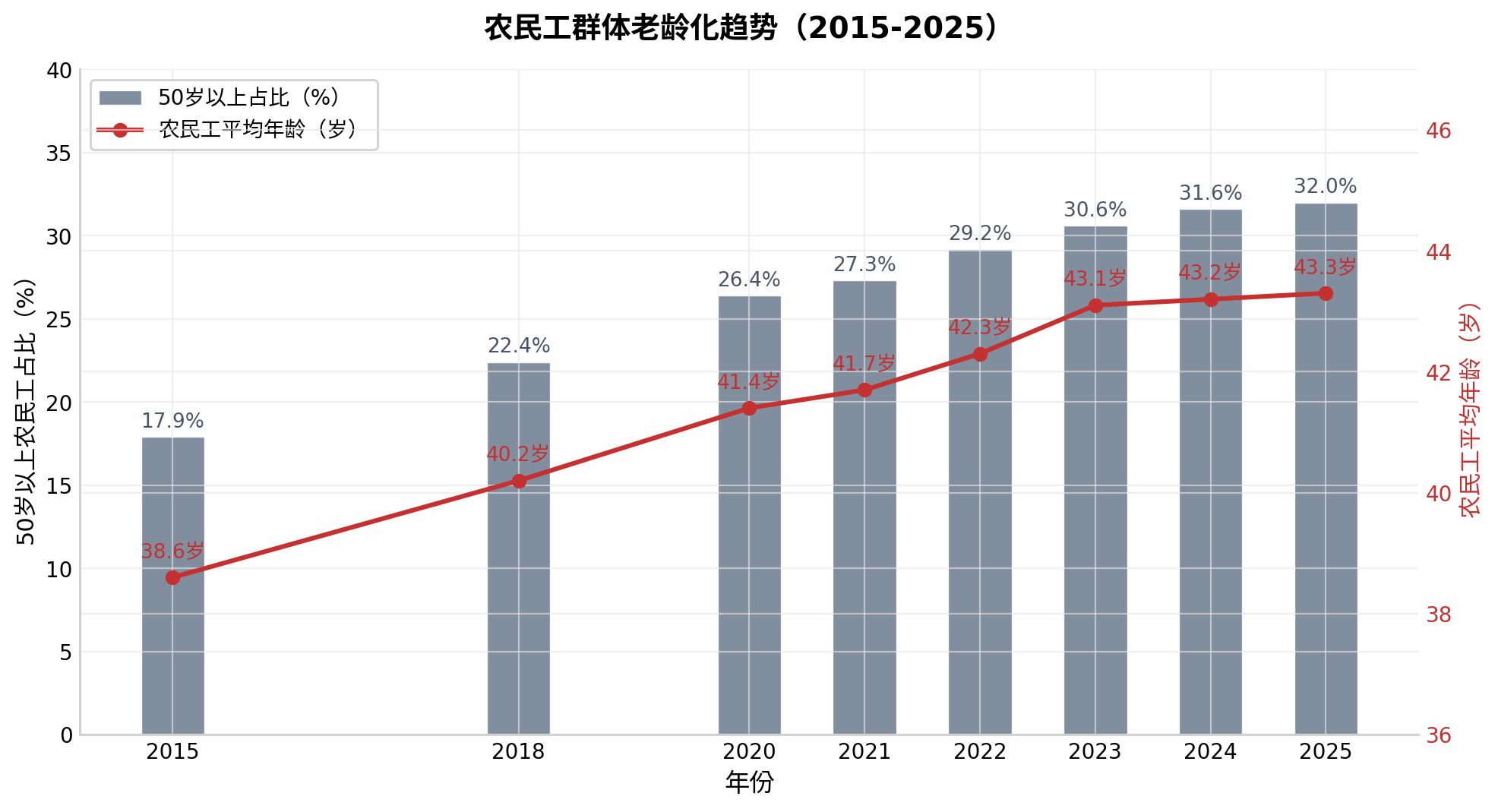
The scale of migrant workers over 50 has reached about 96 million (about 94.71 million in 2024) (WeChat Official Account (Ai Zaodu)) , a considerable share of China’s working-age population. The core predicament of this group is: physical strength declines with age, but there is a lack of channels to transition to non-manual labor skills. Construction is the industry where older migrant workers are most concentrated, but since 2021 the industry has continued to shrink, with migrant workers in construction falling from 55.58 million to 41.56 million in 2025, a cumulative decline of about 14.02 million over four years (cyzone.cn) . At the same time, employment after returning home is even more difficult; a considerable batch of older returned migrant workers employed in county seats earn an average monthly wage of less than 3,000 yuan (Sina Finance) .
4.3.2 “Clearance Orders” and Lack of Protection: The Multiple Overlap of Institutional Exclusion
From 2019, Shanghai, Tianjin and other places issued “clearance orders” targeting over-age migrant workers in construction, prohibiting men over 60 and women over 50 from entering construction sites to perform construction work; by March 2022, the policy had spread to Shenzhen, Taizhou in Jiangsu, Nanchang in Jiangxi, Jingzhou in Hubei, and many other places (Tencent News) . The original intent of the policy was to ensure construction safety, but at the enforcement level it produced a severe employment-exclusion effect. A survey of the labor market at Changli Village in Xi’an shows that older migrant workers over 50 coming to the market to find work make up more than half, and employers recruiting directly call out “no old people, no women” (Sohu) .
In November 2022, the Ministry of Human Resources and Social Security and four other departments jointly issued the Implementation Opinions on Further Supporting Migrant Workers’ Employment and Entrepreneurship, explicitly stating that over-age workers must not be cleared out “across the board” on grounds of age (Construction Training Network) . In December 2025, the Ministry of Housing and Urban-Rural Development issued Order No. 60, the Provisions on the Management of Special Operations Personnel in Building Construction, to be uniformly implemented nationwide from June 1, 2026; the core change is no longer restricting “across the board” by age, but instead “looking at health, qualifications, and standards” — men aged 60 to 65 and women aged 55 to 60, as long as they provide a qualified annual physical-examination certificate and their physical indicators meet the post’s requirements, may legally and compliantly enter the site to work (ifeng.com) . The shift from “looking at age” to “looking at health” marks an important adjustment in policy logic, but men over 65 and women over 60 are still strictly restricted.
Insufficient social-security coverage is another institutional predicament faced by older migrant workers. 2016 data shows that the proportion of migrant workers participating in urban-employee pension insurance was only 21.1%, work-injury insurance 26.7%, and medical insurance 17.1% [(sprp-cn.eu)](http://sprp-cn.eu/Memorabilia/C1/Gender/GenderGD CN.pdf) . Most migrant workers participate in urban-rural resident pension insurance, which averaged only 223 yuan a month in 2023, a 16-fold gap from the 3,743-yuan monthly average of urban-employee pension insurance (Tencent News) . Migrant workers over 60 generally face the predicament of being refused by employers, and because they exceed the statutory retirement age they cannot sign a formal labor contract, only a labor-service agreement, making it hard to defend their rights (NetEase) .
4.3.3 The Return-Home Predicament: “Can’t Keep Going in the City, No Work to Do Back Home”
More than 70% of elderly migrant workers ultimately choose to return home, but their livelihoods after returning are not optimistic (Tencent News) . Their core contradiction can be summed up as “can’t keep going in the city, no work to do back home”: in the city, declining physical strength makes it hard to continue high-intensity construction, manufacturing and other work; after returning home, the rural industrial structure issingle/monotonous, non-agricultural employment opportunities are limited, and county-seat posts such as waiters and security guards tend to recruit young people (NetEase) .
Research shows that older returned migrant workers face “four layers of livelihood pressure”: heavy family financial burdens (children’s marriage, supporting the elderly, etc.), limited non-agricultural employment opportunities after returning home, high work intensity and poor conditions, and relatively low wage levels (Sina Finance) . Their livelihood model shows two prominent features: first, “concurrent employment,” mostly engaged in low-tech, low-threshold light manual work; second, unstable income — some farm while doing odd jobs, and some run small stalls or peddling (Sina Finance) .
At the policy level, positive signals have begun to appear. From 2023 to 2026, the Central No. 1 Document has focused on the issue of older migrant workers for four consecutive years, with the policy wording gradually upgrading from “safeguarding the employment rights of over-age migrant workers” in 2023, to “doing a good job of employment support for older migrant workers” in 2024, “strengthening employment support for older migrant workers” in 2025 (written in for the first time), and “strengthening care and assistance for older migrant workers” in 2026 (Huxiu) . In July 2025, the Ministry of Human Resources and Social Security released the Interim Provisions on the Protection of the Basic Rights and Interests of Over-Age Workers (Draft for Public Comment), systematically responding for the first time at the national level to the issue of protecting the rights of over-age workers (dzng.com) . The State Council’s 2025 Policy Opinions on Improving the Institutional Mechanisms for Integrated Urban-Rural Development further explicitly proposed eliminating all kinds of unreasonable restrictions or employment discrimination affecting equal employment based on hukou, status, age, and so on (ifeng.com) .
Table 2: Comparison of the employment predicaments of the three key groups
| Dimension | Internet practitioners | Female workers | Older migrant workers |
|---|---|---|---|
| Core predicament | Fast technological iteration, “youth dividend” culture, cost optimization | Triple intersectional discrimination of age + gender + marriage-and-childbearing | Declining physical strength, single skills, institutional exclusion |
| Age at which negative effects begin | Around 35 | 29-31 (2-4 years earlier than men) | Around 50 (construction 60/50) |
| Scale estimate | Programmers over 35 account for 9.4%-15.4% (CSDN Blog) | Female labor participation rate aged 15-64 is 68.57% (caixin.com) | About 96 million over 50, 32% of migrant workers (WeChat Official Account (Ai Zaodu)) |
| Re-employment/retention rate | Re-employment rate under 40% (WeChat Official Account Platform) | Need 12 years to recover career trajectory after childbirth ( Healthy Sleep·Preferred Choice) | Average monthly wage under 3,000 yuan after returning home (Sina Finance) |
| Main institutional barriers | 72% of technical posts in recruitment require “under 35” (Economic Observer) | 61.2% asked about marriage-and-childbearing in job-seeking (2023) (myzaker.com) | “Clearance orders” in many places restrict over-age personnel (Tencent News) |
| Wage impact | Re-employment usually means a 20%-30% pay cut (51CTO) | Bearing one child reduces wages by about 7%, a second by 16.8% (McKinsey Greater China) | 2025 average monthly income growth only 2.3%, a ten-year low (Huxiu) |
| Social security | Relatively better (housing fund, social insurance more standardized) | Pension is only 53.59% of men’s (WeChat Official Account Platform) | Pension-insurance participation rate only 21.1% [(sprp-cn.eu)](http://sprp-cn.eu/Memorabilia/C1/Gender/GenderGD CN.pdf) |
| Policy response | In 2025 some companies launched the “35+ Program” (36Kr) | The 2022 revision of the Law on the Protection of Women’s Rights and Interests prohibits asking about marriage-and-childbearing (WeChat Official Account (Financial Knowledge Think Tank)) | MOHURD Order No. 60 in 2025 abolished the “across-the-board” approach (ifeng.com) |
The table above systematically compares the employment predicaments of the three key groups. The predicament of internet practitioners draws the most public attention, but their level of social security is relatively better, and some enterprises have begun to adopt inclusive measures. The predicament of female workers has a temporalfront-loaded quality — negative effects begin to appear from around 30 and intensify sharply during the childbearing stage, accompanied by the continual squeeze of unpaid care work, which severely compresses women’s “employment window.” The predicament of older migrant workers is the deepest and most lasting: they are the “silent majority” of China’s labor market, lacking a voice in the digital age, and facing the multiple blows of physical decline, difficulty in skill transition, insufficient social-security coverage, and institutional exclusion. The commonality of the three groups is that age discrimination is the core barrier in each, but the way discrimination overlaps with other structural factors (technological iteration, gender division of labor, the urban-rural dual system) differs in each case, requiring differentiated policy responses. From the trend of population-structure change, as the total labor force continues to decline and the average age keeps climbing, continuing to exclude these groups not only harms individual well-being but will also aggravate the mismatch and waste of overall human resources.
5. Flexible Employment: A New Way Out or a New Trap
5.1 The Scale and Structure of Flexible Employment
5.1.1 From “Supplementary Option” to “Employment Reservoir”
In recent years, the status of flexible employment in China’s labor market has undergone a fundamental transformation. As of the end of 2021, the national scale of flexibly employed personnel was about 200 million, accounting for 26.5% of total employment (Sina Finance) . This figure climbed further to about 240 million in 2024, of which workers in new forms of employment relying on internet platforms reached 84 million, accounting for about 21% of total employees (dfcfw.com) . In terms of the share of job postings, the market share of new-type flexible employment grew from 8.4% in 2019 to 15.2% in 2024, an increase of nearly double, covering seven major categories: ride-hailing, delivery, life services, knowledge services, and live-commerce.
The rapid expansion of flexible employment has profound economic and social background. On the one hand, the labor demand of traditional industries (especially manufacturing and construction) has contracted, releasing large numbers of older workers; on the other hand, the booming platform economy has created low-threshold, immediately monetizable employment opportunities. Against the backdrop of macroeconomic fluctuations, flexible employment has objectively played the function of an “employment buffer.” However, this “reservoir’s” capacity to absorb workers of different age groups differs significantly — it provides more transitional space for young workers rather than truly solving the employment predicament of the older group.
5.1.2 The Age-Structure Paradox: Not a “Safety Valve” for Older Workers
Flexible employment is often seen by public opinion as a “safe harbor” for older workers, but the data reveals a very different reality. The survey in the China Flexible Staffing Development Report (2022) shows that among flexibly employed personnel, those under 30 account for as much as 48.3%, those aged 31-40 for 29.0%, those aged 41-50 for about 18.0%, while those over 50 account for less than 5% (Sina Finance) . This age distribution presents a pattern exactly opposite to common perception: the core beneficiary group of flexible employment is young people, not older workers.
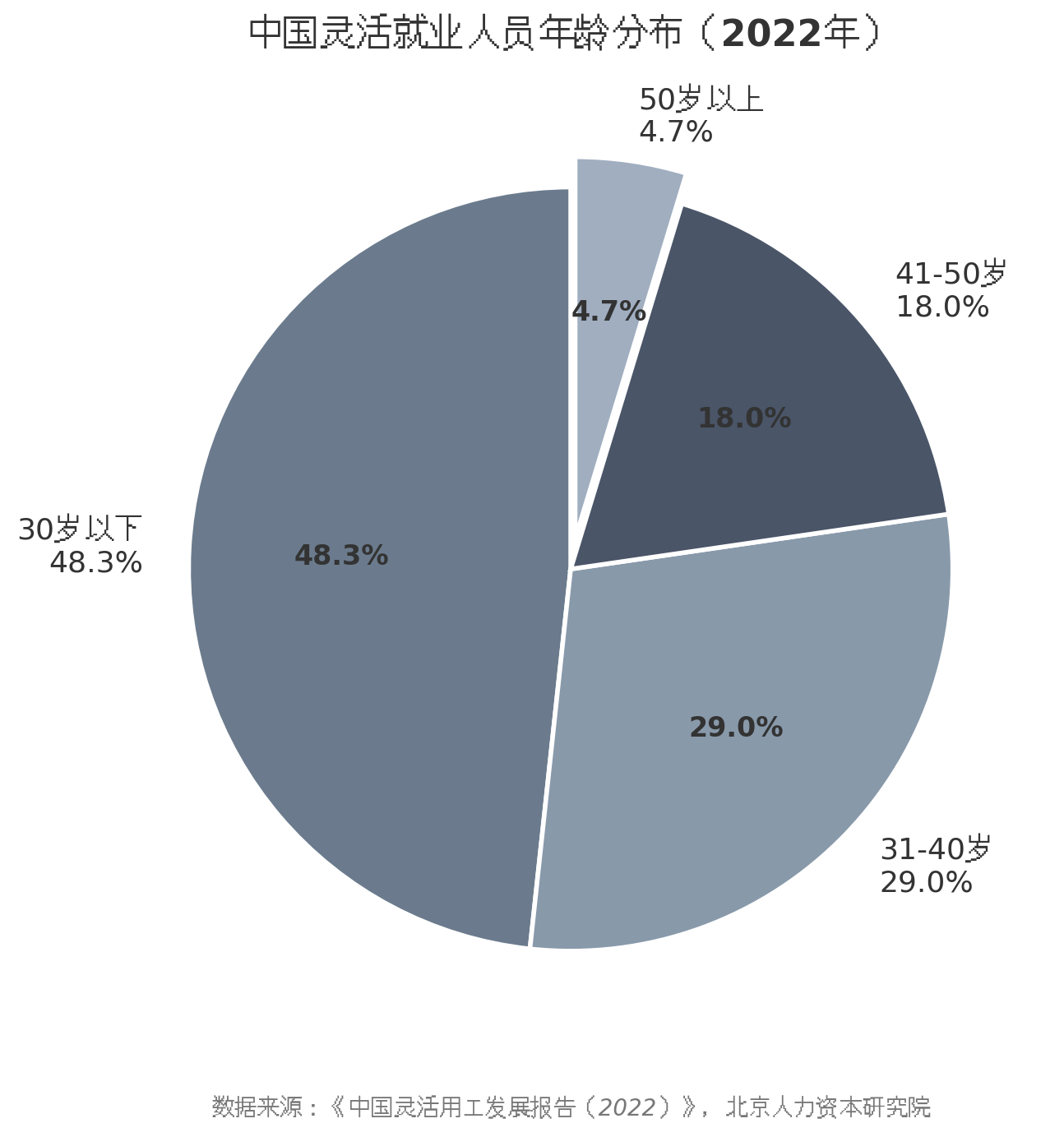
Even more noteworthy, in platform-based new forms of employment, the age bias is more pronounced. Among practitioners in new forms of employment, those aged 35 and below account for 88.6%, of which the 26-35 group accounts for as much as 58.1% (Sina Finance) . This means that the new-type flexible employment represented by ride-hailing, food delivery, and live-commerce is essentially an employment form designed for young workers with a certain level of digital literacy. The extremely low share of those over 50 is not due to a lack of willingness to work, but to the cumulative exclusion of multiple screening mechanisms — digital-skill thresholds, platform-algorithm preferences, and physical requirements.
In terms of regional differences, in Shanghai the share of flexibly employed personnel over 40 exceeds 40%, significantly higher than the national average, closely related to the city’s characteristics of being the earliest to enter deep aging and having strong demand for domestic and eldercare services. But this regional particularity does not change the overall national pattern — the function of flexible employment as a “safety valve” for older workers has actually been overestimated.
5.2 Older Practitioners in the Platform Economy
5.2.1 Ride-Hailing and Food-Delivery Riders: Two Very Different Age Curves
There is marked age stratification within the platform economy. Ride-hailing is the track with the highest participation of older practitioners; the average age of drivers is about 39-40, with the 36-50 group as the mainstay, accounting for 63.1% (Journal of Wuhan University (Humanities and Social Sciences)) . The “middle-aging” characteristic of this field is closely related to its employment attributes: the driving-skill threshold is relatively low, working hours areself-controlled/autonomous, income can be monetized immediately, and over 60% of drivers have a highest education of high school or below, with 90% having worked in manufacturing, construction, or self-employment (Journal of Wuhan University (Humanities and Social Sciences)) . The ride-hailing industry has essentially absorbed large numbers of middle-aged male labor spilling over from traditional manufacturing and construction, becoming the only field in the platform economy with the function of an “older-employment reservoir.”
In sharp contrast is the extreme youth of the food-delivery rider group. Research by Jinan University based on 41,000 samples shows that the average age of food-delivery riders is 32.97, 95.56% are male, the 21-40 age bracket accounts for nearly 80%, and riders over 50 account for only 2.6%. The high demands of food delivery on physical fitness, reaction speed, and route-planning ability make platform algorithms naturally favor young riders in the order-dispatch mechanism. Although middle-aged riders aged 31-40 are seen at some stations as the “mainstay” — because they have heavier family responsibilities and more stable work — this age advantage decays rapidly after 45: the detection rate of physiological health problems among riders aged 46-60 reaches 50%, far higher than the young group.
| Dimension | Ride-hailing drivers | Food-delivery riders | Domestic/eldercare practitioners | Platform live-streaming/e-commerce |
|---|---|---|---|---|
| Main age bracket | 36-50 (63.1%) | 21-40 (77.4%) | 40-55 | 18-35 |
| Share over 50 | About 5%-8% | 2.6% | About 30%-40% | <3% |
| Average monthly income | 7,623 yuan | 7,496 yuan | 4,000-8,000 yuan | Extremely variable |
| Average daily hours | 10-12 hours | 10.8 hours | 8-10 hours | Not fixed |
| Gender structure | Mostly male | 95.56% male | Mostly female | Relatively balanced |
| Education threshold | Low (60% high school or below) | Relatively low | Relatively low | Medium |
| Core threshold | Driving skill | Physical fitness/speed | Patience/experience | Digital literacy |
| Social-insurance coverage | Extremely low | Extremely low | Extremely low | Extremely low |
Data source: China Research Center for New Forms of Employment, School of Sociology of Jinan University, Beijing Human Capital Research Institute, Shanghai Minhang District Gig Market
The table above presents the differences in age and labor characteristics across four main forms of flexible employment. Ride-hailing and domestic/eldercare are the two main channels absorbing older workers, but each has obvious limitations: the ride-hailing industry has already shown capacity saturation, with many places averaging only 10-20 orders per car per day and hourly wages approaching the local minimum-wage standard; the domestic/eldercare industry, though it has a supply gap of about 20 million, is constrained in attractiveness by unstable income, lack of social security, and low occupational prestige. New forms such as food-delivery riders and live-commerce offer almost no room for the participation of older workers.
5.2.2 Income Levels and Hidden Costs
In terms of nominal income, the pay of platform practitioners is relatively high among blue-collar occupations. 2025 data shows that ride-hailing drivers’ average monthly income was 7,623 yuan, second among six categories of blue-collar occupations; food-delivery riders’ average monthly income was 7,496 yuan, up 10.02% year on year, and among full-time riders in first-tier cities 65% earn more than 6,000 yuan a month. But there is a significant gap between nominal and actual income. Taking Shanghai food-delivery riders as an example, the median monthly income is 7,500 yuan, but after deducting fuel, vehicle depreciation, platform fines and other costs, the actual net income is only about 5,000 yuan.
The deeper hidden cost lies in the healthdepletion/wear brought by extremely long hours. Ride-hailing drivers in Fuzhou work about 10-12 hours a day on average, resting 4 days a month; food-delivery riders work an average of 26 days a month, online 10.8 hours a day. This model of trading time for income is especially unfavorable to older workers with declining physical strength. As age increases, the same work intensity means higher health risk, yet the piece-rate pay model of the platform economy provides no compensation mechanism for this age-related “physiological depreciation.”
5.3 The Structural Absence of Rights Protection
5.3.1 Social Insurance “Streaking”: The Protection Vacuum of 160 Million People
The most severe structural predicament faced by flexibly employed workers is the serious inadequacy of social-security coverage. As of the end of 2024, the number of flexibly employed personnel participating in basic employee pension insurance was 70.57 million, a participation rate of under 40% (dfcfw.com) . The employee pension-insurance participation rate is only 29.5%, and the employee medical-insurance participation rate only 27.6%; by this estimate, over 160 million flexibly employed personnel are in a state of “social-insurance streaking” (dfcfw.com) .
The root of the low participation rate lies in the deep contradiction between institutional design and the characteristics of flexible employment. First, flexibly employed personnel must bear in full the social-insurance contributions that should be shared between employer and individual; calculated on the minimum base, this requires paying over 1,000 yuan a month, about one-fifth of their income, a heavy financial burden. Second, under the current system, only about 40% of the social-insurance fees paid by flexibly employed workers enter the personal account, while 60% goes into the pooling account; this account-allocation mechanism further suppresses the willingness to participate. Third, hukou restrictions still constitute an important obstacle — flexibly employed personnel without local hukou cannot participate in employee social insurance in some cities, although from 2026 some cities (such as Hangzhou) have begun to allow non-hukou holders with residence permits to participate.
The survey of workers in new forms of employment is even more shocking: on average, each new-form practitioner participates in only 1.46 types of social insurance; over 60% of instant-delivery riders do not participate in basic pension insurance, more than 38% do not participate in basic medical insurance, and the overall participation share for work-injury insurance is as low as 22%. The ambiguity of labor-relations recognition under the platform employment model means workers are systematically excluded from the current social-insurance system.
5.3.2 Occupational-Injury Protection: Limited Progress and a Huge Gap
Against the backdrop of the traditional social-insurance system’s difficulty in covering the flexibly employed group, the occupational-injury protection pilot has become an important breakthrough in institutional innovation. From July 2022, the Ministry of Human Resources and Social Security launched a pilot for occupational-injury protection for workers in new forms of employment in 7 provinces, covering four major industries: mobility, food delivery, instant delivery, and intra-city freight. As of the end of 2025, the pilot had expanded to 17 provinces and 11 platform enterprises, with cumulative participants exceeding 25 million.
The significance of this pilot system is that it first broke the rigid binding of “labor relations–social insurance,” providing work-injury insurance benefits to platform practitioners without confirming a complete labor relationship. Guangdong performed prominently in the pilot, covering 7 platform enterprises including Meituan, Ele.me, Caocao Mobility, and Lalamove, with the number of participants, the number protected, and premium income all ranking first among the pilot provinces and cities.
However, the pilot’s coverage of 25 million is less than 30% relative to the total scale of 84 million new-form workers. Even more noteworthy is the spontaneous action of platform enterprises: in March 2025, JD took the lead in paying the “five insurances and one fund” for full-time riders and bearing the full cost (about 2,000 yuan per person per month), covering over 150,000 full-time riders as of August 2025; in the same year, Meituan rolled out a rider pension-insurance subsidy plan, subsidizing 50% of pension-insurance fees for eligible riders, covering over a million riders nationwide. Although these measures are symbolically meaningful, they are still a drop in the bucket relative to the vast flexibly employed group.
For older flexibly employed workers over 45, the risk of lacking rights protection is especially prominent. On the one hand, aging significantly increases the probability of occupational injury (such as traffic accidents and musculoskeletal injuries); on the other hand, this group is closer to the statutory retirement age, and a break in social-insurance contributions means their post-retirement pension benefits will be greatly reduced. Without the double protection of work-injury and medical insurance, a single accidental injury or major illness is enough to plunge older flexibly employed workers and their families into poverty. In 2024, national courts concluded over 80,000 first-instance civil cases involving new forms of employment, spanning social-insurance disputes, traffic-accident liability, and many other aspects, reflecting the rapidly accumulating social cost brought by the absence of institutional protection.
6. The Impact of AI Technology and the Triple Divide
6.1 The Overlap of the Skills Gap, Digital Divide, and Intelligence Divide
The rapid iteration of artificial-intelligence technology is reshaping the skill-demand structure of China’s labor market. Cai Fang, an academician of the Chinese Academy of Social Sciences, points out that compared with the young group, the employment predicament of older workers shows the characteristic of “multiple overlapping divides” — this group generally faces structural constraints such as lower average years of education and weak digital skills, and was already hard-pressed to keep pace with industrial-structure adjustment and technological progress; the popularization of AI technology has added a new “intelligence divide” (WeChat Official Account Platform) . The overlap of these three divides is not a simple linear addition but forms a vicious cycle through a self-reinforcing mechanism, pushing older workers to the margins of the job market.
6.1.1 The Generational Fault Line in Digital Skills
Digital skills are a basic capability for workers to participate in the modern economy, and older workers have a significant generational gap in this dimension. The China Labor Market Development Report released in 2024 by the Institute of Population and Labor Economics of the Chinese Academy of Social Sciences shows that among workers over 50, only 26.3% master basic office-software operations, and the proportion able to proficiently use mobile-internet applications is 41.5%, far below the young group (WeChat Official Account Platform) . The Survey Report on the Development Level of Digital Literacy and Skills of All People, released in the same period by the Cyberspace Administration of China, based on 2.72 million valid samples covering 31 provinces (regions, municipalities) nationwide, further reveals the systematic law of digital literacy decreasing with age (Sohu) .
Table 1 Comparison of digital-literacy levels by age group
| Age group | Share withprimary and above digital literacy | Share with advanced digital literacy | Basic office-software mastery rate | Mobile-internet proficiency rate |
|---|---|---|---|---|
| 18-29 | 75.76% | 28.69% | ~75% | ~85% |
| 30-39 | 69.90% | 19.67% | ~65% | ~75% |
| 40-49 | 61.70% | 13.83% | ~45% | ~60% |
| 50-59 | 53.16% | 10.12% | 26.3% | 41.5% |
| 60-69 | 36.22% | 7.34% | ~15% | ~25% |
Data source: Cyberspace Administration of China, Survey Report on the Development Level of Digital Literacy and Skills of All People (2024) (Sohu) ; Institute of Population and Labor Economics, Chinese Academy of Social Sciences, China Labor Market Development Report 2024 (WeChat Official Account Platform) . The office-software and mobile-internet proficiency rates are estimates synthesized from multiple surveys.
The data in the table above reveals two key pieces of information. First, digital literacy shows a clear negative correlation with age: the level ofprimary and above digital literacy falls from 75.76% in the 18-29 age group to 36.22% in the 60-69 group, a gap of 39.5 percentage points; the decline in advanced digital literacy is even more dramatic, from 28.69% to 7.34%, a gap of more than 21 percentage points. Second, 50 is a key turning point — after crossing this age threshold, both the basic office-software mastery rate and the mobile-internet proficiency rate fall off a cliff, with the basic office-software mastery rate plunging from about 45% to 26.3%. This means that more than 70% of workers over 50 lack the basic digital capabilities required by the modern office environment. The root of this generational difference is that older workers (especially those born in the 1960s and 1970s) did not undergo systematic information-technology training during their education, and the demand for digital skills in their adult work scenarios was long at a low level; when digital transformation suddenly accelerated, a hard-to-bridge gap formed between their skill reserves and market demand.
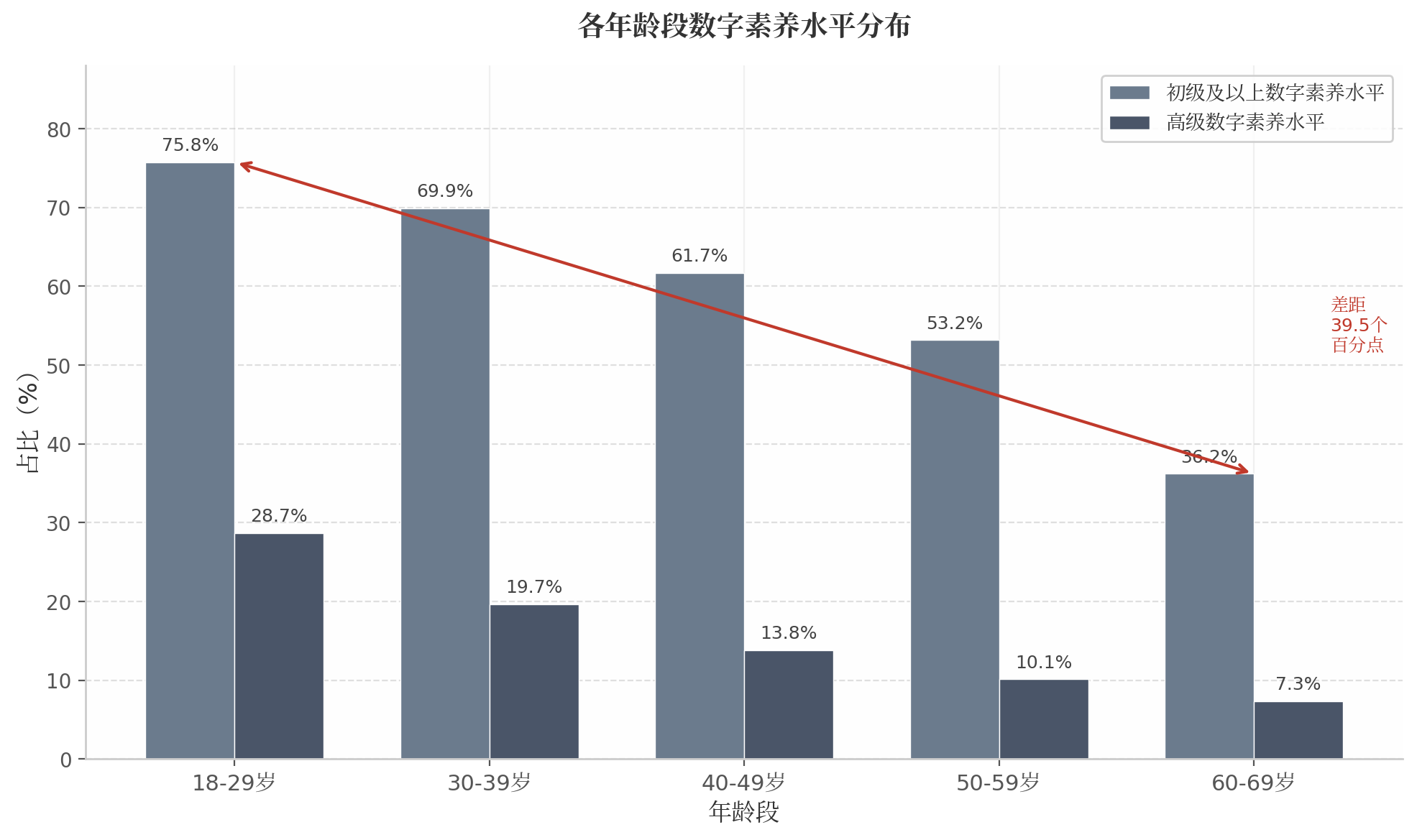
6.1.2 The Scale and Distribution of AI Substitution Risk
The lack of digital skills makes older workers especially vulnerable in the face of AI substitution. The research team of Professor Zhao Zhong at Renmin University of China, using the method of Frey and Osborne (2017), estimated that the potential proportion of China’s urban labor market that could be substituted by AI is as high as 45%, with a potential number substituted of about 165 million (Huxiu) . The McKinsey Global Institute’s forecast is even more aggressive, holding that 51% of work content in China has automation potential, that about 220 million jobs may be reshaped by technologies such as generative AI, and that white-collar work is hit harder than blue-collar work (Zhihu) .
On the industry distribution of substitution risk, estimates differ across studies. Chen Yongwei and Xu Duo (2018), estimating by industry, held that mining, manufacturing, and construction have higher substitution risk (Huxiu) ; Wang Linhui et al. (2022), based on the task attributes of occupations, put the share of employment facing high substitution risk in China at 19.05% (Huxiu) . Although the specific figures vary by methodology, the research consensus points in the same direction: relatively vulnerable groups in the labor market such as women, low-education workers, and older workers are hit harder (Sohu) . The older the age and the shorter the years of education, the higher the risk of a worker’s job being substituted by AI; the employment-substitution effect of AI technology has a clear “selective” character (Huxiu) .
More direct evidence comes from micro-level studies at the enterprise level. An empirical analysis based on Zhongguancun enterprises shows that an improvement in AI technology level significantly increases the share of enterprise employees aged 30-39 and significantly reduces the share of those aged 40-49 and 50 and above — that is, AI has the effect of promoting the “rejuvenation” of employment (CNR) . This finding means that the introduction of AI technology not only reduces older workers’ jobs through the substitution effect, but also changes enterprises’ age-structure preferences through the composition effect, further weakening older workers’ competitive position in the labor market.
6.1.3 The Self-Reinforcing Mechanism of the Triple Divide
The skills gap, digital divide, and intelligence divide do not exist independently but form a self-reinforcing closed loop through feedback cycles. This mechanism can be summarized as: older workers face a skills gap due to lower years of education and insufficient technological content in their early work experience; the skills gap makes it hard for them to operate digital tools and platforms, forming a digital divide; the digital divide in turn limits their opportunities to access and learn AI tools, causing the intelligence divide to deepen further (WeChat Official Account Platform) .
This cycle is especially evident at the market level. Insufficient skills confine older workers to low-tech post areas, with correspondingly low income; the low-income state leaves them unable to invest time and money in skills training; the lack of training in turn causes skills to fall further behind, narrowing the range of posts they can choose from even more. Zhaopin’s 2024 report shows that 62.3% of publicly advertised jobs set an upper age limit, of which the “under 35” restriction accounts for 36.8% and the “under 40” restriction for 18.7% (Huxiu) . When older workers are forced by age thresholds to leave high-quality posts and enter low-skill, low-income employment tracks, each layer of the triple divide keeps deepening. This mechanism means that once unemployed at a certain age node, re-employment quality will keep declining, and it is hard to reverse on its own without external intervention.
6.2 The Age Bias in Enterprise Training Investment
6.2.1 The Systematic Tilt of Training Resources
On-the-job enterprise training is the main channel for workers to update their skills, but this channel is not smooth for older workers. Enterprise training resources generally tilt toward young employees, and older employees are systematically excluded from skill-improvement plans. The formation of this bias has a dual logic: on the one hand, employers’ active screening based on stereotypes, believing older employees “learn poorly” and are “weak at mastering new technology,” with a lower return on investment than young employees (Shanghai University of Finance and Economics Journal) ; on the other hand, older employees’ declining self-efficacy from long being in low-skill posts, with a correspondingly lower willingness to participate in training.
Enterprise case data reveals the actual impact of this bias. A survey of an auto-parts enterprise shows that the retraining cost of old technicians in digital transformation is 30% higher than that of young employees, with an adaptation cycle of as long as 6 to 8 months (WeChat Official Account Platform) . In the service sector, data from a chain retail enterprise shows that the performance-compliance rate of employees over 55 in new formats such as live-commerce is only one-third that of young employees (WeChat Official Account Platform) . These figures are used by enterprise management as a basis for reducing training investment in older employees, yet they overlook a key fact: the difference in training cost is itself the result of insufficient training investment — if enterprises had provided continuous digital-skills training to older employees at an early stage, the later adaptation cost would be greatly reduced.
At the macro level, the age exclusion of the training system is universal. Research by the Chinese Academy of Labor and Social Security Sciences points out that current public training programs have age limits, and the development and supply of training programs for older labor is clearly insufficient (Sohu) . In 2024, the share of national employed personnel withprimary and above digital literacy was 67.85%, but this average level masks severe differentiation between groups (Sohu) . When both enterprise training and public training close their doors to older workers, the self-reinforcing mechanism of the triple divide gains an institutional boost.
6.2.2 The Backlash of Age Discrimination on Enterprise Efficiency
Enterprises’ strategy of excluding older employees achieves the goal of “cost reduction” on the surface, but empirical research shows this practice actually harms the enterprises’ own production efficiency. An empirical study based on tens of millions of job descriptions on China’s major online recruitment platforms in 2021 found that for every 1% increase in the degree of age discrimination, labor productivity falls on average by 0.082%, and total factor productivity (TFP) falls by 0.114% to 0.119% (Shanghai University of Finance and Economics Journal) . The economic implication of this finding is very clear: enterprises reduce short-term salary expenditure by hiring fewer older workers, but at the same time lose the efficiency gains brought by the accumulation of experience capital, ending up with a net loss.
Analysis of the mechanism reveals the root of this paradox. Age discrimination significantly reduces enterprises’ reliance on experience capital and the intensity of human-capital cultivation (Shanghai University of Finance and Economics Journal) . In the age range of 30 to 40, enterprises first simultaneously show declining productivity and reduced human capital, and this range is precisely the stage where age-35 discrimination is frequent. Specifically, when an enterprise sets an age threshold of “40 relative to 30,” the ratio of the marginal loss of productivity to the marginal saving of cost jumps to 0.74 (Shanghai University of Finance and Economics Journal) , meaning that for every 1 yuan of labor cost saved, the enterprise must pay 0.74 yuan in productivity loss. Technology-intensive enterprises are hit especially hard: for every 1% rise in their age-discrimination ratio, total factor productivity falls by 0.146% and salary level by 0.16% (Shanghai University of Finance and Economics Journal) .
The deeper negative impact lies in the formation of a vicious cycle. Age discrimination weakens enterprises’ innovation and learning capacity — older workers have more work experience, can find more efficient work and organizational models, and form a complementary advantage with the new knowledge mastered by young labor (Zhihu Column) . When enterprises systematically exclude older employees, this cross-generational knowledge-complementarity mechanism is destroyed, and enterprises fall into a downward spiral of “low human capital — low efficiency — even lower human-capital investment” (Shanghai University of Finance and Economics Journal) . Against the backdrop of accelerating AI iteration and increasingly complex human-machine collaboration models, this lack of knowledge complementarity will put enterprises at a disadvantage in long-term competition.
From the overall perspective of the labor market, the age bias in enterprise training and the risk of AI substitution form an overlapping effect: older workers face both the external threat of being substituted by technology and the lack of an internal channel to acquire new skills through training, and their employment space keeps narrowing under the double squeeze. Breaking this dilemma requires advancing the construction of a full-life-cycle vocational-training system at the public-policy level, while establishing at the enterprise level a training-resource allocation mechanism centered on capability rather than age.
7. The Institutional Contradiction Between Delayed Retirement and Older-Worker Employment
7.1 The Progressive Delayed-Retirement Plan
7.1.1 Policy Framework and the 15-Year Transition Period
On September 13, 2024, the Standing Committee of the National People’s Congress deliberated and passed the Decision on Implementing the Progressive Delay of the Statutory Retirement Age, to be formally implemented from January 1, 2025, gradually adjusting the retirement age over 15 years (China.com.cn) . This is the first major adjustment to China’s retirement-age system in over 70 years. The specific plan adopts the principle of “small-step adjustment, classified advancement”: the statutory retirement age for male employees is delayed from the original 60 to 63; for female employees whose original statutory retirement age was 55, it is delayed to 58; and for female employees whose original statutory retirement age was 50, it is delayed to 55 (China.com.cn) . In terms of pacing, male employees and female employees originally retiring at 55 are delayed by 1 month every 4 months, and female employees originally retiring at 50 by 1 month every 2 months, ensuring that the actual annual delay is kept between 2 and 4 months, giving workers a sufficient adaptation period.
Advanced alongside delayed retirement is the adjustment of the minimum pension contribution period. From January 1, 2030, the minimum pension contribution period will be gradually raised from 15 years to 20 years, increasing by 6 months each year, with a 5-year buffer period set for 2025 to 2029 (China.com.cn) . By estimate, increasing the contribution period from 15 to 20 years can raise the monthly pension received after retirement by roughly 30%, forming an incentive mechanism of “pay more, get more; pay longer, get more.”
7.1.2 The Flexible Retirement System
The Interim Measures for Implementing the Flexible Retirement System, effective from January 1, 2025, gives employees a flexible choice space of up to 3 years before and after the statutory retirement age (China.com.cn) . After reaching the minimum contribution period, employees may voluntarily choose flexible early retirement, with the advance not exceeding 3 years at most, but the retirement age may not be lower than the original statutory retirement age (50 or 55 for female employees, and 60 for male employees). Flexible delayed retirement requires negotiation and agreement between the employee and the employer, and civil servants and leaders of state-owned enterprises and public institutions are not allowed flexible delayed retirement (China.com.cn) . Notably, the flexible retirement system will continue after the end of the 15-year reform cycle, becoming a long-term institutional arrangement. This design to a certain extent eases older workers’ retirement anxiety, but its premise is that workers still hold a job when they reach the statutory retirement age — which is precisely the foundation currently directly threatened by age-35 employment discrimination.
7.2 The Structural Conflict Between Age-35 Discrimination and Delayed Retirement
7.2.1 Institutional Self-Contradiction: The 28-Year “Employment Vacuum”
China’s labor market faces a profound institutional self-contradiction: on the one hand, 62.3% of publicly advertised jobs set an upper age limit, of which the “under 35” restriction accounts for 36.8% (Sina Finance) , with large numbers of employers excluding job seekers over 35 explicitly or implicitly; on the other hand, the delayed-retirement policy requires workers to work until 63 (men) or 55 to 58 (women). Stacked together, a worker unemployed at 35 who cannot re-enter the formal job market will face an “institutional employment gap” of as long as 28 years — excluded by the job market yet unable to draw a pension, with a lack of systematic employment security and income support in between (see Figure 3).
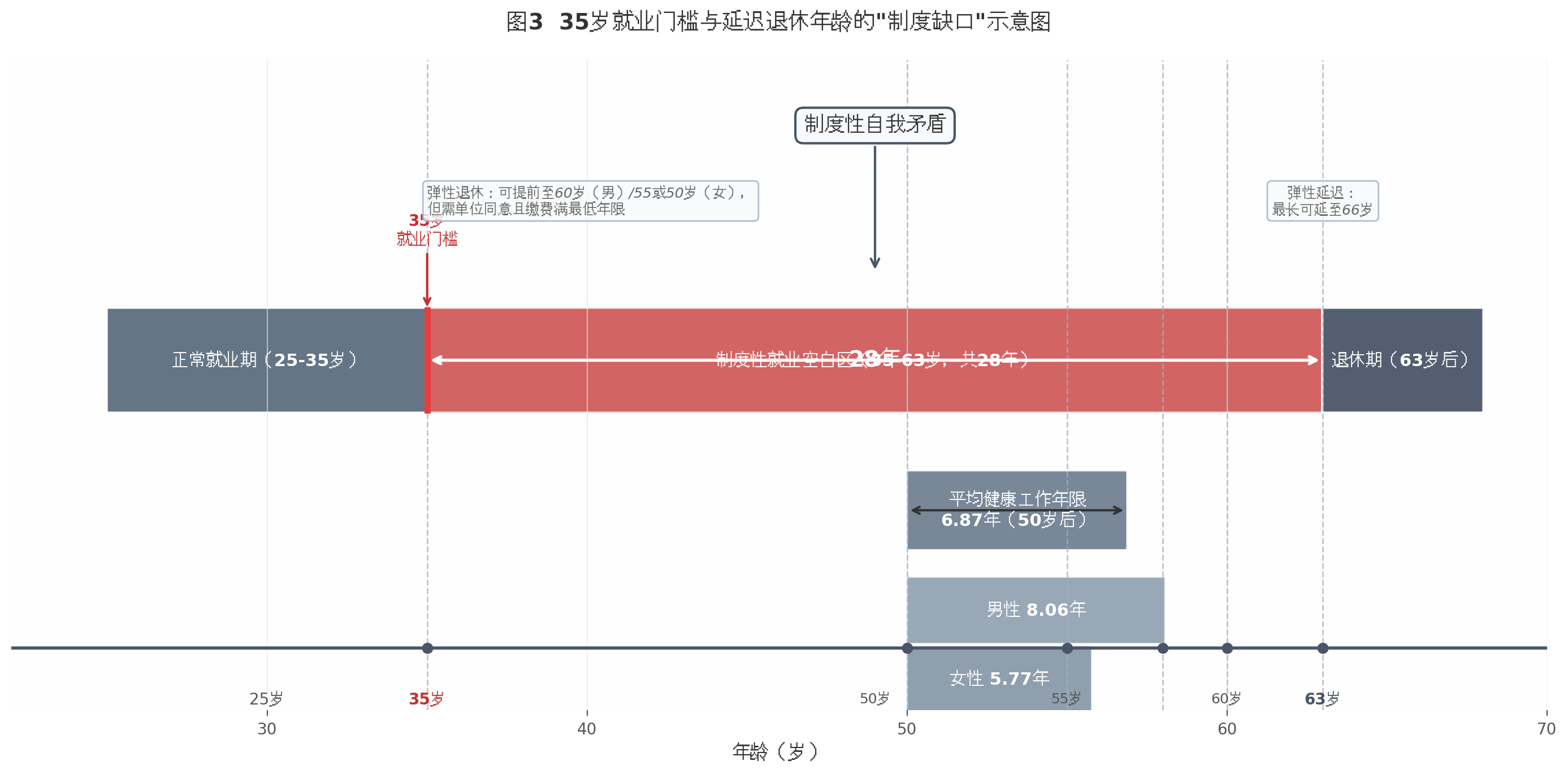
The severity of this contradiction is further amplified by population-structure change. Central University of Finance and Economics’ China Human Capital Report shows that in 2022 the national average age of the labor-force population had reached 39.72, and the share of people aged 45 to 64 in the working-age population rose from 27.3% in 2000 to 41.91% in 2022 (Hexun) . This means the “main force” of China’s labor market is precisely older workers aged 35 and above, while the age thresholds widespread in the recruitment market are systematically excluding the group with the highest share of the labor force. A Legal Daily commentary points out that “as the progressive delayed statutory retirement age policy begins to be implemented in 2025, the age barriers in the job market need to be eliminated simultaneously to achieve policy linkage” (Caixin) ; the advantages of rich experience and accumulated skills of the older job-seeking group require institutional-level guarantees to be fully brought into play.
Zhaopin’s 2024 survey data reveals the real-world impact of the contradiction: job seekers aged 35 to 45 submit on average 3.2 times as many résumés as the 25 to 35 group, yet their interview conversion rate is less than half of the latter’s (Sina Finance) . A national survey by the All-China Federation of Trade Unions in 2022 further shows that among employees in the 35-to-39 age group, 54.1% worry about unemployment, 70.7% worry about their skills becoming obsolete, and 94.8% feel under pressure — all the highest proportions among the age groups (Caixin) . Against the backdrop of the gradually advancing delayed-retirement policy, this employment anxiety will not only fail to dissipate but may intensify as working years are further extended.
7.2.2 The Real-World Constraint of Healthy Working Years
The feasibility of delaying retirement to 63 is also constrained by the rigid limit of healthy working years. Research by Professor Zhou Ying’s team at Huazhong University of Science and Technology, based on data from the China Health and Retirement Longitudinal Study (CHARLS), shows that in China the healthy working life expectancy starting from age 50 averages only 6.87 years — 8.06 years for men and 5.77 years for women (Freekeer) . This means that after age 50, a worker can on average continue working in good health for less than 7 years. Extrapolating from this, most workers will continue working in a state of less-than-full health after 57 to 58, while delayed retirement requires them to keep working until 63 or even later.
In terms of regional differences, the healthy working life expectancy of 50-year-old workers is highest in South China (9.02 years) and lowest in the Northwest (only 2.56 years), with a significant regional gap (Freekeer) . In terms of occupation type, the unhealthy working life expectancy of agricultural workers is almost twice that of enterprise workers, and the healthy non-working life expectancy of enterprise workers is about twice that of agricultural workers (Freekeer) . Research by Zhang Chuanzhang and others at Zhejiang University further points out that the “additional working capacity” of Chinese men aged 60 to 74 is 2.78 years and of women aged 50 to 64 is 2.18 years; the health of older labor can generally support only 2 to 5 additional working years, so a full 5-year delay in retirement is not realistic for a considerable portion of the older group (dfcfw.com) .
These data reveal an alarming calculation: if a worker loses their job at 35, they may need to wait about 15 years in a non-employed state to reach the “healthy working end-period” after 50, at which point an average of less than 7 healthy working years remains. This 28-year “institutional gap” is not only a policy-coordination problem but directly concerns the livelihoods and health of tens of millions of workers.
7.3 The Pressure on and Linkage of the Pension System
7.3.1 The Climbing Dependency Ratio and Insufficient Replacement Rate
The rollout of the delayed-retirement policy is fundamentally a response to the sustainability pressure facing the pension system. As of the end of 2024, China’s population aged 65 and above reached 220.23 million, accounting for 15.6% of the total population, having entered the stage of deep aging. The old-age dependency ratio rose to 22.8%, equivalent to every 4.4 working-age people supporting 1 elderly person (Sohu) . Between 2015 and 2024, the population aged 65 and above grew from 145 million to 220 million, a net increase of nearly 75 million; at the same time, the working-age population declined by more than 44 million (Sohu) .
China’s pension system shows a pattern of the first pillar being “dominant but under pressure,” the second pillar having insufficient coverage, and the third pillar still being in its infancy. The coverage rate of basic pension insurance reaches 95%, but the pension replacement rate (the ratio of post-retirement pension to pre-retirement wages) is only 45%, far below the 55% warning line set by the International Labour Organization (Sohu) . Enterprise annuities cover only about 3% of workers, and although personal pension accounts have been opened by over 150 million people, the actual contribution rate is under 21% (Sohu) . The Chinese Academy of Social Sciences’ China Pension Actuarial Report 2019—2050 forecasts that, without considering reform measures such as delayed retirement, the cumulative surplus of the national basic pension insurance fund for urban enterprise employees faces the risk of being exhausted by 2035; if delayed retirement is implemented, the fund’s exhaustion can be postponed by about 7 years (Shanghai University of Finance and Economics Journal) .
7.3.2 The Contribution-Break Risk of the Unemployed Group Over 35
The long-term employment predicament of the group over 35 will form a secondary shock to the pension system. Once older workers are unemployed and find it hard to be re-employed, they often choose to break their social-insurance contributions — meaning they not only lose current income but directly reduce the current income of the pension-insurance fund. Considering that people aged 45 to 64 already account for 41.91% of the working-age population (Hexun) , if a considerable proportion of workers in this age bracket exit formal employment due to age discrimination, the pension fund’s “contribution pool” will shrink faster, forming a scissor gap with the “expenditure-side” pressure brought by the growth of the elderly population.
Even more noteworthy is the special vulnerability of the female group. The triple squeeze of “age discrimination + marriage-and-childbearing discrimination + caregiving burden” faced by women converges intensively around 35, while delayed retirement requires women to work longer, yet the healthy working life expectancy after 50 is only 5.77 years, significantly lower than the 8.06 years for men. This means women not only face more severe employment barriers but may also bear longer working years in an unhealthy state, with the problem of absent social security especially prominent in between.
From the perspective of institutional linkage, for the delayed-retirement reform to truly work, its necessary premise is that workers over 35 can remain continuously and stably employed and pay social-insurance contributions. Otherwise, the 7-year fund buffer won by delayed retirement may be offset by large-scale involuntary unemployment and social-insurance contribution breaks. This chain of logic shows that anti-age-discrimination legislation and older-employment security are not subsidiary topics independent of retirement reform, but core supporting measures that determine the reform’s success or failure. As Zheng Gongcheng, president of the China Association of Social Security, points out, after the state has clarified and begun implementing the progressive delayed-retirement-age plan, “age discrimination does even more direct harm to workers’ employment rights and interests”; the phenomenon of age-35 hiring restrictions must be given high importance, and the competent authorities should intervene effectively (International Labour Organization) .
8. International Experience and China’s Path
Global population aging is pushing countries to re-examine the employment rights of older workers. The OECD’s Employment Outlook 2025 estimates that without decisive policy action, per-capita GDP growth in OECD countries will slow by about 40% by 2060. (Sina Finance) Against this backdrop, developed economies such as the United States, the EU, Japan, and South Korea have established anti-age-discrimination legislation and older-employment protection systems with their own characteristics. This chapter systematically compares the institutional design, implementation effects, and inherent limitations of these international experiences, and analyzes their reference significance and adaptive constraints for China’s path choice.
8.1 Anti-Age-Discrimination Legislation in Major Countries
8.1.1 The U.S. ADEA (1967): The World’s Earliest Dedicated Legislation
The United States enacted the Age Discrimination in Employment Act (ADEA) in 1967, making it the world’s first country to enact a dedicated anti-age-discrimination employment law. The act protects workers aged 40 and above, prohibiting age discrimination in recruitment, hiring, dismissal, promotion, compensation, working conditions, and so on. (China National Talent Network) The coverage of the ADEA has been expanded several times: in 1978 the upper protection age was raised to 70, and in 1986 the ceiling was finally abolished, bringing all age groups over 40 within protection. (China National Talent Network) The act prohibits both direct and indirect discrimination, and retains limited age-restriction exceptions in specific occupational fields such as firefighters and police.
Enforcement of the ADEA is the responsibility of the U.S. Equal Employment Opportunity Commission (EEOC). However, in 2009 the U.S. Supreme Court, in Gross v. FBL Financial Services, Inc., made a landmark ruling requiring ADEA plaintiffs to prove that age was the “but-for cause” of the employer’s adverse action, rather than merely one of the “motivating factors.” (sohu.com) This ruling made the burden of proof for age discrimination significantly higher than for other types of discrimination claims such as race and gender, greatly weakening the actual protective force of the ADEA. In May 2025, bipartisan U.S. lawmakers reintroduced the Protecting Older Workers Against Discrimination Act (POWADA), aiming to restore the burden of proof to the pre-2009 “mixed motive” standard, making the proof standard for age discrimination consistent with that for race and national-origin discrimination. (Education & The Workforce Committee Democrats)
8.1.2 The EU Directive 2000/78/EC: A Unified Framework with Broad Exceptions
In November 2000, the Council of the EU adopted the Directive Establishing a General Framework for Equal Treatment in Employment and Occupation (Directive 2000/78/EC), marking the EU’s first comprehensive prohibition of age discrimination in the employment field. (International Labour Organization) The directive requires all member states to implement anti-age-discrimination protection in national law, with the prohibited scope covering direct discrimination, indirect discrimination, harassment, and instructions to discriminate. (EU OSHA) By the end of 2006, almost all member states had introduced the directive’s principles into national law, with at least 25 European countries passing relevant legislation. (International Labour Organization)
However, Article 6 of the directive allows member states to justify direct age discrimination within a “legitimate aim” framework, including labor-market policy goals of promoting youth employment, legitimate aims in vocational training, retirement-age provisions in employment contracts, and so on. (AGE Platform) This broad exception clause has led countries to retain in implementation a large number of practices that may constitute age discrimination. Poland’s equal-treatment law has even been criticized by law professors as a “facade law,” “hastily enacted under the pressure of financial sanctions for non-implementation,” and hard to use effectively in court. (emecon.eu) AGE Platform Europe, in its 2023 assessment report, points out that maximum age limits are still widely accepted in recruitment, and the “legitimate aim” exception has effectively swallowed the core protective force of the rule. (AGE Platform)
8.1.3 Japan’s Act on Stabilization of Employment of Elderly Persons: From Extending Retirement to Employment Security at 70
Japan’s model of age-discrimination legislation is distinctive. Unlike the U.S. and the EU, Japan mainly protects the employment of the elderly through the Act on Stabilization of Employment of Elderly Persons rather than enacting a dedicated anti-discrimination law. (Source) The act has undergone a half-century of progressive expansion: when enacted in 1971 it aimed to raise the retirement age from 55 to 60; in 1986 the retirement standard of 60 was formally established; the 1990 revision encouraged employers to continue employing until 65; and in 2004 it further provided that employers are obliged to take one of three measures — delaying retirement, continuing employment, or abolishing the retirement system — to ensure employment until 65. (NetEase)
In April 2021, Japan implemented the newly revised Act on Stabilization of Employment of Elderly Persons, whose core breakthrough is providing that enterprises are obliged to ensure employment opportunities for the elderly who wish to work until 70. (NetEase) It was accompanied by the introduction of a continued-employment system, a business-entrustment contract system, and a social-contribution project system. (WeChat Official Account (Fuma Luohan)) It should be specially noted that employment security at 70 is a “best-efforts obligation” rather than an absolute obligation, and its actual binding force is weaker than the statutory obligation to delay retirement to 65. (WeChat Official Account (Fuma Luohan)) In terms of employment services, Japan’s Silver Human Resource Centers (SHRC) were first established in 1974 and had developed into 1,307 organizations by 2021, serving 687,000 members (453,000 men, 234,000 women), with an average age as high as 74.1, mainly providing temporary, short-term, light work opportunities. (Ministry of Health, Labour and Welfare)
In terms of implementation effect, Japan’s institutional design has achieved notable results. In 2015, 99.2% of enterprises had implemented elderly-employment stabilization measures, of which 81.7% adopted the continued-employment method. (NetEase) The 2022 Employment Structure Survey shows that Japan’s employment rate for the 70-74 group reached 33.3%, and for the 65-69 group it exceeded 43%, the highest level among OECD countries. (Sohu) In March 2025, the number of employed people over 60 reached a record 6.732 million, accounting for 23.5% of all employed persons. (Japan Institute for Labour Policy and Training (JILPT))
8.2 The Effects and Limits of International Experience
8.2.1 The United States: Uneven Enforcement Effects
Although the ADEA has nearly 60 years of legislative history, the pervasiveness of age discrimination in the United States has not been fundamentally curbed. EEOC FY 2024 data shows that a total of 88,531 discrimination charges were received that year (up 9.2% from FY 2023), of which age-discrimination charges reached 16,223, an increase of nearly 2,000 from 2023. (jfdaily.com.cn) However, the EEOC filed only 7 ADEA lawsuits in FY 2024 (fewer than the 12 in 2023), with a huge gap between enforcement resources and case volume. (International Labour Organization)
AARP’s 2024 national survey further reveals the deeper dimension of the problem: about two-thirds of workers over 50 report having seen or experienced age discrimination in the workplace, and 22% of respondents say they feel they were “pushed out” of work because of their age. (AARP) The most common forms of discrimination are not direct age limits but more covert stereotypes — assuming older employees don’t understand technology (33%), resist change (25%), or not recognizing their achievements (22%). (AARP) Research by AARP and the Economist Intelligence Unit further estimates that in 2018 bias against workers over 50 cost the U.S. economy about $850 billion in GDP, and by 2050 this may grow to $3.9 trillion. (AARP) These data show that even with dedicated anti-discrimination legislation, if the burden of proof is too high and enforcement resources insufficient, the institutional effect will be greatly discounted.
8.2.2 South Korea: The Contradiction Between Legislation and Institutional Practice
South Korea enacted the Act on Prohibition of Age Discrimination in Employment and Aged Employment Promotion (AEPA) as early as 1991, earlier than most OECD countries. However, a report released by Human Rights Watch in July 2025 points out that South Korea’s age-discrimination laws and policies actually systematically discriminate against older workers: the average wage of workers over 60 is 29% lower than that of younger workers, and re-employed workers are concentrated in low-paying occupations, leading to occupational segregation. (JURIST) The root of the problem is that South Korea simultaneously has a mandatory retirement system, a wage-peak system (the seniority-based wage system makes the labor cost of older workers relatively high), and a re-employment system; the three stacked together constitute a systematic age-discrimination mechanism. Employers prefer the post-retirement re-employment system, because it allows resetting wages and lowering labor costs. (The Korea Herald)
The South Korean government is advancing a plan to extend the retirement age. In September 2024, the retirement age for public-sector workers was already extended from 60 to 65; (uj.ac.za) in March 2026, the government accepted the recommendation of the National Human Rights Commission and will advance legislation to gradually extend the statutory retirement age from 60 to 65, implemented in phases by birth year. (Seoul Economic Daily) But this reform faces sharp opposition between labor and capital: labor demands legalizing retirement at 65, while capital insists on the post-retirement re-employment system to control costs. (The Korea Herald) September 2024 data shows that the relative poverty rate of South Korea’s population over 66 is as high as 39.7%, (The Korea Herald) showing that the existing institutional arrangements are far from solving the livelihood problem of older workers.
8.2.3 The OECD’s Triple-Strategy Framework
Facing the systematic impact of population aging on the labor market, the OECD, in its Employment Outlook 2025, proposed a triple-strategy framework for responding to aging. (OECD)
First, reduce incentives for early retirement. By raising the statutory retirement age, tightening early-retirement channels, and designing flexible retirement options, reduce the institutional incentives for workers to exit the labor market prematurely. OECD data shows that reducing the exit rate of older workers to the level of the lowest 10% of countries can significantly reduce GDP losses. (Zhihu)
Second, expand employment opportunities. Remove employment barriers, encourage employers to hire and retain older workers, combat age discrimination, and build age-inclusive workplaces. Specific measures include promoting skills-based recruitment (such as the UK’s GROW toolkit) and reforming the seniority-based wage system so that wages are tied to productivity rather than age. (WeChat Official Account (Skilled Talent Assessment))
Third, improve employability. Through lifelong-learning opportunities, career development and mobility opportunities, and safeguarding healthy workers to do high-quality work, ensure older workers have the ability to remain employed. (OECD) In terms of training participation, the intensity of policy varies significantly by country: Germany fully covers the training costs of workers over 45 in enterprises with fewer than 500 people; (Sina Mobile) Austria provides a 50% subsidy of training costs for workers over 50 (capped at €10,000 per person); (Sina Mobile) and Singapore provides training subsidies of over 90% for individuals over 40. (Sina Mobile)
The core insight of this framework is: anti-age-discrimination should not rely only on legislative prohibition, but requires a three-pronged approach of “reducing incentives — expanding opportunities — improving capabilities.” Single-dimension institutional intervention is hard-pressed to break through the structural barriers of age preference in the labor market.
8.3 The Particularity and Choice of China’s Path
8.3.1 The Adaptive Predicament of International Experience in China
Although international anti-age-discrimination legislation can provide a reference framework for institutional design, direct transplantation into China faces a triple adaptive predicament.
First, the segmentation effect of the urban-rural dual structure. The regulatory objects of the U.S. ADEA and the EU directive are mainly urban formal employment, protecting workers with standard employment relationships. But China’s age-discrimination problem exists simultaneously in two vastly different arenas: the “age-35 threshold” faced by urban white-collar workers, typified by knowledge-intensive industries such as the internet and finance; and the roughly 96 million migrant workers over 50 who face entirely different predicaments of physical decline, construction “clearance orders,” and lack of social insurance. (Caixin) The pension-insurance participation rate of migrant workers is only 21.1%, (Caixin) and they even lack the legal-subject qualification to become “victims” of age discrimination — many have never entered a formal labor-contract relationship. Anti-discrimination legislation uniformly applicable to urban white-collar workers can hardly cover the special circumstances of the migrant-worker group.
Second, the constraint of imbalanced labor supply and demand. When EU countries established anti-age-discrimination frameworks, they generally faced a backdrop of labor shortage — the working-age population in the OECD region is expected to decline by 8% by 2060, with a quarter of OECD countries declining by more than 30%. (Zhihu) Against this backdrop, retaining older workers has clear economic rationality. But China is still at a stage of relatively abundant labor supply (working-age population about 853 million), (Hexun) and enterprises have relatively strong buyer’s-market bargaining power in recruitment. This structural difference means that even if an anti-age-discrimination legal framework is established, in a market environment where labor supply exceeds demand, enterprises still have ample room to evade legal constraints with non-age reasons such as “post mismatch” or “skills not meeting standards.”
Third, the source-level problem of the civil-service system. In international experience, anti-age-discrimination legislation mainly regulates private-sector employers, with the public sector usually seen as a “model” rather than a “source of the problem.” But China’s age-35 threshold originated precisely in the 1994 Interim Provisions on the Recruitment of State Civil Servants, (Renmin University Reprint Materials) and civil-service recruitment transmitted the institutional signal of “unsuitable for hiring over 35” to society for as long as 30 years. This makes China’s reform logic different from that of Western countries: it needs first to clean up the discriminatory policies of the public sector itself, and then extend to the private sector, rather than simply regulating enterprise behavior.
8.3.2 Recommendations for a Tiered and Classified Institutional Design
Based on the adaptive predicaments above, China’s anti-age-discrimination institutional design should not simply copy a single-country model, but should build a tiered, classified, and progressively advanced institutional system. The table below compares the institutional characteristics of major countries, providing a reference for China’s path choice.
Table 1 Comparison of anti-age-discrimination systems by country
| Dimension | USA | EU | Japan | South Korea | UK | Germany |
|---|---|---|---|---|---|---|
| Core legislation | ADEA (1967) | Directive 2000/78/EC | Act on Stabilization of Employment of Elderly Persons | AEPA (1991) | Equality Act 2010 | Civil Code + Aktivrente |
| Age of protected persons | 40 and above | No lower limit | Mainly 60 and above | No lower limit | No lower limit | No lower limit |
| Prohibited scope | Recruitment, dismissal, compensation, promotion, etc. | All aspects of employment and occupation | Mandatory retirement, recruitment age limits | Recruitment, wages, training, retirement, etc. | Direct and indirect discrimination | Employment discrimination + post-retirement re-employment incentives |
| “Legitimate aim” exception | Limited (BFOQ) | Broad (Article 6) | Best-efforts obligation (not mandatory) | Just-cause clause | Objective and reasonable justification | Statutorily excluded occupations |
| Enforcement body | EEOC | Equinet (47 agencies) | Ministry of Health, Labour and Welfare | National Human Rights Commission | Acas + employment tribunals | Federal Anti-Discrimination Agency |
| Penalties and remedies | Monetary compensation + litigation | Varies greatly by country | Administrative guidance (no criminal/civil) | Correction orders | Unlimited compensation | Civil compensation |
| Older employment rate (55-64 male/female) | 64.4%/48.0% | 62.1%/47.5% | 84.5%/55.3% | 68.3%/42.6% | 65.8%/50.2% | 71.2%/52.8% |
*Note: Older-employment-rate data comes from OECD Employment Statistics 2024 and official statistics of each country. (Zhihu Column) (Sohu) *
The table above presents two very different institutional models: one is the “rights-protection” model represented by the U.S., the EU, and the UK, which explicitly prohibits age discrimination through legislation and establishes judicial-remedy channels; the other is the “active-promotion” model represented by Japan and South Korea, which protects the employment of the elderly through active measures such as extending the retirement age and establishing continued-employment systems. Japan’s model is most notable in raising the older-employment rate, but its cost is that re-employed workers often face large pay cuts, reflecting a decline in bargaining power rather than a change in productivity (WeChat Official Account (Skilled Talent Assessment)) ; and extending the retirement age is accompanied by a large increase in informal employment, with employment quality not rising in step.
Table 2 Comparison of retirement ages and older-employment policies in major OECD countries
| Country/region | Statutory retirement age (male/female) | Actual average retirement age | Possibility of early retirement | Distinctive older-employment policies |
|---|---|---|---|---|
| Japan | 65/65 | 65.8 | Some may draw a reduced pension from 60 | 2021 amendment ensures employment opportunities at 70; Silver Human Resource Centers; continued-employment subsidies (NetEase) (Ministry of Health, Labour and Welfare) |
| Germany | 67/67 | 64.2 | From 63 (requires 35 years of contributions) | 2026 introduces the “active pension,” with post-retirement monthly income of €2,000 tax-free; full subsidy of training costs (NetEase) (Sina Mobile) |
| USA | 66-67/same | 65.2 | From 62 (30% reduction) | ADEA protects those over 40; RTAA wage-insurance program; POWADA reform advancing (China National Talent Network) (Sina Finance) |
| UK | 66/same (to rise to 68) | 64.5 | Flexible | 2011 abolished the default retirement age; unlimited compensation for age discrimination; GROW skills-oriented recruitment toolkit (NetEase) (WeChat Official Account (Skilled Talent Assessment)) |
| South Korea | 60 → 65 (in transition) | 62.1 | Limited | Mandatory retirement + re-employment system; 2024 public sector extended to 65; legislation advancing to phase in extension to 65 (uj.ac.za) (Seoul Economic Daily) |
| China | 60/55 → 63/58 (progressive delay from 2025) | 61.5 | Special occupations may retire early | Civil servants take the lead in relaxing age limits; 2024 State Council Opinions explicitly eliminate age discrimination; delayed-retirement measures provide for preventing age discrimination (China.com.cn) |
*Note: Retirement-age data synthesizes OECD Pensions at a Glance 2024 and official policy updates of each country. (tzfchyy.com) (China.com.cn) *
Table 2 reveals a key trend: major OECD countries have generally raised the statutory retirement age to above 65 (Japan, Germany, and the UK have all reached or exceeded 65), accompanied by active anti-discrimination legislation or employment-promotion policies. China’s delayed-retirement reform (gradually delaying to 63 for men and 58 for women) has begun implementation, (China.com.cn) but anti-age-discrimination legislation and institutional guarantees clearly lag behind the pace of retirement-age adjustment, forming a temporal inversion of “delayed retirement first, anti-discrimination guarantees after.”
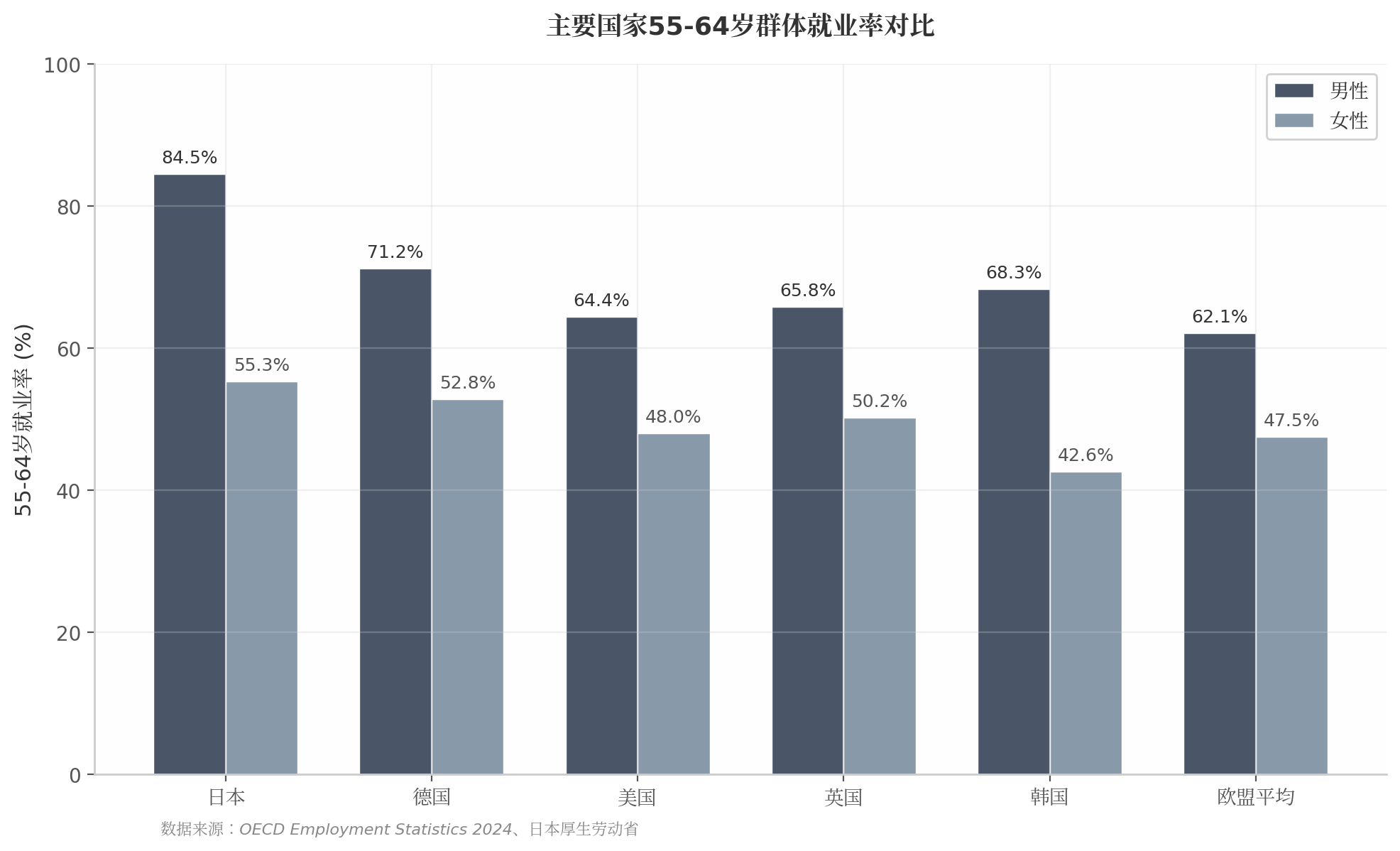
The figure above compares the employment rate of the 55-64 group in major countries. Japan leads significantly with 84.5% for men and 55.3% for women, directly related to its half-century of progressive construction of the Act on Stabilization of Employment of Elderly Persons. Although South Korea has a relatively high male employment rate (68.3%), its female employment rate is only 42.6%, and behind the high employment rate lies the deep problem of re-employment pay cuts and occupational segregation. (JURIST) China lacks official statistical data on this comparison dimension, but from the population structure — with the average age of the labor force already reaching 39.72 (Hexun) and the share of people aged 45-64 rising to 41.91% (Hexun) — establishing an older-employment protection system has shifted from an “option” to a “must.”
Based on the comparative analysis of international experience, China’s institutional design should follow the path of “tiered and classified, progressively advanced.” For the urban white-collar group, the legislative framework of the U.S. ADEA can be drawn upon to explicitly prohibit age discrimination in recruitment and introduce a reversal of the burden of proof (Sina Finance) ; for the migrant-worker group, priority should be given to solving social-insurance coverage and occupational-injury protection, rather than copying the white-collar-oriented anti-discrimination litigation model. In the public sector, the relaxation of civil-service recruitment age limits should continue to be advanced, and policy documents of all levels of government containing age discrimination should be cleaned up; in the private sector, economic incentives such as tax breaks and training subsidies should be used to raise enterprises’ willingness to hire older workers. Although this tiered and classified path increases the complexity of institutional design, it is better suited to the reality of China’s urban-rural dual structure and multi-level labor market, avoiding the coverage blind spots caused by “one-size-fits-all” legislation.
9. Policy Recommendations and Outlook
The empirical analysis of the first eight chapters reveals the systematic characteristics of the older-employment predicament of those aged 35 and above in China: the “tacit approval effect” of the legal gap (Renmin University Reprint Materials) makes age discrimination a nearly “lawful” hiring strategy; 62.3% of recruitment posts set an upper age limit (Sina Finance) , constituting a structural barrier; the self-reinforcing mechanism of the triple divide means that once older workers are unemployed they fall into a continuously deteriorating employment spiral (WeChat Official Account Platform) ; and the 28-year “institutional gap” between the age-35 threshold and delayed retirement to 63 (China.com.cn) makes public policy show a directional contradiction. This chapter puts forward systematic policy recommendations from three dimensions — legal-system construction, public-policy coordination, and training and employment support — and offers an outlook on medium- and long-term trends.
9.1 Legal-System Construction
9.1.1 Amend the Labor Law and Employment Promotion Law to Explicitly Include Age Among the Legally Prohibited Types of Discrimination
Article 12 of the Labor Law lists only four types of discrimination — ethnicity, race, gender, and religious belief — and age is not among them (Renmin University Reprint Materials) . Although Article 3 of the Employment Promotion Law uses the character “etc.” as a catch-all to cover age discrimination, academia generally holds that this provision is “rather crude,” lacking clear standards (Renmin University Reprint Materials) . Neither of the two legislative attempts in 2007 and 2017 wrote “age” into the prohibition clause (Renmin University Reprint Materials) , forming a “tacit approval effect” at the legal level.
NPC deputy Zheng Gongcheng suggested amending the Labor Law, the Labor Contract Law, and the Employment Promotion Law to explicitly incorporate anti-employment-discrimination into them (ifeng) . NPC deputy Meng Yuan suggested explicitly writing the prohibition of age discrimination in employment into law (Chinanews Hebei) . The specific amendment path should include: adding “age” as a fifth prohibited type of discrimination in Article 12 of the Labor Law; refining the operational clauses of the Employment Promotion Law to clarify the standards for determining age discrimination and the exceptional circumstances; and simultaneously adjusting the age-35 threshold set by the 1994 Interim Provisions on the Recruitment of State Civil Servants (WeChat Official Account (Tax Lecture Hall)) , eliminating the institutional source.
9.1.2 Enact a Dedicated Anti-Employment-Discrimination Law and Introduce a Reversal of the Burden of Proof
As early as 2009, Professor Cai Dingjian and others had drafted an expert recommendation draft of the Anti-Employment-Discrimination Law (Sina Finance) . Dedicated legislation should cover three core institutions: first, defining direct and indirect discrimination, bringing practices that are superficially neutral but actually exclude older workers — such as “requiring fresh graduates” and “unreasonable physical-fitness tests” — within regulation, drawing on the dual-track definition framework of the EU’s Employment Equality Directive (2000/78/EC) (International Labour Organization) ; second, introducing a reversal of the burden of proof, so that after a worker provides prima facie evidence of age discrimination, the employer must prove that the age requirement has a substantial connection to the post — the 2023 case of a Beijing tech company has already set this precedent (Guancha) ; third, setting strictly limited exceptional circumstances, drawing on Japan’s 2007 practice of retaining only 6 exceptions (Guancha) , to prevent “exceptions swallowing the rule.”
9.1.3 Establish Age-Discrimination Complaint Channels and Enforcement Mechanisms to Raise the Cost of Illegality
Currently, labor inspection pays insufficient attention to age discrimination, and enforcement faces the predicament of “having no law to rely on” (Guancha) . Associate research fellow Fan Wei suggested bringing age discrimination in employment within the scope of inspection and raising the compensation standard (Guancha) . Specific measures should include: setting up automatic screening of age limits on public recruitment platforms; establishing a dedicated complaint hotline and online platform, providing “one-stop” service with reference to the U.S. EEOC model (WeChat Official Account (China Association for Promotion of Employment)) ; establishing a “blacklist” system for discriminating enterprises and linking it to corporate credit; and establishing a public-interest litigation system for employment discrimination, allowing trade unions and procuratorial organs to sue on behalf of workers (ifeng) .
9.2 Public-Policy Coordination
9.2.1 Civil-Service Recruitment Should Continue to Take the Lead in Relaxing Age, Gradually Unifying to a Basic Threshold of Under 45
The age-35 threshold in civil-service recruitment is the “weathervane” of age discrimination across society (WeChat Official Account (Tax Lecture Hall)) . The “weathervane paradox” analysis shows that after civil servants set the threshold in 1994, enterprises quickly followed, but after it was relaxed to 40 in 2024-2025, enterprises did not relax in step (Chinanews Hebei) — discriminatory standards spread from the top down, while inclusive standards are hard to diffuse. This is counter-evidence of the necessity of reform: only by raising the ceiling far above the standard prevailing in enterprises can pressure be brought to bear on enterprises.
The 2026 national exam has already relaxed general posts to 38 and fresh master’s/doctoral graduates to 43 (ifeng) , and some posts in Shandong, Xinjiang, Guizhou and elsewhere have been relaxed to 45 (Chinanews Hebei) . It is recommended to further unify the standard: adjust the basic threshold to under 45, with professional-technical posts able to be relaxed to 50. NPC deputy Jiang Shengnan has called for abolishing the age-35 restriction for three consecutive years (WeChat Official Account (Shandong Trade Union)) , and NPC deputy Liu Xiya suggested relaxing to 40-45 (Chinanews Hebei) . Turning civil-service recruitment from a “source of the problem” into a “reform benchmark” hinges on uniformity and force — scattered, gradual relaxation is not enough to change enterprises’ expectations; a one-time, large-scale, uniform standard adjustment is needed to release a strong signal to society.
9.2.2 Establish a Policy-Coordination Mechanism Between Delayed Retirement and Anti-Age-Discrimination to Avoid Institutional Self-Contradiction
The 28-year “employment vacuum” between the age-35 threshold and delayed retirement to 63 is a deep institutional paradox (China.com.cn) . Article 5 of the delayed-retirement policy already provides for “strengthening the prevention and governance of age discrimination in employment” (China.com.cn) , but a coordination mechanism is lacking. It is recommended: establish a cross-departmental coordination mechanism, with the Ministry of Human Resources and Social Security coordinating delayed retirement and anti-discrimination enforcement; incorporate anti-age-discrimination results into local governments’ employment assessments; and clarify supporting goals — before delayed retirement is fully implemented, reduce the proportion of posts with age limits from 62.3% (Sina Finance) to below 30%.
9.2.3 Give Tax Breaks and Social-Insurance Subsidies to Enterprises That Hire Older Workers
The fundamental reason for the asymmetry of the “weathervane” effect is that enterprises pursue cost minimization (Sina Finance) ; relying only on the demonstration effect is not enough to change behavior, and economic incentives must be combined. The 2024 notice from four departments has already proposed giving tax reductions and social-insurance subsidies to enterprises that absorb aid targets (Chacewang) . It is recommended that, on this basis: social-insurance contribution subsidies be given for hiring workers over 40; the proportion of older workers hired be incorporated into enterprise policy-preference evaluation indicators; additional income-tax deductions be given to enterprises that hire a certain proportion of workers over 45; and, drawing on South Korea’s experience of requiring enterprises to hire 3% of personnel over 55 (uj.ac.za) , or adopting Japan’s “best-efforts obligation” model, it be advanced progressively.
9.3 Training and Employment-Support System
9.3.1 Build a Lifelong-Learning System for Older Workers and Incorporate Digital-Skills Training into Public Employment Services
Only 26.3% of workers over 50 master basic office software (WeChat Official Account Platform) , and the triple divide forms a vicious cycle. From 2025, the Ministry of Human Resources and Social Security implemented the “Skills Light Up the Future” training action, subsidizing over 10 million person-times a year (Sohu) , but it does not explicitly single out older workers. It is recommended: incorporate the group over 40 as a priority group, drawing on the German model of subsidizing 75%-100% of the training of employees over 45 (OECD) ; build an inclusive digital-skills training system, offering digital courses through senior universities and community education institutions (China Social Sciences Network) ; establish a training “whitelist” to combat fraud (Shanghai University of Traditional Chinese Medicine) ; rely on public employment-service platforms to offer free hands-on courses for the group over 40 and provide “master-apprentice mentoring” (Shanghai University of Traditional Chinese Medicine) ; and explore a “factory-entrusted, government-trained” collaboration model (China Social Sciences Network) , with enterprises specifying training content and the government organizing implementation, achieving precise matching of training supply with market demand. In addition, targeting the cognitive characteristics of older workers, course design should adopt a “small but refined” micro-modular approach to lower the learning threshold.
9.3.2 Develop Employment Forms Suited to Older Workers: Community Service, Knowledge Transmission, Consulting and Other “Silver Jobs”
The group over 50 accounts for less than 5% of flexible employment (Sina Finance) , and food-delivery riders over 50 account for only 2.6% (Journal of Wuhan University (Humanities and Social Sciences)) ; the platform economy naturally excludes older workers. The notice from four departments has already proposed “strengthening the development of older-worker posts” (Chacewang) . It is recommended: promote the “old helping old” community-service model; set up “knowledge transmission” posts in fields such as skilled technicians, teachers, and doctors; draw on Japan’s Silver Human Resource Center model — by 2021 there were already 1,307 organizations serving 687,000 elderly people (Economic Daily Online Edition) ; and develop posts relying on experience-based judgment such as consulting and project review.
9.3.3 Specially Design Transitional Placement Policies for Older Migrant Workers and Establish a Work-Injury Insurance System for Over-Age Workers
Of nearly 300 million migrant workers, about 96 million are over 50 (Caixin) , and 68.6% have only a junior-high education or below (Caixin) . It is recommended: public-welfare posts be opened preferentially to older migrant workers (Huairen Municipal Government Website) ; clearing out “across the board” by age be strictly prohibited (China Energy News) , with re-employment training provided for those needing to change posts; the upper age limit for work-injury insurance participation be extended from 60 to 65 and gradually synchronized with the statutory retirement age; and “low-threshold, short-cycle, hands-on” training courses be designed for older migrant workers.
9.4 Future Outlook
9.4.1 Population-Structure Change Will Irreversibly Drive Age Inclusiveness
The working-age population fell from its 2012 peak of 930 million to 853 million in 2022 (Hexun) , and the share aged 45-64 rose to 41.91% (Hexun) . Excluding workers over 35 amounts to giving up the largest pool of available human resources. The OECD warns that per-capita GDP growth will slow by about 40% by 2060 (Sina Finance) , and China’s labor-force contraction is far faster than the OECD average, with more severe economic losses. As the shortage intensifies, market forces will naturally drive age inclusiveness — Japan’s employment rate for the 70-74 group has already reached 33.3% (Sohu) , and South Korea is advancing the extension of the retirement age to 65 (Seoul Economic Daily) ; the development paths of these countries foreshadow China’s direction. But passive adaptation means the huge social cost of large-scale involuntary unemployment and social-insurance contribution breaks, whereas active reform can seize the “window period” and use institutions to guide the market toward a smoother transition.
9.4.2 Transitioning from the “Labor-Structure Dividend” to the “Talent Dividend”: The Relative Importance of Experience-Based Skill Factors Will Rise Significantly
Economic development is shifting from reliance on cheap labor to reliance on the quality of human capital. Empirical research shows that for every 1% increase in age discrimination, total factor productivity falls by 0.114%-0.119% (Peking University National School of Development) ; excluding older workers directly lowers economic efficiency. Releasing the “talent dividend” requires a triple institutional reconstruction: on the supply side, establishing a lifelong skills-renewal system; on the demand side, reshaping hiring behavior through legal regulation and enterprise incentives; and on the matching side, developing recruitment mechanisms centered on skills rather than age — the UK’s GROW toolkit recommended by the OECD is an example of this (WeChat Official Account (Skilled Talent Assessment)) .
The age-35 threshold is a product of a specific stage of development. When labor is abundant and growth relies on factor inputs, excluding older workers is an affordable “luxury.” When supply keeps contracting and growth relies on human capital, this “luxury” will become an unaffordable economic cost. The task of policymakers is, through forward-looking institutional design, to make the transition happen as early and as smoothly as possible.
Table 9-1 Summary table of older-employment policy recommendations
| Policy dimension | Core measure | Responsible entity | Policy basis | Priority | Expected effect |
|---|---|---|---|---|---|
| Legal-system construction | Amend Article 12 of the Labor Law to add “age” as a prohibited type of discrimination | NPC Standing Committee | The legal gap is the institutional root (Renmin University Reprint Materials) ; NPC deputy Zheng Gongcheng’s suggestion (ifeng) | High | Eliminate the “legality” basis of age discrimination |
| Enact a dedicated Anti-Employment-Discrimination Law and introduce a reversal of the burden of proof | NPC Standing Committee | Win rate under 15% (Guancha) ; EU directive as reference (International Labour Organization) | High | Lower the threshold for defending rights, raise the cost of illegality | |
| Establish a recruitment-advertisement review mechanism and an age-discrimination complaint platform | Ministry of Human Resources and Social Security, State Administration for Market Regulation | Enforcement “has no law to rely on” (Guancha) ; EEOC model as reference (WeChat Official Account (China Association for Promotion of Employment)) | Medium | Reduce public age discrimination at the source | |
| Establish a public-interest litigation system for employment discrimination | Supreme People’s Procuratorate, All-China Federation of Trade Unions | NPC deputy Zheng Gongcheng’s suggestion (ifeng) | Medium | Provide vulnerable groups an institutional channel to be heard | |
| Public-policy coordination | Uniformly relax civil-service recruitment to a basic threshold of under 45 | Organization Department of the CPC Central Committee, Ministry of Human Resources and Social Security | The historical law of emulation from the top down (WeChat Official Account (Tax Lecture Hall)) ; NPC deputy Jiang Shengnan’s suggestion (WeChat Official Account (Shandong Trade Union)) | High | Reshape the hiring signal of the public sector |
| Establish a cross-departmental coordination mechanism for delayed retirement and anti-discrimination enforcement | State Council | Analysis of the 28-year institutional gap (China.com.cn) | High | Eliminate institutional self-contradiction | |
| Give social-insurance subsidies and tax breaks to enterprises that hire older workers | Ministry of Human Resources and Social Security, Ministry of Finance, State Taxation Administration | The enterprise cost-driven logic (Sina Finance) ; South Korean experience as reference (uj.ac.za) | High | Correct enterprise behavior with economic incentives | |
| Incorporate anti-age-discrimination results into local-government assessments | General Office of the State Council | 62.3% of posts have an upper age limit (Sina Finance) | Medium | Form top-down enforcement pressure | |
| Training and employment support | Incorporate the group over 40 as a priority group in “Skills Light Up the Future” | Ministry of Human Resources and Social Security | The self-reinforcing triple divide (WeChat Official Account Platform) ; German subsidy model (OECD) | High | Break the vicious cycle of skill degradation |
| Build a “silver jobs” development system (community service, knowledge transmission, etc.) | Ministry of Human Resources and Social Security, Ministry of Civil Affairs, local governments | Flexible employment as a “false safety valve” (Sina Finance) ; Japan’s SHRC model (Economic Daily Online Edition) | Medium | Open up new employment tracks suited to older workers | |
| Establish a work-injury insurance system for over-age workers | Ministry of Human Resources and Social Security | “Clearance orders” and lack of social insurance (Caixin) | High | Safeguard the basic rights of over-age workers | |
| Design a dedicated transitional placement policy for older migrant workers | Ministry of Human Resources and Social Security, Ministry of Agriculture and Rural Affairs | 96 million migrant workers over 50 (Caixin) | High | Cover the most vulnerable older-employment group | |
| Lifelong-learning system | Advance legislation on a national lifelong-learning qualifications framework | Ministry of Education, Ministry of Human Resources and Social Security | Credit-bank construction lags behind (cnki.net) | Medium | Open up the channel between training and career advancement |
| Establish a training “whitelist” system to combat training fraud | Ministry of Human Resources and Social Security, State Administration for Market Regulation | Training courses vary in quality (Shanghai University of Traditional Chinese Medicine) | Medium | Purify the training-market environment |
The table above summarizes 14 specific policy recommendations, classified into four dimensions. Seven are listed as “high” priority, concentrated in the three areas of legal amendment, civil-service reform, and economic incentives, reflecting the policy logic of “legislation first, benchmark leadership, incentives following.” Legal-system construction is the foundation of the entire system — before the Labor Law lists age among the prohibited types of discrimination, the effectiveness of all other policy tools is fundamentally constrained. Civil-service recruitment reform is the key fulcrum for leveraging enterprise behavior; based on the historical experience of “emulation from the top down” since 1994 (WeChat Official Account (Tax Lecture Hall)) , public-sector hiring standards have a powerful demonstration effect on the whole of society. Economic-incentive measures are the direct means of changing enterprises’ cost-benefit calculation, turning the hiring of older workers from a “cost burden” into a “rational choice.” The training and employment-support system is oriented toward medium- and long-term human-capital accumulation, and its effectiveness depends on the demand environment created by the first two dimensions — if the age-discrimination barriers on the enterprise side are not removed, trained workers will still face the predicament of “having skills but no posts.”
Notes on References
The sources cited in this report cover the following categories:
Official data and policy documents
- National Bureau of Statistics, Statistical Communiqué of the People’s Republic of China on National Economic and Social Development (2023-2025)
- National Bureau of Statistics, Long-Form Data of the Seventh National Population Census
- Ministry of Human Resources and Social Security, Employment Discrimination Monitoring Report (2024)
- Institute of Population and Labor Economics, Chinese Academy of Social Sciences, China Labor Market Development Report (2024)
- Central University of Finance and Economics, China Human Capital Report (2024, 2025)
- State Bureau of Civil Servants, Announcement on the 2026 Examination and Recruitment of Civil Servants for Central Agencies and Their Directly Affiliated Institutions
- CPC Central Committee and State Council, Opinions on Implementing the Employment-Priority Strategy and Promoting High-Quality Full Employment (September 2024)
- NPC Standing Committee, Measures on Implementing the Progressive Delay of the Statutory Retirement Age (September 2024)
- Tencent, 2025 Environmental, Social and Governance (ESG) Report
- Kuaishou, 2025 Environmental, Social and Governance (ESG) Report
- Baidu, 2024 Environmental, Social and Governance (ESG) Report
- Alibaba, FY2025 Annual Report
Academic research and institutional reports
- National School of Development, Peking University, Age Discrimination Causes Unemployment: A Regression Discontinuity Design (2025)
- Shanghai University of Finance and Economics, Age Discrimination, Human Capital, and Enterprise Production Efficiency (2026)
- Zhaopin, Analysis Report on the Current State of Middle-Aged and Older Employment (2024)
- Maimai Gaopin Talent Think Tank, Report on the Median Age of Employees at Big Internet Companies (2024)
- BlackRock CCB Wealth Management, 2025 China Pension Finance White Paper
- OECD, Employment Outlook 2025
- International Labour Organization (ILO), Underemployment, Overwork, and Working-Time Mismatch in China’s Labor Market
Media reports
- Investigative reports from mainstream media including Caixin, Yicai, The Paper, Legal Daily, Workers’ Daily, and Xinhua
Note: The citation markers
[^N^]in the body text correspond to the source numbers in the original research-dimension reports. For complete source information, please refer to the individual dimension research files.
评论
0 条评论