I recently read an article about preparing for the DeepSeek Harness team interview that explains the core concepts of Agent engineering in a way “even a five-year-old can understand.” I’ve organized it into notes for future review, and to share with anyone preparing for interviews for related roles.
Original link: DeepSeek Harness Team Interview Prep
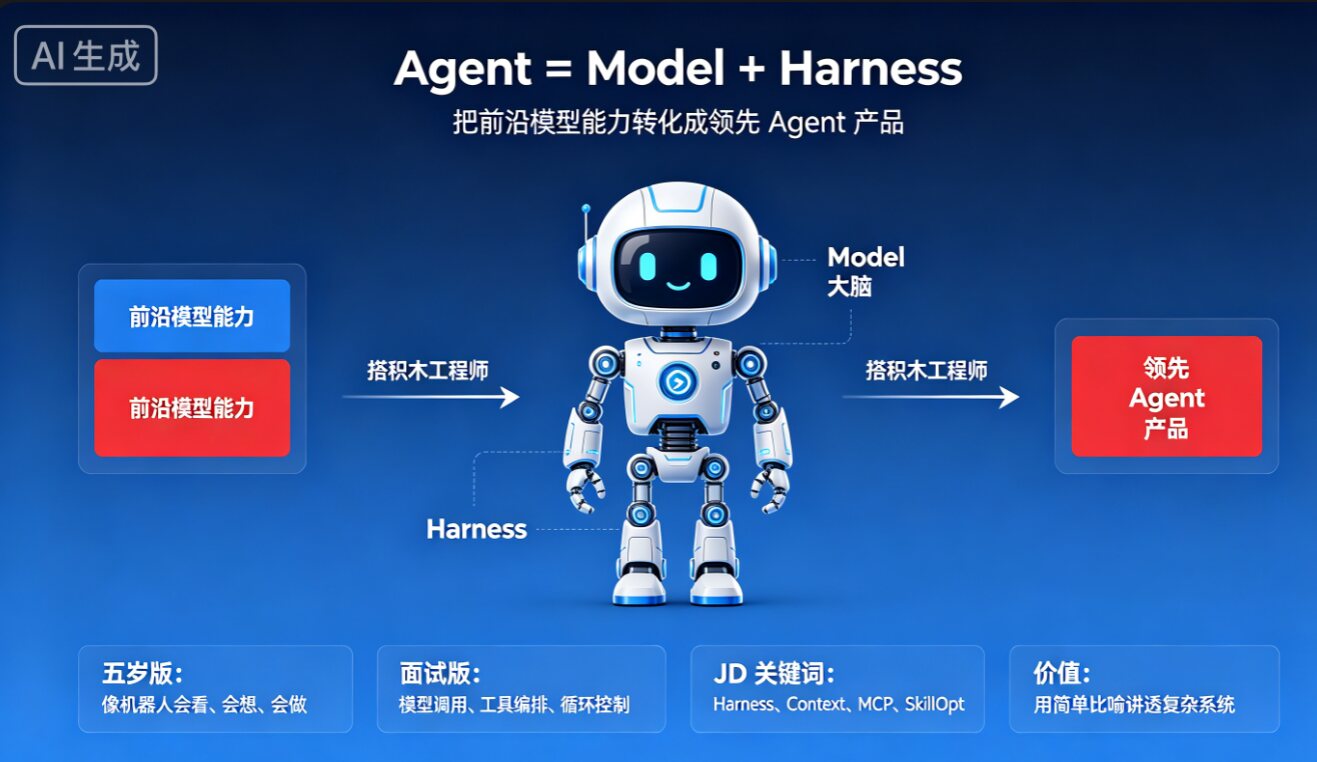
The Core Equation
Model + Harness = Agent
| Role | Analogy | Responsibility |
|---|---|---|
| Model | The brain | Reasoning, language |
| Harness | The body | Tools, memory, loop |
| Agent | A robot that can act autonomously | Perceive → Decide → Act → Feedback |
Why isn’t the model itself enough? Because an LLM is static and stateless; the Harness gives it the ability to perceive, act, remember, and learn in a closed loop. The core work of the DeepSeek Harness team is to build a deeply tailored Outer Harness for their own model.
Components of the Harness
- Orchestration Loop
- Tools
- Memory
- Context Management
- Feedforward Guides
- Feedback Sensors
Harness Architecture Layers
| Layer | Composition | Goal |
|---|---|---|
| Built-in Harness | System Prompt, Code Retrieval, Orchestration Loop | Basic capability |
| Outer Harness | Feedforward Guides + Feedback Sensors | Improve first-time correctness, provide self-correction ability |
The Five Core Concepts Emphasized in the JD
1. Agent Loop
Five-year-old version: Like playing “Simon Says” — think one step, do one step, look at the result, then think of the next step, looping until the task is done.
Interview version: It’s essentially a while(true) loop: LLM call → check whether there’s a tool call → execute the tool → send the result back to the LLM → repeat, until the LLM returns a plain-text response (the termination signal). The ReAct pattern is implemented on top of this structure.
Preventing infinite loops: max_turns limits, wall-clock timeout, token/cost budget, loop-fingerprint detection.
2. KV Cache
Five-year-old version: When reciting a passage, if you remember the first few lines, you don’t have to read it all over again. The KV Cache is the LLM’s “short-term memory sticky note.”
Interview version: The KV Cache is a caching mechanism in the Transformer attention layer. Cached tokens cost about $0.30/million, uncached $3/million — a 10x difference, which is why the Manus team lists it as the most important cost metric.
Key techniques:
- You can’t dynamically add or remove tools (it breaks the prefix cache); use logit masking instead
- Context compression and tool result clearing are both means of maintaining the KV Cache hit rate
3. MCP (Model Context Protocol)
Five-year-old version: Like a universal power plug that lets all models connect to all kinds of tools in the same way.
Interview version: MCP is an open standard from Anthropic for connecting AI assistants to data systems (content repositories, tools, APIs). It defines a client-server protocol, and tools are exposed through a unified MCP server. The Harness needs to integrate MCP to support the third-party tool ecosystem.
4. Context Engineering
Five-year-old version: Mom only puts the few books you need on your desk, instead of piling all the books on it.
Interview version: Context Engineering is a frontier direction more important than Prompt Engineering, with four core strategies:
- Write: save information externally
- Select: pull it in at the right time
- Compress: compress the context, reduce tokens
- Isolate: sub-agents use a new window to isolate
Data: The Manus team found that tool responses account for 67.6% of tokens, while the system prompt is only 3.4% — optimizing the tool response is 20x more effective than optimizing the system prompt.
Interview question: How do you handle context window overflow?
- Automatic compression (e.g., Claude Code compresses automatically at 95% usage)
- tool result clearing
- sliding window
- sub-agent isolation
5. Tool Use + Planning + Skills
Five-year-old version: The toolbox has a hammer, a screwdriver, and scissors; each tool does a different thing. The Agent has to learn to pick the right tool, and also think about how to do it first (Planning), then act according to the plan. Skills are the abilities you’ve already learned, like tying your shoelaces or riding a bike.
Interview version:
- Tool definitions should be written as carefully as a great docstring
- poka-yoke (error-proofing design) interfaces are recommended, e.g., forcing the use of absolute paths to eliminate a whole class of errors
- Planning: planning steps can be embedded in the Agent loop (e.g., smolagents’ PlanningStep)
- Skills: predefined capabilities; SkillOpt proposes treating skill documents as optimizable external state, iteratively improved through text-space optimization
- Multi-agent patterns: Pipeline, Manager, Handoffs, Fan-out. Internal evaluation shows multi-agent is 90.2% better than single-agent, but consumes about 15x the tokens
Interview Question Categories
Technical Depth
- Explain the termination-condition design of the Agent Loop
- Compare Prompt Cache vs Semantic Cache
- What eviction strategies does the KV Cache have?
- The latency difference between Prefill vs Decode
Practical Experience
- Which Agent products have you used deeply? How did you integrate them into your work?
- How do you improve the Tool Use quality of an Agent?
- How large a new domain have you learned with AI assistance?
- What typical Agent failures have you encountered? How did you debug them?
Model-Harness Collaboration
- How do you feed Harness design back into model training?
- What is Harness Coherence? How do you prevent contradictions?
- How do you evaluate Harness coverage?
- How do you control the token cost of multi-agent?
Users and Community
- How do you continuously iterate the product using real internal tasks?
- How do you analyze user feedback and drive improvements?
- How do you maintain a developer community?
Reference Answers for Interview Practice
Q: Please explain “Model + Harness = Agent,” and the role you play in it
Agent = Model + Harness is industry consensus. The model is the reasoning engine, but it lacks the ability to perceive, use tools, remember, and loop. The Harness provides the orchestration loop, tool integration, context management, memory system, and feedback control.
My role on the Harness team is to design and implement the Outer Harness — including feedforward guides (LSP, CLI scripts, etc.) and feedback sensors (static analysis, tests, review agents), to improve the Agent’s first-time correctness and provide self-correction ability. At the same time, I need to work closely with the model training team so that Harness design feeds back into model capabilities, achieving co-evolution.
Q: How do you evaluate the quality of a Harness? What metrics are there?
| Dimension | Metric |
|---|---|
| Efficiency | KV-cache hit rate |
| Correctness | First-time correctness rate, self-correction success rate, whether human intervention is needed |
| Coverage | Harness coverage — whether all common failure modes have a corresponding feedback sensor |
| Consistency | Harness Coherence — feedforward guides and feedback sensors don’t contradict |
| Cost | Token consumption per task, inference cost |
| User perception | Developer experience score, task completion time |
Reference Sources
The following content comes from related concepts mentioned in the original article, serving only as a concept index:
- Agent Harness — Core definition: Agent = Model + Harness, the Feedforward/Feedback architecture of the outer Harness
- Agent Core Loop — while(true) loop structure, termination signal, framework comparison, production considerations
- Advanced AI Engineering Concepts — Harness Engineering, Context Engineering, KV Cache, Prefill/Decode
- Agentic Systems — Augmented LLM, Workflow patterns, tool design principles
- Model Context Protocol — the MCP standard, its role in the Harness
- Context Engineering — four context-management strategies (write, select, compress, isolate)
- SkillOpt — skill documents as optimizable external objects, text-space optimization
- Claude Design — a complete Agent Harness example (45 tools, 24 skills, browser+VM architecture)
- The Log Is the Agent — an Agent’s identity is defined by its experience log
Summary
If you compare an Agent to a robot, then the Model is the brain and the Harness is the body. What the DeepSeek Harness team is looking for is precisely a “building-blocks engineer” who can turn frontier model capabilities into leading Agent products. The value of this article is that it thoroughly explains every red keyword in the JD with a “five-year-old version + interview version,” making it ideal for interview prep or for explaining Agent engineering to non-technical colleagues.
评论
0 条评论