Reading Wu Si’s The Law of Blood Payment (《血酬定律》), one sentence hammered into my brain like a nail:
Whether protecting the people or harming them, violent groups are always pursuing the maximization of blood-payment.
The reason bandits don’t disturb farmers’ plowing is that they need “something left to rob.” In today’s terms: you can’t pull the chives up by the roots — you have to let them grow before cutting, otherwise no new chives will grow. After cutting one batch, the house always scatters a bit of bait so the school of fish tastes the sweetness, and only then will they bite on the next wave.
Scale this logic up to two thousand years of dynastic change, and many things suddenly make sense.
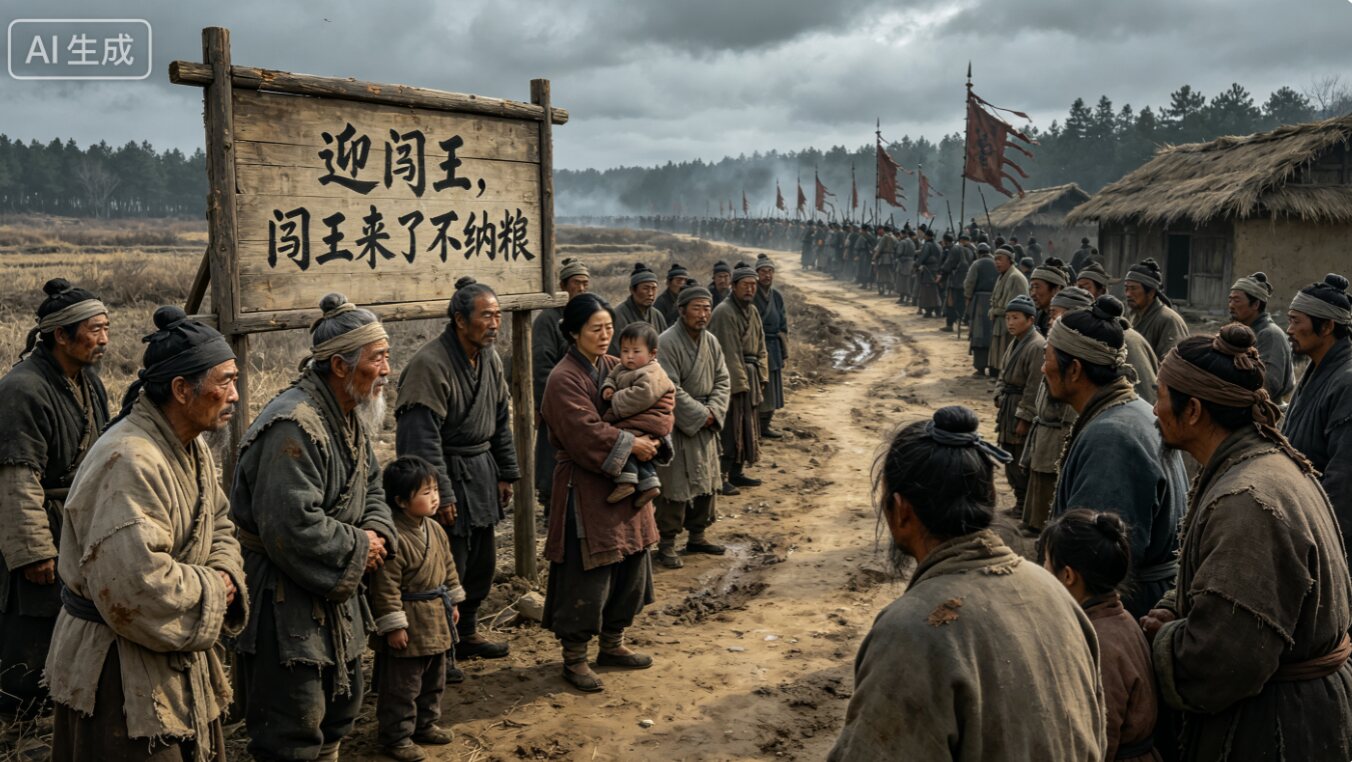
1. The Founding Emperor’s First Goal Was Never “For the People”
Raising armies in turbulent times, the Liu Bangs, Li Yuans, and Zhu Yuanzhangs first had to face not “the people’s suffering,” but the old dynasty, other separatist forces, and violent competitors on the same starting line. The realm wasn’t saved — it was fought for. Territory means land, population, taxes, and corvée labor, that is, an endless stream of ruling revenue.
“Saving the people from fire and water” is of course a good slogan; it can rally hearts, lower the cost of rule, and make more farmers willingly plow the land and hand over grain. But if it were purely for the people, there’d be no need at all to fight for imperial power and monopolize the realm’s resources, let alone launch wars to wipe out rivals. You could perfectly well occupy a region, pacify the people, and then withdraw from the competition.
But history offered no such option. Because all groups that rise by relying on violence share the same core algorithm: maximizing their own blood-payment. In the algorithm, the people are first a productive resource, and only second an object of service.
2. Bandits and the Authorities: The Same “Raise the Chives” Algorithm
Wu Si’s core subversive point is: the difference between bandits and the authorities is only whether the monopoly on violence is legal; the profit-calculation model is exactly the same. They’re both calculating a blood-payment ledger:
1. One-time plunder (pulling the chives up by the roots) = short-term high returns, long-term blood-payment down to zero
If bandits burn all the fields and kill all the farming households, they can indeed seize all the stored grain and property right now. But with no one to farm the land and the households fleeing, there’s no grain output next year, and the bandits no longer have a stable source of plunder. At the same time, slaughtering the people will force them to band together, inform, and bring large-scale government suppression, and the bandits will pay an extremely high cost in casualties — the cost in lives directly swallowing the plunder’s gains, so blood-payment can turn negative.
2. Restraining plunder and letting people farm (being harvested in batches) = long-term sustained blood-payment
Bandits tolerating farmers’ plowing and not wiping them out is essentially treating farming households and land as “assets” that produce sustainably. The households plow in spring and harvest in autumn to produce grain; the bandits then periodically extract and plunder, with a stable inflow of materials every year; with a way to live, the people won’t resist to the death or proactively report to the authorities, greatly lowering the bandits’ cost of bleeding to death in battle. Stretching out the time dimension, the total return from small annual plunder is far higher than the short-term return from killing and robbing everything at once, achieving long-term maximization of blood-payment.
The mountain-bandit case recorded by Wang Yangming is a classic “raise the chives” operation: by day the households farm, by night the bandits retreat to their mountain stronghold, not thoroughly plundering the villages. This neither destroys farming (guaranteeing annual output) nor leaves the people without a way out, avoiding the people joining with the authorities to suppress them; then after the autumn harvest they come down the mountain to extract grain and property, harvesting in batches. Conversely, roving bandits or marauding armies passing through only do a one-off deal, so they burn, kill, and loot everything clean — after all, they don’t need to depend on this land’s output next year, so short-term plunder maximization is the optimal solution.
The authorities are the same:
- Light corvée and low taxes, building waterworks, pacifying refugees = raising the chives well; you need the people to keep farming and trading so you can collect taxes year after year;
- Heavy tax burdens, layer upon layer of extortion, wartime squeezing = harvesting in advance; when short-term interests take higher priority, they ramp up the intensity of over-extraction, even at the cost of draining people’s livelihoods.
“Legal violence” just dresses this algorithm in a dragon robe and official uniform; what’s written at the bottom of the ledger hasn’t changed.
3. A Key Distinction: “Raising the Chives” Is Only a Means — the People Were Never the End
It’s easy to fall into a misconception here: don’t mistake bandits’ and the authorities’ good treatment of the people for goodwill or compassion.
The book’s core assertion closes the loop again: whether protecting the people or harming them, violent groups are always pursuing the maximization of blood-payment.
- “Protecting the people, letting them farm, light taxes”: is nurturing the productive resource, for the sake of long-term plunder;
- “Harming the people, slaughtering, heavy taxes and over-extraction”: is the choice when short-term plunder yields higher returns and the cost of resistance is lower.
The people are merely the productive tool violent groups use to exchange for revenue, just like chives; whether the tool survives depends entirely on “whether staying alive can create more revenue,” not on the violent group itself wanting to protect the lower classes.
4. Prosperous-Era Benevolent Rule Is a Byproduct, Not the Ultimate Goal
Emperor Wen of Han and Emperor Jing of Han reducing land taxes, Emperor Taizong of Tang restraining corvée and reducing campaigns, Emperor Renzong of Song reducing taxes in disaster areas — these really did let the common people live good lives. But peel away the surface of “benevolent rule,” and underneath is still the precise calculation of ruling interests.
Early Han emerged from the great chaos at the end of Qin, with the population more than halved. If heavy taxes and over-extraction continued, the Han dynasty would quickly repeat Qin’s downfall. The reduction of land taxes during the Rule of Wen and Jing was at its core about restoring population and agriculture, rebuilding a stable tax base, and consolidating the Liu family’s imperial power. Emperor Taizong of Tang, drawing lessons from Sui’s fall, restrained corvée and reduced campaigns; the fundamental goal was to avoid large-scale popular revolt and let the Li-Tang dynasty endure.
The people living and working in peace is a byproduct of consolidating rule, not the ultimate goal.
A few emperors did harbor some simple benevolence, such as Emperor Renzong of Song and Emperor Xiaozong of Ming. But this kindness had clear boundaries: once it touched imperial power, national security, or the core interests of the ruling class, the people’s interests immediately gave way. No emperor would, for the sake of the people, voluntarily give up royal privilege, cut bureaucratic salaries, or disband the standing army.
5. Enlightened Rulers and Tyrants: Two Harvesting Strategies
The value ranking of nearly all emperors in ancient China was:
Stability of imperial power, dynastic succession, the interests of the ruling class > the interests of officials and the gentry > the interests of the common people
The people were always at the very bottom.
A monarch who completely abandons his own ruling interests and puts the people entirely first almost never existed in history. Being able to “restrain the squeeze on interests and not drain the pond to catch the fish” already made one an enlightened ruler; whereas Emperor Yang of Sui and the Second Emperor of Qin chose short-term maximized plunder, levying corvée without restraint and imposing heavy taxes, draining people’s livelihoods in one go, until the dynasty finally collapsed.
So the difference between an enlightened ruler and a tyrant isn’t good versus evil, but a difference in time preference. The enlightened ruler understands delayed gratification; the tyrant only wants to grab everything in one handful. Both are plunderers — it’s just that one is a master of “raising the chives,” and the other a brute who “pulls them up by the roots.”
6. The Reversal of Rebel Leaders: From the Oppressed to the New Oppressors
Uprising leaders from the bottom of society, with their starkest contrast, best confirm this logic.
Li Zicheng shouted “equal land and exempt taxes,” Hong Xiuquan proclaimed “great harmony under heaven,” and the people flocked to them. But once they occupied cities and established power, they quickly began extracting wealth, building palaces, and enfeoffing the powerful, reestablishing a system of over-extraction from the people.
The reason isn’t complex: once they transformed from ordinary people over-extracted by the old dynasty into a new violent ruling group, the underlying logic of pursuing the maximization of their own blood-payment didn’t change. Overthrowing the old plunderers was only so they could become the new plunderers.
This isn’t a sudden mutation in personal morality, but position determining the algorithm. Sitting in that position, holding the machinery of violence, facing the same fiscal pressure, military-pay pressure, and pressure to divide spoils among the powerful — no matter how pure the original intention, the structure pulls people back.
7. The Contemporary Echo of the Blood-Payment Logic
The stories of ancient emperors aren’t far from today. As long as there exists a monopolistic power of distribution or coercion, this “raise-and-harvest combined” algorithm will reappear in a new skin.
In the stock market, the house won’t wipe out retail investors in one go. After cutting one batch, they always pump up a rally to make the venue lively again, so retail investors taste the sweetness and come back with more principal. In the workplace, certain companies won’t squeeze employees dry until they all quit at the first opportunity, but retain a bit of sweetness, a bit of promotion fantasy, so the team can sustainably output surplus value. On monopoly platforms, the occasional small subsidies and membership perks conceded are also just to keep the “harvested ones” in the ecosystem staying and growing.
Looking at it more neutrally, this logic is also embodied in corporate management and social governance: reasonably controlling over-extraction and preserving employees’ basic room to survive is what maintains a team’s sustained output; moderately adjusting distribution and guaranteeing the basic survival of the lower classes is what maintains social stability and long-term economic output. Draining without restraint will ultimately trigger systemic backlash.
The only difference is: what ancient emperors monopolized was legal violence, while what certain modern actors monopolize is market access, data, algorithms, or capital channels. But at the bottom of the ledger, the same line is written — maximization of blood-payment.
8. From Ancient Imperial Power to Modern Hegemony: Is the US a “Stationary Bandit”?
In Power and Prosperity (《权力与繁荣》), Mancur Olson compares the origin of the state to bandits: roving bandits rob and leave, draining the pond to catch the fish; a stationary bandit, after setting himself up as king of the mountain, will instead maintain production order and restrain the intensity of plunder, in exchange for long-term stable tribute. Applying this framework to today’s international system, the US, as the world’s only superpower, shows a striking similarity.
1. The Dollar Tide: Periodic Financial Bloodletting
The dollar is the core currency of global trade, foreign debt, and foreign-exchange reserves, yet the Federal Reserve adjusts policy based only on the US domestic economy. This forms a cycle of “flood tide — ebb tide — bottom-fishing”:
- Flooding (flood tide): when the US economy slumps, it cuts rates and expands the balance sheet; cheap dollars flow into emerging markets, inflating local asset bubbles;
- Raising rates (ebb tide): after US inflation runs high, it hikes rates aggressively; dollars flow back, triggering currency depreciation, reserve depletion, and corporate foreign-debt blowups in emerging markets;
- Bottom-fishing harvest: once other countries’ quality assets fall to rock-bottom prices, US capital re-enters to buy up minerals, enterprises, and core real estate cheaply.
Latin America’s “lost decade,” the 1997 Asian financial crisis, and the turmoil in Turkey and Sri Lanka have all been widely interpreted as products of this mechanism. Former US Treasury Secretary Connally put it bluntly: “The dollar is our currency, but it’s your problem.”
2. Asymmetric Trade: Exchanging Paper Dollars for Physical Goods
The US has long maintained a huge trade deficit, yet can continuously import global industrial goods, agricultural products, and energy. Other countries toil to produce physical goods, and what they get back is often just US Treasury IOUs. By virtue of currency privilege, the US has formed a long-term one-way inflow of resources.
3. Military Hegemony: The Violent Backstop Maintaining the Harvest System
Global troop deployments, alliance systems, and military intervention are essentially about eliminating actors that might challenge the dollar settlement system. Iraq and Libya once tried to conduct oil trade bypassing the dollar, and were subsequently struck militarily; financial sanctions against Iran, Russia, and others are about cutting off their ability to use the dollar system.
4. Rules and Technological Hegemony: Taking the Lion’s Share of Profits
Core patents in chips, high-end equipment, biopharmaceuticals, operating systems, and the like let the US collect high intellectual-property fees from the whole world; the rules of the World Bank, IMF, WTO, and so on are dominated by it, and foreign aid often comes attached with conditions like opening up finance and selling off state-owned enterprises, thereby controlling other countries’ economic lifelines.
5. The Correspondence to the Stationary Bandit
The US won’t plunder all countries at once until they completely collapse — that way the global production and trade system would disintegrate, with no more goods, resources, or profits to draw from. It maintains the basic order of globalization, provides a trade framework, and safeguards shipping-lane security, letting all countries keep producing and trading, and then, by virtue of its dollar, rules, technology, and military advantages, takes the biggest slice of the cake at the distribution stage.
This is completely consistent with the logic of mountain bandits not killing all the farmers and ancient dynasties letting people rest and recuperate: only by “raising” the whole world in moderation can you suck blood stably over the long term and maximize your own interests.
6. A Key Difference: The Analogy Can’t Be Taken to the Extreme
But unlike ancient bandits, the modern globalized system contains genuine elements of mutual benefit: East Asia and Southeast Asia achieved economic takeoff through export orientation, and the flow of capital, technology, and markets raised overall production efficiency. The problem isn’t “no mutual benefit,” but that the distribution of benefits is extremely unbalanced.
In addition, countries also possess limited but real checks-and-balances and exit rights: the BRICS nations pushing local-currency settlement, many countries increasing gold holdings, and establishing regional trade agreements are all reducing dependence on the dollar. Ancient people facing bandits and imperial power had almost no channel to escape or resist; today’s countries can at least choose “not to be fully dependent.”
So a more accurate statement is: the US isn’t a roving bandit plundering without a bottom line, but a “stationary bandit” holding a global monopoly on violence, currency, and rules — it provides order, and also draws excess profit within that order; it maintains the system, but the system’s dividend distribution is heavily tilted toward itself.
9. Seeing It Clearly Isn’t for the Sake of Cynicism
Acknowledging that the primary motive of emperors through the ages and of hegemons is the maximization of their own interests, not the welfare of the people or of the populace of other countries, produces a sense of historical nihilism. But this isn’t meant to deny all civilizational progress, nor to brand everyone a villain.
Quite the opposite: only after seeing the “blood-payment logic” clearly can we more soberly understand why good institutions must disperse power, why violence must be constrained by the rule of law, and why a market economy and fair competition are more reliable than an enlightened-ruler complex or unipolar hegemony. An enlightened ruler’s benevolence is ultimately a matter of probability and personality; institutional checks and balances are the most stable umbrella of protection for ordinary people.
From bandits to emperors, and then to global hegemony, what changes is only the scale and packaging of violence; what doesn’t change is that cold formula:
Whoever controls violence, currency, and rules controls the blood-payment.
And what we can do, after recognizing this formula, is to try to live in an era that locks violence in a cage.
评论
0 条评论