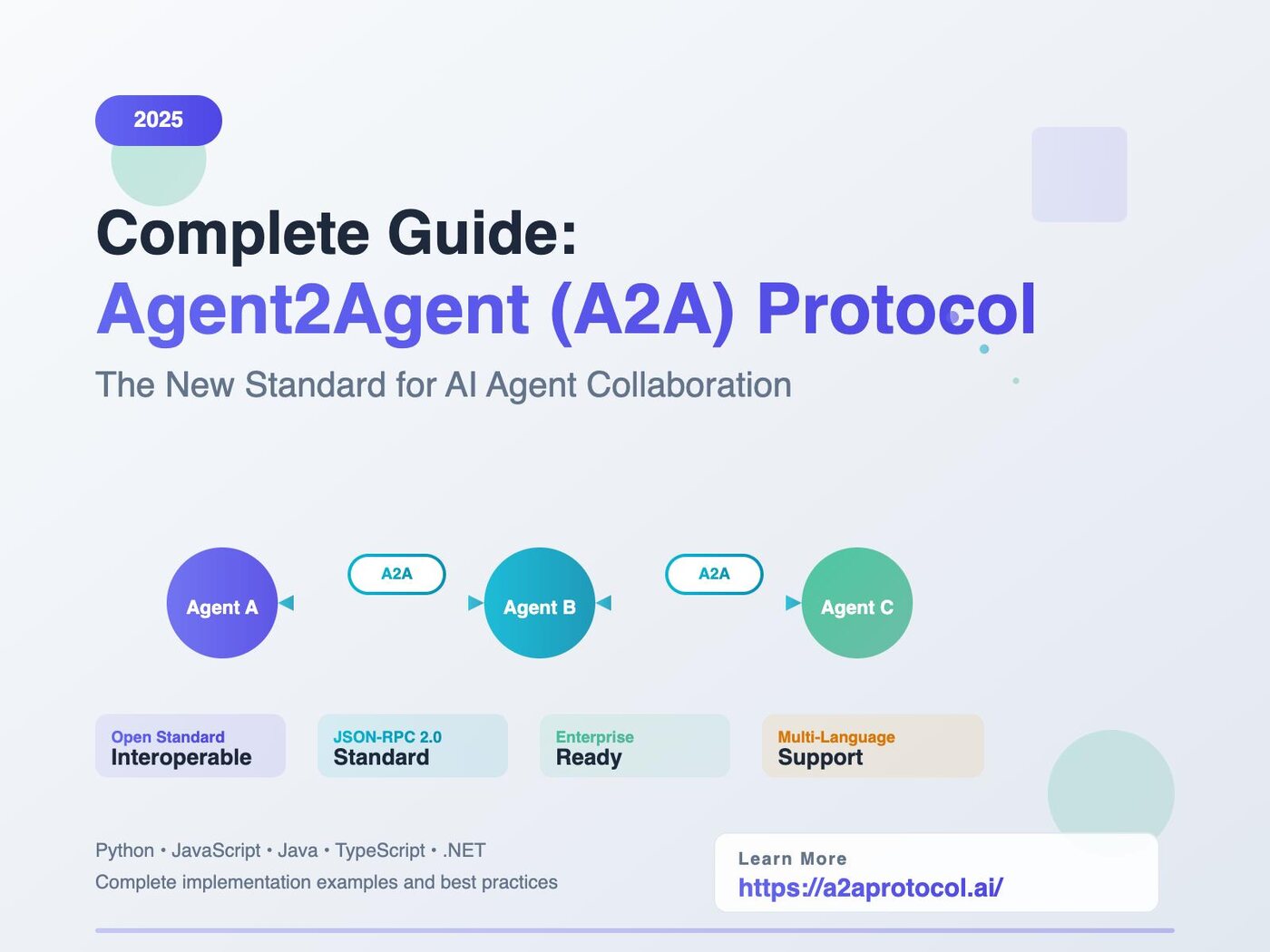
Lately the term “A2A” has been turning up more and more often in AI circles, but a lot of people are confused the first time they hear it: what exactly does A2A refer to?
Actually A2A currently has two mainstream meanings. One is the hottest thing right now, Agent-to-Agent (the AI agent communication protocol), pushed by Google and now placed under neutral stewardship by the Linux Foundation. The other is what traditional IT has long called Application-to-Application (system-to-system integration). This post explains both thoroughly, and — drawing on my own many years of practice in enterprise RPA and automation — talks about its real practical value.
1. The Current Mainstream: Agent-to-Agent (the A2A Agent Protocol)
1. What is A2A?
A2A is short for Agent-to-Agent. It’s an open standard communication protocol released by Google in April 2025 and now placed under neutral stewardship by the Linux Foundation. It has exactly one core goal: letting AI agents developed by different vendors and on different frameworks collaborate across systems.
In other words, an Agent built on GPT, Gemini, Claude, or an in-house enterprise framework no longer needs a pile of custom APIs to delegate tasks to and negotiate work with other agents.
Core positioning: agents collaborate as equals, rather than one simply calling the other as a tool. This is complementary to MCP (Model Context Protocol), not a replacement for it.
2. Why do we need A2A?
Before there was a unified standard, the pain points for enterprises implementing multi-agent scenarios were very obvious:
- Heterogeneous agents can’t talk to each other: the GPT ecosystem, the Gemini ecosystem, LangChain agents, and in-house enterprise RPA/data agents each do their own thing;
- Integration cost is extremely high: cross-department and cross-company agent collaboration requires writing custom interfaces and maintaining large amounts of private protocol every single time;
- No standard mechanisms: no standardized way to discover the other side’s capabilities, track the progress of long-running tasks, or do enterprise-grade permission authentication.
A2A exists to solve these problems. It makes collaboration between agents as standardized as a browser visiting a web page is today.
3. The Four Core Components
The A2A protocol’s architecture is very clearly designed, made up of four main parts:
① Agent Card
A standard JSON file, usually placed at a fixed public path (such as /.well-known/agent.json). It declares to the outside world:
- What capabilities it has
- Where the interface address is
- Which authentication methods it supports
- Whether it supports files, text, or other interaction modes
Key advantage: it exposes only the necessary information — not the internal model, private databases, or prompts — protecting intellectual property.
② Task (a stateful unit of work)
Task is the smallest unit of collaboration in A2A, and it comes with a complete lifecycle:
|
It natively supports:
- Long-running tasks (hours is no problem)
- Streaming real-time progress updates
- Human intervention, pausing, and resuming
It’s not a simple question-and-answer exchange — it’s genuine task-level collaboration.
③ Transport layer (compatible with existing web standards)
A2A doesn’t reinvent the wheel; underneath it’s built on mature web technologies:
- Synchronous requests: HTTP/HTTPS + JSON-RPC 2.0, standard POST calls;
- Streaming real-time output: SSE (Server-Sent Events);
- Optional bindings: gRPC or REST.
For enterprises this means existing gateways, load balancers, and monitoring systems can basically all be reused directly.
④ Enterprise security system
A2A natively supports:
- Bearer Token
- JWT
- OAuth 2.0
- Signed Agent Cards for cross-domain trust verification
It fits very well with real-world scenarios like corporate intranets, multi-tenant isolation, and audit compliance.
4. The Core Difference Between A2A and MCP
A lot of people mix up A2A and MCP, but their positioning is completely different:
| Dimension | MCP | A2A |
|---|---|---|
| Parties interacting | model ↔ tool | Agent ↔ Agent |
| Typical scenario | AI calling a database, RPA, or system interface | Two agents negotiating and delegating a complex process |
| Shape of the relationship | one-way tool invocation | collaboration as equals |
| Example | A large model querying CRM customer data | A finance agent delegates payroll calculation to a compensation agent, then hands it to a legal agent for review |
Put simply: MCP lets AI call tools; A2A lets AI work together with other AI.
5. Typical Implementation Scenarios
Drawing on my past experience doing enterprise RPA and internal system automation, A2A is valuable in at least the following directions:
Multi-function agent collaboration inside an enterprise
The RPA/AI Agents of HR, compensation, finance, and sales can each talk to the others, with work orders flowing automatically — no need for every department to develop its own integration interface.Cross-vendor AI ecosystem integration
An in-house data Agent can directly call a third-party large-model analysis Agent without repeatedly adapting to different vendors’ SDKs.Complex long-process automation
Work orders are decomposed automatically, multiple agents divide up the processing, and progress is reported back in a unified way — achieving genuine end-to-end automation.Cross-organization business collaboration
The client’s sales Agent and the vendor’s supply-chain agent automatically reconcile accounts and confirm orders, cutting out a huge amount of manual communication cost.
2. The Traditional IT Meaning: Application-to-Application
Before AI got hot, A2A had another meaning in the enterprise integration space: Application-to-Application, a general term for the specifications governing automated data exchange between two independent business systems.
It isn’t any single standard but a class of integration patterns:
- Applicable scenarios: data synchronization between ERP, CRM, financial systems, and operations platforms;
- Common implementations: REST API, WebService, EDI, MQ message queues, ETL;
- Core characteristics: mainly one-way or two-way data synchronization, with no capability for “intelligent autonomous negotiation”;
- The biggest difference from Agent-A2A: traditional A2A is programs rigidly passing data, whereas AI-A2A is autonomous agents communicating with each other and dynamically allocating work.
If you see A2A in traditional ERP or financial system documentation, it most likely refers to this application-to-application integration pattern.
3. A One-Sentence Way to Tell Them Apart
- When today’s tech community, or the AI/automation space, says A2A → it means the Agent-to-Agent AI agent collaboration protocol, which has standards and specifications and is oriented toward multi-agent coordination;
- When A2A appears in legacy system integration or traditional ERP integration docs → it means Application-to-Application, a general term for application-level interface integration patterns.
4. The Value for Enterprise Automation and RPA
I’ve spent more than a decade on internal enterprise system development and RPA automation, and the deepest lesson I’ve learned is this: many companies don’t lack automation capability — it’s that the automation capabilities of different departments and different systems are isolated from each other.
The value of A2A is that it provides a standardized collaboration language, letting the Agent/RPA systems that HR, finance, legal, sales, and other departments each built separately be connected at low cost. In the past, integrating any two systems meant writing a whole set of custom interfaces; in the future it may be enough for each side to implement the A2A protocol once, and then intelligent work-order flow across the whole business becomes possible.
This isn’t a simple technical upgrade — it’s turning the “automation islands” inside a company into one intelligent collaboration network.
Conclusion
The A2A protocol is still in a phase of rapid development and ecosystem building, but the direction it represents is very clear: AI is no longer just a set of single-point tools, but organisms capable of collaborating with one another. For people who work long-term on enterprise automation, RPA, and internal system development, understanding and keeping an eye on A2A is a key step in positioning early for the next generation of enterprise intelligent collaboration architecture.
If you’re also working on deploying Agents or RPA inside your company, why not start today by thinking about this: could the automation capabilities you have on hand be connected in the A2A way in the future?
评论
0 条评论