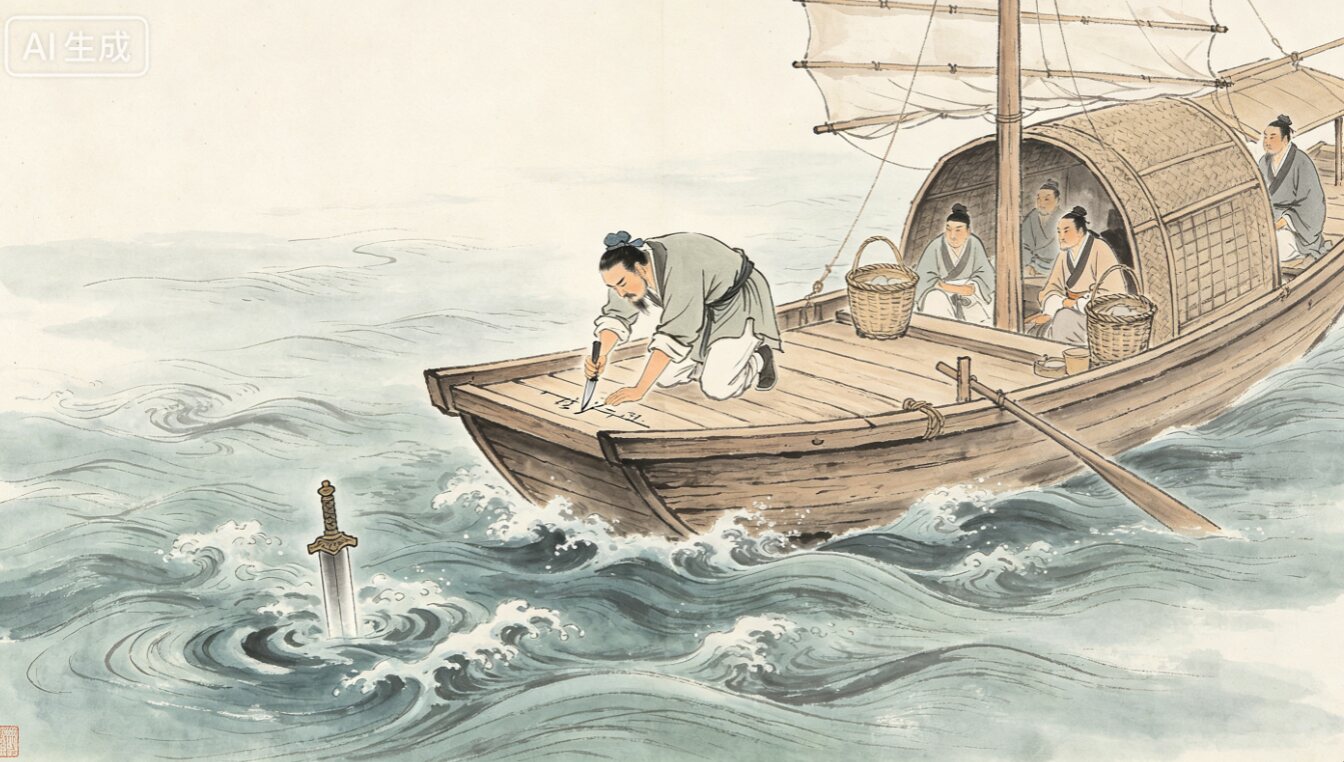
When I read fables as a boy, I always laughed at the foolishness of the man from Chu. A fine sword falls into the rushing river, and instead of diving in at once to retrieve it, he unhurriedly carves a mark into the hull, confidently recording the spot where the sword went down, so that once the boat reaches shore he can enter the water at that mark and search for it. Such a static, rigid way of doing things looks absurd and laughable through a child’s eyes. But as the years went by and I ran the full gamut of what life has to offer, it suddenly dawned on me: this ancient fable, which comes from the Lüshi Chunqiu · Chajin (《吕氏春秋·察今》) compiled under Lü Buwei in the Warring States period, was never a distant antique. It is the truest portrait of modern life.
1. A Thousand-Year-Old Irony in the Original Text
Every word of the original is spare, and together they lay bare the nature of obstinate dullness:
There was a man of Chu crossing the river, and his sword fell from the boat into the water. He hurriedly notched the boat and said: “This is where my sword fell from.” When the boat stopped, he entered the water at the place he had notched to look for it. The boat had already moved on, but the sword had not. To seek a sword like this — is that not bewildered?
(楚人有涉江者,其剑自舟中坠于水,遽契其舟曰:”是吾剑之所从坠。”舟止,从其所契者入水求之。舟已行矣,而剑不行,求剑若此,不亦惑乎?)
In a handful of sentences it exposes the thinking error people commit most often: the world is forever flowing and changing, yet the human mind insists on freezing the past in place. The boat is the era and its circumstances, surging forward; the sword is the goal, the fixation, and the opportunity we long for; and the notch on the hull is the old experience, the old cognition, and the old rules we cling to. The boat has long since drifted onward and the situation has long since turned over, yet we keep staring at yesterday’s mark, trying to find in a changing world an answer that stopped fitting long ago. That is the “notching the boat to seek the sword” of countless people today.
2. Old Maps in the Workplace
The workplace has never lacked people notching the boat. Plenty of workers wallow in their past success and treat yesterday’s achievements as an eternal winning formula. Ten years ago you could get a firm foothold through offline grinding, paper ledgers, and traditional wining-and-dining, so they hold fast to the old methods — refusing to learn digital tools, discarding new ways of thinking about work, resisting new industry models. Now the market environment has iterated, work models have been reinvented, and customer needs have changed enormously. The old path to success stopped working long ago, yet they still hug their outdated work routines and refuse to take a step forward, complaining that the times are unfair and the industry is involuted — never once reflecting that they themselves fell behind long ago.
There are also quite a few managers obsessed with past management templates, answering every project with high-pressure overtime and mass manpower, ignoring what the new generation of employees wants and how market rules have changed, copying old experience onto new problems — until the team scatters, performance slides, and it all ends in futility.
3. Old Creeds in Business
In the marketplace and the commercial world, the same fixation on notching the boat is everywhere. The older generation of brick-and-mortar operators, having ground out years in the industry, believe in the ancient creed that “good wine needs no alley” — they dig deep offline and hold to traditional operating models. In a new era of ubiquitous e-commerce, short-video traffic, and online consumption as the mainstream, the consumption scene, the marketing channels, and customer habits have all changed utterly. Yet they stubbornly refuse to operate online, reject new-style marketing, and guard operating philosophies from years ago, watching foot traffic shrink year by year and revenue grow ever bleaker — and still they won’t adapt.
Worse, some entrepreneurs blindly follow trends, copying other people’s past successful business models wholesale while ignoring today’s realities of market saturation, policy adjustment, and consumption upgrading. They chase the hot new thing with out-of-date thinking, and in the end they burn through their energy and lose money for nothing — nothing more than staging the sword-hunting farce over and over.
4. Old Scripts in Education
In family education, many parents are also stuck deep in the boat-notching predicament. Countless mothers and fathers reflexively apply their own upbringing to their children of a new era. Because they themselves grew up through hardship, struggle, and the rod, they conclude that this method of education is changeless across the ages — ignoring that today’s children grow up in a completely different environment, under completely different psychological pressure, with a completely different cognitive horizon. The era’s education system, its mode of competition, and its atmosphere for growing up have been turned upside down, yet parents still hold to aged educational ideas: eyes only on scores, no talk of method, only accusations that the child is fragile and lazy, unwilling to adjust their approach to the times. In the end they breed endless parent-child conflict and cage their children’s growth.
Some parents also cling to out-of-date ideas about careers, fixed on the hot majors and stable industries of years ago, blind to the rise and fall of industries, forcing a plan onto their child’s life — binding the infinite possibilities of a child’s future with the cognition of yesterday.
5. Old Curves in Investing
Especially in investing and wealth management, countless people are sunk deep in the boat-notching thinking trap. In the years when the property market was red hot, house prices rose steadily year after year and buying was a guaranteed profit, so a lot of people calcified the fixed belief that “buying property always holds and gains value.” Even after the property cycle reversed, the demographic structure changed, and market supply and demand flipped completely, there are still people following the crowd into leveraged purchases at the top, holding on to the old experience that “house prices only go up.” They stare at the price trajectory of the past decade and more, ignoring today’s reality of a cooling market and excess inventory, treating a past industry bonus as an eternal law. They end up catching a falling knife at the peak, watching their assets shrink, and carrying a heavy mortgage — becoming losers in the era’s upheaval. That outcome is exactly the classic farce of guarding an old mark while facing a new situation.
In the stock market, this fixation is even more common. Countless retail investors trade on the experience of past market conditions, believing that “uptrends last forever and following the crowd always pays,” blindly forecasting future returns based on some earlier period of gains. When a certain sector or a certain stock keeps climbing, they copy the money-making logic of the past, ignoring the rotation of market cycles, policy intervention, and the fading of industry tailwinds, and they enter heavy at the top. They keep staring at the profit notches of the past while ignoring the stock market’s essential volatility, using a static historical trend to forecast a dynamic market. In the end the market reverses, the bubble bursts, their principal is trapped, and the losses are severe.
6. Old Warmth in Relationships and Daily Life
Beyond all this, plenty of people in everyday life remain trapped by fixation: a relationship has already ended, the two people’s values have drifted apart and their circumstances are worlds away, the bond is nothing like it was — yet they keep flipping through the old days, clinging to yesterday’s warmth, demanding of a person and a relationship that have long since changed that they meet the standard of what used to be beautiful, and obstinately trying to salvage a past that cannot be reproduced. How many people drown in old sentiments of gratitude and obligation, holding up favors and rules from years ago and demanding that today’s relatives and friends accommodate and compromise, blind to the fact that everyone’s circumstances, status, and situation have already shifted — ending only with wider distance and resentment in the heart.
Holding to stale cognition, trusting blindly in past experience, refusing to adapt with the current — these fixations hidden everywhere in life are all modern people’s version of notching the boat to seek the sword.
7. The Boat Has Already Moved On, but the Sword Has Not
One line from the Lüshi Chunqiu — “the boat had already moved on, but the sword had not” — lays bare the root of all inner friction and all failure. The only unchanging thing in the world is that everything is always changing. The river never stops rushing, the boat never stops advancing, affairs are new every day, and hearts change year by year. No experience, no fixation, no rule can fit every circumstance. True foolishness has never been a lack of ability — it is meeting a dynamic world with static cognition, guarding an expired mark while chasing an answer that has already flowed past.
As a child I laughed at the foolish man from Chu. Only after growing up did I learn that we are all passengers on a crossing boat. Everyone is sailing on the river of the era, everyone loses the “fine sword” in their heart, and everyone has at some point instinctively carved a mark into the hull of their life. But real growth is knowing when to let go of a fixation in time, to discard the old rules, to move with the changing world, and to update your own cognition.
There’s no need to guard the notches of the past, no need to be bound by yesterday’s experience. Change with the current, advance as your heart directs, break fixed thinking, and take in the new knowledge of the era — only then, in the endlessly rushing river of years, can you avoid being trapped by the past and confused by the present, and find the answer to life that belongs to right now.
评论
0 条评论