The tens of millions of laws, moral codes, rules, and notions of justice in the world pile layer upon layer into the surface appearance of social order, looking fair, constant, and self-evidently right. But strip away all the civilizational polish, the Confucian homilies, and the institutional articles, and hidden underneath is one unchanging ultimate meta-rule: the one with the most violence gets to decide. This isn’t worldly prejudice and it isn’t a slant on human nature. It is the fundamental rule that determines every secondary rule, the underlying game-theoretic logic running through ancient and modern, connecting history and present reality.
1. What Violence Means Today
The violence here was never only the physical coercion of blades and slaughter, of troops and campaigns. In ancient times it was the imperial monopoly on the power of life and death and the brute force of punishment; today it is the resource control that monopolizes markets and the economic say that grips survival. The birth, amendment, retention, or abolition of every rule, and the definition, interpretation, and selection of every justice, has never been measured against the yardstick of public morality — only against the core of maximizing the strongest party’s interests.
2. The Meta-Rule Underneath the Chinese Empire
Look across a thousand years of order and chaos, rise and fall in the Chinese empire, and the meta-rule is always the unchanging base color. When Emperor Wu of Han adopted Dong Zhongshu’s three memorials on heaven and man, exalting Confucianism alone and dismissing the hundred schools, later generations mostly took it as the victory of sage morality and the establishment of benevolent orthodoxy. That’s not how it was. Dong Zhongshu’s entire argument never once tried to prove Confucianism an absolute truth. It only spelled out one thing, over and over: Confucianism’s core of ranked hierarchy and loyal, know-your-place subjects fits best the stability needs of a unified imperial power, and it can avoid the rapid collapse that befell the Qin from relying purely on Legalism and overdrawing on violence.
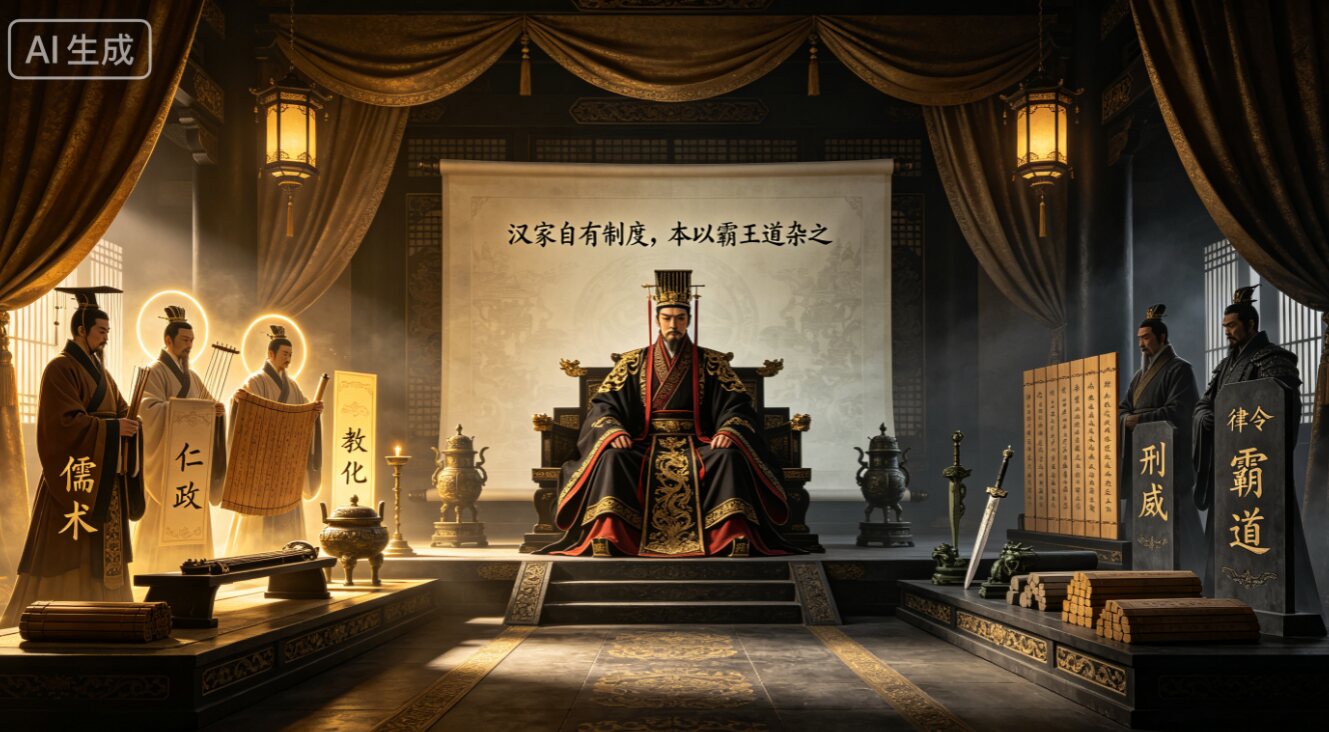
Han emperors never sincerely practiced the Confucian kingly way in full. Emperor Xuan of Han’s line — “the House of Han has its own system, fundamentally mixing hegemonic and kingly ways” — tore off all the disguises of ritual teaching. Confucian benevolence and moral instruction were the surface rules displayed outward, a gentle instrument for disciplining the masses and softening conflict; Legalist severity, imperial statecraft, and the deterrence of violence were the underlying foundation of domestic rule. The kingly way is the flashlight that decorates order, used only to illuminate and constrain subjects; the hegemonic way is the trump card that sustains power, keeping the ruler forever exempt from the rules. So-called orthodox thought and official justice were never natural truths — only the optimal instruments of rule selected by whoever holds the most violence.
3. Zhu Yuanzhang: The Meta-Rule Performed Naked
Zhu Yuanzhang’s conduct of government displayed the essence of the meta-rule to perfection. He summoned the great Confucian scholars to work through the Tang code, revising it article by article and polishing it repeatedly into the Great Ming Code (《大明律》), establishing a written legal system for the whole realm and building what looked like a fair, orderly system of social rules. But an emperor holding ultimate violence was never bound by the laws he himself made. He separately compiled the Da Gao (《大诰》) of severe and brutal penalties, punishing outside the law, extending guilt by association at will, and placing his personal will above the law of the state.
When Mencius’s reciprocal view of justice — “if the ruler regards his ministers as dirt and weeds, then the ministers regard the ruler as bandits and enemies” — touched the core interests of absolute monarchical power, Zhu Yuanzhang’s response was blunt and cruel: he removed Mencius from the honored place in the Confucian temple, strictly forbade officials to remonstrate, and ordered Confucian scholars to cut and revise the entire Mencius, hacking out eighty-five passages that constrained the ruler’s power and argued that the people are precious and the ruler light. He remade the official standard of justice with his own hands, erasing completely the two-way check between ruler and minister, and keeping only the one-way ritual discipline of loyalty to the throne. This is the ultimate power of the meta-rule: the strong don’t merely make the rules — they can revise justice itself.
4. The Rupture Between Rank, Rights, and Cognition
The boundaries of rank and rights in a society have always been man-made gradations drawn by the strong, not a fixed and unchanging heavenly principle. The ancients laid out a strict hierarchy: a county magistrate occupies one mu, a commoner occupies one fen, a slave occupies one li — ranks clear, seniority and juniority in order. This forms the first layer of cognition through which people initially see the world: a mountain is a mountain, water is water, and the established order is assumed to be naturally reasonable.
But the nature of power is expansion, and the instinct of interest is plunder. Those at the top who hold control will always quietly nibble away at the living space of the weak: a greedy and harsh magistrate keeps squeezing commoners’ rights, compressing the legally allotted one fen down to two or three li, so that his subjects’ actual condition is worse than a legally recognized slave’s; meanwhile a household servant attached to the power at the very top, riding the momentum of “a seventh-rank official at the chancellor’s gate,” holds actual resources and actual say far beyond those of an ordinary county magistrate.
At that point rank and reality rupture completely, and people enter the second layer of cognition: a mountain is not a mountain, water is not water. All the clear boundaries of status, all the rules of rights, all the standards of justice lose their absolute force. So-called seniority and juniority, fairness, and morality are all flowing, tamperable tools serving the interests of the strong. Language and naming are the products of cognition and also its traps: people use black-and-white labels to divide social strata, yet can never define the gradated oppression of power, and can never find the qualitative tipping point where a commoner becomes a dependent — simply because all the rules were built in the first place to serve the strong party’s right of control.
5. Invisible Violence in Modern Society
This meta-rule never expired along with ancient imperial rule. It simply changed into a gentler, more concealed form and persists within modern society and the modern workplace. The ancient troops and punishments have become today’s market monopolies, resource barriers, and control over performance metrics; the emperor’s exclusive privileges have become the rule exemptions of capital and management.
Monopoly platforms write bullying clauses, raise their take rates at will, and use big data to price-discriminate against loyal customers, unilaterally breaking the market rules of fair exchange. Companies adjust performance targets casually, occupy labor without pay and extract it excessively, and tighten the space for choosing work — gripping employees’ survival through economic control. On the surface they preach workplace justice of fair competition and pay according to work; underneath, what runs is still the meta-rule that the strong decide. Rules are the flashlight used to constrain the weak; the capital and managers who write the rules always hold a natural right of exception.
6. Backlash and Balance: The Third Level of Cognition
But acknowledging the cruelty of the meta-rule doesn’t mean falling into total jungle nihilism. The order of the world has its own balancing tension. Whoever holds the most violence can unilaterally make rules, define justice, and squeeze the weak, yet cannot escape the long-term backlash of the group at the bottom. The choices available to commoners and the weak — from enthusiastic support and docile obedience, to passive work slowdowns and voting with their feet, all the way to rising up in resistance when driven to the wall — raise the strong party’s cost of ruling and of doing business layer by layer.
In the short term, the strong can exploit their control to benefit themselves at will and break through rules, with nobody able to check them in the moment; but over the long run, the collective behavior of the weak continuously corrects the order, forcing the strong to adjust the rules, restrain their plunder, and reshape their narrative of justice. This is the third level of cognition: a mountain is still a mountain, water is still water. We see clearly the cruel essence that power sets the rules and interest sets justice; we’re no longer blinded by surface morality, and no longer fixated on the fantasy of absolute fairness. At the same time we understand that disorderly plunder eventually meets its backlash, and that order forever iterates and evolves through contest and balance.
7. Taming the Meta-Rule
The progress of civilization is, in essence, one continuous process of taming the meta-rule. The unrestrained private violence and imperial coercion of ancient times were taken into public hands by modern rule of law and locked in an institutional cage; the disorderly expansion of capital and the arbitrary plunder of market power are continuously constrained by antitrust law and legislation protecting workers’ rights.
The meta-rule is the base color of human society. It cannot be rooted out entirely, but it can be checked, regulated, and tamed. Seeing clearly the essence of “whoever holds the most violence gets to decide” isn’t endorsing injustice or submitting to power. It’s seeing through the real origin of all morality and all rules and stepping out of the black-and-white cognitive trap. Only by understanding the underlying logic of order can you penetrate every disguised pitch, view the world’s gains and losses, class differences, and imbalances of rules with a clear head, hold your bottom line in the contest, expect fairness while staying lucid, and — after seeing the cruelty plainly — still hold the progress of civilization in awe.
评论
0 条评论