
Back when I read the ending of Those Things About the Ming Dynasty, it was easy to be struck by that famous line:
“So-called century-long fame, thousand-autumn hegemony, eternal glory — compared with one thing, they really amount to nothing. There is only one success: to live your life in your own way.”
The whole book casts Xu Xiake as an ideal symbol who broke free of the imperial-examination shackles and stayed true to his heart. After the closing curtain on three hundred years of Ming court intrigue, power struggles, and dynastic rise and fall, Xu Xiake’s travels across mountains and rivers become one of the book’s most infectious touches of romantic brightness.
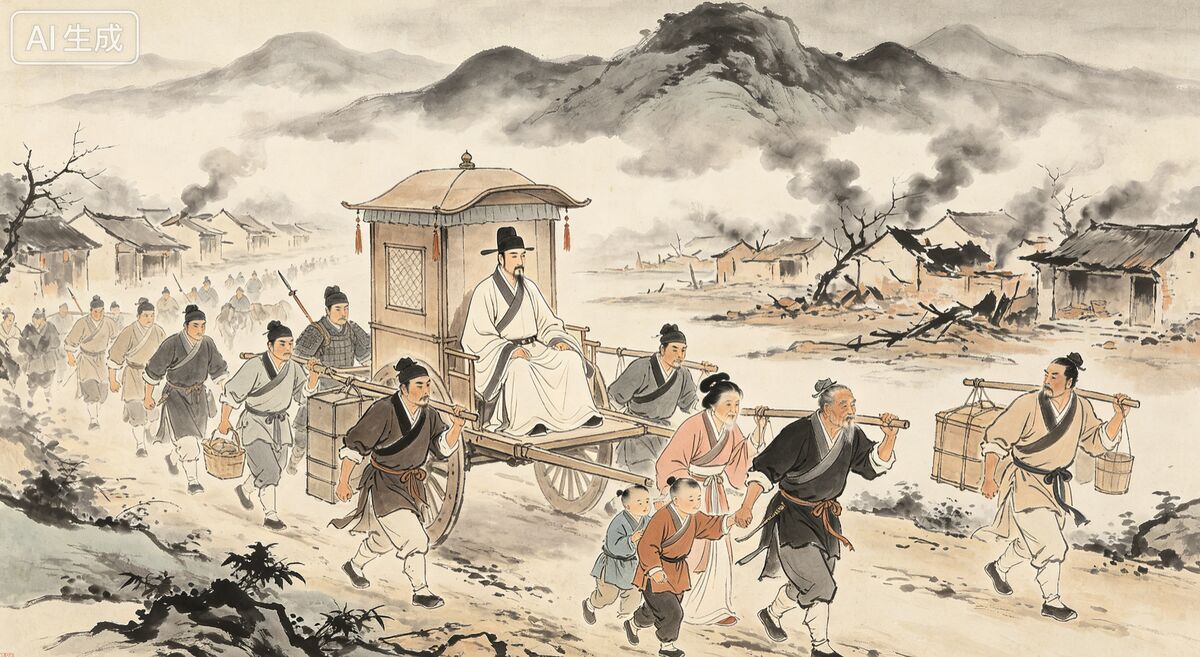
Reading this when young, one can hardly help a naive question: traveling across most of China, crossing mountains and rivers, being away from home for years on end “tourism shopping” — what kind of deep family wealth could support that? Only after flipping past the romantic narrative and comparing the original text of The Travels of Xu Xiake with Wu Si’s analysis in The Law of Blood Pay did the full picture come clear: aside from the financial resources of his own Jiangnan landlord family, a considerable share of the costs of his journeys rested on the postal-relay system of the late Ming, which had already rotted through completely. Armed with official horse tallies gifted by officials, corvée resources meant strictly for public business were diverted to private use — conscripting villagers to carry sedan chairs, demanding food, lodging, and supplies, and when common people fled into the mountains to escape corvée, seizing them and coercing them into service. Part of the price of this dashing journey through the mountains and rivers was passed directly onto rural commoners at the bottom. Mainstream narratives celebrate the individual’s spiritual pursuit, yet often leave out the ordinary people being squeezed behind the privilege.
Following the thread of the postal-relay system’s collapse, the logic of the Chongzhen Emperor’s decision to cut the relay stations also becomes clear.
By the late Ming, the postal-relay system had long since strayed from its original institutional purpose. No longer simply serving public business, officials, celebrities, and their relatives and friends could enjoy corvée provisions for free as soon as they got hold of a horse tally, while local common people groaned under the burdens apportioned to them. The court’s finances were strained; Chongzhen saw the enormous drain of the relay stations and chose to abolish them. But the reform dared not touch the real vested interests — the gentry and bureaucratic class that issued horse tallies recklessly — and dared not constrain the privileges of those at the top. The blade in the end fell only on the lowest-ranking relay runners, and great numbers of people at the bottom who made their living from the relay stations lost their livelihood. As it happened, the northwest was stricken by disaster everywhere; among the unemployed relay runners was Li Zicheng, who in the end set off an uprising that swept the realm.
From this it’s easy to raise a further question: is it true that nearly every empire, once it reaches its middle and later period, cannot escape this script? Land is continually annexed by the powerful and privileged, the bottom is squeezed, taxes are piled on layer after layer, and finally the entire system collapses with a crash.
And the Huang Zongxi Law happens to distill this cycle into an incisive summary. It comes from Huang Zongxi’s Ming Yi Dai Fang Lu · Tian Zhi III (“Waiting for the Dawn · On Land Systems, Part Three”), which Qin Hui generalized as the Huang Zongxi Law: the court, with the original intention of reducing the people’s burden, pushes through tax reform — simplifying tax categories and consolidating collection. After running for some time, the old burdens have not truly been abolished, merely renamed, and new levies and surtaxes pile up layer upon layer, so that in the end the people’s burden rises rather than falls. This is the so-called harm of accumulation that can never be reversed.
Zhang Juzheng’s Single Whip Law is a textbook case: merging land tax, corvée, and miscellaneous levies into a single silver payment, with the original intent of reducing official extortion. But by the end of the Ming, corvée had come back to life under various names, and on top of that were piled the three surcharges — the Liao, the suppression, and the training levies. Old taxes still there, new taxes springing up everywhere, all of it pressing down on self-cultivating farmers already on the brink of bankruptcy. What reform changed was paperwork and nomenclature; it never constrained the privileged class that extracted the benefits. A reform meant to lighten burdens ended up becoming a tool for making them heavier.
The formal institutions are written in lofty terms, but reality evolves a whole set of implicit rules. The paper rules are “white”; the practical configuration negotiated through the contest of various forces is “gray” — and the two are often split apart. This historical logic isn’t entirely sealed away in ancient history; it can also shine on today’s workplace reality.
The state’s written Labor Law is equivalent to the contemporary version of “institutional reform”: the law requires social insurance to be paid in full and requires economic compensation when labor relations are terminated in a layoff, in order to protect workers’ rights. These are the public, formal rules.
Do the arithmetic from a company’s perspective: compliant employment means social-insurance costs, layoff compensation, open-ended labor contracts — a series of rigid obligations. When operating pressure rises and the company needs to control costs, breaking the law directly is too expensive, so it turns to maneuvering within the gaps of the system.
Rather than facing and absorbing employment costs, it develops a whole set of gray plays: converting large numbers of positions to outsourcing to sever the employing entity; after two years of service, inducing employees to resign voluntarily and then be rehired, artificially resetting seniority and erasing the future compensation base; suppressing the base salary in the labor contract and moving the bulk of income into performance bonuses; using performance pressure to force employees to quit on their own, thus avoiding dismissal compensation.
All the paperwork is complete, every signature says “the employee’s own free will,” and on paper everything is fully compliant. Nominally it’s cost reduction and efficiency gains, project-based employment; in actual result: the protections the law grants workers are diluted, and the risks and costs of doing business are shifted downward onto the wage workers.
In ancient times, the postal-relay system was originally a public institution of the state, diverted by the privileged class with the price borne by common folk; tax reform was meant to reduce burdens, but since vested interests were left untouched, burdens piled up layer after layer.
Today, labor law is meant to balance labor and capital; some actors, rather than facing the costs the system brings, turn to exploiting procedural loopholes, using a flawless outer shell to dissolve the system’s original intent.
My Two Years as an Outsourced Contractor at a Big Tech Company
This “exploit the procedural loophole” game — I’m inside it myself. I currently work as an outsourced contractor at one of the top internet giants, and the longer I stay, the more I find this mechanism has been designed with precision: nearly all non-core business goes through outsourcing, and many departments at my previous company had long since been filled with outsourced staff too. Outsourcing itself isn’t the original sin — it’s a flexible employment model. But when it becomes a routine means for companies to evade employment costs and transfer operating risk, the flavor changes.
I sit on the same floor of the office building as full-time employees, use the same systems, attend the same meetings, even carry the same KPIs — but my labor relationship is walled off inside another company. When something goes wrong, primary responsibility can be pushed onto the outsourcing firm; when layoffs come, a single “the project has ended” is enough to send me packing without paying the N+1 that full-time employees get; paying the five insurances and one fund at the minimum base is the norm, and year-end bonuses, stock, and promotion paths basically have nothing to do with me; the client can make nearly unlimited demands of me while bearing none of the long-term responsibilities an employer should.
Even more covert are the information asymmetry and managerial dominance. The client knows my performance ratings, my attendance, my output, even my emotional state; while we can hardly learn the project’s real budget, our own real bargaining room, or what other people in the same role are paid. Technical surveillance also seeps into daily life: the OA system records login duration, internal messaging tools leave traces, code-commit frequency is tallied. These tools, originally meant for efficiency management, become leverage for keeping people in line in an outsourcing setting.
Recently I saw a news item: a company in Shenzhen moved employees’ workstations 50 kilometers away — no air conditioning, no ventilation, clocking in four times a day, surveillance throughout. Nominally it was a “normal reassignment”; in reality it was meant to force employees to quit on their own and save the company a severance payment.

This is precisely the contemporary version of the “legal right to harm”: it’s not that they don’t pay you, but that they compress your rights to the very edge of the law; it’s not violent expulsion, but letting you slowly bleed inside the system. Ancient officials collecting customary bribes valued “a thin stream flowing long” — never provoking the taxpayers into revolt all at once. Today’s corporate exploitation is likewise an extraction arrived at through precise calculation: it doesn’t want your life, only your surplus value; it doesn’t breach the legal floor, it just rubs back and forth along it, over and over.
Of course, past and present can’t simply be equated: ancient times lacked effective channels for correction, while today labor inspection and labor arbitration remain real outlets for workers to defend their rights. But the logic of human nature and the contest of interests runs the same.
The power of naming always rests in the hands of the strong. In ancient times, literati circles dressed up the private use of the postal-relay system as an elegant matter of personal favors; today companies dress up the evasion of employment obligations as business-process optimization. The wording is glossy, the labels are clean — but the price is genuinely borne by the weaker side.
Xu Xiake achieved “living his life in his own way,” and behind that romantic life lay hidden costs brought by the privileges of his era; just as behind many glossy corporate financial reports lie prices transferred out through implicit rules.
History doesn’t simply repeat itself in the original form, but if you only change the wording of the rules without constraining the groups that profit, the burden will keep being conducted downward — this ancient regularity is always worth staying wary of.
评论
0 条评论