Last night DeepSeek released the DeepSeek Harness (dsh) developer preview v0.1, open-sourced directly under the MIT license. The first time I saw the line in the official announcement — “Everything is a plugin,一切皆插件” — my first reaction was: finally, someone is seriously taking Agent frameworks down the road of “componentization.”
What Exactly Is an Agent Harness?
Let’s get this concept straight first. The model handles “thinking,” but an Agent that can actually get work done also needs a pile of peripheral capabilities: tool invocation, conversation context management, memory and storage, code sandboxing, execution loops, task scheduling — even a visible, tangible UI.
The collection of these peripheral capabilities is the Harness (agent framework/runtime). What DeepSeek Harness open-sources is exactly this layer — it isn’t yet another model, but the skeleton that assembles “model + tools + loop + interface” together.
Everything Is a Plugin: Not a Slogan, but the Architecture
DeepSeek Harness has only one core design principle: models, tools, skills, sessions, sandboxes, storage, loops, scheduling, UI — all Agent capabilities are composed of plugins, freely replaceable and flexibly recombinable.
That sentence sounds like marketing copy, but it is an architecture-level decision, not just lip service:
- The model is a plugin: today you connect DeepSeek; tomorrow, if you want to switch to another model, you swap the plugin instead of modifying the framework;
- Tools are plugins: adding a tool = registering a capability, with no need to touch the core code;
- Sessions, storage, sandbox, and UI are all plugins too: the entire Harness is a box of building blocks that can be freely assembled.
The value of this design lies in the ecosystem. If a framework’s features can only be added by the official maintainers, its evolution is linear; once “adding features” becomes “writing plugins,” everyone in the community can potentially contribute a block, and evolution grows exponentially. Draw an analogy to VS Code’s plugin ecosystem, and you can roughly grasp the imagination behind this model.
Underneath It All Is the Cordis Meta-Framework
The key that makes “everything is a plugin” possible is the underlying Cordis meta-framework. Cordis handles plugin loading, unloading, and dependency management; the concrete components inside Harness run as plugins and collaborate with each other through “services” and “events.”
The official team also published a design paper: “A Programming Paradigm for Spatiotemporal Composability.” If you’re interested in “how to build composability into the foundation of a framework,” it’s worth a read.
Hands-On: Up and Running With One Command
Getting started is simple. After installing Node.js:
|
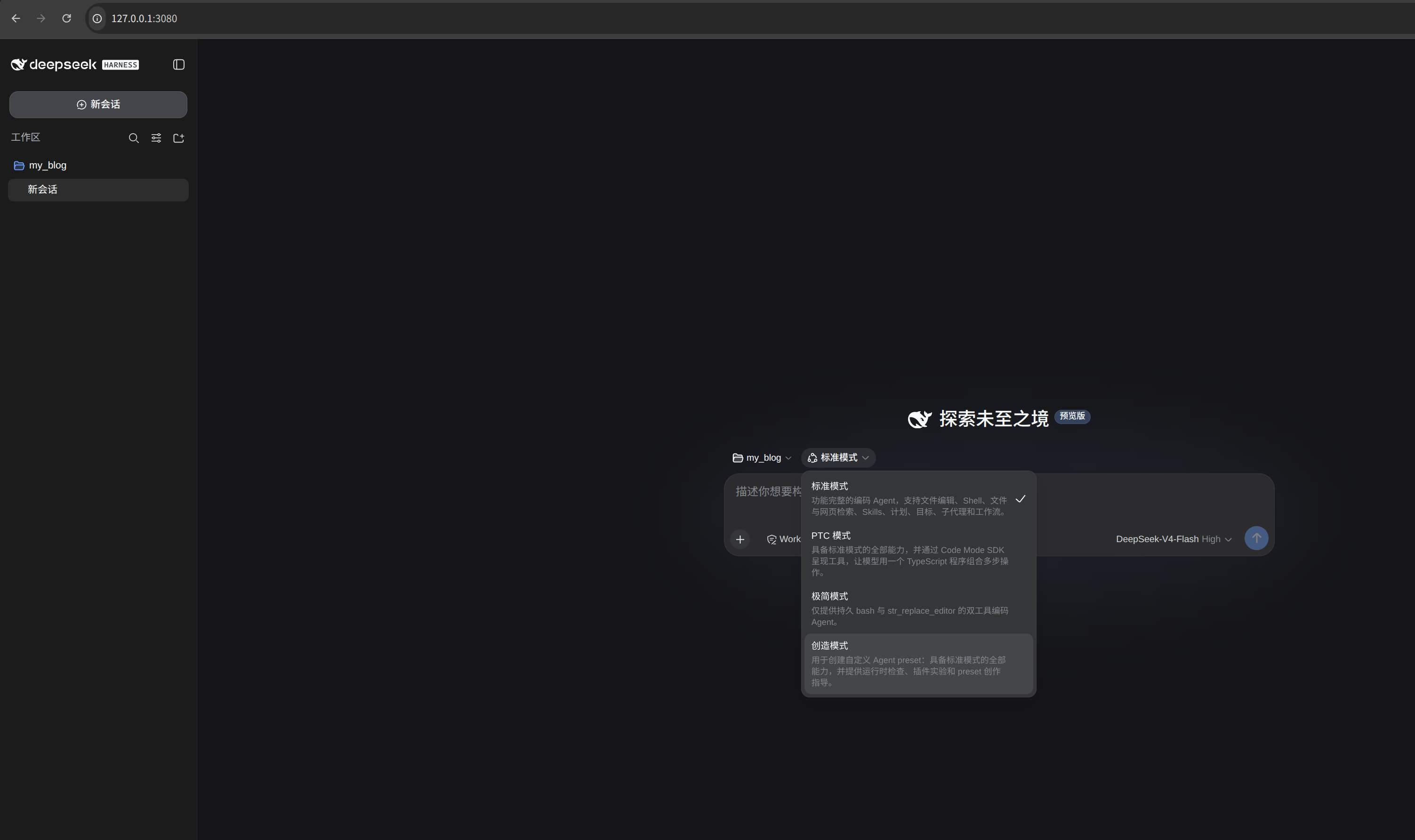
By default this launches the Web UI at http://127.0.0.1:3080. You can also run it from source:
|
The barrier to plugin development is also low: a plugin is just a TypeScript module exporting an apply function. When the framework loads it, it calls apply and passes in the context object ctx, and you simply register capabilities on ctx. After reading the official basic development tutorial, you can essentially write your first minimal plugin.
A Few of My Takes
First, what’s worth looking forward to. Pluginization is a necessary stage on the road to maturity for Agent frameworks. A pluggable Harness means the model layer, tool layer, and UI layer can evolve independently, and developers don’t have to be locked into someone’s all-in-one suite. People in the community are already comparing it with products like Claude Code / Cowork — the direction is similar, but DeepSeek has taken the “plugin ecosystem” idea further, and has simultaneously opened up a matching npm plugin ecosystem.
Now, where to keep a cool head. It is explicitly at the developer preview stage; the official team itself has flagged “breaking changes are coming.” In other words, the plugins you write now may well need rework in a few months. The Cordis meta-framework itself is also still evolving rapidly, and ecosystem maturity will take time. If you want to play with it seriously, my suggestions:
- Lock your versions; don’t chase the latest;
- Focus on learning and contributing; don’t rush it into production;
- Hang around GitHub Discussions — feedback and bug reports are the best nourishment for a preview release.
Closing
Competition among Agent frameworks has already shifted from “whose model is stronger” to “whose ecosystem is more open.” With “everything is a plugin,” DeepSeek Harness has given its own answer — turning the framework into a foundation onto which anyone can stack building blocks.
The preview isn’t perfect, but the direction is right. At the very least, I’m going to install it and write a few small plugins to test the waters.
评论
0 条评论