On the twenty-fourth day of the twelfth lunar month—Little New Year’s Eve in the south—I dragged my suitcase onto the train at Hangzhou West, with my kid, heading all the way west.
We were going to my wife’s home in the northwest for the New Year. Ever since we got married, it had been seven or eight years since I’d gone back to my own hometown for the New Year; every year we went to my family instead. Her parents are getting old, living in Wuwei, and every year they hoped she’d come back, and every year it fell through. This year she suddenly said she wanted to go back and see them, and I said let’s go then—after all, she should spend some time with her own parents too.
And so began this long westward journey. Two big suitcases, almost entirely the kid’s stuff—milk powder, changes of clothes, regular medicines, snacks and instant noodles for the road, plus the dinosaur toy and the tablet he insisted on bringing. Only when packing did I realize that taking a child out is practically like moving house. On top of that, there were the ten-odd jin of winter bamboo shoots my father had dug, buried in sand and packed in a cardboard box, which he’d carried from our hometown all the way to Hangzhou. Bamboo shoots are delicate things—leave them out and they dry up in a few days, so you have to keep them in damp sand to preserve their moisture. My dad said the northwest is dry and has few vegetable varieties, and there’s nothing like this out there, so bring some for the in-laws to have a fresh taste.
At the security checkpoint in the high-speed rail station, I held the suitcase with one hand and the child in the other. He’s only 5 and still constantly wants his dad to carry him; after a few steps he doesn’t want to walk. Holding the kid in one arm and dragging the suitcase with the other, thirty jin of weight made my arm go numb. My wife pushed the other suitcase ahead, clearing the way, and kept looking back to help me with the backpack on the ground. At security, I had to heft the box onto the belt—I bounced the child onto my shoulder and swung the dozens of jin of luggage up with one hand. In that moment I felt like a circus acrobat.
My wife said the northwest winter is much colder than Hangzhou—dry and cold, the wind cutting right through you—and told me to bring a few more warm clothes. Our son, hearing for the first time that we were going to “grandma’s house,” was excited the whole way, asking non-stop: “Does grandma’s house have heating?” “Is there really a desert there?” “Can I build a snowman?”
I couldn’t answer. To me, the northwest was also a strange place. All I knew was that from this moment on, I was taking my family to a city I knew nothing about, to spend a completely different New Year.
Nine and a half hours on the high-speed rail was the longest ride I’d ever taken. The heating in the carriage was running high, and out the window the scenery slowly shifted from the water towns of Jiangnan to the Loess Plateau, the palette fading all the way from verdant green to ashen yellow.
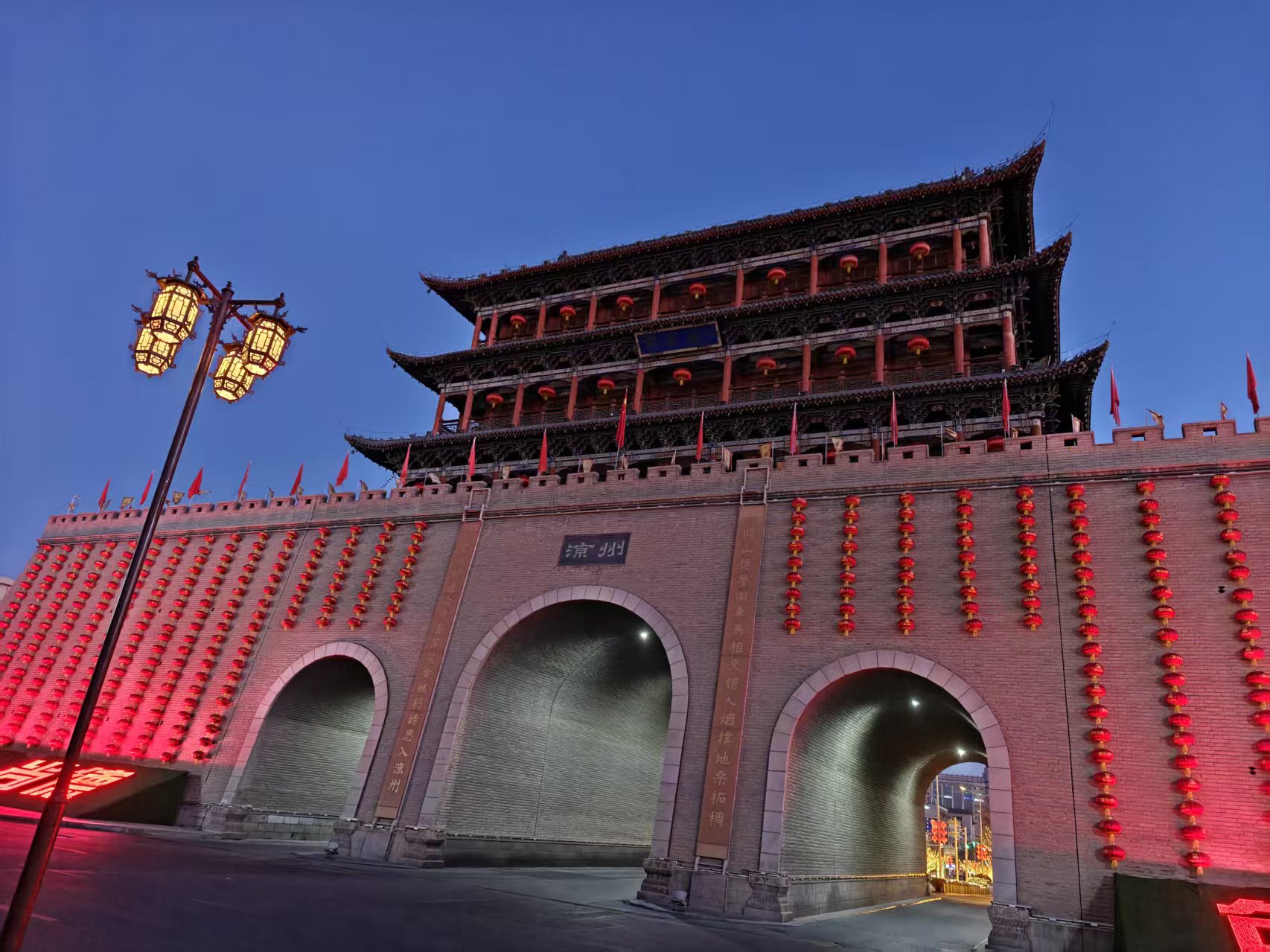
After the full nine-and-a-half-hour ride, we finally reached the transfer stop—Xi’an. This was also my first time in Xi’an. Actually it should have taken only a bit over 7 hours; I had no experience and picked a train that went from Hangzhou West to Shanghai Hongqiao, looped around, and then on to Xi’an, adding a solid 2 hours for nothing.
It was my first time in Xi’an, but stepping out of the rail station I could already feel the city’s thick history. Taking a taxi to the hotel, the driver went along Wenjing Road, and the street sign clearly read “Weiyang Road”—the Rule of Wen and Jing, Weiyang Palace, names I’d only seen in history textbooks, now alive on street signs by the roadside. Outside the car window, the streetlights glowed hazily, lighting the wide, straight road, and in the distance the outline of the city wall stood silently in the night. A capital of thirteen dynasties—every brick steeped in history; a pity time was short and we could only skim the surface.
First we went to the city wall. The road there was interesting—both sides lined with densely packed low houses, red walls and gray tiles, narrow alleys, giving the illusion of being in a Beijing hutong. But look closer and it’s different: the houses here are more solid, the walls higher, exuding a northwestern ruggedness.
Xi’an’s city wall was built during the Hongwu era of the Ming dynasty, a dozen-odd years later than Nanjing’s and a bit smaller in scale—Nanjing’s wall is the longest capital wall in the world, at 35 kilometers, while Xi’an’s is only 13.7 kilometers. But Xi’an’s wall has one advantage: it’s the most complete surviving ancient city-defense system in China—four gates, moat, arrow towers, corner towers, the whole set preserved. Nanjing’s is longer but broken and scattered, many sections strewn throughout the city, without that “one complete ring” sense of awe.
I spent 100 yuan on a ticket to climb up. Honestly it was a bit of a loss—the wall should be visited at night, when the lights come on and it looks good. The section we went to was covered in lanterns, all kinds of shapes—dragons, phoenixes, palace lanterns—lining the whole way, but by day none were lit, hanging gray and dull on the wall, actually looking like clutter. Going up in broad daylight, the brick wall was gray, the lanterns gray, and the wind strong enough to blow you off balance. But we were already there and it felt like a waste not to go up. Standing on the wall looking down, traffic flowing, past and present intertwined—it was a peculiar experience.
After coming down we went to the Giant Wild Goose Pagoda. This pagoda is where Master Xuanzang, after returning from India with the scriptures, presided over translating Buddhist texts—over 1,300 years ago. The pagoda body leans slightly but is still solemn. The north square has a musical fountain, and our son played too wildly by the pool; he lost his footing and slipped, half his body plunging into the water. It was below freezing that day; his pants and shoes were soaked through and he shivered with cold. I didn’t have time to scold him—I scooped him up and rushed to the nearby Joy City. Finding a children’s clothing store, buying new pants, new shoes, a flurry of operations, spending several hundred yuan.
By the time we came out in dry clothes, the boy was fine, but I’d broken a sweat, heart still pounding. This kind of sudden situation is what you most dread when traveling, but when it happens you just have to grit your teeth and deal with it.
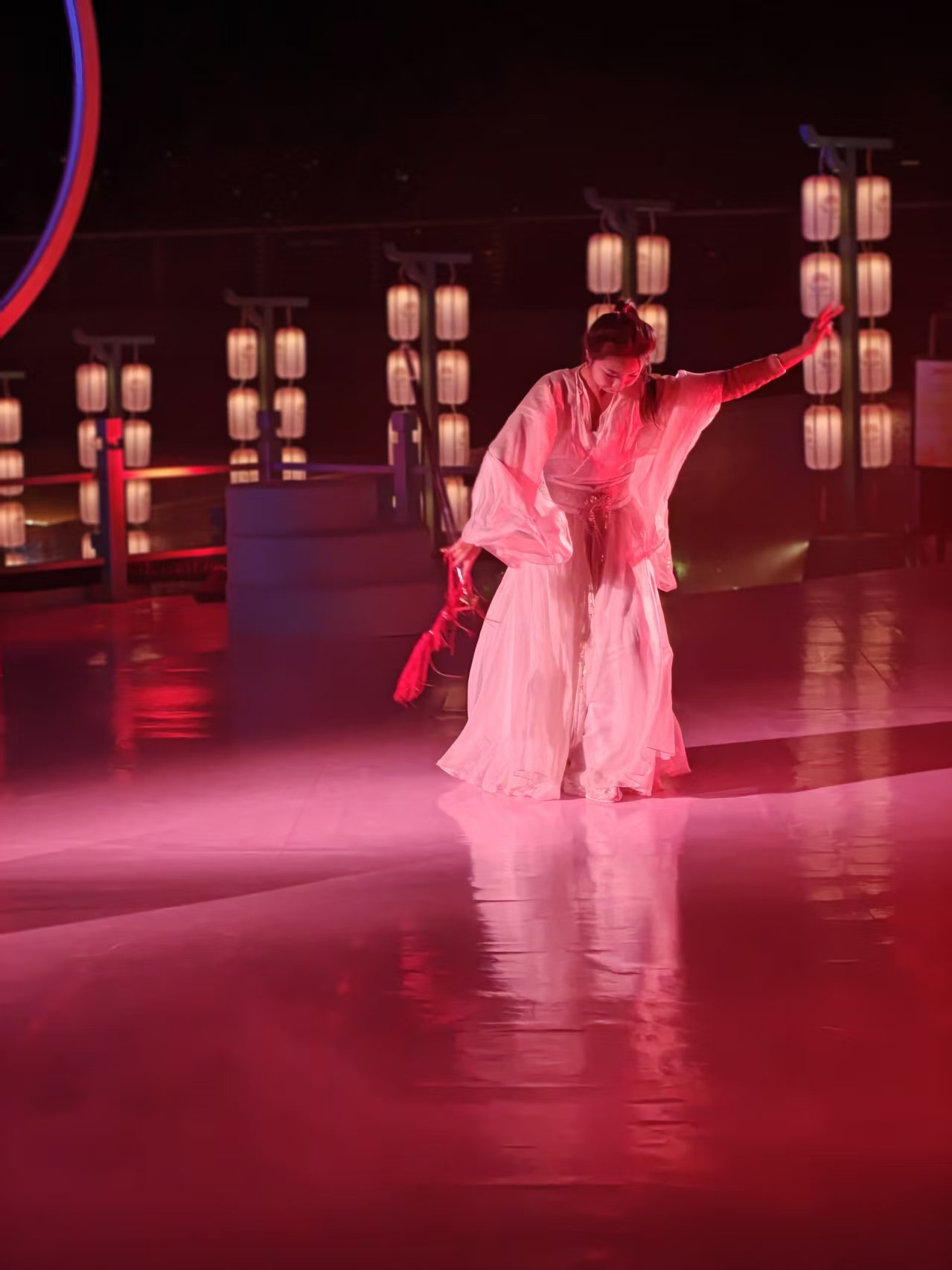
In the evening we went to the Grand Tang Mall and watched a performance. The NPCs were fun—dressed in ancient costume, one suddenly came up and asked, “My lord, from where do you come?” I was taken aback for a moment before I could answer. That street was brightly lit, full of young people in hanfu taking photos, and for a moment it really felt like traveling back to the high Tang. But honestly, I just can’t get used to the carbs in the northwest. Yangrou paomo, roujiamo, liangpi… my friends all say they’re fragrant, but as I chewed I kept missing the bowl of pian’er chuan downstairs from my home in Hangzhou.
The next day was another five-plus hours of high-speed rail, from Xi’an North all the way west to Wuwei East.
This stretch was even harder to endure than from Hangzhou to Xi’an. The scenery outside grew more and more desolate, slowly shifting from the Loess Plateau to gobi desert, occasionally flashing past a few lonely villages with thick loess piled on the roofs. Passing Tianzhu, the altitude unknowingly climbed to over two thousand meters; the watch on my wrist gave a “beep,” and a prompt popped up on the screen—“Altitude Care” enabled, continuously monitoring blood oxygen. I’d always thought this feature useless, never expecting it would actually have its day.
The people in the carriage grew fewer and fewer, and by the latter half it was almost half empty. I leaned by the window looking outside, feeling as if I were being bit by bit cast out of the civilized world, delivered to a rougher, more primitive place.
Arriving at Wuwei East station, the cold wind sobered me up entirely. Out of the station I headed straight to the car-rental point and picked up a Volkswagen Lavida—the most basic kind, without even a backup camera; reversing relied entirely on mirrors and intuition. When inspecting the car, the salesman said prices rose during Spring Festival; 10 days’ rent plus insurance came to nearly 4,000 yuan. I gritted my teeth and rented it anyway—after all, without a car in this place you can hardly move. It just hurt my heart; if it weren’t so far, I’d definitely have driven my own car here—over here I could only drive a “barebones” sedan.
But the next ten days proved the money was well spent. Without this car, I couldn’t have gone to Tiantishan or Dahonggou, and visiting relatives and friends would have been inconvenient too. Only, every time I reversed, I had to have my wife get out and watch, afraid of scraping something.
My wife’s home is in Minqin County under Wuwei, a small place surrounded by desert. The population isn’t large here, and it keeps shrinking—many families in the village have moved away, their empty houses stamped by government departments, long left idle. The environment is too harsh, water scarcer and scarcer, the land drier and drier; those young people who could leave, left.
About Minqin, two things left a deep impression on me. One is the slogan “Don’t let Minqin become a second Lop Nur.” At the end of the last century, Minqin’s groundwater table plummeted, the oasis shrank, and experts predicted the place might vanish like Lop Nur.
The other is the story of Su Wu herding sheep. During the Western Han, Su Wu was detained on a mission to the Xiongnu, exiled to herd sheep at “Beihai” for nineteen years, holding fast to his credentials and never submitting. And this “Beihai,” it’s said, lies within today’s Minqin County. In Minqin there’s a Suwu Mountain, the only mountain in the country named after Su Wu, with a Suwu Temple on it. Over two thousand years ago, Su Wu herded sheep amid this desert and gobi, holding fast to Han integrity—I wonder whether the water he drank back then was as salty as this. A man who endured nineteen years of hardship for his nation’s honor, and the people on this land struggling for survival—there seems to be some fateful echo between them.
We spent a dozen-odd days in the northwest this New Year—my first time not celebrating at my own home. The damp cold of the south and the dry cold of the northwest are completely different things; my lips cracked in three places, and every night before bed I had to apply a thick layer of lip balm. At night my throat was dry and painful as I slept, and in the morning when I woke and spat, it came with streaks of blood. I hadn’t brought a computer, but my hands itched to write code, so I hugged my phone to modify projects and update my blog, and fiddled along the way with that sports-assistant app I’d been working on for a long time. At my wife’s home, frankly, I couldn’t get used to sleeping on the northern heated kang, and neither could our son—we’d be woken by the heat in the middle of the night.
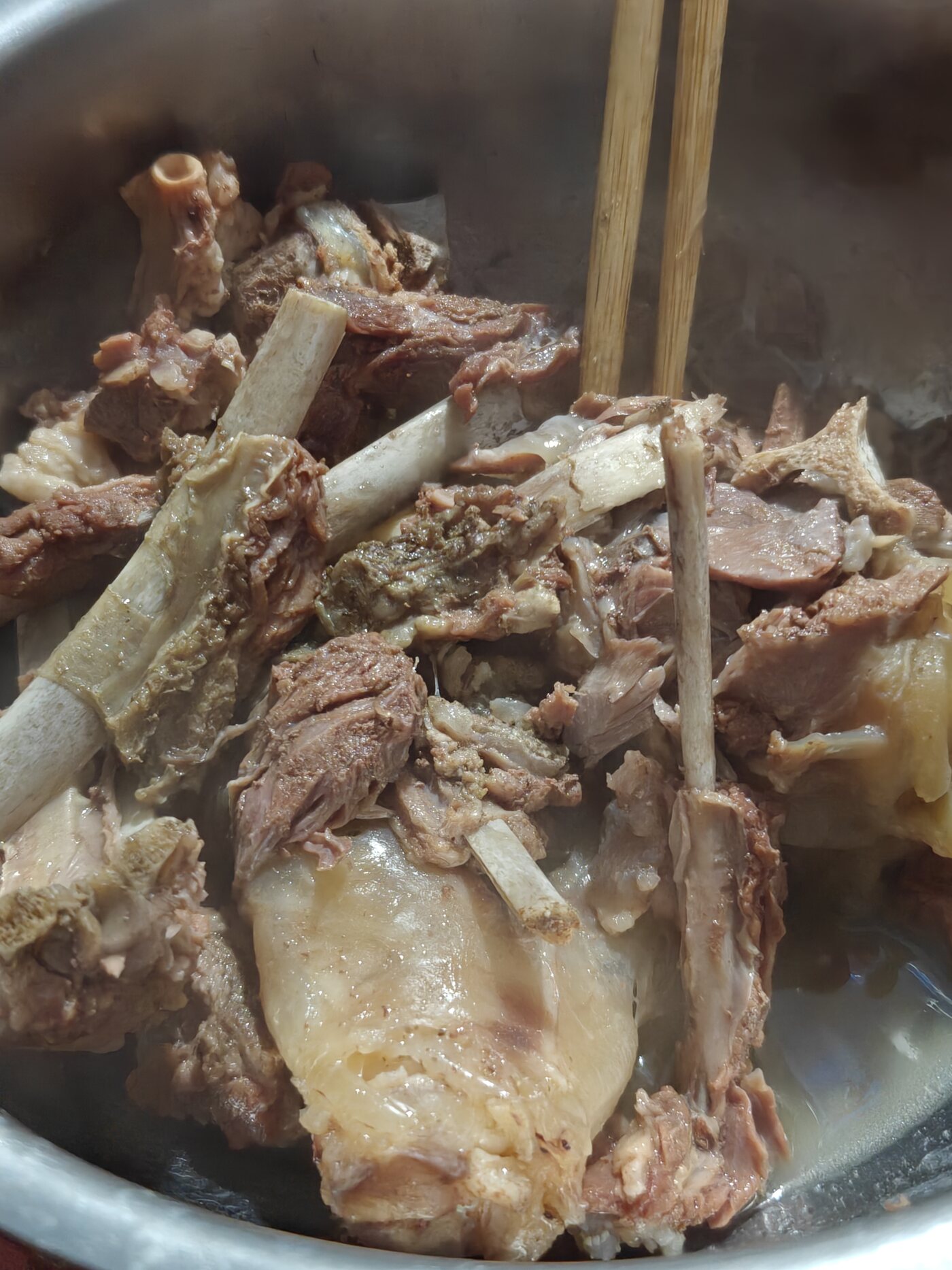
The highest standard of hospitality at my father-in-law’s house is mutton. Boiled in plain water with nothing added, not even salt, and just fished out to dip in vinegar and chili. It was my first time seeing this way of eating, and I was nervous inside—can you eat this? But one bite and it was actually delicious. The meat was very tender, and not gamey at all. I later learned that Minqin’s sheep grow up eating grass from saline-alkali land, so the meat itself has little gamey smell. In Hangzhou I never ate mutton, finding the smell unbearable, but these days at my father-in-law’s place I could even eat a few pieces.
Minqin is severely desertified and short of water. Every household in the village drinks rainwater collected in cisterns; I couldn’t get used to it—there was an indescribable salty taste, and the water quality was poor, rather hard.
Later I figured out why it’s so dry here. Minqin sits in the northeastern part of the Hexi Corridor, with the Wushaoling range running across the east—this mountain is like a giant wall, blocking all the moisture blown in from the eastern coast. The windward slope of the range still gets some rain, but once it hits the leeward slope there’s nothing at all—this phenomenon is called the “rain shadow effect.” Add to that the pincer of the Qilian Mountains to the south and the Tengger and Badain Jaran Deserts to the north, and Minqin becomes an island surrounded by dryness. Annual precipitation is only a bit over 100 millimeters, while evaporation is as high as over 2,000 millimeters; the only plants that survive are drought-tolerant saxaul and camel thorn.
So I had to buy bottled water from the supermarket every day, hauling case after case home. Even drinking water became a luxury—unimaginable in Hangzhou, where annual rainfall is over 1,500 millimeters; a single rain shower would be enough for Minqin to drink for half a year. Looking out the window at the bare hills and the sand filling the sky, I suddenly understood why my wife always said “the northwest is hard”—not being dramatic, it’s genuinely hard.
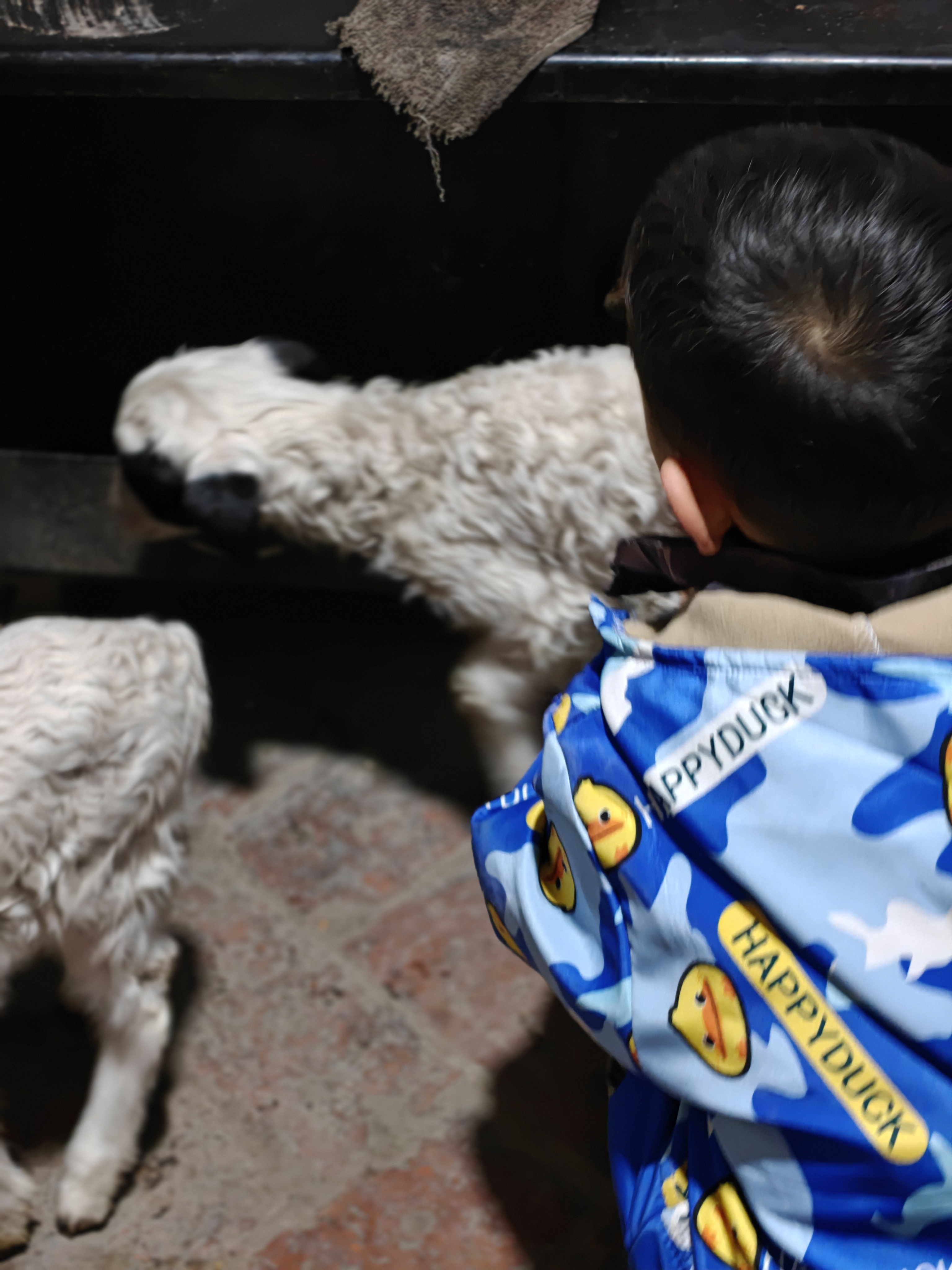
My father-in-law keeps dozens of sheep in the yard. Minqin’s sheep are famous; there’s a saying, “Nine-tailed sheep, boiled in plain water, fragrance under heaven.” This place is pinched between the Tengger and Badain Jaran Deserts, a harsh environment that ironically became the cradle of good mutton—the forage grass grown in saline-alkali land is rich in minerals, and sheep raised on it have tender meat with almost no gamey smell. A simple sheep pen was built in the yard, and every early morning you could hear the bleating. Our son, seeing so many sheep for the first time, was beside himself with excitement, pestering every day to go feed them grass. Even more coincidentally, our visit coincided with ewes giving birth; a few newborn lambs were still toddling, fluffy little bundles, walking unsteadily as if drunk.
Our son squatted on the ground watching the lambs, eyes sparkling, asking whether he could take one home. I told him sheep aren’t allowed on the train; he pouted, turned, and went to chase the slowest-running lamb.
On New Year’s Eve I pasted the couplets together with the kid’s uncle. But honestly, if not for pasting couplets I wouldn’t have felt that the New Year was coming. After dinner that evening, the night was eerily quiet. In my hometown Huangshan, from New Year’s Eve afternoon the firecrackers are nonstop, crackling until the morning of the first day. But in Minqin, only a few scattered bangs, soon fading into silence—pitifully few compared with the south.
The real liveliness came in the small hours. The villagers have a custom: they go tear down magpie nests, bring the nests with their branches and leaves to build a fire, and then the whole family, old and young, jumps over the fire one by one—said to share in the magpies’ good fortune. It’s called “crossing the fire basin.” That night the family set up a table to play cards after dinner, not breaking up until the small hours. Our son wanted to sleep at 10; no matter how we called, he wouldn’t wake, wrapped in the quilt, dead to the world. Just as the game got lively, a burst of firecrackers suddenly sounded outside, and the villagers began walking toward the village entrance one after another. We followed out and from a distance saw a crowd already gathered, firelight flickering in the darkness. Sparks were blown every which way by the night wind, human shadows flickering in the firelight—it actually had a kind of primitive ceremonial feel. When my turn came, as I stepped across I was thinking: humans celebrate the New Year, the magpies get their homes raided—sharing this “good fortune” really feels a little unfair to them. Later I heard from relatives that around the New Year, in the county town a magpie nest can sell for several hundred yuan each, demand exceeding supply—a Spring Festival “hot commodity.” I was silent for a while after hearing this, not knowing whether to pity the magpies or admire this “New Year economy” that adapts to local conditions.
On the third day we went to my wife’s uncle’s house to pay New Year’s respects. The moment we entered we smelled meat filling the house—the aunt had long since stewed mutton and stir-fried a few home-style dishes, hot and steaming, filling a whole table. Northwesterners are down-to-earth; at the table they kept piling meat into my bowl, and I ate until grease ran down my chin—no way to decline even if I wanted.
After the meal, the uncle said he’d take us to look around nearby. The car hadn’t gone far out of the village before we hit a stretch of gobi desert. Feet stepping on the sand, it sank softly underfoot; after a few steps you were out of breath. Our son had never seen a real desert, was wildly excited, squatting on a sand slope playing with the sand, grabbing a handful and tossing it up, watching the wind scatter the grains. In the distance, a few dead saxaul trees, branches twisted, pointing at the sky—a desolate kind of beauty.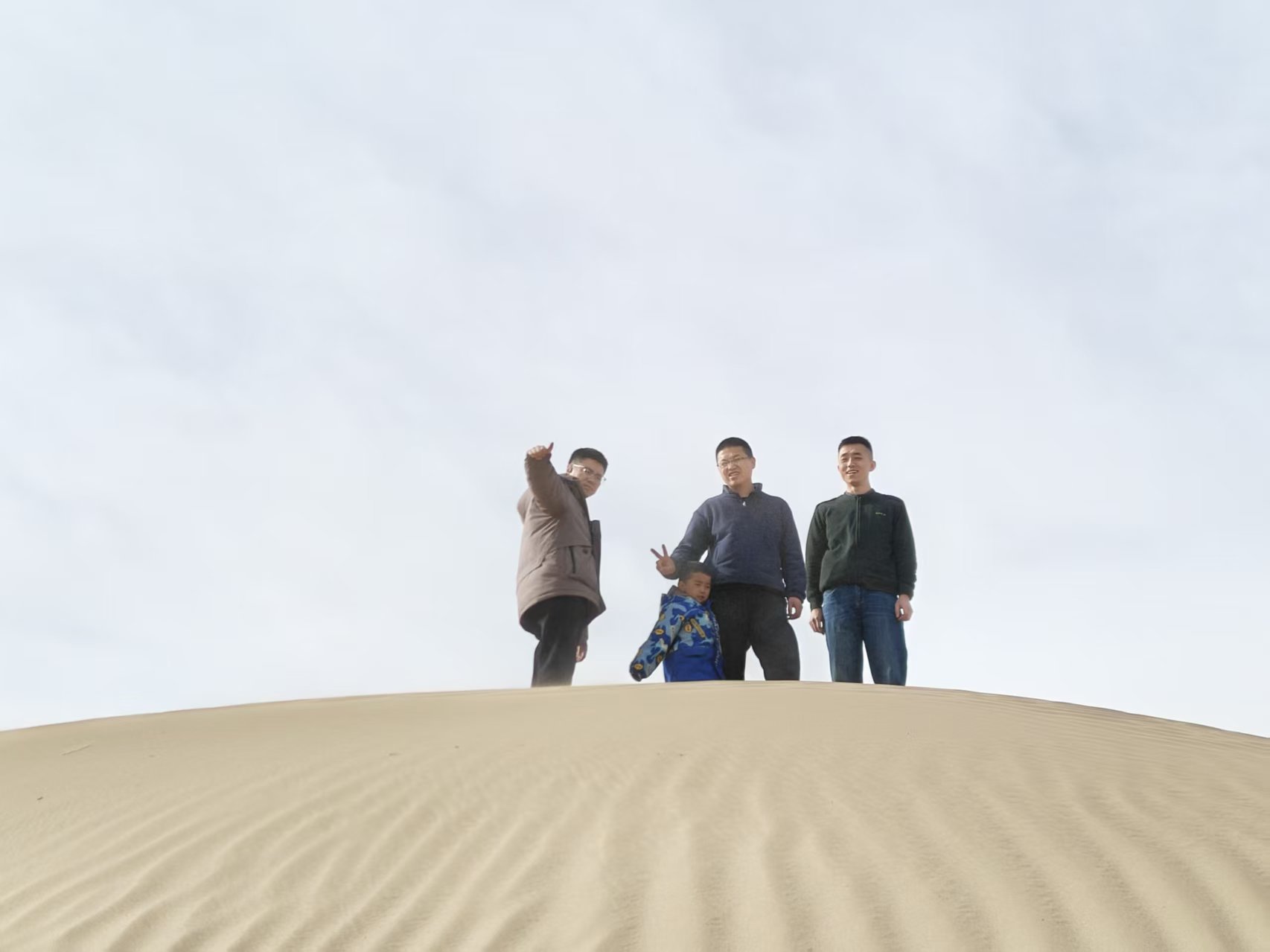
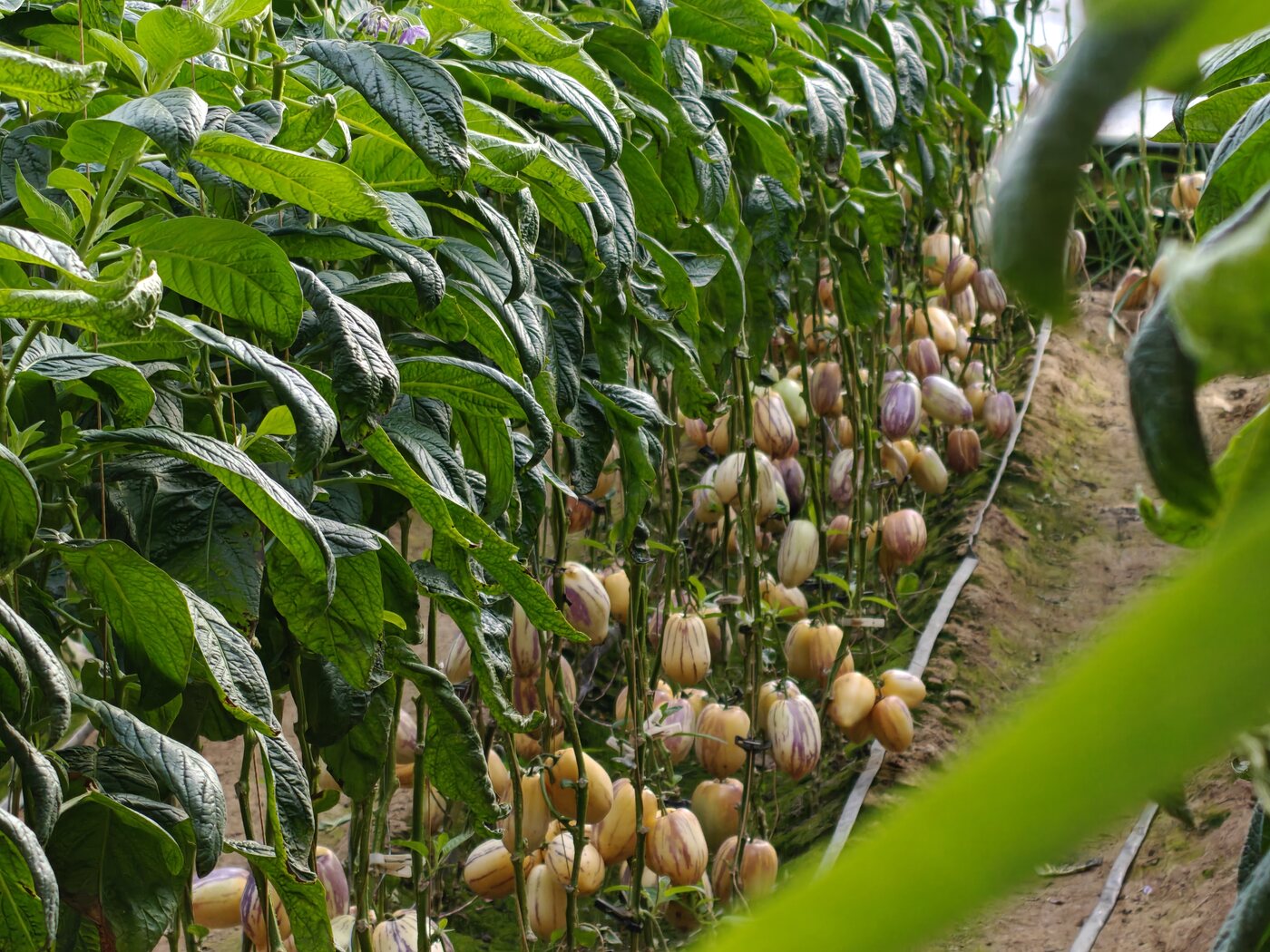
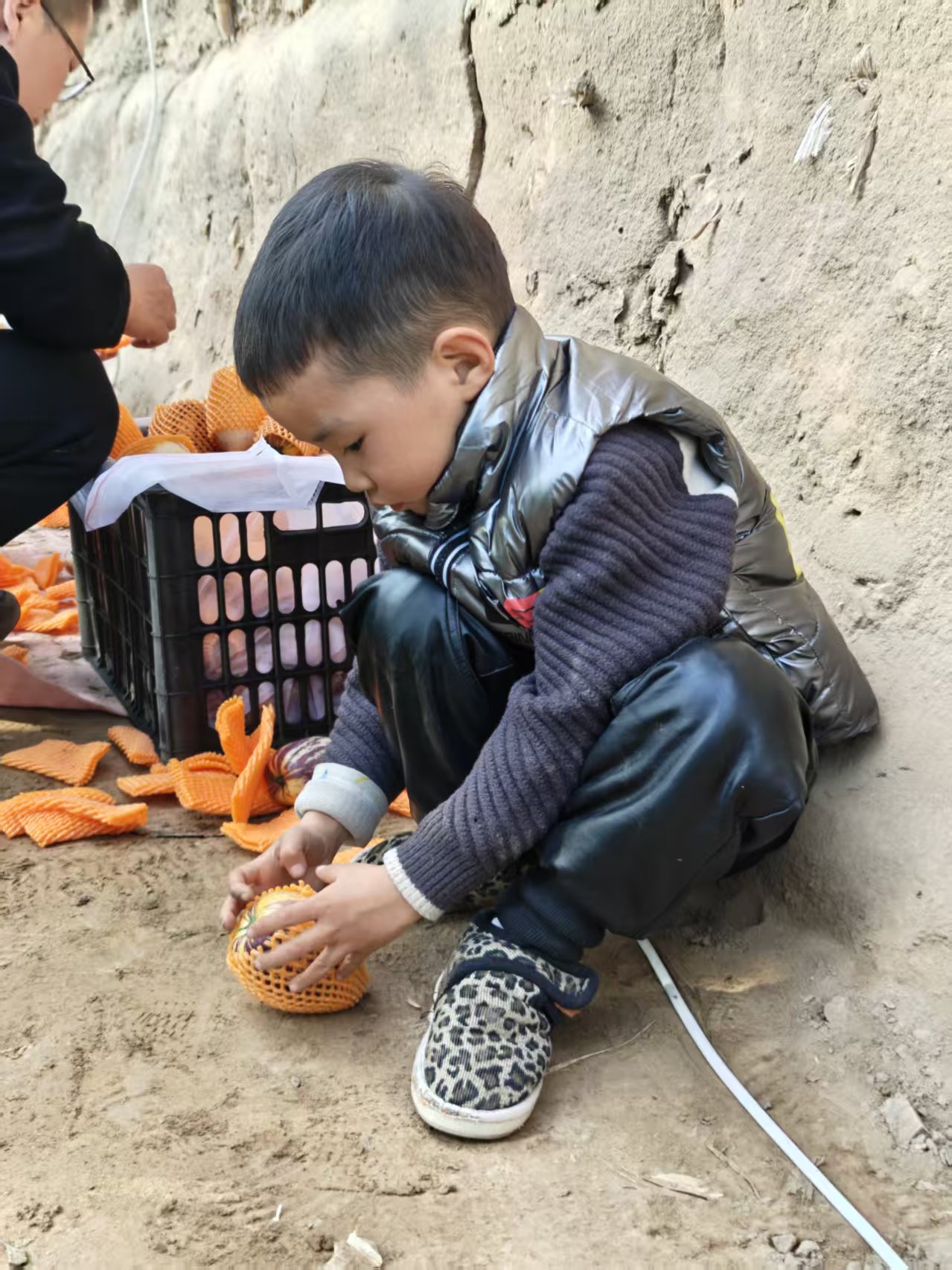
After the desert, the uncle took us to his greenhouse. It turned out he grew pepino melons—I’d only ever heard of them in Journey to the West, never thought I’d actually get to eat them. The greenhouse was hot and humid, rows of pepino melons hanging on the vines, golden-yellow like little lanterns. The uncle said these fruits would be shipped out in a couple of days; we could pick as we liked and take as many as we wanted. Our son perked up at once, brought a small stool and sat by the packing box, imitating the workers, stacking the netted pepino melons one by one into the box, laying a layer of soft paper once a layer was full, so serious no one dared interrupt. I picked a few too and cracked one open right in the greenhouse—the flesh golden, juice running, sweet with a faint milky fragrance. Between packing, our son looked up, saw me with juice all over my chin, and couldn’t resist reaching for one too, squatting by the box, eating while working—far more focused than doing homework.
In our free time we went to look around Tiantishan Grottoes—this year Gansu’s cultural-tourism authority offers free tickets to those born in the Year of the Horse; as luck would have it, I saved quite a bit.
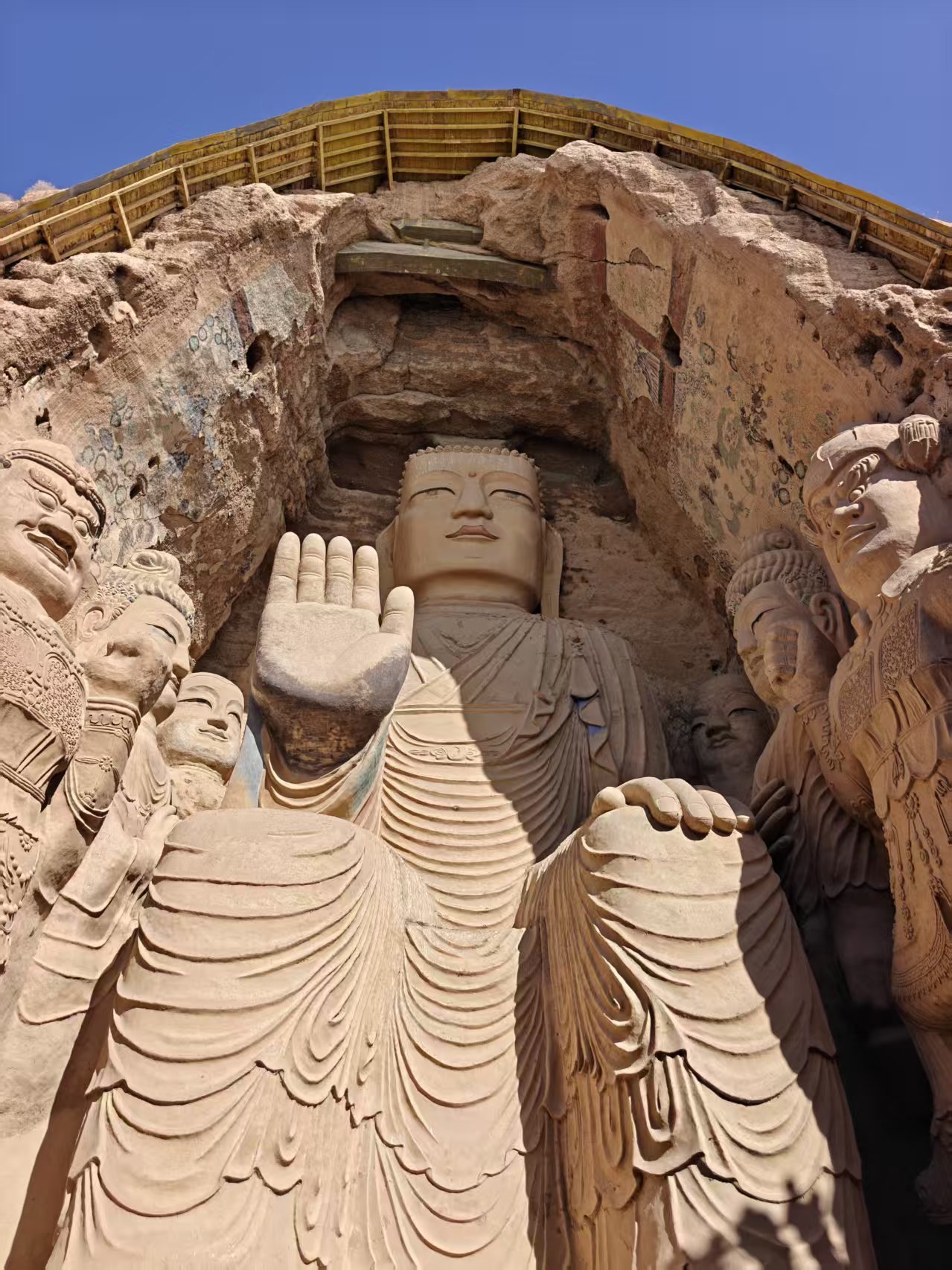
Few people have heard of these grottoes, but their status is far from ordinary. They were carved during the Northern Liang period, over 1,600 years ago, and are called by historians the “ancestor of Chinese grottoes.” The title “ancestor” isn’t given casually—it’s the first royal grotto in Chinese history commissioned by an emperor (Juqu Mengxun, King of Northern Liang), predating even Dunhuang’s Mogao Caves. The eminent monk Tanyao, who presided over the carving back then, later went to Pingcheng (today’s Datong) and presided over the carving of the famous “Tanyao Five Caves” at Yungang. Later still, when Northern Wei moved its capital to Luoyang, those craftsmen carried the technique to Longmen. So the origins of both Yungang and Longmen actually lie in this small northwestern ravine.
Having lived in Hangzhou for so many years, I’ve been to the Feilaifeng carvings in front of Lingyin Temple countless times. Feilaifeng’s grottoes began in the Five Dynasties under Wuyue, five hundred years later than Tiantishan, and the style is completely different—Feilaifeng is cliff carvings on limestone, mainly featuring Jiangnan-flavored subjects like the Cloth-bag Maitreya and the Eighteen Arhats, radiating the nimbleness of a Jiangnan water town; Tiantishan is a great Buddha cave on a loess cliff, the Tang-dynasty Sakyamuni statue 28 meters tall, towering on the cliff, exuding a northwestern grandeur and desolation.
One south, one north; one soft, one hard; one continuing from the Five Dynasties to the Ming and Qing, the other a royal project from the Northern Liang onward.
Beside the grottoes, the Huangyang River Reservoir was frozen with thick ice, a vast white expanse stretching to the foot of the great Buddha. Without rippling water, the great Buddha had no reflection, and was simply mirrored directly on the ice, which actually made it look more solemn. The northwestern wind blew over, and a layer of fine snow on the ice was driven along by the wind like mist. I crouched and touched the ice, my fingertips going numb—the ice was so thick you couldn’t see the water below. This sense of desolation is completely different from the gentleness by Hangzhou’s West Lake—beside the Feilaifeng carvings flows the murmuring Cold Spring Stream, while here there’s only the frozen reservoir and bare loess cliffs.
Standing by the reservoir, I suddenly felt it quite wondrous—there’s a grotto at my doorstep, and after traveling halfway across China I ran into its “ancestor.”
Coming out of the grottoes we went to the Dahonggou scenic area, within Tianzhu Tibetan Autonomous County. The car wound up the mountain, the altitude rising higher and higher, the scenery outside shifting from loess slopes to snow mountains. Reaching the summit, the view suddenly opened wide—a chain of snow mountains right before my eyes, a blinding white reflecting dazzling light in the sun. The air was thin, and after a few steps you were a bit short of breath, but that sense of vastness made you forget the altitude. Our son, seeing real snow mountains for the first time, rolled in the snow with excitement. I stood still, just looking at those peaks, feeling how tiny a person really is—before nature, nothing counts.
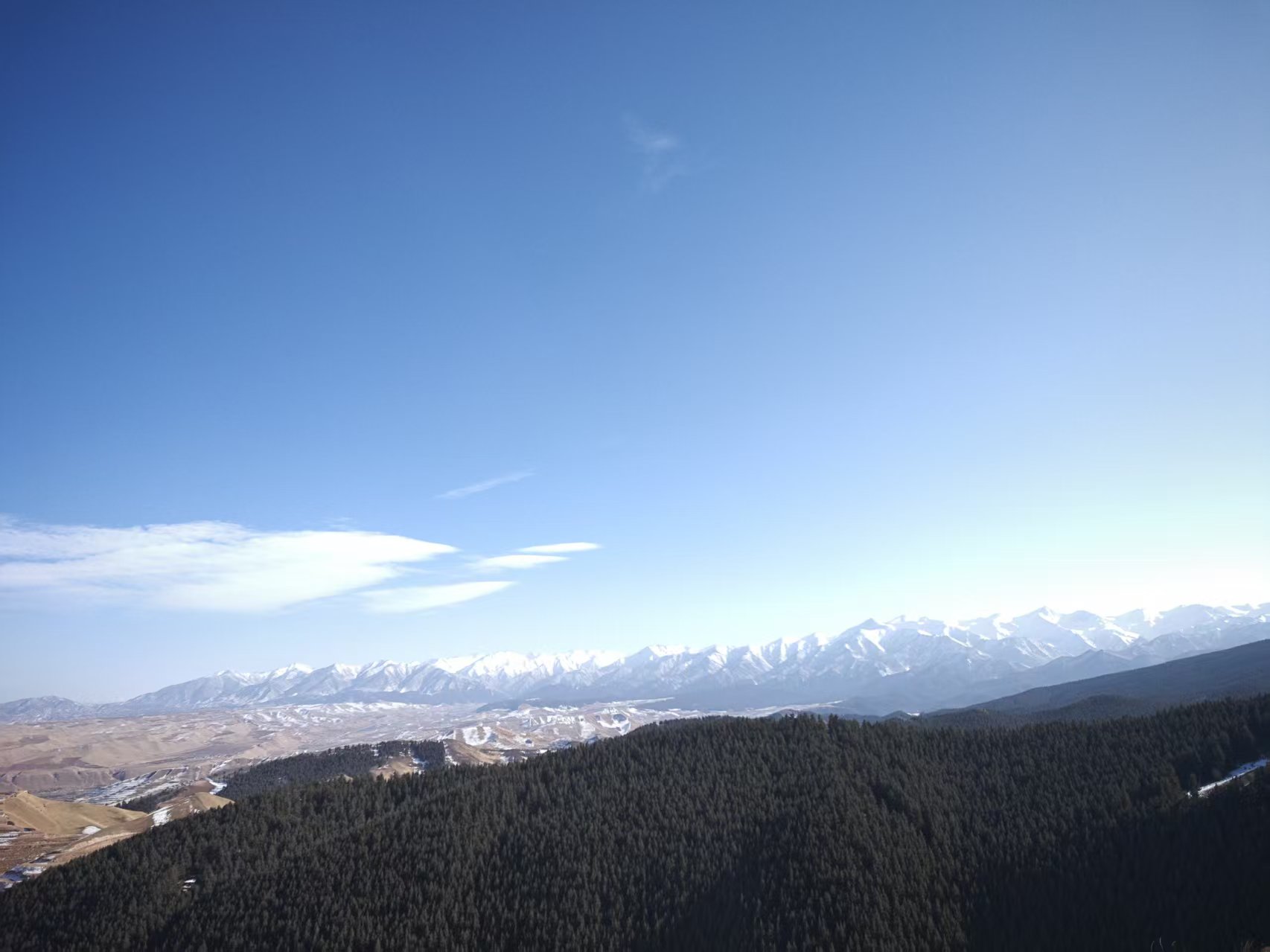
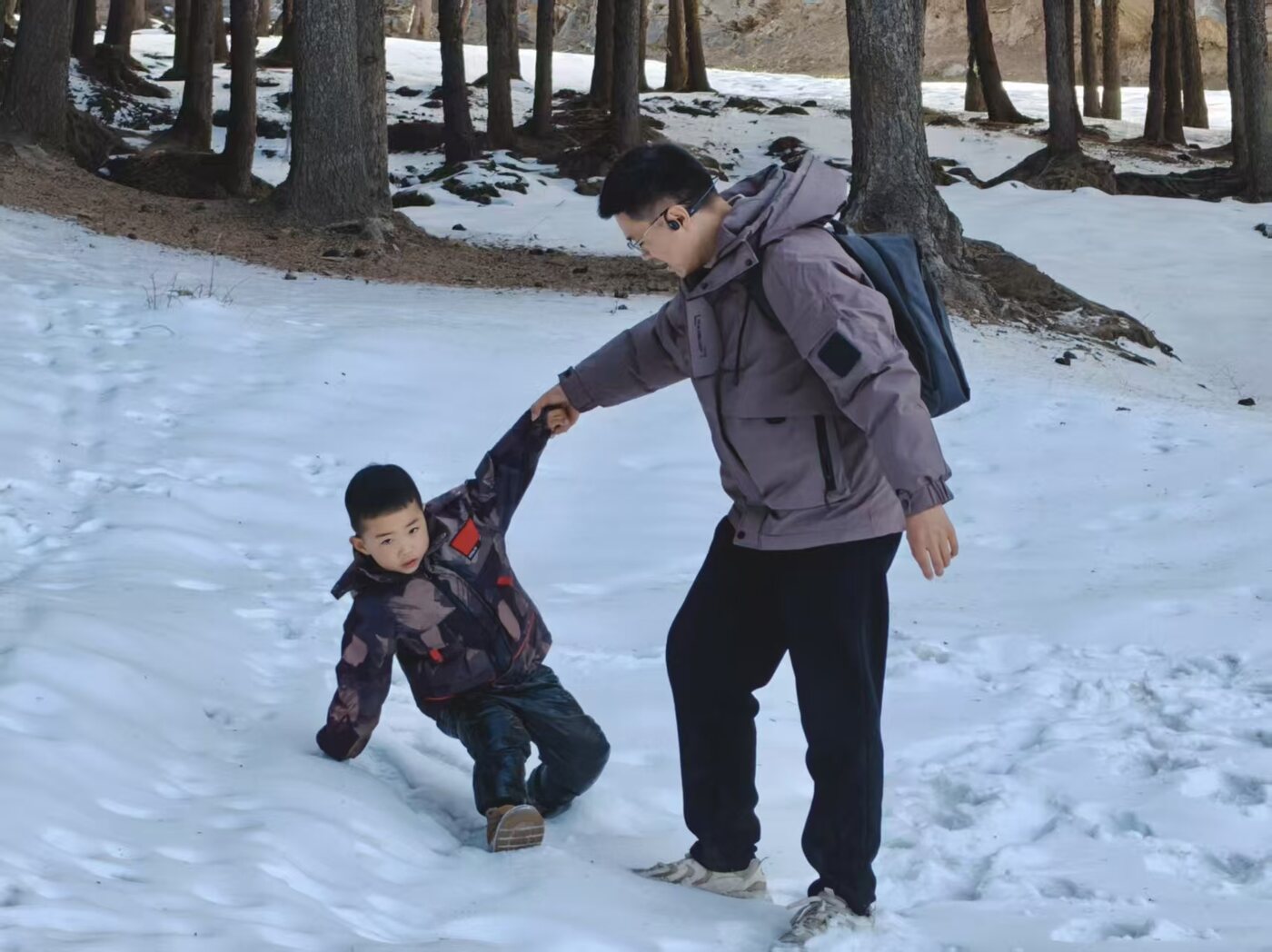
Along the Hexi Corridor line, the sights are scattered but each has its flavor, and most importantly there are few people. Standing before the grottoes as the wind blew, I suddenly understood why the ancients wanted to carve caves and statues here—besides faith, probably also because this place is perfect for daydreaming and thinking things over. Back at the hotel that evening I watched the documentary Hexi Corridor and paired it with the photos taken during the day, feeling the trip wasn’t wasted at all.
The northwest’s sandstorms really live up to their reputation. On the fifth and sixth, the weather was awful, with sandstorms blowing for two whole days. In the morning the sky was already yellow, worsening by midday, PM2.5 badly over the limit, the air-quality reading on my phone off the charts. The wind was strong enough to blow you off your feet, sand stinging your face, your eyes unable to open. I hid indoors, not daring to go out, watching through the window—the whole world was a murky yellow, as if overlaid with an earth-colored filter. The locals were quite calm, saying this was routine fare, a few storms every spring. But this southerner really had his eyes opened—so “eating dirt” isn’t an exaggeration; you really do chew sand in your mouth.
On the seventh day we left Minqin, first taking my mother-in-law to the Wuwei city hospital for a checkup. Arriving in Wuwei, we dropped by her fourth uncle’s house, chatted about everyday matters, then booked a hotel and settled in. Along the way we visited the Leitai Han Tomb.
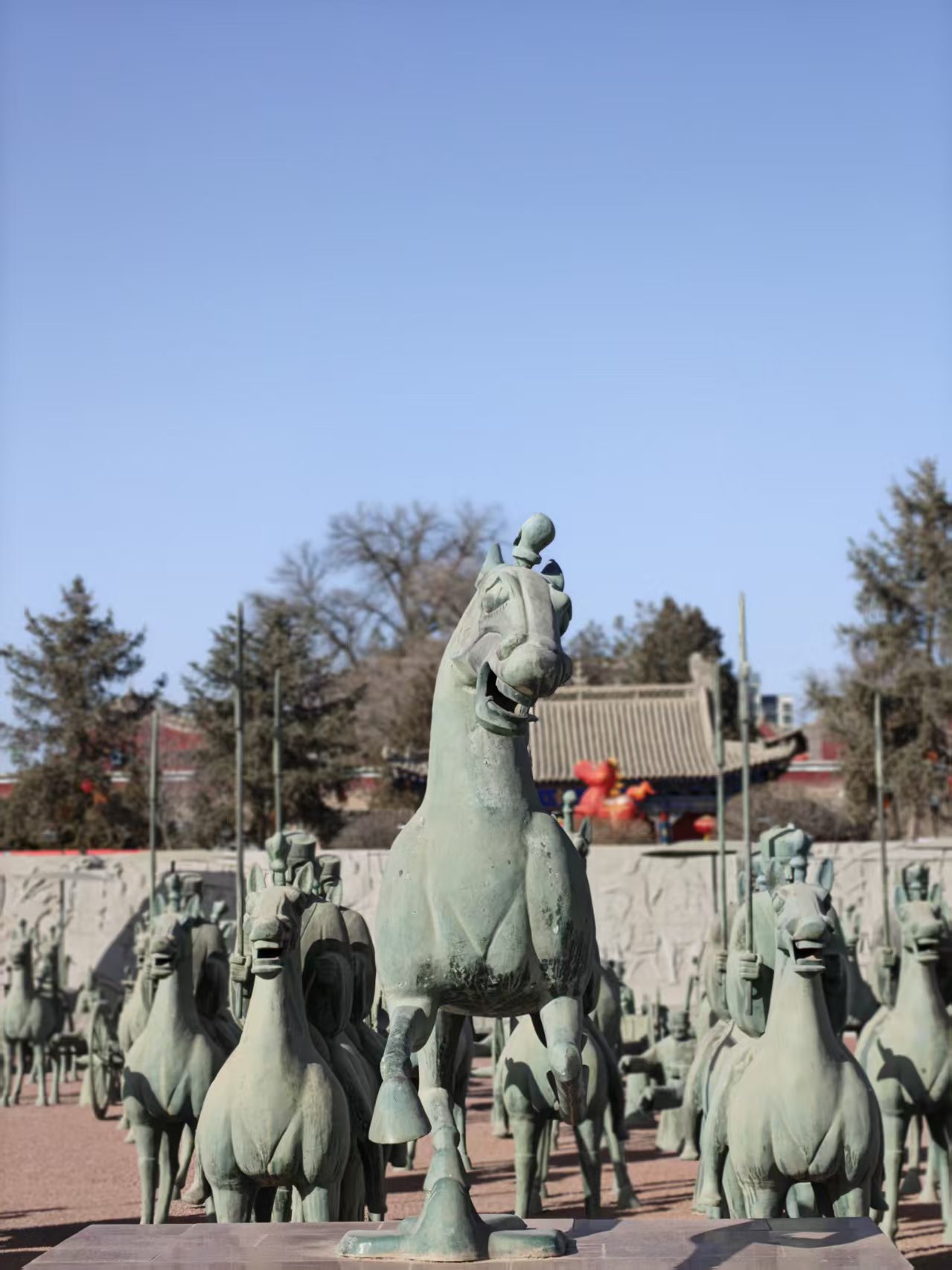
This is where the famous “Galloping Horse Treading on a Flying Swallow” was unearthed. The city of Wuwei—its name itself carries a piece of iron-blooded history: in 121 BC, Emperor Wu of Han sent the cavalry general Huo Qubing on an expedition to the Hexi region, defeating the Xiongnu, and to proclaim his “military might,” named the place Wuwei. Over two thousand years ago, Huo Qubing rode the war horses of the Han empire, galloping across this very land, driving the Xiongnu out of the Hexi Corridor. And this bronze galloping horse—three hooves in the air, one hoof on a swallow—that speed and power seem like a miniature of that iron cavalry of old.
The Leitai Han Tomb is the tomb of a general from the late Eastern Han; the tomb passage is very narrow, so you have to bend down to walk in, and inside it’s cold and damp. But the most striking is that bronze galloping horse—though what you see in the museum is a replica, the genuine piece being kept in the Gansu Provincial Museum—standing there imagining that two thousand years ago a bronze steed was buried here, a flying bird under its hoof, that sense of motion seeming about to burst out of the earth.
In the exhibition hall I stared at the horse for a long time. As a kid the textbook called it “Galloping Horse Treading on a Flying Swallow”; scholars now call it the “Bronze Galloping Horse.” But whatever its name, that sense of power is real. A fine horse with three hooves in the air, one hoof on the back of a flying swallow, all its center of gravity resting on that single point, and yet it stays balanced. This craftsmanship would be top-tier even today.
On our second day in Wuwei, I squeezed out over an hour to take our son to the Confucian Temple.
The Confucian Temple is in the southeast corner of the city, just dozens of meters from my hotel. First built during the Zhengtong era of the Ming, over five hundred years ago, it’s hailed as “the crown of the Longyou academy.” The first impression on walking in was quiet—the northwestern winter is naturally sparsely populated, and in the temple the only sound was the echo of our footsteps in the courtyard. Our son said it looked like a scene from a TV drama—red walls and gray tiles, ancient cypresses reaching the sky, the air carrying that distinctive smell of old wood.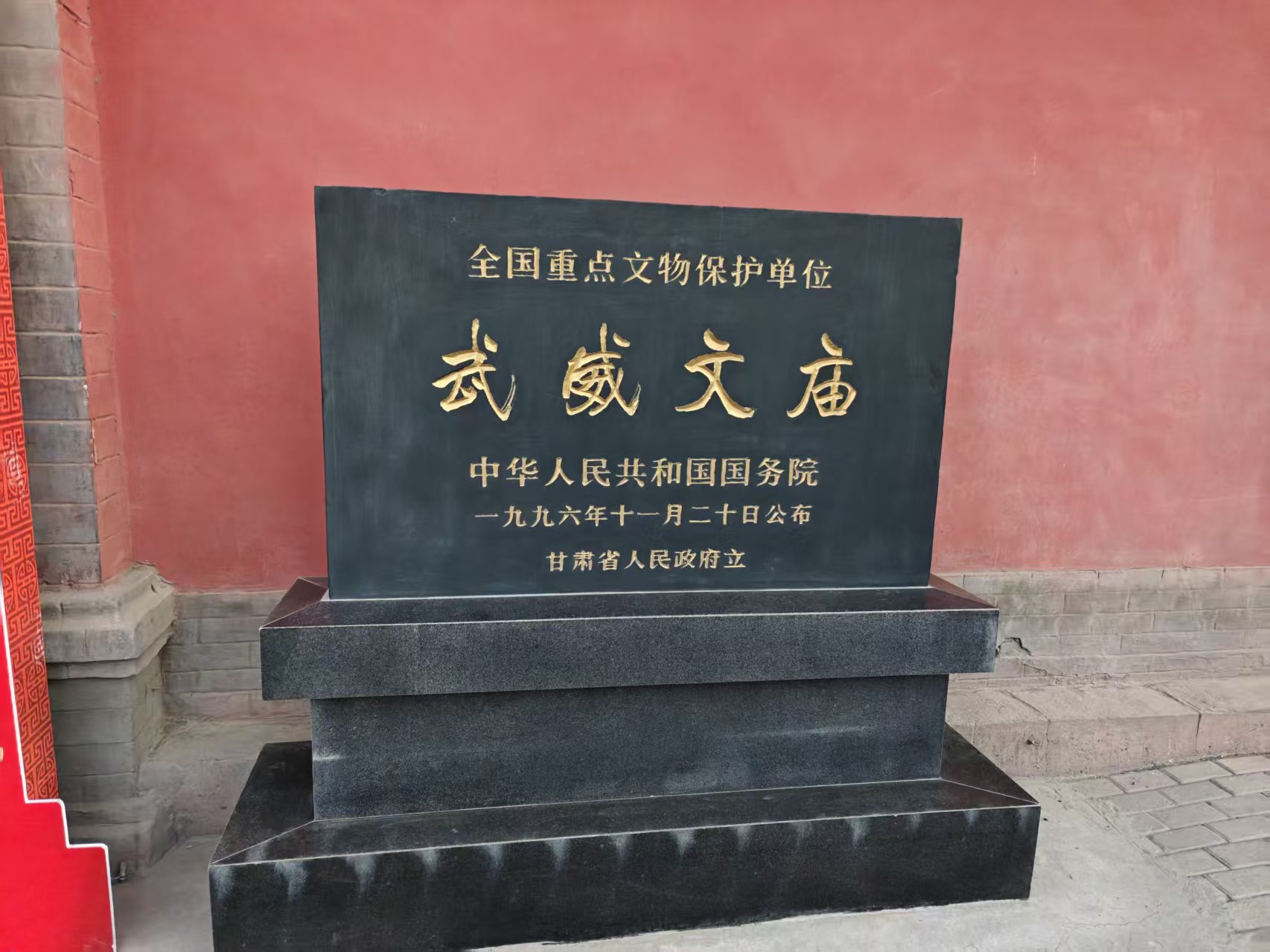
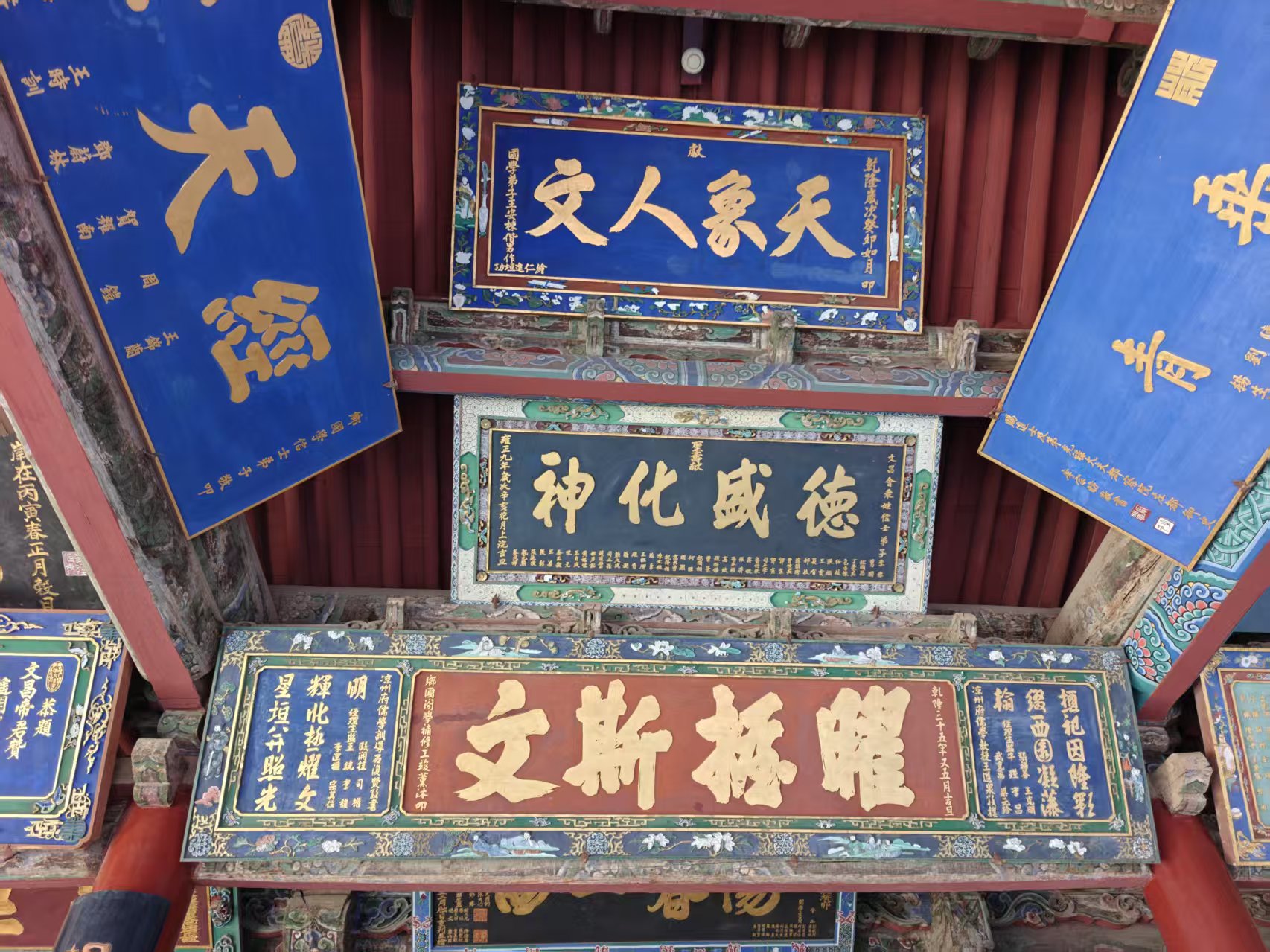
The most striking was the Guiji Hall. Under the eaves of the hall’s front corridor hung densely packed plaques, row after row from top to bottom, requiring you to look up. I counted—at least forty-some, spanning from the Kangxi reign all the way to the Republic of China, a span of over two hundred years. Most of the characters I didn’t recognize; when my son asked what they said, I couldn’t answer either, and could only look them up one by one on my phone.
One was titled “Guilu Chuiging,” inscribed by a Left Censor-in-Chief of the Censorate during the Daoguang reign. “Gui” is the cassia tree in the moon palace; in ancient times “plucking the cassia in the toad palace” meant passing the imperial examination; “chuiging” means to favor or regard highly. The whole phrase means the God of Literature favors the students, letting them succeed in the exams. Another read “A Book City That Never Sleeps”—I especially liked these four characters. It describes how in ancient Liangzhou the students read by candlelight through the night, the lamps never going out, so the whole city was like a book city that never sleeps.
Standing under those plaques, I suddenly felt quite small. These plaques lived through the prosperous reigns of Kangxi and Qianlong, through the chaos of the Republic, and some even dodged that special era—it’s said that before the Cultural Revolution this place was converted into an office, and since people found the roof beams too high to keep warm, they added a ceiling and built partition walls, and only because the plaques were hidden inside did they escape disaster. Later, when repairs were done and the coverings lifted, they saw the light of day again. Of course, I learned all this history by photographing the plaques and translating them with Doubao, including that stele inscription by Lin Zexu.
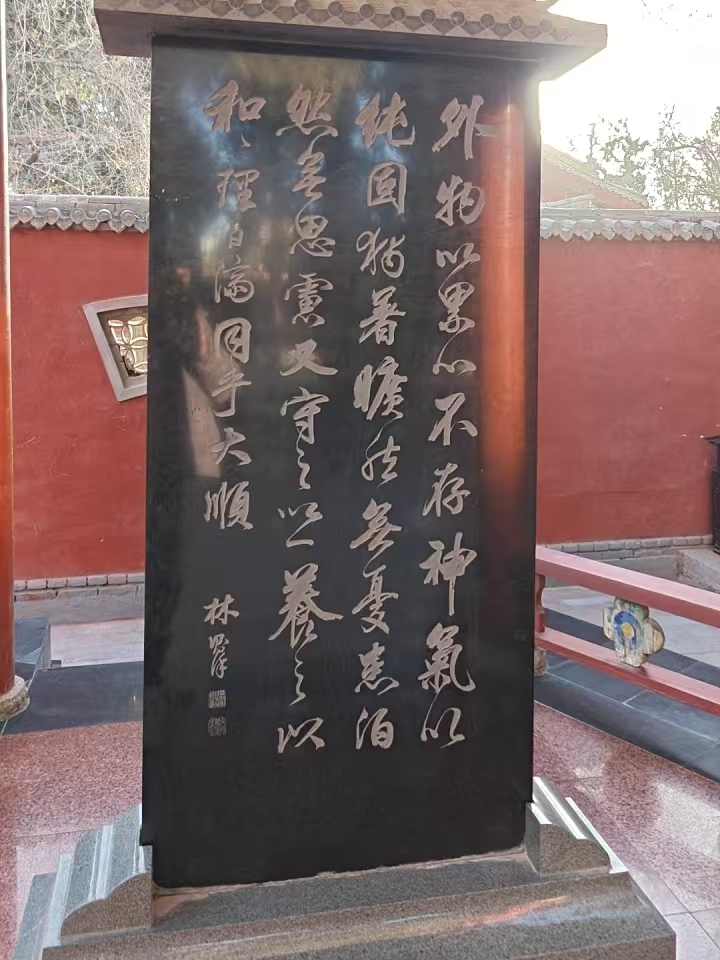
The inscription on the stele reads: “The external world burdens the mind and so should not be kept; the spirit is pure and firm and thus stands alone; expansive, free of care and trouble; calm, free of thought and worry; and hold to the One, nourish with harmony; harmony and principle advancing daily, in accord with the Great Flow.” This is Lin Zexu’s precious calligraphy bequeathed to Wuwei; the original is now kept in the Wuwei City Museum. The text comes from Ji Kang’s On Nourishing Life (《养生论》) from the Three Kingdoms period, expounding on cultivating the self and returning to simplicity—not being burdened by external things, keeping the mind pure and unified, to reach a state of harmony. A hard-edged man who banned opium and destroyed it at Humen, passing through Wuwei on his way to exile in Yili, yet left behind such words about “nourishing the mind”—quite interesting.
Our son didn’t quite understand these things; he preferred the magpie in the courtyard, calling out as it sunned itself. But I thought, some seeds, once planted, may take many years to sprout. Like the “Galloping Horse Treading on a Flying Swallow” from my elementary textbook, like the characters I saw today—it’s fine not to understand them now; sooner or later, you will.
On the eighth day, the day of our return, I got up at five.
Changed clothes, put on my watch, came out of the hotel—it was still dark. The stone-slab road of the Ming-Qing old street gleamed blue-green under the streetlights. I ran all the way to the foot of the Liangzhou ancient city wall, looked up, and there it stood silently, gray-black, like a stretch of frozen time. I suddenly remembered a game I played as a kid called Red Cliff, which had a Liangzhou City and a Wuwei Temple. Back then I never knew that one day I’d actually stand before the place-names from a game.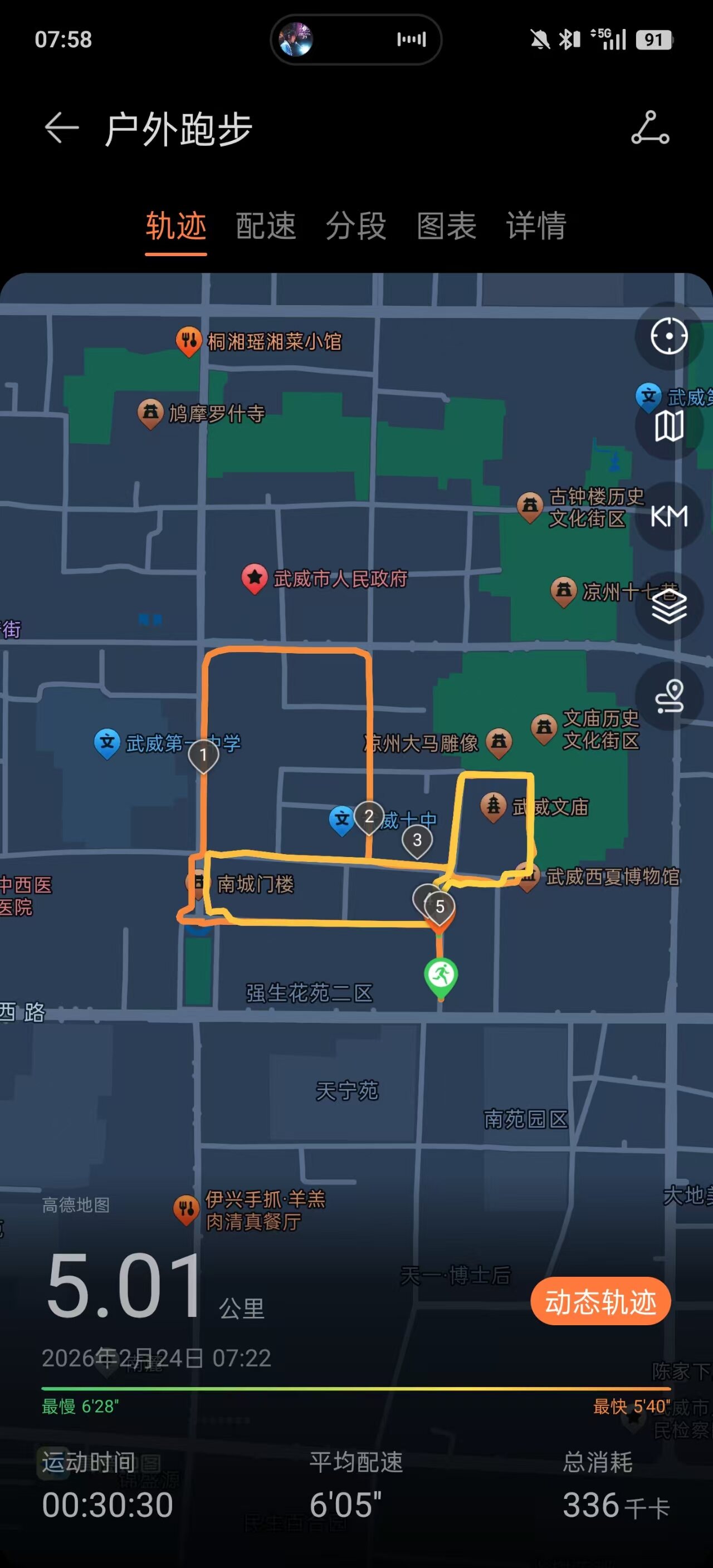
And that “Galloping Horse Treading on a Flying Swallow”—I’d studied it in an elementary textbook, but it was only standing in the museum that I first learned it was unearthed here. That feeling is quite wondrous, like a line of poetry memorized in childhood, met again many years later, suddenly understood.
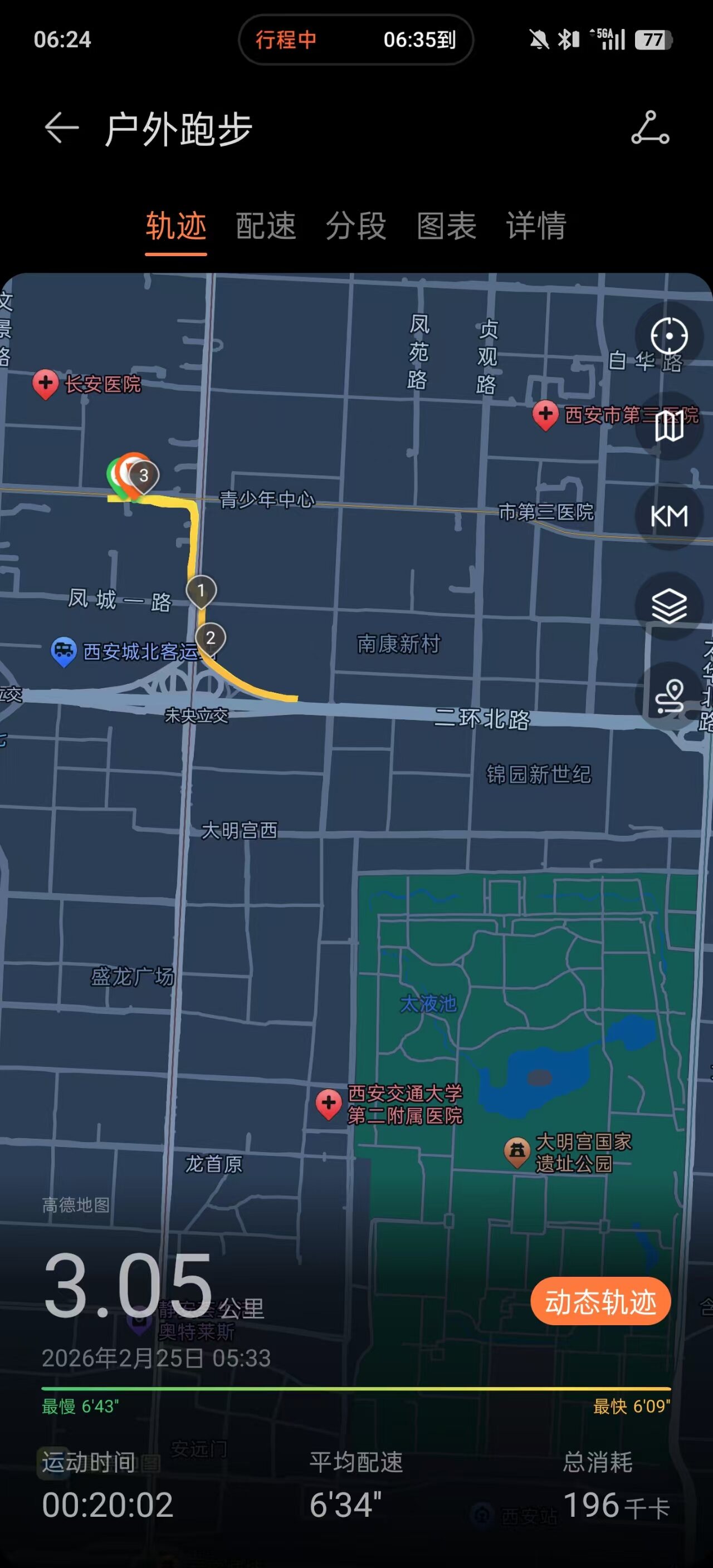
In the afternoon we reached Xi’an and stayed another night there on the way back. As usual I rose at five on the ninth day, planning to run 5 kilometers around the Daming Palace ruins, but about 20 minutes in I casually checked my high-speed rail ticket—damn, I’d misread the time!
I rushed back to the hotel, heart pounding harder than during the run. Luckily I made it in the end, but I never finished the Daming Palace track, and always felt I owed something.
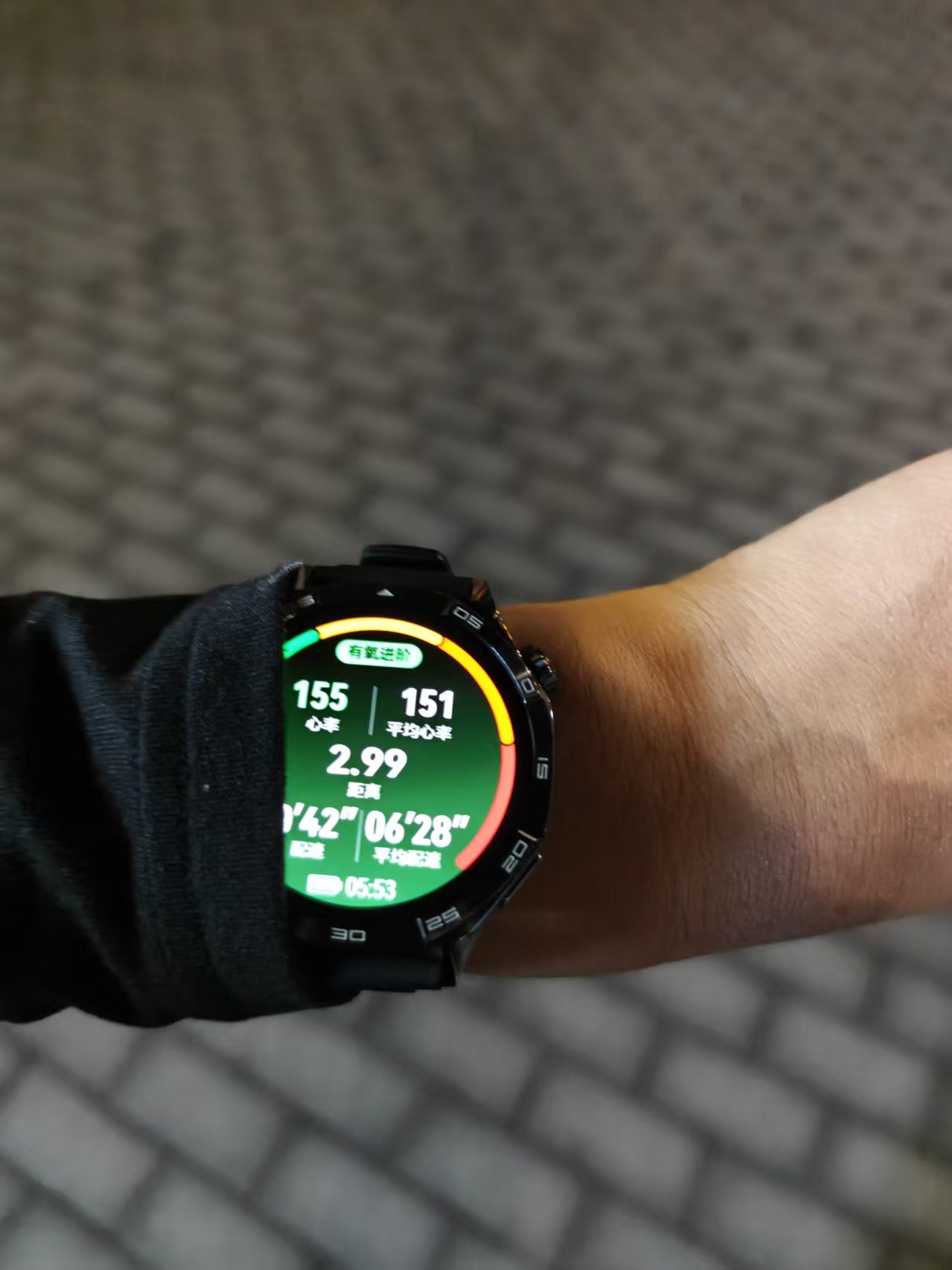
On the return high-speed rail, outside the window were rolling loess hills. I opened my laptop (remotely connected to my phone) and added a map to my own blog.
Actually I’d long wanted to do this.
The run in Wuwei was another one on my “city running list.” I suddenly had a thought: could I, in this lifetime, go to 100 cities and leave a running record in each one? Not for checking in on social media—just to measure with my own feet those names I’d only ever seen on maps.
I didn’t finish the Daming Palace run in Xi’an—a regret. But a regret is fine; it gives me a reason to come back.
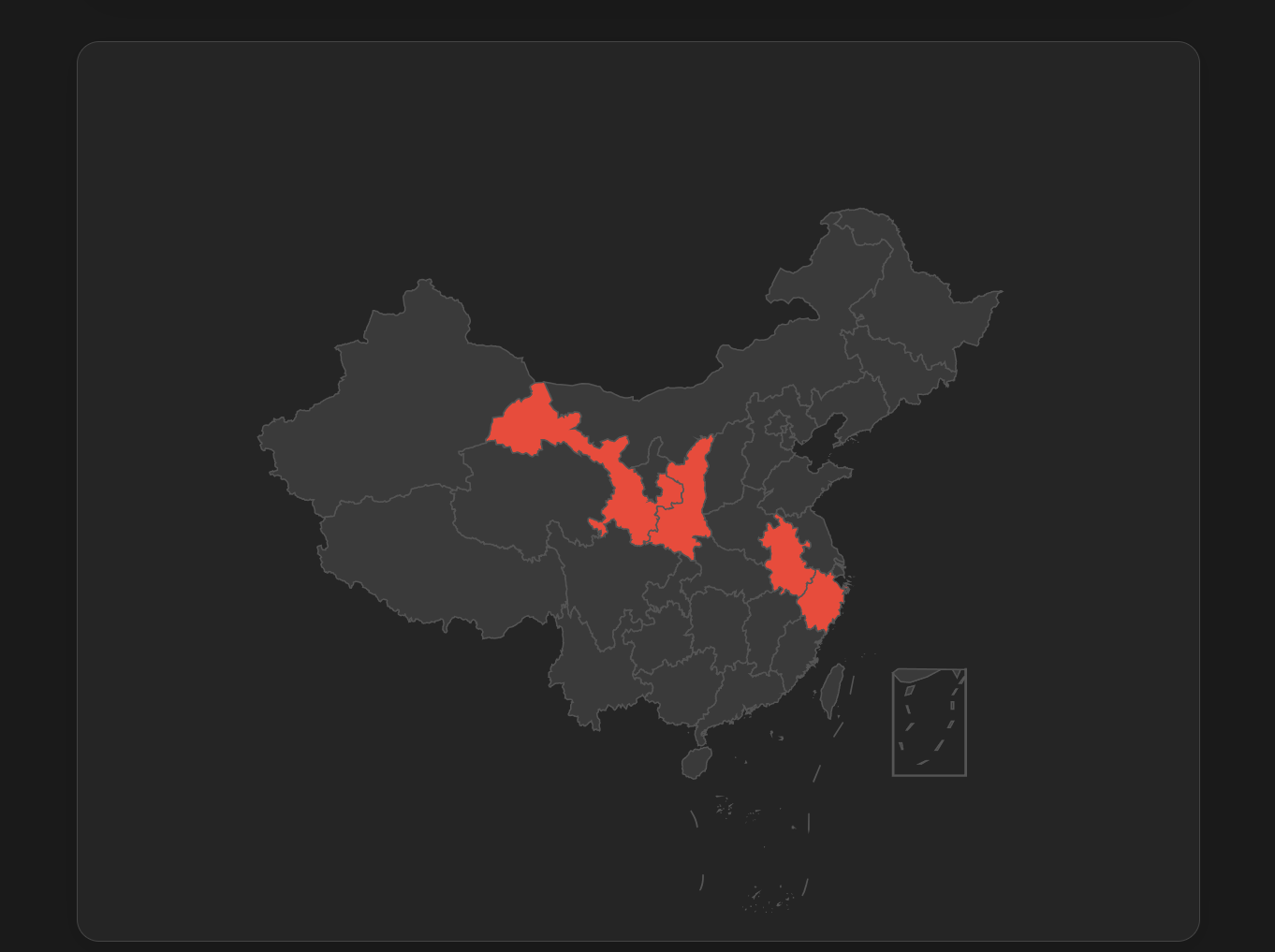
The map is already built, though not many cities are lit up yet. But no matter—this is only the beginning.
评论
0 条评论