Starting From a Screenshot
This morning I came across a video screenshot:
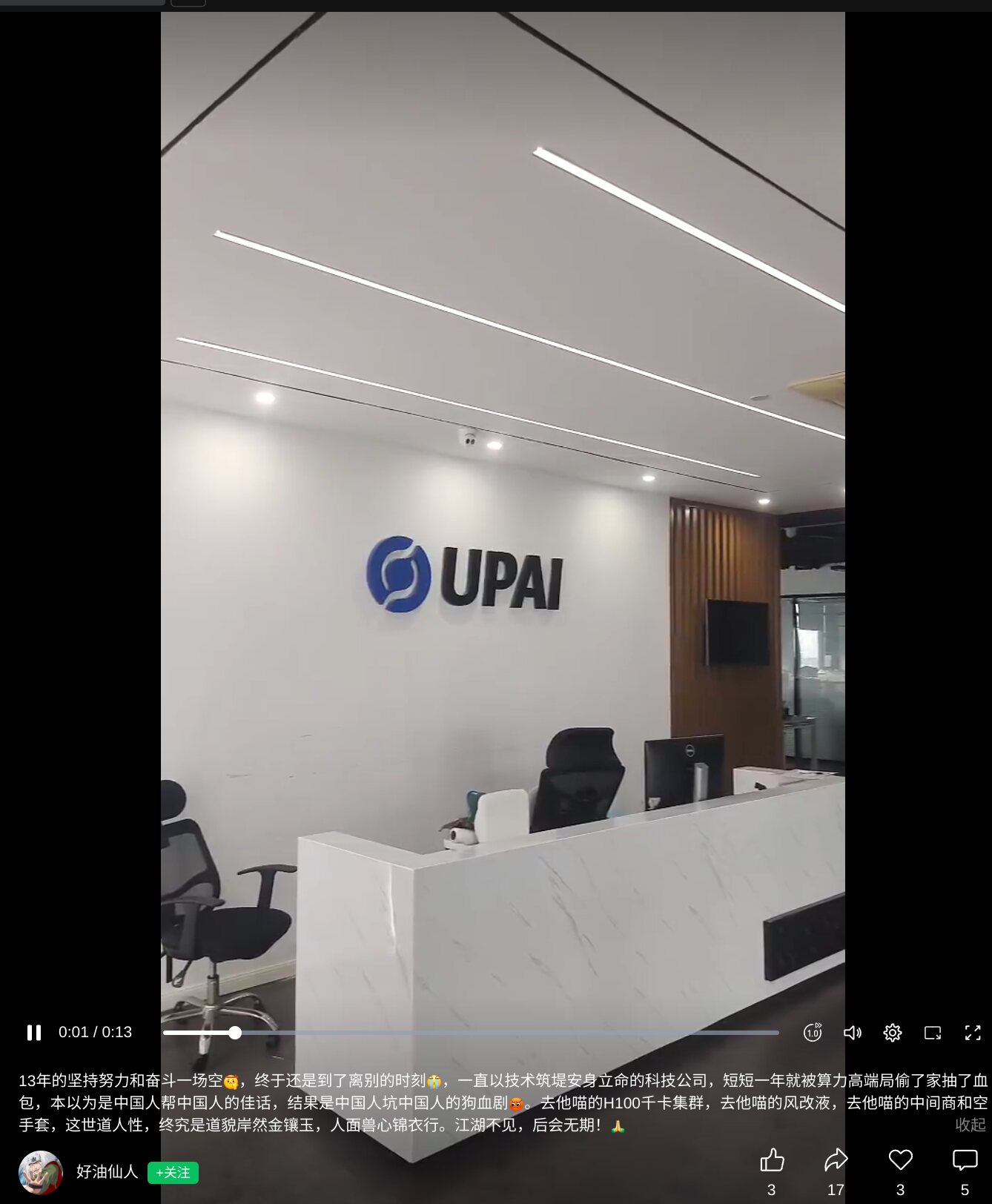
The image shows the front desk of a tech company, and the caption is written heavily: “13 years of persistence, effort, and struggle — all for nothing,” “to hell with the H100 thousand-card cluster,” “to hell with wind-chilled liquid cooling,” “Chinese people screwing Chinese people.”
I stared at this picture for a long time. The person who posted the video was the company’s operations lead — someone fairly well known in the community and internet circles. Just think about what it must have taken to drive an operations lead to post something so indignant, so full of disappointment.
This is not some company unrelated to me. This was the second full-time company I joined after coming to Hangzhou in 2013. The first was an outsourcing firm doing IDC data-center construction for Alibaba — I barely even want to mention it. In those less-than-10 months I learned nothing much, earned nothing much, regularly pulled all-nighters and worked overtime for a salary of 3,000 yuan. But that was still the road I came by. At the time I naively thought it was because I had no ability, no skills, and so could only do this kind of low-skill work — so I worked hard to learn technology and real skills. I stayed up all night studying ops and networking.
Then I joined in February 2014 and left in 2017. During my years there, our team atmosphere was great and the boss was a good person. The pay wasn’t much — I started at just over 5,000 yuan — but with my abilities back then, 5,000 was enough to satisfy me. I kept getting raises afterward, and before I left it was close to 10,000. For a single person who had just arrived in Hangzhou, honestly, it was a small-but-beautiful company, without the messy exploitation and scheming of other companies.
Many of my current colleagues came out of that company. Yesterday, eating in the cafeteria, I ran into the CDN tech lead from back then — he’s an architect now, a good guy, though he also left later. My current client-side TL also came from that company; he joined it more than half a year after me. Even at my last company, Youzan, my TL and my TL’s TL were both former colleagues from that same company. Everyone is still in touch to this day. Some of us have been colleagues for many years.
And one more thing: I met my wife at that company. She still works there, and she has already been owed ten months of wages. So no matter how you look at it, my ties to that company can’t be severed.
The Current State of My Household
My wife has worked at this company for nearly ten years. Over the decade she has seen its highs and accompanied it through its lows. Now, she has been owed a full ten months of salary. The company hasn’t formally declared bankruptcy, but everyone knows it’s already standing on the edge of the cliff. Last year I pushed her to quit — we even argued several times over it. I said there’s no point burning your time there; this company is done. But she said she doesn’t want to leave right now: she can’t find anything better out there either. Live on the 2,394-yuan-a-month subsistence allowance? Face age-35 discrimination? Oh, right — she’s also a graduate of Liaoning University, a 211 school, a proper full-time 211 bachelor’s degree, far better than my lousy associate degree. But as a woman, as someone past 35, it doesn’t matter whether you’re 211 or 985 — you get discriminated against all the same. Many people at her company haven’t been paid since last year. I asked her at the time: the people at your company are all talented — owed wages this long and they don’t make a fuss, don’t file for arbitration, don’t even resign. I really couldn’t understand it back then. Not until I was laid off at the end of last year and spent half a year unemployed did I realize: maybe, just like me, they can’t even find a same-pay job.
And me? Unemployed for more than half a year. Now doing outsourcing at a big tech company. Can you imagine being required to sign a pile of unequal agreements and contracts on your very first day? Please read Can’t Survive and Thinking of Going Into Outsourcing? Read My Outsourced-Worker Experience First
After being laid off, it’s not like I didn’t job-hunt. I sent out plenty of resumes and had some interviews. But the reality is: today’s workplace environment is rotten through and through — rotten past the point of rotting further. What I’ve lived through can prove these words. A few days ago Nokia Hangzhou announced its withdrawal; many foreign companies are pulling out, and what’s left is basically these domestic companies with severe exploitation and squeezing. It’s either 996 or big-small weeks; either layoffs or pay cuts; either PUA or empty pie-in-the-sky promises. A textbook era of bad money driving out good. My wife says she doesn’t want to job-hunt anymore; she has no hope left for today’s society and workplace. Am I any different? After all these years of striving, I’ve ended up back at square one. My salary is still lower than ten years ago, and I still get exploited and squeezed.
Outsourcing — the Option I Once Looked Down On Most
I used to especially despise outsourcing.
I thought outsourcing was the downhill road for tech people — for those who don’t want to improve, “the place you go when you can’t survive anywhere else.” I’ve done tech for so many years: written code, worked at big companies, led projects. Me, go into outsourcing? I couldn’t save face, and I couldn’t stomach it. And outsourcing pays very poorly.
But now I’ve realized that at my age, getting into big-tech outsourcing is already the best option available to me.
It’s not that I’ve stopped having ambitions — it’s that the market simply doesn’t have many “proper positions” left for people in my age bracket. Over 35, in the eyes of employers, you’re a hassle: too expensive, too experienced, hard to manage, heavy family burden, can’t work overtime. They’d rather have two cheap, obedient young people than hire one middle-aged person who can solve problems independently.
I went into outsourcing not because outsourcing is good, but because the other options are worse. I interviewed at some small companies with big-small weeks run by little emperors — unregulated, low pay — places I didn’t want to go. Big-tech full-time positions already screen by degree and age. And although I’m in outsourcing now, I won’t say a single good word about any outsourcing firm. The company that signed my contract has the worst onboarding experience and the worst online reputation of any company I’ve ever worked at — bar none. A quick search turns up the disgusting “standby check-in” tricks everywhere. I advise everyone to think twice about outsourcing, unless you have no other choice.
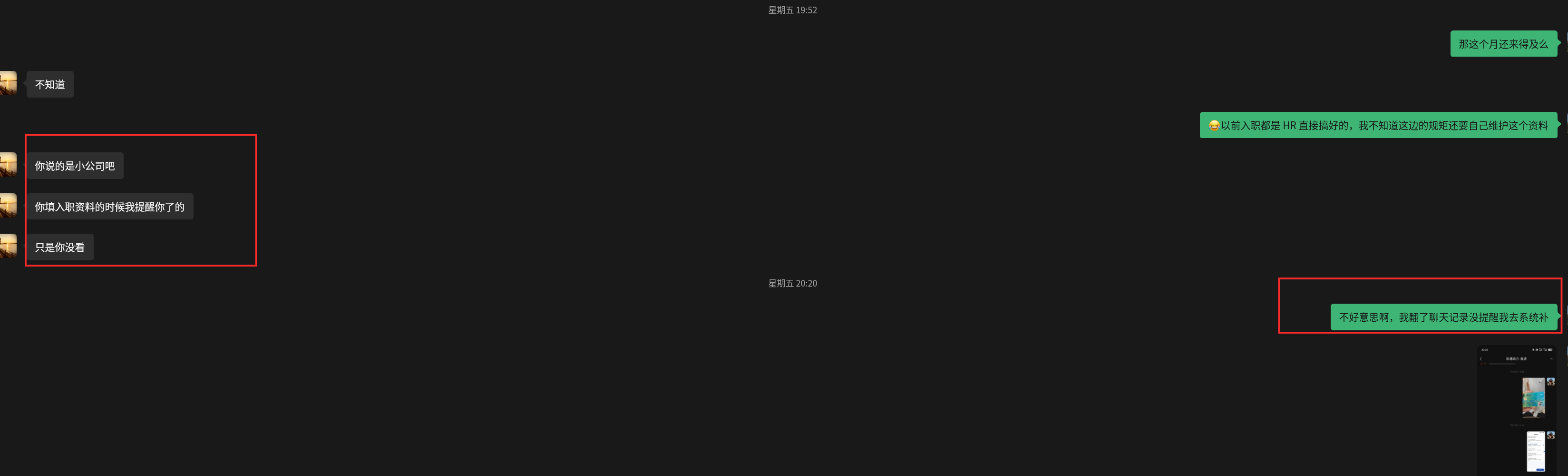
On day one you sign a pile of unequal clauses; before the contract is even signed they make you hand-copy KPI assessment documents and mail them in; the probation salary is cut to 80%. At first they lowballed the salary to a fraction of what I asked — I refused outright. Later they added a bit, but it still fell far short of my expectations. Given my family situation, though, I could only accept it first. Then HR rushed me to sign the contract, but I didn’t have a payroll card yet. I said I’d go get one; he said just fill in anything for now and amend it later. I listened to him, got the card and sent it to him, thinking he would enter it for me — turns out I had to update it in the system myself, but he never said so. Payday came on the 15th. No pay. I checked, and found that some crappy internal software had left me a message on the 10th saying DingTalk couldn’t reach me — yet when I flipped through DingTalk, not a single person had ever sent me a word. I asked the onboarding HR; I said that at previous companies HR just handled all this directly, and I didn’t know that here the custom was to maintain this data yourself. And then I got mocked by him for having only worked at small companies. Yeah, yeah, you’re right — NetEase and Youzan where I worked before were all small companies. Only your outsourcing firm is a big company.
The more active outsourcing is, the worse this workplace environment is. My current team has 3 full-timers and 7 outsourced workers, and the people I interface with are all outsourced too. I don’t have exact data, but it feels like everyone is an outsourced employee. I heard my previous company once planned to gut the entire product-and-R&D org and replace everyone with outsourced workers; I don’t know whether it was carried out, but in some departments there’s one full-timer sitting with a pile of interns plus an outsourced team. These companies have played cost-cutting-and-efficiency to the extreme. The core reason is that this market has entered the era of existing stock — there’s no more increment. All anyone thinks about is cutting expenses and squeezing labor. Day after day they broadcast noble-sounding PR about this charity and that charity, while being penny-pinching and scheming toward the very people doing the work for them. They practice equal work for unequal pay, and the reason they dare to do it so shamelessly is that on this land of ours, respect for and protection of workers is far too weak, and the cost of breaking the law is extremely low. That’s why these enterprises dare to use this model on a large scale — and also because there are simply too many people. I don’t hate outsourcing as an employment form, but this employment form has become a tool for vested interests to grab profits and shift costs and risks onto others. Laid-off full-timers get compensation; outsourced workers get none. If you want to recover the compensation that rightfully belongs to you, you’ll have to spend enormous energy — this covert raising of the cost of defending your rights: if that isn’t exploitation and squeezing, what is? And I’ve heard some companies have even come up with some kind of “outsourcing purge plan” — meaning that while I sit here complaining about and resenting outsourcing, in the future even outsourcing work might not be available.
An Era Where Bad Money Drives Out Good
This is my strongest feeling right now: bad money drives out good.
Companies that seriously build products get squeezed to death by those playing capital games; companies willing to give employees decent treatment get squeezed to death by those surviving on squeezed labor costs; people who follow rules and value technology get squeezed to death by those who know how to flatter, pick sides, and involute.
What’s finally left in the market isn’t the best at technology, but the best at scheming against people. Workers are treated as disposable batteries — used up and swapped out. You talk about dignity, and they talk to you about “blessings”; you bring up labor law, and they talk about gratitude; you ask for fair compensation, and they tell you the macro environment is bad. One general’s glory is built on ten thousand withered bones. If you come from the bottom, it doesn’t matter how many years you went to school or how high your degree is — without resources, without connections, you’re cannon fodder. You sew the wedding dress for others, only to be kicked aside in the end. No company actually practices the “growing together” it preaches; it’s all official-sounding talk on the surface, while underneath it’s all calculation and exploitation.
If the people who work earnestly can’t survive, and the market ends up full of squeezing and tricks, what is that if not bad money driving out good?
There’s a saying that in these past years, everyone who strove and pushed themselves ended up in debt. Thinking about it, that’s true. I worked so desperately to escape poverty, learned technology, and in the end the money I made all went into buying an apartment — a loan of over 1 million yuan. Now the price has fallen, the down payment is gone, and I still owe the bank 600,000. Whether I can keep working every month is something no one cares about, but the mortgage has to be paid on time. In his short story “Diary of a Madman,” Lu Xun wrote: “I opened the history book to check… every page bore the words ‘benevolence, righteousness, and morality’… between the lines, the whole book was covered with two words: ‘eat people.’”
Is Technology Still Worth Pursuing?
Writing to this point, someone is bound to ask: so do you still love technology?
I love it. I still enjoy researching new things, enjoy breaking complex problems down clearly, enjoy that “oh, so it can be done this way” moment of insight. But love is one thing; making a living from technology in this environment is another.
I’ve found that many people in tech are treated as consumables. When the company needs you, you’re “talent”; when the project is done and costs are cut, you’re “an optimization target.” Your experience, your accumulation, the nights you stayed up — in HR’s Excel sheet they’re just one row of data that can be deleted.
Sometimes I really want to say: there’s no future in tech, it won’t bloom into anything. Not because technology itself is no good, but because this society hasn’t left much of a living for people who pursue technology earnestly.
Who Is Technological Progress Really For?
People often say technology is neutral, and that technological progress makes everyone better off. I used to believe that too.
But look at history: cars replaced horse carriages — where did the coachmen go? They didn’t automatically live better because transportation advanced. Most were simply pushed out of the market by more efficient machines, then went on to do harder, less stable work.
Looms replaced hand weaving — where did the weavers go? The steam engine, electrification, automation, the internet, AI — every technological revolution repeats the same story: productivity really did rise, but the gains were never divided equally among ordinary people.
Have working hours for ordinary people like us gotten shorter?
No. It used to be the 8-hour workday; now 996, big-small weeks, and 24-hour on-call have become the norm. Clocking off used to mean clocking off; now there are always messages chasing you on WeChat. Technology made communication more efficient, so the boss can find you at any hour; technology made collaboration more efficient, so you can do the work of three people alone; technology made monitoring more precise, so even your slacking time is calculated to the minute.
Productivity has risen dozens of times over, yet ordinary people haven’t worked dozens of times less. Where did the extra efficiency go?
It went to stock prices, to the boss’s yacht, to capital’s compound interest — to places that will never show up on your pay stub.
So stop fooling me with “technology will make everyone better off.” Technology is just a tool; what matters is whose hand holds the tool. In the hands of workers, it’s liberation; in the hands of capital, it’s a more efficient juicer.
Human Nature and History
At the end of the day, this isn’t just a workplace problem.
I used to read Lu Xun and see his “open the history book and it’s all man-eating” as nothing but literary anger. Looking again now, I find many of those words were never out of date. History has changed clothes countless times — from ancient to modern, from court to marketplace, from schoolroom to livestream room — but the underlying logic is often the same: the side holding power tends to treat the weaker side as fuel.
It’s just that today’s “man-eating” is more covert, more civilized, more compliant. It doesn’t draw your blood; it siphons your time, your health, your passion, your family relationships. And once you’re squeezed dry, it uses “the macro environment is bad” to politely show you the door.
What Else Can I Do?
Honestly, I don’t know which road is best right now either.
What I want to say is: you people up on high can do this, can squeeze endlessly, without regard for whether the workhorses live or die, and we may be forced by livelihood to sign a series of unequal treaties with you for now. But do you think you capital folks can keep playing this way forever? If we can’t beat you at the game, then at worst we simply stop playing along. Right now I just don’t consume, don’t have children, don’t participate in anything hyped by vested interests — low-desire survival. As long as I don’t starve to death, that’s enough.
Many young people today don’t marry and don’t have children; I think this is the best form of resistance. It’s not that they don’t want to marry or have kids — it’s that after doing the math they realize they’re nearly squeezed dry themselves: what would they use to raise a family? Rather than bring a child into this world to be fuel, better to choose not to have one. That’s not negativity — it’s biological instinct: when the environment isn’t fit for survival, a species reduces its own reproduction. How many creatures in history have vanished exactly this way? Humans are nothing special.
Look at the species listed as protected animals — which one wasn’t eaten to extinction by humans?
There are only a few things I’m sure of:
- I will never again stake my entire fortune on any single company. A company is not your home; a labor contract is not a deed of indenture. Finish the day’s work and go home — never burn one extra bit of myself.
- Health matters more than KPIs. I’ve seen too many people wreck their bodies for work, and in the end the company won’t pay your medical bills.
- Keep pursuing technology — but pursue it for myself. For my own projects, for people I respect, for things that leave a mark — not for some position that can be “optimized” at any time.
- Be kinder to family. My wife has been owed ten months of wages and is still holding on. It’s at times like this that you learn who truly stands with you. During my six months unemployed in the first half of the year, my mother urged me several times to find work; my wife never said one word of pressure. And now I won’t pressure her either — I respect her choice.
Final Words
This article has no constructive conclusion whatsoever.
I just wanted to write down the real current state of a 35-year-old tech worker: unemployed for half a year, wife owed ten months of wages, working in outsourcing. Maybe in a few years, looking back, I’ll find today’s anxiety and anger childish; maybe I’ll be even angrier. But at least right now, I don’t want to pretend I still believe the noble-sounding fairy tale that “hard work brings rewards.”
If this era treated people who work earnestly well, I wouldn’t be writing this — and I believe that operations lead wouldn’t be writing that either. I don’t know whether this article will survive, and I don’t know whether my company will come after me, but I don’t care. I need to vent my dissatisfaction and resentment toward this era and this society. I’d rather bottle others up until they fall ill than bottle myself up until I fall ill.
My advice to younger people: learn English well, and if you can get out, go see the world. Don’t involute yourselves in this garbage market until you grind yourselves — and others — to death.
At the end of the day, ordinary people have no future. Whatever you were born into is most likely what you’ll remain. As the saying goes: dragons beget dragons, phoenixes beget phoenixes, and the rat’s son digs holes. This isn’t fatalism — it’s the conclusion I’ve drawn after living thirty-some years and watching far too many people around me. The real opportunities, the real resources, the real channels for climbing — from the moment of birth, people aren’t on the same starting line. An ordinary person’s lifelong effort sometimes amounts to nothing more than not falling too fast.
Think about it: so many people study desperately, fight through the gaokao, and finally make it to college. Four years of college feed the school’s teachers, feed the shops, canteens, and cram schools around campus — yet the one thing they can’t feed after graduation is themselves. That’s the most ironic part: the machine called education runs at full throttle, but it has never guaranteed that its output will have a rice bowl.
What a tragic thing. And yet this society keeps raising the price of the admission ticket, causing credentials to devalue step by step. Jobs that used to need an associate degree now need a bachelor’s; jobs that used to need a bachelor’s now need a master’s; jobs that used to need a master’s now need a PhD. The time, money, and energy invested keep growing, while the returns keep shrinking. The input-output ratio is severely out of balance.
If we want to change the status quo, the first step is: stop treating “people first” as a slogan.
评论
0 条评论