Lately I’ve been studying the restaurant business, especially the projects that look like they have “a low barrier to entry and solid returns.” As it turns out: there aren’t any. Getting a return without putting in the work is simply not realistic — drop that idea sooner rather than later.
Recently I’ve been watching a lot of Yong Ge Talks Restaurants (勇哥说餐饮), and I bought his course to study along with it. One episode turned up a franchise-recruitment brand called Nezha Xianyin (哪吒仙饮), and quite a lot of people got burned by it. Put plainly: you want to open a shop and make money; he only wants to collect your franchise fee. Running a store is something you have to learn yourself and get deeply involved in yourself. If you don’t even know how to find a storefront, don’t know how to calculate gross margin, and haven’t validated a minimum viable profit model, and yet you sink hundreds of thousands or millions into a franchise, you will most likely die an ugly death. And don’t let your thinking get warped by that chicken-soup story about Coca-Cola selling only 25 cups back in the day.

1. The Franchise Truth, Laid Out in One Table
This image comes from a video breaking down a franchise project. The table’s title is blunt: “Can this restaurant be saved?” The “current state” column spreads the problems out plainly:
- Daily revenue: 1,400 yuan
- Gross margin: 0.35
- Daily gross profit: 490 yuan
- Daily fixed costs: 916 yuan
- Daily net profit: -426 yuan
In other words, every day this shop opens for business, the math says it loses another 426 yuan. The owner put in 300,000 and is still bleeding money. The video’s title is “Invested 300,000 and still hasn’t learned his lesson” — and “hasn’t learned his lesson” here doesn’t mean the owner isn’t working his guts out. It means the pie the franchise recruiter drew for you is so perfectly round that even while you’re losing money, you keep assuming it’s your own operation that’s at fault.
There’s also an “after adjustment” column on the right side of the table: daily revenue lifted to 2,000, gross margin up to 0.55, rent and labor both squeezed down, and net profit ending up at 584 yuan. This kind of “after adjustment” data is usually exactly the version used to tell stories during recruitment. In reality, how easy is it to raise revenue and cut costs at the same time? Never mind that — a brand-new brand with zero name recognition, on what basis is it going to claw 2,000 yuan a day out of the crack between Mixue, Guming, Chabaidao, and Luckin?
2. I Looked Up the Company’s Address and Froze
After the video I casually searched “Nezha Xianyin Brand Operations Center” on Amap, and when the pin dropped, I froze for a second:
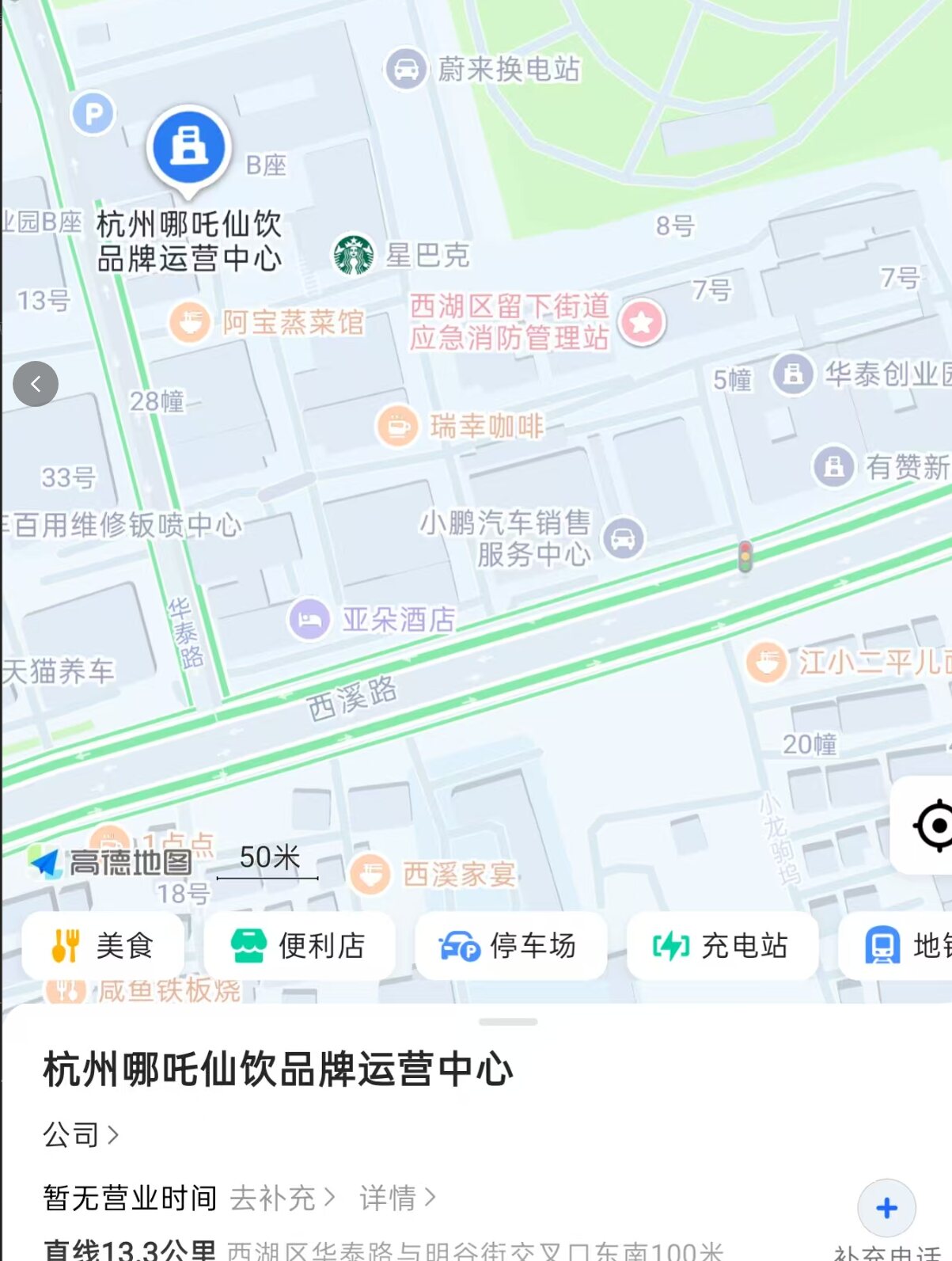
Near the intersection of Huatai Road and Minggu Street in Xihu District — a few hundred meters, in a straight line, from my former employer’s campus.
I spent a full five years on that campus. Commuting every day, eating, holding meetings, working overtime — I knew the surroundings so well I could walk them with my eyes closed. Starbucks, Luckin, Abao’s Steamed Dishes, the Atour Hotel… I’ve been to all of them. But it never once occurred to me that a franchise-recruitment company’s “brand operations center” was hiding right there on that campus.
The feeling was complicated. On one hand, you’re online researching franchise scams, reading it like somebody else’s story. On the other hand, the setting of that story is a place you walk through every day — maybe even a building your former colleagues pass on their way home from work. You think you know that area inside out, but really you’ve only ever seen what you wanted to see.
3. Why Franchise-Recruitment Brands Are a Trap by Design
Nezha Xianyin has been confirmed as a franchise-recruitment company. Judging by public information and its recruitment tactics, there are at least a few signals worth being on guard about:
1. The underlying logic is completely opposed: you want to open a shop and make money, he only wants the franchise fee
The profit logic of a legitimate chain brand is this: long-term repeat purchases at the stores, volume moving through the supply chain, expansion on the back of brand reputation. The stores have to survive for headquarters to keep making money.
The profit logic of a franchise-recruitment company is entirely different: a one-time harvest of franchise fees, equipment fees, and the markup on supplies. A store going under costs them nothing at all.
- The sales scripts are all templates: low investment, high gross margin, fully managed for you, no restaurant experience needed, viral hit products making thousands a day;
- Risks are deliberately dodged: no mention of rent, labor, or shrinkage, no mention of losses in the off-season, no mention of competition in the trade area — only the prettiest, most idealized revenue numbers get amplified;
- After-sales is a total write-off: the mask comes off the moment you pay. Sloppy site selection, watered-down training, forced supply of materials at inflated prices, and virtually no operational support afterward.
2. No product moat — it’s all short-term viral hype, one harvest and gone
Viral-drink franchise recruiters like Nezha Xianyin share a common trait: no proprietary core ingredients, no mature standardized operating system. They just copy whatever drink is hot on the market and slap a new package and name on it. Once the hype fades in 3–6 months, foot traffic falls off a cliff, and headquarters has long since switched to a new brand and started recruiting again. They will never take responsibility for the old stores.
3. They precisely harvest two weaknesses in beginners
Weakness one: wanting a shortcut, unwilling to learn from scratch.
Beginners think franchising means “buying a ready-made business” — no need to develop your own products, no need to run a supply chain, no need to figure out site selection. It’s all about saving effort and hassle. Franchise recruiters pounce on exactly that laziness, hyping “open a shop easily with zero experience” and reducing the complexity of running a restaurant to pay-the-money-and-lie-back-and-earn.
Weakness two: no grasp of basic finance, can’t read a profit model.
Most outsiders can’t tell revenue from profit, can’t distinguish gross margin from net margin, and can’t compute rent, depreciation, labor, shrinkage, or allocated marketing costs. Recruiters show only the high per-item gross margin (drinks commonly carry 70%–85% ingredient gross margin) and deliberately hide the rigid monthly fixed spend, painting you a big net-profit pie — and only after you open do you discover that everything you earn goes to rent and wages.
4. Contract traps lock you in layer by layer, and seeking redress is nearly impossible
- Equipment must be purchased from headquarters, priced 30%–100% above the open market;
- Core ingredients are supplied exclusively, with a fat markup taken over the long run;
- The contract stipulates the franchise fee is non-refundable; failed site selection and business losses are not their responsibility;
- The corporate entity changes hands frequently; when it goes under, they re-shell and launch a new brand, leaving you nowhere to pursue liability.
5. No commercial franchise filing, yet still collecting franchise fees
This is the most easily overlooked point, and also the most critical one. Under the Regulations on the Administration of Commercial Franchises (《商业特许经营管理条例》), a brand that wants to franchise must satisfy “two stores, one year” — at least two directly operated stores, in business for more than a year. It must also complete a commercial franchise filing with the commerce authority (what many people call a “franchise permit” or “franchise operating license”).
This filing isn’t optional; it’s a statutory precondition. And yet in reality, huge numbers of franchise-recruitment companies — themselves only recently formed, without a single decent directly operated store — start recruiting nationwide. What’s more insidious is that they’ll write the contract as a “technology cooperation,” “brand authorization,” or “service agreement,” sidestepping the word “franchise” so that the franchisee can hardly claim “unlicensed franchising” later on.
Checking isn’t complicated either: go to the Ministry of Commerce’s Commercial Franchise Information Management website, MOFCOM franchise lookup, enter the name of the brand’s headquarters company, and see whether there’s a filing record. If you can’t find one, or if the filing date is later than the recruitment date, keep your guard up.
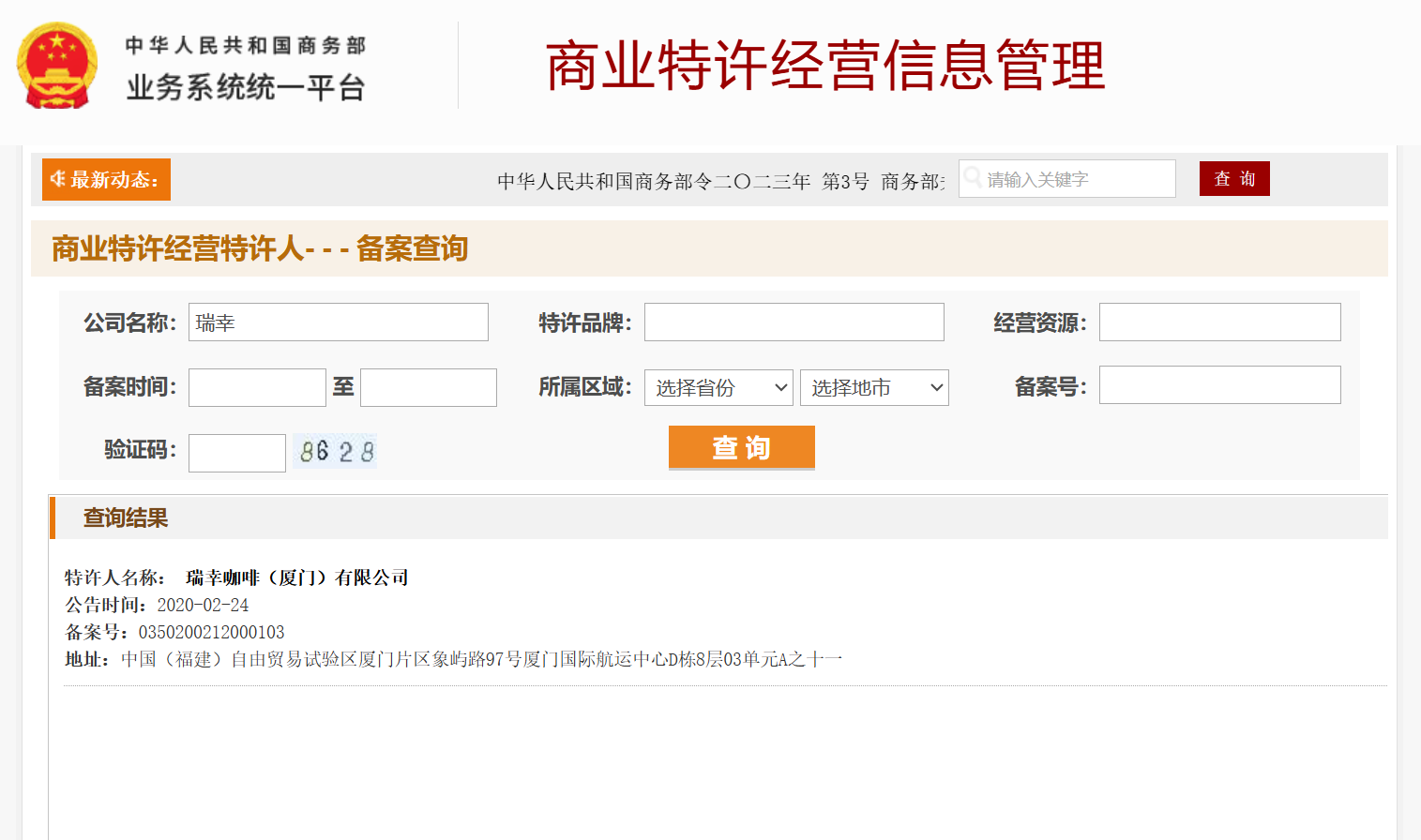
Take Luckin as an example: on the platform you can find the filing information for “Luckin Coffee (Xiamen) Co., Ltd.,” with an announcement date of 2020-02-24 and the filing number and address all clearly listed. A legitimate brand’s filing is public and traceable. Companies that can’t even turn up a filing yet dare to take hundreds of thousands of your yuan in franchise fees are, in essence, trading on an information gap.
6. Having a filing doesn’t mean you’re safe either: the case of WE LUCKY, which I found on Douyin
I said above that a missing filing is a red flag, but that doesn’t mean “with a filing you can sleep easy.” On Douyin I also came across a coffee/tea franchise brand called WE LUCKY, whose company behind it is Shanghai Xiaochuiyan Brand Management Co., Ltd. I looked it up on the MOFCOM franchise information platform, and it really does have a filing:
| Item | Detail |
|---|---|
| Franchisor name | Shanghai Xiaochuiyan Brand Management Co., Ltd. |
| Announcement date | 2023-06-14 |
| Filing number | 0311200212300106 |
| Filed address | Room 902, Building 2, Block 1, No. 1588 Lianhang Road, Minhang District, Shanghai (Pujiang Town, Block 481, Parcel 1/9) |
A filing, a number, an address — it looks far more “legitimate” than Nezha Xianyin. But dig a little further and the doubts don’t shrink one bit:
Social insurance contributors: 0: the 2023 annual report shows 0 people enrolled, which flatly contradicts the “300-person team” in the recruitment pitch. A company claiming to have a professional operations, supervision, and training system actually has no employees on social insurance at all, so any subsequent support is basically empty words. (Addendum: I later found via Qichacha that the contributor count was 2 — but whether it’s 0 or 2, it’s two orders of magnitude off from the advertised “300-person team,” and the real size of the operations crew remains in doubt.)
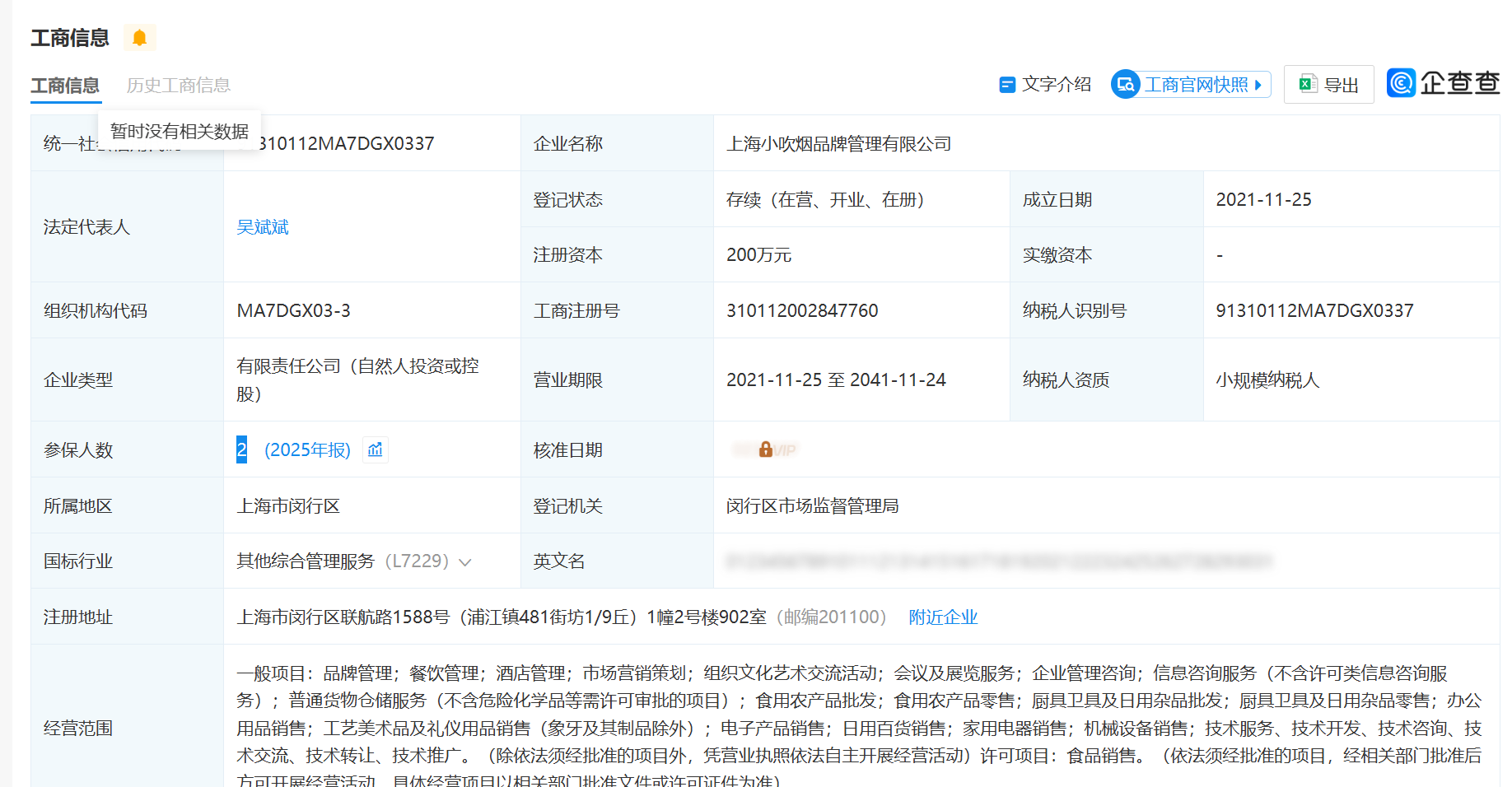
Paid-in capital not disclosed: registered capital is 2 million, the paid-in column is “-“, so the actual capital contribution is unknown.
Multi-brand operation: the same entity runs several franchise brands besides WE LUCKY, including Yaodangjia and Dingjiniu — a textbook “franchise-recruitment factory” playbook. The moment one brand’s reputation goes rotten, they re-shell and start the next one.
Recently established, frequent equity changes: founded in November 2021, filed only in June 2023 — a year and a half old at the time of filing; and the shareholders were just changed again in March 2024.
In other words, this is a “franchise-recruitment company with a filing.” A filing is only a statutory formality review: get the paperwork in order and it comes through. MOFCOM doesn’t go verify whether you actually have a real operations team or the capacity for ongoing support. Plenty of the franchise-recruitment companies that have been exposed held valid filings right up until things blew up.
What matters even more is the market environment. The milk tea and coffee tracks are now severely saturated; every few dozen meters on the street brings you Luckin, Cotti, Mixue Bingcheng, Guming, Chabaidao, and Chagee. What consumers respond to is brand mindshare and repeat-purchase habit. A no-name brand nobody has ever heard of — with no traffic entry point and no supply-chain cost advantage — on what basis does it survive competition in a red ocean?
So when judging whether a franchise project is workable, the filing is only the lowest threshold, not an endorsement of safety. What you really need to look at is: the survival rate of actual offline stores, headquarters’ real operations team, whether supply-chain pricing is transparent, and the true revenue and profit of franchisees already open. Those are the things that decide whether you survive.
4. A More Concrete Price Tag: the “Governor of Two Provinces” and Her 600,000
While researching Nezha Xianyin, I kept going back to a case on one of Yong Ge’s call-ins — a stay-at-home mom from Jiangxi whom netizens nicknamed the “Governor of Two Provinces.” If Nezha Xianyin is a cross-section of the franchise-recruitment playbook, then this mom is the real-world sample that stepped precisely into every single one of those moves.
She’s 35, with a middle-school education and five children. Her husband works in a factory. The family income isn’t much, but it’s stable. Last year she suddenly “woke up” and decided to become an entrepreneur and be her own boss, with a very specific goal: franchise Chagee. She searched online for an “official phone number” and called it, and the person on the other end told her Chagee wasn’t franchising anymore, but that she could franchise its “sub-brand.” She figured that was close enough and agreed.
What followed was a textbook chive-harvesting sequence:
- Mortgaged the family’s only property, then borrowed from relatives and friends to scrape together 600,000;
- Signed provincial agency rights for both Jiangxi and Zhejiang in one go, spending over 200,000 on agency fees alone, on the grounds that “the second agency is half price”;
- Took an agency in Zhejiang — 800 kilometers from her home, a place she’d barely ever been — simply because the salesperson said it was a bargain;
- Opened two stores: the mall location peaked at just over 1,000 yuan a day in revenue, the other was so dead it did two or three hundred;
- Lost several thousand yuan within ten days of opening, and couldn’t answer a single question about gross margin, the trade area, or the competition.
Netizens call her the “Governor of Two Provinces” because she held agency rights for both Jiangxi and Zhejiang at the same time. The title sounds imposing. In reality it was two sheets of waste paper bought with her whole family’s survival capital.
Her problem is far more than simply “being scammed.” Take the whole process apart and it’s practically a complete collection of the most typical decision-making flaws of a low-awareness entrepreneur:
1. She saw only the money-making stories, not the underlying risks
She scrolled past other people getting rich from milk tea shops and remembered only “open a shop and pull in tens of thousands a month, take an agency and earn while you sleep.” She completely ignored that a no-name milk tea brand has no brand traffic, carries a supply-chain premium, and offers no product differentiation; and that the tea drink industry is viciously involuted, with payback periods for a single store stretching out across the board. She absorbed only fragmentary success-flavored chicken soup and actively tuned out the real cases of closures, losses, and unsold inventory.
More critically, she couldn’t even identify the brand she wanted to franchise correctly. Someone who can’t find Chagee’s official phone number — how could she possibly spot the trickery inside a “sub-brand” pitch?
2. She mistook nerve for ability and blindly leveraged up, betting the family fortune
With five children at home, cash-flow pressure was already extreme and there was no emergency reserve — yet she chose to mortgage the property and borrow money, throwing the family’s entire safety net in. The first rule for a high-awareness entrepreneur is “don’t start a business with your family’s survival capital.” Her logic was “you have to be willing to put money in to make big money,” and she couldn’t tell boldness from a gambler’s mindset.
3. She couldn’t tell an “agency dividend” from “being the one harvested”
A regional agency for a no-name brand is, in essence, the brand’s way of collecting cash fast: take the agency fee, force you to stockpile ingredients, mandate a number of store openings, and dump all the risk onto the agent while the brand collects rain or shine. She assumed that landing two provincial agencies meant monopolizing the market and lying back to collect franchise fees. She didn’t understand that a regional agency that actually makes money either comes from a top-tier chain with its own foot traffic, or from someone who already has mature retail space resources and a recruitment team. An ordinary person taking a no-name agency ends up holding a pile of ingredients and a bunch of empty storefronts.
4. No whole-picture accounting — she counted gross profit but not total cost
Yong Ge asked her what her daily gross profit was, and she sighed, “What gross profit? It’s all losses” — she hadn’t even figured out what gross margin means. Ordinary people see a 70% gross margin on a cup of milk tea and think that’s high, but the complete cost of operating also includes rent, labor, utilities, ingredient shrinkage, equipment depreciation, marketing, inventory pushed on you by agency quotas, and loan interest. Mortgage borrowing carries ongoing interest; even if a store is marginally profitable, the profit most likely won’t fill the hole the loan leaves.
5. A single information source, no independent judgment, easily swayed
She most likely heard only the recruiter’s one-sided pitch: no on-site visits to the brand’s older stores, no asking peers about their losses, no checking corporate credentials, no looking up franchise dispute litigation. What’s even more absurd is how it played out afterward: Yong Ge advised her to pursue legal channels to reduce her losses, and the franchise company, seeing the video was hurting them, promised “get the video taken down and we’ll give you support.” She believed it, turned around and demanded that Yong Ge remove the video — and the moment it came down, the company blocked her.
The cruelest part of this case isn’t that the money is gone. It’s that from start to finish she never built the capacity to judge that “this thing might be wrong.” The franchise-recruitment company could harvest her not because she’s stupid, but because she knew nothing about how the business world actually runs, while the desire to “be the boss” pushed her to put everything on the table.
The saying “you can’t earn money beyond your own awareness” carries two layers of truth in this case: one, whatever you win by luck you’ll eventually lose back by skill; two, if your awareness isn’t there, you can’t even see the trap. The recruiter’s script, the bullying clauses in the agency contract, the interest cost of borrowing, the brutal reality of industry involution — all of it sat inside her blind spots. And those blind spots are the deep pits that swallow wealth.
It’s precisely because I’ve seen this case that looking back at Nezha Xianyin’s office address — a few hundred meters from my old employer’s campus — makes the hair on my neck stand up. Companies like this manufacture countless “Governors of Two Provinces” every single day. It’s just that most of them never make the trending list.
5. The Truth About Starting a Restaurant: There Are No Shortcuts
After this stretch of study, several things have become clearer and clearer to me:
1. There is no such thing as a low-barrier, high-return, low-effort restaurant project
Restaurants are brutally hard offline physical businesses, hinging on site selection, quality control, cost control, and day-to-day fine-grained operations. Even a small jianbing stall or a tiny milk tea shop requires getting up early to prep, watching the kitchen, controlling shrinkage, and maintaining your customer base. Want to be an absentee owner? 99% chance you lose money.
2. Three core competencies for opening a shop — don’t put big money in until you’ve mastered them
- Site selection: reading foot traffic in the trade area, matching the customer profile, competitor density, rent-to-value, and the traps hidden in transfer fees;
- Cost accounting: being able to compute blended gross margin, the monthly break-even point, and the minimum viable profit model (how many orders a day before you stop losing money);
- Store operations: shrinkage control, staff management, online and offline marketing, and a plan for the off-season.
Going in with hundreds of thousands before you can do these three things is the same as sitting down at the gambling table naked.
3. Watch out for viral, opinion-shaping chicken soup
Stories like “Coca-Cola only sold a small amount of product in its early days” cherry-pick the successful outcome and hide the era’s tailwinds, the capital invested, the long trial and error, and the unique channel resources. They simply don’t apply to an ordinary person opening a small offline shop. Back then supply was scarce and competition was minimal; now the streets are viciously involuted with milk tea and snacks, with the same kind of shop every few steps. Merely copying someone else’s path to success doesn’t work at all.
You can’t run a business on legendary stories used to numb yourself. You have to run it on real data and real cost calculations that land on the ground.
6. My Own Learning Sequence and Pitfall-Avoidance Advice
Given where I am now in learning about restaurants, I’ve laid out the sequence for putting it into practice:
1. First, distinguish a legitimate chain from a franchise-recruitment company
- Legitimate brand: many offline stores that have survived more than 2 years, they let you quietly visit old franchisees on your own, they volunteer the risk of operating losses, supply-chain pricing is transparent, and their profit projections are conservative;
- Franchise-recruitment brand: blanket short-video recruitment ads across the entire internet, very few surviving offline stores, they won’t let you visit old stores alone, salespeople pressure you to sign with countdown discounts to force you to pay on the spot, and they only talk up income and never losses.
2. Don’t put the cart before the horse in your learning sequence
- Master basic finance first: gross margin, break-even, fixed versus variable costs — be able to build a store projection spreadsheet on your own;
- Work the offline market: walk the trade areas, watch competitors’ real foot traffic, ask around about actual rent, transfer fees, and wages, and accumulate site-selection experience;
- Test cheaply: if you can start with a stall, start with a stall; if you can start with a tiny shop, start with a tiny shop. Get the minimum viable profit model working and validate product and traffic before scaling up your investment;
- If you must franchise: prioritize long-established chains with years of depth and high store survival rates, visit several stores that have been open for more than six months incognito, and ask the owners one-on-one about real profit and headquarters’ support.
3. Avoid the “looking for an easy way out” thinking trap
A lot of people’s original motive for franchising is to escape learning and escape hard work — and that is precisely the root of the losses. There is no outsourced shortcut in running a restaurant. Product taste, cost, service, foot traffic — every link needs the owner watching it personally. Headquarters can only provide assistance; they cannot run the business for you.
7. Final Words
Seeing that Nezha Xianyin’s office is right on my old employer’s campus, my strongest feeling wasn’t anger — it was cold dread in hindsight.
The dread is this: if I weren’t currently out of work with time on my hands to study restaurants, but instead a few years ago, while still employed, had suddenly thought “let me start a side hustle” or “let me open a shop” — is it possible I’d have been moved by this company’s pitch too? After all, it was that close to me, it looked that “legitimate,” and it sat right inside the circle I know.
That’s also a reminder to me: the more familiar the environment, the easier it is to let your guard down. Darkness under the lamp isn’t only a physics phenomenon — it’s a cognitive blind spot too. Back in March I also looked into a few franchise brands, and one of them told me to buy a train ticket to Wuhan for an inspection visit. I didn’t go, because my gut said there was a trap. Looking back now, that “limited-time slots” and “we’ll reimburse your travel for an inspection” script is itself the standard franchise-recruitment procedure.
A while back I passed a Zhao Yiming snack store on the way through Putian and chatted with the owner. He said franchising and all had cost him 1 million, and told me not to even bother looking into it. Ha — crude words, sound reasoning.
If you’re also eyeing a franchise project, my advice is simple:
- Don’t just look at the recruitment deck; go stake out a real store and watch its foot traffic;
- Don’t just look at the “after adjustment” profit model; calculate whether you can break even in the most pessimistic scenario;
- Don’t be intimidated by a “brand operations center” office — check whether it has a MOFCOM commercial franchise filing, whether its trademarks are complete, and how long its directly operated stores have been running;
- And most importantly: learn the craft first, then talk about opening a shop.
Franchise-recruitment brands thrive for one essential reason: supply meets demand. On one side are outsider entrepreneurs who want to slack off and make quick money; on the other are recruitment companies whose whole business is harvesting principal. There has never been a shortcut in the truth about restaurant entrepreneurship. Every store that earns a stable profit got there because the operator mastered costs, dug deep offline, and ground through long-term operations. Shore up your basic operating knowledge first, validate the market at low cost, and thoroughly kill the fantasy of “little effort, big returns” — only then will you avoid falling into the franchise-harvesting trap.
评论
0 条评论