I. The Middle-Aged Man Discarded by a Precision System
Unemployed for a full six months.
Hangzhou’s job market has completely rotted away. I thought that after all these years of striving in the workplace, pushing hard and once achieving decent results — promoted with a raise three years running, my salary climbing all the way to a monthly average of 25k, peaking at a monthly average of 30k+ — I thought that with this experience, finding a job at the same salary in the market should be relatively easy. I wasn’t even hoping for a raise; I could have accepted a slight cut. But after half a year of searching, I still haven’t found one.
Back in March I interviewed at several places and got as far as serious salary talks. The highest offer was from an AI team at my previous employer, saying they’d pay me the same as before, but on the condition of two months’ work as two months of consultancy. I didn’t agree at the time, because they wouldn’t pay social security or the housing fund, and there was no telling what day they’d cut me again. Afterwards I interviewed at several more places, all small companies; at one I had already passed the second round, but we couldn’t reach agreement on salary — I asked for 22k and they felt I was asking too much. Next came outsourcing. Among them, the AI large-model technical support outsourcing role at Alibaba offered at most 15k, saying it could be negotiated up to 16k. Halving my pay was something I really couldn’t accept, so I didn’t go. Because I’ve always felt outsourcing is unstable, and that it puts you a grade below others.
So I kept looking. It has now been a six-month gap and I still haven’t found anything. Interview opportunities grow fewer by the day, and if this keeps up my savings will run dry sooner or later. There’s also several thousand a month in mortgage payments, with over 60 months of mortgage left in total. I do have severance, but monthly expenses are large too. If this goes on, the only option will be to sell the house, pay off the mortgage and withdraw from Hangzhou. I can’t stay here anymore.
Right now in Hangzhou, Alibaba and all the big companies are laying people off frantically and hiring extremely cautiously. If you’re not a near-perfect match, then no matter how rich your experience, you don’t even get an interview. On top of that my degree is a junior-college diploma, so although my work experience is extensive, finding a job is as hard as climbing to heaven.
I can’t say exactly when it started, that the confidence of “earning a living by my own ability” inside me got worn away bit by bit. Maybe it was after some message left read and unanswered, maybe it was in the silence after an HR person heard my expected salary, maybe it was when I realized ten years of experience was worth less than a single bachelor’s degree. The promotions and raises I was once proud of, the projects I conquered through all-nighters, the professional moat I built up desperately — in round after round of interviews and price-cutting, they suddenly started to look like a joke.
Nobody suddenly announces that you’ve failed, and there’s no dramatic trial that makes you collapse on the spot. The real collapse is how every application, every interview, every failed salary negotiation slowly hollows out the “effort brings reward” you once believed in.
There is no earth-shattering rout, only day-after-day erosion.
I used to think that working conscientiously, doing my part solidly and supporting my family well would earn me a stable life. Only after being cut in one sweep at thirty-five and trapped in the crack between family and reality did I see it completely: the effort of people at the bottom has always been a one-way consumption.
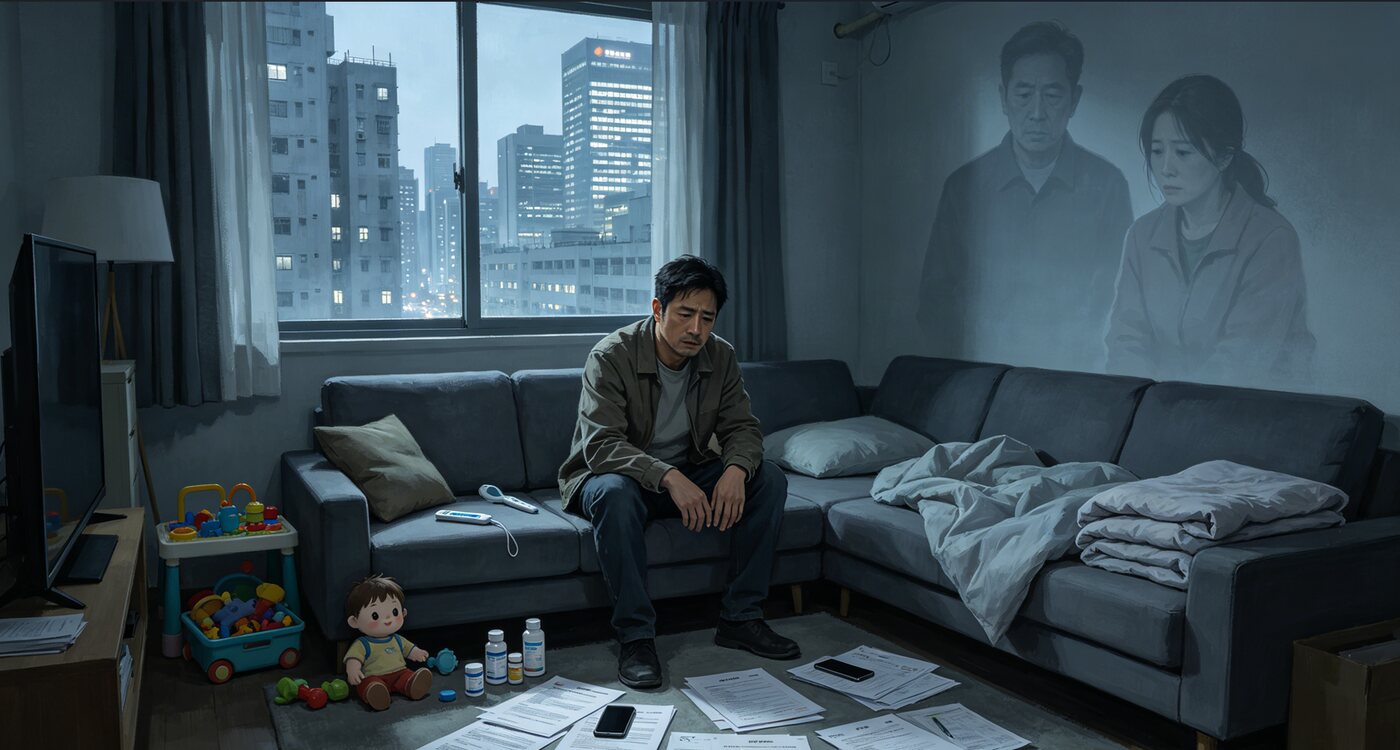
These past six months have been pressed out of me by layer upon layer of suffocation.
I haven’t lain flat and given up, and I haven’t wasted my time. I was simply, suddenly, discarded by this precision system of social division of labor.
Before, I followed every rule: clocked in on time, put my head down and gave my all, accepted the rat race, married, had a child, took on family responsibility. I thought two-way collaboration was the most basic understanding among adults. But reality slapped me hard across the face — society only needs your labor, not your life; capital only extracts your value and takes no responsibility for your future. It isn’t that any particular boss is rotten at heart; the whole market is simply this unsentimental, looking only at results.
At thirty-five, with energy still decent and experience ample — and yet, it seems that reaching this age turns you into a consumable to be eliminated. Finding work is as hard as climbing to heaven; every kind of credential filter and age filter; resumes sent in are all left read and unanswered. Most companies simply aren’t hiring at all, and everything that is hiring is outsourcing — consumables to be used up and thrown away. I did interview at several places and pass the interviews, but the salaries offered were all cut in half, and I didn’t want to go. Even though I still carry a mortgage of several hundred thousand. After working hard all these years, I’ve ended up at 35 discovering that this wage level is worse than what I had 10 years ago.
I genuinely feel disillusioned to the core. So what were all those years of effort, hardship and all-nighters spent mastering skills and experience worth? I’ve learned that people younger than me and far less capable may be earning more than the offers I’m now negotiating. I find that extremely hard to accept, so I would rather not go at all than hand these garbage outsourcing firms a bargain. Since the market undervalues my ability and can’t give me the salary I expect, then I simply won’t go.
But not working is tormenting too. The most wearing thing is never unemployment itself — it’s the anxiety with nowhere to go after losing your job, and the internal friction at home that can’t be cut clean.
The child is only 5 and needs someone watching every day. My wife holds her post to keep the family income going, but her company too has been in arrears on wages for most of the year. She has a 211-university degree, but what good is that? However high the credential, in the face of reality it’s the same outcome — at her age, going out she’d have just as much trouble finding work. Over a hundred people at her company have gone most of a year without wages and none of them dare resign. At first I could hardly believe such a thing could happen in Hangzhou. But it really did happen. These so-called pre-sales people, developers and operations staff with high credentials are still helpless when facing this problem. They dare not resign — afraid of unemployment, afraid that a long gap means never finding work again — so even without pay they choose to keep staying. When the nest is overturned, how can there be any intact eggs? Earlier, my wife and I were at the same company. Honestly, back then that company was also in the internet industry’s upswing; it had raised funding, was in its glory, had team-building every week, and a wonderful atmosphere. But it has come to the point today where it can’t even pay wages, six months in arrears. It leaves one sighing. Companies like this in Hangzhou are everywhere you look. Many of the bosses are honestly decent people, but in an environment like this it isn’t all the bosses’ fault either.
Our little family has already become shaky, yet all I have is a body full of technical skill — no management experience, no marketing or sales experience — and my pitiful technical experience has long been depreciating rapidly in the AI era. I can use AI coding to build many standalone products and small systems; operations, development and front end are all things I can handle. But I don’t know how to sell anything, and the monthly mortgage, the family’s daily expenses, the child’s classes, tuition and living costs won’t go down just because my skills have depreciated. I was laid off and got N+1 severance and a bit over 2,000 a month in unemployment benefits, but that’s a drop in the bucket; if I never find a job, it will run dry sooner or later.
Sometimes I feel I’ve been too naive. At this age, still bound by the workplace’s PUA rhetoric that effort brings reward, still holding the worker’s mindset that effort must be rewarded — it’s utterly ridiculous. In reality, effort sometimes brings no reward at all.
Recently I’ve been learning how to make breakfast food, and I’ve been watching the show Brother Yong Talks Food Business. If effort brought reward, then those people who invested hundreds of thousands, millions, even tens of millions and ended up losing everything down to the last cent — were they not hardworking? The market looks only at demand, only at results, not at the process.
II. The Cognition of My Family of Origin
At the start of the year my mother sprained her foot and fractured it while doing cleaning work. She rested for most of a year and the old injury still hasn’t healed, and the work-injury compensation was never properly carried out. I told her not to go back, but she remains fixated on the two or three thousand yuan the compound pays for cleaning.
She isn’t afraid of a second injury, isn’t afraid that being bedridden will drag the whole family down — she is only fixated on the meager cash right in front of her.
In her cognition, a person is only useful if they sell their physical labor.
My father’s obsession strikes me as even more unbelievable. He is single-mindedly scheming to buy a Vietnamese bride for my younger brother, who still hasn’t found a partner. He pays no mind at all to the fact that this is a high-risk scam that touches the legal red line, and ignores the highly probable outcome of losing both the money and the person and ending up buried in debt. At the construction site he gnaws a few steamed buns for dinner and still thinks about things this far-fetched.
In his eyes, carrying on the family line and continuing the ancestral line matters more than the family’s stability, more than avoiding risk, more than the actual lives of his sons and grandsons. I can’t persuade him; in his cognition a person must, in the end, have one or two descendants.
The underlying logic of the older generation: they have never really been thinking for the next generation — they simply treat their children as their own pension insurance box. The so-called carrying on the family line, raising sons to support you in old age, being cared for until your end — but is this idea still of any use?
My mother-in-law died suddenly of a cerebral hemorrhage in March, just over sixty. Her children all work thousands of kilometers away; by the time they heard the news and rushed back, she was long gone — they didn’t even get to see her one last time. In my home village an old man died in a ditch while washing clothes; both of his sons were hundreds and thousands of kilometers away in other places, and it was villagers out fishing who found the body. So in the end, who ate the dividend of having children? Was it the parents who had them? Even when the person is gone, the children aren’t there for the illness. As the saying goes, “the child wishes to care for the parent, but the parent is no longer there” — more often the child finds it hard to even support himself, let alone his parents.
Rural parents live on a pension of one or two hundred a month. They toil a whole lifetime to raise their children and send them out of the countryside, and all the money those children earn goes to subsidize people elsewhere — the ones who get rich are people elsewhere. Buying a house, consuming, marrying, having children: which of these doesn’t involve paying taxes? Urbanization’s blanket advertising and ideological indoctrination — the propaganda that marriage requires buying a house and a car — isn’t that the result of notions manufactured by capital? In the end they talked a bunch of people into buying houses, taking over the bag at the peak, creating batch after batch of demolition-compensation households and local infrastructure. Those people got filthy rich, enjoying the era’s dividend. But what about the ones who took over the bag? They are merely the era’s sacrifices.
Carry a mortgage and once you lose your job you may never turn things around in a lifetime. Those gorgeous high-rises and parks that get built — how much chance do the wage slaves working 996 and 007 every day have of sitting down in them and enjoying them?
They lived through an era with no social security and no pension safety net, spent a whole life inside scarcity and fear, and so treated childbearing as the only pension investment and continuing the family line as life’s single standard answer.
They exchanged physical labor for survival all their lives, and so decided everyone should do the same; they believed all their lives in “more children, more blessings,” yet cannot see the survival dead end of young people at the bottom today. Instead they feel that young people now live far better than they did in their day. My younger brother is currently in Yiwu doing
the most bottom-tier work as a courier, earning a few thousand a month, which may barely be enough for his own survival. I don’t understand — even if you bought him a bride, could he hold up this family? Even if you bought a bride who didn’t run away and had a child, even if everything went smoothly, could his meager wage support a whole family, old and young? The courier industry will most likely be replaced by AI in the future. There are already driverless delivery vehicles all over the streets.
As the person in the family with relatively more experience and cognition, who has also worked in the internet industry for so many years, even I can’t avoid the confusion and predicament of being laid off and unable to find work. If he loses his job, could he do better than me? In a family with no resources and no connections, what on earth is the point of clinging to carrying on the family line and raising sons for old age?
III. The Most Absurd Truth of This Era
The most absurd, most split truth of this era, I now see crystal clear:
Society frantically promotes marriage and childbearing to sustain the dividend of the labor structure, while providing zero safety net and over-extracting from the bottom.
The so-called childbearing subsidies are a drop in the bucket, hardly covering even the cost of formula; affordable childcare is missing, child-rearing costs are soaring, and the workplace absolutely does not accommodate family responsibility.
It demands that ordinary people take on the responsibility of raising the next generation and keeping society running, while transferring all the economic cost, all the time cost and all the career price onto each individual ordinary family.
More ironic still is this closed loop of two-way exploitation:
When young, you work desperately, do unpaid overtime and overdraw your health, creating profit for capital and for society; in middle age, the moment you have some family drag and your cost-performance ratio slips, you are laid off and discarded without hesitation. They only care about your consumption — they no longer need your productive power. As for the mortgage you still have to pay and the child you still have to raise, that’s none of their business anymore. In fact quite a few people don’t even last until unemployment in their early thirties; they die suddenly from long-term overwork.
Society harvests your labor, then urges new young people to be born to fill the gap. Round after round, never stopping.
IV. What Exactly Do Ordinary People Want When They Have Children?
I have asked myself countless times: what exactly do ordinary people want when they have children?
Want to be locked in for a lifetime? Want to sacrifice a career, drain savings and burn through energy? Want to be squeezed by your family of origin and continuously exploited by society even after the child grows up? Want, when you can barely protect yourself, to be forced to shoulder all the heavy burdens of elder care, child-rearing and supporting a family?
Set in today’s survival context at the bottom, having children is long since no blessing but a decades-long one-way expenditure.
The older generation raised children to stockpile labor and stockpile pension security; modern people raise children in pure burden-bearing and endless sacrifice.
The so-called raising sons for old age, in a present where you get laid off at thirty-five and young people can barely look after themselves, is already an old fairy tale that has completely stopped working. As far as the individual is concerned, marriage and children bring no visible benefit at all — it’s all burden.
V. Clarity Means Rebuilding Yourself on the Ruins
I have long since shed all naive fixations.
I no longer believe diligence brings reward, no longer believe that division of labor and collaboration is a two-way meeting, no longer believe the old survival truths of the older generation.
I finally understand that the so-called “in a poor and lowly family everything is sorrowful” was never because people don’t work hard enough, but because people at the bottom are trapped in double shackles:
Outside are social rules that harvest without mercy and discard once used; at home are the family-of-origin notions that are rigid, short-sighted and only add trouble.
The confusion, the irritability and the breakdown of these six months aren’t because my mindset is poor — reality really is too suffocating.
On one side I have to fight workplace age discrimination, fight unemployment anxiety, fight the pressure of supporting a family; on the other side I have to stop my family from overdrawing their bodies and falling into debt traps.
Everyone is living for their own fixation, and I alone am propping up a shaky little family with everything I have. Nobody empathizes, nobody shares the load, nobody understands.
I too have gradually come to my senses:
I can’t change the era’s rules of exploitation, can’t reverse my parents’ decades of cognition, and no longer want to be kidnapped by the worldly standards of childbearing, carrying on the family line and stable wage labor.
The way out for people at the bottom has never been desperately catering to the rules, but learning self-protection, cutting losses, breaking the shackles, and taking the initiative of your own life into your own hands.
If this system only knows how to harvest endlessly and doesn’t understand giving, if it means to pull the chives up by the roots, then one day everyone will understand and see through this double-standard set of rules, and will no longer participate in or trust them. On one side it constantly assigns responsibilities to ordinary people — get employed and pay taxes, buy a house to drive the economy, marry and have children to maintain the population, support your elders and take on elder care; on the other side, risk, cost and consequence are almost entirely borne by the individual, while equivalent protection and return are severely absent.
Maybe I’m too extreme, but I insist on holding this extreme view, because all of it is what I have personally lived through in this era.
Some people may say there’s no use saying these things — the house was one you chose to buy, nobody forced you to buy it; the 996 job was one you found yourself, you could have found a job without overtime, but you wouldn’t accept the lower wage; every choice was a decision you made yourself, and complaining here is useless.
All I can say is that transferring an entirely structural predicament onto the individual as a personal problem is deeply disgusting. For example, buying a house has never been simple voluntary consumption; it is a shackle of essential demand manufactured by social rules. Many people say out loud that “nobody forced you to buy a house,” but in reality layer upon layer of hidden thresholds stand before ordinary people: public school enrollment for your children, urban household registration, stable matchmaking and partner selection, the standard of “establishing a family” in the eyes of your elders. The whole of public opinion, the matchmaking market and the allocation of educational resources together shape “buying a house” into a threshold adults cannot avoid. Not buying means enduring high rent for years, difficulty getting your child into the school you want, being looked down on in matchmaking, and drifting without stability for decades. It isn’t a luxury you may or may not buy — it is a precondition for how urbanization allocates resources. Back then, in an environment where the property market kept rising, everyone was indoctrinated with “the sooner you buy, the better the deal,” and ordinary people could hardly foresee the risks of future layoffs, falling income and pressure on housing prices. You can’t use a predicament ten years later to argue backwards that they “shouldn’t have chosen that” at the time.
The market splits cleanly into two roads: high-paying technical or functional roles — overtime, rat race, age-based elimination, short-term over-extraction; relaxed roles without overtime — salary halved, unable to cover the fixed expenditures of mortgage, childcare and elder care.
Ordinary people have aging parents above and young children below, with fixed monthly debt right in front of them. It isn’t simply a question of “can you accept a low wage” — it’s that a low wage fundamentally cannot support the basic running of a family. That amounts to society offering only two options: overdraw your health for a subsistence wage, or earn too little to support your family.
This isn’t free choice; it’s a binary constrained by the cost of survival, with no real way out. For the overwhelming majority of ordinary people there appears to be a choice, when in fact there is none at all.
This line of argument deliberately sidesteps every macro issue: the urban-rural pension gap, the pittance of rural pensions, workplace age discrimination at 35, companies laying off and defaulting on wages at will, inadequate implementation of labor protections, the full weight of childcare and elder care costs pressed onto families, capital hyping property and marriage standards…
None of these were caused by one person; they are a macro environment formed by long-term developmental imbalance combined with capital’s profit-seeking. Yet the other side gathers all the contradictions into “the choices you made yourself,” which amounts to ignoring how the environment sweeps people along and simply accusing the individual of not being perceptive enough or restrained enough.
I suddenly feel this world is very uninteresting and not beautiful at all. Maybe my own desires are too strong — always longing for unrealistic things out of reach. Perhaps lowering my desires, lowering my quality of life and refusing to be kidnapped by consumerism would make my life a bit more comfortable?
But all I want is for my income to cover the unavoidable fixed expenditures of mortgage, childcare and my parents’ medical care; I want a stable job. I don’t consider these luxury desires but the basic security an ordinary person needs to stay alive — and yet this era seems unable to provide even these most basic guarantees. I don’t want to chase a high salary or lavish benefits.
But today’s consumerism, property market and workplace rat race, combined, have packaged “living a stable life” into a high standard you can only reach by overdrawing yourself desperately. If you don’t want to play this game, you get labeled as lying flat and slacking and are kicked out. For most people the cost of maintaining a basic life has already exceeded what an ordinary person can steadily afford through normal labor.
Writing all this and that, complaining about this and that — put plainly, it’s still because I’m too weak myself. All I have is a body full of technical skill, but I never learned how to monetize it. So at 35 I’m still taking that resume to the talent market to be picked over by young HR staff and team leads who might be who knows how many years younger than me. I can only hope to live under someone else’s roof, working for others to obtain the resources to survive.
评论
0 条评论