In Blood-Reward Law, Wu Si devotes an entire chapter to taking apart the essence of Jin Yong’s wuxia. He doesn’t follow the usual “romantic fantasy” path; instead he peels the wuxia dream open and grounds it in the underlying survival logic of violence, blood rewards, the right of lawful injury, and the absence of order in ancient society. After reading that chapter, many familiar tropes suddenly take on a colder explanation when you look at wuxia again.
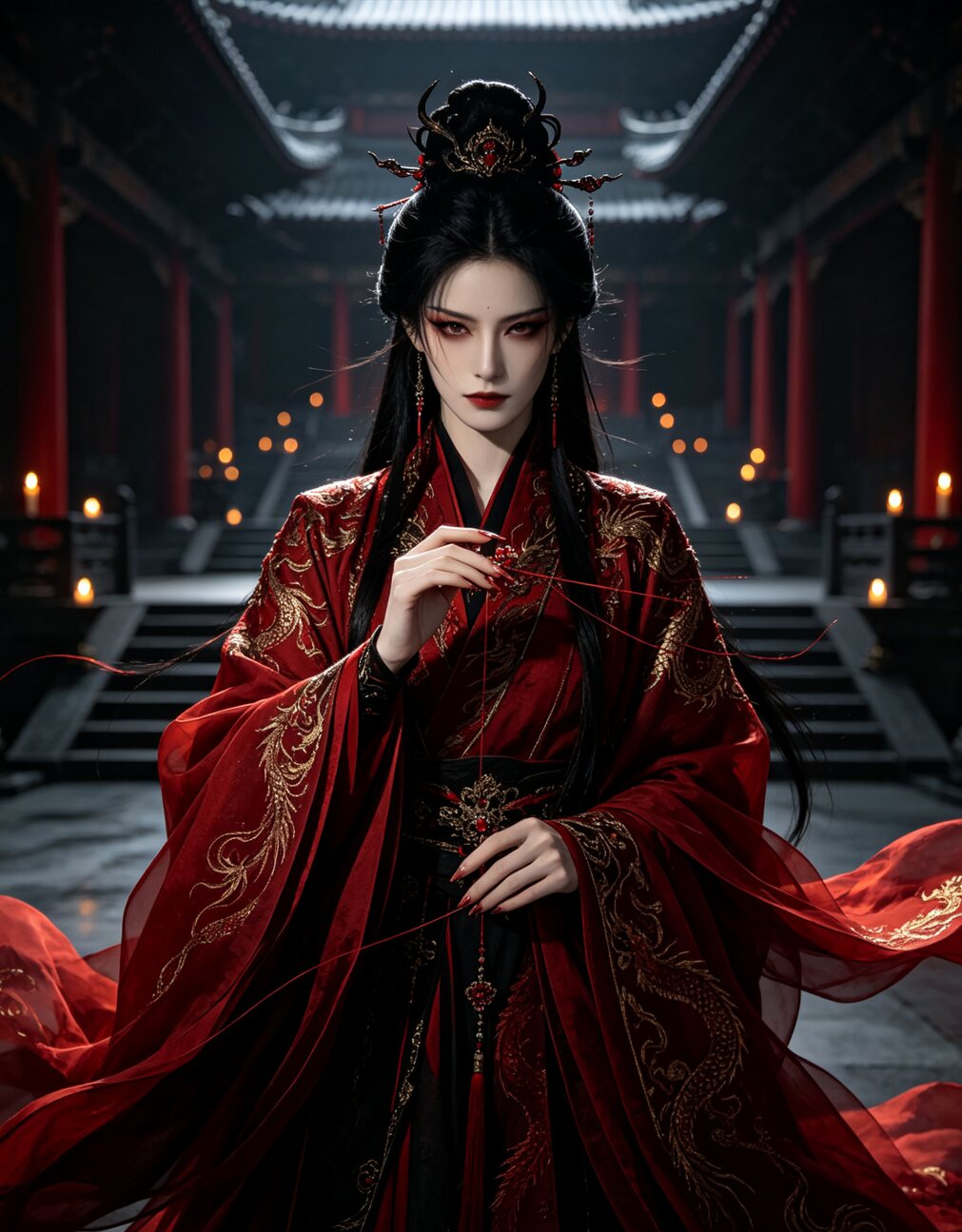
AI image prompt: dark ancient-style wuxia, Dongfang Bubai, supremely alluring and morally ambiguous, an androgynously beautiful face, cold indifferent eyes hiding a murderous edge, a solitary, proud, upright bearing, a crimson gold-woven robe with sleeves billowing flamboyantly, slender fingers lightly pinching an embroidery needle — a thin needle concealing lethal killing intent. The overall image matches the core of Blood-Reward Law: commanding the supreme right of violent domination, holding the rules of life and death in the jianghu, majestic without anger, with an emperor’s bearing and absolute dominance, transcending worldly good and evil, looking down on all beings with detachment. Setting: an empty black-and-red ancient palace hall, flickering candlelight, an oppressive and deadly atmosphere; 8K high definition, extreme detail, cinematic lighting, Chinese ink-wash texture, sophisticated composition, maximum tension, cold-tone ambiance, prominent subject, wuxia epic feel.
1. The Core of the Wuxia Dream: Ordinary People’s Craving for the “Power of Violent Domination”
1. Blood-reward logic as the foundation: violence is the source of all resources in ancient society
The core thesis of Wu Si’s book is clear: the gun (violence) produces all rules, wealth, dignity, and security.
In ancient times, lawful violence was supposed to be monopolized by the government, but the government was often absent, or abused its “right of lawful injury.” Ordinary people had no means of self-defense; their property, persons, and dignity could be violated at any time by officials, local strongmen, or mutinous soldiers. All their lives they could only “make a living by sweat” (sweat rewards) — meager returns, at everyone’s mercy.
Wuxia characters are completely different: they directly possess unconstrained, superhuman violence. In ancient society this equaled holding the most elite productive resource of all — blood rewards. Ordinary people farmed, labored, paid rent, and served corvée; wuxia heroes, with their superb martial arts alone, could walk the whole world freely.
2. The great hero is a scaled-down emperor ordinary people can fantasize about
The emperor is legally the only person with domain-wide violence: controlling life and death, distributing wealth, receiving homage, answerable to no superior, surrounded by beauties. Jin Yong refined this imperial fantasy, lowering the entry threshold to a height ordinary people can project themselves into.
- Extremely low threshold: no illustrious family background, no years of labor — a single stroke of fortune grants top-tier violence;
- None of the emperor’s costs: no governing the realm, no guarding against vassal conflicts, no burden of statecraft;
- Exempt from real-world ritual law: wielding the power of life and death while carrying a built-in “righteous martial virtue” filter — killing is punishing the strong to aid the weak, without an emperor’s moral guilt;
- Complete escape from bottom-tier survival shackles: no farming or labor, no taxes, no household-registration or legal constraints, provisioned wherever they go — perfectly avoiding ordinary people’s lifelong predicament of “toiling for a living.”
Wu Si’s summary is sharp: the wuxia dream is a simplified, improved emperor’s daydream for ordinary people who feel a sense of justice but don’t want to endure hard labor.
2. The Soil of Ancient Reality: Failed Official Violence Breeds the Fantasy of “Private Justice”
1. The government holds the “right of lawful injury,” and those at the bottom have nowhere to seek reason
The “right of lawful injury” mentioned repeatedly in Blood-Reward Law is everywhere in Ming-Qing historical records: officials and constables hold statutory violence, the cost of harming commoners is extremely low, and the benefit of helping commoners is extremely low.
If commoners chose to petition or sue, the blood-reward costs were terrifyingly high: travel expenses, bribes, prison risk, retaliation after losing — do the math and “swallowing the loss in silence” turns out to be the optimal solution. Formal law and public power couldn’t provide fair protection: powerful gentry colluded with officials to oppress commoners, customary levies and informal rules over-extracted from the people, and when upright officials like Hai Rui or reformers like Zhang Juzheng tried to correct the rules, the entire bureaucratic group devoured them instead. In times of chaos the government’s control collapsed, bandits and warlords ran rampant, and there was absolutely no backstop for the safety of life.
When the supply of public justice is chronically short, people fantasize about a private force of violence, belonging only to themselves, to fight injustice — the knight-errant is the embodiment of that fantasy. If the government won’t deliver justice, then hold martial arts yourself and personally settle every wrong you see on the road.
2. Violent plunder as the norm of survival: everyone understands “the strong-and-weak axis determines survival”
The blood-reward law has three core tenets:
- Violent plunder trades life for gain;
- Plunder appears whenever the gain exceeds the cost;
- Violence only transfers wealth; it never creates wealth.
China’s dynastic cycles, wartime refugees, mountain bandits, warlords, landlords, and local strongmen are essentially all violent games between different groups:
- Top tier: the court monopolizes lawful violence to harvest the whole population;
- Middle tier: officials use the right of lawful injury to privately skim benefits;
- Strong at the bottom: take to the mountains as bandits, making a living through violent plunder;
- Weak at the bottom: can only passively endure plunder.
Ordinary people spend their lives at the very bottom of the violence food chain, passively absorbing harm long term — inwardly they naturally crave a “reversal of strong and weak.” Wuxia offers ordinary people a shortcut: without robbing commoners, use violence only to punish evildoers — possessing the power of the strong while standing on moral high ground.
3. How the Wuxia Dream Compensates for Every One of Ordinary People’s Scarcities
Set against the lifelong deprivations of an ordinary ancient person, wuxia can deliver nearly the full compensation package — this is the key to why it struck such a deep chord.
| Real-world scarcity | Wuxia compensation |
|---|---|
| Scarcity of safety: no protection of the person | The hero’s martial arts mean no one can harm him |
| Scarcity of fairness: corrupt officials misjudge cases | The knight carries his own adjudication power, personally eliminating bullies and corrupt officials |
| Scarcity of wealth: a lifetime of bottom-tier labor barely covers food and clothing | The hero roaming the jianghu receives gifts freely — no toiling for a living |
| Scarcity of dignity: commoners can only grovel before officials and strongmen | Everyone in the martial world bows respectfully to the great hero |
| Scarcity of affection: bottom-tier marriages are mostly makeshift arrangements for survival | The hero naturally has soulmates and beauties devoted to him |
| Scarcity of freedom: household registration, corvée, and taxes bind one tightly | The hero wanders the four seas, beyond the reach of the law |
At the same time, this fantasy carries a built-in self-beautifying mechanism. What distinguishes the knight-errant from the bandit is the added “martial virtue” and “righteousness,” packaging private violence as an instrument of justice. This packaging dissolves the cruel essence of violent plunder, letting people project themselves with a clear conscience.
4. Why Is This Fantasy So Deep-Rooted That It Still Has a Market Today?
1. The enormous gap between real labor and violence
Ordinary people can obtain resources only through long-term labor (sweat rewards) — heavy investment, limited returns. In the wuxia setting, violence can obtain everything at low cost. This caters to the human instinct to escape drudgery and acquire resources easily. Wu Si calls it “the lazy man’s fantasy of wealth.”
2. The historical weakness of public order’s backstop capacity
Ancient states had limited governance capacity; law enforcement depended on officials’ self-discipline, informal rules ran rampant, and public relief and fair trials were chronically absent. Once public power fails to provide stable protection, people pin their hopes on knight-errants — private-remedy-style justice.
Modern society has complete judicial and public-security systems that weaken this need, but deep down people still crave “controlling their own fate without being bullied by others” — which is why wuxia culture still has its audience.
3. Violent competition is the underlying logic running through history
From the Liangshan outlaws and Sun Wukong to the knights of the jianghu, the core of these literary classics is always “possessing superhuman violence to change one’s circumstances.” This is no accident. Generation after generation of Chinese people witnessed with their own eyes: the rise and fall of dynasties, the ascent and descent of classes — all ultimately determined by the configuration of violence. This historical memory settled into a collective psychology, spawning a wuxia dream passed down through the generations.
Summary
Setting aside the romantic shell of jianghu loyalty and exhilarating vendettas, and viewing it through Wu Si’s lens of “blood rewards” and the “right of lawful injury”: the wuxia dream is a collective compensatory fantasy born among the ancient bottom classes in a social environment where public power failed, the right of lawful injury ran rampant, and violence determined survival resources.
In essence it is ordinary people’s longing for unconstrained power over violence — a commoner’s version of the imperial dream, without the emperor’s costs and with a built-in halo of justice. Its root lies in the long stretch of history in which public order chronically failed to give ordinary people safety and fairness, leaving them to accomplish, only in a fictional jianghu, the self-preservation, revenge, freedom, and dignity forever unattainable in reality.
Short-version note: the wuxia dream = a private-justice fantasy under failed public power = a commoner’s improved emperor daydream = a collective craving for blood rewards (the power of violent domination).
评论
0 条评论