1. Core Underlying Concepts (the Book’s Theoretical Foundation)
1. The Blood-Reward Law (the Book’s Core)
- Definition: survival resources obtained by fighting and bleeding, by violent plunder — the reward of violence. Labor exchanges for wages, land for rent, violence for blood rewards.
- Three core points
① Nature of value: violence creates no wealth; it only transfers wealth; the size of the blood reward depends entirely on the asset value of the plunder target.
② Trigger condition for action: blood-reward gain > four combined costs, and violent plunder occurs.
The costs fall into four categories: conscience/moral cost, opportunity cost of farming, labor, or trade, consumption of weapons, manpower, and supplies, and casualty risk from government suppression or gang warfare.
③ Underlying survival calculus: people weigh things rationally — how much risk of death they’re willing to bear, and how far they’ll sacrifice their own interests, to obtain the resources to stay alive.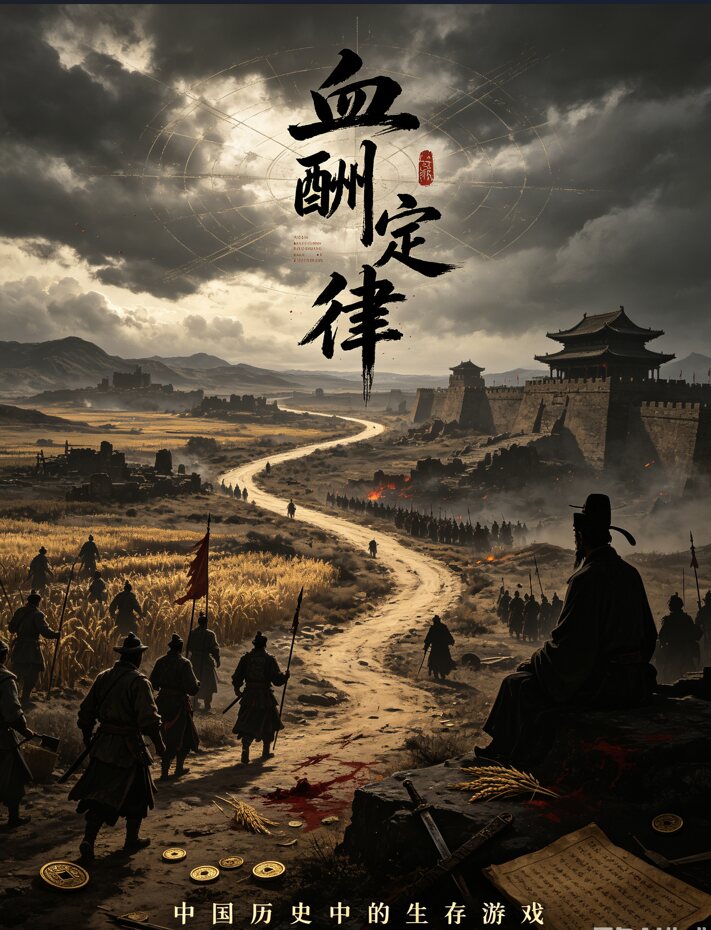
2. The Meta-Rule: the Fundamental Rule That Determines All Rules
- Definition: the strongest in violence calls the shots — all laws, rites, morals, and institutions are made by whichever group controls violence.
- Key corollaries
① “Justice” has no fixed standard; the violent group in power can revise value judgments at will (e.g., the Ming court abridged Mencius, weakening the idea that the people are precious and the ruler is light).
② The ultimate resolution of conflict is violence; if eliminating an opponent is cheap, all reason and law become void. - Three groups in society
- Officials: the group acting as agents of lawful violence
- Commoners: farmers, artisans, and merchants — the producing, creating group
- Bandits: outlaws and roaming brigands living by unlawful violence
3. Derived Concepts: The Right of Lawful Injury & Legal Reward
- The right of lawful injury (from Hidden Rules)
Officials possess a state-granted, low-cost capacity to harm (harassment, exorbitant levies, delayed case handling); to avoid losses, commoners proactively deliver gray income — this is the root from which hidden rules are born. Its essence is the right to use lawful violence. - Legal reward: institutionalized blood reward
When bandits collect protection money long-term, or the court levies taxes, violent plunder dons the cloak of institutions and the resulting stable long-term income is called legal reward.
2. Core Deduction: Bandit Transformation — Two Survival Modes of Violent Groups
Mode 1: Roaming bandits (short-term plunder, maximizing one-off blood rewards)
- Behavioral traits: drifting everywhere, burning, killing, and looting; no long-term operation of territory; no protection of producers.
- Classic case: the warlord “defense-zone” system in Republican-era Sichuan. Warlord territories changed hands frequently, so there was no need to maintain people’s livelihood long-term — they frantically pre-collected decades of land tax, piled on dozens of surcharges, and drained the pond to catch the fish.
Mode 2: Stationary bandits (long-term rule, pursuing sustained legal reward)
- Behavioral logic: if a violent group is certain of holding land long-term, it will proactively establish order, restrain its men, and protect farming and production. Only if the people keep producing goods can taxes/protection money be collected steadily year after year.
- Classic case: Li Zicheng. Early on, a roaming bandit slaughtering and plundering everywhere; after occupying Henan and commanding a million troops, treating the realm as permanent territory, he ordered an end to killing and looting and transformed into a ruler.
Two-way conversion between farmers and bandits (survival returns determine identity)
- Farmer → bandit: when natural disasters, heavy taxes, unemployment, or unpaid rent drive productive returns to zero and there is no way out, risking one’s life to rob becomes the rational choice.
Historical evidence: among bandits executed in the late Qing, over 70% were jobless drifters, followed by discharged soldiers and bankrupt coolies; tenant farmers in the Northeast, unable to pay rent after poor harvests, briefly joined bandit gangs to earn money for the rent. - Bandit → farmer: when the government suppresses banditry forcefully, the risk of violent plunder rises sharply; as farming order is restored and returns from the land rise, mountain bandits come down to farm.
- Extreme environments: when population plummets and land lies waste (Zhang Xianzhong’s massacre of Sichuan left some county seats with barely a dozen households), robbery stops paying, and bandits can only hunt and farm to survive.
Violent competition forces institutional reform
When violent groups compete for territory, to maintain long-term returns they proactively reduce the intensity of benefit extraction, reform laws, and ease tensions at the bottom.
Case: early Qing land enclosure and harsh fugitive-serf laws over-extracted from bond servants; later, to avoid large-scale uprising, the laws were gradually relaxed and a tenant-farming system replaced serfdom.
3. Core Deduction: A Study of Life Prices — Life Can Be Quantified and Priced
Core argument: “life is priceless” doesn’t exist. Ancient society had official statutory life prices and market life prices; life and survival resources could be exchanged at equivalent value.
1. Official statutory life prices (the redemption system)
Ancient law explicitly set the price for different classes of people to redeem a death sentence — the higher the status, the dearer the life:
- Qing dynasty: a third-rank high official could redeem death with 12,000 taels of silver; a commoner, only 1,200 taels;
- Ancient Tibetan law: life prices in three ranks and nine grades; a nobleman’s life was worth his own weight in gold, while a bottom-tier commoner was worth only a straw rope;
- Both the Han and Ming dynasties had systems of paying to redeem crimes and buying titles to escape death.
2. Market life prices (bandit ransom trading)
A complete market for trading lives took shape, with dedicated underworld slang, and ransoms (life prices) priced entirely according to a family’s wealth:
- Rich male hostage: “pulling a fat pig”; rich young woman: “inviting Guanyin”; child hostage: “holding a boy”; poor person: “pawn ticket”; ransom: “water head”; killing a hostage: “tearing the ticket.”
Poor people at the bottom had no plunder value, so bandits rarely kidnapped them — their life price approached zero.
3. The life-and-death calculus of the bottom classes
- Professional bandits’ mortality rate reached 38.2% — an extremely high risk of death exchanged only for barely subsistence-level survival goods; only people who have completely lost their fallback in life choose violent plunder.
- Underlying logic: when poverty breaches the survival floor, possessions and life become fully equivalent — ordinary people are willing to trade their lives for the basic resources to go on living.
4. Deep Reading of Key Chapters
1. “What Dreams Did Jin Yong Weave for Us”: Wuxia as an Improved Emperor Dream
- Core of the wuxia fantasy: imagining oneself with unconstrained, superhuman violence — able to judge others at will yet bound by no law.
- The real-world desires behind the great-hero fantasy: obtaining peerless martial power, wealth, fame, and multiple partners at low cost, never needing to labor for a living, and exercising the “right of righteous judgment” at will.
- Real-world critique: in actual history, unconstrained power of violent judgment belonged only to the emperor; wuxia novels deliberately avoid survival realities (making a living, mortgages, supporting a family) — they are the daydreams of ordinary people in an environment of missing order and unfair distribution.
2. “What 1587, A Year of No Significance Left Unsaid”: Huang Renyu Ignored the Underlying Conflict of Violent Distribution
- Root of Hai Rui’s and Zhang Juzheng’s tragedies: both destroyed the hidden rules by which the bureaucratic group profited through the “right of lawful injury,” touching the collective interests of all officials — and were ultimately devoured by the bureaucratic system as a whole.
- Limits of “management by numbers”: the underlying logic of ancient imperial society is distribution through violent plunder; mere numerical statistics cannot change the interest structure — the numbers only become a tool for over-extracting from the bottom.
- Underlying cause of dynastic collapse: the bureaucratic group endlessly overdraws the bottom-tier producers until farmers’ survival resources are completely stripped away, ending in violent uprising that restructures the rules of distribution.
3. The Complete Definition of Hidden Rules
- Behavioral constraints formed privately and spontaneously;
- Formed on the basis of each party’s capacity to harm or benefit the others, lowering the cost of conflict;
- Contrary to the state’s formal laws and mainstream morality, so they can only operate covertly;
- Crossing the line brings definite retaliation — everyone holds a unified expectation of the consequences of behavior;
- Through hidden rules, power holders obtain gray income that formal institutions don’t allow.
5. Extensions to Reality (in Light of Today’s Bottom-Tier Survival)
- The survival game under shrinking labor returns
Today’s workers are equivalent to ancient farmers; mortgages, layoffs, and high living costs are equivalent to ancient heavy taxes. When wage income can’t cover fixed survival expenses, ordinary people are forced to bear higher risks in exchange for survival resources. - Outsourced labor: the modern version of “roaming-bandit benefit extraction”
Formally laying off employees requires companies to pay high compensation (the cost of long-term rule), while labor dispatch and outsourcing act like short-term warlords — no need to protect workers long-term, just suppress wages and cut benefits to maximize short-term returns. - The modern “life price”: labor bargaining power
The unemployed and outsourced workers have extremely low labor bargaining power, corresponding to the cheap life prices of ancient commoners at the bottom; without a sound social safety net, workers can easily be pushed to the survival floor. - The eternally unchanging underlying logic
Rules of resource distribution are determined by the stronger capacity to constrain and harm. In ancient times, officials and bandits held the power of violent injury; today, capital and enterprises hold the power to price employment. Ordinary workers lack any equivalent countervailing power and can only passively accept the rules of distribution.
6. Summary of the Book’s View of History (the Blood-Reward View of History)
- The meta-rule (the strongest in violence sets the rules) is the source of all institutions, morals, and laws;
- Violent groups live on blood rewards and legal rewards — ruling stably long-term, they protect producers; occupying briefly, they drain the pond to catch the fish;
- Producers’ survival returns and the intensity of violent groups’ extraction play a reverse game: once extraction breaches the survival floor, the bottom reconstructs the rules with violence;
- The right of lawful injury spawns hidden rules — the tool by which the official class extracts extra profit;
- Life carries a quantifiable market price, and the height of the life price is determined by the resource value the individual can produce.
评论
0 条评论