Four zeroes
My Alipay bill for October: 54 transactions, 2,640.65 yuan. Of that, 373.20 went through reimbursement and sits under car care. What actually left my own pocket: 2,267.45.
Add the 4,000 mortgage and a family of three pushed 6,267.45 yuan out the door this month. Four thousand of it went to the bank — 63.8 percent. The remaining 2,267 is what living cost.
The monthly summary breaks the bill into four boxes, and I read them one by one: large purchases 0, buy-now-pay-later 0, instalments 0, automatic deductions 19.
The first three zeroes aren’t discipline. Nothing this month was big enough to need instalments or credit. The 19 automatic deductions weren’t me spending either; they went off on schedule. The acts of spending that were actually mine came to 35, spread over 31 days: 1.74 a day, under two presses a day.
The itemised list doesn’t survive scrutiny either. The 676.16 under top-ups and bills is two sums: my child’s Hangzhou medical cover for 2027, 340 paid by the individual against a 750 government subsidy; and 336.16 for water and electricity. The 600 under account withdrawals is my child’s allowance. Food and drink, 352.44 across 12 transactions, 29.3 yuan a meal; household goods, 107.06 across 10, 10.7 a run; transport, 159.96 across 6, 26.66 each.
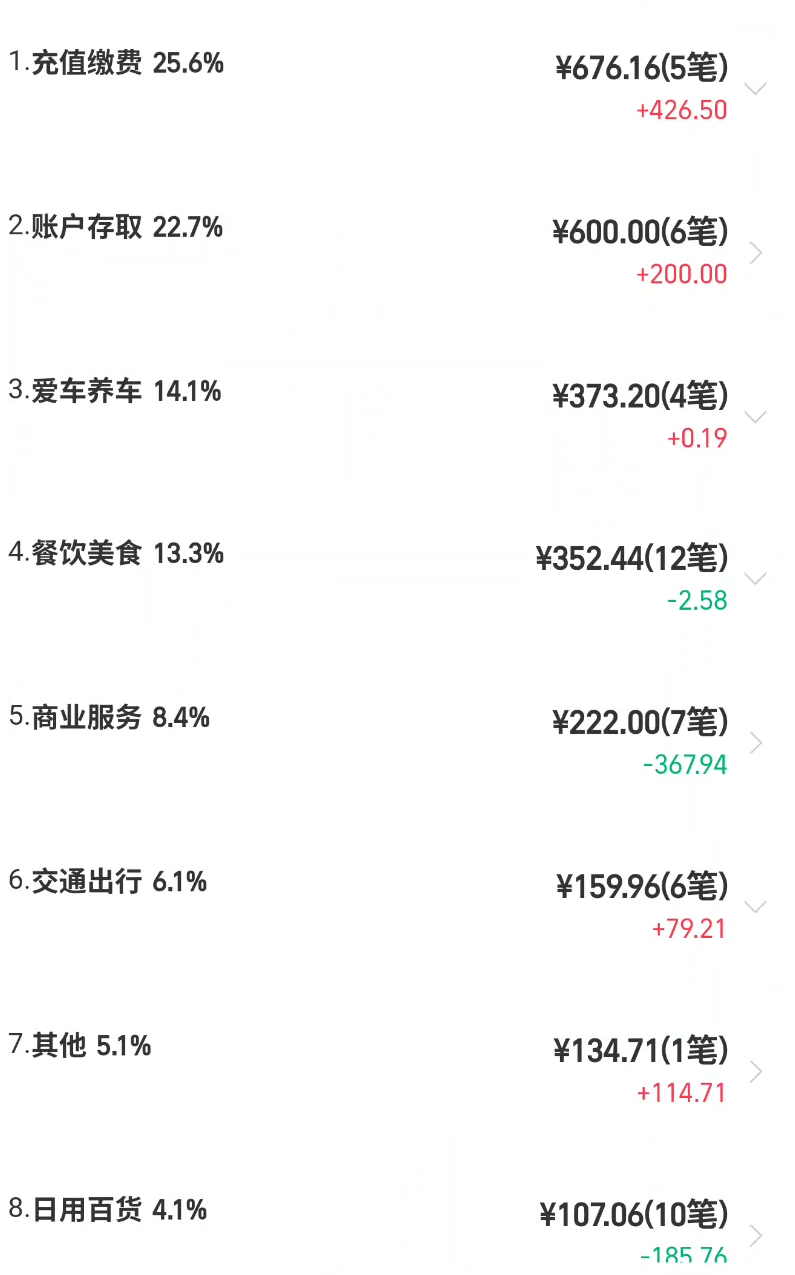
A family of three ate out twelve times in a month and shopped for household goods ten times. You call that living frugally? That is what it looks like when nothing is left over.
And this 2,267 is only the Alipay page. The mortgage isn’t in it. School fees, tutoring and insurance aren’t fully in it either — a year of tutoring costs as much as these three months. WeChat Pay, cash, payroll deductions: none of it is among the 54 transactions. I have to count even this much out page by page, because the rest can’t be avoided.
A family of three spends less than one person in this country
The 2025 statistical bulletin: national per-capita consumer spending 29,476 yuan a year, urban 35,869, rural 20,259. Per month that’s 2,456 nationally, 2,989 urban, 1,688 rural.
Divide my 2,267.45 by three and you get 755.82 per person. In other words, my family of three together spends less than the national average for one person. Per capita we’re at thirty percent of the national figure and a quarter of the urban one.
Another way to put it: my household spends 27,209 a year; one person in this country spends 29,476. The whole family for a year comes to less than one person for a year, short by 2,266.6 yuan — almost exactly what I actually spent in October. The shortfall is precisely one month of my family’s living.
We also went to Shanghai in October. Per-capita consumer spending there in 2025 was 57,076 yuan, 4,756 a month. The three of us in Shanghai were at under a sixth of the local average.
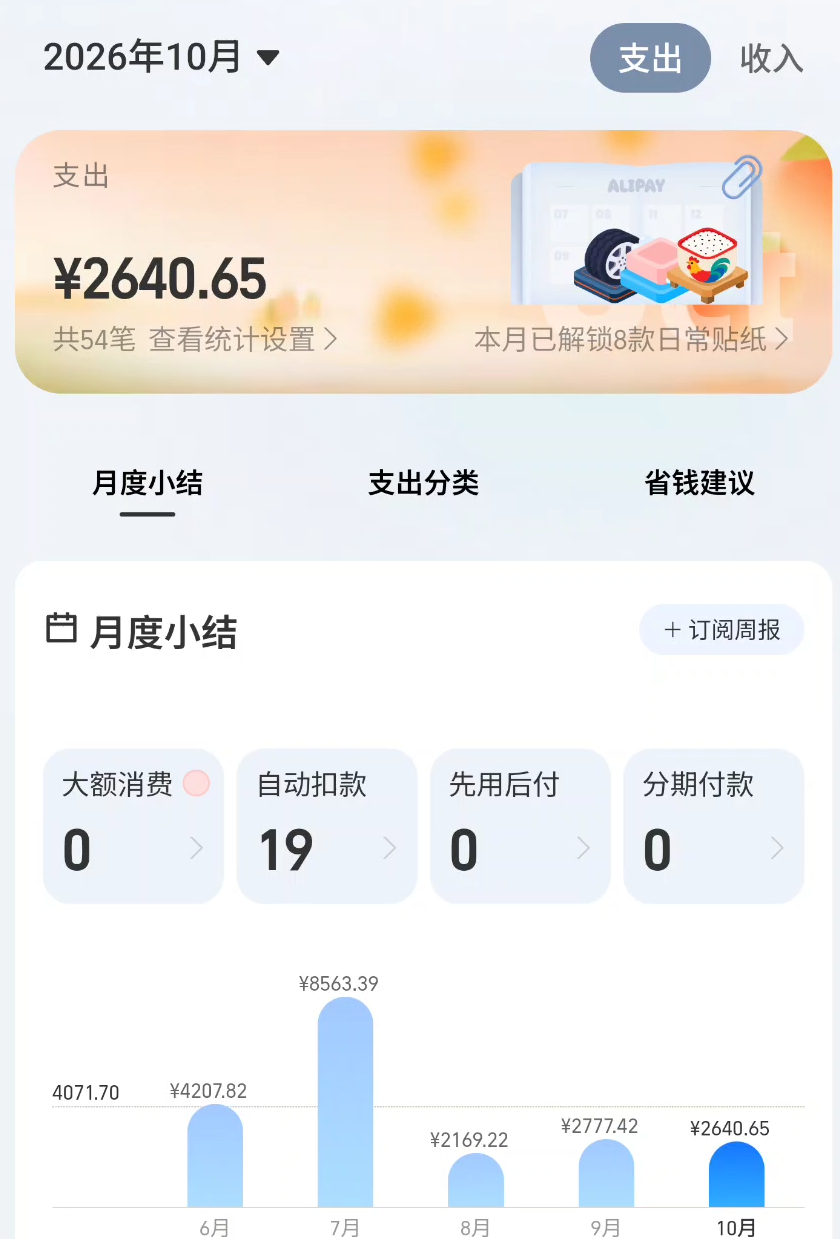
The other bars while we’re here: July’s 8,563.39 is 3.24 times October — that was a different account. August 2,169.22, September 2,777.42, October 2,640.65: those three are the current normal.
The 1.2 million jewel at the counter
In the mall under that finance tower in Lujiazui I saw a piece of jewellery priced at 1.2 million yuan. Standing there, I wasn’t thinking about whether it was pretty. Who can afford it? Where does the money come from?
The first question has a precise answer. The 2025 Bank of East Asia · Hurun Wealth Report, published 30 June 2026: 5.06 million affluent households with assets above 6 million yuan; 126,000 ultra-high-net-worth households above 100 million. Those 5.06 million households hold 145 trillion yuan between them, 1.07 times the country’s GDP. There are roughly 494 million households by census count — so one percent of households hold more money than the entire country produces in a year, by seven percent.
Those 126,000 households are 0.0025 percent of all households. To them 1.2 million isn’t a purchase; it’s change.
The data runs the other way too, in the same report: the 6-million, 10-million and 100-million tiers are all shrinking, by 68,000 households, 2.9 percent, and 4,000 households respectively. The people standing at that counter are not the same people as in 2021. The wealth is shrinking; the price tag isn’t.
Their money wasn’t saved from wages
The second question the report answers itself: among households with over 100 million in assets, 80 percent are business owners, and for those households business assets make up more than 70 percent of total assets.
Not saved from wages. Priced in.
Then three rules side by side: capital gains on individual A-share trades have been temporarily exempt from income tax since 1994; a primary residence held five years is exempt, and there is no nationwide property tax on holding; estate and gift taxes have never been levied. My wage, at a 45 percent marginal rate, and their untaxed valuation run on two different rulebooks.
The tax administration’s own filing data draws the same line: earners above one million yuan a year are about 1 percent of filers and pay over half of all personal income tax; the top 10 percent by declared income pay over ninety percent. After the 2018 threshold rose to 5,000 a month, the share of urban employees paying income tax fell from 44 percent to 15 percent, and the official line now is that comprehensive income below 100,000 a year basically owes nothing.
The top ten percent pay ninety percent of the income tax. The number is the mechanism.
As for whether their money comes out of someone else’s wages — I wrote in “Out of Debt Is Light” that one person’s cost saving is exactly another person’s lost income. The other half of that sentence: the income of those 126,000 households comes from no one’s wages. It comes from the quoted price of their own assets. The loop doesn’t apply to them. The rule that applies to them is: you pay 1.2 million for it, and only then is it worth 1.2 million tomorrow.
500K is a position, not an effort
Two hundred thousand a year I’d call genuinely impressive. Three hundred thousand takes real effort and real grinding. Beyond that, personal effort stops being enough — you need to lead a team.
The 200,000 line has an official scale behind it: income under 100,000 a year basically owes no tax, and taxpayers are only 15 percent of urban employees; my two years at 20,000 a month sat inside that 15 percent. What percentile 200,000 occupies I don’t have — the official data cuts at 100,000 and 1,000,000 and nothing in between.
So do the arithmetic upward. The 2025 annual reports of all 5,516 A-share listed companies are in, and market-wide labour productivity is 660,000 yuan per person, which the statistics bureau says is 3.6 times the economy-wide average. Reverse it and the economy-wide average is about 183,000 yuan per person. The same year those companies paid 7.35 trillion yuan in employee compensation and added 530,000 staff.
My take-home during probation was 12,000 a month, 144,000 a year. Against “the average person in this economy produces 183,000 a year,” the two numbers sit almost flush. On the average line, my wage and my output are roughly the same thing — not even refined exploitation.
The 500K threshold is not something extra effort crosses. Sell your output to the absolute limit and you land around 183,000. 500K, 1 million, 39.98 million — all of it has to come from outside output.
The per-capita pay table shows what “outside output” means. Most striking rows from the 2025 reports: ST Xinchao in oil and gas at 4.06 million, which is resource rent; Geebit in gaming at 1.4811 million, which is IP and cash flow; Montage at 943,100 and Moore Threads at 718,900 in semiconductors, which is valuation; thirty brokerages above 500,000 per head, sixty percent of the industry, which is a licence; and banks and insurers for reference, China CITIC Bank at 594,700, Ping An at 344,000.
Those industries aren’t paying high wages. They are dividing the return on an asset among the headcount.
So the accurate statement isn’t “people earning over 500K are levered by capital.” It’s: earning over 500K almost never happens on the personal-effort path. It happens wherever you’re hung on an asset. The same pair of hands writing code at a company averaging 943,100 and one averaging 120,000 is the same pair of hands.
The top is blunter still. Rongzheng sampled 5,463 companies: eighteen executives above ten million, the highest at 39.98 million. Output can’t explain 39.98 million — that’s 110,000 a day, 365 days a year. That’s equity vesting: valuation landing once in someone’s passbook.
The share didn’t drop; the door changed
The statistics bureau’s June 2026 flow-of-funds note: the household sector’s share of gross national income in primary distribution went from 62.6 percent in 2020 to 63.5 percent in 2024; the compensation-of-labour share went from 52.4 to 54.4 percent.
So on the macro books, “labour’s share keeps shrinking” is false. The share didn’t fall; it rose a little.
Then where should the anger go? The share is intact; the door changed — from seniority to scarcity. Those thirty brokerages, those semiconductor firms: they don’t ask whether you can do the job, they ask whether you can be hung on that asset.
And “lead a team,” in practice, means producing the most value for the least spend. Through incentives? Many companies don’t use incentives. They use 271 to make you grind yourself.
Alibaba’s 3.75, 3.5, 3.25 map to 20, 70, 10 percent, internally called 361. What matters is the order: the ratios are fixed before anyone is evaluated. It isn’t an assessment; it’s an allocation rule — with enough headcount, someone has to eat the bottom ten. You don’t have to be bad. You only need a team of exactly the right size. The ancestor of this scheme is GE’s vitality curve, 20-70-10, so “capital rigging the game” isn’t a feeling; it’s a traceable institutional transplant from Jack Welch’s conference room to my performance sheet.
The law moved on this long ago: Supreme People’s Court Guiding Case No. 18 (Zhongxing Telecom (Hangzhou) v. Wang Peng, published November 2013) holds that “ranking last in an appraisal is not equivalent to being incompetent,” and a unilateral termination on that basis is unlawful, with compensation due.
The grind has a measured scale too. Average weekly hours for enterprise employees were 48.3 in September 2026 and 48.6 for 2025, against the statutory 8 hours a day and 40 a week set in 1995. That’s 8.3 extra hours a week, 431.6 a year, or — at eight hours a day — 54 extra working days.
So the full version of “grind or get out” is: work 54 more days, for a place in the bottom ten whose headcount was fixed before you walked in.
I have exactly one kind of capital, and it’s falling
The central bank’s 2019 survey of urban household assets and liabilities, 30 provinces, 30,000-plus households: mean total assets 3.179 million yuan, median 1.630 million — a gap of 1.549 million. The central bank’s own report says this “indicates an uneven distribution of household assets.” Housing is close to seventy percent of total assets, 1.878 million per household.
Ordinary Chinese urban households aren’t without capital. They have exactly one kind: the flat. And since 2021 that one kind has been falling.
My account sits right there: bought at 2 million, now worth 1.6 million; the 600,000 down payment has evaporated into the price; 600,000 left to repay over 18 years. Other people’s capital levers their income; my capital levered away the next 18 years of mine. Same phrase, “levered by capital,” two directions.
Put the 1.2 million jewel back into my ledger: it is 73.6 percent of the median urban household’s entire net worth — roughly seven-tenths of a Chinese urban family selling the flat, the savings and the car; it is 59.2 times the 20,259 yuan a rural resident spends in a year; my household spends 27,209 a year, so it is 44 years and 3 months.
Hurun’s 5.06 million households and the central bank’s 3.179 million per household are not the same population — one counts only those above 6 million in assets, the other all urban households. Don’t mix the two.
You have to spend, or the machine stops
“All holidays exist for consumption.” I used to take that as a rant. It isn’t.
The term “holiday economy” appeared in 1999, when the State Council revised the national holiday rules and created the Golden Weeks, against weak domestic demand after the Asian financial crisis. The academic phrasing at the time: “entrusted with the hope of expanding domestic demand.” That same year, total rest time including weekends reached 114 days for the first time. From 2025 statutory holidays went from 11 to 13, adding New Year’s Eve and 2 May, with language encouraging people to combine them with paid leave into longer breaks.
Longer holidays aren’t the problem. The question is whether they have anything to do with your income. They don’t. They only have to do with your spending.
The other end of the ledger: 2025 retail sales of consumer goods passed 50 trillion yuan, growing just 3.7 percent, with final consumption contributing 52.0 percent of GDP growth. The machine only turns if you spend.
And the line about cheap goods subsidising foreign buyers — the Ministry of Finance and the tax administration have conceded it, and are pulling it back: in January–September 2024 domestic VAT revenue was 5.05 trillion yuan, down 5.6 percent, while export rebates were 1.57 trillion, up 10.4 percent; over the 14th Five-Year Plan, export rebates topped 9 trillion. Since 1 December 2024 aluminium and copper product rebates have been scrapped, and the rates on solar and batteries have been cut year after year, with battery rebates ending entirely on 1 January 2027.
My anger has been confirmed, document by document.
As for “they’ll do anything to destroy your job, hold unemployment up, and hire the rest cheaply” — it sounds like conspiracy theory. It is the body text of Chapter 23 of Capital. Marx’s words: capitalist accumulation “constantly produces, and in proportion to its energy and volume, a relatively surplus population, i.e. a population surplus to the average needs of capital valorisation, and therefore a surplus or additional working population.” He named them the relative surplus population, also called the industrial reserve army. What I said on instinct, someone wrote down as a law a hundred and fifty years ago.
After 35: broke means broke
Save while you can earn, and don’t throw it around, because you won’t always be able to earn. Most people, me included, just caught a wave; when you get older and the wave passes, you find out how deep the exploitation runs.
After 35 my spending creed changed: no money, no purchase. I don’t believe any advertising anymore, only my actual needs. Being “immune to consumption” isn’t a state of mind; it’s an organ that grows once there’s nothing in your pocket.
Meet the basic material needs and I’m free. Everything beyond that gets paid for with time, energy, and pieces of your soul.
The programmers who work themselves to death at 996 aren’t stupid. They want to climb too badly, doing low-value work until the grind kills them: 54 extra days for a place in the bottom ten whose headcount was already fixed. I can do that arithmetic, so I don’t climb.
The dumbest are the ones who take out loans for a car, a flat, a marriage, a child — we’re the ones squeezed driest. Being single costs almost nothing; marry and have a kid and expenses are everywhere. I bought in 2019, took the loan in January 2020, the payment comes out on the 10th, my child is in school. I’m that dumb one: 63.8 percent back to the bank.
I’m not running
After 35 I don’t believe grand narratives either. I follow what’s actually in front of me and live for myself.
Fifty trillion in retail sales, 52.0 percent of growth, 145 trillion in the hands of one percent, 126,000 households who can afford that jewel — put together, those numbers say one thing: keep running.
I’m not running.
In October I spent 2,267, for a family of three, and we went to Shanghai. That number isn’t my report card. It’s my boundary.
评论
0 条评论