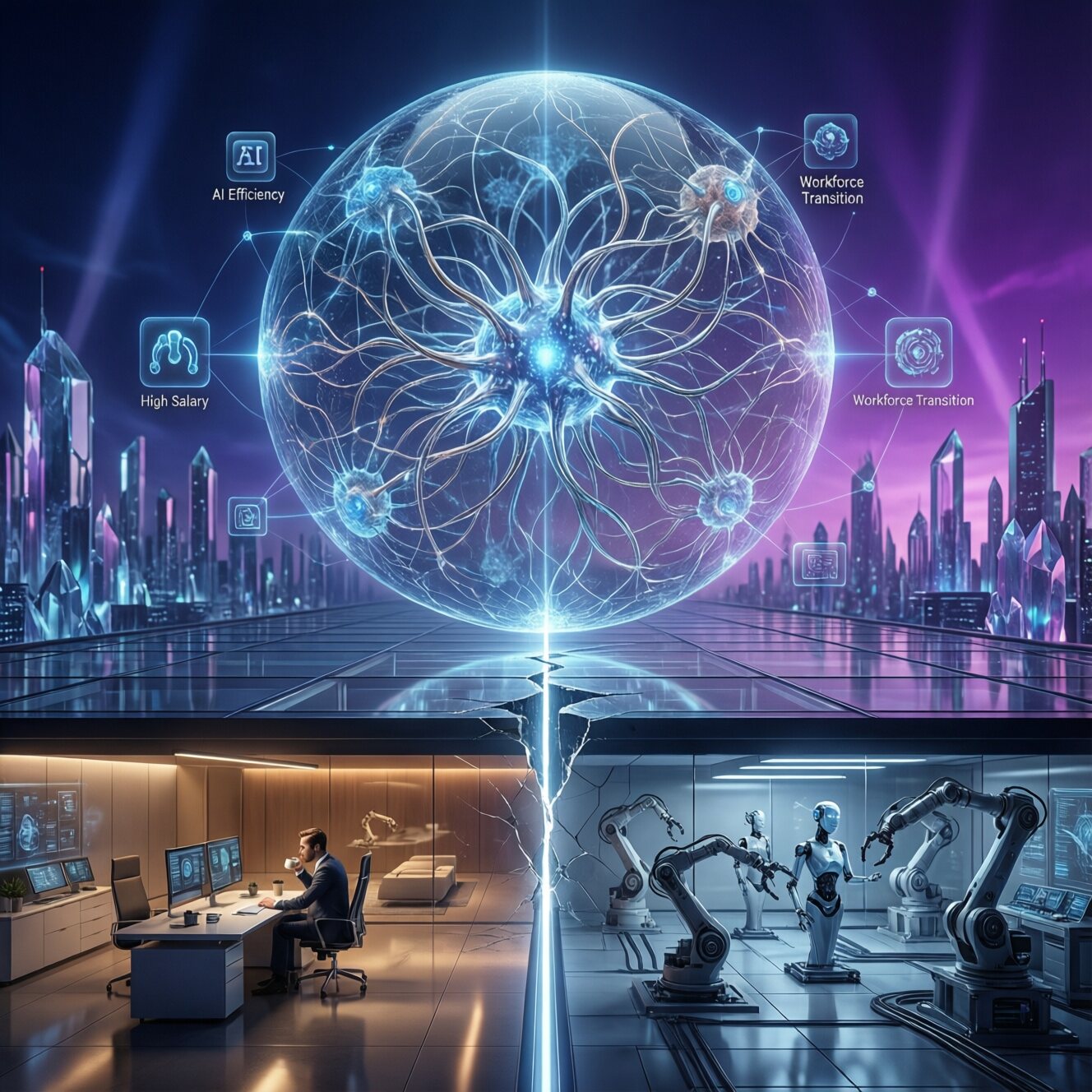
“Tencent’s average employee pay hits a million yuan a year” and “NetEase uses AI to lay off outsourced staff” trended simultaneously. On one side, enviable high salaries in the industry; on the other, a cold efficiency tool. As someone in tech, what I see isn’t a simple labor news story but a deep game over technological value, organizational efficiency, and human ethics.
Background: When the Technology Dividend Hits Cost Pressure
This morning when I scrolled to this news, I was sipping coffee and preparing for the day’s work. Three seemingly unrelated pieces of information outline the truest cross-section of today’s internet industry:
- Tencent’s 2023 average per-capita compensation cost of 1.025 million yuan - a figure that made outsiders gasp that “the internet is still a golden industry”
- An old antibiotic being scalped to a thousand yuan a box - the supply-demand imbalance in traditional industries remains severe
- NetEase denies “using AI to lay off all outsourced employees” - but AI-driven workforce optimization is already an open secret in the industry
Put together, these three things are especially interesting. Tencent’s high pay represents the “talent premium” of technology-intensive companies; the antibiotic scalping is a product of “information asymmetry” in traditional industries; and the AI-layoff rumor reveals how technology is used to solve the “labor-cost problem.”
Anyone who has built enterprise systems knows that when a technology shifts from a tool for “improving efficiency” to a weapon for “cutting costs,” its ethical boundary starts to blur. Today let’s talk about the systemic problems and ethical dilemmas overlooked beneath the surface of technological prosperity.
Technical Breakdown: How Does AI “Optimize” the Workforce? A Technical-Architecture Perspective
Setting aside whether NetEase really used AI to lay off outsourced staff, let’s first look, from a technical angle, at how this could theoretically be done. As someone who has built enterprise RPA and intelligent ticketing systems, I can tell you that the technical architecture of such a system is far more mature than you’d imagine.
1. The technical implementation of a workforce-performance evaluation system
|
The core of this system architecture is the data loop:
- Data-collection layer: connect Jira, Git, WeCom/DingTalk, and the financial system
- Feature-engineering layer: quantify work behavior into computable metrics
- AI-model layer: use NLP to analyze chat records and a rule engine to evaluate output
- Decision layer: a composite score that gives a “retain/observe/optimize” recommendation
2. System architecture diagram: the full chain from data to decision
|
This system is technically entirely feasible, and many big companies have already implemented it to varying degrees. The key is that when the technical system is mature enough, the “optimization” decision shifts from human judgment to automated execution.
My View / Cool-Headed Thinking: The Technology-Ethics Predicament of Efficiency Above All
1. The truth behind “a million per person”: survivor bias and structural divergence
Tencent’s per-capita pay of 1.025 million yuan is widely circulated, but few bother to break down its composition:
- Compensation cost ≠ take-home pay: includes social insurance, housing fund, benefits, etc.; actual take-home may be 60–70% of that
- Severe structural divergence: executive and core technical staff pay pulls up the average
- Outsourced staff aren’t counted: the low cost of many outsourced staff supports the high pay of core employees
This is like when we look at system monitoring metrics: the average often hides the real distribution. A system’s average response time may be 100ms, but 90% of requests may complete within 50ms while 10% of slow requests drag out to 1s. Looking only at the average means ignoring the group that’s been “averaged.”
2. AI layoffs: when technology loses its warmth
Although NetEase denies “using AI to lay off all outsourced staff,” data-driven workforce optimization is already the norm. Here are a few cool-headed thoughts:
First, the technical difficulty of algorithmic fairness
|
Second, the systemic risk of the outsourcing system
Outsourcing was originally meant to flexibly handle business fluctuation, but it has become a tool for systematically reducing cost. From a technical-architecture standpoint, it’s like:
- Core services self-managed with Kubernetes (full-time employees)
- Non-core services on serverless functions (outsourcing)
- When function-compute costs rise, just switch vendors or cut features
Third, the self-alienation of tech workers
Most ironically, the programmers who build these “optimization systems” may themselves become targets of optimization. It’s like humans building Skynet in The Terminator, only to be devoured by it in the end.
3. Antibiotic scalping: the technical debt of traditional industries
An old antibiotic scalped to a thousand yuan a box is, on the surface, a supply-demand problem, but at a deeper level it’s information asymmetry caused by the low degree of digitalization in the pharmaceutical industry.
Compare with the internet industry:
- Internet: transparent prices, well-developed price-comparison systems, real-time algorithmic adjustment
- Pharmaceutical industry: opaque circulation links, distorted price signals, inefficient supply-demand matching
This reminds me of when I built e-commerce systems a decade ago — solving a similar information-asymmetry problem. But the particularity of the pharmaceutical industry is that it cannot be fully marketized, and it needs to retain some inefficiency to ensure accessibility.
Implications for Product Builders: A Product Philosophy of Technology for Good
1. Consider the experience of the “person being optimized” when designing systems
Anyone who has built enterprise systems knows the design often considers only the manager’s needs and ignores the experience of the execution layer. A good tech product should:
Build a feedback-loop mechanism
|
2. Find the balance between efficiency and fairness
A common mistake tech product managers make is over-pursuing efficiency metrics. From an engineering standpoint, any system needs a certain redundancy to guarantee robustness.
- Technical systems: need backup nodes and disaster-recovery mechanisms
- Organizational systems: need talent reserves and cross-skilling
- Product design: need inclusive design that considers edge users
3. Data transparency and algorithmic explainability
If you want to use data-driven workforce decisions, at least:
- Disclose the evaluation dimensions: let employees know how they’re being evaluated
- Provide an appeal channel: algorithms can err and need human correction
- Audit the model regularly: prevent algorithmic bias from accumulating
This is like building a monitoring system: you can’t just alert without explaining; you must tell the developer “why this metric is abnormal” and “what the possible causes are.”
4. The product responsibility of tech workers
As a technologist with over a decade of experience, I increasingly feel that a tech product isn’t just a collection of features but a carrier of values. Every line of code we write and every system we design invisibly shapes ways of working and social relations.
Conclusion: The Warmth of Technology Lies in the Designer’s Original Intent
When I run marathons, I often think: pace matters, but knowing why you run matters more. So it is with technology: efficiency matters, but direction matters more.
Tencent’s million-per-person and the AI-layoff rumor look like two extremes of the business world, but they actually reflect the same question: on the road to maximizing efficiency, have we lost technology’s original intent?
Technology should be an empowering tool that lets people do more valuable things, not replace people and optimize people. A good technical system should be like a good marathon aid station: not judging your result at the finish line to decide whether to give a medal, but supporting you along the way so you run farther and better.
As tech workers, we hold in our hands the power to change the world. This power can be used to build cold efficiency machines, or to craft tech products with warmth. The choice lies in every product design and every line of code we write.
Technology for good isn’t a slogan; it’s a value choice in every technical decision. In this age where algorithms decide everything, perhaps what we need isn’t just smarter systems, but wiser system-design philosophy.
评论
0 条评论