I changed into a clean shirt before heading out this afternoon. Nothing fancy — I just figured that meeting someone I’d never really talked to in nine years deserved a bit of effort. I had been hiking in the morning and was drenched in sweat; my clothes were wet when I got back. So I cleaned myself up a bit and set off on my little scooter.
His name is bestony, Bai Huancheng. The last time we shared a frame was 2017: I joined NetEase, and he had just left. Back then I only knew his name from a WeChat group; I couldn’t even remember his avatar. Later, when I was doing some part-time teaching at Jikexueyuan, I scanned the instructor list and found he was moonlighting there too. After that he just sat in my contacts. Almost everything I knew about him over those years came from his Moments: he went to Tencent Cloud, then to ByteDance as a product manager on Feishu’s open platform, and then quit to go independent. The impression he gives is of someone with some influence in the open source community, someone who is always traveling around giving talks as an evangelist.
Nine years, and all we ever shared was a stint at the same company in the same role, plus a part-time teaching gig at the same place. Then I happened to see the event he had posted in his Moments: it was at Yun Gu Zhi Xin in Hangzhou. So I messaged him — let us finally meet in person. Today the venue was about 10 km from my place, not far at all.
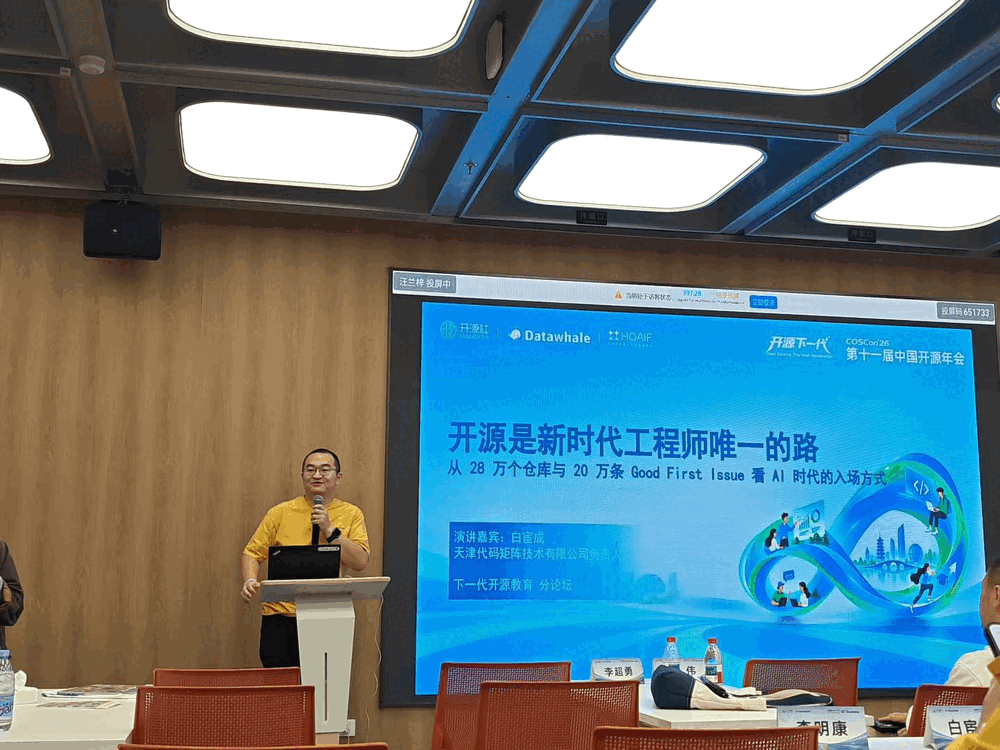
The line on the big screen was blunt: open source is the only road left for engineers in this era. The subtitle was longer — from 280,000 repositories and 200,000 Good First Issues, a look at how you get into this industry in the AI era. The speaker bio read: Bai Huancheng, head of Tianjin Code Matrix Technology, Next-Generation Open Source Education track.
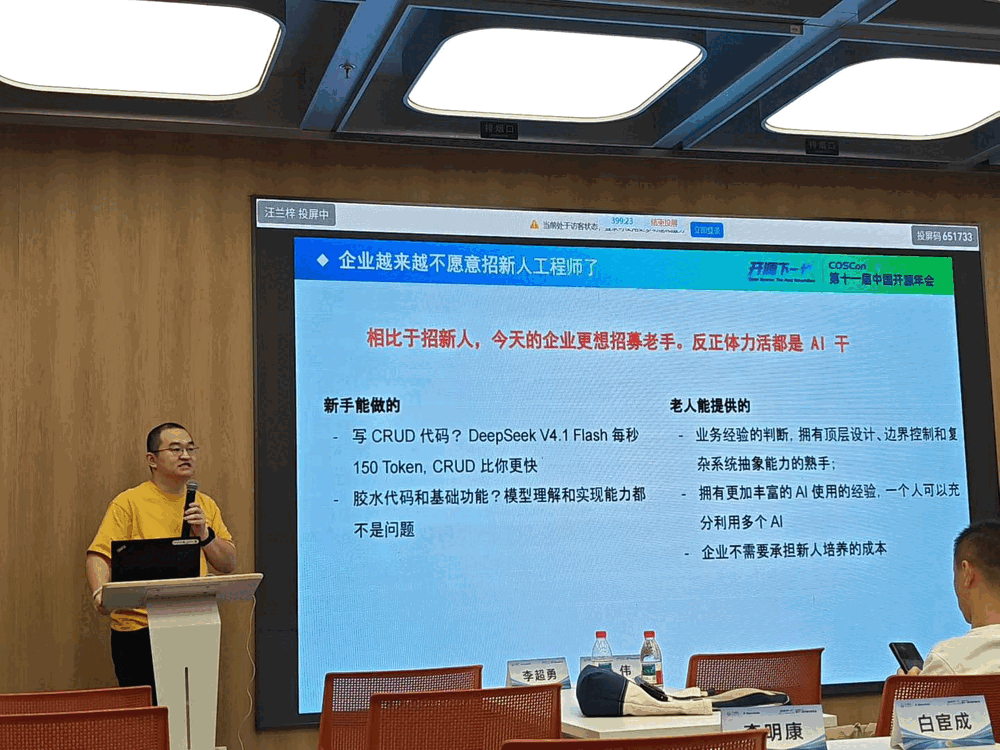
Then he turned to a slide in the middle and I sat up straight. The headline was “Companies are less and less willing to hire junior engineers,” with a red line underneath: compared with new hires, companies today want veterans — the grunt work is done by AI anyway.
The left column was headed “What a newbie can do”: write CRUD code? DeepSeek V4.1 Flash does 150 tokens per second, and it writes CRUD faster than you. Glue code and basic features? Model comprehension and implementation are no longer the problem. The right column was “What a veteran brings”: business judgment, top-level design, boundary control, the ability to abstract across complex systems; far richer experience in using AI, so one person can run several models at once; and the company doesn’t have to pay for training a newcomer.
“AI is already this strong. Why would I hire a fresh graduate?”
It’s not a nice sentence, but I know it’s true. That’s how plenty of bosses do the math: a fresh grad needs someone to hold their hand, needs half a year before you dare let go, will break production; the strongest model tier costs about 1,400 yuan a month, works 24/7, takes no leave, doesn’t ask for a raise, doesn’t sulk. What’s left for people? Judgment and creativity — the two things that are hardest to hire and impossible to rush.
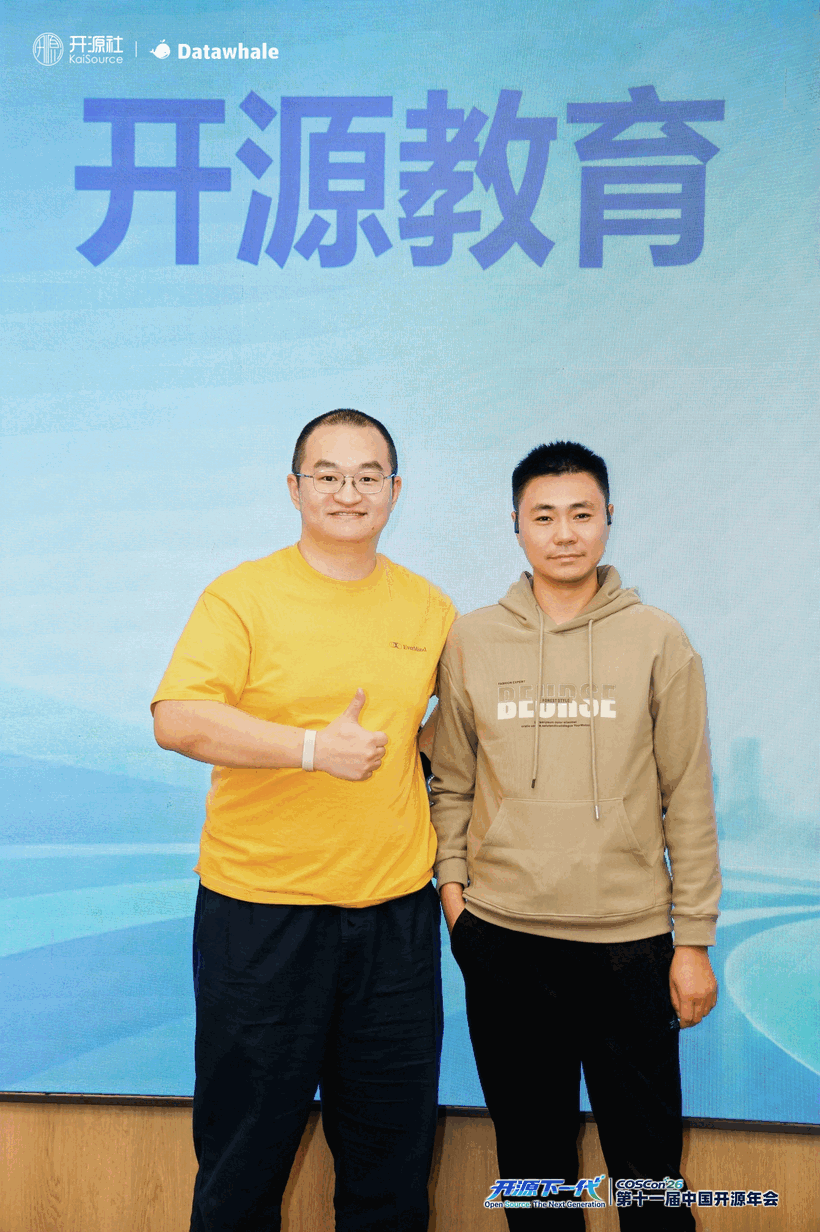
After the talk, I stood face to face with him in front of the booth for the first time and we took a photo — a high-resolution one, hahaha. He’s more easygoing and approachable in person than I expected, and speaks more slowly than he does on stage.
Honestly, back when I was teaching at Jikexueyuan, I just wanted a side gig to cover what I’d spent on the training. He, on the other hand, kept hunting for every chance to build his own influence. Count up all these years and it feels like I haven’t gotten anything done, though for a while the work I did at one company did carry some weight. But that was company-level weight, and honestly it’s worth jack shit. You have to do things for yourself, things that raise your own influence. Once you earn recognition in the industry that isn’t tied to a company, the road starts to widen.
On the way back I kept thinking about my own situation.
I started out as a secretary. Vocational college diploma. That brand doesn’t wash off; it’s followed me for over a decade and it still shapes things today — resume screens, promotion criteria, doors that nobody says are closed but that never open for you. My work history isn’t pretty either, plenty of detours. I’m not going to pretend otherwise here: the diploma has cost me.
But exactly because of that, I had no preparation at all back then. Nobody designed a path for me, nobody led me into the internet industry — I taught myself, then paid for classes to fill the gaps, then took side projects and moonlighted as an instructor, building my own influence and my ability along the way. People like me still had a crack to squeeze through in those years: companies were short-handed, willing to give someone without a polished background a chance. You do the work first, and you talk about the rest later.
That crack is closing.
In the old model, a young person’s first two years at a company were essentially paid learning: bad code had someone to catch it, incidents had a senior to absorb them. Today the boss’s math is simpler — “hiring a fresh grad costs more than subscribing to a model.” So “join a company, then learn slowly” is getting narrower for new graduates. It isn’t that they’re lazy. The ticket in is being taken back.
So what then? He gave an answer on stage, and it happens to be what I’ve come to believe over the past few years: open source.
280,000 repositories. 200,000 Good First Issues. I drifted a little when I heard those numbers — that many entrances, and none of them check your diploma, your age, or whether you have a big-company badge. Fix a bug and the commit is there, visible to anyone. No interviewer decides for you; the code speaks.
This is also what I’m doing. I’ve open sourced almost everything I can out of the projects I’ve written — because apart from using them myself and finding them useful, I want more people to use them. Only when people use it does it have value. Don’t start by thinking about charging money. First, does what you built have a market, is anyone willing to use it; only after that does it matter whether anyone will pay for it.
This is also something I saw from Liu Run recently, and it lines up with what I think: software right now is like sandblasting — a big pile gets sprayed out all at once. The value of software is heading toward zero. Closed-source software will most likely have no way forward in the future.

So what is the way forward? For people who write software, the way forward is open source plus a paywall.
I don’t think open source is a cure-all. It’s slow, it pays nothing, and most of the time you have to find the problem yourself, read other people’s code yourself, and put up with maintainers not replying for days. But it is one of the few doors in this industry that is still open to everyone.
He was talking about a company’s hiring math; what I heard was something else. If my turn comes again, what do I have left? The badge gets taken back, the role gets merged, the company names on my resume expire. What stays is probably only the things I put in public, where other people could see them. After all, I have been through one round of optimization already. And the fact is, even seasoned people in this industry are having a hard time under the AI shock right now. Never mind newcomers.
A man I’d never really talked to in nine years gave me a lesson the first time we met in person. It wasn’t cheap, and it wasn’t comfortable.
评论
0 条评论