From Kickoff to Go-Live: A Full Breakdown of the UiPath Automation Implementation Methodology
Amid the wave of enterprise digital transformation, RPA (Robotic Process Automation) has become a core tool for cutting costs and boosting efficiency. But the success of an automation project is never just “build the robot and you’re done”—it needs a standardized, repeatable implementation framework to safeguard delivery quality. As a leading global RPA platform, UiPath’s mature automation implementation methodology is exactly the key support that helps enterprises bridge the gap from “technology selection” to “value realization.”
I. The Core Logic of the Methodology: Delivering Value Through Collaboration
The essence of the UiPath automation implementation methodology is to turn vague automation requirements into deliverable business results through close collaboration between the “implementation team + client team.” The implementation team usually consists of a Solution Architect (SA), Business Analyst (BA), automation developers, a project manager and an infrastructure engineer, while the client team provides the business scenarios, validates the requirements and accepts the results. This methodology breaks a project into eight consecutive stages; each stage defines its goals, roles, tasks and outputs, avoiding common problems like “requirement mismatch” and “delayed delivery” at the root.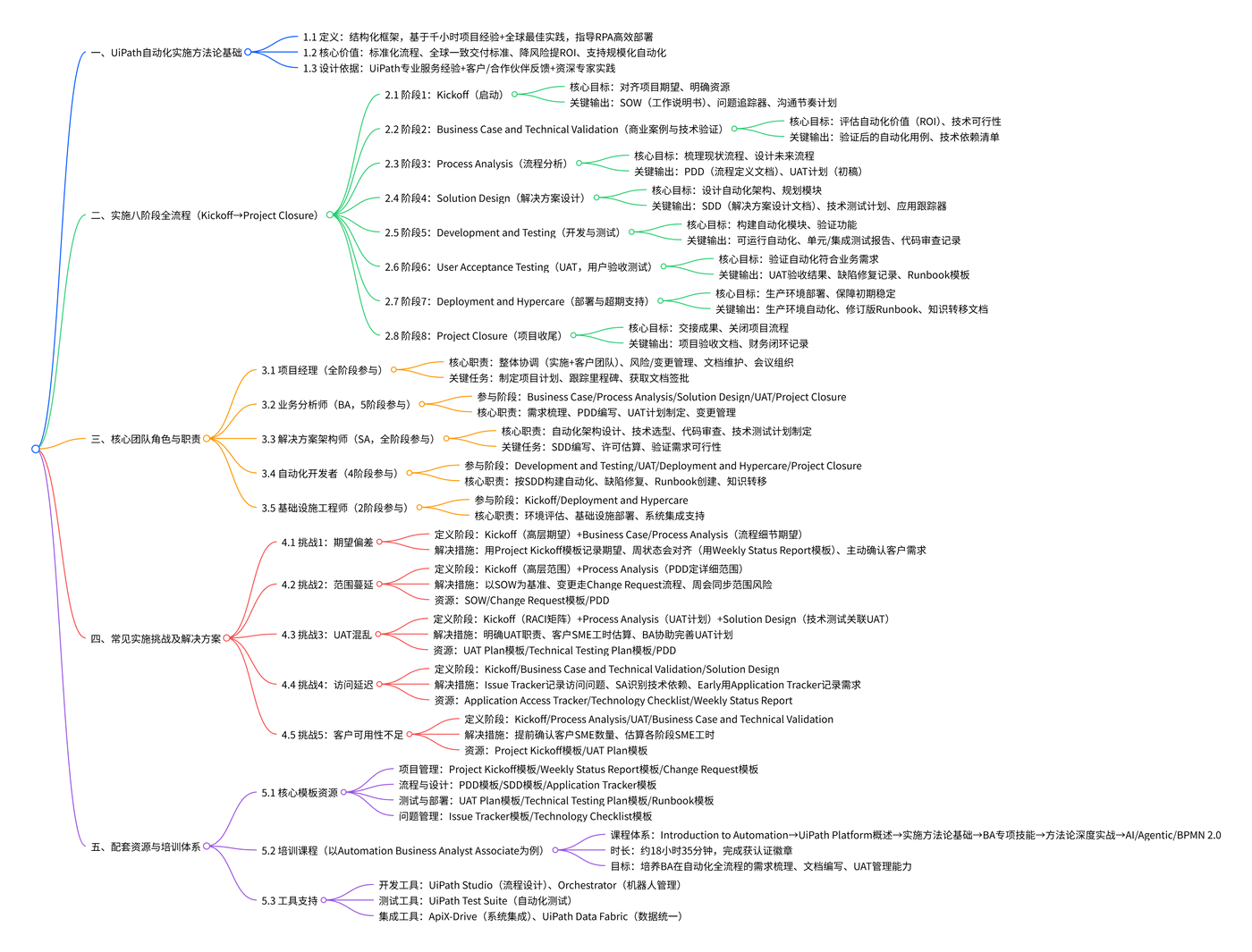
II. The Full Eight-Stage Flow: Step by Step from Kickoff to Closure
1. Kickoff
This is the “tone-setting period” of the project; the core goal is to get the implementation team and the client team to agree on the project scope, expectations and resources.
- Key actions: review the client’s existing environment (test/dev environments, data and test-case readiness), sign the Statement of Work (SOW), establish communication mechanisms, and start using an Issue Tracker.
- Common pitfall: many teams mistakenly treat “clarifying project expectations” as a task for later process analysis, but in fact only by defining the boundaries at the kickoff stage can later requirement creep be avoided.
2. Business Case and Technical Validation
Automation is not “automation for automation’s sake”; the core of this stage is validating the project’s “business value” and “technical feasibility.”
- Key actions: the Business Analyst (BA) validates the cost-effectiveness of the automation use cases, the Solution Architect (SA) assesses technical complexity and dependencies, and together they confirm whether the project matches the initial estimate and contract expectations.
- Core outputs: validated automation use cases and an ROI (return on investment) analysis report.
3. Process Analysis
This is the key stage that determines the “depth and breadth” of automation. The BA and SA break down the existing business processes together, identify automatable points, and optimize the “current process” into a more efficient “future process.”
- Key actions: write the Process Definition Document (PDD), draft the User Acceptance Testing (UAT) plan, and define success criteria and test scenarios.
- Common pitfall: skipping process optimization and automating a “redundant process” directly only freezes in the inefficiency and wastes resources.
4. Solution Design
The SA leads the design of the automation’s technical architecture, breaking the “future process” into developable modules and planning the testing and deployment strategy.
- Key actions: draw the future-state process diagrams, produce the Solution Design Document (SDD), draft the technical testing plan, and record application access requirements (Application Tracker).
- Design principle: balance “current requirements” with “future expansion” so that a rigid architecture does not make future iterations too costly.
5. Development and Testing
The automation developers build modules based on the PDD and SDD, verifying code quality through unit tests, functional tests and integration tests.
- Key actions: module development, code review, executing the technical testing plan, and validating the end-to-end flow in a simulated production environment.
- Efficiency upgrade: introducing test-automation tools greatly improves testing efficiency, which is why the “test automation engineer” role is rising so fast today.
6. User Acceptance Testing
End users work with the implementation team to verify, against the UAT plan, whether the automation meets the business needs. If defects are found, the BA logs them and the developers fix them promptly.
- Key actions: pre-production testing, defect fixing, and creating a Runbook template.
- Core value: getting business users deeply involved in validation avoids the gap between delivery and requirements caused by a technical team “getting carried away on its own.”
7. Deployment and Hypercare
Migrate the automation packages to production and enter the “Hypercare” period—an intensified monitoring-and-support phase to ensure the new system runs stably.
- Key actions: deploy to production, daily run reviews, knowledge transfer to the long-term support team, and revising the Runbook.
- Practical point: large enterprises usually set up a dedicated automation operations team, and knowledge transfer during Hypercare is the key to long-term maintenance.
8. Project Closure
The implementation team and the client team confirm that all services have been delivered, complete the document handover and contract signing, and close out the financial process.
- Key actions: result acceptance, knowledge consolidation and lessons-learned review to inform later projects.
III. The Deeper Value of the Methodology: More Than “Successful Delivery”
The significance of the UiPath automation implementation methodology lies not only in ensuring the success of a single project but also in helping an enterprise build reusable automation capability. Through standardized stage division, role collaboration and output management, an enterprise can gradually build its own “Automation Center of Excellence (CoE)”, moving automation from “one-off projects” to “operations at scale” and ultimately achieving continuous gains in business efficiency.
For an enterprise new to RPA, this methodology is a “pitfall-avoidance guide”; for a mature automation team, it is an “efficiency amplifier.” Only by fully understanding the logic of each stage and getting technology and business truly in sync can RPA really become the “accelerator” of an enterprise’s digital transformation.
评论
0 条评论