Short Answer
China’s hairdressing industry is a vast service sector worth over 400 billion yuan, employing more than 4 million people — but internally it is highly stratified. 70% of hairdressers earn less than 6,000 yuan a month, and only 10% clear 10,000+ yuan a month; the apprentice stage typically pays just 2,000–4,000 yuan, with a growth cycle of 1–3 years. Startup capital for opening a shop ranges from 100,000 yuan (a small community store) to 500,000+ (a mall-location store); the traditional model profits through high-margin perms and coloring (60%+) and prepaid-card cash flow — yet in 2024 more than 300,000 stores closed industry-wide, with a closure rate near 19% in first-tier cities. Meanwhile, the quick-cut model represented by Youjian (no upselling, no membership cards, standardized service) is expanding at 10–15% a year, representing the core direction of the industry’s transformation.
Chapter 1: Industry Panorama — A Livelihood Service Industry Employing Tens of Millions
1.1 Industry Size and Number of Practitioners
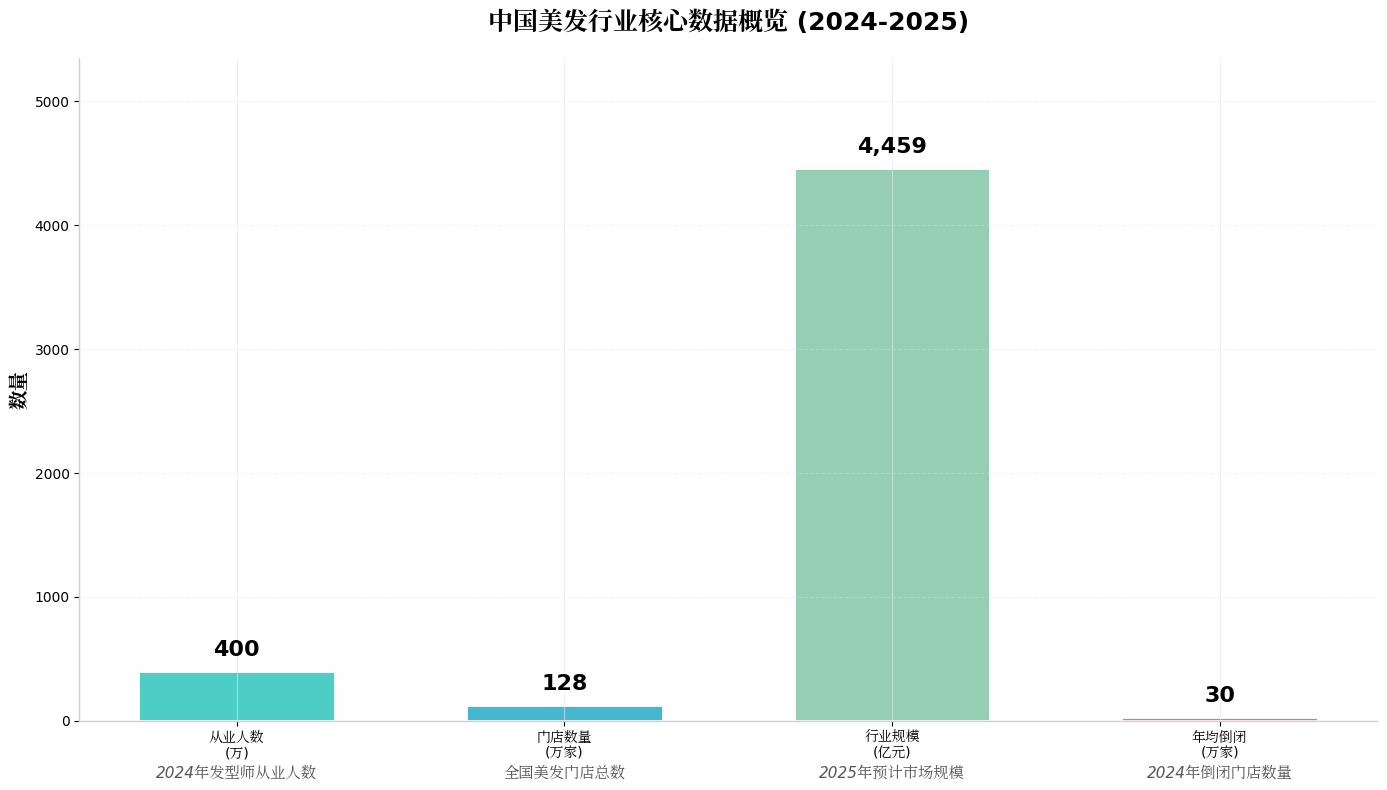
After more than thirty years of market-driven development, China’s hairdressing industry has grown into one of the fastest-growing service-consumption sectors in the national economy. According to Meituan’s estimates, the number of practicing hairdressers nationwide reached 4 million in 2024 (QQ News); adding beauticians, nail technicians, assistants, and related workers, the whole beauty-and-hair industry employs over 10 million people (hsw.cn). National Bureau of Statistics data shows that over the past decade the service sector added an average of 7.41 million jobs a year (Chongqing News), and hairdressing, as an important part of the service sector, contributes a substantial share of those jobs. Tang Degao, president of the China Hairdressing and Beauty Association, told the media that China has more than 1 million hairdressing stores (hsw.cn); according to Qichacha’s latest business-registration data, as of early 2024 there were 1.2814 million hairdressing-related enterprises in active status nationwide (Industry Research Network), with Chongqing ranking first among Chinese cities at 25,100 (Toutiao).
In terms of market size, iiMedia Research data shows the Chinese beauty-and-hair industry reached 351.26 billion yuan in 2019 (Jobui) and is expected to break 445.9 billion yuan by 2025 (Xinhua Chongqing), a compound annual growth rate of 4.6%–8%. Globally, the professional beauty services market is expected to reach $233.56 billion in 2025 (Jobui), with the Asia-Pacific region holding a 36.13% market share — the Chinese market’s contribution cannot be ignored. The perm-and-dye segment is also growing: China’s perming-solution market reached 8.75 billion yuan in 2022 and is expected to exceed 11 billion yuan by 2025 (MSN).
| Core indicator | Data | Source / year |
|---|---|---|
| Practicing hairdressers nationwide | 4 million | Meituan estimate, 2024 (QQ News) |
| Hairdressing-related enterprises | 1.2814 million | Qichacha, early 2024 (Industry Research Network) |
| Whole-industry practitioners (incl. beauty) | 10 million+ | China Hairdressing and Beauty Association (hsw.cn) |
| Industry market size | 445.9 billion yuan (projected) | CCID Puhua, 2025 (Xinhua Chongqing) |
| Average annual new service-sector jobs | 7.41 million | NBS ten-year data (Chongqing News) |
| Perming-solution market size | 11 billion yuan (projected) | CCID Puhua, 2025 (MSN) |
| Global professional beauty services market | $233.56 billion | Fortune Business Insights, 2025 (Jobui) |
1.2 Market Structure: An Extremely Fragmented “Ant Market”
One of the most striking features of China’s hairdressing industry is its highly fragmented market. According to Zhiyan Consulting, as of early 2025, enterprises with registered capital under 1 million yuan account for over 93% of beauty-and-hair companies, while those with registered capital above 50 million yuan make up less than 1% (dayoo.com). This structure means the industry is dominated by small and mid-sized sole proprietors and mom-and-pop shops, with no true national leading enterprises. By ownership, about 95% of China’s beauty-and-hair establishments were private capital in 2019 (Jobui); low entry barriers and relatively small startup costs are the main reasons so many practitioners pour in.
This highly fragmented market structure brings fierce competition but also leaves consolidation room for model innovators. In recent years, chain quick-cut brands represented by Youjian have expanded rapidly to over 1,800 stores within 5 years through standardized service and digital operations (iiMedia), becoming the industry’s most disruptive new force. Meanwhile, traditional chain brands like Yedao Styling operate 300+ directly managed stores nationwide (dayoo.com), and Beauty Farm’s brands cover 352 stores (dayoo.com) — leading brands are gradually changing the industry landscape through chain operations and branding.
By region, first-tier and new first-tier cities are the main markets for hairdressing consumption, but third- and fourth-tier cities and county areas are becoming new growth poles. Meituan data shows that since 2022, transaction volume in Meituan’s service retail in low-tier cities has grown at a compound annual rate of over 90% (Fortune Business Insights), with annual transacting users growing at over 60% compound. The consumption down-market trend is clear: chain brands are accelerating expansion into third- and fourth-tier cities, distinctive local chains are flourishing, and service retail has become a new increment of China’s domestic consumption.
1.3 Practitioner Profile: Young, Low-Education, Highly Mobile
Hairdressing practitioners show distinct group characteristics. The age structure is extremely young: data shows that among hairdresser assistant/apprentice positions, practitioners under 24 account for as much as 73%–78% (Zhiyan Consulting), while those over 30 make up less than 10%. This means the industry mainly absorbs young workers just entering society — mostly with modest education but strong hands-on ability, taking hairdressing as their first job in urban services.
A low education threshold is another hallmark. Recruiting data shows that over 90% of hairdresser apprentice/assistant postings have no education requirement (Securities Times website); high school or below is the mainstream. This contrasts sharply with other service-sector jobs — hairdressing has virtually no education barrier; entry depends entirely on craft and practical experience. This low threshold is both the industry’s appeal (providing jobs for large numbers of low-education youth) and its pain point (leaving overall practitioner quality uneven and skilled talent in short supply).
Gender imbalance also deserves attention. In hairdressing, male practitioners hold absolute dominance. Take Zhejiang province: of the 512 people who took the hairdresser vocational skill-level certification in 2023, only 98 were women, or 19% (futuremarketreport.com). In one vocational school in Huzhou, a hairdressing class of 19 had just one female student, dubbed the “only seedling” (futuremarketreport.com). Reasons female barbers are scarce include high work intensity (standing 10–12 hours a day), limited career-advancement space, and difficulty balancing family after marriage and childbirth. By contrast, the beauty sector is almost entirely female — forming a gender-segregated landscape of “mostly men” in hairdressing and “mostly women” in beauty.
High turnover is the industry’s fourth notable feature. Because traditional hair salons are strongly tied to product commissions and single-store systems are incomplete, annual staff turnover reaches 80% (people.com.cn). Youjian, by stripping the sales attribute from hairdressers and building a standardized promotion system, has kept attrition around 20% (people.com.cn) — far below the industry average. High turnover destabilizes store operations, makes service quality uneven, and reflects the industry’s weaknesses in talent retention and career-development systems.
Chapter 2: The Full Pay Landscape — The Long “Raise” Road from Apprentice to Director
2.1 Apprentice and Assistant Stage: Starting Out on the Breadline
The hairdressing pay system shows a classic pyramid structure, its base a vast population of apprentices and assistants. According to multi-city recruiting data aggregated by platforms like Jobui, hairdresser apprentice/assistant monthly pay in 2025 generally ranges from 2,000–4,000 yuan (Zhiyan Consulting), and in some third- and fourth-tier cities as low as 1,500–2,000 yuan. Specifically:
| City tier | Apprentice/assistant monthly pay | Most common range | Source |
|---|---|---|---|
| First-tier (Beijing, Shanghai, Guangzhou, Shenzhen) | 3,000–6,000 yuan | 3,500–4,500 yuan | Jobui, 2025 (Jobui) |
| Second-tier (Hangzhou, Chengdu, etc.) | 2,500–5,000 yuan | 3,000–4,000 yuan | Jobui, 2025 (MOFCOM Department of Trade in Services) |
| Third/fourth-tier cities | 2,000–3,500 yuan | 2,000–3,000 yuan | Jobui, 2025 (futuremarketreport.com) |
| County seats and townships | 1,500–2,500 yuan | ~2,000 yuan | Jobui, 2025 (CBNData) |
Apprentice-stage income usually consists of an extremely low base salary (sometimes none at all) plus a small shampoo commission. Many stores provide apprentices with room and board (sina.cn) — against first-tier cities’ high housing costs, this effectively serves as hidden compensation for low pay. A Xiamen-area survey shows hairdresser assistants’ median annual salary is 43,500 yuan (Zhiyan Consulting), with the 10th percentile at just 27,900 yuan and the 90th percentile at 70,700 yuan — a striking spread. Notably, assistants with less than 1 year of experience make up an extremely small share (just 3%) (Zhiyan Consulting), reflecting either limited demand for newcomers or extremely high newcomer turnover — many quit early, unable to endure the low pay and high-intensity labor.
The apprenticeship usually lasts half a year to a year, with the main work being shampooing, cleaning, and assisting stylists. The core value of this stage isn’t current income but learning basic skills and industry experience. A veteran hairdresser recalled: “When I first entered the trade I worked as a gofer in a barbershop with no wages at all — just room and board — and those days went on for two years.”[^23] This “zero-wage apprenticeship” still exists in traditional small shops; though legally contentious, it remains a widespread industry practice.
2.2 The Hairdresser Stage: The Watershed Where the Income Gap Widens
The climb from assistant to technician (perm-and-color specialist) to full hairdresser is the most critical and grueling stage of the whole career. Technicians mainly handle perms, coloring, and other technical operations, with monthly pay generally 3,000–5,000 yuan (ihr360.com) — an improvement over apprenticeship but still low. Moving from technician to a hairdresser who can cut hair independently usually takes 1–3 years of study and accumulation (ihr360.com), and many people switch careers midway because of low income and no visible hope.
After successfully becoming a hairdresser, the income structure changes fundamentally. A hairdresser’s pay consists of base salary + performance commission, with the base generally below 1,500–2,000 yuan (some stores pay no base at all), so main income depends entirely on commission (sina.cn). Commission items include haircut commission (usually 20%–40%), perm-and-color commission (usually 30%–40%), card-sales commission (5%–15%), and product-sales commission, etc. This income structure means: hairdressers with high technical skill, strong sales ability, and rich client resources can earn far above average, while those with mediocre craft and poor communication can only scrape by on the breadline.
Industry survey data shows hairdressers’ monthly pay distribution follows a clear “80/20 split” (sina.cn):
| Monthly pay range | Share | Corresponding group |
|---|---|---|
| 2,000–4,000 yuan | 40% | Junior hairdressers, few clients, skills still improving |
| 4,000–6,000 yuan | 30% | Some experience, can independently complete basic services |
| 6,000–8,000 yuan | 20% | Skilled, with a stable client base |
| 10,000+ yuan | 10% | Senior hairdressers/store managers, deep client resources |
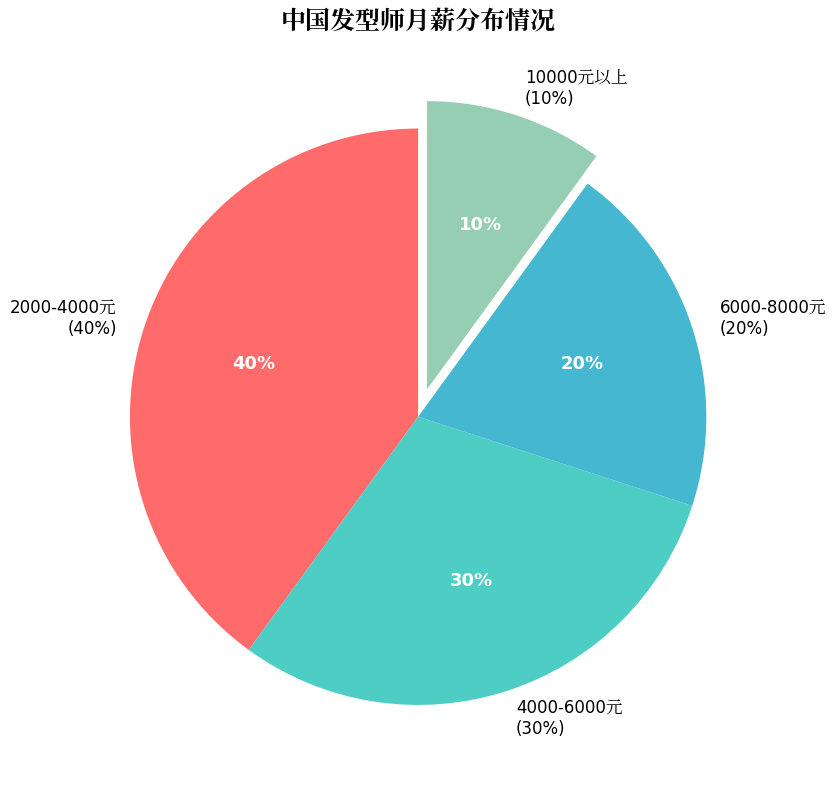
This means more than half (70%) of hairdressers earn under 6,000 yuan a month, and only about 10% actually reach “over 10,000 a month” — and these high earners are mostly concentrated in first-tier cities like Beijing, Shanghai, and Shenzhen (sina.cn). In second- and third-tier cities, hairdressers’ average pay is about 3,000–6,000 yuan (Jobui) — no clear advantage over local average wages.
Hairdressers’ income is also significantly affected by peak and off seasons. Around Spring Festival is the traditional peak season, with business volume usually 2–3 times normal and income rising accordingly. Summer (June–August) is usually the off season, when income may drop 30%–50%. One hairdresser said: “In peak season I can make over 10,000; in the off season only four or five thousand.” (Jobui) This income instability adds further pressure on practitioners’ livelihoods.
2.3 Store Manager and Director Stage: The High-Income Tier for the Few
At the top of the pyramid are store managers, technical directors, and successfully self-employed owners. Store managers usually need 5+ years of industry experience; besides outstanding technical ability, they need team-management and store-operations skills. Store managers’ monthly pay ranges from 20,000 to 100,000 yuan, and managers of large chains or high-end salons can earn 500,000–1,000,000 yuan a year (Jobui).
Technical director is another upward path; the role requires reaching industry-top level in some technical domain (coloring, perming, styling). A high-end salon technical director’s haircut is usually priced at 500–1,000+ yuan (Jobui), serving 5–10 clients a day, which alone yields 50,000–100,000 yuan a month. Many selectees on Meituan’s 2025 “Top 100 Hairdressers” list are top technical talents of this caliber (BOSS Zhipin).
Opening one’s own store is more hairdressers’ ultimate dream. Starting from small shops, hairdressers accumulate client resources and first capital, then gradually open their own stores. Successful owners can earn 200,000–1,000,000+ yuan a year (Jobui) — but startup failures are equally numerous. Data shows the investment payback period for a new barbershop is usually 1–2 years, yet a considerable share of stores close within half a year of opening due to poor management (Jobui). One practitioner’s experience is quite representative: he rose to regional supervisor at a well-known Wuhan chain, earning as much as 500,000 yuan a year; after quitting to start his own business, poor management left him bankrupt and in debt (Jobui).
2.4 Pay Comparison Across Levels and Income-Composition Analysis
| Career level | Years of experience | Monthly pay range | Income composition |
|---|---|---|---|
| Apprentice/assistant | 0–1 years | 2,000–4,000 yuan | Base + shampoo commission; mainly base |
| Technician (perm/color) | 1–2 years | 3,000–5,000 yuan | Base + perm/color commission; skill starts to pay |
| Junior hairdresser | 1–3 years | 5,000–8,000 yuan | Base + overall commission; accumulating clients |
| Senior hairdresser | 3–5 years | 10,000–30,000 yuan | Mainly commission; client resources are the core asset |
| Store manager/technical director | 5+ years | 20,000–100,000 yuan | Base + high commission/dividends + equity |
| Entrepreneur/owner | Varies | 200,000–1,000,000+ yuan/year | Store profit + brand premium |
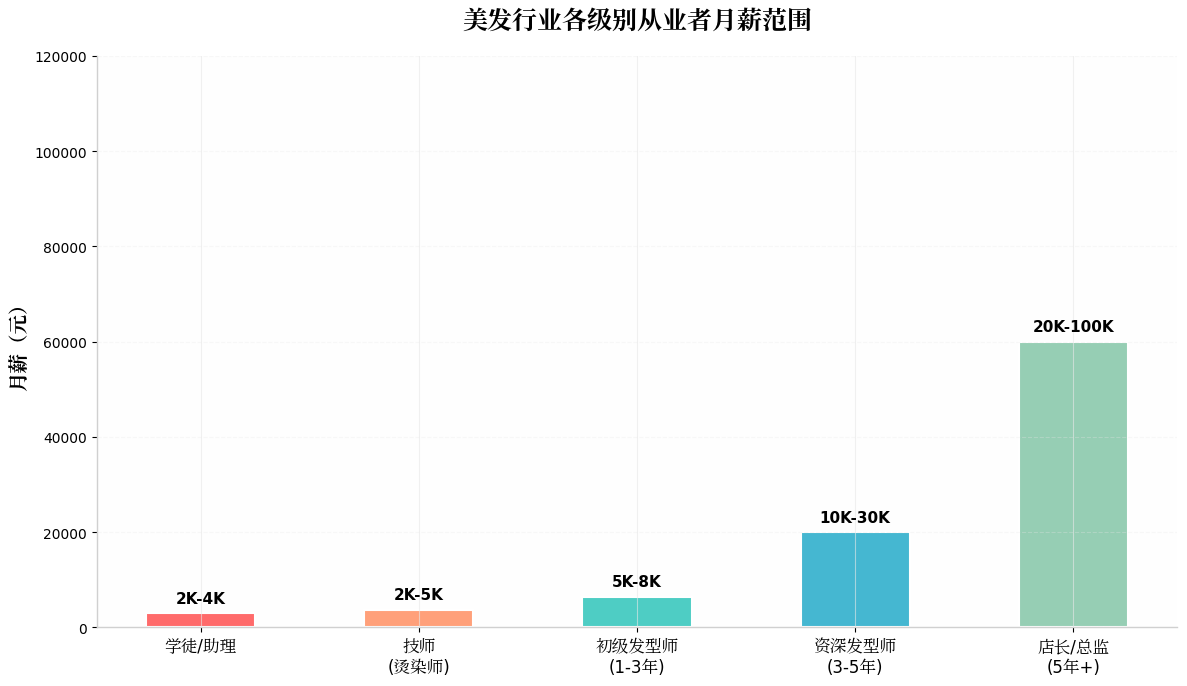
Another key feature of hairdresser income is extreme dependence on commission. Multiple practitioners and recruiting data show hairdressers’ base salaries are generally below 1,500–2,000 yuan (or nonexistent), so high pay depends entirely on card-sales commission, piece-rate commission, and the like (sina.cn). This income structure has two consequences: on one hand, it incentivizes hairdressers to improve their skills and sales ability and serve clients well for more commission; on the other, it produces the industry’s chronic illness of excessive upselling — when a hairdresser’s survival depends entirely on selling cards and products, “30 minutes of cutting, 25 minutes of pitching” becomes inevitable.
Chapter 3: The Haircut Pricing System — Full-Spectrum Pricing from 10-Yuan Quick Cuts to 3,000-Yuan Designer Cuts
3.1 Price Stratification of Haircut Services
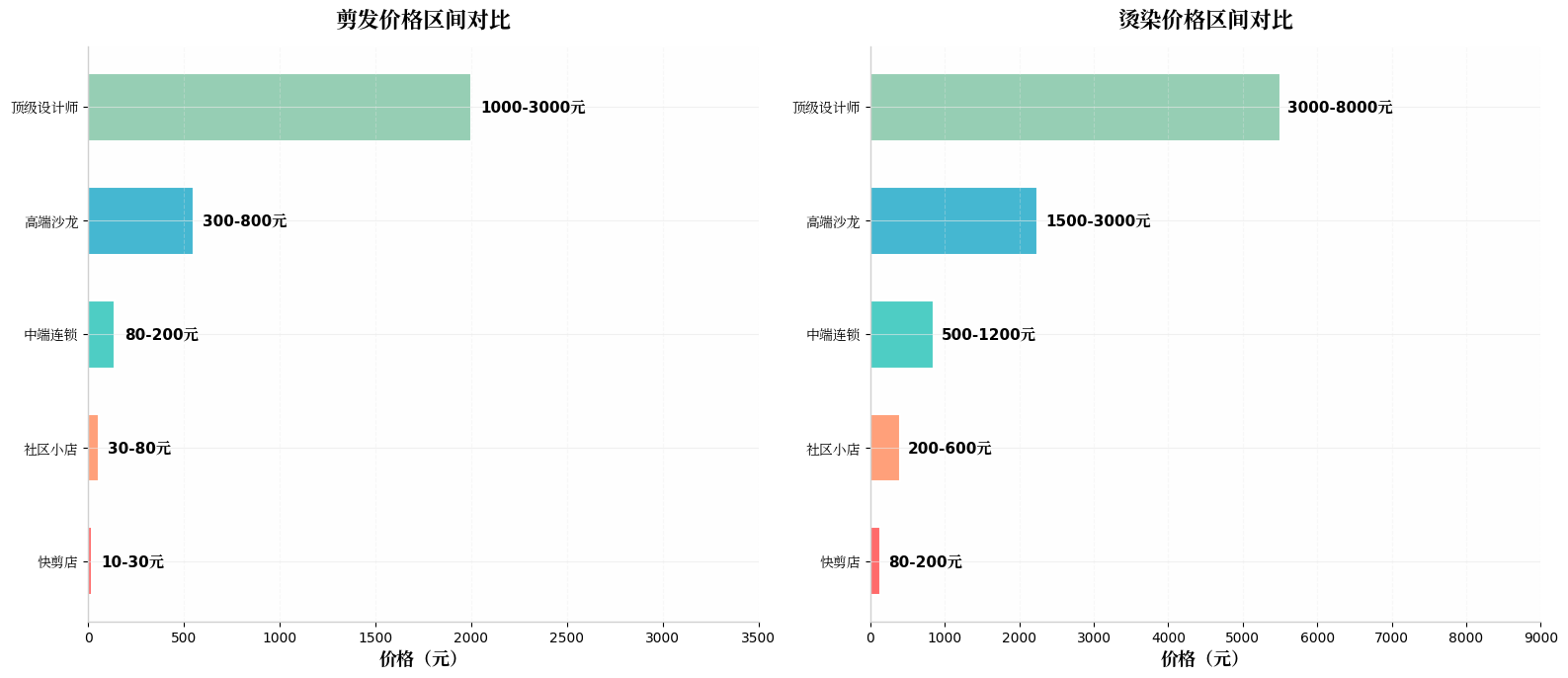
The price system of China’s haircut market is extremely stratified — from 10-yuan quick cuts to 3,000-yuan top-designer cuts, a price span of 300 times. This stratification reflects the differing needs of different consumer groups and embodies the value differences created by hairdressers’ skill levels, brand premiums, and locations.
| Store type | Haircut price range | Target clientele | Core features |
|---|---|---|---|
| Quick-cut store | 10–30 yuan | Price-sensitive, basic needs | No shampoo, no upselling, done in 10 minutes, standardized process (Jobui) |
| Community small shop | 30–80 yuan | Neighborhood residents, everyday needs | Mostly mom-and-pop, regular-customer economy, friendly service |
| Mid-range chain | 80–200 yuan | White-collar workers, quality needs | Branded management, better environment, guaranteed technique |
| High-end salon | 300–800 yuan | High-income groups, aesthetic needs | Famous designers, fashion frontier, personalized service |
| Top designer | 1,000–3,000 yuan | High-end custom, status symbol | IP hairdressers, media exposure, appointment-only service |
Take the Chongqing market: prices differ sharply by positioning — community shops charge 15–50 yuan for wash-cut-blow-dry; mid-range chains charge from 58 yuan to over 100 for a cut; the ARC salon in a high-end business district charges 188–588 yuan, with its Xingguang 68 branch at 200–1,000 yuan (Jobui). At Chongqing’s Dongtian Styling flagship store, a director’s cut is priced at 198 yuan and a creative director’s cut at 298 yuan (Jobui). At Shanghai’s mid-positioned SKY.SALON, haircuts start above 100 yuan (Jobui).
3.2 Perm and Color Services: The Real “Cash Cow”
If haircuts are the traffic-driver, then perm-and-color services are the true profit core of a hair salon. Perm-and-color gross margins typically reach 60%+, far above the 30%–40% gross margin of haircut services (Jobui). A veteran shop owner revealed: “Haircuts bring people in; perms and colors are what actually make money.” (Jobui)
Perm-and-color price differences depend mainly on three factors: product cost (the gap between ordinary domestic solutions and imported high-end brands can reach 10x), technical complexity (simple coloring versus creative highlights or balayage involve completely different skill), and hairdresser level (the pricing gap between an ordinary hairdresser and a director-level designer can reach 3–5x).
| Store type | Standard perm/color | High-end perm/color / custom | Estimated margin |
|---|---|---|---|
| Community small shop | 200–600 yuan | 600–1,000 yuan | 50–60% |
| Mid-range chain | 500–1,200 yuan | 1,200–2,500 yuan | 55–65% |
| High-end salon | 1,500–3,000 yuan | 3,000–8,000 yuan | 60–70% |
Chongqing market data shows ordinary coloring from 268 yuan, perms from 380 yuan, and perm-and-color packages from 880 yuan (Jobui). High-end stores’ creative coloring starts at 580 yuan, perm packages from 680 yuan, and hair treatments at 220 yuan/session (Jobui). In the ultra-high-end market, some top salons’ perm-and-color packages reach 5,000–8,000 yuan, targeting price-insensitive high-net-worth clients who pursue ultimate results.
Notably, value-added services like scalp care and hair repair are becoming new profit growth points. As consumers pay more attention to hair health, anti-hair-loss treatments, nutrient infusion, and similar items command ticket sizes of 200–500 yuan/session (Jobui), with consumption frequency higher than perms and colors (possible monthly), bringing stores steady cash flow.
3.3 The Consumer Psychology and Pricing Strategy Behind Prices
Pricing for hairdressing services is not simply cost plus profit; it deeply reflects consumers’ mental accounting and identity needs. Hairdresser Awei points out in his analysis that the essence of a haircut’s price isn’t the “blade work” but “the identity label in the customer’s mind” (Jobui): the quick cut (20–30 yuan) solves the problem of “length,” the ordinary salon (30–100 yuan) solves “grooming,” the first-tier-city designer (300–800 yuan) solves “image design,” and the IP hairdresser (1,000+ yuan) solves “identity and personality” (Jobui).
This stratified pricing lets people of different spending power all find suitable services, while creating multiple profit sources for the store. For operators, the key is clarifying your positioning — running a “volume” quick-cut or community store, a “price” high-end salon, or a mid-range chain in between. Stores with vague positioning and chaotic price systems usually fail for exactly that reason first.
Chapter 4: Opening Costs and Return on Investment — A Low-Barrier Business with a Low Survival Rate
4.1 Detailed Breakdown of Opening Costs
The cost of opening a barbershop falls into two broad categories: fixed costs (incurred whether or not you’re open) and variable costs (varying with business volume). For a typical 50–80 square meter community store, startup capital is usually 100,000–300,000 yuan (Jobui).
Up-front one-time investment mainly includes:
| Cost item | Amount range | Notes |
|---|---|---|
| Renovation | 50,000–150,000 yuan | Big gap from basic to premium finishes; mid-range stores ~800–1,500 yuan/㎡ |
| Equipment purchase | 30,000–80,000 yuan | Shampoo beds, mirror stations, chairs, perm/color equipment, tools, etc. |
| Initial rent | 10,000–60,000 yuan | Deposit-plus-prepay arrangements; varies greatly by location |
| Licenses and permits | 1,000–3,000 yuan | Business license, hygiene permit, etc. |
| Opening promotion | 3,000–10,000 yuan | Online and offline promotion costs |
| Total | 100,000–300,000 yuan | Community small store 100,000–150,000; mall store 200,000–500,000 |
Take SKY.SALON as an example: this 130-square-meter mid-to-high-end hair salon in Shanghai’s Xuhui district had an up-front investment of 160,000–170,000 yuan (Jobui). Another practitioner planning to open a store estimated the cost of a town store at about 30,000 yuan (minimal configuration), covering basic equipment and renovation (Jobui). For mall locations, costs rise sharply — in Shanghai’s Jing’an district, a 50㎡ barbershop inside a mall can pay 40,000–60,000 yuan a month in rent, 3 times that of a community street shop (Jobui). One high-end brand’s single-store renovation cost exceeded 800,000 yuan; at an average 68-yuan haircut price, it would need to serve 120 people/day just to cover basic costs (Jobui).
Monthly fixed operating costs (Jobui):
| Cost item | Community store (2nd/3rd-tier) | Mall store (1st-tier) |
|---|---|---|
| Rent | 3,000–8,000 yuan/month | 15,000–30,000 yuan/month |
| Base payroll | 5,000–10,000 yuan/month | 10,000–20,000 yuan/month |
| Utilities and misc. | 1,000–2,500 yuan/month | 2,000–4,000 yuan/month |
| Consumables and products | 2,000–5,000 yuan/month | 5,000–10,000 yuan/month |
| Depreciation and amortization | 2,000–3,000 yuan/month | 5,000–10,000 yuan/month |
| Marketing | 1,000–3,000 yuan/month | 5,000–20,000 yuan/month |
| Monthly total | 14,000–32,000 yuan | 42,000–94,000 yuan |
Rent is usually the largest fixed cost, at 10%–20% of monthly revenue (Jobui). On labor: shampoo workers/assistants earn about 2,500–4,000 yuan a month, receptionists 3,000–4,500 yuan, and hairdressers’ base pay is usually only 1,000–2,000 yuan (commission separate) (Jobui). With renovation and equipment depreciated over 5 years, a store with 200,000 yuan of up-front investment books about 3,333 yuan a month in depreciation (Jobui).
4.2 Profit Model and Break-Even Analysis
The core profit logic of a hair salon is “haircuts for traffic + perms and colors for money + cards to lock in customers.” A well-run community store usually grosses 30,000–80,000 yuan a month, with a gross margin of about 50%–60% and a net margin of roughly 15%–25% after all costs (Jobui). At 50,000 yuan of monthly revenue and a 20% net margin, monthly net profit is about 10,000 yuan, with a payback period of roughly 1–2 years.
| Revenue source | Share | Gross margin | Notes |
|---|---|---|---|
| Perm/color services | 40–50% | 60–70% | Core profit source |
| Haircut services | 25–30% | 30–40% | High-frequency traffic driver |
| Product sales | 10–15% | 40–50% | Haircare products, styling products, etc. |
| Memberships/prepaid cards | 10–15% | – | Cash-flow source; revenue recognized over time |
| Other (treatments, etc.) | 5–10% | 50–60% | Value-added services |
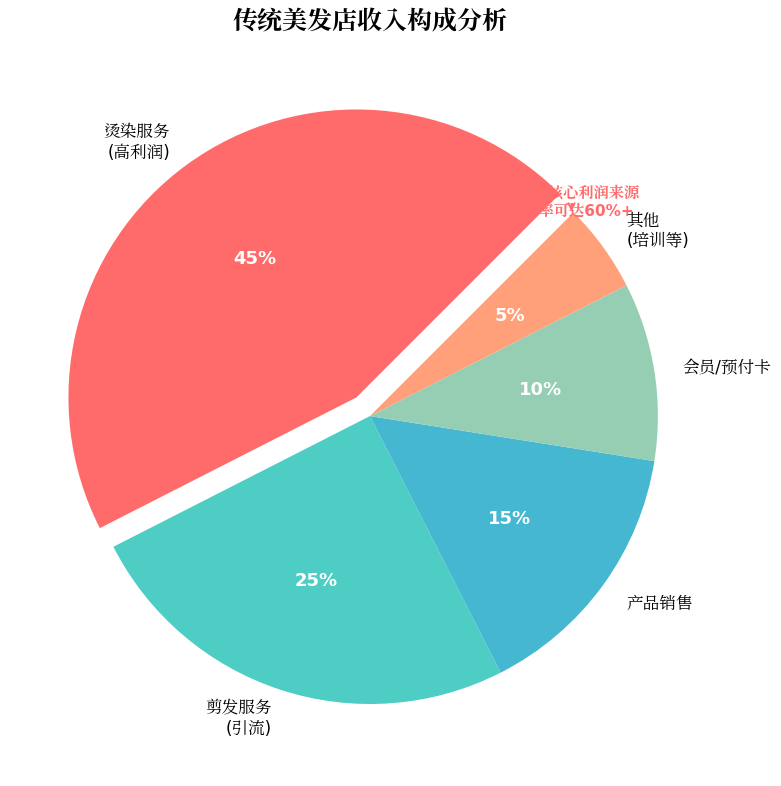
Key break-even indicators include: average daily customer volume, ticket size, and repurchase rate. For a community store to reach 50,000 yuan of monthly revenue, daily revenue over 30 days must be 1,667 yuan. Assuming an 80-yuan ticket (haircut plus the occasional perm or color), the store must serve about 21 customers a day. With 3 hairdressers, each serving 7 customers a day — a relatively reasonable workload.
However, break-even calculations must account for revenue per square meter and per employee. Quick-cut stores can profit at low ticket sizes because of extremely high sales per square meter and output per employee. Data shows quick-cut stores’ sales per square meter are about 3 times those of traditional stores (Jobui) — quick-cut stores are usually only 15–30 square meters, with hairdressers serving 30–50 customers a day, versus 8–15 customers a day in traditional stores. Around business districts and office buildings, quick-cut stores have captured 70% of office workers’ basic haircut demand (Jobui).
4.3 A Startling Wave of Closures: The Structural Predicament Behind the High Failure Rate
Although the hairdressing industry’s entry barrier looks low, its survival rate is far below what outsiders imagine. By incomplete count, more than 300,000 barbershops closed nationwide in 2024 (Jobui); the closure rate in first-tier cities is expected to reach 18.73% in 2025, and 26.3% in third- and fourth-tier cities (Jobui). In Q1 2026, 127,000 new stores opened nationwide while 213,000 closed — a net loss of 86,000 (Jobui). This “opening while closing” phenomenon starkly reveals the industry’s structural predicament.
The high closure rate has many causes. First is the cost black hole: rents and labor costs in first-tier business districts keep climbing, squeezing margins. In Shanghai’s Jing’an district, a 50㎡ barbershop in a mall pays 40,000–60,000 yuan a month in rent (Jobui) — meaning 1,300–2,000 yuan a day in rent alone, so the store is already deep in “rent debt” the moment it opens each morning. One high-end brand’s single-store renovation cost exceeded 800,000 yuan; at an average 68-yuan haircut, it needs 120 customers/day just to cover basic costs (Jobui) — an almost impossible task.
Second is the business-model trap. Traditional salons rely excessively on the prepaid-card model for quick cash recovery, but this model has serious hidden dangers. In one Beijing chain’s 2024 absconding incident, unconsumed prepayments reached tens of millions of yuan (Jobui), exposing the fragility of the industry’s cash chains. While prepaid cards provide short-term cash flow, they also skew operating priorities — store managers focus more on “how to get customers to buy more cards” than “how to improve service quality,” ultimately causing customer trust to collapse. User feedback shows over 70% of consumers resent the “30 minutes of cutting, 25 minutes of pitching” experience (Jobui), and the top reason post-90s consumers choose community budget barbershops is “no upselling pressure” (Jobui).
Third is the technical talent gap. Industry surveys show hairdressers’ average monthly wage is 8,000 yuan, but the training cycle takes as long as 3 years (Jobui). In 2024, hairdressing workforce attrition reached 37%, with newcomer retention below 20% (Jobui) — creating a vicious cycle of declining service quality and rising labor costs. When a store’s core hairdresser quits, they often take a large share of loyal clients with them — a fatal blow to the store.
Chapter 5: What Actually Makes Money — An In-Depth Analysis of the Hairdressing Industry’s Five Profit Models
5.1 Traditional Service Revenue: Haircuts for Traffic, Perms and Colors for Money
This is the basic profit model of the vast majority of hair salons. In this model, haircuts are positioned as the traffic product — competitively priced to draw customers in — while profit is realized through high-margin perm-and-color services. A veteran shop owner put it bluntly: “Haircuts bring people in; perms and colors are what actually make money.” (Jobui) The model makes sense because haircuts are a high-frequency necessity (men monthly, women every 2–3 months), while perms and colors are low-frequency, high-ticket items (2–4 times a year) — the combination guarantees both traffic and profit.
The challenge, however: if a store’s perm-and-color conversion rate is low, or ticket sizes can’t be raised, haircut revenue alone struggles to cover operating costs. Data shows perm-and-color customers typically make up 30%–50% of a traditional salon’s clients (Jobui); below 25%, the store is very likely to lose money. The keys to raising perm-and-color conversion are the hairdresser’s sales ability and customer trust — which is also the root of traditional stores’ heavy dependence on upselling.
5.2 Product Sales: From “Selling Services” to “Selling Products”
Hair-product sales are an important profit supplement for stores. Shampoos, conditioners, waxes, gels, and similar products sold in stores carry gross margins of usually 40%–50% — higher than haircut services (Jobui). Some high-end stores also carry agency or house-brand professional-line products, further widening margins.
A further innovation is the “house brand + hair-school R&D” model (Jobui). Some large chain brands build their own hair-dye factories and develop house-brand products, cutting product costs by 40% (Jobui) and selling directly to consumers through store channels, eliminating middlemen. This model not only increases revenue but also addresses consumers’ trust pain point around chemical dyes — through a “one color, one certificate” traceability system, every bottle of dye carries a blockchain certification code, letting customers “see” the product’s safety (Jobui).
5.3 Prepaid Cards / Memberships: The Double-Edged Sword of Cash Flow
The prepaid card (membership card) system is the hairdressing industry’s most controversial yet most universal profit tool. Stores use promotions like “top up 1,000 get 200 free” or “top up 5,000 get 2,000 free” to entice customers into prepaying large sums — quickly recovering cash flow on one hand and “locking in” customers’ long-term consumption on the other. For operators, prepaid balances amount to an “interest-free loan” that can relieve urgent cash needs in a store’s early days or tight periods.
But the model’s risks are equally huge. First is the compliance issue of fund management — prepayments are essentially customer “claims,” not store “revenue,” yet many stores use them directly for daily operations or expansion; once management falters, “absconding” incidents easily follow. Second is the negative impact on customer experience — excessive card upselling has become one of the industry’s biggest pain points; in 2025 hairdressing complaints, prepaid-card absconding and hidden charges accounted for over 80% (Jobui). More and more consumers (especially post-90s and post-00s) explicitly say they’d “rather pay a bit more than buy another card and fall into another pit” (Jobui).
Some innovative stores are exploring healthier membership models. For example, SKY.SALON’s treatment annual card (680 yuan/year, unlimited sessions, plus a 68-yuan labor fee each time) doesn’t itself make money but adds foot traffic and repurchase for the store (Jobui). Another is the top-up discount card (e.g., top up 1,000 yuan for 12% off): it doesn’t force large prepayments but attracts voluntary top-ups with real discounts — earning higher trust.
5.4 Chain Franchising: From Single-Store Operation to Brand Export
For entrepreneurs who have successfully run a single store, franchise chains are an effective path to scaled expansion and revenue growth. Franchise revenue sources include: franchise fees (varying from 50,000 to 150,000 yuan), brand management fees (3%–5% of the franchisee’s revenue), deposits (refunded at contract end if no breach), and supply-chain profit (centrally procured products supplied to franchisees at a markup) (Jobui).
Youjian is the exemplar of this model. As of 2025, Youjian operates over 1,800 stores in 26 cities nationwide (iiMedia). Its success lies in adopting a “directly managed hosting” model — the franchisee provides the investment while Youjian supplies the full front-, mid-, and back-end package of brand, data systems, talent supply, and management systems (people.com.cn). This asset-light model lets Youjian expand rapidly while keeping service quality relatively standardized. Youjian founder Xiong Guoping, after leaving Alibaba, grew the brand from 1 store to 1,000 in just 5 years (taobao.com), becoming the most disruptive innovator in China’s hairdressing industry.
5.5 Platform and IP Models: New Profit Paths of the Digital Era
In the digital era, a hairdresser’s personal brand has never mattered more. By running personal accounts on platforms like Douyin, Xiaohongshu, and Meituan, hairdressers can accumulate followers, showcase their work, attract new customers, and even sell hair products through livestream commerce. Some top hairdresser bloggers earn millions of yuan a year (Jobui).
Meituan’s 2025 “Top 100 Hairdressers” list is a typical case. The list evaluates four dimensions — technical level, service attitude, style experience, and user reviews — and selected 4,500 quality hairdressers from 58 cities nationwide (BOSS Zhipin). Selected hairdressers receive platform traffic support and an online badge; on average, more than 200,000 people browse hairdressers’ personal pages every day (BOSS Zhipin). One Shenzhen hairdresser said that since joining Meituan’s craftsman section in 2019, by continuously sharing work and accumulating reviews, his monthly income broke 50,000 yuan (QQ News).
A further business model is “hairdressing + education” — successful hairdressers monetize personal experience by running training courses, hosting technique-sharing sessions, and publishing instructional videos. A mature instructor’s hourly rate can reach 500–2,000 yuan (Jobui) — income that also boosts personal brand influence.
Chapter 6: Industry Upheaval — The Quick-Cut Shock, Digital Transformation, and Future Trends
6.1 The Quick-Cut Revolution: A Lifestyle Change from Japan to China
The quick-cut model may be the most disruptive innovation to hit the hairdressing industry in recent years. Japan’s QB HOUSE is the progenitor of quick cuts; its model boils down to “four don’ts”: no shampoo, no upselling, no cards, no perms or colors — only pure haircut service, done in 10 minutes at a ticket price of 1,000 yen (about 60 yuan) (WeChat official account (Awei Beauty Academy)). With extreme efficiency and standardization, QB HOUSE averages over 1.25 million customer visits a month, with annual revenue approaching 300 million yuan (WeChat official account (Awei Beauty Academy)).
Among China’s quick-cut brands, Youjian is the most successful representative. Youjian innovated locally on the QB HOUSE base: adopting a “vacuum-cut-blow” model (after the cut, loose hair is vacuumed away by air instead of washing), keeping standard stores to 30–50 square meters, and pricing haircuts at about 40 yuan (people.com.cn). Youjian’s “four don’ts” — no upselling, no cards, no perms, no coloring (taobao.com) — precisely hit young consumers’ (especially the “socially anxious”) intense demand for a pressure-free consumption experience.
The quick-cut model’s success is no accident. It solves multiple pain points of traditional hairdressing: first, the trust problem — clearly posted prices with no hidden charges give consumers 100% certainty (Jobui); second, the efficiency problem — done in 10–15 minutes, walk-in and cut, skipping the lengthy process of booking, waiting, shampooing, and upselling; third, value for money — a price around 40 yuan, between independent shops and traditional brand salons, offers a balance point of “good craft + good environment.”
Quick cuts’ impact on traditional barbershops is selective rather than total. Data shows quick cuts mainly capture basic haircut demand — mom-and-pop shops in old neighborhoods that don’t upsell are barely affected, while chain brand stores that “drive traffic via cards with inflated quotes” have closure rates as high as 40% (Jobui). Around business districts and office buildings, quick-cut stores have taken 70% of office workers’ basic haircut demand (Jobui). But for high-end studios focused on perms, colors, and styling, and community veterans living on regular-customer relationships, quick cuts’ impact is relatively limited.
6.2 Digital Transformation: Omnichannel Operations from Offline to Online
Digitalization is reshaping how the hairdressing industry operates. First is the shift in customer-acquisition channels — traditional salons relied on old-customer referrals and natural offline foot traffic, but now Dianping, Douyin, and Xiaohongshu have become stores’ main acquisition channels. Take SKY.SALON: over 80% of its customers are regulars, and nearly all of the remaining 20% of new customers come from Dianping (Jobui). The store spends over 20,000 yuan a month marketing on Dianping — more than 20% of total costs (Jobui).
The core logic of online acquisition is “content is the shelf” (WeChat official account (Leyuan Talks)). Consumers increasingly complete the whole “need arousal → decision → order” journey on social platforms. For hair salons, this means continuously producing quality content — before/after hairstyle comparisons, technique tutorials, screenshots of customer praise — to attract potential customers through “seeding.” Meituan platform data shows that since 2024, traffic to works created by hairdressers on the platform has grown 260% year-on-year (verypow.cn), with users under 30 accounting for as much as 59% (verypow.cn).
Digitalization also shows in store management. Youjian developed its own front-, mid-, and back-office management systems, achieving digitalized store management and automated user operations (iiMedia). Customers must book via the mini program before consuming; the back-office system intelligently records and schedules staff shifts, customer-flow allocation, and acquisition (people.com.cn). This digital capability not only improves operating efficiency but also accumulates valuable customer data, providing the foundation for precision marketing and service optimization.
6.3 Consumption Upgrades and Personalization: From “Cut It Short” to “Express Myself”
As consumers’ aesthetic standards rise and personalization demands grow, the hairdressing industry is shifting from “functional service” to “experiential service.” Survey data shows high-spending customers have increased their spending on premium items like custom skincare and personalized styling by over 40% (BOSS Zhipin). Future hairdressing service will no longer be a simple “wash-cut-blow-dry” but an integrated solution including image design, color consultation, and scalp health management.
Personalized customization has become one of the industry’s most conspicuous trends. From creative coloring (highlights, ombré, hidden color) to customized perm plans for different hair types, to AI-analysis-based personalized hairstyle recommendations (syjlp.com), technological progress is making “a thousand faces for a thousand people” service possible. Virtual hair try-ons, AR color simulation, and similar technologies let customers preview results before changing hairstyles, greatly improving decision certainty and satisfaction (syjlp.com).
The rise of the men’s grooming market is another trend worth watching. Traditionally, women were hairdressing’s main consumers, but data shows the male share has risen to 35% (syjlp.com), driving rapid growth of niche sub-categories like men’s barbershops, men’s skincare, and men’s styling. Dedicated men’s barbershops (like “Barbershops” specializing in American pompadours and retro styles) are springing up in first- and second-tier cities, with ticket sizes usually 100–300 yuan — far above ordinary quick cuts — targeting young men with high image standards.
6.4 Health and Sustainability: The Industry’s New Value Proposition
As consumers’ health awareness awakens, the fusion concept of “health + aesthetics” is rapidly permeating the hairdressing industry. Data shows 68% of consumers care about the ingredient safety of perm and dye products (MSN), and plant-amino-acid perming solutions have grown to a 35% market share (MSN). Concepts like ammonia-free dyeing, organic haircare, and hypoallergenic formulas have become product selling points, driving the premiumization of hair products.
Scalp care is one of the fastest-growing segments under this trend. According to CCID Puhua’s analysis, value-added services like anti-hair-loss treatments and nutrient infusion can raise per-customer revenue by 40% (Jobui). Some forward-looking stores have introduced AI scalp-detection equipment, analyzing follicle health to design personalized care plans for customers (Jobui) — extending hairdressing service from “surface beautification” to “deep health management.”
Chapter 7: Career Paths — An Advancement Guide from Apprentice to Boss
7.1 The Growth Cycle: A Craft That Demands Patient Polishing
Becoming a qualified hairdresser usually requires a long accumulation across three stages (ihr360.com):
Stage 1: Assistant/apprentice (0–1 years). Main work: shampooing, cleaning, running errands for hairdressers. The core tasks of this stage are getting familiar with the industry environment, learning basic skills (head massage, the wash-and-care routine, tool use), and cultivating service awareness. Income is extremely low (usually just base pay or piece rates), but without passing this stage, later development is out of the question.
Stage 2: Technician (1–3 years). Begins learning perm-and-color techniques, mastering solution application, reading softening progress, color mixing, and other professional skills. Technical demands rise markedly at this stage, and income starts tying to skill (perm/color commission). The real challenge is coordinating “eye, hand, and brain” — color sensitivity, hair-type judgment, and control over solution reactions all require masses of practice to form.
Stage 3: Hairdresser (3–5+ years). Begins cutting customers’ hair independently, growing from a blow-dry hand into a hairdresser capable of personalized design. This stage demands not only a solid technical foundation but also cultivated aesthetics, communication skills, and client-management ability. Many hairdressers choose to study away at this stage, learning the latest trend techniques and design concepts; annual training costs range from a few thousand to over ten thousand yuan (syjlp.com).
| Stage | Duration | Core tasks | Income level | Key challenges |
|---|---|---|---|---|
| Apprentice | 0–1 years | Shampooing, chores, observation and learning | 2,000–4,000 yuan | Low pay, exhausting work, no visible hope |
| Technician | 1–3 years | Learning perm/color techniques | 3,000–6,000 yuan | High technical difficulty, needs massive practice |
| Junior hairdresser | 1–3 years | Independent cutting, accumulating clients | 5,000–8,000 yuan | Few clients, slow reputation building |
| Senior hairdresser | 3–5 years | Style design, client maintenance | 10,000–30,000 yuan | Continuous learning, avoiding aesthetic fatigue |
| Store manager/director | 5+ years | Team management, technical leadership | 20,000–100,000 yuan | Management ability, industry influence |
Notably, China’s hairdresser training cycle is far shorter than Japan’s. In Japan, going from apprentice to independent hairdresser usually takes 8–10 years (syjlp.com) — the first 3 years devoted to practicing shampooing, years 3–5 to learning sectioning and strand control, years 5–8 to cutting “model customers’” hair, and only at 8–10 years can one truly design hairstyles independently (syjlp.com). Japanese hairdressing schools run 2–3 year programs (now unified at 3 years), and students must complete the full term to graduate (syjlp.com). This rigorous education system ensures Japanese hairdressers’ overall technical level leads the world, but it also means higher time costs and a slower promotion pace.
7.2 The “Success Codes” of High-Earning Hairdressers
Case analyses of the industry’s high earners reveal several shared “success codes”:
First, solid technique is the foundation. However clever the marketing, what ultimately retains customers is craft. One hairdresser earning a million a year shared that he spends half his income on Korean perm, color, and care products to study; with extreme attention to products and extreme dedication to technique, his monthly income broke 100,000 yuan after a year (syjlp.com). At least one systematic advanced-training session a year is a necessary condition for maintaining competitiveness.
Second, client resources are the most core asset. Hairdressing is a strongly relationship-driven industry — once a customer recognizes a hairdresser, they often follow for the long term, even “following the hairdresser wherever they go.” SKY.SALON founder Linda accumulated over a decade of loyal clients before opening her store; when she left to open it, those clients followed directly, even “driving one or two hours just to have her do their hair” (Jobui). This customer stickiness is built on long-accumulated professional trust and human care.
Third, building a personal IP is the accelerator. In the social-media era, hairdressers’ exposure channels have widened enormously. By sharing works, tutorials, and daily life on Douyin, Xiaohongshu, and similar platforms, hairdressers can break through their store’s geographic limits and attract a broader clientele. Selectees on Meituan’s “Top 100 Hairdressers” list average over 200,000 people browsing their personal pages (BOSS Zhipin) — traffic that converts noticeably into real income.
Fourth, good at recommending without being off-putting. Though excessive upselling is an industry pain point, hairdressers who can’t recommend at all struggle to earn high incomes too. The key is “the measure of recommendation” — offering apt suggestions based on genuine understanding of the customer’s real needs and professional judgment, rather than hard-selling for commission. High-earning hairdressers usually have outstanding communication skills, naturally building trust during service so customers accept recommendations “willingly.”
7.3 The Entrepreneurial Path and Risk Avoidance
For hairdressers aspiring to start a business, the following advice is worth heeding:
Early accumulation is crucial. Before opening a store you need at least 3–5 years of front-line experience — not only solid technique but also familiarity with every link of store operations (client management, staff management, cost control, marketing). More importantly, accumulate a batch of core clients willing to follow you — these “seed customers” are a new store’s main revenue source in its early days.
Positioning must be clear; site selection careful. Before opening you must define your target clientele and price positioning. A community budget store (30–80-yuan tickets), a mid-range boutique (100–300 yuan), or a high-end custom store (500+ yuan)? Different positioning determines differences in location, renovation, team configuration, and marketing strategy. SKY.SALON chose a convenient office building over a street-front shop; though sacrificing some natural foot traffic, it brought monthly rent of 50,000–60,000 yuan down to an affordable range (Jobui).
Start asset-light; control cash flow. For a first venture, start with a small store, keeping up-front investment within 100,000–150,000 yuan, avoiding over-renovation and redundant staff. Reserve at least 6 months of operating funds as a buffer against the low traffic and losses of the opening period.
Team management decides success or failure. A hair salon’s core competitiveness lies in its people — especially hairdressers. Building a reasonable compensation system (base + commission + dividends), providing growth space, and fostering a positive team culture are the core means of retaining talent. Some innovative stores adopt a “venue management fee” model — hairdressers keep all fees from serving customers, paying the store only a 2,500-yuan monthly venue management fee (syjlp.com). Under this model, hairdressers’ take-home income has multiplied several times over, and work motivation has risen dramatically.
Chapter 8: Conclusions and Recommendations — Who Can Actually Make Money in the Hairdressing Industry?
8.1 “Money-Making Possibility” Assessment for Four Types of People
Through in-depth analysis of the industry panorama, the following conclusions emerge:
Type 1: Apprentices/newcomers (0–1 years’ experience). “Making money” is nearly impossible at this stage — 2,000–4,000 yuan a month barely covers basic living. But choosing the right platform (such as the training systems of chains like Youjian) enables fast accumulation of standardized skills, and future growth space will be larger.
Type 2: Ordinary hairdressers (1–5 years’ experience). The group with the greatest income divergence. 70% earn under 6,000 yuan a month — “making money” isn’t easy; but the top 10% can earn over 10,000 or even tens of thousands a month. Whether you “make money” depends on three factors: whether your technique is solid, whether your client resources are rich, and whether you’re good at self-marketing.
Type 3: Senior hairdressers/store managers (5+ years’ experience). If you’ve made it this far, the probability of “making money” rises sharply. Monthly income of 20,000–100,000 yuan is the norm, and the share earning 200,000–1,000,000+ yuan a year is significantly higher than at other stages. But the premise is having survived the long accumulation period and built a stable client base and industry reputation.
Type 4: Entrepreneurs/owners. Reward and risk coexist. Successful owners can earn hundreds of thousands or even millions a year, but the data of 300,000+ store closures in 2024 also shows the probability of failure far exceeds that of success. Whether you “make money” depends on whether positioning is clear, cost control sound, and team management effective.
8.2 Advice for Those Considering Entering the Industry
Think carefully; don’t enter with a “get rich quick” mindset. The hairdressing industry requires long-term accumulation; income in the first 1–3 years is usually very low, and without enough patience and love for the craft it’s easy to quit halfway.
Choose a formal training path. Although “apprenticing in a store” is cheap, learning efficiency is also low — it may take 2–3 years to complete training. Professional hairdressing school courses cost tuition (usually 5,000–20,000 yuan) but teach basic skills systematically in 3–6 months, with further improvement through practice afterward (Jobui).
Prefer chain brands over independent small shops. Chains usually have more complete training systems, clearer promotion channels, and steadier customer flow. Hairdressers at emerging brands like Youjian earn 20% more than industry peers (people.com.cn), with attrition of only 20% (far below the industry average of 80%) (people.com.cn).
Value personal brand building. Keep sharing your work on Douyin, Xiaohongshu, Meituan, and similar platforms, accumulating online exposure. In the digital era, “being seen” is the prerequisite for high income.
If you plan to start a business, be sure to accumulate enough capital and client resources first. Don’t start in debt, don’t overestimate opening-period traffic, and reserve ample cash-flow buffer.
8.3 Industry Outlook
China’s hairdressing industry is in a period of deep transformation. On one hand, the traditional model (card upselling, information asymmetry, opaque service) is being eliminated by consumers “voting with their feet”; on the other, the quick-cut model represented by Youjian, the new operating paradigm centered on digital platforms, and the service upgrade oriented toward personalization and health are reshaping the industry landscape.
The future hairdressing industry will show these trends: quick-cut stores will keep expanding, seizing the basic haircut market; mid-to-high-end salons will shift toward “studio-ization,” with designer IPs and customized service as competitive moats; digital transformation will become standard, with the whole chain from acquisition to management moving online; health care will become a new growth point, with value-added services like scalp management and hair repair growing rapidly.
For practitioners inside the industry, adapting to change, learning continuously, and embracing digitalization is the only path to staying competitive through the transformation. The hairdressing industry will never disappear — “people always need haircuts” — but who can make money in this ancient trade depends on whether they can keep pace with the times.
References
(QQ News): Meituan data — over 3.6 million practicing hairdressers in 2025; see Shenzhen News Net report of July 2025.
(Shenzhen News Net): Meituan estimate — 4 million practicing hairdressers in 2024; see QQ.com report of August 2025.
(hsw.cn): Views of Tang Degao, president of the China Hairdressing and Beauty Association; see Toutiao report of November 2024.
(Chongqing News): National Bureau of Statistics data; see Securities Times report of June 2025.
(Industry Research Network): Qichacha data; see Chongqing News report of February 2024.
(Toutiao): Chongqing ranks first nationwide in hairdressing enterprises; see Xinhua Chongqing report of February 2024.
(Jobui): iiMedia Research, 2020–2021 China Beauty and Hairdressing Industry Report.
(Xinhua Chongqing): CCID Puhua, Analysis of the Development Status and Trends of the Beauty and Hairdressing Industry in 2025.
(Jobui): Fortune Business Insights — global professional beauty services market of $233.56 billion in 2025.
(MSN): CCID Puhua — China’s perming-solution market expected to exceed 11 billion yuan in 2025.
(dayoo.com): Zhiyan Consulting, Assessing 2025! The Industrial Chain and Development Status of China’s Beauty and Hairdressing Industry.
(iiMedia): Youjian official website — over 1,800 stores in 2025.
(Fortune Business Insights): Meituan data; see Securities Times report of June 2025.
(Zhiyan Consulting): 2025 Xiamen hairdresser assistant/apprentice salary analysis report.
(MOFCOM Department of Trade in Services): 2025 Changzhou hairdresser assistant/apprentice salary analysis report.
(Securities Times website): Jobui platform — hairdresser apprentice/assistant recruiting data, 2025.
(futuremarketreport.com): Survey of the Huzhou Art and Design School, Zhejiang; see Dayoo News report of April 2024.
(people.com.cn): 36Kr, Early-Stage Project | Positioning Itself as the Lianjia of the Hairdressing Industry, “Youjian” Plans 10,000 Stores in 5 Years.
(Jobui): Jobui — Shanghai hairdresser assistant/apprentice salary data, 2025.
(futuremarketreport.com): Jobui — third/fourth-tier city hairdresser assistant salary data, 2025.
(CBNData): Jobui — county-seat hairdresser assistant salary data, 2025.
(sina.cn): Multi-source aggregated data on hairdresser salary distribution; see 2024 data from Luya Net, Manyoumao, and other platforms.
(Jobui): Qingdao News Net 2010 report — a hairdresser’s growth experience.
(ihr360.com): The hairdressing industry’s three-tier division (assistant–technician–hairdresser); see multiple industry analysis sources.
(ihr360.com): Barber apprenticeship completion times; see 2025 data from Toutiao and Luya Net.
(Jobui): Professional hairdressing school program lengths; see 2025 data from Zhihu and Luya Net.
(Jobui): Hairdresser income composition analysis; see 2023–2024 data from multiple industry sources.
(Jobui): Hairdresser wage distribution; see 2024–2025 data from Luya Net.
(Jobui): Hairdresser pay in second/third-tier cities; see 2024 data from Luya Net and Manyoumao.
(Jobui): Peak/off-season income differences; see multiple industry interview sources.
(Jobui): Hairdresser career paths; see Qinxue Net analysis of 2021.
(Jobui): High-end hairdresser income; see multiple industry interview sources.
(Jobui): Teacher Awei, How Hairdressers in First-Tier Cities Can Run a Good Shop, 2025.
(BOSS Zhipin): Meituan’s 2025 “Top 100 Hairdressers” list released; see Shenzhen News Net report of July 2025.
(Jobui): Sina Finance report of May 2025 — barbershop closure wave sweeping the country.
(Jobui): NetEase News report of April 2024 — from 10 million yuan a year opening barbershops to bankruptcy and debt.
(Jobui): Smzdm report of May 2026 — analysis of quick-cut stores trouncing traditional barbershops.
(Jobui): Chongqing Daily report of February 2024 — Chongqing hairdressing industry survey.
(Jobui): Xingyao Medical Beauty report of August 2025 — rankings and prices of Chongqing’s top ten barbershops.
(Jobui): Guma Jia website report of March 2023 — SKY.SALON business case analysis.
(Jobui): WeChat official account article of August 2025 — cost accounting for barbershops.
(Jobui): WeChat official account article of August 2025 — a barbershop chain plan netting 2 million yuan a year.
(Jobui): Manyoumao answer of October 2024 — the cost of opening a barbershop alone.
(taobao.com): Zhihu — why the Youjian model succeeds.
(WeChat official account (Awei Beauty Academy)): Winshang report of January 2017 — analysis of Japan’s QB HOUSE model.
(WeChat official account (Leyuan Talks)): Youzan Shuo report of March 2025 — how to acquire customers on Xiaohongshu, Douyin, and Meituan simultaneously.
(verypow.cn): China Report Hall report of August 2025 — 2025 hairdressing industry observations.
(BOSS Zhipin): Sina Finance report of January 2026 — in-depth analysis of 2025 beauty-industry trends.
(syjlp.com): CCID Puhua, Analysis of the Development Status and Trends of the Beauty and Hairdressing Industry in 2025.
(syjlp.com): Zhihu answer of March 2025 — how long a barber must study before completing training.
(syjlp.com): WeChat official account article of September 2025 — why 30 million Teacher Tonys love wearing headphones.
(syjlp.com): WeChat official account article of August 2025 — Teacher Awei on the history of Japanese hairdressing.
(syjlp.com): Shanghai Hairdressing and Beauty Industry Association — a brief look at Japanese hairdressing culture.
(syjlp.com): CBNData report of January 2022 — how much money Teacher Tony can really make in the hugely profitable hairdressing industry.
(syjlp.com): Toutiao report — the profit model of a post-95 handsome guy’s hair salon.
评论
0 条评论