China’s phone repair industry stands at a critical inflection point, transitioning from the traditional mom-and-pop shop model toward branding, chain operations, and digitalization. Although the overall market has broken through 80 billion yuan and is projected to keep expanding at a compound growth rate of 8%–10%, structural divergence is intensifying — chain brands are expanding rapidly on the strength of capital and technology, while large numbers of independent repair shops face severe survival pressure from improving phone quality, the impact of e-commerce, and rising rents. Industry data shows that between 2016 and 2023, the number of phone repair stores nationwide plummeted from 500,000 to fewer than 200,000, a closure rate as high as 60%, while the workforce has stayed at a high level of roughly 5 million people. Entry barriers are extremely low: no hard educational requirements, a technical learning cycle ranging from 3 months to 1 year, and startup capital of about 35,000–57,000 yuan to open a store. The industry’s profit model centers on repair service fees, with overall gross margins reaching 50%–70% and net margins in the 30%–40% range — but income is sharply stratified, with about 35% of practitioners earning only 30,000–60,000 yuan a year and facing considerable operational uncertainty.
China’s Phone Repair Industry Today: An In-Depth Analysis Report
1. Market Size and Development Status
As an important part of the consumer electronics aftermarket, China’s phone repair industry is undergoing unprecedented structural change. With rising smartphone penetration and growing consumer awareness of device maintenance, phone repair has been shifting from the scattered, non-standardized “small workshop” model of the past toward a modern service industry that is centralized, branded, and digital. This chapter provides a comprehensive analysis of the industry’s current state across multiple dimensions: market size, demand structure, technology level, and policies and regulations.
1.1 Market Size and Growth Trends
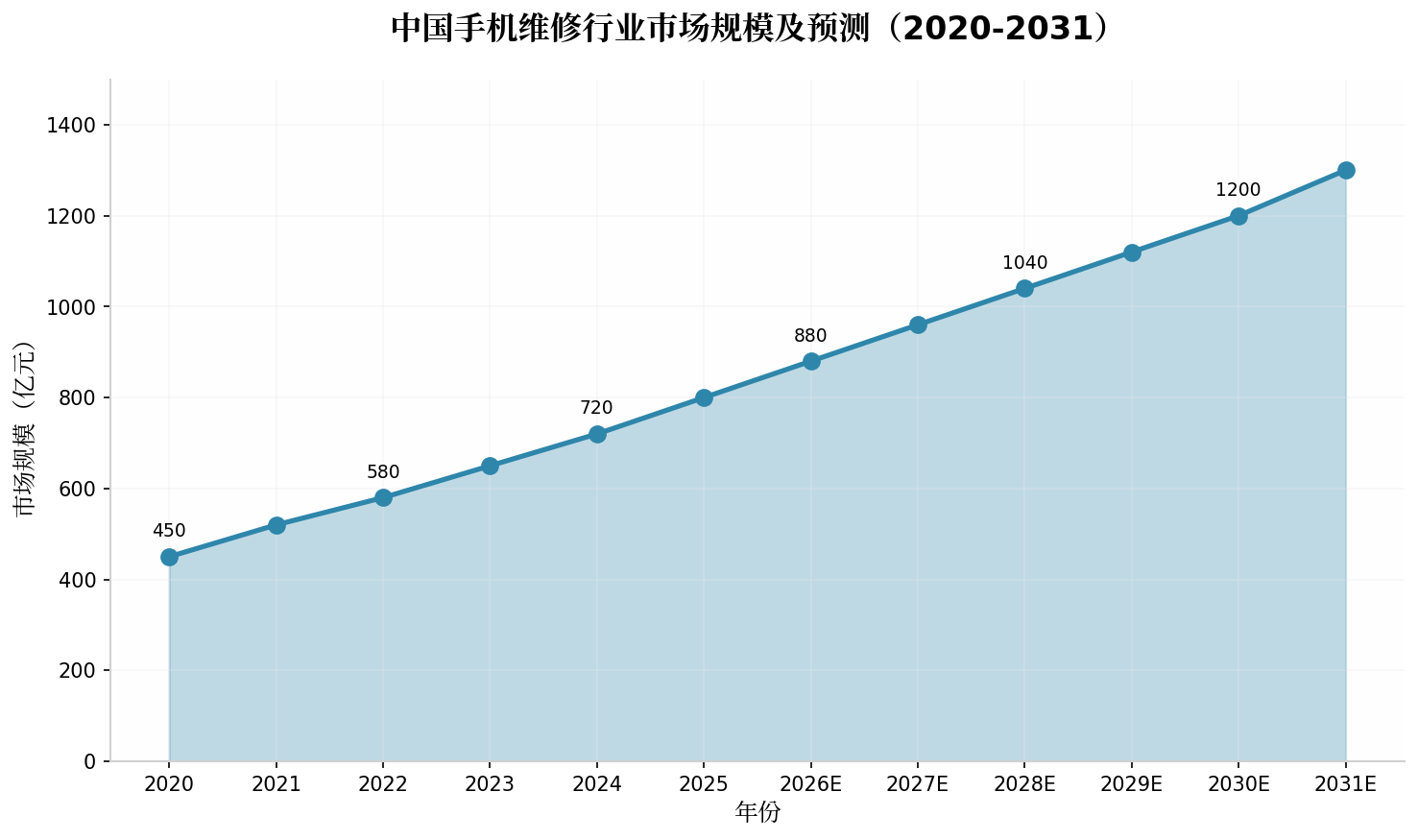
1.1.1 Domestic Market: A Hundred-Billion-Yuan Scale with Steady Growth
China’s phone repair market has formed an enormous industry scale and maintains steady growth. According to the In-Depth Market Research and Investment Strategy Forecast Report for China’s Smartphone Repair Industry, 2024–2029 released by the China Research Puhua Industry Research Institute, China’s smartphone repair market exceeded 80 billion yuan in 2025, with annual repair volume topping 50 million devices. Another analysis report from Industry World offers a more optimistic forecast, projecting the 2025 market size to break through 100 billion yuan, with a compound growth rate steady at 8%–10%. The discrepancy stems mainly from different statistical scopes — the latter may include value-added services such as used-phone refurbishment and parts sales. Taken together, an estimate of 80 to 100 billion yuan is fairly reasonable and reflects the industry’s true volume.
The market’s continued growth is driven by several factors. First, China’s smartphone base has exceeded 1.6 billion devices, and this enormous installed base forms the solid foundation of repair demand. Second, replacement cycles have lengthened significantly. Data shows the average replacement cycle for domestic users was about 22 months in 2016, extending to 38 months (over 3 years) by 2023 — approaching 30 months. Longer replacement cycles mean users are more inclined to extend the life of existing devices through repair, directly stimulating growth in repair demand. Third, technological iteration has created new repair growth points. With the spread of 5G, foldable screens, and flexible OLED technologies, phone internals are increasingly complex, and repair difficulty and unit prices rise accordingly. For example, repair prices for flexible-screen and foldable phones have already broken through 1,500 yuan, making them the core growth engine of the high-end market.
Looking at market structure, out-of-warranty repair dominates, with a market share exceeding 80%. This is mainly because manufacturers’ warranties typically last one year, while the average service life of a phone far exceeds that. Once a phone is out of warranty, consumers care more about value for money when choosing repair services, giving third-party repair chains and independent shops broad market space. In addition, lower-tier markets are becoming a new growth engine. As first- and second-tier city markets approach saturation, the consumption potential of third- and fourth-tier cities and county-level markets has been further unleashed, contributing over 40% of the incremental growth. Consumers in these regions are more price-sensitive, and official after-sales coverage is insufficient, creating development opportunities for locally operated independent repair shops and regional brands.
1.1.2 Global Market: Asia-Pacific Dominance and Continued Expansion
From a global perspective, the smartphone repair market also shows strong growth momentum. According to Business Research Insights’ forecast, the global smartphone repair market was worth about $20.98 billion in 2025 and is expected to reach nearly $45.52 billion by 2035, a compound annual growth rate (CAGR) of about 8% over the period. QYR (QYResearch) data shows global market sales already reached $204.24 billion in 2024, projected to hit $289.81 billion by 2031, a CAGR of 5.2%. _univdatos is more optimistic still, putting the 2023 market at roughly $215.2 billion and expecting accelerated growth at a 5% CAGR. Though these figures differ, they all point to one conclusion: the global phone repair market is a massive market worth hundreds of billions of dollars, and it will keep expanding over the next decade.
The Asia-Pacific region is the core engine of global phone repair market growth. The region accounts for 45% of the world’s smartphone users; the enormous user base and rapidly rising smartphone penetration together drive strong growth in regional repair service demand. China, India, and Southeast Asian countries are the main contributors. Notably, Chinese-brand phones have an overseas installed base of over 200 million units, especially in Southeast Asia and the Middle East, creating new opportunities for cross-border repair services and parts exports, with related service demand growing as fast as 50% per year.
Within the global market, repair types also show a clear structure. Data shows screen repair and replacement is the largest segment, accounting for 40% of all repair types — consistent with the screen being one of the most fragile and most expensive components of a phone. Camera repair and replacement comes next at 20% of total repair services, reflecting consumers’ heavy reliance on phone cameras. In addition, about 70% of mobile users worldwide have encountered battery- or screen-related problems, which forms the most core demand base of the repair market. However, the market also faces challenges: with limited access to genuine parts, about 60% of consumers worldwide worry about repair quality, underscoring the urgent need for standardized services and genuine-parts supply chains.
1.2 Industry Demand Structure Analysis
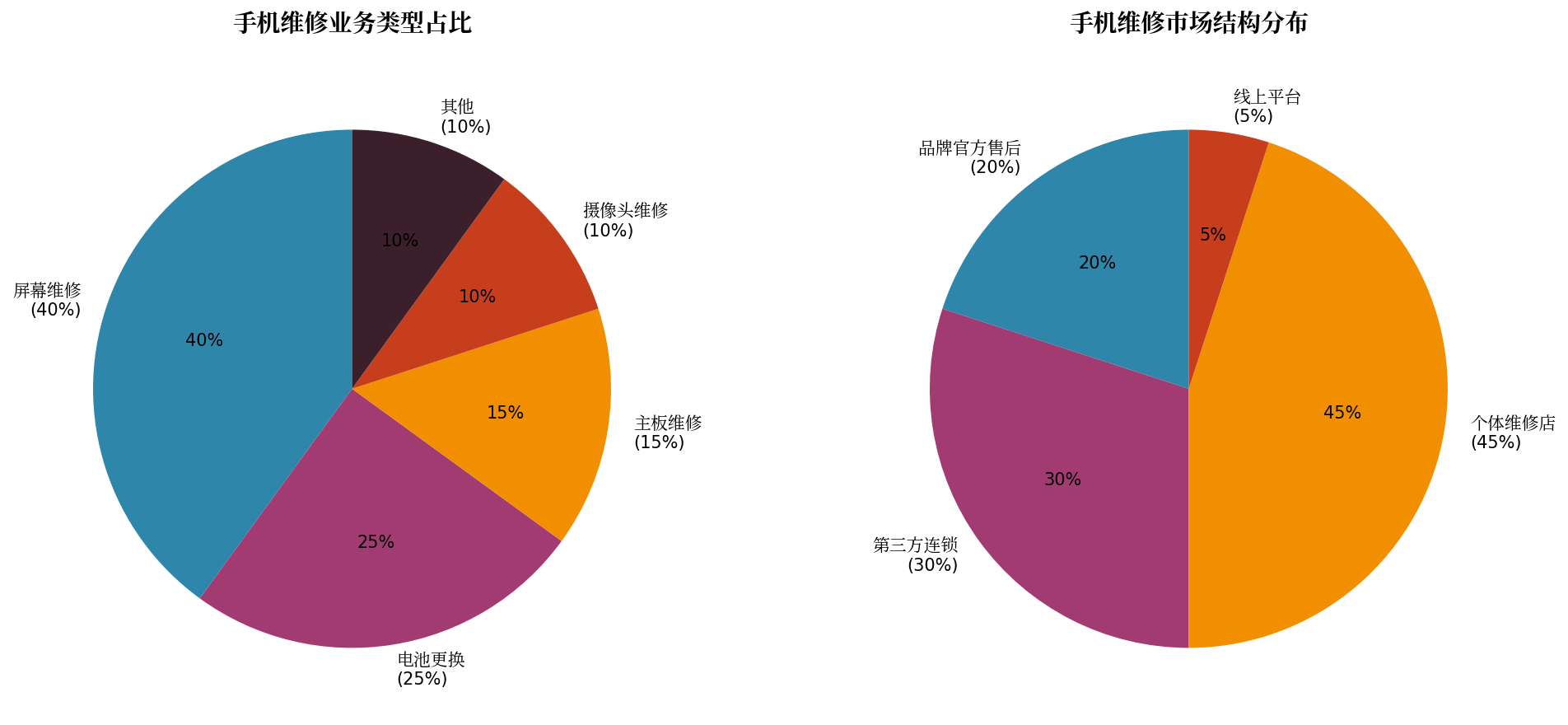
1.2.1 Repair Type Distribution: Screens, Batteries, and Motherboards at the Core
Smartphone repair demand is highly concentrated, made up mainly of a few core fault types. According to industry statistics, screen faults are the most common problem in phone repair, accounting for as much as 52% — directly related to the screen’s physical nature as the phone’s largest and most fragile interface. Whether it’s a shattered outer glass or damage to the inner display or touch function, the phone’s normal use is severely affected, making screens the item users are most willing to pay to fix. Screen repair is also repair shops’ main revenue source; the high parts cost and technical barrier together form the industry’s technical moat.
Battery problems come next as the second-largest source of repair demand. As phones age, battery degradation and shorter battery life are inevitable. For many users, replacing the battery significantly improves the phone experience and extends its life cycle, so battery replacement demand is very common. Especially for brands with integrated battery designs like Apple, battery replacement has become a standardized repair service. Motherboard repair represents the tip of the industry’s technical pyramid. Motherboard faults come in many varieties — failure to power on, no signal, water-damage corrosion — and repairs are complex, demanding extremely high professional knowledge and hands-on skill. Although motherboard repair volume is lower than screens and batteries, its ticket size and profit margin are usually the highest of all repair items, making it the core indicator of a repair shop’s technical strength.
Beyond these three core repair types, other demand includes replacement or repair of cameras, charging ports, speakers, and microphones. In addition, software fault handling and data recovery services form part of repair demand — data recovery especially has grown in importance as the value of users’ data rises. Notably, repair demand also varies by phone brand. Data shows Apple phones account for 45% of the industry’s total out-of-warranty repair volume (as high as roughly 50% in 2016), and their repair gross margins are typically higher than other brands’. This is thanks mainly to Apple products’ large installed base, user loyalty, and relatively closed ecosystem, which make its users more inclined to choose quality-assured services when repairing.
1.2.2 Brand Demand Differences: The Apple, Huawei, and Domestic-Brand Landscape
Along the brand dimension, phone repair demand shows a clearly stratified landscape. With their high-end market positioning and enormous user bases, Apple and Huawei are the repair market’s core service targets. Apple users’ repair demand concentrates on screens and batteries; because official repair prices are steep, large numbers of users seek third-party repair out of warranty, providing the market with ample foot traffic. Huawei, with a rich product line spanning the flagship Mate/P series down to the nova and Enjoy series across high, mid, and low tiers, has more diverse repair demand. Especially after its supply-chain challenges, Huawei phones’ resale value retention and users’ willingness to repair have both increased; its official after-sales network initiative, the “Thousand Counties Plan,” is also actively pushing down-market, aiming for 90% coverage of county-level authorized service centers.
Domestic brands like Xiaomi, OPPO, and vivo, with their extreme value-for-money and broad user bases, are likewise an important part of the repair market. Users of these brands are generally more price-sensitive, so after warranty they lean toward cost-effective third-party repair services. This has prompted third-party repair platforms such as Shanxiuxia and Geekbar to partner with these brands, providing users with officially endorsed or standardized on-site repair services. For example, Xiaomi’s strategic partnership with Shanxiuxia is a typical case: by integrating socialized service resources, it compensates for the shortcomings of its own offline service network.
Overall, the brand landscape of the repair market correlates strongly with phone sales market share. High-end models carry higher repair prices and greater technical difficulty, placing higher demands on repair providers’ technical capability and parts supply chains. Mid- and low-end models win on sheer installed volume and stable repair demand — the foundation supporting the survival of large numbers of independent repair shops. As brands’ market shares shift dynamically, the repair market’s demand structure adjusts with them, posing a continuous challenge to practitioners’ technical learning and business adaptability.
1.2.3 Consumer Behavior: Repair vs. Replace Decision Factors
When a phone breaks, whether a consumer repairs it or simply buys a new one is a complex decision influenced by many factors. Price is the primary decision factor. When the repair cost — especially for core components like screens or motherboards — approaches or exceeds a certain proportion of the phone’s secondhand residual value (usually 30%–50%), consumers tend to just replace it. This is why repair shops need diversified profit models, such as used-phone buyback and trade-in services, using value-added services to offset the limitations of repair alone.
The phone’s age and sentimental value also play an important role. For devices used only a short time, or that carry important data and memories, users are more willing to invest in repair. For old models used for many years, the repair value is relatively low. Repair convenience and transparency likewise influence consumer decisions. Modern consumers, especially younger generations, increasingly favor repair models offering online booking, on-site service, transparent pricing, and full-process traceability. The rise of O2O repair platforms is precisely a response to this consumer trend. Through standardized service processes and transparent pricing, these platforms effectively lower consumers’ decision costs and trust barriers.
In addition, rising environmental awareness has begun to influence consumer choices. More and more users recognize that repairing rather than replacing is an important way to reduce e-waste and practice sustainable consumption. This shift of mindset gives the phone repair industry new social value and developmental momentum. Taken together, a rational consumer weighs repair cost, phone value, data importance, service experience, and personal environmental beliefs before deciding to repair or replace. To win customers, repair providers must build comprehensive advantages across multiple dimensions: price, technology, service, and brand trust.
1.3 Industry Technology Level and Intelligent Transformation
1.3.1 Repair Skill Barriers: From Basic to Precision
The phone repair industry’s technical barriers keep evolving alongside phone technology. In the early feature-phone era, repair work centered on simple hardware replacement — batteries, screens, buttons — with relatively low technical barriers. But in the smartphone era, especially with the spread of complex technologies like full screens, under-display fingerprint sensors, multi-camera modules, highly integrated motherboards, and water/dust resistance, repair work has evolved from simple “parts swapping” to testing, soldering, and repairing precision electronic components, and technical barriers have risen sharply.
Currently, repair techniques in the industry can be roughly divided into several tiers. First is basic repair: screen assembly replacement, battery replacement, mid-frame and back-cover replacement, etc. — low technical barriers, learnable after short training, and the main business of most independent repair shops. Second is mid-level repair, involving replacement of small- and medium-scale integrated circuits (ICs) on the motherboard — charging ICs, audio ICs, Wi-Fi modules — as well as ribbon-cable jumpers, and reballing CPUs and memory. This requires circuit knowledge and proficient soldering skills. The top tier is chip-level repair and data recovery, such as precisely repairing traces on multilayer motherboards or recovering important data from severely physically damaged phones. These technologies are the industry’s “crown jewels**,” and engineers who master them are the scarcest and highest-paid talent in the industry. By 2027, AI-assisted repair is expected to account for 40% of the industry, which will fundamentally change the skill requirements for repair engineers — from purely manual operation to human-machine collaboration.
1.3.2 Intelligent Diagnostics: AI Assistance and Automated Equipment
Technological innovation is profoundly reshaping the phone repair industry’s operating model, with intelligent diagnostic systems and automated equipment as the two core drivers. Traditional fault diagnosis relied mainly on the individual experience of repair engineers, suffering from high misdiagnosis rates and low efficiency. In contrast, AI-algorithm-based intelligent diagnostic equipment can quickly and precisely locate complex problems like motherboard short circuits and camera focus failures. Reports indicate such intelligent diagnostic systems already cover more than 60% of the industry, cutting the misdiagnosis rate from 8% to 1.2%, boosting repair efficiency by 40%, and lowering customer complaint rates by 35%. For example, platforms like Geekbar already widely apply AI visual inspection systems, significantly improving their standardized service capability.
On the repair execution side, automated equipment is also beginning to play an important role. 3D printing can customize 90% of non-standard parts, cutting costs by 40%; automated soldering robots are being applied to precision motherboard repair, pushing yield rates past 99%. One leading chain brand, after introducing an automated production line, raised a single store’s daily repair volume from 80 devices to 200 — a stunning efficiency gain. These technologies not only improve repair quality and efficiency but also reduce reliance on senior technicians, making the industry’s standardization and scaled expansion possible. In the future, with further convergence of AI, big data, and IoT, the phone repair industry will develop toward remote fault prediction, automated repair, and personalized service-plan customization, transforming from passive response to proactive service.
1.3.3 Parts Supply Chain: Domestic Substitution and the Genuine-Parts Challenge
The parts supply chain is the phone repair industry’s lifeline; its cost, quality, and supply stability directly determine the profitability and quality of repair services. In recent years the supply-chain landscape has been undergoing profound change. On one hand, domestic substitution is accelerating. In core parts areas such as screen modules and batteries, domestic manufacturers like BOE and Desay Battery have grown their market share to 65%, effectively reducing dependence on imported parts and giving repair shops more high-value options. However, for the precision equipment and certain core components needed for high-end chip-level repair, some import dependence remains.
On the other hand, access to genuine parts has long been an industry pain point. Especially for brands like Apple, strict control over the parts supply chain makes it very hard for third-party repair shops to obtain official genuine parts. This not only drives up repair costs but has also sparked broad social debate about the “Right to Repair.” To meet this challenge, the industry is exploring multiple solutions. For instance, some large repair chains are building deep partnerships upstream in the supply chain to develop “curated” or “certified” high-quality third-party parts, offering more competitive prices while guaranteeing quality. Policy is also pushing change. The 2025 edition of the General Rules for Electronic and Electrical Product Repair Services strengthened environmental standards, driving more than 60% of repair outlets to complete green certification, prompting more shops to adopt eco-friendly, compliant parts and disposal processes. Meanwhile, as mainstream manufacturers gradually open up some repair technology licensing, the number of patent dispute cases has fallen 20%, creating a more favorable environment for the healthy development of the third-party repair market.
1.4 Policies, Regulations, and Industry Standards
1.4.1 Consumer Rights Protection: The “Three Guarantees” Rules and Repair Service Norms
Policies and regulations are an important cornerstone for regulating market order in the phone repair industry and protecting consumer rights. In China, the regulation most directly related to phone repair is the Provisions on the Responsibility for Repair, Replacement and Return of Mobile Telephone Commodities, commonly known as the “Three Guarantees” rules for mobile phones. These provisions spell out the responsibilities and obligations of phone sellers, repairers, and manufacturers when a phone develops a performance fault. For example, the Three Guarantees validity period for a mobile phone’s main unit is one year; within that period, if the phone has quality problems, the repairer must repair it free of charge; if after two repairs it still cannot be used normally, the seller must, upon presentation of the Three Guarantees certificate, replace it free of charge with a phone of the same model and specifications or accept a return. These rules give consumers a clear legal basis for defending their rights.
In practice, however, enforcement still faces many challenges. Many consumers are unaware of the specific content and time limits of the “Three Guarantees,” and some non-chain repair outlets exploit this information gap, failing to strictly follow the rules and infringing consumer rights. For instance, in one case a consumer’s newly replaced screen went black from non-human-caused damage just over ten days later, yet the repair shop demanded extra repair fees on various pretexts. After mediation by market regulators, the consumer was successfully refunded under the Three Guarantees rules (the Three Guarantees period for major components such as screens is usually six months). In addition, problems like information opacity during repairs, excessive repair, and swapping out original parts are common, generating large numbers of consumer complaints.
To address these problems, regulators and industry organizations are strengthening norms and guidance. Publicized consumer-rights cases serve as reminders that consumers should ask for receipts when receiving repair service, record the specific items, charges, and times of service and goods, and keep purchase invoices and Three Guarantees certificates for future claims. Meanwhile, some leading repair companies have begun proactively promoting service standardization, using technologies like full-process video recording and blockchain evidence preservation to improve transparency and rebuild consumer trust. For example, Baibon Technology’s “whole repair process on-chain” service lets users verify the authenticity of repair records via hash values, significantly improving retention among its high-end customers.
1.4.2 Environmental and Recycling Policies: E-Waste Disposal Requirements
With rising environmental awareness worldwide, the phone repair industry — an important link in the lifecycle of electronic products — faces increasingly strict environmental regulations and policy requirements. The Chinese government attaches great importance to the recycling and disposal of waste electrical and electronic equipment, issuing a series of policies and regulations aimed at building a complete circular-utilization system and reducing e-waste pollution. Among them, the Regulations on the Administration of the Recovery and Disposal of Waste Electrical and Electronic Equipment is the industry’s core regulation, clarifying the responsibilities and obligations of recycling and disposal enterprises and the intensity of government oversight.
In February 2024, the General Office of the State Council issued the Opinions on Accelerating the Building of a Waste Circular Utilization System, setting clear goals for industry development: by 2025, preliminarily build a waste circular utilization system covering all fields and links, with the resource recycling industry’s annual output value reaching 5 trillion yuan. Against this policy backdrop, the newly formed central state-owned enterprise China Resources Recycling Group was established in October of the same year, specifically tasked with building a national, functional resource recycling and reuse platform. The company plans to replicate and promote the safe phone recycling and disposal model nationwide and extend it to computers, hard drives, and the entire electronic and electrical equipment field, with the ultimate goal of forming a nationwide cascaded-utilization trading platform for waste electronic products.
These macro policies have profoundly influenced the phone repair industry. First, they push repair enterprises toward a “repair + recycling” circular-economy model. Many repair shops have begun doubling as used-phone buyback, refurbishment, and resale businesses, opening new revenue streams in line with green policy direction. A used phone in decent condition can re-enter the secondhand market after repair and refurbishment; badly damaged ones can be disassembled, with chips and electronic components reused for repair — maximizing resource utilization. Second, environmental policies set higher requirements for waste disposal during repair. For example, processing enterprises must collect and store hazardous waste from disassembly by category and hand it to qualified units for disposal. This requires repair enterprises to establish standardized operating procedures and ledger systems, recording the source, quantity, category, processing technology, and destination of waste to ensure traceability.
1.4.3 Local Regulations and Market Rectification Cases
Within the framework of national macro policy, local governments have also issued a series of local regulations and industry norms to address specific problems in the phone repair market, such as information opacity, unknown parts provenance, and privacy-data leak risks. A typical example is Shenzhen’s Specifications for Secondhand Phone Transactions. As the country’s largest secondhand trading market, Shenzhen targeted pain points like information opacity and weak consumer confidence in secondhand phone trading, regulating the whole process — from recycling management, repair management, quality inspection, and privacy-data protection to after-sales service — to promote the digitalization and standardization of secondhand phone trading.
Market rectification campaigns also occur from time to time, mainly targeting illegal and non-compliant behavior such as unlicensed operation, counterfeit parts, and consumer fraud. For example, some repair shops advertise “brand-new original screens” but actually install only glass with a re-pressed outer layer — so-called “after-pressed screens” — or even shoddy assembled screens, severely harming consumers’ right to know and their property. In mediation cases where law enforcement intervened, repair shops were found to have infringed consumers’ right to know by concealing the true state of repairs, and were ultimately required to refund the overcharges. In addition, some merchants exploit consumers’ technical ignorance, exaggerating simple software issues or minor faults into severe problems like a “burned-out motherboard” to induce them to buy new phones; this “motherboard scam” is also a key target of market regulators.
Although these local regulations and rectification campaigns may raise compliance costs in the short term, in the long run they help clean up the market environment, weed out unscrupulous merchants, and push the industry from price competition toward quality and service competition — ultimately benefiting repair enterprises that stick to standardized, branded operation.
2. Entry Barriers and Practitioner Profiles
The phone repair industry has long been seen as a “low-barrier, high-return” technical trade, attracting large numbers of entrepreneurs and job seekers. Yet as technology iterates and market competition intensifies, entry barriers and occupational requirements are quietly changing. This chapter analyzes in depth the technical, educational, and financial barriers to entering the industry, and paints a real group portrait of today’s practitioners through dimensions such as age, gender, education, and income.
2.1 Entry Barriers and Admission Conditions
2.1.1 Education Requirements: No Hard Barrier, Emphasis on Hands-On Skill
Unlike many other technical trades, the phone repair industry has no hard educational requirements for practitioners. This stems mainly from the trade’s intensely practice-oriented nature — the quality of repair skill is ultimately proven by actual operation, not by diplomas. The industry contains many successful repair technicians and entrepreneurs whose educational backgrounds span middle school, high school, junior college, and even bachelor’s degrees; what they share is solid hands-on ability and a spirit of continuous learning. This low educational barrier offers a viable career path for many young people who weren’t good at traditional exam-oriented schooling but are strong with their hands.
That said, education isn’t completely unimportant in the industry. As smartphone technology grows ever more complex, repair work demands higher overall competence from practitioners. Those with a foundation in electronic circuits and computer science tend to grasp motherboard-level repair, phone working principles, and intelligent diagnostic equipment much faster. So while entry doesn’t require advanced degrees, reaching technical mastery and standing out in fierce competition increasingly depends on systematic learning and knowledge reserves. Some professional repair training schools have begun incorporating more theoretical teaching into their curricula to cultivate high-caliber talent suited to future technological development.
2.1.2 Technical Training: Learning Cycles and Costs
For someone starting from zero who wants to enter the phone repair industry, there are three main learning paths: apprenticing, attending a training school, and self-study. Each has its pros and cons, with different learning cycles and costs.
Apprenticing is the most traditional way, usually done in a phone repair shop. Apprentices pay anywhere from 2,000 to 5,000 yuan, and some even earn a small wage. The advantage is exposure to real fault cases and learning the whole practical process — from receiving customers, communicating quotes, to repair operations and after-sales service. The drawbacks are equally obvious: irregular study time and an unclear learning cycle. Apprentices often end up running errands and doing odd jobs, compressing the time actually spent learning the trade. Many apprentices, after a year or so, can still only do simple external parts replacement, aren’t proficient with core tools like soldering irons and hot-air guns, let alone advanced techniques like motherboard repair.
Attending a training school is currently the more systematic and efficient way to learn. Legitimate training schools usually have clearly planned learning cycles — generally two to three months, or about one month for technicians with an existing foundation seeking advanced training. Fees are relatively high, usually around 5,000 to 10,000 yuan, and some advanced courses cost more. The key to choosing a school is teaching quality and curriculum. A reliable institution constantly updates its syllabus to track market demand, ensuring students graduate with practical skills aligned to real work rather than outdated basics. When choosing, students should focus on whether the school provides ample hands-on practice, whether it supplies repair tools and consumables, and whether it offers employment or entrepreneurship guidance after graduation.
| Learning method | Learning cycle | Cost range (yuan) | Pros | Cons |
|---|---|---|---|---|
| Repair shop apprentice | Not fixed (usually 1–2+ years) | 2,000 – 5,000 | Rich real-world experience, exposure to the full process | Unclear learning cycle, fragmented teaching, may be reduced to cheap labor |
| Professional training school | 2–3 months (systematic study) | 5,000 – 10,000+ | Short learning cycle, systematic and comprehensive content, hands-on guidance | Higher cost, must vet the institution’s credentials, possible gap between theory and practice |
| Self-study (online/books) | Extremely variable | Low (mainly material costs) | Flexible time, low cost | Lacks systematic guidance, no hands-on environment, low learning efficiency, easy to take detours |
Table 1: Comparison of the main ways to learn phone repair
2.1.3 Store-Opening Costs: Startup Capital, Equipment, and Rent
Opening a phone repair store is the end goal for many entering the industry; its relatively low startup cost is a major draw for entrepreneurs. According to data from several industry media outlets and training institutions, in third- and fourth-tier cities or county seats, opening a small 20–30 square meter phone repair store requires an initial investment of roughly 35,000 to 57,000 yuan. This sum mainly covers the following:
First is equipment and tooling, about 7,000 to 12,000 yuan. This is the core investment, directly determining the scope and efficiency of repair business. Basic equipment includes:
- Basic tool kits: screwdrivers of various types, pry bars, tweezers, suction cups, etc.
- Soldering tools: temperature-controlled soldering irons, hot-air guns (for desoldering and reballing).
- Testing equipment: adjustable DC regulated power supplies, multimeters, oscilloscopes (for motherboard fault detection).
- Precision operation equipment: high-magnification microscopes (for chip-level repair work), screen laminating machines (for screen separation and bonding — the core equipment of screen repair).
- Other auxiliary equipment: UV curing lamps (for curing screen adhesive), bubble removers, etc.
Second is the initial parts inventory, about 8,000 yuan. To ensure timely repairs, a store needs a standing stock of common parts such as screen assemblies, batteries, charging-port flex cables, and back-cover glass for popular models of each brand. Parts sourcing channels and prices directly affect margins; novice shop owners typically stock up at large electronics markets like Shenzhen’s Huaqiangbei.
Third is store rent and renovation. Rent is the biggest ongoing expense, running roughly 15,000 to 30,000 yuan a year depending on city and location. Community stores, mall stores, and office-building stores each have pros and cons; foot traffic, target customers, and rent cost must be weighed together. For renovation, a clean, professional storefront runs about 7,000 yuan, covering signage design, in-store layout, workbenches, display cabinets, etc.
Last is labor cost. For a mom-and-pop shop or solo operation, labor can be skipped initially. But if you need to hire a repair technician, wages and other miscellaneous costs run about 8,000 to 15,000 yuan per month. For a newly opened store, owners are advised to master repair skills themselves to control costs to the maximum.
| Cost item | Amount range (yuan) | Notes |
|---|---|---|
| Equipment and tools | 7,000 – 12,000 | Includes soldering, testing, screen-laminating and other core equipment |
| Initial parts inventory | 8,000 | Common screens, batteries, flex cables, etc. |
| Annual rent | 15,000 – 30,000 | Depends on city and location; the biggest ongoing expense |
| Storefront renovation | 7,000 | Includes signage, workbench, display cabinets, etc. |
| Labor cost (optional) | 8,000 – 15,000/month | Self-operation advised initially to control costs |
| Total (excluding labor) | ~37,000 – 57,000 | For a 20–30 sqm store in a third/fourth-tier city or county seat |
Table 2: Estimated initial cost of opening a small phone repair store
2.1.4 Qualifications and Certifications: Brand Authorization and Industry Certificates
In the phone repair industry, official certification is not a mandatory entry barrier, but obtaining relevant certifications matters greatly for boosting professional credibility and expanding business scope. These certifications fall into two broad categories: official brand authorization and industry skill certificates.
Official brand authorization is the “golden key” to the high-end repair market and a stable customer flow. Major phone brands (Apple, Huawei, Samsung, etc.) have all established their own Authorized Service Provider (ASP) or Independent Repair Provider (IRP) systems. With official authorization, a repair shop can:
- Use official genuine parts: this is the core of solving consumer trust issues — especially for brands like Apple, where official and third-party parts differ significantly in quality and compatibility.
- Get official technical support: repair manuals, technical bulletins, diagnostic tools, etc. — crucial for handling new models and complex faults.
- Perform in-warranty repairs: take on service for devices under warranty and receive official settlement of repair fees.
- Use official brand marks: displaying brand authorization logos on the storefront and promotional materials greatly boosts the shop’s professional image and consumer trust.
However, obtaining official brand authorization is both difficult and expensive. Manufacturers’ qualification reviews are extremely strict, typically requiring a corporate entity of certain scale, a professional repair environment, an engineering team that has passed rigorous training and assessment, plus hefty authorization fees and deposits. This puts it out of reach for the vast majority of independent shops and small chains.
Industry skill certificates, by contrast, are endorsements of individual technical ability. Some industry associations or government bodies organize vocational skill-level certification for phone repair and issue corresponding certificates. These certificates prove to some extent that the holder has the relevant theoretical knowledge and operating skills, and can help in job hunting or add points in some bidding projects. But for day-to-day business, consumers care more about actual repair skill and reputation; certificates play a relatively limited role.
In short, for most newcomers, solid skills and a good reputation are a “pass” more important than any certification. As the industry develops and standardizes, obtaining authoritative certifications will become an important way to boost competitiveness, but in the short term they aren’t essential.
2.2 Workforce Size and Structure
2.2.1 Number of Practitioners: A Million-Scale Job Market
China’s phone repair industry is an enormous job market absorbing large amounts of labor. According to 2018 statistics from the industry platform “51Xiu,” the industry’s workforce was roughly estimated at 5 million people. Listed company Baibon Technology, citing industry analysis in its 2023 annual report, noted that the operating entities are roughly 1 million mom-and-pop shops and freelancers. The discrepancy may stem from different statistical scopes: the 5-million figure may cover the entire phone aftermarket (repair, sales, recycling, parts production, etc.), while 1 million is closer to the number of core repair service providers. Either way, the phone repair industry provides millions of jobs and is an important livelihood industry.
However, the composition and quality of the workforce face severe challenges. Reports note that over 60% of industry practitioners can only handle simple after-sales problems — screen swaps, reflashing firmware, installing charging ports — and in some regions only a few repair shops can handle technical work like motherboard repair. This generally low technical capability leads to uneven service levels industry-wide and intensifies homogeneous low-price competition. In addition, the technical-upgrade needs of the massive repair workforce don’t match the industry’s pace of development. Although repair training schools have sprung up in recent years, cultivating tens of thousands of high-skilled talents annually, relative to the enormous existing workforce the pace of technical renewal remains slow.
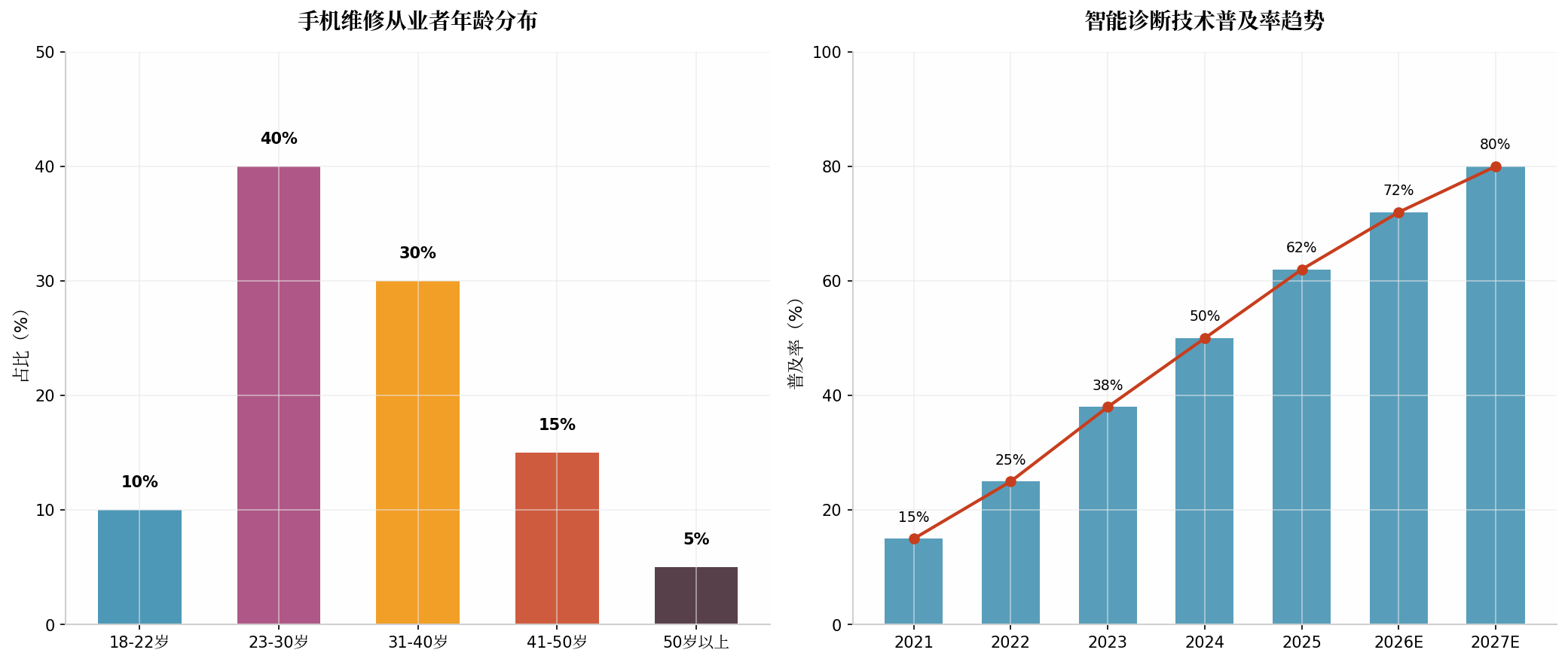
2.2.2 Age and Gender Distribution: Mostly Young and Middle-Aged Men
The age structure of phone repair practitioners shows a clear youthful character. A survey of a comparable technical trade found practitioners are mainly young and middle-aged, with 47.2% aged 22–30 and 38.5% aged 31–40 — together over 85%. This is closely related to phone repair’s high work intensity, long hours of bench work, and demanding requirements for learning new technology. Young people usually have stronger hands-on ability and willingness to learn, mastering the latest repair techniques faster. At the same time, as a manual craft, phone repair offers a viable career path for many young people with limited education who are willing to work hard.
On gender, the phone repair industry is highly male-dominated. Although precise statistics for phone repair are lacking, referencing other technical trades and service industries, male practitioners typically far outnumber females. For example, 2018 data showed women made up 37.2% of urban-unit employment. On platforms like Meituan Waimai and Didi — also technical-service categories — male practitioners exceed 90%. Given that phone repair involves precision operation, prolonged contact with electronic components, and potential soldering hazards, the work environment holds relatively less appeal for women; it can be inferred that male practitioners likely make up 80% or even over 90% of the phone repair industry.
2.2.3 Education Composition: Middle and High School as the Base, Junior College Share Rising
Educational attainment in the phone repair industry is generally low, consistent with the trade’s lack of hard educational barriers. Many veteran repair masters may have only a middle- or high-school education; through years of practice and the master-apprentice model they have accumulated rich repair skills. However, as smartphone technology grows ever more complex, repair work is no longer simple disassembly and reassembly — it involves circuit analysis, software programming, precision soldering, and other high-skill operations, demanding a higher cultural foundation and learning ability from practitioners.
In recent years, with the popularization of vocational education and the industry’s growing demand for high-caliber talent, the share of practitioners with junior college degrees or above has been gradually rising. Graduates of vocational colleges majoring in electronic information, communications technology, and related fields have begun choosing phone repair and related aftermarket services as a career option. With more systematic theoretical knowledge, they can understand and master new technologies faster and hold certain advantages in high-end roles such as chip-level repair and technical management. Although the industry’s base remains mostly lower-education, optimizing the educational structure is an inevitable trend of the industry’s future transformation and upgrading.
2.2.4 Practitioner Characteristics: Mom-and-Pop Shops and Sole Proprietors Dominate
The most typical operating form in China’s phone repair industry is the “mom-and-pop shop” and sole proprietorship. This model is flexible and low-cost, and has constituted the industry’s main body for decades. According to industry report data, mom-and-pop shops held a 75% market share in 2020, but this is projected to fall to 45% by 2025 — a change reflecting the profound evolution of the competitive landscape.
Traditional mom-and-pop shops are usually rooted in a community: the owner is the core repair technician, while the owner’s spouse handles reception, checkout, and parts sales. Their strengths are low operating costs, flexible decision-making, and warm, localized service. Their weaknesses are equally prominent: limited technical level, unstable parts supply chains, non-standardized service processes, and weak brand-marketing capability. Facing standardized, scaled competition from brand chains and online platforms, independent repair shops are under ever-greater survival pressure. To survive and develop, some mom-and-pop shops have begun seeking transformation — for example, joining third-party repair chain alliance systems to gain brand endorsement, supply-chain support, and technical training; others dig deeper into their communities, offering finer-grained service, or transform into “repair + secondhand recycling” comprehensive stores to broaden revenue sources.
2.3 Analysis of Practitioner Income Levels
2.3.1 Income Stratification: The Gap from Apprentice to Technical Master
Income in the phone repair industry forms a giant pyramid, with vast gaps between practitioners at different technical tiers and operating models. Based on industry observation and recruiting-platform data, practitioners’ annual incomes can be roughly divided into the following tiers:
Tier 1: Apprentices and junior repair workers. Newcomers fresh from training school or just entering the trade usually start as apprentices or assistant engineers. Income at this stage is low — monthly pay generally around 3,000–5,000 yuan, or about 30,000–60,000 yuan a year. In less developed regions, apprentice income may be even lower, sometimes just a basic living allowance. The focus at this stage is learning skills and accumulating real-world experience.
Tier 2: Mid-level repair technicians. Technicians who have mastered basic repair skills and can independently complete screen, battery, and other parts replacements on common models are the industry’s backbone. Their monthly pay is typically 5,000–10,000 yuan, or about 60,000–120,000 yuan a year. This group serves as the main force in repair shops and chain brands; technical proficiency and service efficiency are the main determinants of their income.
Tier 3: Senior repair engineers / technical leads. Engineers who can handle motherboard-level repair, data recovery, and other complex faults are scarce talent in the industry, usually with deep circuit knowledge and rich field experience. Their monthly pay can reach 10,000–20,000 yuan or more, roughly 120,000–240,000+ yuan a year. They typically work in large repair centers, official after-sales, or high-end third-party chains, or run their own shops with excellent technical reputations.
Tier 4: Successful entrepreneurs / technical masters. These people combine top-tier skills with outstanding business management ability. They may own repair brands or chains, or monetize their skills through short videos, technical training, and similar channels. Annual income can reach hundreds of thousands or even millions of yuan. They are the tiny minority at the pyramid’s tip, representing the peak of technical entrepreneurship.
2.3.2 Regional Differences: First-Tier vs. Third/Fourth-Tier City Income
Phone repair practitioners’ income is closely tied to their city’s economic development and spending power, showing significant regional variation.
In first-tier cities (Beijing, Shanghai, Guangzhou, Shenzhen), high living costs and fierce competition push repair service pricing relatively high. A mid-level technician may earn 8,000–15,000 yuan a month, and senior technicians earn more. However, steep rents and living costs also eat into real disposable income. Opening a store in a first-tier city means big foot traffic and high ticket sizes, but also the greatest competitive pressure and operating costs.
In second- and third-tier cities, income levels are moderate and living pressure relatively light. A mid-level technician earns roughly 5,000–8,000 yuan a month. Repair markets in these cities still have considerable room to grow; especially for chain brands that can provide standardized service and good experiences, they are the main battlefield for rapid expansion.
In third- and fourth-tier cities and county seats, income levels are relatively low — a mid-level technician may earn 3,000–6,000 yuan a month. But store-opening costs are extremely low and competition relatively mild. For independent repair shops with strong skills and good business sense, quality localized service can absolutely bring in over 10,000 yuan a month, even making them the local “repair king” with very handsome income and stable social standing. So for technical entrepreneurs, lower-tier markets are often the better choice for achieving financial freedom.
2.3.3 Income Growth Paths: Technical Mastery and Business Expansion
For phone repair practitioners, income growth follows two main paths: technical mastery and business expansion.
Technical mastery is the foundation. In the repair industry, skill is hard currency; technical level directly determines service capability and pricing power. Every leap from a junior worker doing simple replacements to a senior engineer handling complex motherboard repairs means a marked income increase. Continuously learning new techniques — especially for high-end brands like Apple and Huawei and new device types like foldables — is the key to raising personal value. Mastering high-end skills like chip-level repair, data recovery, and Face ID/fingerprint repair not only greatly raises the profit margin per repair but also builds a personal technical reputation, attracting difficult-case orders from across the country.
Business expansion is the amplifier. Once skills reach a certain level, business expansion can convert personal ability into greater commercial value. This includes:
- From employee to entrepreneur: open your own repair shop, moving from earning wages to earning profit. Risk increases, but so does the income ceiling.
- Broadening the service range: beyond repair, add value-added services such as used-phone buyback and sales, parts retail, phone beautification (screen protectors, color customization), and data recovery, forming a one-stop service system that raises ticket size and customer stickiness.
- Building a personal IP: use short-video platforms like Douyin, Kuaishou, and Bilibili to share repair processes and technical knowledge, building a “technical master” personal brand. Through livestream commerce (selling tools and parts), paid online teaching, and remote technical guidance, you can monetize traffic, break geographic limits, and scale income dozens or even hundreds of times over.
- Technical training: once skills and reputation reach a certain height, opening offline or online training classes to teach industry newcomers is the highest-level monetization of technical value.
3. Profit Models and Ways of Making Money
The phone repair industry’s profit model has evolved from the single revenue stream of repair service fees into today’s diversified, composite income structure. Successful repair businesses and independent operators usually build a comprehensive profit system combining core services, value-added services, and innovative businesses to withstand market risk and raise overall profitability. This chapter dissects the industry’s main revenue sources, cost structure, and successful profit strategies.
3.1 Core Revenue Sources
3.1.1 Repair Service Fees: Screen, Motherboard, and Battery Replacement
Repair service fees are a phone repair shop’s most core and fundamental revenue source. According to market surveys, a typical repair shop charges 100 to 300 yuan per repair, with parts margins of 30% to 50%. For a mid-sized repair shop sustaining 200–300 repairs a month, repair services alone can bring in monthly revenue of 40,000–90,000 yuan. Repair pricing is usually based on several factors:
- Technical difficulty of the repair item: simple battery replacement is priced low, while complex motherboard repair or data recovery commands high fees. Motherboard repair typically runs 300–1,500 yuan, and data recovery services can reach 500–3,000 yuan.
- Phone brand and model: repair costs for high-end brands and flagship models (iPhone Pro series, Huawei Mate/P series) are usually higher than for mid- and low-end models, mainly due to higher parts costs and greater repair risk.
- Parts quality: using parts of different grades (original screens, after-pressed screens, domestic assembled screens) directly affects the quote. Offering repair plans at different price points meets the needs of customers with different spending power.
- Service format: pricing also differs across on-site repair, in-store repair, and mail-in repair. On-site repair usually carries an additional service fee to cover the engineer’s travel and time.
Among the many repair items, screen repair is especially lucrative. Take the iPhone: an original screen’s procurement cost may account for 40%–60% of the repair quote, but after deducting costs, the gross profit per screen is still considerable. For technically mature shops, screen replacement is a high-volume, stable profit source.
3.1.2 Parts Sales Revenue: Cases, Screen Protectors, Chargers, etc.
Beyond repair services, parts and accessory sales are another important revenue source for repair shops. This business, often called the “aftermarket,” features low cost, high margin, and high repeat purchase. Commonly sold accessories include: protective cases, tempered-glass screen protectors, chargers and data cables, Bluetooth earphones, phone stands, and power banks.
Accessory gross margins are usually very high. For example, a tempered-glass protector costing a few yuan can sell for 20–50 yuan in a physical store — a margin exceeding 500%. Cases, chargers, and similar products carry equally handsome margins. For repair shops, the advantages of accessory sales are: a natural traffic funnel (customers coming in for repair are likely to need accessories), immediate demand (when a screen protector cracks or a charger breaks, consumers want to buy right away rather than wait for online delivery), and an experience advantage (physical stores let customers touch and feel product quality).
A successful repair shop tightly integrates accessory sales with repair services. For instance, after replacing a customer’s screen, recommending a high-quality case and tempered protector to prevent the next shattering can effectively raise the ticket size and turn one-off repair customers into long-term accessory consumers.
3.1.3 Value-Added Services: Data Recovery, Unlocking, Reflashing
Value-added services are the key to a repair shop’s technical strength and differentiated competitiveness, and the main source of high profit. These services target specific customer needs with higher technical barriers, and are priced accordingly. The main value-added services include:
- Data recovery: the most technically demanding and highest-priced of all value-added services. When a phone won’t power on due to water damage, drops, or system crash, but the photos, contacts, WeChat history, and other data stored inside are vital to the user, data recovery becomes crucial. Professional data recovery engineers can read raw data from the phone’s storage chip (NAND Flash) and perform low-level reconstruction and parsing to recover user data. Fees range from hundreds to tens of thousands of yuan depending on fault complexity; for enterprise clients or data involving important legal evidence, fees run even higher.
- Phone unlocking / account removal: when users forget their lock-screen password, or a purchased secondhand phone still has the original owner’s ID account (Apple ID, Huawei account) that can’t be signed out, professional unlocking services are needed. This service requires deep understanding of phone security mechanisms, has a high technical barrier, and typically costs 100–500 yuan.
- System-level repair and software services: including firmware reflashing, jailbreaking (iOS), rooting (Android), system downgrade, and black-screen/white-Apple-logo fixes. These services mainly address software-layer problems; for skilled engineers the operations are relatively simple and quick, making this a high-pure-profit business.
- Motherboard repair: the tip of the hardware-repair pyramid. It involves testing, replacing, and repairing the thousands of tiny components on a motherboard, requiring extremely refined soldering skill and deep circuit knowledge. A successful repair saves the user the huge expense of replacing the entire motherboard (usually very expensive), so customer acceptance is high and profit margins are enormous.
3.1.4 Profit Models of Brand-Authorized Shops and Official After-Sales
The profit models of brand-authorized service providers (ASPs) and official after-sales service centers differ fundamentally from third-party repair shops. Their core advantages are brand endorsement, genuine parts, and official warranty, and they mainly serve in-warranty users and consumers who pursue high-quality service and are price-insensitive.
Their profits come from two main sources:
- Manufacturer settlement: for in-warranty repairs covered by the “Three Guarantees,” the manufacturer bears the service fee. Authorized providers repair at the manufacturer’s unified prices and settle with the manufacturer periodically. This business line has relatively transparent and stable margins.
- Out-of-warranty repair services: for out-of-warranty or human-caused damage, official after-sales charges consumers at unified high-standard prices. Because they use official genuine parts and provide professional service and warranty, their repair prices are usually far above third-party shops’. For example, the official motherboard repair price for the iPhone 16 Pro Max reaches 4,000 yuan, a 200% premium over third parties. This high-pricing strategy is the main source of official after-sales profit.
However, official after-sales also has extremely high operating costs, including expensive store rents, professional equipment investment, and labor costs for strictly trained engineering teams. As a result, official after-sales functions more as a guarantee of brand image and service quality than as a pure profit center.
3.2 Cost Structure and Profit Margins
3.2.1 Main Cost Items: Rent, Labor, Parts Procurement
A phone repair shop’s cost structure is relatively clear, consisting of three main blocks: rent and utilities, labor, and parts procurement.
| Cost item | Share of revenue | Notes |
|---|---|---|
| Rent and utilities | 20% – 30% | The biggest fixed cost, especially in first-tier cities or core commercial districts. |
| Parts cost | 25% – 35% | The main variable cost, directly tied to repair volume and items. |
| Labor | 15% – 25% | Includes technicians’ and clerks’ wages, commissions, social insurance, etc. |
| Other expenses | 10% – 15% | Includes marketing, equipment depreciation, platform commissions, misc. |
Table 3: Analysis of the main cost structure of a phone repair store
Rent and utilities are the largest fixed cost share. In first-tier cities, a decently located store may pay 10,000–20,000 yuan a month in rent, while an equally sized store in a third- or fourth-tier city may cost only 2,000–5,000 yuan. Location selection is the key to cost control, requiring the best balance between foot traffic and rent. Parts cost is the main variable cost; procurement channels and prices directly affect repair gross margins. Buying directly from first-tier distributors or large wholesale markets (like Huaqiangbei) gets lower prices but requires bargaining power and capital. Labor is another major cost: a well-rounded repair technician typically earns 8,000–15,000 yuan a month, while reception and sales clerks earn around 4,000–6,000 yuan a month.
3.2.2 Gross and Net Margin Levels
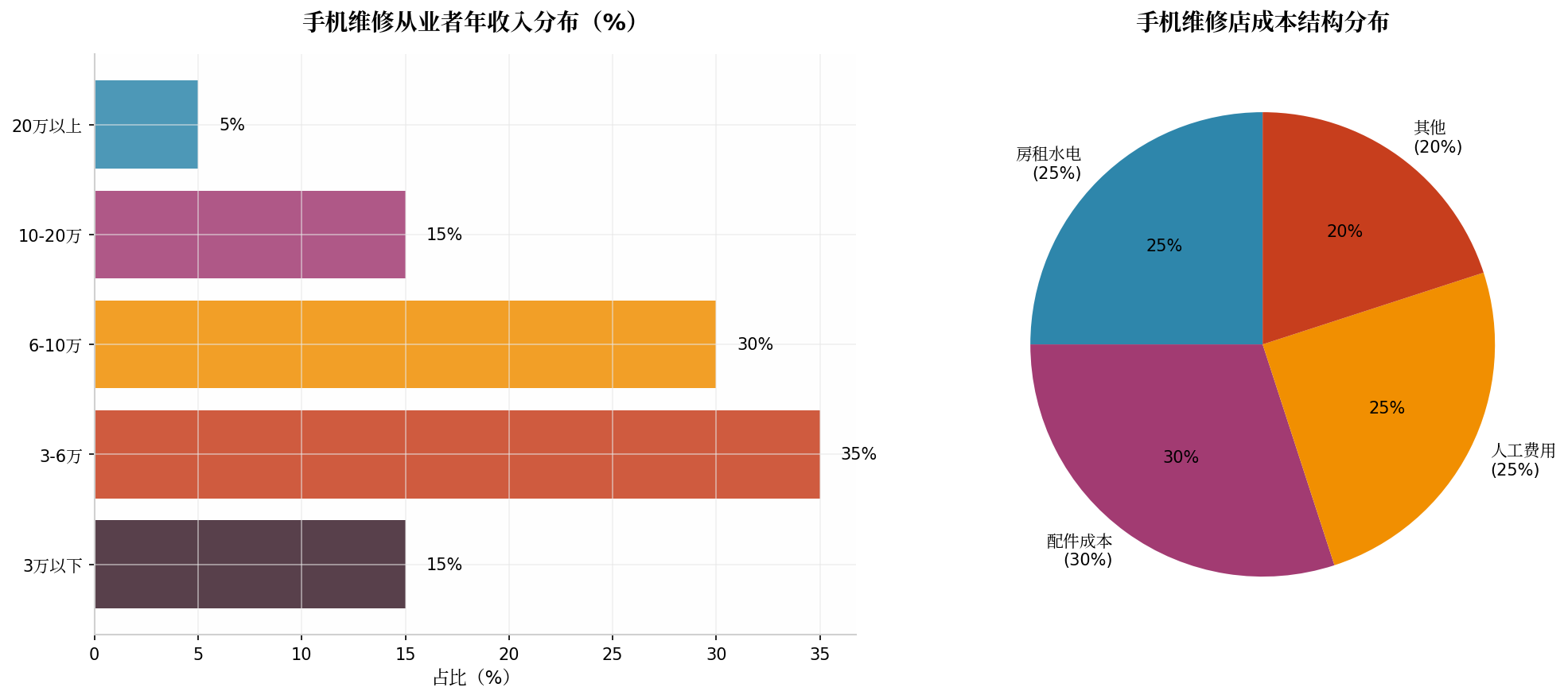
Overall, a well-run phone repair shop can achieve gross margins of 50%–70%, with net margins of roughly 30%–40%. That means a shop with monthly revenue of 50,000 yuan grosses about 25,000–35,000 yuan, and after deducting rent, labor, utilities, and other costs, nets about 15,000–20,000 yuan.
For example, a 20–30 sqm community store serving 20 customers a day at an average ticket of 90 yuan reaches monthly sales of 54,000 yuan. At a 60% gross margin, monthly gross profit is 32,400 yuan. After deducting roughly 20,000 yuan in monthly fixed expenses (rent, labor, utilities, etc.), monthly net profit can reach 12,400 yuan, or about 148,000 yuan a year. For excellent repair shops that also do used-phone buyback and resale, average monthly profit can reach as high as 50,000 yuan.
3.2.3 Payback Period: The Watershed Between Success and Failure
Because startup costs are relatively low, phone repair stores are generally considered to have fast payback periods. Industry estimates put the payback period for a normally operating new repair store at roughly 6–12 months. That means with a 50,000-yuan initial investment, good operation can recover all costs and turn profitable in about half a year to a year.
However, that’s only an idealized estimate. In reality, the payback period is affected by many factors and is the key watershed separating successful from failed operators. A weakness in any link — location, technical level, marketing ability, customer service, cost control — can greatly extend the payback period or even cause losses. In fiercely competitive markets, a new repair store that fails to quickly build a stable customer base and good reputation right after opening may well be eliminated before recouping its costs.
3.3 Innovative Profit Exploration
3.3.1 Used-Phone Buyback and Refurbished Resale
Used-phone buyback and resale (the C2B2C model) has become the phone repair industry’s most promising growth point and profit source. This business fits naturally with repair services, forming a perfect commercial loop. Many customers coming in for repair do so because their phone is old, badly damaged, or due for replacement — the shop can then offer valuation and buyback for the old device. Bought-back phones, after professional inspection, grading, and repair/refurbishment, can be resold at a margin.
The profit potential of the used-phone business is considerable. A phone bought back for 1,000 yuan, after tens to a hundred-plus yuan in repair and refurbishment costs, can sell for 1,500–2,000 yuan — a margin of 30%–50% or even higher. The keys to success in this business are: accurate valuation ability (knowing market prices and model residual values inside out), professional inspection and refurbishment capability (precisely the repair shop’s strength), and stable sales channels (offline store, or online platforms like Xianyu and Zhuanzhuan). For repair shops, running a used-phone business not only greatly increases revenue but also provides customers with one-stop upgrade service, improving customer stickiness.
3.3.2 Phone Insurance Partnerships (Screen-Crack Insurance, etc.)
Partnering with insurance companies to sell phone protection products — such as screen-crack insurance, accidental-damage insurance, and extended-warranty services — is an innovative way for repair shops to expand revenue channels. This “repair + insurance” model benefits all parties:
- For consumers: buying screen-crack insurance for a low price (tens to a hundred-plus yuan) entitles them to free or low-cost official repair if the screen shatters accidentally, greatly reducing the risk of steep repair bills.
- For repair shops: as an insurance sales channel they earn sales commissions from insurers — extra, nearly zero-cost income. Meanwhile, when insured phones need repair, the shop can take the order as a designated service provider, gaining a stable business source.
- For insurers: partnering with repair shops everywhere lets them quickly build a vast offline sales and service network, lowering operating costs.
Running this business requires the repair shop to have a base of customer trust and sales capability. Recommending relevant insurance products while repairing a customer’s phone or selling a new one is an effective sales scenario.
3.3.3 The O2O On-Site Repair Service Model
With the development of internet technology and changing consumer habits, the O2O (Online to Offline) on-site repair model emerged and grew rapidly. Shanxiuxia and Geekbar are representative companies. The model’s core idea — “order online, service at your door” — aims to solve traditional repair shops’ pain points: inconvenient locations, high time costs, and opaque pricing.
Its profit model is mainly the platform commission model. The platform attracts orders through online channels (app, mini program, website), then dispatches them to partner repair engineers. After the engineer completes the repair on site, the user pays the platform, which shares revenue with the engineer. The platform’s value lies in: traffic acquisition and distribution, service standardization and quality control (setting unified repair processes, parts standards, and pricing systems), and brand building and user trust. The O2O model’s advantage is greatly improved user experience and repair efficiency; its challenges are managing and training engineers, uniformly guaranteeing service quality, and high online customer-acquisition costs.
3.3.4 Technology Export: Training, Franchising, and Remote Guidance
Once repair skills reach the top level and enough industry reputation has accumulated, technology export becomes a high-value profit method. It takes three main forms: technical training, brand franchising, and remote technical support. Running phone repair training classes to teach newcomers or peers wanting to level up is the most direct monetization path; outstanding instructors can earn hundreds of thousands or even millions of yuan a year. Brand franchising packages a successful operating model, supply-chain system, and brand identity for export, earning franchise and management fees. Remote technical support mainly serves other repair professionals: when they hit unsolvable difficult cases in daily work, they can pay a technical master for remote diagnosis and guidance. This breaks geographic limits and maximizes the value of technical skill.
4. Competitive Landscape and Analysis of the Store-Closure Wave
China’s phone repair industry is in profound transformation, marked notably by the continuing spread of a “store-closure wave.” From 2016 to 2023, the number of phone repair stores nationwide plunged from 500,000 to fewer than 200,000 — a closure rate as high as 60%. Behind this shakeout is the combined force of technological iteration, market competition, rising costs, and shifting consumer habits. Large numbers of technically backward, poorly managed independent shops have been eliminated, while chain enterprises with technical strength, brand influence, and standardized service capabilities have expanded against the trend, significantly raising industry concentration.
4.1 Evolution of the Market Competitive Landscape
4.1.1 “A Tripod of Three”: Official After-Sales, Chain Brands, and Independent Shops
Currently, China’s phone repair industry has formed a “tripod” competitive landscape of three camps: official after-sales, third-party chain brands, and independent repair shops. Each camp has its own character, serves consumer groups with different needs, and together they form a multi-tiered, differentiated market service system.
Camp 1: Brand official after-sales repair. Representatives include the official authorized service centers of mainstream phone brands such as Apple, Huawei, Xiaomi, OPPO, and vivo. This camp’s core advantages are original parts, professional technology, standardized service, and powerful brand endorsement. Official after-sales mainly serves in-warranty users and high-end-model users who demand extremely high repair quality and are price-insensitive. Their repair prices are usually the highest on the market — for example, the official motherboard repair price for the iPhone 16 Pro Max reaches 4,000 yuan, a 200% premium over third-party shops. To compensate for insufficient outlet coverage, official after-sales is also actively seeking partnerships with third-party platforms, such as Xiaomi’s strategic cooperation with Shanxiuxia, expanding service radius by integrating socialized service resources.
Camp 2: Large third-party repair chain brands. Representatives include Shanxiuxia, Geekbar, Baibon (BYBON), One-Hour Quick Repair, Hi Repair, JD Service+, and Meituan Flash Repair. This camp is the core force of industry consolidation in recent years, achieving scaled, standardized operation through an “online traffic + offline service” model. They focus mainly on the out-of-warranty repair market, with core competitiveness in convenient service, moderate prices, and wide outlet coverage. For example, Shanxiuxia’s “central warehouse + regional hub store” model achieves parts delivery within 24 hours and engineer arrival within 4 hours. As of 2025, Shanxiuxia has more than 2,000 stores nationwide and serves over 8 million devices a year. These chain brands place great weight on technological innovation and digital management; for instance, the AI visual inspection system applied on the Geekbar platform cut the misdiagnosis rate from 8% to 1.2% and shortened engineer training cycles by 50%.
Camp 3: Independent repair shops and small repair outfits. This is the largest and most widely distributed group, typically existing as mom-and-pop shops, community stores, and computer-mall stalls. Its core advantages are low prices, fast repairs, and flexible operation. It mainly serves price-sensitive low-end-model users and budget-limited consumers. However, this camp also faces many problems — uneven technical levels, unguaranteed parts quality, high privacy-security risks, and lack of warranty service — and is the key target of industry standardization efforts. As market competition intensifies and industry norms advance, about 15% of non-standard repair enterprises exited the market in 2024.
| Competitive camp | Representative enterprises | Core advantages | Target customers | Market share (est.) | Development trend |
|---|---|---|---|---|---|
| Official after-sales | Apple, Huawei, Xiaomi, OPPO, vivo official service centers | Original parts, brand endorsement, professional technology, in-warranty service | High-end model users, in-warranty users | ~20% | Service network sinking down-market, partnering with third-party platforms |
| Third-party chains | Shanxiuxia, Geekbar, Baibon, JD Service+, Meituan Flash Repair | Standardized service, convenient and efficient, moderate prices, online traffic | Out-of-warranty users, value- and convenience-seeking users | ~30% | Rapid expansion, the core force of industry consolidation |
| Independent shops | Mom-and-pop shops, community stores, computer-mall stalls | Low prices, fast repairs, flexible operation | Low-end model users, price-sensitive consumers | ~45% | Shrinking numbers, facing transformation or elimination pressure |
| Online platforms | Aihuishou, Zhuanzhuan (mail-in repair) | Transparent pricing, easy comparison, wide coverage | Young users, users accustomed to online consumption | ~5% | Merging with offline service, becoming an important traffic funnel |
Table 4: Overview of the competitive landscape of China’s phone repair industry
4.1.2 Chain Brand Expansion: Case Studies of Shanxiuxia, Geekbar, etc.
Among the many third-party repair chain brands, Shanxiuxia is undoubtedly the fastest-developing and most influential case. Its success lies in precisely seizing the O2O on-site repair market opportunity. Founder Wang Yuan started with his first offline repair store in Hangzhou in 2011; acutely perceiving consumers’ need for time savings and convenience, he decisively pivoted in 2015 to focus on on-site repair service. Through an asset-heavy “online platform + self-employed engineers” model, Shanxiuxia achieved strong control over service quality.
Shanxiuxia’s core advantage is its highly efficient operating model. Compared with traditional offline stores, the O2O model drastically lowers costs. Wang Yuan once did the math: to complete 100,000 repairs in a city, the traditional model requires 200–250 stores, with steep rents, renovation, staffing, and inventory costs. Through Shanxiuxia’s platform, each city needs only one or two offices, with engineers going on-site to complete the same order volume — achieving a huge boost in internal efficiency and a dramatic cut in costs. This cost advantage can be converted into price advantages and operating benefits, ultimately passed back to consumers. On the strength of this model, Shanxiuxia holds over 60% of the on-site phone repair market, with operations covering more than 30 cities, averaging 150,000 to 200,000 orders a month at an average ticket of about 400 yuan.
4.1.3 The Trend of Rising Industry Concentration
The current market landscape of China’s phone repair industry shows a marked “big cake, small ants” character: the market is enormous (hundreds of billions of yuan), but participants are extremely fragmented — no service provider yet holds a market share above 5%. This high fragmentation has caused a host of problems: uneven service quality, no unified standards, high channel costs, and low operating efficiency.
However, industry concentration is accelerating. On one hand, leading chain brands are rapidly grabbing market share through capital operations and standardized expansion. On the other, independent shops are closing en masse under multiple pressures, releasing market space. Mom-and-pop shops’ market share plunging from 75% in 2020 to 45% in 2025 is clear proof of this trend. In the future, as branding, chain operations, and digitalization deepen, industry concentration will rise further. It is foreseeable that the market will come to consist mainly of a handful of large national chain brands, the phone manufacturers’ official after-sales networks, and a portion of quality independent shops that successfully transform into specialized, community-oriented service points.
4.2 The Store-Closure Wave: Phenomenon and Data Analysis
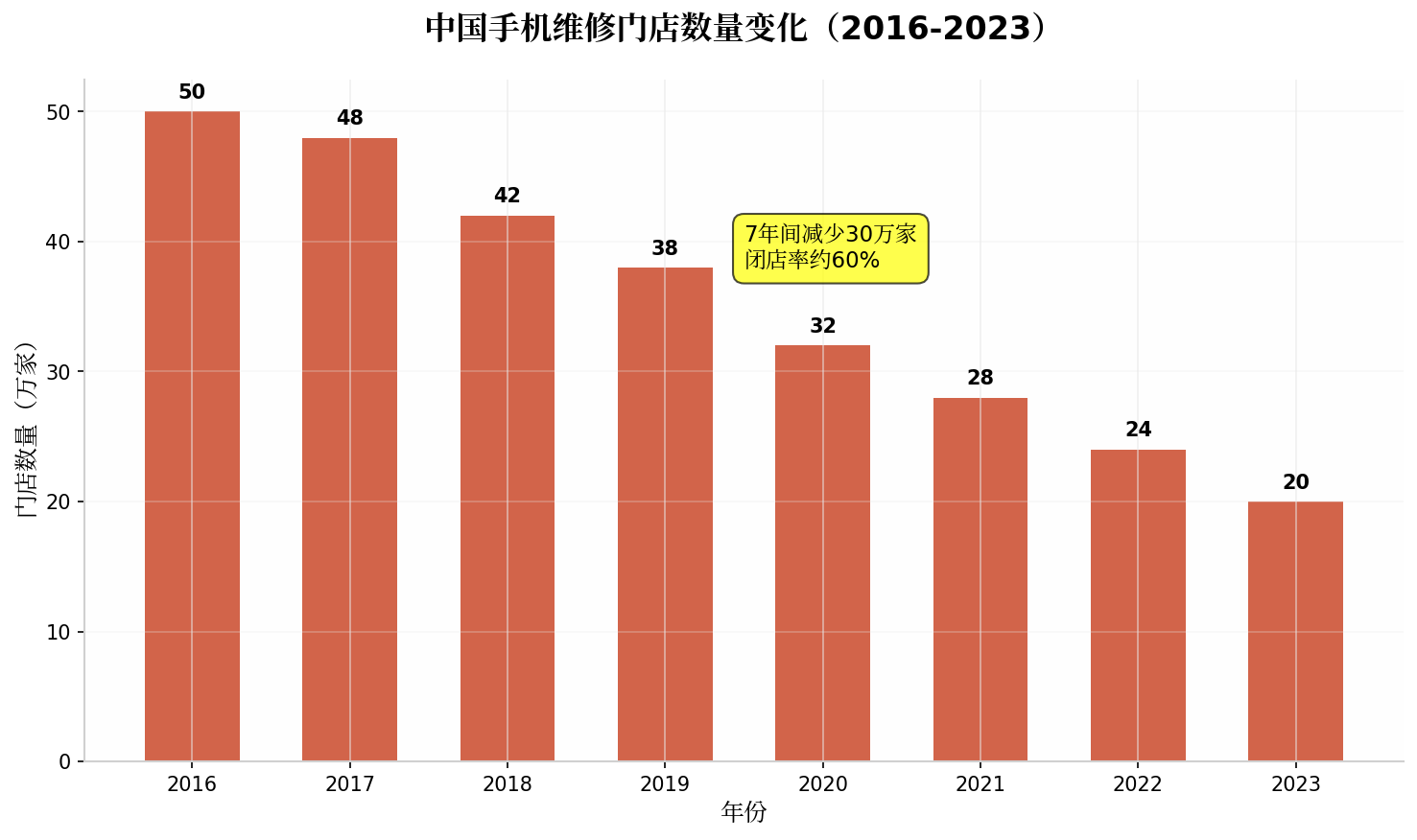
4.2.1 Store Numbers Plummet: From 500,000 to Fewer Than 200,000
Over the past several years, China’s phone repair industry has experienced an unprecedented “store-closure wave,” with store numbers falling off a cliff. According to aggregated data and industry observation, the number of offline phone repair stores nationwide plunged from a 2016 peak of over 500,000 to fewer than 200,000 in 2023. That means in just 7 years, more than 300,000 phone repair stores vanished from the market — an average of over 100 stores closing every day. Behind this startling figure is a profound and brutal structural shakeout the industry is undergoing.
The closure wave is not evenly distributed across all types of repair shops. The hardest hit are mainly traditional computer-mall stalls, street-side mom-and-pop shops, and small and mid-sized repair shops with one-dimensional skills, backward service, and no core competitiveness. For example, the successive shutdowns of Beijing Zhongguancun’s Hailong Electronics City and Dinghao Building — two major electronics malls — forced large numbers of repair shops dependent on their foot traffic to relocate or change trades. At Kemao Electronics City, where many clustered after relocating, most stores remain open but are deserted; one owner complained, “By three in the afternoon I still hadn’t made a single sale.” This vividly depicts the survival plight of traditional offline stores squeezed between the e-commerce onslaught and the drying up of offline traffic.
4.2.2 Estimated Closure Rate: A 60% Survival Challenge
Based on the drop from 500,000 stores to fewer than 200,000, it can be estimated that over the past several years, the phone repair industry’s overall closure rate reached over 60%. That means of every 10 repair stores that opened, more than 6 ultimately failed to keep operating and closed. Such a high closure rate is at the higher end even among all brick-and-mortar retail and service industries, highlighting the severe survival challenge the industry currently faces.
This high closure rate is no accident — it results from the combined action of internal industry problems and external environmental change. On one hand, excessively low entry barriers drew floods of entrepreneurs lacking skills, capital, and management ability to blindly pour in, intensifying competition. On the other, phone repair stores generally have short life cycles. A new store that fails to build a stable customer base and reach profitability within its first 6 to 12 months is very likely to collapse from a broken cash flow. In highly homogeneous price competition, margins are endlessly compressed; many stores run long-term at razor-thin profit or a loss, and eventually can’t carry on.
4.2.3 Anatomy of Closure Causes: Multiple Overlapping Factors
The phone repair industry’s closure wave is the result of multiple factors — technological, market, cost, and policy — overlapping and resonating. Dissecting these causes helps reveal the internal logic of the industry shakeout.
| Closure cause category | Specific manifestation | Impact level | Detailed explanation |
|---|---|---|---|
| Technology factors | Improved phone quality structurally reduces repair demand | ★★★★☆ | Advances in manufacturing and durability lower overall repair frequency. New models raise repair technical barriers; old repair techniques are obsoleted. |
| Market factors | Impact from O2O platforms and e-commerce channels | ★★★★☆ | On-site repair platforms (Shanxiuxia, Geekbar) and brand official after-sales divert large numbers of customers. Online parts sales (Taobao, JD) squeeze offline parts retail space. |
| Cost factors | Continuously rising rent and labor costs | ★★★☆☆ | Rents in core commercial districts and electronics markets are steep and keep climbing. Recruiting and retaining excellent repair technicians costs more and more. |
| Competition factors | Homogeneous competition and price wars | ★★★★☆ | Similar service items and no differentiation trigger fierce price wars. To cut costs, shoddy parts get used, damaging industry reputation and creating a vicious cycle. |
| Management factors | Lack of brand awareness and marketing ability | ★★★☆☆ | Most mom-and-pop shops remain in the traditional operating mode, unable to effectively attract and retain young customers. Crude management, poor customer stickiness. |
Table 5: Multi-dimensional analysis of the causes of phone repair store closures
4.3 In-Depth Dissection of Closure Causes
4.3.1 Technology Factors: Better Phone Quality, Less Repair Demand
A fundamental, long-term driver of the store-closure wave is the marked improvement in smartphone manufacturing quality and the evolution of product design. This has profoundly changed the market’s demand structure for traditional repair services.
First, the dramatic improvement in overall phone durability has directly reduced total repair volume. In the feature-phone era and early smartphone days, limited manufacturing processes and quality control meant phones developed all kinds of hardware and software faults frequently. But over the past decade, with mainstream brands’ massive R&D and production investment, smartphone quality is a world apart from before. Lin Dong, a repair master with over twenty years in the trade, observed pointedly: “Before, phone quality didn’t pass muster — counterfeit and low-end phones were rampant and broke easily, so repair volume was huge. As phone quality improved, today’s phones rarely have problems under normal use, so there just aren’t as many repairs.” Consumer Li Mu’s experience confirms this: her Apple and vivo phones ran five or six years without ever breaking, to the point she was actually “hoping” the phone would die so she’d have an excuse to buy a new one. This broad improvement in product quality reduces the frequency of repair business at the source — pulling the very ground out from under traditional shops that live on repair volume.
Second, the disappearance of certain fault types has directly erased the profit pillar of some repair shops. Industry data shows screen faults once accounted for 52% of all phone faults — the single repair item contributing the most profit. But as screen technology advances — with the spread of high-strength cover materials like Corning Gorilla Glass and brands’ investment in drop-resistant design — the probability of screen shattering is falling. The report warns: “Imagine if the fragile-screen fault is gradually solved or designed away — will repair shops still be profitable with half their profit gone?” This is no groundless fear. Historically, ribbon-cable faults once brought the repair industry enormous profits; as that problem was gradually solved, the company that had been biggest in the ribbon-cable business faded from the market. This kind of demand substitution through technological evolution is fatal for shops with one-dimensional skills that fail to transform in time.
Finally, phones are ever more integrated; modular and all-in-one designs sharply increase repair difficulty and cost. Many new phones use non-removable batteries, integrated motherboards, and complex internal stacking designs with heavy use of adhesive, making amateur disassembly extremely difficult and risky. For independent shops lacking professional equipment, skills, and legitimate parts sources, the barrier to repairing new high-end models keeps rising — and a failed repair can mean huge compensation claims. This forces many average-skill shops to give up the high-value new-model repair business and turn to repairing old, low-value models, compressing margins further.
4.3.2 Market Factors: The Impact of O2O Platforms and Official After-Sales Channels
If better phone quality reduced the “total volume” of repair demand, the upheaval in market channels is “redistributing” that reduced share. The two forces hitting traditional independent shops hardest are the rise of O2O on-site repair platforms and the improvement and down-market expansion of brand official after-sales systems.
O2O on-site repair platforms (like Shanxiuxia and Geekbar), with extreme convenience, transparent pricing, and standardized service, precisely hit the pain points of young urban consumers. These platforms acquire customers online, build brand trust, then dispatch uniformly trained, uniformed engineers to provide on-site service — the whole process traceable and warrantied. By contrast, traditional repair shops have fixed locations requiring customers to travel, opaque pricing, and the risk of parts being swapped — a complete experience disadvantage. Data shows online repair order volume grew 120% year-on-year in 2023, while offline repair stores’ foot traffic generally fell by over 40% in the same period. This see-saw trend clearly shows consumers voting with their feet. Through scale effects and standardized service, O2O platforms are rapidly eating into market share that once belonged to offline stores.
Meanwhile, mainstream phone manufacturers are also vigorously building out and perfecting their own after-sales systems. In the past, official service points were few, expensive, and slow — leaving third-party shops enormous room to survive. But now brands like Huawei, Xiaomi, OPPO, and vivo are actively expanding their offline service networks, especially in third- and fourth-tier cities. Huawei’s “Thousand Counties Plan” targets raising county-level authorized service center coverage to 90%. In addition, official after-sales has begun offering more diverse services — “2-hour express repair,” mail-in repair, and relatively affordable flat-rate “value repair” promotions — improving service convenience and value. As official channels’ service experience improves and outlets draw nearer, consumers — especially quality- and safety-conscious mid-to-high-end users — naturally prefer official after-sales, further squeezing third-party shops’ survival space.
4.3.3 Cost Factors: Continuously Rising Rent and Labor Costs
While the revenue side is squeezed, traditional repair shops’ cost-side pressure keeps mounting — and continuously rising rent and labor costs are the direct cause of margins being devoured until the business can’t carry on.
Rent is a brick-and-mortar store’s largest fixed expense, and its rise is a heavy burden for repair shops whose margins were never high. Take Lao Qian, who has run a phone repair store in Beijing for over a decade: his store rent climbed from just over 3,000 yuan a month a dozen-plus years ago to around 10,000 yuan today. Meanwhile his income didn’t grow — it fell sharply — prompting his lament: “Once the rent is paid, the money’s gone.” In core commercial districts, rent pressure is even more severe. For example, repair shops relocated from Zhongguancun Electronics Plaza pay over 20,000 yuan a month in rent even in a non-core location like Kemao Electronics City. Under this scissors effect of plunging revenue and rigidly rising costs, many repair shops quickly sink into the mire of losses.
Rising labor costs also intensify the pressure. On one hand, training a skilled repair technician takes considerable time and investment, and talent with high-end repair capability (motherboard repair, data recovery) is even scarcer. To retain core technical staff, shops must pay competitive salaries. On the other, as urban living costs rise generally, even ordinary clerks and apprentices demand ever-higher wages. For a small repair shop with unstable foot traffic and income, paying steady staff wages is a substantial expense. When business is good, labor may take only a small share of revenue; when business is slack, that fixed expense can become the last straw that breaks the camel’s back.
4.3.4 Competition Factors: Severe Homogeneity and Price Wars
The phone repair industry, especially the mid- and low-end market, has long suffered from severe homogeneous competition. Most independent shops offer much the same services — screen swaps, battery swaps, reflashing, etc. Lacking core technical moats and brand differentiation, “price wars” have become the main competitive weapon. This low-level cutthroat competition has driven down industry-wide margins, trapping practitioners in the dilemma of “no business without price cuts, no profit with them.”
Repair practitioner A Feng frankly admits that consumers’ first instinct now is to just buy new, or make do with an idle old phone; few choose repair unless the phone holds something important or is nearly new. This “better to replace than repair” mindset is largely caused by the mismatch between repair prices and phones’ residual value. When a screen repair costs several hundred yuan, consumers feel it’s better to chip in a bit more for a new phone. This price-sensitive environment forces repair shops to cut prices to attract customers.
In addition, homogeneous parts sourcing intensifies price competition. Many small repair shops procure parts from the same few large wholesale markets like Shenzhen’s Huaqiangbei, so their parts costs and quality barely differ. To fight for customers, some shops don’t hesitate to use shoddy cheap parts to cut costs and post irresistibly low quotes. While this may attract some unsuspecting customers in the short term, in the long run shoddy parts bring high re-repair rates, severely damaging store reputations and the industry’s credibility — a vicious cycle of bad money driving out good. In this quagmire of homogeneous competition, independent shops without core technology or brand endorsement can hardly build sustainable advantages, and eventually fade away in price wars.
4.3.5 Management Factors: Lack of Brand Awareness and Marketing Ability
Many traditional phone repair shop owners come from technical backgrounds — skilled at repair, neglectful of business management. Under the traditional belief that “good wine needs no bush” (a good product sells itself from a deep alley), they generally lack the awareness and ability for brand building and marketing, putting them at a severe disadvantage against modern, brand-operated competitors.
First, lack of brand awareness. The vast majority of independent shops have no brand name of their own — often just a simple “XX Phone Repair” sign — unable to build distinct recognition or consumer trust among numerous competitors. O2O platforms and large chain brands, through professional brand VI design, unified service standards, and sustained media exposure, have established professional, reliable brand images in consumers’ minds. When consumers need repair, they first search for and choose brands they’ve heard of, with reputational guarantees.
Second, single, outdated marketing methods. Traditional shops’ customer acquisition is very passive, relying mainly on natural foot traffic and referrals from regulars. In the era of e-commerce and social media, this approach is extremely inefficient. They neither can nor will invest in online promotion — setting up WeChat official accounts, listing on Meituan/Dianping, search engine optimization (SEO), or online advertising. They neither understand nor excel at using new-media tools to attract and retain customers. A Feng, a repair shop owner of five years, saw his store revenue fall 25% in 2020 and 2021 — a major reason being the lack of effective online traffic channels.
Finally, lack of modern customer management and data analysis capability. Successful chain brands manage customer information through CRM systems, doing precise user profiling and re-marketing — for example, proactively pushing battery-inspection offers after a phone has been in use for a while. Traditional shops have no such concepts at all: the customer gets the phone fixed and leaves, with no long-term, effective connection established — resulting in extremely high customer churn, with repeat purchase and referral rates out of the question. In an era where refined operations decide success or failure, this crude management model leaves them no chance against systematic brand competition.
5. Industry Pain Points, Challenges, and Future Trends
After a period of wild growth and brutal shakeout, China’s phone repair industry stands at a new crossroads. Although the market remains enormous, the pain points accumulated over years and the rapid changes in the external environment together constitute the severe challenges today’s practitioners face. At the same time, technological innovation, model innovation, and policy guidance point the way for the industry’s future development. This chapter systematically reviews the industry’s current core pain points, analyzes the internal and external challenges it faces, and looks ahead to future trends and opportunities.
5.1 Core Industry Pain Points
5.1.1 Trust Crisis: Opaque Repair Processes and Uneven Parts Quality
The trust crisis is the phone repair industry’s deepest and most stubborn pain point. For years, opaque repair processes and a mixed-bag parts market have bred widespread consumer distrust of repair shops. Consumers’ biggest worries include: parts being “swapped out” (good original parts replaced with old ones), minor problems treated as major ones (simple issues exaggerated into serious faults to justify high fees), use of shoddy non-original parts (leading to recurring problems after repair), and unsupervisable repair processes. This lack of trust greatly raises consumers’ decision costs and psychological burden, and damages the whole industry’s reputation.
The causes of this pain point are manifold. First, the industry lacks unified service standards and regulatory mechanisms, leaving service quality uneven. Second, the parts supply chain is non-standardized, flooding the market with parts of all origins and grades that consumers can’t tell apart. Finally, the professional barrier of repair technology itself puts consumers at a natural disadvantage in the information game with repair shops. Solving this trust crisis requires systematic reform on multiple levels: technology (full-process video recording, blockchain evidence preservation), models (brand endorsement, standardized service), and policy (establishing repair service quality certification systems).
5.1.2 Talent Shortage: Loss of High-End Technical Talent and a Missing Training System
Although the industry’s workforce is huge, professionals who truly master high-end repair techniques (chip-level repair, data recovery) are extremely scarce. Industry reports note that over 60% of practitioners can only handle simple after-sales problems, while high-end technical talent is in short supply. This structural talent shortage has become the bottleneck constraining the industry’s service upgrade and value growth.
Behind the talent shortage lies the absence of an industry talent-development system. Currently, the traditional “master teaches apprentice” model remains mainstream, with its long training cycles, fragmented teaching content, and outdated knowledge systems — hard-pressed to meet rapidly iterating technological demands. Although the market has seen a flood of repair training schools, their teaching quality is uneven and many courses are disconnected from real market needs, making “unemployed upon graduation” or “learning useless things” commonplace. In addition, phone repair’s high work intensity, low social status, and unclear career prospects lead many young people to switch careers after acquiring some skills, causing high-end talent to leak away.
5.1.3 Parts Supply: Restricted Genuine Channels and Non-Standard Parts Risks
The parts supply chain is the phone repair industry’s lifeline, and a major current pain point. For many third-party repair shops, channels for obtaining brand-official genuine parts are extremely limited or even nonexistent. Strict control of the parts supply chain by brands like Apple and Huawei leaves third-party shops dependent on the unofficial parts market. That market is large but riddled with problems: uneven quality — everything from high-grade pulled parts and original-quality aftermarket parts to shoddy knock-offs, all mixed together; opaque pricing — information asymmetry makes parts procurement costs highly volatile; unstable supply — parts for some less popular models may go out of stock.
Using unofficial parts lowers costs but brings huge risks. Once a parts-quality problem causes a failed repair or secondary fault, it not only harms consumer rights and triggers disputes but can also deal a devastating blow to the repair shop’s reputation. Therefore, how to build a reliable, stable, high-quality, and reasonably priced third-party parts supply chain is a challenge shared by all unofficial repair channels. In recent years, some well-resourced repair chain brands have begun partnering deeply with upstream supply chains to launch their own “curated” parts brands, trying to establish their own standards and moats in this area.
5.1.4 Service Homogeneity: Price Wars and Cutthroat Competition
As noted above, service homogeneity is the root of the industry’s fall into low-price cutthroat competition. Most repair shops offer highly similar service items and technical capabilities, lacking differentiated value. In consumers’ eyes, the only difference between repair shops may be price, making “price wars” the only competitive weapon. This competitive model is unsustainable: it constantly compresses industry margins, leaving enterprises unable to fund technical upgrades and service innovation, ultimately harming the industry’s long-term development and consumers’ final interests. Breaking homogeneity and moving toward differentiated competition (through technical specialization, service experience, brand positioning, etc.) is the necessary path for the industry’s transformation and upgrade.
5.2 Challenges and Opportunities Ahead
5.2.1 Technology Challenges: Repair Demands of 5G, Foldables, and Other New Technologies
Rapid technological iteration poses continuous technical challenges to the repair industry. 5G technology brings more complex RF modules and antenna designs, increasing the difficulty of signal-related fault repair. Foldable phones introduce entirely new failure points, such as flexible screen damage and hinge structure wear and malfunction. Repairing these new technologies requires more specialized knowledge and equipment and places new demands on parts supply. Practitioners who can’t keep pace with technological development — continuously learning and updating skills — will be eliminated by the market. Yet these challenges also contain enormous opportunities: providers who master repair techniques for high-end models like foldables will earn higher technical premiums and profit margins.
5.2.2 Model Challenges: Online-Offline Integration and Digital Transformation
The digitalization of consumer behavior demands the repair industry undergo digital transformation with online-offline integration (OMO). This isn’t just opening an online store or adding a booking function — it requires digitally connecting the whole process: online customer acquisition, customer management, service booking, payment and reviews, with offline service delivery, inventory management, and staff scheduling. For independent shops used to traditional operating models, this is a profound reshaping of mindset and capability. How to effectively use online platforms for traffic, how to raise operating efficiency with digital tools, and how to build a seamless online-offline customer experience will determine whether they can survive in the future.
5.2.3 Policy Opportunities: Support from Environmental Regulations and the Circular Economy
The state’s vigorous push for the circular economy and environmental regulations brings the phone repair industry unprecedented policy opportunities. Repair itself is the practice most aligned with circular-economy and sustainable-development ideals — extending product life through fixing and reducing e-waste. Related policy support, such as recycling subsidies for waste electronic products and tax incentives for the repair industry, is gradually landing. This provides a favorable policy environment and fertile ground for repair enterprises to run integrated “repair + recycling + refurbishment” businesses. Enterprises that actively embrace the circular-economy model can not only gain policy support but also build a good social image and win consumer recognition.
5.2.4 Market Opportunities: Lower-Tier Markets and Emerging Overseas Markets
Although repair market competition is fierce in first- and second-tier cities, the vast lower-tier markets (third- and fourth-tier cities and counties) and emerging overseas markets still hold enormous growth opportunities. In lower-tier markets, consumers are price-sensitive and official after-sales coverage is insufficient, offering broad development space for locally operated repair shops and chains pushing their channels down-market. Overseas — especially in Southeast Asia, Africa, and the Middle East, regions with rapidly growing smartphone penetration — the supporting repair service market is still in its infancy. Going abroad to provide repair services, technical training, and parts supply will become a new growth point for Chinese repair enterprises. For example, Transsion’s Carlcare after-sales system built in the African market provides a successful model for localizing overseas service for Chinese brands.
5.3 Future Development Trend Forecasts
5.3.1 Technology Trends: AI Diagnostics, AR Remote Assistance, and Automated Repair
Cutting-edge technologies like artificial intelligence (AI) and augmented reality (AR) will be deeply integrated into every step of phone repair. Future repair flows will begin with AI intelligent diagnosis: users describe fault symptoms via a phone app or mini program; the AI system, based on big data and machine-learning models, makes a preliminary judgment of the cause, estimates the repair plan and cost, and recommends nearby service points. During repair, junior technicians can perform complex operations under the real-time guidance of remote experts via AR glasses, breaking geographic limits and achieving “infinite replication” of expert skill. Going further, automated repair robots will be applied to standardized repair flows (battery replacement, screw tightening), greatly improving efficiency and consistency, freeing human technicians from repetitive labor to focus on more complex fault analysis and chip-level repair.
5.3.2 Model Trends: Branding, Chain Operations, and Standardized Service
Branding and chain operations are the most certain development direction for the phone repair industry’s future. As consumers raise their demands for service quality and trust, chain brands that can deliver a unified brand image, standardized service processes, transparent pricing, and reliable warranties will win ever more market share. Independent repair shops will face the choice of “join a franchise or be eliminated.” The future industry landscape will be jointly dominated by a few national repair-service giants plus distinctive brands that cultivate specific regions or specific technical niches. Service standardization will penetrate every detail — from engineers’ attire and service scripts to repair operation flows and parts quality grades, all will have explicit rules and executable SOPs (standard operating procedures).
5.3.3 Business Trends: From Repair to Comprehensive Phone Aftermarket Service Providers
Phone repair enterprises’ business boundaries will keep expanding, evolving from single-service repair providers into comprehensive providers of full-spectrum phone aftermarket solutions. Their core business will revolve around the phone’s life cycle, forming a closed-loop ecosystem:
- Pre-sale / new-phone stage: providing new-phone sales, trade-ins, phone insurance (screen-crack insurance, etc.), and similar services.
- In-use stage: providing phone accessories, beautification (screen protectors, customization), data management, and other services.
- After-sales / repair stage: providing all kinds of in- and out-of-warranty repair, data recovery, and other services.
- Recycling / retirement stage: providing old-phone buyback, environmentally sound disposal, and other services.
By building such a comprehensive service system, enterprises can establish long-term, multi-dimensional connections with phone users, maximize user lifetime value (LTV), earn revenue from multiple business lines, and strengthen their ability to withstand market risks.
5.3.4 Ecosystem Trends: Integration into the Circular Economy and Sustainable Development
The phone repair industry will grow from one node in the commercial ecosystem into a key link in the circular-economy system. Future repair enterprises will be not only service providers but also practitioners of resource circular utilization. Their roles will include: repair and refurbishment centers (giving old devices new life through fixing), waste product recycling stations (legally and compliantly recycling electronic devices that can no longer be used), and resource regeneration interfaces (partnering with downstream e-waste processors to extract valuable metals and materials). This shift in ecological role will bring repair enterprises new social value and commercial opportunities — for example, gaining government subsidies or tax breaks by participating in Extended Producer Responsibility (EPR) systems. Ultimately, the phone repair industry will deeply integrate with phone manufacturing, sales, recycling, and other industries, together building a green, low-carbon, sustainable consumer electronics industry ecosystem.
评论
0 条评论