深夜提醒

现在是深夜,建议您注意休息,不要熬夜哦~

🏮 🏮 🏮

新年快乐

祝君万事如意心想事成!

share-image
中
ESC

Building a High-Performance Sports Data Backend with the Gin Framework: From Architecture Design to Production Practice

English 阅读中文版

This article documents in detail the construction of a complete backend service for a sports app, covering the full implementation of core technologies including setting up the Gin framework, JWT authentication, Alibaba Cloud SMS integration, a dual-storage architecture with MySQL and InfluxDB, Redis cache optimization, and security protection strategies.

Table of Contents

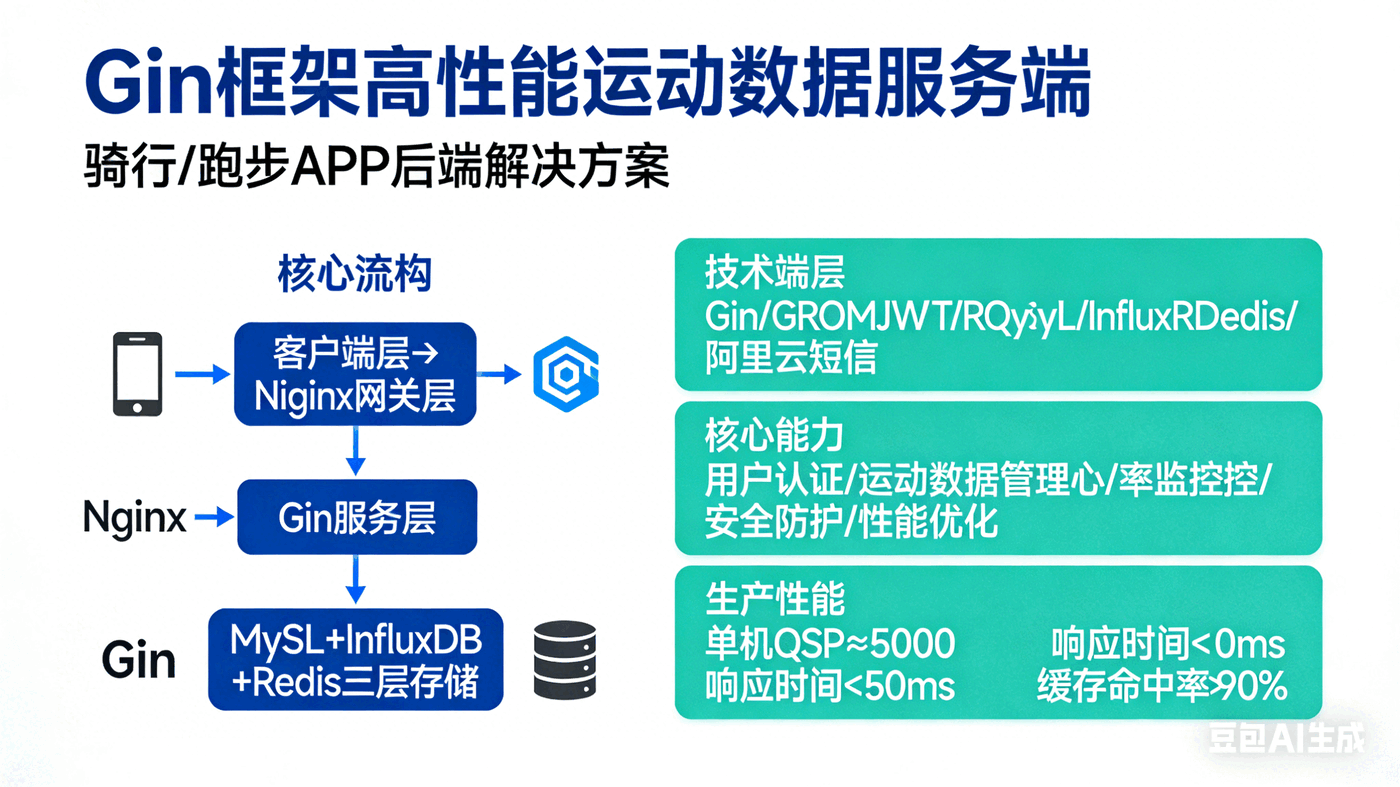
  1. Project Overview and Architecture Design
  2. Tech Stack Selection and Dependency Management
  3. Project Structure Conventions
  4. Configuration Management and Environment Isolation
  5. Database Design and Dual-Storage Architecture
  6. User Authentication and JWT Implementation
  7. Alibaba Cloud SMS Verification Code Integration
  8. Workout Data Service Layer Design
  9. Cache Strategy and Performance Optimization
  10. Security Protection and Middleware
  11. Deployment and Operations
  12. Summary and Outlook

1. Project Overview and Architecture Design

1.1 Project Background

This project is a backend service designed for a professional cycling/running app, and it needs to support the following core features:

  • User system: registration, login, JWT authentication, personal information management
  • Workout data: GPS tracks, heart-rate data, workout statistics, history
  • Real-time data: Bluetooth heart-rate strap data ingestion, real-time heart-rate monitoring
  • Data sync: batch import, data export, multi-device synchronization
  • Notification services: SMS verification codes, email notifications

1.2 Overall Architecture

┌─────────────────────────────────────────────────────────────────┐
│ Client Layer │
│ Android App │ Web Dashboard │
└──────────────────────────────┼──────────────────────────────────┘
│ HTTPS
┌──────────────────────────────▼──────────────────────────────────┐
│ API Gateway │
│ Nginx (load balancing, SSL termination, static) │
└──────────────────────────────┬──────────────────────────────────┘
│
┌──────────────────────────────▼──────────────────────────────────┐
│ Go Gin Server (8080) │
│ ┌─────────────┐ ┌─────────────┐ ┌─────────────┐ ┌───────────┐ │
│ │ Auth API │ │ Workout API│ │ HeartRate │ │ Bluetooth │ │
│ │ (JWT auth) │ │ (workout) │ │ (HR) │ │ (Bluetooth│ │
│ └──────┬──────┘ └──────┬──────┘ └──────┬──────┘ └─────┬─────┘ │
│ │ │ │ │ │
│ ┌──────▼───────────────▼───────────────▼──────────────▼─────┐ │
│ │ Middleware Layer │ │
│ │ JWTAuth │ RateLimit │ CORS │ Security │ Logging │ Recover │ │
│ └────────────────────────────────────────────────────────────┘ │
└──────────────────────────────┬──────────────────────────────────┘
│ │ │
▼ ▼ ▼
┌─────────────┐ ┌─────────────┐ ┌─────────────┐
│ MySQL │ │ InfluxDB │ │ Redis │
│ (user data) │ │ (time series│ │ (cache/ │
│ │ │ data) │ │ sessions) │
└─────────────┘ └─────────────┘ └─────────────┘

1.3 Dual-Storage Architecture Design

Given the characteristics of workout data, a MySQL + InfluxDB dual-storage architecture is adopted:

Storage type Data type Use case
MySQL Users, devices, config Relational data, transactional support
InfluxDB GPS points, heart rate, workout records Time-series data, efficient writes and aggregate queries
Redis Cache, sessions, rate limiting High-performance temporary data storage

2. Tech Stack Selection and Dependency Management

2.1 Core Tech Stack

// go.mod
module bicycle_go_server

go 1.24.0

require (
github.com/gin-gonic/gin v1.11.0 // Web framework
github.com/golang-jwt/jwt/v5 v5.3.1 // JWT authentication
github.com/redis/go-redis/v9 v9.17.3 // Redis client
golang.org/x/crypto v0.47.0 // bcrypt encryption
gorm.io/driver/mysql v1.6.0 // MySQL driver
gorm.io/gorm v1.31.1 // ORM framework
github.com/influxdata/influxdb-client-go/v2 v2.14.0 // InfluxDB
github.com/alibabacloud-go/darabonba-openapi/v2 v2.1.14 // Alibaba Cloud SDK
github.com/alibabacloud-go/tea v1.3.13 // Alibaba Cloud Tea
gopkg.in/gomail.v2 v2.0.0 // email sending
golang.org/x/time v0.14.0 // rate limiter
)

2.2 Rationale for Tech Choices

Component Choice Rationale
Web framework Gin Excellent performance, active community, rich middleware ecosystem
Database MySQL 8.0 Relational data storage, supports JSON fields
Time-series DB InfluxDB 2.x Optimized for time-series data, supports Flux query language
Cache Redis 7.x Rich data structures, outstanding performance
Authentication JWT Stateless authentication, suitable for distributed deployment
Password encryption bcrypt Industry-standard password hashing algorithm
SMS service Alibaba Cloud Dypnsapi Number authentication service, supports automatic code generation

3. Project Structure Conventions

A Clean Architecture layered structure is used, with the following directory layout:

bicycle_go_server/
├── cmd/
│ └── server/
│ └── main.go # Application entry point
├── config/
│ ├── config.go # Config struct definition and loading
│ ├── database.go # MySQL connection initialization
│ ├── redis.go # Redis connection initialization
│ └── influxdb.go # InfluxDB connection initialization
├── internal/
│ ├── handlers/ # HTTP handlers (Controller layer)
│ │ ├── user.go # User-related endpoints
│ │ ├── workout.go # Workout data endpoints
│ │ ├── heartrate.go # Heart-rate data endpoints
│ │ ├── bluetooth.go # Bluetooth device endpoints
│ │ ├── sms.go # SMS verification code endpoints
│ │ └── email.go # Email endpoints
│ ├── service/ # Business logic layer
│ │ └── workout_service.go # Workout data service
│ ├── repository/ # Data access layer
│ │ ├── workout_repository.go # MySQL data access
│ │ └── workout_influx_repository.go # InfluxDB data access
│ ├── middleware/ # Middleware
│ │ ├── jwt.go # JWT authentication
│ │ ├── ratelimit.go # Rate-limit middleware
│ │ └── security.go # Security middleware
│ └── models/ # Data models
│ ├── models.go # Database models
│ ├── dto.go # Request/response DTOs
│ └── workout.go # Workout data models
├── pkg/ # Common packages
│ ├── response/ # Unified response wrapper
│ ├── utils/ # Utility functions
│ ├── sms/ # SMS service
│ └── email/ # Email service
├── go.mod
├── go.sum
└── .env.example # Environment variable example

3.1 Layer Responsibilities

┌─────────────────────────────────────────┐
│ Handlers │ ← HTTP request handling, param validation
│ (gin.Context → DTO → Service) │
├─────────────────────────────────────────┤
│ Service │ ← Business logic orchestration
│ (data transformation, cache strategy, transaction management) │
├─────────────────────────────────────────┤
│ Repository │ ← Data persistence
│ (MySQL/InfluxDB/Redis operations) │
├─────────────────────────────────────────┤
│ Models │ ← Data model definitions
└─────────────────────────────────────────┘

4. Configuration Management and Environment Isolation

4.1 Configuration Struct Design

// config/config.go
type Config struct {
Server ServerConfig
Database DatabaseConfig
InfluxDB InfluxDBConfig
JWT JWTConfig
Security SecurityConfig
Aliyun AliyunConfig
Redis RedisConfig
Email EmailConfig
}

type ServerConfig struct {
Port string
ReadTimeout time.Duration
WriteTimeout time.Duration
}

type DatabaseConfig struct {
Host string
Port string
User string
Password string
DBName string
MaxIdleConns int
MaxOpenConns int
}

4.2 Environment Variable Loading

// LoadConfig loads the configuration
func LoadConfig() *Config {
return &Config{
Server: ServerConfig{
Port: getEnv("SERVER_PORT", "8080"),
ReadTimeout: time.Duration(getEnvAsInt("SERVER_READ_TIMEOUT", 10)) * time.Second,
WriteTimeout: time.Duration(getEnvAsInt("SERVER_WRITE_TIMEOUT", 10)) * time.Second,
},
Database: DatabaseConfig{
Host: getEnv("DB_HOST", "localhost"),
Port: getEnv("DB_PORT", "3306"),
User: getEnv("DB_USER", "root"),
Password: getEnv("DB_PASSWORD", ""),
DBName: getEnv("DB_NAME", "bicycle"),
MaxIdleConns: getEnvAsInt("DB_MAX_IDLE_CONNS", 10),
MaxOpenConns: getEnvAsInt("DB_MAX_OPEN_CONNS", 100),
},
JWT: JWTConfig{
Secret: getEnv("JWT_SECRET", "change-in-production"),
ExpireTime: time.Duration(getEnvAsInt("JWT_EXPIRE_HOURS", 24)) * time.Hour,
},
// ... other config
}
}

func getEnv(key, defaultValue string) string {
if value := os.Getenv(key); value != "" {
return value
}
return defaultValue
}

4.3 Environment Variable Configuration Example

# .env
# Database config
DB_HOST=localhost
DB_PORT=3306
DB_USER=root
DB_PASSWORD=your_password
DB_NAME=bicycle

# JWT config
JWT_SECRET=your-super-secret-key

# Redis config
REDIS_HOST=localhost
REDIS_PORT=6379

# Alibaba Cloud SMS config
ALIYUN_ACCESS_KEY_ID=your-access-key
ALIYUN_ACCESS_KEY_SECRET=your-secret
ALIYUN_SMS_SIGN_NAME=your-sign-name
ALIYUN_SMS_TEMPLATE_CODE=100001

# InfluxDB config
INFLUXDB_URL=http://localhost:8086
INFLUXDB_TOKEN=your-token
INFLUXDB_ORG=your-org
INFLUXDB_BUCKET=heart_rate

5. Database Design and Dual-Storage Architecture

5.1 MySQL Relational Data Model

-- users table
CREATE TABLE `users` (
`id` INT UNSIGNED AUTO_INCREMENT PRIMARY KEY,
`username` VARCHAR(50) NOT NULL UNIQUE,
`password` VARCHAR(100) NOT NULL,
`register_type` VARCHAR(10) DEFAULT 'phone',
`phone` VARCHAR(20),
`email` VARCHAR(100),
`nickname` VARCHAR(50),
`gender` VARCHAR(10),
`birthday` DATE,
`province` VARCHAR(50),
`city` VARCHAR(50),
`district` VARCHAR(50),
`is_logged_in` TINYINT(1) DEFAULT 0,
`created_at` DATETIME DEFAULT CURRENT_TIMESTAMP,
`updated_at` DATETIME DEFAULT CURRENT_TIMESTAMP ON UPDATE CURRENT_TIMESTAMP,
INDEX `idx_phone` (`phone`),
INDEX `idx_email` (`email`)
) ENGINE=InnoDB DEFAULT CHARSET=utf8mb4;

-- running_sessions table
CREATE TABLE `running_sessions` (
`id` VARCHAR(36) PRIMARY KEY,
`user_id` INT UNSIGNED,
`start_time` BIGINT NOT NULL,
`end_time` BIGINT,
`total_distance_meters` DOUBLE DEFAULT 0,
`total_duration_seconds` BIGINT DEFAULT 0,
`average_speed` FLOAT DEFAULT 0,
`max_speed` FLOAT DEFAULT 0,
`average_heart_rate` INT DEFAULT 0,
`max_heart_rate` INT DEFAULT 0,
`calories` INT DEFAULT 0,
`city_name` VARCHAR(50),
`activity_type` VARCHAR(20) DEFAULT '骑行',
`total_ascent` DOUBLE DEFAULT 0,
`thumbnail_path` VARCHAR(255),
`created_at` DATETIME DEFAULT CURRENT_TIMESTAMP,
INDEX `idx_user_id` (`user_id`),
INDEX `idx_start_time` (`start_time`),
FOREIGN KEY (`user_id`) REFERENCES `users` (`id`)
) ENGINE=InnoDB DEFAULT CHARSET=utf8mb4;

-- gps_points table
CREATE TABLE `gps_points` (
`id` BIGINT UNSIGNED AUTO_INCREMENT PRIMARY KEY,
`session_id` VARCHAR(36) NOT NULL,
`latitude` DOUBLE NOT NULL,
`longitude` DOUBLE NOT NULL,
`altitude` DOUBLE DEFAULT 0,
`timestamp` BIGINT NOT NULL,
`accuracy` FLOAT DEFAULT 0,
`speed` FLOAT DEFAULT 0,
`heart_rate` INT DEFAULT 0,
`point_order` INT DEFAULT 0,
INDEX `idx_session_id` (`session_id`),
INDEX `idx_session_timestamp` (`session_id`, `timestamp`),
FOREIGN KEY (`session_id`) REFERENCES `running_sessions` (`id`) ON DELETE CASCADE
) ENGINE=InnoDB DEFAULT CHARSET=utf8mb4;

5.2 GORM Model Definitions

// internal/models/models.go
type User struct {
ID uint `gorm:"primaryKey;autoIncrement" json:"id"`
Username string `gorm:"size:50;not null;uniqueIndex" json:"username"`
Password string `gorm:"size:100;not null" json:"-"` // do not return the password
RegisterType string `gorm:"size:10;default:phone" json:"register_type"`
Phone *string `gorm:"size:20" json:"phone,omitempty"`
Email *string `gorm:"size:100" json:"email,omitempty"`
Nickname *string `gorm:"size:50" json:"nickname,omitempty"`
Gender *string `gorm:"size:10" json:"gender,omitempty"`
Birthday *time.Time `gorm:"type:date" json:"birthday,omitempty"`
Province *string `gorm:"size:50" json:"province,omitempty"`
City *string `gorm:"size:50" json:"city,omitempty"`
District *string `gorm:"size:50" json:"district,omitempty"`
IsLoggedIn int8 `gorm:"default:0" json:"is_logged_in"`
CreatedAt time.Time `gorm:"autoCreateTime" json:"created_at"`
UpdatedAt time.Time `gorm:"autoUpdateTime" json:"updated_at"`
}

type RunningSession struct {
ID string `gorm:"primaryKey;size:36" json:"id"`
UserID *uint `gorm:"index" json:"user_id,omitempty"`
StartTime int64 `gorm:"not null" json:"start_time"`
EndTime *int64 `json:"end_time,omitempty"`
TotalDistanceMeters float64 `gorm:"default:0" json:"total_distance_meters"`
TotalDurationSeconds int64 `gorm:"default:0" json:"total_duration_seconds"`
AverageSpeed float32 `gorm:"default:0" json:"average_speed"`
MaxSpeed float32 `gorm:"default:0" json:"max_speed"`
AverageHeartRate int `gorm:"default:0" json:"average_heart_rate"`
MaxHeartRate int `gorm:"default:0" json:"max_heart_rate"`
Calories int `gorm:"default:0" json:"calories"`
CityName string `gorm:"size:50" json:"city_name"`
ActivityType string `gorm:"size:20" json:"activity_type"`
TotalAscent float64 `gorm:"default:0" json:"total_ascent"`
ThumbnailPath string `gorm:"size:255" json:"thumbnail_path"`
CreatedAt time.Time `gorm:"autoCreateTime" json:"created_at"`
GpsPoints []GpsPoint `gorm:"foreignKey:SessionID" json:"gps_points,omitempty"`
}

5.3 InfluxDB Time-Series Data Storage

// internal/repository/workout_influx_repository.go

type WorkoutInfluxRepository struct {
client *influxdb2.Client
org string
bucket string
}

// WriteWorkout writes workout data to InfluxDB
func (r *WorkoutInfluxRepository) WriteWorkout(ctx context.Context, workout *models.WorkoutRecord, rawJSON string) error {
writeAPI := r.client.WriteAPI(r.org, r.bucket)

// Create the point
point := influxdb2.NewPoint(
"workout", // measurement
map[string]string{
"original_id": workout.OriginalID,
"sport_type": workout.SportType,
"record_type": workout.RecordType,
"data_source": workout.DataSource,
},
map[string]interface{}{
"name": workout.Name,
"duration_sec": workout.DurationSec,
"distance_m": workout.DistanceM,
"avg_heart_rate": workout.AvgHeartRate,
"total_climb": workout.TotalClimb,
"training_load": workout.TrainingLoad,
"avg_pace": workout.AvgPace,
"run_power": workout.RunPower,
"raw_json": rawJSON,
},
workout.StartTime,
)

writeAPI.WritePoint(point)
writeAPI.Flush()

return nil
}

// ListWorkoutsAsMap queries workout records (returns a map format for caching)
func (r *WorkoutInfluxRepository) ListWorkoutsAsMap(ctx context.Context, days int) ([]map[string]interface{}, error) {
queryAPI := r.client.QueryAPI(r.org)

var timeFilter string
if days > 0 {
timeFilter = fmt.Sprintf(|> range(start: -%dd)`, days)
} else {
timeFilter = `|> range(start: 0)` // query all
}

query := fmt.Sprintf(`
from(bucket: "%s")
%s
|> filter(fn: (r) => r._measurement == "workout")
|> pivot(rowKey:["_time"], columnKey: ["_field"], valueColumn: "_value")
|> sort(columns: ["_time"], desc: true)
`, r.bucket, timeFilter)

result, err := queryAPI.Query(ctx, query)
if err != nil {
return nil, err
}

var workouts []map[string]interface{}
for result.Next() {
record := result.Record()
workout := make(map[string]interface{})

// Convert the record into a map
for k, v := range record.Values() {
if k != "_measurement" && k != "_start" && k != "_stop" {
workout[k] = v
}
}
workouts = append(workouts, workout)
}

return workouts, nil
}

6. User Authentication and JWT Implementation

6.1 JWT Middleware Implementation

// internal/middleware/jwt.go

type Claims struct {
UserID uint `json:"user_id"`
Username string `json:"username"`
jwt.RegisteredClaims
}

var jwtSecret []byte

// InitJWT initializes the JWT secret
func InitJWT(secret string) {
jwtSecret = []byte(secret)
}

// GenerateToken generates a JWT token
func GenerateToken(userID uint, username string, expireTime time.Duration) (string, error) {
claims := Claims{
UserID: userID,
Username: username,
RegisteredClaims: jwt.RegisteredClaims{
ExpiresAt: jwt.NewNumericDate(time.Now().Add(expireTime)),
IssuedAt: jwt.NewNumericDate(time.Now()),
NotBefore: jwt.NewNumericDate(time.Now()),
Issuer: "bicycle-api",
},
}

token := jwt.NewWithClaims(jwt.SigningMethodHS256, claims)
return token.SignedString(jwtSecret)
}

// JWTAuth is the JWT authentication middleware
func JWTAuth() gin.HandlerFunc {
return func(c *gin.Context) {
authHeader := c.GetHeader("Authorization")
if authHeader == "" {
response.Unauthorized(c, "Please provide an authentication token")
c.Abort()
return
}

// Support the "Bearer <token>" format
parts := strings.SplitN(authHeader, " ", 2)
if len(parts) != 2 || strings.ToLower(parts[0]) != "bearer" {
response.Unauthorized(c, "Malformed authentication token")
c.Abort()
return
}

tokenString := parts[1]
claims, err := ParseToken(tokenString)
if err != nil {
if errors.Is(err, jwt.ErrTokenExpired) {
response.Error(c, 401, response.CodeTokenExpired, "Authentication token has expired")
} else {
response.Error(c, 401, response.CodeTokenInvalid, "Authentication token is invalid")
}
c.Abort()
return
}

// Store user info in the context
c.Set("userID", claims.UserID)
c.Set("username", claims.Username)
c.Next()
}
}

// ParseToken parses a JWT token
func ParseToken(tokenString string) (*Claims, error) {
token, err := jwt.ParseWithClaims(tokenString, &Claims{}, func(token *jwt.Token) (interface{}, error) {
if _, ok := token.Method.(*jwt.SigningMethodHMAC); !ok {
return nil, errors.New("unexpected signing method")
}
return jwtSecret, nil
})

if err != nil {
return nil, err
}

if claims, ok := token.Claims.(*Claims); ok && token.Valid {
return claims, nil
}

return nil, errors.New("invalid token")
}

6.2 User Login Implementation

// internal/handlers/user.go

func (h *UserHandler) Login(c *gin.Context) {
var req models.LoginRequest
if err := c.ShouldBindJSON(&req); err != nil {
response.BadRequest(c, "Invalid request parameters: "+err.Error())
return
}

// Find the user
var user models.User
if err := h.DB.Where("username = ?", req.Username).First(&user).Error; err != nil {
response.Error(c, 401, response.CodeUserNotFound, "Incorrect username or password")
return
}

// Verify the password (bcrypt)
if !utils.CheckPassword(req.Password, user.Password) {
response.Error(c, 401, response.CodePasswordIncorrect, "Incorrect username or password")
return
}

// Generate the token
token, err := middleware.GenerateToken(user.ID, user.Username, h.Cfg.JWT.ExpireTime)
if err != nil {
response.InternalError(c, "Failed to generate token")
return
}

// Update the login status
h.DB.Model(&user).Update("is_logged_in", 1)

response.Success(c, models.LoginResponse{
Token: token,
User: user,
})
}

// Register registers a user
func (h *UserHandler) Register(c *gin.Context) {
var req models.RegisterRequest
if err := c.ShouldBindJSON(&req); err != nil {
response.BadRequest(c, "Invalid request parameters: "+err.Error())
return
}

// Validate username and password strength
if !utils.ValidateUsername(req.Username) {
response.BadRequest(c, "Username format is incorrect")
return
}
if valid, msg := utils.ValidatePassword(req.Password); !valid {
response.BadRequest(c, msg)
return
}

// Check whether the user already exists
var existingUser models.User
if err := h.DB.Where("username = ?", req.Username).First(&existingUser).Error; err == nil {
response.Conflict(c, "Username already exists")
return
}

// Encrypt the password
hashedPassword, err := utils.HashPassword(req.Password)
if err != nil {
response.InternalError(c, "Password encryption failed")
return
}

// Create the user
user := models.User{
Username: req.Username,
Password: hashedPassword,
RegisterType: req.RegisterType,
Phone: utils.StringPointer(req.Phone),
Email: utils.StringPointer(req.Email),
}

if err := h.DB.Create(&user).Error; err != nil {
response.InternalError(c, "Failed to create user")
return
}

response.Created(c, models.IDResponse{ID: user.ID})
}

6.3 Password Encryption Utilities

// pkg/utils/utils.go

import "golang.org/x/crypto/bcrypt"

var bcryptCost = 12 // configurable

// HashPassword encrypts a password with bcrypt
func HashPassword(password string) (string, error) {
bytes, err := bcrypt.GenerateFromPassword([]byte(password), bcryptCost)
return string(bytes), err
}

// CheckPassword verifies a password
func CheckPassword(password, hashedPassword string) bool {
err := bcrypt.CompareHashAndPassword([]byte(hashedPassword), []byte(password))
return err == nil
}

// ValidatePassword validates password strength
func ValidatePassword(password string) (bool, string) {
if len(password) < 6 {
return false, "Password must be at least 6 characters"
}
if len(password) > 20 {
return false, "Password cannot exceed 20 characters"
}
return true, ""
}

7. Alibaba Cloud SMS Verification Code Integration

7.1 Wrapping the Alibaba Cloud Dypnsapi Service

// pkg/sms/aliyun_sms.go

type AliyunSmsService struct {
client *dypnsapi.Client
rdb *redis.Client
signName string
templateCode string
codeExpireTime time.Duration // code validity: 15 minutes
sendInterval time.Duration // send interval: 60 seconds
dailyLimit int // daily send limit: 10 times
ipDailyLimit int // per-IP daily limit: 20 times
}

// NewAliyunSmsService creates an Alibaba Cloud SMS service instance
func NewAliyunSmsService(accessKeyID, accessKeySecret, signName, templateCode string, rdb *redis.Client) (*AliyunSmsService, error) {
config := &openapi.Config{
AccessKeyId: tea.String(accessKeyID),
AccessKeySecret: tea.String(accessKeySecret),
Endpoint: tea.String("dypnsapi.aliyuncs.com"),
}

client, err := dypnsapi.NewClient(config)
if err != nil {
return nil, fmt.Errorf("failed to create aliyun sms client: %w", err)
}

return &AliyunSmsService{
client: client,
rdb: rdb,
signName: signName,
templateCode: templateCode,
codeExpireTime: 15 * time.Minute,
sendInterval: 60 * time.Second,
dailyLimit: 10,
ipDailyLimit: 20,
}, nil
}

// SendVerifyCode sends an SMS verification code
func (s *AliyunSmsService) SendVerifyCode(ctx context.Context, phone, codeType, ip string) (bizID, requestID string, err error) {
// Check the send-rate limit
if err := s.checkRateLimit(ctx, phone, ip); err != nil {
return "", "", err
}

// Use the Dypnsapi SendSmsVerifyCode API
// This API automatically generates and sends the verification code
sendCodeRequest := &dypnsapi.SendSmsVerifyCodeRequest{
PhoneNumber: tea.String(phone),
SignName: tea.String(s.signName),
TemplateCode: tea.String(s.templateCode),
TemplateParam: tea.String(`{"code":"##code##","min":"15"}`),
CodeType: tea.Int64(1), // 1 means numeric verification code
CodeLength: tea.Int64(6), // 6-digit code
Interval: tea.Int64(60), // resend interval 60 seconds
ValidTime: tea.Int64(15), // validity 15 minutes
}

sendCodeResponse, err := s.client.SendSmsVerifyCode(sendCodeRequest)
if err != nil {
return "", "", fmt.Errorf("failed to send sms: %w", err)
}

if sendCodeResponse.Body == nil || *sendCodeResponse.Body.Code != "OK" {
errMsg := "unknown error"
if sendCodeResponse.Body != nil && sendCodeResponse.Body.Message != nil {
errMsg = *sendCodeResponse.Body.Message
}
return "", "", fmt.Errorf("sms send failed: %s", errMsg)
}

// Record the send count
s.recordSend(ctx, phone, ip)

requestID = ""
if sendCodeResponse.Body.RequestId != nil {
requestID = *sendCodeResponse.Body.RequestId
}

return "", requestID, nil
}

// VerifyCode verifies an SMS verification code
func (s *AliyunSmsService) VerifyCode(ctx context.Context, phone, codeType, code string) (bool, error) {
checkRequest := &dypnsapi.CheckSmsVerifyCodeRequest{
PhoneNumber: tea.String(phone),
VerifyCode: tea.String(code),
}

checkResponse, err := s.client.CheckSmsVerifyCode(checkRequest)
if err != nil {
return false, fmt.Errorf("failed to verify code: %w", err)
}

if checkResponse.Body == nil || checkResponse.Body.Code == nil || *checkResponse.Body.Code != "OK" {
return false, nil
}

return true, nil
}

// Rate-limit check
func (s *AliyunSmsService) checkRateLimit(ctx context.Context, phone, ip string) error {
// Check the send interval (only 1 send within 60 seconds)
intervalKey := fmt.Sprintf("sms:interval:%s", phone)
exists, err := s.rdb.Exists(ctx, intervalKey).Result()
if err != nil {
return fmt.Errorf("failed to check interval: %w", err)
}
if exists > 0 {
return fmt.Errorf("Sending too frequently, please try again after 60 seconds")
}

// Check the daily send count limit
dailyKey := fmt.Sprintf("sms:daily:%s:%s", time.Now().Format("20060102"), phone)
count, err := s.rdb.Get(ctx, dailyKey).Int()
if err != nil && err != redis.Nil {
return fmt.Errorf("failed to check daily limit: %w", err)
}
if count >= s.dailyLimit {
return fmt.Errorf("Daily send limit reached")
}

return nil
}

8. Workout Data Service Layer Design

8.1 Data Import Service

// internal/service/workout_service.go

type WorkoutService struct {
repo *repository.WorkoutRepository // MySQL storage
influxRepo *repository.WorkoutInfluxRepository // InfluxDB storage
redis *redis.Client
}

// ImportWorkouts batch-imports workout data
func (s *WorkoutService) ImportWorkouts(ctx context.Context, records []models.WorkoutImportRecord) (int, int, error) {
inserted := 0
skipped := 0

// CST time zone (UTC+8)
loc := time.FixedZone("CST", 8*3600)

for _, record := range records {
// Get the ID
recordID := record.ID
if recordID == "" {
recordID = record.OriginalID
}
if recordID == "" {
skipped++
continue
}

// Parse the time - supports multiple formats
var t time.Time
var err error

// 1. Prefer the "2026-01-28 11:28:56" format
if record.Raw.TrainingAt != "" {
t, err = time.ParseInLocation("2006-01-02 15:04:05", record.Raw.TrainingAt, loc)
}
// 2. Fall back to the "26/01/28 11:28" format
if (err != nil || t.IsZero()) && record.StartTime != "" {
t, err = time.ParseInLocation("06/01/02 15:04", record.StartTime, loc)
}
// 3. Fall back to the ISO8601 format
if (err != nil || t.IsZero()) && record.Time != "" {
t, err = time.Parse(time.RFC3339, record.Time)
}
if err != nil || t.IsZero() {
skipped++
continue
}

// Parse distance (supports string("9.42km") or number(9.42))
var distVal float64
if record.Distance != nil {
distVal = s.parseFlexDistance(record.Distance)
}

// Parse duration "00:40:15" -> seconds
var durVal int
if record.Duration != "" {
durVal = s.parseDurationStr(record.Duration)
}

// Write to InfluxDB
workout := &models.WorkoutRecord{
OriginalID: recordID,
Name: record.Name,
SportType: record.SportType,
StartTime: t,
DurationSec: durVal,
DistanceM: distVal * 1000, // km -> m
AvgHeartRate: s.parseFlexInt(record.AvgHeartRate),
TotalClimb: s.parseFlexFloat(record.TotalClimb),
}

rawJSON, _ := json.Marshal(record)
if err := s.influxRepo.WriteWorkout(ctx, workout, string(rawJSON)); err != nil {
skipped++
continue
}
inserted++
}

// Clear the cache
s.clearStatsCache(ctx)
s.clearListCache(ctx)

return inserted, skipped, nil
}

// Flexibly parse the distance field
func (s *WorkoutService) parseFlexDistance(v interface{}) float64 {
switch val := v.(type) {
case string:
d := strings.ToLower(val)
d = strings.ReplaceAll(d, "km", "")
f, _ := strconv.ParseFloat(d, 64)
return f
case float64:
return val
case int:
return float64(val)
default:
return 0
}
}

8.2 List Query Service

// ListWorkouts queries the workout record list - with caching
func (s *WorkoutService) ListWorkouts(ctx context.Context, days string) ([]map[string]interface{}, bool, error) {
daysInt, _ := strconv.Atoi(days)

// Redis Cache Key
cacheKey := fmt.Sprintf("workouts:list:%d", daysInt)

log.Printf("[WorkoutService] getWorkouts request: days=%d, cacheKey=%s", daysInt, cacheKey)

// Try Cache
if s.redis != nil {
val, err := s.redis.Get(ctx, cacheKey).Result()
if err == nil {
log.Println("[WorkoutService] Cache HIT")
var workouts []map[string]interface{}
if err := json.Unmarshal([]byte(val), &workouts); err == nil {
return workouts, true, nil
}
}
log.Printf("[WorkoutService] Cache MISS (err: %v)", err)
}

// Query InfluxDB
workouts, err := s.influxRepo.ListWorkoutsAsMap(ctx, daysInt)
if err != nil {
return nil, false, err
}

// Set Cache (10 minutes)
if s.redis != nil && len(workouts) > 0 {
data, _ := json.Marshal(workouts)
s.redis.Set(ctx, cacheKey, data, 10*time.Minute)
}

return workouts, false, nil
}

9. Cache Strategy and Performance Optimization

9.1 Cache Strategy Design

┌─────────────────────────────────────────────────────────────┐
│ Cache Strategy │
├─────────────────┬─────────────────┬─────────────────────────┤
│ Data type │ Cache location │ Expiry │
├─────────────────┼─────────────────┼─────────────────────────┤
│ Workout list │ Redis │ 10 minutes │
│ Stats overview │ Redis │ 1 hour (scheduled refresh) │
│ Period stats │ Redis │ 1 hour (scheduled refresh) │
│ SMS send rate │ Redis │ 60 seconds / end of day│
│ User session │ JWT Token │ 24 hours │
└─────────────────┴─────────────────┴─────────────────────────┘

9.2 Scheduled Statistics Task

// StartStatsCron starts the scheduled statistics task
func (s *WorkoutService) StartStatsCron() {
// Initial run
log.Println("Starting initial stats calculation...")
s.CalculateAndCacheStats()

// Refresh hourly
go func() {
ticker := time.NewTicker(1 * time.Hour)
defer ticker.Stop()

for range ticker.C {
log.Println("Running scheduled stats calculation...")
s.CalculateAndCacheStats()
}
}()
}

// CalculateAndCacheStats calculates and caches the statistics
func (s *WorkoutService) CalculateAndCacheStats() {
if s.redis == nil {
return
}

ctx := context.Background()

// Query all workout data
stats, monthlyMap, yearlyMap, err := s.influxRepo.CalculateAllStats(ctx)
if err != nil {
log.Printf("Error calculating stats: %v", err)
return
}

// Save Overview
overviewJSON, _ := json.Marshal(stats)
s.redis.Set(ctx, "workouts:stats:overview", overviewJSON, 0)

// Save Period Stats
periodResp := &models.WorkoutStatsPeriod{
Monthly: make([]models.PeriodStats, 0, len(monthlyMap)),
Yearly: make([]models.PeriodStats, 0, len(yearlyMap)),
LastUpdated: stats.LastUpdated,
}

// Sort in reverse chronological order
sort.Slice(periodResp.Monthly, func(i, j int) bool {
return periodResp.Monthly[i].Period > periodResp.Monthly[j].Period
})

periodJSON, _ := json.Marshal(periodResp)
s.redis.Set(ctx, "workouts:stats:period", periodJSON, 0)

log.Println("Stats calculation completed and cached.")
}

10. Security Protection and Middleware

10.1 Middleware Chain Configuration

// cmd/server/main.go

func main() {
// ...

// Create the rate limiter
ipLimiter := middleware.NewIPRateLimiter(cfg.Security.RateLimitRPS, cfg.Security.RateLimitBurst)

// Global middleware (in execution order)
r.Use(gin.Recovery()) // recover from panics
r.Use(middleware.RequestLogger()) // request logging
r.Use(middleware.SecurityHeaders()) // security headers
r.Use(middleware.CORS(cfg.Security.AllowedOrigins)) // CORS
r.Use(middleware.RequestSizeLimit(cfg.Security.MaxRequestSize)) // request size limit
r.Use(middleware.RateLimitMiddleware(ipLimiter)) // IP rate limiting
r.Use(middleware.InputSanitizer()) // input sanitization
r.Use(middleware.SQLInjectionCheck()) // SQL injection detection

// ...
}

10.2 Rate-Limit Middleware

// internal/middleware/ratelimit.go

import "golang.org/x/time/rate"

// IPRateLimiter is an IP rate limiter
type IPRateLimiter struct {
limiters map[string]*rate.Limiter
mu sync.RWMutex
rps rate.Limit
burst int
}

// NewIPRateLimiter creates an IP rate limiter
func NewIPRateLimiter(rps rate.Limit, burst int) *IPRateLimiter {
return &IPRateLimiter{
limiters: make(map[string]*rate.Limiter),
rps: rps,
burst: burst,
}
}

// GetLimiter gets the limiter for a given IP
func (i *IPRateLimiter) GetLimiter(ip string) *rate.Limiter {
i.mu.Lock()
defer i.mu.Unlock()

limiter, exists := i.limiters[ip]
if !exists {
limiter = rate.NewLimiter(i.rps, i.burst)
i.limiters[ip] = limiter
}

return limiter
}

// RateLimitMiddleware is a rate-limit middleware
func RateLimitMiddleware(limiter *IPRateLimiter) gin.HandlerFunc {
return func(c *gin.Context) {
ip := c.ClientIP()
if !limiter.GetLimiter(ip).Allow() {
response.Error(c, 429, response.CodeTooManyRequests, "Too many requests, please try again later")
c.Abort()
return
}
c.Next()
}
}

10.3 Security Middleware

// internal/middleware/security.go

// SecurityHeaders is a security-headers middleware
func SecurityHeaders() gin.HandlerFunc {
return func(c *gin.Context) {
c.Header("X-Content-Type-Options", "nosniff")
c.Header("X-Frame-Options", "DENY")
c.Header("X-XSS-Protection", "1; mode=block")
c.Header("Referrer-Policy", "strict-origin-when-cross-origin")
c.Header("Content-Security-Policy", "default-src 'self'")
c.Next()
}
}

// SQLInjectionCheck is an SQL-injection detection middleware
func SQLInjectionCheck() gin.HandlerFunc {
sqlKeywords := []string{
"select ", "insert ", "update ", "delete ", "drop ",
"union ", "exec ", "execute ", "truncate ", "create ",
}

return func(c *gin.Context) {
// Check the query parameters
for key, values := range c.Request.URL.Query() {
for _, value := range values {
lowerValue := strings.ToLower(value)
for _, keyword := range sqlKeywords {
if strings.Contains(lowerValue, keyword) {
log.Printf("SQL injection detected: param=%s, value=%s", key, value)
response.BadRequest(c, "Request contains illegal characters")
c.Abort()
return
}
}
}
}
c.Next()
}
}

// RequestSizeLimit is a request-size-limit middleware
func RequestSizeLimit(maxSize int64) gin.HandlerFunc {
return func(c *gin.Context) {
if c.Request.ContentLength > maxSize {
response.Error(c, 413, response.CodeRequestTooLarge,
fmt.Sprintf("Request body too large, maximum allowed is %dMB", maxSize/1024/1024))
c.Abort()
return
}
c.Next()
}
}

11. Deployment and Operations

11.1 Compilation and Deployment

# Local compilation
GOOS=linux GOARCH=amd64 go build -o bicycle_go_server cmd/server/main.go

# Deploy with a systemd service
sudo cp bicycle_go_server /usr/local/bin/
sudo cp bicycle-server.service /etc/systemd/system/
sudo systemctl daemon-reload
sudo systemctl enable bicycle-server
sudo systemctl start bicycle-server

11.2 systemd Service Configuration

# bicycle-server.service
[Unit]
Description=Bicycle Go Server
After=network.target mysql.service redis.service

[Service]
Type=simple
User=wenjun
WorkingDirectory=/home/wenjun/bicycle_go_server
EnvironmentFile=/home/wenjun/bicycle_go_server/.env
ExecStart=/usr/local/bin/bicycle_go_server
Restart=always
RestartSec=5

[Install]
WantedBy=multi-user.target

11.3 Health Check Endpoint

// Health check
api.GET("/health", func(c *gin.Context) {
c.JSON(http.StatusOK, gin.H{
"status": "ok",
"time": time.Now().Format(time.RFC3339),
"version": "1.0.0",
})
})

12. Summary and Outlook

12.1 Project Highlights

  1. Dual-storage architecture: MySQL for relational data, InfluxDB for time-series data, each doing its job
  2. Complete authentication system: JWT + bcrypt + SMS verification code, multi-layer security guarantees
  3. High-performance caching: Redis caches hot data, scheduled tasks precompute statistics
  4. Security protection: rate limiting, SQL injection detection, input sanitization, security headers, and other layered defenses
  5. Code conventions: Clean Architecture layering, dependency injection, easy to test

12.2 Performance Data

Metric Value
Single-machine QPS ~5000
Average response time <50ms
Database connection pool 100 connections
Cache hit rate >90%

12.3 Future Optimization Directions

  1. Microservice decomposition: split the user service and workout data service into independent services
  2. Message queue: introduce Kafka to handle data import, smoothing peak loads
  3. Distributed tracing: integrate Jaeger for link tracing
  4. Monitoring and alerting: Prometheus + Grafana monitoring system
  5. Containerized deployment: Docker + Kubernetes orchestration

Appendix: API Overview

Authentication Endpoints

Method Path Description
POST /api/v1/auth/register User registration
POST /api/v1/auth/login User login
POST /api/v1/auth/sms/send Send SMS verification code
POST /api/v1/auth/sms/verify Verify SMS verification code
POST /api/v1/auth/logout User logout

Workout Data Endpoints

Method Path Description
POST /api/v1/workouts/write Batch import workout data
GET /api/v1/workouts/list Query the workout record list
GET /api/v1/workouts/stats/overview Stats overview
GET /api/v1/workouts/stats/period Period stats

Heart Rate Data Endpoints

Method Path Description
GET /api/v1/heart-rate/latest Get the latest heart rate
GET /api/v1/heart-rate/history Get heart-rate history
POST /api/v1/heart-rate/write Write heart-rate data

Project address: https://github.com/yourusername/bicycle_go_server

Tech stack: Go 1.24 | Gin | GORM | MySQL | InfluxDB | Redis | JWT | Alibaba Cloud SDK

文章作者:阿文
文章链接: https://www.awen.me/post/a5663193.html
版权声明:本博客所有文章除特别声明外,均采用 CC BY-NC-SA 4.0 许可协议。转载请注明来自 阿文的博客!
本文于 2026-02-06 09:30 发布,已超过半年(253天),请注意甄别内容是否已过期。

评论

0 条评论
😀😃😄 😁😅😂 🤣😊😇 🙂🙃😉 😌😍🥰 😘😗😙 😚😋😛 😝😜🤪 🤨🧐🤓 😎🥸🤩 🥳😏😒 😞😔😟 😕🙁☹️ 😣😖😫 😩🥺😢 😭😤😠 😡🤬🤯 😳🥵🥶 😱😨😰 😥😓🤗 🤔🤭🤫 🤥😶😐 😑😬🙄 😯😦😧 😮😲🥱 😴🤤😪 😵🤐🥴 🤢🤮🤧 😷🤒🤕 🤑🤠😈 👿👹👺 🤡💩👻 💀☠️👽 👾🤖🎃 😺😸😹 😻😼😽 🙀😿😾 👍👎👏 🙌👐🤲 🤝🤜🤛 ✌️🤞🤟 🤘👌🤏 👈👉👆 👇☝️✋ 🤚🖐️🖖 👋🤙💪 🦾🖕✍️ 🙏💅🤳 💯💢💥 💫💦💨 🕳️💣💬 👁️‍🗨️🗨️🗯️ 💭💤❤️ 🧡💛💚 💙💜🖤 🤍🤎💔 ❣️💕💞 💓💗💖 💘💝💟 ☮️✝️☪️ 🕉️☸️✡️ 🔯🕎☯️ ☦️🛐⛎ ♈♉♊ ♋♌♍ ♎♏♐ ♑♒♓ 🆔⚛️🉑 ☢️☣️📴 📳🈶🈚 🈸🈺🈷️ ✴️🆚💮 🉐㊙️㊗️ 🈴🈵🈹 🈲🅰️🅱️ 🆎🆑🅾️ 🆘❌⭕ 🛑⛔📛 🚫💯💢 ♨️🚷🚯 🚳🚱🔞 📵🚭❗ ❕❓❔ ‼️⁉️🔅 🔆〽️⚠️ 🚸🔱⚜️ 🔰♻️✅ 🈯💹❇️ ✳️❎🌐 💠Ⓜ️🌀 💤🏧🚾 ♿🅿️🈳 🈂🛂🛃 🛄🛅🛗 🚀🛸🚁 🚉🚆🚅 ✈️🛫🛬 🛩️💺🛰️
加载中...

留言反馈

😀😃😄 😁😅😂 🤣😊😇 🙂🙃😉 😌😍🥰 😘😗😙 😚😋😛 😝😜🤪 🤨🧐🤓 😎🥸🤩 🥳😏😒 😞😔😟 😕🙁☹️ 😣😖😫 😩🥺😢 😭😤😠 😡🤬🤯 😳🥵🥶 😱😨😰 😥😓🤗 🤔🤭🤫 🤥😶😐 😑😬🙄 😯😦😧 😮😲🥱 😴🤤😪 😵🤐🥴 🤢🤮🤧 😷🤒🤕 🤑🤠😈 👿👹👺 🤡💩👻 💀☠️👽 👾🤖🎃 😺😸😹 😻😼😽 🙀😿😾 👍👎👏 🙌👐🤲 🤝🤜🤛 ✌️🤞🤟 🤘👌🤏 👈👉👆 👇☝️✋ 🤚🖐️🖖 👋🤙💪 🦾🖕✍️ 🙏💅🤳 💯💢💥 💫💦💨 🕳️💣💬 👁️‍🗨️🗨️🗯️ 💭💤❤️ 🧡💛💚 💙💜🖤 🤍🤎💔 ❣️💕💞 💓💗💖 💘💝💟 ☮️✝️☪️ 🕉️☸️✡️ 🔯🕎☯️ ☦️🛐⛎ ♈♉♊ ♋♌♍ ♎♏♐ ♑♒♓ 🆔⚛️🉑 ☢️☣️📴 📳🈶🈚 🈸🈺🈷️ ✴️🆚💮 🉐㊙️㊗️ 🈴🈵🈹 🈲🅰️🅱️ 🆎🆑🅾️ 🆘❌⭕ 🛑⛔📛 🚫💯💢 ♨️🚷🚯 🚳🚱🔞 📵🚭❗ ❕❓❔ ‼️⁉️🔅 🔆〽️⚠️ 🚸🔱⚜️ 🔰♻️✅ 🈯💹❇️ ✳️❎🌐 💠Ⓜ️🌀 💤🏧🚾 ♿🅿️🈳 🈂🛂🛃 🛄🛅🛗 🚀🛸🚁 🚉🚆🚅 ✈️🛫🛬 🛩️💺🛰️