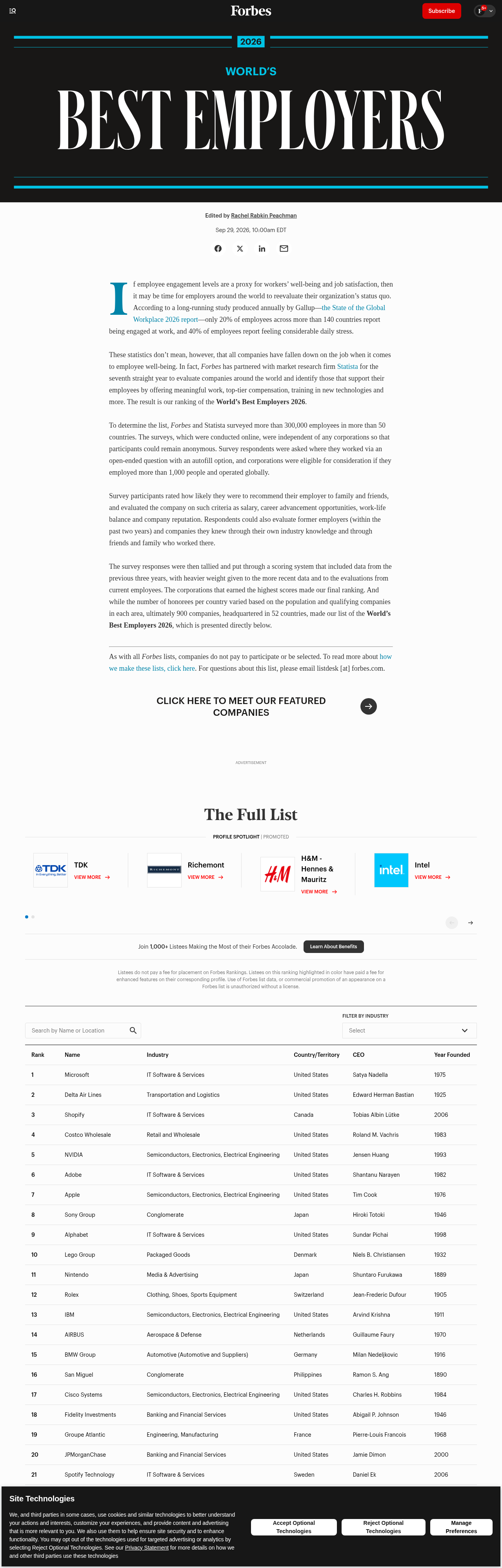
Data sources: Forbes, World’s Best Employers 2026 (published September 29, 2026, with Statista, seventh year); the historical ranking records on each company’s official Forbes profile page. The screenshot above is the list page itself.
1. What the list actually says
On September 29, 2026, Forbes published the seventh edition of its World’s Best Employers ranking. The methodology is simple: it commissioned Statista to survey more than 300,000 employees across 50 countries with anonymous questionnaires, asking “would you recommend your employer to family and friends,” combined with indicators like pay, career advancement and work-life balance, weighted with rolling data from the previous three years, to rank roughly 900 large companies from 52 countries.
The top 10: Microsoft, Delta Air Lines, Shopify, Costco, NVIDIA, Adobe, Apple, Sony, Alphabet, Lego.
The top 50 break down like this: 22 from the United States, 6 from France, 4 from Japan, 4 from Germany, 2 each from Switzerland, Sweden and Canada, and 1 each from Denmark, the United Kingdom, the Netherlands, the Philippines, Turkey, South Africa and South Korea. Not one company headquartered in China. Keep scrolling through 51–100 and it is the same: every Chinese company whose 2026 rank can be looked up on Forbes’ official profile pages sits somewhere past 200 (see the table in section 2).
2. This is not “never made it” — it is “slid out”
Chinese companies are no strangers to this list’s top 100. Quite the opposite: from 2017 through 2020, a whole row of Chinese giants stood inside it. Forbes keeps a profile page for every company it has ever ranked, and those pages record where each one landed year by year:
| Company | Historical best | 2026 rank |
|---|---|---|
| Alibaba | No. 7 (2018) | No. 210 |
| Huawei | No. 8 (2021; No. 14 in 2020) | Not on the list |
| Kweichow Moutai | No. 25 (2019; No. 45 in 2018) | Not on the list |
| PetroChina | No. 38 (2018) | Not on the list |
| China Mobile | No. 47 (2019) | Not on the list |
| Ping An | No. 48 (2020) | No. 708 |
| Sinopec | No. 85 (2018) | No. 447 |
| NetEase | No. 80 (2018; No. 97 in 2017) | No. 382 |
| PDD Holdings | No. 93 (2023) | Not on the list |
| Xiaomi | No. 142 (2024) | No. 352 |
| ByteDance | No. 295 (2024) | No. 538 |
| ICBC | No. 242 (2024) | No. 494 |
| China Construction Bank | — | No. 488 |
| Baidu | No. 433 (2024) | Not on the list |
The direction is unmistakable: over eight years, the Chinese giants collectively slid from the top 100 to positions 200–700, or fell off the list entirely. If this were cultural difference or survey bias, it would not happen to trace exactly a downward curve that starts in 2018. The questionnaire measures one thing — “would you recommend your employer” — and the answers keep getting uglier, which means the employees being asked are increasingly unwilling to lie.
3. How the donkeys get slaughtered: seven episodes from the public record
“Grind the mill, then slaughter the donkey” sounds like an emotion, but in the labor history of Chinese big tech it is a documented process. Only episodes that made it into public reporting:
1. Huawei’s “251 incident” (2019). A former employee, Li Hongyuan, negotiated with the company over year-end compensation he believed he was owed after leaving. He was then detained for 251 days on extortion charges, released for insufficient evidence, and compensated by the state. Huawei’s response was a cold statement: “We support Mr. Li in using legal means to defend his rights.” For a man who had given the company his best years, the road to claiming legally mandated compensation ran through a detention center. It remains the most extreme specimen of slaughtering the donkey — and the reason the whole internet remembers a number.
2. NetEase’s forced-removal layoff (November 2019). An employee of nearly five years was diagnosed with a serious illness, then pushed out through engineered performance reviews, given a deadline to leave, and escorted out by security. After the uproar, NetEase apologized publicly and admitted there had been “crude and heartless” handling. I once worked at NetEase as a full-time employee; the silence of former colleagues on WeChat Moments that day spoke louder than the apology.
3. The “Striver Agreement” (Huawei, widely reported around 2019). Voluntarily apply to become a “striver” — the terms include giving up statutory benefits such as paid annual leave. The donkey must sign away its right to be a donkey, so the mill can spin faster.
4. The “graduation” script (from 2022). At JD.com the layoff notice is called a “graduation notice”; Youzan handed out “graduation packages”; “sending talent back to society” became the universal translation. Layoffs are normal. Wrapping dismissal in ceremony is a second consumption of the dismissed person’s intelligence. Language here does one job: to teach the people inside the mill to accept, in advance, that they will be the donkey eventually.
5. 996.ICU (2019). Programmers launched a protest repository on GitHub naming a batch of companies — Huawei and Alibaba among them — for excessive overtime. It was the first collective bad review from Chinese internet employees, seven years before this Forbes questionnaire. The survey merely translated that review into a ranking.
6. JD.com: from “not my brother” to hunting time-card fraud (2019–2025). Liu Qiangdong said in 2019 that “anyone slacking off is not my brother.” In 2025 the group issued directives to tighten attendance enforcement and crack down on “punch-in proxies.” The shelf life of a brotherhood narrative is exactly as long as a donkey’s working life.
7. The BYD construction-site scandal in Brazil (January 2025). Brazilian labor authorities rescued 163 Chinese workers from a construction site at BYD’s Bahia factory, finding conditions “akin to slavery”: confiscated passports, excessive hours, squalid communal dorms. BYD promptly terminated the construction contractor. What makes this grave is the timing: it landed just as Chinese big tech set out en masse for overseas markets — the first time this labor culture got publicly inspected on the global employer-brand dimension. The same year, BYD’s hard demand for “10% annual price cuts” from suppliers went viral through the industry. Once the capacity round is milled, the list of donkeys turns out to include more than employees.
And one background fact everyone knows by heart: the age-35 phenomenon. Across internet and banking, employees over 35 are systematically filtered at the résumé screen; mid-career “optimization” has moved from unspoken rule to open rule. In Europe or America, running this filter on equivalent roles is lawsuit-grade age discrimination. Here it is the default checkbox on job sites.
4. Why the mill-owner logic can’t win this questionnaire
The list scores one sentence: would employees recommend their employer? That is precisely the question the Chinese big-tech management model is least built to answer:
People are a “cost,” not an “asset.” Expand with overtime in boom times, cut for efficiency on plateaus — at no stage does the donkey share the grain. Alibaba’s headcount has fallen by roughly fifty thousand in two years (per its annual reports); Tencent, ByteDance and JD have all run public layoff rounds, and every one of them is branded “organizational optimization.” What gets optimized is the organization; what pays the price is the person.
No bargaining mechanism. Employee organization with real collective-bargaining power barely exists in this system, and the cost of legal remedies is so high — the 251 incident is the price tag on asking — that an ordinary person chooses silence. Silence does not score well on questionnaires.
The dividend changed its name, not its logic. The demographic dividend is spent, so they move on to the degree dividend, the age dividend. Once “we can always hire someone cheaper and younger” becomes middle-management instinct, employee satisfaction can never become a KPI.
Industrialized euphemism. Graduation. Optimization. Delivering talent to society. Cost reduction and efficiency. Embracing change. Each translation lowers the cost of a company not telling the truth, and raises the cost of an employee trusting one. The questionnaire asks for trust; here, it runs a deficit every year.
One methodological honesty note: this is an anonymous self-report survey, scoring habits differ by country, and Chinese respondents are culturally conservative about “willingness to recommend.” But reserve that discount, and the remaining amount is still too large to explain with bias — above all because it has a direction, a slope, and a timeline that overlaps with the layoff record of Chinese big tech.
5. Closing: this list, read by an outsource worker
I have worked at NetEase and Youzan as a full-time employee, and now I work at a big tech company as an outsource contractor. Nothing about this list surprised me. Not even a little.
Because the outsource contract is the institutionalized form of slaughtering the donkey: do the longest work, take the thinnest benefits, carry the biggest blame — and when something goes wrong, you are not an employee, you are a vendor. There are two herds of donkeys in the mill: one lines up for N-plus-one severance; the other doesn’t even hold a permanent badge to the mill door.
The companies in the top 100 are not saints either — Microsoft’s employees curse their bosses too. But this questionnaire at least insists on asking a question that is rarely taken seriously on our side: after being used, how do you rate the people who used you?
Chinese companies have long front-run the revenue lists, the shipment lists, the unicorn lists. Only on the cheapest indicator of all — employees willing to recommend — have they vanished from the top 100. Revenue is what the mill produces; this list is what the donkeys score. The day mill-owners start caring about the donkeys’ reviews is the day Chinese characters reappear in this list’s top 100.
That day requires no miracle. It only requires paying statutory severance in full, tearing down the age-35 gate, retiring the word “graduation” from the PR department — and treating the donkey as a donkey, not as a consumable.
Appendix: data and sources
- List page: forbes.com/lists/worlds-best-employers/ (screenshot of the first 21 rows above; ranks 51–100 were cross-checked one by one against Forbes company profile pages — every Chinese company with a lookup-able 2026 rank sits past No. 200)
- Historical ranks: forbes.com/companies/{alibaba,huawei,xiaomi,netease,bytedance,icbc,ping-an-insurance,sinopec,pdd-holdings,baidu,china-construction-bank}/
- Methodology: Forbes × Statista, 300,000+ respondents, 50 countries, ~900 companies from 52 countries, anonymous survey
- Episode sources: Huawei 251 (2019), NetEase’s layoff apology (Nov 2019), 996.ICU (2019), JD “graduation” and attendance directives (2022/2025), Brazilian labor authority findings at BYD’s site (Jan 2025) — all public reporting from those years
评论
0 条评论