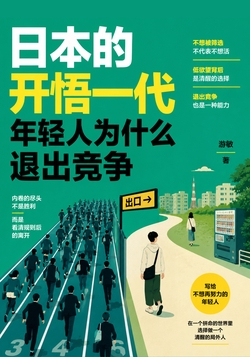
In Japan’s “Enlightened Generation”: Why Young People Opt Out of the Competition (《日本的”开悟一代”:年轻人为什么退出竞争》), You Min uses nine chapters to break down the entire process by which Japanese society went from the bursting of the bubble to the formation of a low-desire society. While reading this book, I kept drawing comparisons in my head — it’s clearly written about Japan thirty years ago, yet it reads like a prophecy about China today. The employment ice age, fresh-graduate status, the illusion of a permanent post, non-regular employment, the single-person society, the downgrading of desire, the ebbing of grand narratives, the small-ticket consumption mindset… every one of these terms lands precisely on the nerves of today’s young people.
1. After the Bubble Burst: When “Following the Steps” No Longer Leads to Good Outcomes
Japanese young people before the bubble burst, like Chinese college students before the nineties, believed in a clear upward path: graduate, join a big company, endure the overtime, training, and promotions, and you’d get a stable income, a house, and social status in return. But the moment the bubble burst, companies frantically cut campus recruitment, and the “employment ice age” arrived.
The cruelest part of the Japanese workplace is the weight of “fresh-graduate status.” Whether you can get into a good company in the year you graduate directly determines your future training, income, and social status — even your marriage and children. Miss that window, and the negative chain reaction can last ten or twenty years. This reminds me of the current job market here: if you don’t have a prestigious-school background and you’ve also lost your fresh-graduate status, finding a job is damn near impossible. Many companies’ entry-level roles now require a 985/211 degree; work that a vocational-college graduate could do ten years ago now has a threshold raised to an outrageous degree. The higher requirements aren’t because companies truly need them, but because there are too many people and the economy is declining, so they have to raise the bar to cut costs and boost efficiency.
The special harm of the bubble bursting isn’t just fewer jobs — it destroyed the belief that “as long as you follow the steps and work hard, good results are guaranteed.” The less stable the economy, the more people crave certainty, yet certainty itself is shrinking. Big companies no longer promise lifetime employment; dispatch, contract, and part-time roles keep multiplying, and government departments are also financially squeezed. Local governments used to get by on land sales, infrastructure, and tax growth; now debt and revenue pressure surge up together.
2. From Doubling Down to “Enlightenment”
Many commentators say Japanese young people “lost their fighting spirit,” but You Min points out an overlooked fact: when people first encounter uncertainty, their first reaction is usually to double down, not to give up outright. The “low desire” and “enlightenment” of Japanese young people formed only after a long process.
What keeps people going has never been grand slogans, but a path you can see and touch. As long as the stages of studying, getting a job, buying a house, marrying, having children, and retiring run roughly smoothly, individuals are willing to invest for the long term. But once every stage becomes expensive, crowded, and full of variables, that investment gradually loses its persuasive power.
The “enlightenment” here isn’t a religious awakening or seeing through the vanity of the world; it’s a rational judgment at the level of daily life: proactively lowering your goals, restraining your desires, and avoiding high-risk commitments, so you don’t get locked in by long-term debt, company pressure, and family obligations. So what Japanese young people are opting out of isn’t labor or life itself, but a life process whose cost keeps rising while its returns grow ever less stable.
3. The Illusion of the Permanent Post: Stability Isn’t an Infinitely Supplied Resource
When the economy is unstable, the two words “stability” best stir the imagination. After Japan’s bubble burst, though the lifetime-employment system wasn’t abolished immediately, companies quietly shrank their permanent posts and instead increased “non-regular employment” — part-time, dispatch, contract, and temporary workers. For companies, this lowers costs and lets them respond flexibly to the market; for young people, it means stepping into society and immediately hitting a rigidly hierarchical filtering system: a tiny few squeeze into the core, and most are blocked at the periphery.
Core posts demand loyalty, overtime, and absolute obedience; peripheral posts offer low pay and little security. Jumping from the periphery into the core costs a frighteningly high price. Everyone always thinks that grinding themselves to the bone will buy security, without noticing that the territory of security keeps shrinking. Japan also went through a frantic civil-service craze; public posts are less exposed to market shocks, carry high social status, and offer a guaranteed income rain or shine. But the public sector also has to face financial strain, changing demographics, and shifting policy winds.
Reading this, I think of how many people now feel about outsourcing versus permanent posts: doing the same work, but permanent posts gatekeep on education and age, and even an entry-level role requires a prestigious-school background. So-called “flexible employment” looks more and more like a means for companies to squeeze costs in disguise.
4. Four Escape Routes: When the Main Road Is Badly Congested
Society has an evaluation system that urges everyone to follow the steps and complete the life process. And those who “opt out” disrupt the rhythm. This shows that the “main road” society provides is already badly congested, with more and more side roads; once you take a side road, it becomes harder and harder to get back.
A healthy society does need diverse lifestyles, but if that diversity mostly comes from forced “downgrading,” then it’s a serious structural problem. The book mentions “four escape routes”; I didn’t see in my notes exactly what the four are, but I understand it points to: not marrying, not having children, not buying a house, and not participating in long-term competition. On the surface these choices are personal freedom; behind them is often a helpless rational calculation.
On this point, I wrote a rather fierce annotation in WeChat Read. Some people aren’t doing badly only now that they’ve lived to today — from the moment they were born, it was predetermined that their whole life could only be at the bottom. Li Si said, “A person’s worthiness or unworthiness is like that of a rat — it depends on where they find themselves.” How well you live is actually already determined by the ecological niche you’re born into; bluntly put, it’s class solidification. People born at the bottom can hardly cross classes no matter how hard they try; people born well have more opportunities, resources, and choices — the opportunities an ordinary person can’t get in a lifetime, they might toss aside casually. The more resources you have, the more people want to cooperate with you; the fewer resources you have, the more easily you’re bullied and put through compliance tests, able only to sell your body and so-called dignity and loyalty in exchange for a few scraps of resources. Don’t think that buying a house in a big city and getting a household registration makes you better than others — eight or ten thousand in debt every month, and once you lose your job you’ll know what’s what. At 35, it’s your life on the line. What’s meant to be yours will be yours in the end; what isn’t meant to be yours, don’t force it.
5. The Single-Person Society: The Market Replaces Human Relationships
The extreme convenience of Japanese cities has greatly lowered the hidden cost of living alone. Ticket machines, mobile payment, convenience stores, food delivery, instant retail — as long as money covers the basic expenses, a person doesn’t have to explain themselves to anyone, nor force themselves into complicated human relationships.
But eating alone and going to the movies alone doesn’t mean a person truly enjoys solitude. Very likely they just don’t want to spend money on socializing, don’t want to deal with the give-and-take of relationships, or simply can’t carve out stable time to accommodate other people’s rhythms. When young people discover they can buy basic convenience from the market, their obedience to family arrangements drops straight down.
The problem is that the market can only replace part of human relationships. It can provide meals, entertainment, cleaning, delivery, and brief companionship, but it can hardly provide stable responsibility. The more a person depends on the market, the more they need continuous paying ability; once their earning power declines, their quality of life collapses quickly. After escaping family pressure, real-world problems don’t automatically disappear.
Under the line “live for yourself,” I annotated four characters. Not that I agree with complete atomization, but as an acknowledgment: when the traditional family script leaves you breathless, choosing to live alone is sometimes a necessary act of self-protection.
6. The Burden of the Family: East Asian Society’s Cure-All Has Stopped Working
East Asian society has a glaring feature: the family has taken on too much of the responsibility that public institutions, companies, and communities should share. Housing is the most glaring example — it isn’t just a place to live; it’s tightly bound up with marriage eligibility, family dignity, and asset allocation. For young people with average incomes, whether you have a house directly determines whether you dare to marry, dare to have children, or even dare to quit and change jobs.
The family is both a haven and a source of pressure. Parents can help you scrape together a down payment, look after the kids, and provide a place to stay, but what comes with it is pressure to marry, interference in career choices, comparisons of income, and a heavy sense of indebtedness. So many people choose not to marry, not to have children, and not to buy a house — not because they want to break with the family, but because they want to be bound as little as possible to this family system.
For a long time, East Asian society has been used to treating the family as a cure-all: if a young person loses their job, they move back home; if there’s no one to look after the kids, they turn to the grandparents; if the grandparents get sick, the children step up; if educational competition is fierce, the whole family pours in money. This logic worked in the era of economic takeoff, because everyone believed the next generation would live better. But in an era of low growth, the family still carries the responsibility, yet sees no future compensation, so young people naturally no longer want to burrow into this responsibility system.
Low birth rates, late marriage, living alone, and low desire have never been isolated phenomena. They all point to a single core: the family system is already overburdened. If society dumps responsibility onto the family on one hand while blaming young people for not wanting to marry and have children on the other, it will only fall into an unsolvable dead loop.
7. The Downgrading of Desire: A Survival Strategy in a Low-Return Environment
When the “enlightened generation” became popular in Japan, it carried a somewhat counterintuitive flavor. In the traditional view, young people are supposed to be the main force of consumption — keen on romance, travel, cars, brand names, and housing, and craving career success. Yet a batch of Japanese young people went the opposite way: extremely low material desire, very little socializing, no interest in marriage and romance, work goals set very low, and preferring to stay home on their days off.
This “enlightenment” isn’t about grasping profound wisdom or cutting off the seven emotions and six desires; it’s a survival strategy evolved in a low-return environment. Since big-ticket consumption becomes a heavy burden, long-term commitments bring unknown risks, and complicated relationships drain too much money and energy, you might as well lower your expectations and hold only onto the small certainties of happiness you can control.
Once opportunities for promotion and raises grow scarce, the cost-effectiveness of socializing looks extremely low: you have to pay money, give up your rest time, and force yourself to keep up the courtesies, yet in the end you may not get any real benefit in return. Digital entertainment offers a cheaper substitute: scrolling videos, reading comics, playing games, social media, live streams, virtual idols, anime and manga culture — for very little money you can get continuous sensory stimulation. Though it can’t replace a full life, it’s enough to fill fragmented time.
The days their parents’ generation bought through frantic overtime and mortgages aren’t necessarily comfortable; marriage and children mean shouldering a burden for decades; loyalty to a company doesn’t necessarily buy protection; consumption upgrades may in the end be nothing but stack after stack of new bills. So young people no longer treat traditional success standards as life’s default, but begin to ask: Do I really need this? Can I afford it? Is it actually worth it?
Eating a bowl of beef rice alone, living in a small single room, wearing basics, and playing games on the weekend — in their eyes this doesn’t mean failure. When income is limited, low desire can keep life stable and keep it from being dragged under by overconsumption; more importantly, it brings a more clear-headed attitude toward life — no longer taking on unnecessary expenses just to conform to society’s gaze.
But low desire also has a cost. Beside the line “cut consumption, postpone marriage and children, give up career ambition,” I annotated “so it’s pay cuts and layoffs, then.” When large numbers of young people all make this choice, corporate growth, local tax revenue, the pension system, and demographics all take a hit. Once individual rational choices are scaled up to the group level, they reshape the entire economic landscape.
A more hidden cost is the contraction of personal ability. If low desire merely trims ineffective consumption, that’s self-protection; but if it turns into long-term avoidance of socializing, refusal of training, and shirking of responsibility, the road ahead will only get narrower. So “enlightenment” isn’t always freedom — sometimes it’s clarity, sometimes helplessness, and sometimes just self-consolation.
8. The Ebbing of Grand Narratives: From Common Goals to Personal Calculation
The stage of rapid development is the most fertile ground for “grand narratives”: society uses a set of magnificent common goals to explain and rationalize personal sacrifice. For the sake of the nation catching up, economic takeoff, a family’s turnaround, and a better next generation, individuals can endure high-intensity labor, meager benefits, crowded housing, and long-term competition.
This logic had a real foundation in postwar Japan. The country recovered from ruins, manufacturing expanded, urbanization advanced, exports grew, and household income rose steadily. The link between personal effort and national development was visible to the naked eye: if the company did well, wages rose; if tax revenue was high, public services improved; if you saved, you could trade up to a bigger house and fund your children’s education; the next generation really did have more opportunities.
But the problem emerged after success, after stagnation. When a country enters a wealthy stage, young people can hardly be moved by “catch-up” narratives anymore. What they see is the internal inequity of distribution, the scarcity of opportunity, and the heavy pressure of life within a mature society. The country as a whole is respectable, but individuals’ daily lives aren’t necessarily easy. If national success can’t translate into a tangible sense of security for the individual, grand goals lose their persuasive power in daily life.
In the “grand narratives” section I annotated: I deeply dislike grand narratives, and what they narrate is mostly irrelevant to ordinary people. When the economy lacks labor, young people are told to work desperately; when consumption is weak, they’re encouraged to spend; when the birth rate drops, marriage and children are expected of them; when aging worsens, young people are made to shoulder an even heavier support burden and taxes. In young people’s eyes, they are always taking on responsibility, yet rarely the object the system prioritizes caring for and protecting.
When grand narratives ebb, the old responsibilities still weigh on their shoulders, yet a new sense of meaning is slow to be established. Companies still demand full commitment, families still expect you to settle down and build a career, the state still needs tax revenue and population, and the market still craves consumption. The only difference is that young people no longer readily accept the moral packaging of these demands; they’ve begun to calculate one by one: Is this job worth it, is this house worth it, is marriage and children worth it, is socializing worth it.
This careful calculation is often accused of being utilitarian, but in an environment full of variables, calculation is actually self-protection. People in the past dared to talk about ideals because they believed there’d be a long-term return; now that long-term gains can’t be seen or touched, everyone naturally turns to short-term, controllable benefits.
Public opinion also always likes to package young people’s hardships as striving: living alone is called independence, drifting is romanticized as chasing dreams, overtime becomes passion, and postponing marriage and children becomes pursuing self-fulfillment. Japan’s lesson tells us that, compared with open rebellion, young people lean toward “silent exit” — not taking to the streets, not proposing grand plans, just quietly reducing participation. They stop going to company dinners, stop dating, stop buying houses, stop having children, don’t even want to go out on holidays, and buy only the cheapest things. On the surface all is calm, yet every indicator quietly deteriorates.
The ebbing of grand narratives also affects political attitudes. If young people feel that no matter who’s in charge, their wages, housing, and family pressure don’t change, they can’t be bothered to participate in politics. Japan has long had an extremely low youth voter turnout, giving elderly voters too much say, so policy naturally tilts toward pensions, healthcare, and asset protection. The less young people participate, the harder their demands are to get on the agenda — a dead loop.
In the “public-opinion packaging” paragraph I also wrote a workplace annotation: separation of tasks — don’t let others steer you. If your ideas differ from someone else’s, they’ll say your thinking is rigid. In reality they just didn’t get an advantage out of you, but the other person outranks you, so they think they can PUA you. This is probably also a variant of the grand narrative in the micro-workplace — using more noble-sounding rhetoric to make you accept an unequal exchange.
9. The Small-Ticket Consumption Mindset: Instant Experience Replaces Future Commitment
Houses, cars, lavish weddings, and full sets of home appliances are gradually losing their appeal, replaced by convenience stores, games, video sites, virtual idols, blind boxes, membership subscriptions, food delivery, instant retail, and all kinds of lightweight social services. What these consumption forms have in common is: the amount per transaction isn’t high, the decision threshold is extremely low, you can start anytime, and you can stop anytime.
In the past the market organized consumption around the family and big-ticket goods; now it runs around personal time and attention. Young people have reduced long-term debt but increased high-frequency small payments; they’ve distanced themselves from real-world relationships but deepened digital connections; they’ve given up grand goals but rely more on short-cycle satisfaction.
Digital content, virtual idols, and AI companions are ultimately not real people, but they can provide stable responses, low-conflict interaction, and a completely controllable space for the imagination. The root of the problem isn’t games or short videos themselves, but that when real life becomes dim in its goals, the feedback of the digital world looks extremely competitive.
The market keenly captures this “affordability.” Big-ticket consumption requires confidence in the future; small-ticket consumption only requires a glance at your current balance. A high-growth society sells people the future; a low-growth society’s commerce turns to selling instant experience. It lowers the threshold of life, yet it may also empty your savings without you noticing. Each transaction looks small, but added together it’s a lot; the deeper impact is that it easily creates “bearable stagnation” — low risk, low accumulation, low connection.
The boom in small-ticket consumption can’t mask the underlying predicament. Platform bills looking good doesn’t mean young people’s lives are secure; online entertainment being red-hot doesn’t mean social bonds are healthy. Japan’s lesson tells us the market can always burrow precisely into the gaps in the human heart. After a person exits workplace competition, says goodbye to the traditional family, and gives up big-ticket consumption, they still need to eat, to pass the time, to have companionship, and to find meaning.
10. Looking for Room: Structural Problems Can’t All Be Pushed Onto Individuals
When it comes to young people’s “exit,” public opinion always likes to go to extremes: either accusing them of not being able to take hardship and lacking responsibility, or over-romanticizing them as clear-headed and absolutely free. You Min’s position is more sober: young people’s choice to opt out carries both helplessness and reasonableness, and also hides a heavy cost; it’s both a silent rebellion against unfair exchange, and something that may lead to a comprehensive contraction of personal ability, social relationships, and society’s capacity for reproduction.
The first warning Japan’s experience gives us: never push structural problems entirely onto individuals. A person should indeed work hard and pay for their own choices, but the job market, housing prices, educational rat-races, aging, and public welfare — these larger environments absolutely can’t be changed by fighting alone. If society urges people to strive, consume, marry, and have children on one hand, while providing no support on the other, in the end you’ll only see more and more people choosing “low participation” and lying flat completely.
To reawaken a sense of participation, a credible exchange mechanism must be established: working desperately can buy income growth, skill improvement, and dignity as a person; starting a family won’t be crushed by housing, childcare, schooling, and eldercare; when you spend money, future income and security can back it up; and when you take on social responsibility, public institutions can also offer protection.
Employment is the starting point. To weaken the influence of “your graduation determines your whole life,” give more opportunities for career change and retraining, and don’t let a gap in your resume become an indelible stain. Non-regular employment can exist, but it mustn’t turn into a trap of long-term over-extraction with no security whatsoever. Part-time, dispatch, and contract workers should all have basic benefits, promotion paths, and an income floor.
Working hours also matter. Young people don’t necessarily not want to work; they just don’t want to sell their whole life to a company. If endless overtime can only buy a barely-subsistence wage, then marriage, children, and socializing naturally get squeezed out of sight. Shortening meaningless overtime, improving efficiency, and guaranteeing rest not only protect workers, but also give everyone time to date, care for family, study and recharge, and participate in the community.
Housing policy is unavoidable. When a house becomes a hard threshold for marriage, children, and a sense of security, young people are forced to shoulder heavy long-term debt. A stable rental market, reasonable commuting distances, ample public housing, equal rights for renters and buyers, and curbs on speculative property flipping can all effectively lower life’s risks.
Conclusion: Renegotiating the Life Contract in an Era of Low Growth
After finishing this book, my deepest feeling is: the “enlightenment” of Japanese young people is essentially a renegotiation of the life contract in an era of low growth. When the high returns promised by the old contract can’t be delivered, they choose to use low desire, low participation, and low commitment to reduce the risk of default.
This choice is hardly blameworthy — it can even be called rational. But it shouldn’t be romanticized, and even less should it be stigmatized. What truly needs reflection is the old contract itself — it demands that young people keep paying out loyalty, labor, consumption, and childbearing, yet increasingly fails to provide the corresponding stability, dignity, and hope.
China’s current situation has far too many similarities with Japan back then: a shrinking job market, credential inflation, age discrimination, sky-high housing prices, soaring costs of marriage and childbearing, and a disconnect between grand narratives and individual reality. But we won’t necessarily replicate Japan’s path completely. The difference is that Japan “got rich before it got old,” while we are “getting old before getting rich”; Japan had relatively complete infrastructure and social security, whereas our young people may face a steeper downhill slope.
Either way, “enlightenment” shouldn’t become an excuse for society to evade responsibility. When young people vote with their silence, what truly deserves a response isn’t “why don’t you work harder,” but “what kind of exchange terms can we offer.” Otherwise, the low-desire society won’t be just Japan’s story — it will become the reality of our generation too.
评论
0 条评论