“When I graduated, my homeroom teacher sent me to intern at a JAC dealership plant owned by a friend of the vice principal. Every day my job was hauling light-truck spare parts — pure manual labor, for less than 1,000 yuan a month.”
That experience from over ten years ago, seen from today, is virtually a perfect specimen of an illegal internship — mismatched major, pay below the floor, bundled by personal favors, forced assignment. It’s just that back then we were all too young to see how the profit chain ran, and powerless to resist.
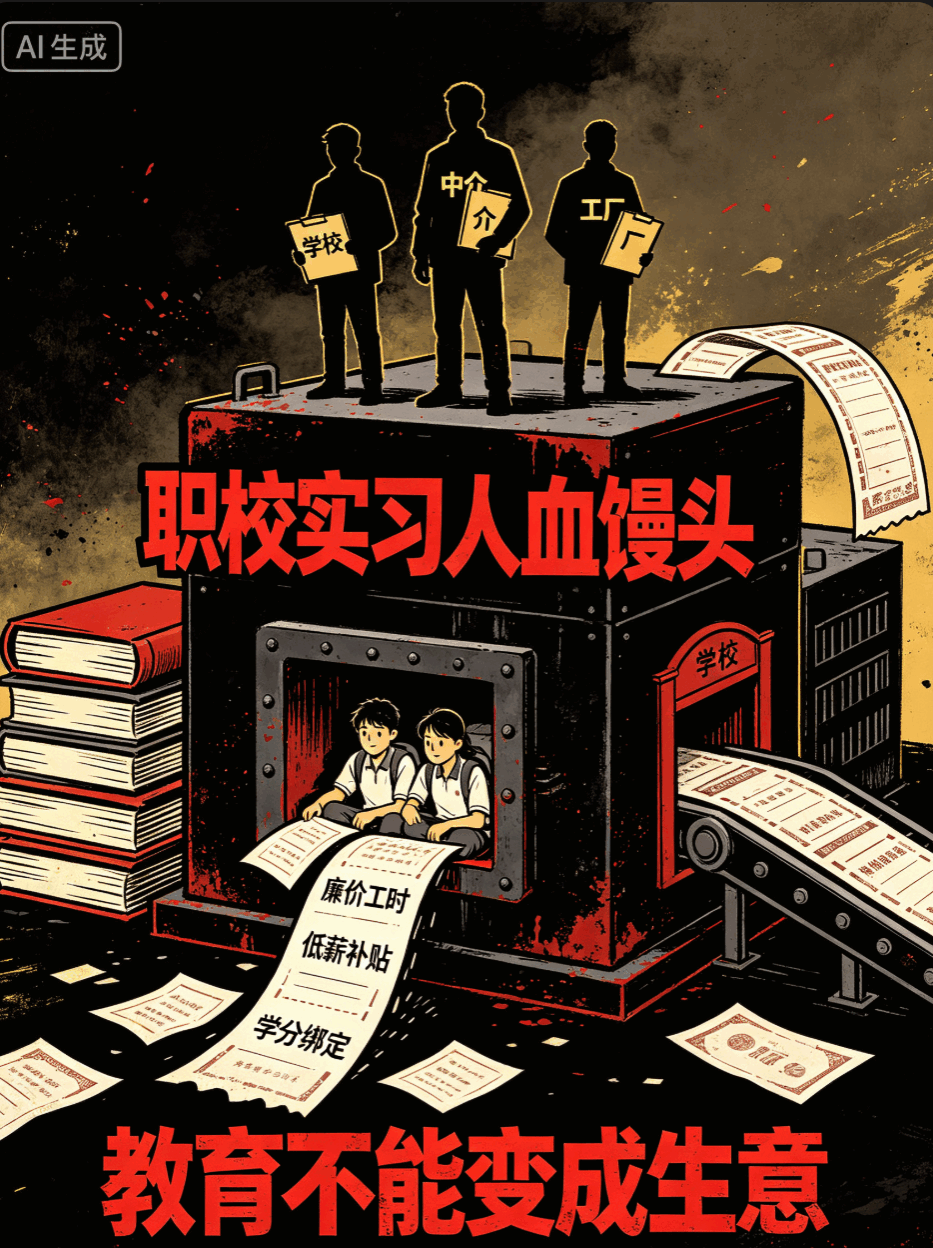
Looking back now, that technical school was nothing more than a labor brokerage dressed in educational clothing. Many vocational schools today still run the same script; they’ve merely moved the stage from the auto-parts warehouse to the electronics-factory assembly line. The only difference: back then I was sold once through “personal favors”; today’s students are resold in bulk by an entire industry chain.
1. At Least Four Red Lines Were Crossed in This Affair
1. The major didn’t match at all — it wasn’t even “adjacent”
I was hauling light-truck spare parts in a JAC dealership’s warehouse; every day’s work was moving goods, stacking goods, clearing inventory. This wasn’t “skills practice” — it was pure manual labor.
Article 7 of the Regulations on the Management of Vocational School Student Internships, jointly issued in 2021 by the Ministry of Education and seven other departments (Jiao Zhi Cheng [2021] No. 4), states clearly: “Internship positions should meet the requirements of the training objectives and match or be close to the student’s major. In principle, internships must not be arranged across major categories.” Article 50 of the newly revised Vocational Education Law of 2022 further emphasizes: “Negotiate with the internship host to arrange positions matching the student’s major; students must not be assigned to internship training unrelated to their field of study.”
Unless my major was “logistics hauling” or “warehouse management,” assigning me to haul auto parts was illegal from the root. And the Regulations contain another clause aimed exactly at this situation: students must not be assigned only to simple repetitive labor. Hauling spare parts doesn’t even qualify as “low technical content” — it’s repetitive manual work.
2. Absurdly low pay — the middle spread was skimmed away
Over ten years ago, even in a second- or third-tier city, a porter’s normal monthly wage should have been around 1,500-2,000 yuan. I took home less than 1,000. Where did the difference go?
Article 17 of the Regulations is explicit: “Internship hosts receiving students for position internships should refer to their own pay standards for the same position, along with the interns’ workload, work intensity, working hours, and other factors, and provide appropriate internship compensation. For students who participate in actual work relatively independently at the internship position and preliminarily possess the ability to work independently in a practical position, the compensation should in principle be no less than 80% of the probation-period wage standard for the same position at the host.” I did a full-time worker’s job and was paid less than half of a regular worker’s wage.
What’s worse was that “friend of the vice principal” relationship — the plant’s normal hourly fees to the labor provider, passed through the vice principal’s connection, were skimmed layer by layer by middlemen, the school, and the homeroom teacher, until what landed in my hand was that pitiful living allowance. This kind of operation is explicitly defined in the 2021 Regulations as “strictly prohibited: organizing internships illegally for profit” — the top ban among the 1 “strict prohibition” and 27 “must nots.”
3. Forced assignment bundled with personal favors — I had no right to choose
The homeroom teacher notifying me to intern at the vice principal’s connected plant was not a “recommendation” — it was coercion in disguise.
Article 9 of the Regulations is explicit: “When vocational schools arrange position internships, they must obtain an informed-consent form signed by the student and their legal guardian (or parent). If the student and their legal guardian (or parent) clearly disagree with the school’s internship arrangement, they may choose a qualifying internship host on their own.” In other words, students have the right to apply for self-arranged internships; the school cannot force unified assignment to some privately connected enterprise.
But the reality back then was — the homeroom teacher would never tell me “you can choose”; he would only say “don’t go and you won’t get your diploma.” Using the diploma as a bargaining chip to intimidate students into compliance was the most common tactic in those years’ vocational-school internship chaos. Article 66 of the newly revised Vocational Education Law of 2022 specifically prescribes penalties for this behavior: where a vocational school organizes internships through illegal channels, the education administration shall order corrections, confiscate illegal gains, and impose a fine of one to five times the illegal gains.
4. No labor protection for high-intensity manual work
Long-term hauling of auto parts is heavy manual labor — no accident insurance, no overtime pay, no work-injury protection. Article 16 of the Regulations explicitly requires: “Students must not be assigned to physical labor of Grade III intensity or above, or to other internships harmful to physical or mental health.” Looking back now: a seventeen- or eighteen-year-old student hauling tens to hundreds of jin of truck parts every day — if something had gone wrong, who would have been responsible?
2. The Curriculum Itself Was Expired Merchandise
The problem wasn’t just the internship. The deeper issue: what the school taught was obsolete the moment you walked out the door.
My major was secretarial studies. Of the meeting minutes, handwritten shorthand, official-document typesetting, and archive organization taught in class back then, which one hasn’t since been replaced by software? Feishu and DingTalk’s online meetings come with built-in recording and speaker identification; AI can generate a complete minutes document in seconds. Shorthand — that “chicken-scratch” craft — has practically entered the museum. Archive management was long ago taken over by electronic systems.
A secretarial-studies associate-degree student graduates to discover that the core skills he learned can be done on the market by a free or few-dozen-yuan SaaS subscription. This isn’t students not trying — it’s the curriculum itself stranded in the previous era.
Article 3 of the newly revised Vocational Education Law of 2022 states: “Vocational education is an educational type of equal importance to general education; it is an important component of the national education system and human-resource development, bearing the important duties of cultivating diverse talents, passing on technical skills, and promoting employment and entrepreneurship.” Article 51 also requires vocational schools to promptly update majors, courses, and textbooks in line with industrial development and technological change.
But when a school is still teaching students skills already replaced by software, what it cultivates is not “diverse talents” but idle population behind the assembly line. Graduate and be unemployed on the spot; tuition and living expenses paid, time burned, only to find the diploma and the skills can’t be exchanged for a matching job.
This further shows: that technical school didn’t care whether I could find employment — it cared whether I could pay tuition on time, whether I could be smoothly shipped out to intern, whether I could help the school make its numbers look pretty. Whether my major had market value ranked dead last.
3. This Is No Isolated Case — It’s Standard Operation on the Industry Chain
My experience is not unique. In recent years, similar incidents have been exposed one after another, some far more tragic than mine.
1. The students who never walked off the assembly line alive
A 17-year-old vocational student in Shandong was uniformly assigned by his school to intern on an unrelated factory’s assembly line, working 12 hours a day. He fell ill and asked for leave; it was refused. He ultimately died an unnatural death. Examining the internship agreement afterward, it listed only base pay — overtime pay, working-hour caps, and safety guarantees were all left unclear.
A nursing-major student in Yunnan was sent by her school to a factory internship in another province, completely mismatched to her major. She developed a fever on the job and asked for leave to no avail; delayed treatment led to respiratory failure and her death.
And there are more students who never made the news: hundreds forced collectively into factories, with credits withheld and diplomas denied for noncompliance; standing on the job for over ten hours a day for meager pay; majors in nursing, preschool education, or auto repair, stuffed into electronics plants to drive screws. Their “practical training” has nothing whatsoever to do with vocational education.
2. The complete profit chain of school-enterprise middlemen
Some vocational schools, labor agencies, and factories have formed a three-way profit closed loop:
- Factories: obtain large batches of obedient, low-cost labor cheaply, skipping social insurance, full overtime pay, and formal employment management costs;
- Labor agencies: broker between schools and enterprises, earning per-head commissions and price spreads;
- Schools: hit their “employment rate” and “internship rate” targets while skimming directly off students’ wages.
The arithmetic exposed online goes like this: the enterprise pays the labor agency 25 yuan/hour, the agency pays the school 22, and only 15 finally reaches the student’s hand. With three hundred students, 10 hours a day, 26 days a month, the school alone pockets hundreds of thousands of yuan in commission every month from this one item. And this money never appears on any public financial ledger.
Meanwhile, the school can also wield its pretty “internship rate” data to win fiscal appropriations and recruit students. The students pay with their labor and health and receive only an “internship certificate” stamped under coercion.
3. Why does the school dare do this?
Because students are too easy to squeeze.
Seventeen or eighteen, fresh out of the school gate, ignorant of labor law, ignorant of Ministry of Education documents, with parents mostly thinking “just endure a few months and get the certificate.” The school holds two hard cards: the diploma, and information asymmetry. As long as I still want to graduate, as long as I don’t know I can arrange my own internship, as long as my parents don’t make a fuss, this business can keep running forever.
4. The Three Institutional Loopholes Letting the Chaos Persist
These illegal internships could become a stable business thanks to three institutional gaps.
1. Internship agreements substitute for labor contracts; students lack full protection under the Labor Law
Internships are usually classified in law as civil service relationships, not employment relationships. This means enterprises need not pay the “five insurances and one fund,” and minimum wage, overtime pay, and work-injury compensation carry no mandatory force. When students seek redress, evidence is hard to collect and procedures are cumbersome — much of the time they can only swallow their losses.
2. Internships forcibly bound to diplomas
The school controls the power of graduation assessment, and “no internship, no diploma” becomes the most effective deterrent. Fearing they won’t get the certificate, most students are forced to comply, not daring to report or resist. The diploma, which should certify learning outcomes, here becomes the shackle binding students.
3. Deliberately raised barriers to self-arranged internships
Some schools nominally allow self-arranged internships but in practice impose complex stamping, approval, and follow-up-visit processes — even requiring parents to appear in person and employers to issue all sorts of certificates — effectively blocking students’ channels for finding matching internships on their own. In the end, the vast majority of students can only “voluntarily” submit to the school’s unified assignment.
5. Today, the Tools and Channels for Defending Rights Have Matured
If my experience happened today, the path would be far clearer than it was over ten years ago.
Step one: refuse forced assignment and submit a self-arranged internship application. Under Article 9 of the Regulations, students have the right to choose a qualifying internship host themselves, and the school has no right to obstruct. If the school threatens “no internship, no diploma,” that is a clear violation.
Step two: preserve all evidence. Pay slips, work photos, attendance records, chat logs or recordings of the homeroom teacher notifying you to intern. These materials are the core evidence for subsequent complaints.
Step three: complain and report through multiple channels.
- Complain to the vocational-and-adult-education section of the local education bureau (the supervising department for schools’ illegal internship arrangements)
- Call the 12345 government services hotline for referral to the education bureau
- Report to the labor security inspection agency (for the internship host’s infringement of labor rights)
- Raise the issue through the Ministry of Education’s website or hotline
Step four: demand that the school re-arrange a compliant internship and make up the wage difference. Under Article 46 of the Regulations, for schools that organize internships in violation of the rules, the supervising department shall order corrections; those that refuse to correct or cause serious consequences shall be punished, along with responsible persons, according to law.
Article 66 of the new 2022 Vocational Education Law adds a heavyweight penalty: where vocational schools arrange student internships through human-resources service agencies or labor-dispatch units, illegal gains shall be confiscated and fined at one to five times the illegal gains; where illegal gains are less than 10,000 yuan, they shall be calculated as 10,000 yuan. This means that once skimming is verified, the school faces not just administrative discipline but real monetary fines.
6. Looking Back: The School Had Long Ceased to Be a Place of Teaching
I was young back then; facing the homeroom teacher’s “arrangement” and the diploma threat, I could only passively accept it. Hauling those heavy truck parts every day, calluses ground into my hands, collecting less than 1,000 yuan at month’s end — aggrieved inside, with nowhere to seek reason.
Looking back now, it was no “school-enterprise cooperation” and no “on-post internship” at all — it was a profit chain funneling vocational students as cheap labor. The vice principal used school resources to solve his friend’s labor problem; the homeroom teacher met the school’s internship quota; the factory got labor half the price of regular workers. And my internship — which should have been spent learning skills — became unpaid drudgery.
This kind of school-enterprise cooperation, using personal connections to treat students as “money trees,” long ago strayed from vocational education’s original purpose of cultivating skilled talent.
More ironically, such schools keep a whole set of people fed: the vice principal eats kickbacks through personal favors, labor agencies get rich on per-head fees, and the surrounding restaurants, supermarkets, and copy shops live off student spending. From enrollment to graduation, one child feeds the teachers, feeds the professors, feeds the shops around the school — but is the one person it can’t feed: himself.
This isn’t education; it’s a business. Students are raw materials, internship hosts are downstream factories, the diploma is an IOU holding payment hostage, and the education bureau’s appropriations and enrollment quotas are numbers on the profit statement. The original intent of teaching and nurturing people was long ago crushed beneath this precise machinery of interest calculation.
Fortunately, in recent years the state has been seriously rectifying this — from the 2021 Regulations on the Management of Vocational School Student Internships (1 strict prohibition, 27 must-nots), to the newly revised 2022 Vocational Education Law dedicating a chapter to internship rights, to local education departments’ special investigations and “double-random, one-public” spot checks — this gray profit chain is being severed link by link.
But the law is only the floor. What truly must change is the school-running mindset that treats students as resources. Vocational education should be rooted in cultivating virtue and people — not in turning the next generation into the cheapest, most easily replaced parts on the assembly line.
My experience is not an isolated case but the shared memory of that generation of vocational students. Speaking it out lets students still living through the same thing know: this is not a “normal arrangement” — it’s a violation; we don’t have to swallow it in silence — we have the right to say “no.”
7. Credentials Are Depreciating: Running the Education Numbers Again
Mine was a technical school, but zoom out a bit and you’ll find the cost-effectiveness of the entire education chain is sliding downward. It’s not that studying is useless — it’s that the piece of paper called a diploma is worth less and less.
1. How much does it actually cost to put a child through school?
Running a basic account for an ordinary domestic city on the ordinary public-school route:
- 3 years of kindergarten: public kindergarten tuition plus meals runs just over 4,000 yuan a semester — looks cheap. But my son is now 5, in the middle class, and with enrichment classes like painting, basketball, Lego, and roller-skating at about 100 yuan each, twice a week is 800 yuan, and 52 weeks a year is over 40,000; add materials fees, activity fees, and sundries, and one semester comes to 20,000 all told — 40,000 a year. Private kindergartens aren’t an option for ordinary people, so they don’t even enter the calculation. Over 3 years: 120,000;
- 6 years of primary school: tutoring materials, uniforms, after-school care, enrichment classes, meals and commuting — about 10,000 a year, roughly 60,000;
- 3 years of middle school: extra tutoring, evening study, materials, living expenses — about 12,000 a year, roughly 36,000;
- 3 years of high school: tuition, tutoring, boarding, living expenses — about 20,000 a year, roughly 60,000;
- 4 years of university: public undergraduate tuition 5,000/year, housing 1,200/year, living expenses 1,500/month — about 21,000 a year, roughly 85,000 over 4 years.
On the public route, the baseline investment starts at 360,000. And that excludes school-choice fees, expensive cram schools, arts-track exams, renting apartments to accompany studying, going abroad, and major illness or accidents. On the private or hyper-competitive premium route, 800,000 is only the starting point, and pushing past 1.2 million is nothing unusual.
2. After all that investment, how much comes back?
Take an ordinary undergraduate as an example: fresh-graduate monthly salary of 4,500 yuan, 4,000 take-home after social insurance — 48,000 take-home a year. The first 10 years rise slowly to an average of 6,000 a month, 72,000 take-home a year; only around the 15-year mark does it touch 12,000 a month, 144,000 take-home a year. If you’re “optimized” out at 35, a stable job spans just 13 years.
The first 10 years total about 720,000; the last 3 about 360,000 — 13 years of work, 1.08 million total take-home.
Sounds like a lot, but subtract the 360,000 spent on education, then subtract post-adulthood rent/mortgage, food, socializing, retirement savings, medical care, and future child-rearing — daily consumption eats over 60% of income, and what can truly be saved is very little.
3. Slow payback, low ceiling, early age-based elimination
Just to earn back the 360,000 spent on schooling takes over 5 years without eating or drinking; if unemployment, pay cuts, or illness strike along the way, the payback period stretches to over a decade. And for most ordinary clerical, operations, and basic technical roles, monthly pay struggles to stably break 15,000.
My wife and my brother-in-law are both undergraduate graduates; more than a decade on, their monthly pay still hasn’t broken 20,000. The era of riding school and credentials to high pay is long gone.
The online stories of people earning hundreds of thousands or millions a year usually rest on a stack of top-tier universities, hot majors, and first-tier-city resources — utterly out of reach for most ordinary people, rare as phoenix feathers. Ordinary people getting an ordinary bachelor’s degree and earning ten or twenty thousand a month a dozen years later — that’s the norm.
Even crueler is age-based elimination. Companies generally have a 35-year-old threshold: for the same role, younger people cost less and handle overtime without strain, while middle-aged workers are optimized first. An ordinary person’s golden earning window is only 22 to 35 — a short 13 years — during which they must also carry a mortgage, marry, and raise kids, leaving no way to accumulate a buffer against mid-life unemployment.
Add credential inflation on top. Associate degrees already struggle to land decent jobs; now bachelors are everywhere and master’s programs expand enrollment year by year — the same investment buys less value each year.
4. If the returns are known to be low, why keep studying?
It’s not that studying is useless — it’s that not studying narrows the road further.
Without university, most can only enter factories or basic service industries at 3,000-4,000 a month, with virtually no path to raises. Civil-service exams, public institutions, state-owned enterprises, and medium-to-large companies all gate at the bachelor’s threshold; without the credential, you don’t even qualify to submit a résumé. Education is no longer an “investment” — it’s more like a basic survival ticket: spending hundreds of thousands to buy an entry pass to workplace competition, guaranteeing neither high pay nor stability, only ensuring you’re not left with absolutely nowhere to go.
5. Returns are Extremely Polarized
- Computer science, medicine, electric power, the state system: strong long-term stability; the return on educational investment is decent;
- Humanities, general business, ordinary management roles: high investment, low starting pay, high mid-life layoff risk — the return rate is visibly sliding.
My technical school back then sent me into a warehouse to haul auto parts — a microcosm of many vocational students; and those classmates who took the undergraduate route are now in office buildings doing basic roles that could be optimized away at any time. Low-end vocational education has degenerated into a channel for supplying cheap labor, while ordinary bachelor’s degrees face credential depreciation and mid-life unemployment — the cost of the entire education chain keeps rising while the long-term returns available to ordinary people keep shrinking. This is probably also one of the core roots of why many young people lie flat, resist childbearing, and reject the rat race.
6. In the AI Era, What Is Truly Useful?
I don’t deny that studying is useful, nor that credentials still hold threshold value. But it must be admitted: the act of going to university itself is becoming more and more useless. Much of the knowledge taught in class is obsolete at graduation; many of the skills jobs require are learned more efficiently through self-study and online resources than in the classroom.
In the AI era, what’s truly scarce isn’t a piece of paper but the ability to learn autonomously — judging whether information is true or false, continuously updating knowledge, and rapidly converting what you learn into problem-solving ability. School can’t give you these; it can only hand you a ticket. How you walk after entering the gate is up to you.
One child feeds the teachers, feeds the professors, feeds the shops around the school — but is the one person it can’t feed: himself. This isn’t the tragedy of the school; it’s the inevitable result of education being alienated by business.
评论
0 条评论