In the age of the time clock (Stechuhr), working time and rest time were at least clearly separated. Today the workshop and the living room have merged into one. Working anywhere, anytime has become possible. The laptop and the smartphone have built a mobile labor camp.
With the absolutization of working time, sacred time has all but vanished. Even the pauses within work are tense. The purpose of rest is to let us recover from fatigue so that we can go on working normally.
We now live in a post-Marxist era. Under the neoliberal regime, exploitation no longer takes the form of alienation and de-realization; it has become freedom and self-realization (Sich-Verwirklichung). There is no other here acting as exploiter; instead, the self willingly over-exploits itself, on the basis of a belief in perfecting itself. The individual realizes itself all the way to death. Self-optimization leads to death. In this context, resistance, uprising and revolution are no longer possible.
The capitalist economic system absolutizes survival. People live in an illusion: that more capital can create a longer life. Life and death are separated strictly and rigidly, and life is thereby cast under a shadow of terror and rigidity. In order to survive, people develop a hysteria, and no longer care about how to live better.
When there are no other possibilities left in politics, it approaches dictatorship — the sole rule of capital. Today politicians are degraded into puppets of the system, at best gifted stewards or bookkeepers; they are no longer Aristotelian statesmen.
Children turn everything they can touch into toys, including the things we usually regard seriously — things belonging to the realms of economy, war, law. A car, a pistol, a legal contract all become toys in an instant.
Today everything submits to capital. The value of life means the total value a person can generate as a customer, since every moment of life has been commodified. Human worth is reduced to customer value or market value. A complete life is converted into pure commercial interest.
We fill the world with ever cheaper fast-consumption goods, and the world suffocates among the commodities. This department store differs in no essential way from a madhouse. It looks as though we possess everything, yet we have lost the most fundamental thing of all: the world.
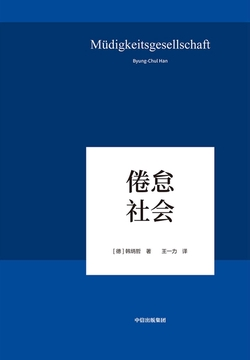
Today I read The Burnout Society and found that what he describes is me.
Byung-Chul Han has a core judgment: twenty-first-century society has shifted from a “disciplinary society” to an “achievement society.” The disciplinary society is the one Foucault described — governing people through institutions like prisons, factories and hospitals, using “you must not” and “forbidden.” Back then work was simple: finish your own tasks and you could clock out; work and life were clearly separable. But today’s society is different. It doesn’t drive you with prohibitions; it sweeps you along with “you can” and “you’ve got this.” It sounds like freedom, but it’s actually a more concealed form of exploitation.
I know this stuff all too well, because it was the daily reality of my workplace career over the past dozen-plus years.
But to explain clearly what I went through, I first have to sort out two completely different kinds of “unfreedom.”
Two Kinds of Cage
In 1984 Orwell wrote a society like this: telescreens monitoring everywhere, thought police knocking at any moment, controlling every person with blunt prohibitions and violence. Foucault’s “disciplinary society” runs on exactly this logic — the shackles are visible, the rules are written out in the open, and “you must not” is used to constrain you. This violence is exposed; at least you know you’re locked up.
But in Brave New World Huxley wrote another kind of society: no telescreens, no thought police, people packaged neatly and docilely inside “happiness,” “pleasure” and “growth.” Nobody forces you — you walk into the cage on your own, still believing you’re pursuing freedom. Byung-Chul Han’s “achievement society” runs on this logic — the shackles are beautified as striving, the fetters are packaged as empowerment, and you don’t even realize you’ve been enslaved.
| Type | Representative | Form | Method of constraint | State of the person |
|---|---|---|---|---|
| Orwellian | 1984 | Disciplinary society | External coercion, prohibitions, punishment; visible shackles | Forced obedience, aware of being unfree |
| Huxleyan | Brave New World | Achievement society | Positive rhetoric, value induction; hidden shackles | Voluntarily competing, mistaking it for self-realization |
One line sums it up particularly well: what Orwell feared was that someone would take away your freedom; what Huxley feared was that people would give up freedom on their own and enjoy doing it.
Freud once conceived of a psychological mechanism — a repressive mechanism full of prohibitions and commandments. The conflicts, anxieties and neuroses inside a person all arise because desire is suppressed by external rules. That psychological model is perfectly isomorphic with the disciplinary society: hospitals, madhouses, prisons, barracks, factories, using “you must not” to maintain order. Psychoanalysis was valid in that era, because the problem really did lie in “repression.”
But the achievement society is different. It gradually removes those explicit commandments and prohibitions and lets you out of the cage — not actually giving you freedom, but making you believe you are already free. Freudian psychoanalysis gradually stops working in this new society, because the problem modern people face is no longer “what has been forbidden,” but “I can do anything, and yet I don’t know what I want.”
Early in my career I also ran into Orwellian hard control — written rules, crude orders, top-down suppression. That oppression was very direct; at least you knew where the enemy was, and there was still a stubborn urge to resist pent up inside you.
But what ran through the first half of my life was mostly Huxleyan domestication. “Work hard, get stronger, hit your performance targets, catch up with others” — this rhetoric all sounds positive, all “for your own good.” I was like the people in Brave New World who had taken “soma”: over-exploiting myself willingly, and for a long time never noticing that this was an invisible set of fetters. That is the most terrifying part — you aren’t being forced by an outside power; you are self-driven, self-numbed, utterly unable to see that you’re in bondage.
“You Are Your Own First Person in Charge”
At one company I worked for, there was a slogan on the wall: “You are your own first person in charge; your TL comes only second.” And: “Today’s best result is tomorrow’s minimum requirement.” When I first arrived I was quite moved — I felt the company respected people and gave them autonomy. After two years I understood what that sentence really meant: when something goes wrong, don’t look for anyone else.
Decision-making power, resource allocation and performance targets were all in upper management’s hands. The boss and the executives drew annual salaries in the millions or tens of millions, set the rules and set the direction. But once a business failed, the real reasons — bad decisions, insufficient resources — were never mentioned by anyone. The blame was passed down layer after layer, until in the end it all landed on the front-line executors.
The assessment was doubly standard. A front-line employee doing the same work could earn an “excellent”; at a higher level, where the effort was even greater, the rating was somehow only “meets expectations.” Good performance was taken as expected; bad performance meant you “lack ability” or “lack a service mindset.” The key thing is that there was no evaluation standard at all to reference for whether performance was good or bad — if they say you’re good you’re good, if they say you’re not you’re not.
What’s most brutal about this rhetoric is that it converts external institutional oppression into your own PUA of yourself. Nobody forces you to work overtime, but you force yourself. Nobody tells you you’re not working hard enough, but you tell yourself that in your head. You aren’t oppressed by others — you are your own overseer, and the harshest one at that.
The disciplinary society produced madmen and criminals; that violence was exposed, and at least you knew where the enemy was. The achievement society produces people with depression and burnout; this violence can’t be seen or touched, and you can’t even find a target to resist.
Han makes an analogy in the book that I think is exactly right: everyone in the achievement society is actually inside their own labor camp. Only this labor camp is special — you are simultaneously the prisoner and the guard, the victim and the perpetrator. There is no master, and exploitation proceeds just the same. You set your own targets, pump yourself up, apply pressure to yourself, and in the end burn yourself down to the last drop of oil.
He says that the symptoms of people suffering from depression and chronic fatigue syndrome are strikingly similar to those of prisoners in a concentration camp: extreme numbness, indifference, overwhelming drowsiness, unable even to distinguish bodily cold from external commands. The only difference is that the concentration camp prisoners were malnourished and skeletal, whereas the modern “laboring animal” eats well, sleeps little, and many are even overweight. The same mental breakdown, a different physical state.
This reminds me of a colleague at a previous company who worked overtime until nine or ten every night, was on call at a moment’s notice on weekends, and whose health check reports grew thicker every year. Everyone could see he was forcing himself to hold on, including him. But he couldn’t stop. Nobody forced him — his TL even told him several times to leave early — but he simply couldn’t stop. That voice saying “you are your own first person in charge” had already internalized itself into an invisible whip, more effective than any external command.
The achievement society disciplines emotion just as rigorously. Its core logic is: striving only, no burnout; positivity only, no negativity. Anger, grievance, resistance, complaint — these emotions are all treated in the workplace as “unqualified” and “holding everyone back.” Bring it into a service context and it becomes an iron law: the customer is always right, you may not show dissatisfaction, you may not lose your temper. Negative emotion is forcibly suppressed; it isn’t that the conflict disappears, only that it is smothered and forbidden from showing.
But emotion doesn’t vanish into thin air. The anger pushed down isn’t resolved; it simply can’t erupt openly or form a visible conflict, so it turns inward and consumes you. On the surface you pile on a smile and say “sure, no problem,” while inside, that fire is burning your own organs. Over time a person either goes numb or becomes a powder keg that explodes at the slightest spark.
I was PUA’d this way once by a newly arrived leader. The project was under enormous pressure at the time, client demands were capricious, team morale was very low, and at a retrospective meeting I couldn’t help saying a few honest things, my tone carrying obvious exhaustion and dissatisfaction. Afterwards the leader called me in for a talk — not to discuss where the problem lay, but to say bluntly: “You have emotions.”
The moment those two words came out, I knew the nature of the conversation had changed. It wasn’t about solving the problem; it was about solving the person who raised the problem. “Having emotions” is a charge in the achievement society, meaning you are unprofessional, irrational, uncooperative, and lacking a service mindset. Your exhaustion isn’t treated as a signal of overwork but as an attitude problem; your dissatisfaction isn’t treated as feedback on an unreasonable process but as a flaw in your personal cultivation. Emotion itself became original sin, and you had to rectify it immediately, restore your positivity immediately, and turn back immediately into that qualified component that always smiles and always complies.
In that moment I suddenly realized that the achievement society’s exploitation of people has penetrated down to the emotional level. It doesn’t just extract your labor; it colonizes your emotions. You must stay enthusiastic, compliant and efficient at all times — even the right to feel bad inside has been taken from you. This isn’t freedom; this is a slavery in which even your soul has to pay rent.
After Attention Gets Chopped Up
In order to keep people producing nonstop, the achievement society not only kidnaps your will, it reshapes the structure of your attention.
In earlier societies, work had boundaries and people had white space. Philosophical thinking, cultural creation, scientific breakthroughs — all of it required deep attention. You had to be able to focus, to space out, to stop and think things through. But now? Tasks never reach an end; before the last one is done, the next one is already pressing in. Multitasking is praised as an ability, when in fact it’s a degradation of attention, no different from a wild animal surviving in the wild: staying alert at every moment, switching states nonstop, just to avoid being eaten.
The human brain isn’t a CPU. Frequent task switching consumes your mental energy and your computing power. Deep focus is gone, the time to space out and review is gone, and all that’s left is mechanical execution and passive busyness. There’s a line that puts it pretty brutally: if you want to destroy a person, pile on tasks relentlessly until they have no time to think.
Once attention fragments, the workplace starts to turn into a jungle. Han says modern society is gradually becoming a natural hunting ground, and applied to the workplace that’s not wrong at all. Colleagues used to be collaborators; now colleagues are competitors — checking each other, crowding each other out. Information blockades, public denial, isolation and exclusion, credit-stealing and blame-shifting: the roots of all these covert forms of bullying lie in the fact that everyone is struggling to survive, and warmth and collaboration ceased to exist long ago.
Stimulants
Han also raised a concept I find especially glaring: the achievement society is turning into a “stimulant society” (Dopinggesellschaft).
Before, “brain stimulants” were spoken of negatively; now they’ve been given a nicer name, “neuroenhancers” — coffee, energy drinks, alertness medication, and even those self-suggestions like “you can do it” and “another day full of energy.” Essentially they’re all the same thing: using external stimulation to force yourself to stay excessively positive.
The problem is that stimulants create an illusion. You think you’re more efficient and more capable, when in fact your body is just spinning empty in an overdrawn state. Down three cups of coffee a day and grind until midnight, and what you produce may be worse in quality than two hours’ work while properly awake. So-called “neuroenhancement” doesn’t enhance genuine effectiveness; it enhances the performative sense of “looking highly efficient.”
This is what Han calls “effectiveness that produces no effectiveness” — you’re busy to death, and yet you haven’t actually accomplished anything. The whole workplace has fallen into a collective performance of busyness: everyone is sprinting, everyone is working overtime, everyone is pumping themselves up, but look back and there’s very little of real value. Stimulants haven’t solved the problem; they’ve only made you spin faster inside it, until you spin yourself into a breakdown.
It reminds me of something rather ironic: coffee was originally feed given to livestock, to make them do more work. In modern times it has become the “life-extending elixir” in every hand in the office building. From animal feed to beast-of-burden beverage, only the container has changed; the logic is unchanged — you have to pour something in before you can keep turning the millstone.
The Logic of Consumables
Once you see this logic clearly, you realize that the modern office worker is actually a consumable of social progress. On weekdays you output labor; on holidays you complete the consumption loop. Rest isn’t for healing yourself; it’s for “working better, consuming better.” Effort isn’t for growth; it’s to avoid being eliminated.
We think we’ve gained freedom and escaped external discipline, when in fact we’ve fallen into a more concealed self-enslavement. There is no enemy, yet there is constant self-confrontation. There is no oppression, yet there is constant self-exploitation. There is no dead end, yet we remain mired in burnout and anxiety.
Regression to Animality
Reading this far, I suddenly remembered a passage Marx wrote in the Economic and Philosophic Manuscripts of 1844. The gist is that the fundamental difference between humans and animals is this: animals live purely on instinct — eating, drinking, reproducing, circling around physiological needs — but humans are different. The essence of a human being ought to be free, conscious creative activity, spiritual thinking, the pursuit of value.
And when a human being becomes alienated, they regress to an animal state of existence. Labor is no longer self-realization but merely work you must do in order to stay alive. Spiritual exploration, ideals, independent thinking — all of it is set aside. The joy and satisfaction of life are finally reduced to material consumption and sensory pleasure, those superficial physiological stimuli. Especially given today’s various 996 and 007 schedules.
Marx was not yet thirty when he wrote that passage, and yet he had already written out in advance the predicament we would face more than a century later. Think about the current state of the workplace: work exists only to pay the mortgage and the bills, with no question of creativity or self-realization. After work you’re half dead from exhaustion, and the only comfort is scrolling short videos, online shopping, eating a good meal — these are what Marx called “ornament and physiological satisfaction,” the only remaining sources of pleasure for a person in an alienated state. But short videos too fully exploit the weaknesses of human nature to keep the brain producing dopamine, and prolonged immersion is actually an even greater depletion of the body.
This is the achievement society’s cruelest move: it doesn’t just exploit your labor, it hollows out your spirit and makes you regress to animality. You aren’t “living”; you’re merely “surviving.” The difference between you and a wild animal may be reduced to the fact that you can use Alipay and order takeout.
Cheng-Zhu Neo-Confucianism and Modern Achievement-ism
Stepping back to look, this predicament isn’t something new to the twenty-first century.
Cheng-Zhu Neo-Confucianism emphasizes “investigating things to extend knowledge, preserving heavenly principle and extinguishing human desire,” and places the standard of life’s value entirely in the external world. You must seek outward for your whole life, defining yourself by worldlyfame and rank, ritual standards and other people’s evaluations. Your own original heart, your real desires, your bodily and mental experience — all of it must be suppressed. This is essentially the same thing as today’s achievement-ism: both seek value outward, discipline the individual with uniform standards, promote effort without boundaries, and deny human finitude.
In ancient times people were bound by ritual teachings and the imperial examinations; today they are bound by performance metrics, salary and job level. In ancient times people were made to cultivate themselves and seekfame and rank for a lifetime; today people are made to compete and seek output for a lifetime. The first thirty-five years of my life were spent exactly this way: as a student I memorized by rote for the sake of scores and doubted myself whenever I bombed an exam; as an adult the benchmark was always other people’s salaries and achievements — signing up for courses, taking further training, staying up late, voluntarily burrowing into high-pressure environments; and to fit the mass template of life, I bought a house at the peak, took on a mortgage, and didn’t dare stop even after developing a chronic illness.
I even wrote an article about how technical support could rescue itself from burnout — automation, writing documentation, learning communication skills, making yourself “more valuable.” At the time I thought I had found the answer, and I encouraged others in the article to do the same. Looking back now, that was just greasing the millstone. I thought I was improving myself; actually I was only making this machine of mine turn more smoothly, faster, and for longer. Here lies the achievement society’s greatest cleverness: it makes you believe the problem is inside you, and the solution is inside you too. You are forever “rescuing yourself,” and forever unable to escape the cage.
Every choice was a sprint along external standards, and I lived as a “standard person.” Heidegger said most people spend their whole lives sunk in the state of “the They” (das Man), drifting with the crowd and living a homogenized secondhand life. The internet age has amplified this phenomenon countless times over — if others look glamorous you chase them, thought is simplified into utilitarian calculation, life is degraded into endless labor, and you have never truly lived for yourself.
All of It Fails
Han also mentions an observation: the modern loss of faith isn’t only directed at God or the beyond — it even includes reality itself. Nothing is capable of lasting. Jobs vanish without warning, performance metrics are scrapped at a stroke, leaders are swapped out on a whim, housing prices drop, effort turns out to be useless, health collapses.
I used to disbelieve all this. I always felt that if I pushed hard enough, competed hard enough, had credentials solid enough and skills strong enough, I could hold my own life in my hands. Buying a house, chasing performance targets, fighting for promotion — I treated these as articles of faith in life and spun like a wound-up spring for over a decade.
Then they failed one after another. No matter how high your performance rating, the business line gets cut on a whim and your contribution is instantly zeroed out. You buy a house at the peak and take over the bag; the loan on your back doesn’t drop by a cent, yet the asset shrinks. Technology iterates faster than people age — what you were proud of last year is obsolete this year. And health above all: the meager results you won by overdrawing your body can be wiped out entirely by a single illness.
Everything I believed in during the first half of my life — effort, competition, credentials, skills, buying a house, performance, promotion — all of it failed, all of it disillusioned. You suddenly discover that the “certainties” you chased so desperately were themselves the greatest illusion. The achievement society not only makes you exploit yourself, it makes you believe this game is stable, predictable, and worth betting your whole life on. And once you’ve placed the bet, you find the table can be flipped over at any moment.
Crueler still is another layer of truth: all the effort you expend for the sake of living will lead to death. You compete with everything you have, strive, chase, thinking you’re heading toward a better life, when actually you’re only accelerating your own consumption. Every drop of squeezed-out energy, every overdrawn night, every portion of sacrificed health is pushing you toward the end. You aren’t living out your life; you’re using labor to spend your life in advance.
The Philosophy of Mind and “Being-toward-Death”
So where is the antidote?
Wang Yangming’s philosophy of mind teaches that “the mind is principle” — true principle lies not in external rules but in the original heart and innate knowing. It overturns the Cheng-Zhu pursuit of the outward and advocates settling inward, following your original heart, and uniting knowledge with action. Don’t blindly follow the crowd, don’t get swept along by the worldly; hold on to your own judgment and spiritual freedom.
This aligns closely with Heidegger’s “being-toward-death.” Only by facing death squarely and recognizing the finitude of life can a person leap out of the torrent of “the They,” actively set boundaries for their life, and break free of the shackles of endless labor. Finitude is the beginning of all freedom.
The philosopher Handke also distinguished two kinds of “hand”: one is the laboring, grasping hand, characterized by grabbing, taking, seizing, controlling, possessing, with the mindset of “I must get, I must win, I must be useful”; the other is the playing hand, characterized by loosening, letting go, neither grabbing nor seizing, no longer treating the world as prey and resource, but simply being present, playing without purpose.
For my first thirty-five years, I used only the first kind of hand. Grabbing at performance ratings, grabbing at promotion, grabbing at a house, grabbing at other people’s approval, believing that the more I grabbed, the safer I’d be. In the end I grabbed a handful of nothing and grabbed myself into a breakdown. Only after waking up did I understand that real freedom isn’t grasping more but daring to let go — letting go of the things you assumed were “essential”: position, salary, other people’s evaluations, the worldly template of success. Only when the hand loosens does the heart have room.
In the year I turned thirty-five, I went through illness, debt and a layoff — and it was in that low point that I actually woke up. No longer attached to the worldly template of success, no longer anxious about other people’s pace, no longer burning body and mind for the empty names of salary and performance. Even after half a year of unemployment, even when suitable workplace opportunities appeared, I gave up every position that consumed me and was filled with hypocrisy and PUA.
Some people say my standards are too high, that I don’t understand compromise. Actually they’re still inside the competitive cage of seeking outward, while I no longer want to live a secondhand life.
From the obsession that “everything is possible,” to accepting my own limits; from living inside the world’s evaluations, to being true to myself and seeking inward. This transformation taught me one thing: real freedom in life isn’t endless striving, but understanding your original heart, accepting your boundaries, and daring to make trade-offs.
If it is for the sake of spiritual freedom, then worldlyfame and rank, a secure livelihood, and the glitter of external things may all be given up.
评论
0 条评论