For a stretch recently I’ve been clearly aware of a fatigue I can’t quite name: I don’t want to play games, don’t want to follow any shows, can’t be bothered to go to gatherings with friends, and even the new technology I used to love digging into leaves me flat. It isn’t depression and it isn’t self-indulgence. It’s just that — nothing feels like it matters.
Thinking it over carefully afterward, this state didn’t arrive out of nowhere. It’s the inevitable result of three layers of pressure stacking up once you reach the milestone of 35: physiological, practical, and psychological. What’s more ironic is that the line companies like to use — “older workers are hard to manage, they’re old foxes” — is essentially the same logic projected into the workplace.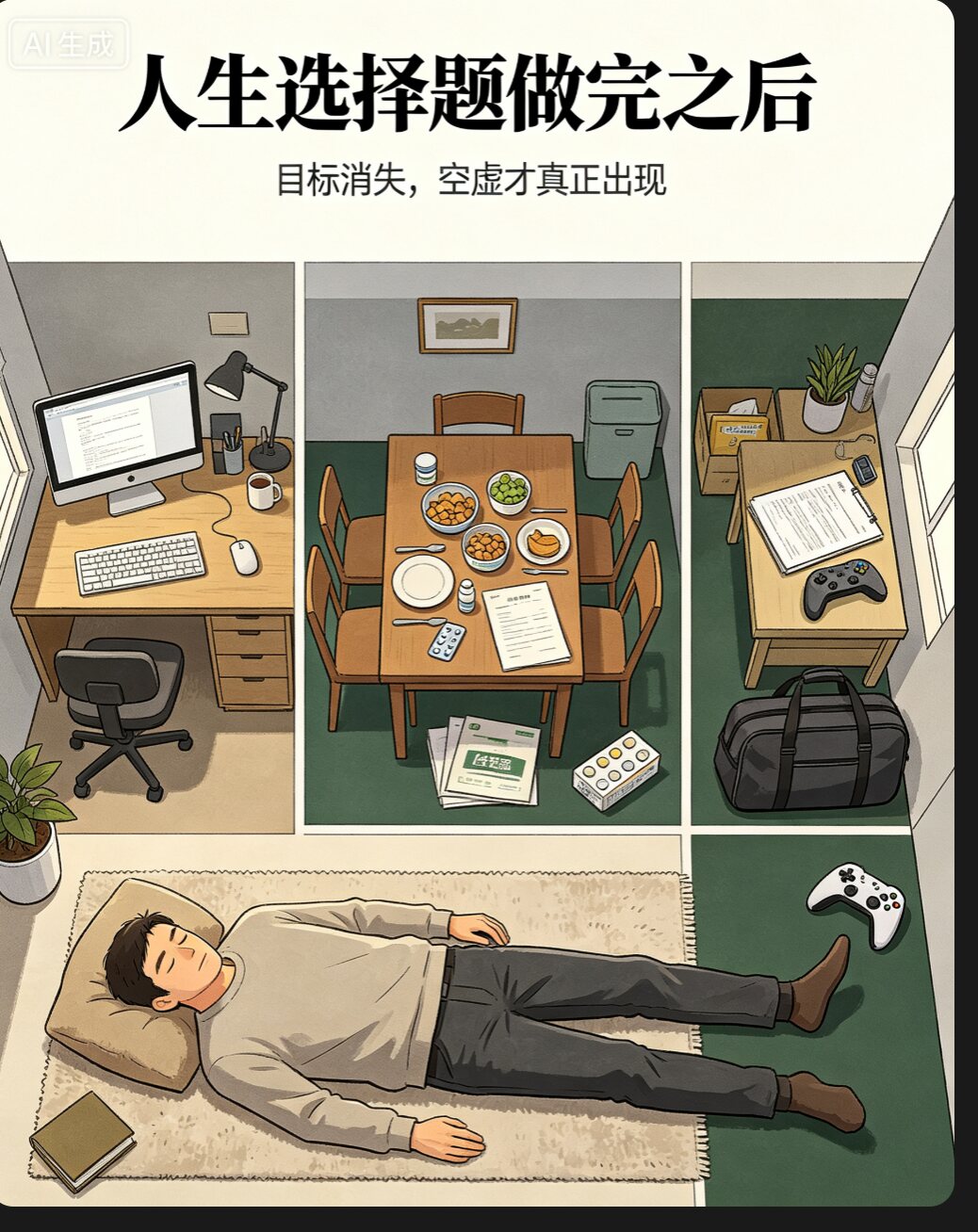
1. The Physical Layer: Pleasure Got Harder
After 35, the body is the first thing to defect.
Hormones start a gentle slide downward. Testosterone drops in men, bringing easy fatigue and a loss of interest; estrogen fluctuates in women, and mood goes numb and low more readily. When you were young, a hotpot dinner, an all-night gaming session, or a trip somewhere could keep you happy for a long time. Now dopamine secretion has decreased, the same things rarely deliver intense pleasure again, and you’re naturally inclined to find everything flavorless.
Your stamina can’t take the wear either. Late nights, overtime, business dinners — recovery is visibly slower. When you were young you could brute-force it on novelty alone; now your body instinctively rejects anything that burns energy: parties are too loud, binge-watching is too tiring, hobbies take too much strength, and all you want is to lie down. It’s not that you don’t want to love life — your body chose power-saving mode first.
2. The Shackles of Reality: Life’s Multiple-Choice Questions Are Basically All Answered
If physical change is the base color, then the ossification of your practical circumstances is the mold that presses you solid.
1. The goals you once had have all either landed or fallen through
In your twenties you had clear things to run toward: get into school, land a good job, fall in love, buy a house, get married, get promoted, save your first pile of money. Every one you finished brought an obvious hit of achievement.
But think back — how many of those things were really what you wanted? Gustave Le Bon writes in The Crowd (《乌合之众》) that an individual inside a crowd easily loses the ability to think independently and gets swept along by the collective will. We think we’re pursuing school, a house, marriage, a promotion, when much of the time it’s simply the machine of society pushing us along — do what should be done at a given age, do what everyone around you is doing. These goals do bring a sense of achievement, but that feeling is more like the feedback of “task complete” than satisfaction coming from the heart. Once the task list has been crossed off one item at a time, life suddenly has no next default goal, and the emptiness arrives.
By 35 those goals have basically settled. Your job is either stuck in the middle with nowhere up or down, or you can see straight through to retirement; the mortgage, the car loan, the pressure of elder care and child-rearing are fixed, looping and repeating every day, with no new life tasks. People are driven to happiness by goals; when the long-term goal disappears, the emptiness wells up directly.
2. Parents above, children below — freedom squeezed to nothing
35 is the peak of family responsibility. Your parents start needing care; your child’s education and your time with them eat up huge amounts of your day. You no longer belong only to yourself, and every interest and every scrap of personal space gets compressed.
When you want to do something purely for yourself, your first reaction is “that’s a waste of time, a waste of money, there’s no time.” Little by little you give up every pleasure on your own initiative, and after long enough you genuinely feel that nothing is fun anymore.
3. The workplace’s 35-year-old crisis: effort with no visible return
I feel this one especially keenly. I’ve written before about recruitment chaos, HR keyword screening, and AI-driven involution. All of it is really draining the spirit of 35-year-old technical people.
The industry updates fast, young people are cheaper and can pull all-nighters, and AI is still replacing entry-level work. Your own advantage of a dozen-plus years of experience gets diluted, effort doesn’t necessarily mean promotion, and lying flat brings anxiety. On one side you don’t dare slack off; on the other you can’t see a path upward. Prolonged internal friction dulls your emotions, and you slowly lose enthusiasm for the work, the industry, and making money.
3. The Psychological Layer: Three Kinds of Burnout Stacked
The double drain of body and circumstance finally shows up in your mental state.
First is disillusionment. In your twenties you believed effort gets rewarded, believed in fairness and opportunity. At 35 you’ve seen through the workplace playbook, the rules of capital, and the ways of human dealings, and you understand that many things can’t be changed no matter how hard you try. After expectations come up empty, a person automatically shuts down emotion and stops being moved by competition, keeping up with others, or novel things. It’s like watching HR rigidly screen resumes by keywords — you only find it laughable and helpless, with absolutely no urge to prove yourself.
Second is the loss of your own identity. The labels of the first half of life are all outward-facing: employee, partner, parent, child. Very few identities are purely your own. When you’re busy you don’t notice; the moment you stop, you suddenly ask: Who am I? Where do I come from? Where am I going? Apart from these responsibilities, what do I like? What do I want? Go a long time without answers and you sink into a hollow feeling that everything you do is for other people and means nothing.
That line of questioning made me realize that a lot of what I used to call “interests” may not have belonged to me either. I used to get genuinely excited seeing a new phone, a smartwatch, a new pair of earbuds, feeling that I was chasing a better life. Looking back now, much of that excitement was manufactured by consumerism — it keeps telling you that owning newer devices and cooler features will make you a better self. But once you actually buy it, the novelty rarely lasts a month, and then you’re drawn to the next new product, over and over. Those desires weren’t love coming from the heart; they were a sense of lack continuously fed to me by the outside world.
Wang Yangming said “there is nothing outside the mind.” The real answer isn’t in the phone, the watch, the house, or the title — those external things — it’s inside your own heart. Turning inward isn’t escaping reality; it’s stopping the use of consumption and labels to define yourself and listening to what you actually care about. Only when a person no longer confirms their own worth through outside novelty can they touch a more stable core.
Third is emotional numbness. Sustained anxiety, pressure, and repeated suppression make the brain trigger self-protection, lowering emotional perception to avoid ongoing pain. The manifestation is that you can’t get happy, and sadness isn’t deep either — food, games, socializing, making money, travel, all of it registers as nothing. It’s not that you dislike them; it’s that you can’t feel the pleasure.
4. Tell the Two States Apart
Of course, not every “nothing feels like it matters” needs to set off alarms.
If it’s only a temporary phase of burnout — a few days alone, a short trip to empty your head, temporarily stepping away from work relieves it, and once in a while a small thing or two can still loosen you up a little — then you’re just tired. Rest normally and it’ll pass.
But if it lasts more than two months, with insomnia or hypersomnia, a sharp change in appetite, self-denial, total numbness toward everything, frequent feelings that life is meaningless, and no energy to handle daily chores, then it isn’t simple burnout. It’s an emotional problem worth taking seriously, and I’d suggest seeking some psychological counseling as appropriate.
5. Don’t Force Yourself to “Pull Yourself Together”
The way you recover after 35 is completely different from the way you did when you were young. Stop chasing “find a lifelong hobby” or “life needs a great achievement” — those grand goals only add pressure.
What suits you better is: do five minutes a day of some small purposeless thing — take a walk, listen to old songs, wander the supermarket, tend a plant, slack off watching a documentary. Small, easy things are more likely to wake dopamine up.
Actively cut off meaningless drain: pointless socializing, involuted competition, comparing yourself through short videos, anxious overthinking about the future — reduce all of it. Keep your energy for yourself; you don’t have to force yourself to fit in or to be ambitious.
Work is only a tool for survival. You don’t have to insist on loving it. Lower the expectations and don’t hang your self-worth on it. Leave a few hours a week completely undisturbed by family and work, belonging only to you, and slowly get back the feeling of “living for myself.”
Most importantly, accept that “nothing feels like it matters” is itself the normal state of middle age. At 35 you no longer live on novelty the way young people do, and pleasure shifts from the stimulating type to the calm type. You don’t have to force yourself to be fired up and positive; being plain and relaxed is a normal state of life too.
6. When Companies Say “Older Workers Are Hard to Manage, Old Foxes,” It’s Really Because They Can’t Be Fooled Anymore
Finally, back to the company’s point of view.
A lot of companies complain that employees over 35 are “hard to manage,” “have no drive,” “old foxes.” At bottom it isn’t an ability problem — it’s a management-cost problem. A 35-year-old has seen too many empty promises, is sick of hearing “blessing,” “growth,” “the future of your options,” and is immune to chicken soup. They care more about actual returns, work boundaries, and dignity, and they won’t work unpaid overtime for a vague, inflated goal anymore.
To a company, of course such a person is “hard to manage.” Because they’re no longer easy to PUA, no longer easy to hold emotionally hostage, no longer willing to sacrifice their own life for a leader’s expectations. They know what they want and they know their own value, and they no longer accept cheap incentives.
But that isn’t a flaw. Quite the opposite — it’s the clear-headedness an adult ought to have. Companies like young labor because young people are cheap, easy to motivate, able to pull all-nighters, and easy to shape. A 35-year-old is hard to manage because they’ve finally learned to respect their own time and energy.
So when you feel that “nothing means anything,” don’t rush to blame yourself. You haven’t degenerated. You’ve simply reached a stage where your life’s coordinates need recalibrating. Your body is changing, your responsibilities are heavier, your mindset is maturing. Those “old foxes” companies talk about are nothing more than people who have finally stopped playing along with the game.
评论
0 条评论