“In the course of capital accumulation, a relative surplus population is inevitably produced.”
While workers carry out capital accumulation for the capitalists, they are at the same time, on an ever-widening scale, turning themselves into a relative surplus population — this is the population law peculiar to the capitalist mode of production.
— Karl Marx, Das Kapital (《资本论》)
This law that Marx revealed in Das Kapital is being replayed today in a new form. Capital accumulation drives technological innovation, the organic composition of capital keeps rising, capital’s demand for labor relatively declines while the supply of labor keeps increasing — ultimately forming an “industrial reserve army.” These people aren’t ones society truly can’t afford to support; rather, under capital’s logic of valorization, employing them can no longer generate enough surplus value, so they are systematically eliminated.
Today, as the AI wave sweeps the globe, companies’ employment logic has been thoroughly reconstructed: on one side, capital is flooding madly into AI infrastructure, pouring money into computing power, models, and automation systems; on the other side, waves of mass layoffs are spreading, with people aged 35+ bearing the brunt as the key group being “optimized.” What AI eliminates has never been the age of “35” itself, but those who cling to old rules, refuse to change, and can be easily replaced. The key to breaking through has never been to fight the trend, but to go with the times, find your own unique value amid the AI flood, and forge a path of survival that can’t be replaced.

1. The Cruel Reality: People 35+ Are Being Squeezed from Two Sides
1.1 The Company’s Calculus Has Changed
Today, a company’s core demand has long since shifted from “rich experience” to “cost-effectiveness + AI fit”: they’d rather lay off 35+ veterans with higher pay and limited energy and pour the money into AI infrastructure than give a raise to keep them; they’d rather hire mid-level talent with 3–5 years of experience who can pair with AI to produce output fast than give people 35+ a chance — even if the latter have solid skills and deep experience.
Zhaopin’s 2026 data stings even more: the résumé-view rate for job seekers over 35 is a full 40% lower than for those under 30, the interview-invitation rate is only 4.2%, and nearly 60% of middle-aged people’s résumés are eliminated outright at the system-screening stage, never even seeing an HR person’s face.
1.2 AI Is Flattening the Experience Gap
Basic business capabilities that once required years of accumulation can now be picked up by young people in a few days with AI tools; the once-prestigious “senior” label has now become a synonym for “high cost.” We’ve seen far too many 35+ technical people replaced by the combination of young people + AI, holding a body of hands-on experience yet repeatedly hitting walls in the job market; we’ve also seen quite a few middle managers optimized away in company downsizings, wanting to shift back to hands-on grassroots work but unable to let go of their status, ultimately trapped in a dilemma with no way forward or back.
More realistically, the delayed-retirement policy has landed, and those born in the 1980s must work until 63 to retire. If you lose your job at 35, the 28-year career vacuum in between forces you to shoulder the multiple pressures of mortgage, elder care, and raising children, with the risk of a break in social-insurance contributions piling on top.
1.3 Graduates Keep Climbing — Tens of Millions of Cheap Labor Squeeze the Living Space
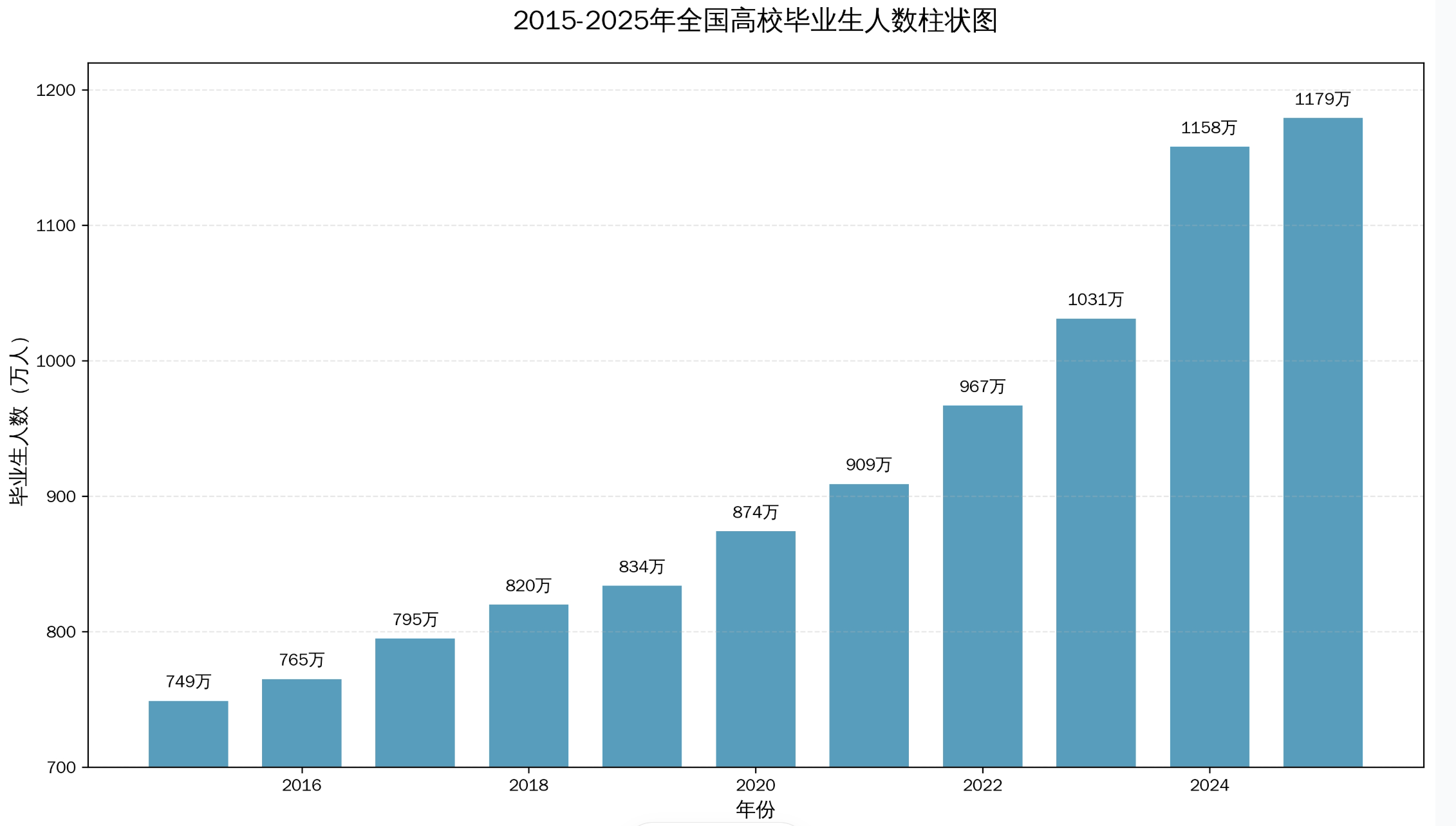
From 2015 to 2025, the number of college graduates soared from 7.49 million to 11.79 million, a net increase of over 4 million in ten years, staying persistently at a tens-of-millions high level. Behind this is the superposition of four overlapping factors: the lagged effect of college enrollment expansion, the birth peak around 2000, sustained policy push, and the rising degree threshold from industrial upgrading.
The cruellest blow to older workers is this: you have to compete for a rice bowl not only against AI, but also against a crowd of younger, cheaper college students who can work more overtime for the very same position.
- Supply keeps swelling: sustained enrollment expansion since 1999, with undergraduate, vocational, and graduate admissions all continuing to grow from 2015 to 2020. Expansion has a 3–4 year lag — the large-scale vocational expansion of 1 million in 2020 directly drove the surge in junior-college graduates from 2023 to 2025; graduate expansion (an extra 189,000 in 2020) rapidly increased the number of master’s graduates.
- The degree threshold keeps rising: as the economy shifts toward services and high-tech, companies broadly raise their degree requirements. In 2015 the gross higher-education enrollment rate was 40%; by 2025 it had exceeded 60% — the market is flooded with large numbers of young job seekers with “excess credentials.”
- The cost gap is stark: the salary of one 35+ technical person can often hire 2–3 fresh undergraduates. For a company, rather than pay a high price to keep an “over-experienced” middle-aged person, it’s better to hire a “plug-and-play” young person at lower cost and pair them with AI tools to produce output fast.
When tens of millions of graduates pour into the job market every year, the competition facing the 35+ group is long past a “contest of ability” — it’s a “cost-effectiveness crush.” Young people have no mortgage pressure, no family entanglements, can work overtime, can travel, and have low salary expectations — in a company’s cost calculus, this is virtually an across-the-board replacement of the 35+ group.
Even more severe, 2025 already saw the turning point where the number of graduates exceeded the number of new admissions for the first time, meaning credential devaluation is accelerating. When a “bachelor’s degree” turns from a scarce item into a standard fixture, the 35+ group’s only remaining “credential advantage” is also rapidly dissolving.
1.4 The 35+ Group in the Global Layoff Wave
This AI-triggered layoff wave has already swept major companies worldwide, regardless of industry or scale. Below is a summary of companies from public reports in 2025–2026 that explicitly cited AI/automation as the main reason for layoffs:
| Year | Company | Layoff scale (approx.) | AI-related layoff reason |
|---|---|---|---|
| 2025 | Amazon | 30,000 | Resources shifted from labor to AI/large models and warehouse automation; AI replaces logistics dispatch, customer service, and other roles |
| 2025 | Microsoft | 19,000 | Investment tilted toward Azure AI/OpenAI; AI replaces basic development, testing, and ops roles |
| 2025 | Meta | 4,000 | Retreat from the metaverse, full pivot to AI content recommendation and generative AI, streamlining non-core teams |
| 2025 | Salesforce | 4,000 (customer-service roles) | AI customer service launched, automatic-resolution rate up from 40% to 85%, human agent demand halved |
| 2025 | Intel | 21,000 (about 20%) | Cut non-core business to go all-in on AI chips; process department staffing heavily streamlined |
| 2025 | IBM | 2,700–5,000 | AI software and consulting replace traditional IT services; basic ops and outsourced roles shrink |
| 2025 | HP | 4,000–6,000 | AI automation replaces desktop support, testing, and basic development; target to save $1 billion over 3 years |
| 2025 | Chegg (online education) | 2,000 (45%) | AI tools like ChatGPT seize the market, replacing basic teaching and Q&A roles |
| 2026 | Meta | 8,000 (about 10%) | To fund huge AI investment and improve efficiency; AI replaces junior R&D, testing, and other roles |
| 2026 | Oracle | 20,000–30,000 (about 18%) | AI databases replace traditional DBAs, implementation, and after-sales; large numbers of grassroots technical roles automated |
| 2026 | Block (formerly Square) | 4,000 (40%) | AI + small teams can replace traditional departments; in-house AI agents cover multiple processes |
| 2026 | Amazon | 16,000 | Focus on AI business, shrink non-AI business, offline operations, and some R&D roles |
| 2026 | Cloudflare | 1,100 (about 20%) | AI usage surged 600%, replacing ops, security analysis, customer service, and other roles |
| 2026 | HSBC | 20,000 (3–5 year plan, about 10%) | AI replaces credit, compliance, customer service, and other mid/back-office non-client-facing roles |
| 2026 | Goldman Sachs | 3,000+ | AI writes research reports and does risk control; junior analyst demand down 60% |
| 2026 | Citigroup | 20,000+ | AI compresses the credit-approval cycle from 3 days to 2 hours, replacement rate reaching 80% |
As the table shows, these companies aren’t laying off due to losses — most are actually profitable. The core purpose of the layoffs is to shift labor costs onto AI infrastructure buildout, and people 35+ become the first to be optimized because of their high salary expectations and low energy fit. At the same time, tens of millions of college graduates keep pouring into the market every year, further intensifying the competitive pressure on the 35+ group — companies can hire “degree-qualified + AI-fit” young people at lower cost, further amplifying the 35+ group’s cost-effectiveness disadvantage.
2. Why Companies “Don’t Want 35”: A Four-Way Contest of Cost, Energy, Control, and Organizational Structure
The age-35 crisis isn’t simply “not able enough” — it’s the result of a company’s overall accounting across four dimensions: cost, energy, control, and organizational structure. Understanding this logic is what lets you treat the right symptom.
2.1 The Worst Cost-Effectiveness (the most direct factor)
| Dimension | 35+ | Young people |
|---|---|---|
| Salary expectation | 10+ years’ experience, high salary demands | Low starting pay, little bargaining room |
| Hidden cost | High social-insurance/housing-fund base, more annual leave | Low base, less leave, high fault tolerance |
| Overtime flexibility | Family entanglements, hard to sustain long-term high intensity | No burdens, on call anytime |
| Company’s accounting | Cost of one 35-year-old ≈ 2–3 young people | No need to spend extra on basic roles |
The company’s subtext: for grassroots roles they want “tool people,” not “experts.”
2.2 Energy and Family Entanglements (a real constraint)
People 35+ are often at the “elders above, children below” stage of life:
- Overtime, all-nighters, and long-term postings away from home are hard to sustain
- Sudden family matters are frequent, with a leave probability significantly higher than that of young people
- Physical recovery declines, and efficiency falls off a cliff after continuous high-intensity work
This isn’t “not working hard” — it’s the objective constraint of a life stage. But a company’s grassroots roles essentially buy “time + physical energy,” and 35+ is naturally weakened in competitiveness on both.
2.3 Fixed Thinking and Control Anxiety
Technical level: accustomed to old methodologies, with a longer learning curve for new technologies (like AI, new systems) and stronger psychological resistance to change.
Management level: 35+ professionals have often “seen through the playbook” — PUA doesn’t work, pie-in-the-sky promises aren’t believed, no blind obedience. Worse, if a 35+ newcomer is older than their direct supervisor, both the cost of command and management friction rise.
Team level: internet companies have an average age of 27–28; a 35+ newcomer integrating into the team easily produces a generation gap, affecting team atmosphere and collaboration efficiency.
2.4 Organizational Echelon and the Need for “Blood Renewal”
Companies want an “olive-shaped” structure: senior decision-making, middle management bridging top and bottom, grassroots execution. If you’re still interviewing for grassroots or junior-middle-management roles at 35, you’ll be assumed to have “insufficient growth potential” and “no potential to rise to senior levels.”
Especially during a fast-growth industry phase (like the internet golden age), cadre rejuvenation is an explicit strategy — eliminate those with weak upward momentum, make room for young people, and keep organizational vitality.
2.5 Hidden Risks and Screening Efficiency
| Risk type | Specific manifestation |
|---|---|
| Health risk | Rising probability of chronic illness, more sick leave and medical spending |
| Employment risk | Strong labor-arbitration awareness, high dismissal cost |
| Screening cost | Age is the lowest-cost filter tag; HR doesn’t have to assess ability one by one |
2.6 Which Industries Are Strictest? Which Are Relatively Lenient?
Industries that strictly cap at 35:
- Internet/big tech: fast tech iteration, lots of overtime, youth-oriented strategy
- Finance/investment banking/consulting: high intensity, lots of travel, salary-sensitive
- Manufacturing/factories: high physical demands on the assembly line, cost-sensitive
- Some SOEs/public institutions: recruitment ads explicitly state “under 35”
Relatively lenient (judged by ability, not age):
- Professional services: lawyers, doctors, accountants, senior consultants (clear experience premium)
- Technical expert roles: architects, senior engineers, industry experts (scarce skills)
- Management roles: middle level and above, mature managers (can lead teams, control costs)
- Traditional industries: retail, catering, agriculture (heavy on experience, light on age)
2.7 Beware Self-PUA: The Age-35 Predicament Is Never the Individual’s Fault
Many people say that hitting a wall job-hunting at 35 is because you’re not excellent enough and can’t keep up with the pace. But calm down and think — is this really just an individual problem?
Attributing the entire workplace age predicament to middle-aged people themselves is itself a disguised form of PUA.
Right now, the vast majority of companies’ role structures are essentially assembly-line screw designs. The division of labor is split into tiny fragments, requiring no deep experience, only repetitive execution and being on call. Such roles simply can’t use a middle-aged person’s accumulated experience. A company’s primary consideration in hiring has never been who does the work more steadily and thoroughly, but who has a lower employment cost and greater room for over-exploitation.
The narrative circulating in the market always says middle-aged people have fixed thinking, too many family entanglements, and are hard to manage. Seemingly personal shortcomings, they are in fact loopholes left by the system’s design. Companies only pursue short-term efficiency and fast blood renewal to compress costs; the work models they build are by default suited to the high-intensity over-draft state of young people, yet they refuse to adjust role mechanisms or optimize employment systems. Instead, they define middle-aged people who can’t fit these harsh rules as the ones being eliminated.
The so-called age-35 workplace threshold has never been a watershed of ability, but a hard standard by which capital and the company system screen for low-cost labor. Middle-aged people shoulder family responsibility, know how to weigh bottom lines when doing things, and no longer blindly obey — this is inherently a trait of maturity, yet under a single assessment standard it becomes a flaw.
There’s no need to negate yourself or blame yourself. This is a structural problem of the entire workplace environment; no matter how much the individual changes, it’s hard to counter the established system of rules.
2.8 The “Chinese Characteristic” of Age Discrimination: “If You Won’t Do It, Plenty Will” Under the Demographic Dividend
Many people think the age-35 crisis is a global ailment, but on closer inspection it looks more like a workplace predicament with “Chinese characteristics.”
In the book The Stigma Trap (《污名陷阱》), the author compares American workplace attitudes toward age. In the US, real age discrimination often doesn’t start to appear until age 50 and above; 35 is right in one’s career golden period, the stage where experience and energy are most balanced, and companies compete to hire such people.
This isn’t empty talk from a book — I’ve seen it with my own eyes. My former Team Leader was even older than me, and later jumped ship to the Swedish foreign company HM. Once I saw him in an online meeting, and in the video frame I could even see a gray-haired old man — in China’s workplace environment, someone that age would have been “optimized” many times over, but in the Swedish company he still attends meetings normally and participates in projects normally, and no one thinks anything of it.
In China, meanwhile, 35 has become the dividing line for workplace “old age,” and the big words “under 35” on recruitment ads blatantly shut people out at the door.
Why does the same age have utterly different fates in China and the US?
At root, it still comes down to population structure.
China has 1.4 billion people and over 10 million college graduates every year, with labor supply in a long-term state of surplus. In such a market environment, companies are naturally in a strong position — if you won’t do it, plenty of people will. When a position can easily recruit a 25-year-old at half the salary of a 35-year-old, who can also work unlimited overtime, a company has no incentive whatsoever to keep “high-cost” employees over 35. Age thus becomes the lowest-cost screening tool.
In developed countries like the US, the labor market is relatively tight, the supply of working-age labor is insufficient, and companies find it hard to recruit, so they naturally treasure experienced middle-aged employees more. There, 35 isn’t a burden but a synonym for “immediate combat power.”
This isn’t excusing companies’ age discrimination, but seeing clearly a cruel reality: when labor supply exceeds demand, companies have ample confidence to be picky; only when labor becomes scarce will the experience and value of people 35+ be truly valued.
So rather than agonizing over “why exactly 35,” it’s better to recognize this as a workplace phenomenon specific to the demographic-dividend period. In this environment, the individual’s way to break through isn’t to wait for the environment to change, but to proactively jump out of the “being picked” lane and find a way of survival that doesn’t depend on company employment and isn’t bound by age labels.
One-sentence summary: 35 isn’t a watershed of ability, it’s a “watershed of cost-effectiveness” — what companies want are young people who are “cheap, useful, obedient, and able to work overtime,” while people 35+ happen to be the group with high cost, limited energy, hard to manage, and easy to replace.
3. Six Pragmatic Paths to Break Through
Beneath the predicament, there are always breakthrough-makers. What AI eliminates has never been the 35+ age group, but those who cling to old rules, refuse to change, and can be easily replaced. The following six paths are the most pragmatic and feasible directions for breaking through.
Path One: Let Go of Obsession, Embrace Flexible Employment
The biggest Achilles’ heel of people 35+ is often the inability to let go of the obsession with “big-company stability” and “respectable work.” In the age of AI, stability has long become a luxury. Rather than suffer age discrimination and AI replacement in full-time employment, it’s better to proactively jump out of the comfort zone, embrace flexible employment, and take your fate into your own hands.
The core of flexible employment is “light assets, high fit”:
- Technical people can focus on outsourcing projects for SMEs and technical services in niche fields, building a reputation through platforms like Chengxuyuan Kezhan and Dianya
- Gather 2–3 peers of similar age to band together into a small team, take on projects, with one person coordinating and everyone pairing with AI to boost efficiency and press down operating costs
- Do technical consulting, proposal ghostwriting, enterprise digital-transformation advisory work, etc. — no need to sit in an office, earning stable income through professional ability
Pit-avoidance bottom line: refuse pure commission-sharing models, keep the upfront payment at no less than 40%, and sign cross-border projects through legitimate platforms to avoid being freeloaded off.
The essence of flexible employment is to break the traditional “company keeps people” model and turn it into “keeping yourself.” Although there’s no backing of social insurance and housing fund, at least you no longer have to endure the grievance of age discrimination, and no longer have to worry about being easily replaced by AI.
Path Two: Go Deep in a Niche, Avoid Red-Ocean Lanes
AI’s replacement ability is concentrated in general, standardized, repeatable roles, whereas for niche fields that require industry depth, offline hands-on work, and customized service, AI is hard to replace — this is precisely where the core advantage of people 35+ lies.
Three niche fields especially suited to people 35+:
- Digital-transformation rectification for traditional industries: large numbers of SMEs need professionals to help complete equipment upgrades, system buildouts, data management, etc. This kind of work needs to combine industry experience, which AI cannot complete independently
- Legacy system maintenance and industry-customized implementation: many companies’ legacy systems need dedicated maintenance, and customization needs require deep cultivation combined with industry scenarios — young people don’t want to do it, and AI has a hard time grasping it
- Technical support for brick-and-mortar industries: smart transformation and predictive maintenance in industries like home appliances and furniture require combining offline hands-on work with technology; AI can only provide assistance and can’t replace human hands-on work
The key to going deep in a niche is “less but refined.” Rather than be a “knows a bit of everything, masters nothing” generalist, it’s better to be an “expert in a certain field,” taking one field deep and thorough and forming your own technical barrier.
Path Three: Leverage AI Empowerment, Turn the Opponent into a Tool
Many people 35+ are full of resistance to AI, seeing it as their “natural enemy.” But in fact, AI has never been an opponent — it’s a tool you can leverage. It can fill the energy and efficiency gaps of people 35+ and amplify your own experience advantage.
The core of people 35+ using AI empowerment is “use AI for basic work, use experience for core decisions”:
- Technical people can use AI to write code, debug, and organize documentation, handing the tedious basic work to AI while focusing themselves on core aspects like project coordination, problem-solving, and customized design
- Non-technical people can use AI to optimize workflows — for example, generating marketing copy, making reports, handling basic customer service — while focusing themselves on core work like client communication and resource integration
Don’t be afraid to learn AI tools. Today’s AI tools are simple to operate, like a “point-and-shoot camera”; an ordinary person can get the hang of them in a week. The point isn’t to master all AI tools, but to find the tools suited to your industry and your role, making AI your “assistant” rather than your “opponent.”
Path Four: A Downshifting Mindset — Stabilize Cash Flow First, Then Seek Development
Another fatal misconception of people 35+ is being unable to let go of status, obsessed with “salary no lower than before” and “position no lower than before.” 2026 data shows that laid-off people 35+ wait an average of 10 months to be re-employed, with salaries dropping directly by 27.6%, and even by a half (40%) at big internet companies.
Downshifting isn’t compromise, it’s pragmatism:
- You can accept a lower salary and a demotion, moving from a management role back to a hands-on role
- Move from big companies to SMEs, from first-tier cities to second- and third-tier cities — companies in second- and third-tier cities are more tolerant of age, and living costs are lower
- First find a job with stable income, solving real problems like mortgage, elder care, and raising children, then use your spare time to build a side hustle and go deep in a niche field
The market isn’t short of experts; what it’s short of is middle-aged people willing to work steadily, at a reasonable salary, who can produce output fast. In the face of survival, dignity has never been the most important thing — stabilizing cash flow and continuously creating value is the root of breaking through.
Path Five: Cross Over, Build a Side Hustle, Create Multi-Channel Income
In the age of AI, a single income source carries extremely high risk. For people 35+, the best protection is to build a multi-channel income system of “main job + side hustle.”
Three principles for choosing a side hustle: hard for AI to replace, low barrier, stable income.
- Technical people can do technical teaching, industry Q&A, and online courses, turning their experience into knowledge products
- Get into local convenience technical services and store digitalization, connecting with local merchants — demand is stable and doesn’t care about age
- Non-technical people can rely on their own industry experience to do AI + content creation, AI + personalized customization
The core of crossing over is to “leverage your own strengths and graft them onto a new lane,” rather than start from zero. The experience and resources of people 35+ are both precious assets; as long as you find a suitable entry point, you can leverage AI to amplify your value and achieve multi-channel income growth.
Path Six: Accumulate Connections, Build a Personal IP
The biggest advantage of people 35+, besides experience, is the network of connections accumulated over many years. In the age of AI, connections and a personal IP are wealth even harder to replace than technical skill — AI can replace your work, but it can’t replace your connections, and it can’t replace your reputation and influence in the industry.
Building a personal IP doesn’t require chasing “viral traffic”; the focus is “precise positioning, sustained output”:
- In industry communities and short-video platforms, share your industry experience, hands-on cases, and AI-tool usage tips
- Proactively connect with peers and clients, do every job and every project well, accumulate reputation, and let old clients proactively introduce new ones
- Regularly exchange with peers and communicate with clients to understand industry trends and market demand, adjusting your development direction in time
The core of a personal IP is to turn you from “passively job-hunting” into “being actively in demand.” When you have a reputation and influence in your industry, age becomes your “endorsement” rather than your “shackle.”
4. Closing Words
The arrival of the age of AI is a trend, irreversible. The way out for people 35+ has never been to fight AI or complain about age discrimination, but to learn to go with the times, adjust your mindset, find your own positioning, and amplify your own advantages.
Speaking of age discrimination, I have one more personal attitude to share: for companies that blatantly discriminate against people 35+ in recruitment, I choose to refuse to buy the products they make — voting with my feet is the only resistance I can offer as a consumer.
This isn’t just angry talk; I really do it. I once interviewed at Alibaba Cloud, and its CDN and object-storage product lines discriminated against me on age. In a fit of rage, I tore down all the CDN domains and OSS storage I had configured on Alibaba Cloud. That’s my attitude — since you discriminate against me, why would I still shamelessly go use your products? Am I out of my mind?
If a company doesn’t even respect the experience of middle-aged people, how could it possibly truly respect its users? Today it throws away 35-year-olds as “expired goods”; tomorrow it will treat its own product quality and user experience with the same logic. Such a company isn’t worth a single cent of my money.
We needn’t envy the top-tier people who can enjoy the AI dividend, nor need we be anxious about the impact of young people. Everyone has their own pace, and everyone can find their own survival lane in the age of AI.
Remember, 35 isn’t the end of your career — it’s a new starting point. Let go of obsession, embrace change, empower AI with experience, break through cutthroat over-competition with niches, and secure survival with multiple channels, and you’ll find that the age of AI holds not only elimination but new opportunities.
Those people 35+ who can weather the winter and proactively seek change will ultimately stand firm amid the flood of the times and become their own source of confidence. After all, real security has never come from a company’s stability, but from your own “irreplaceable” ability.
评论
0 条评论