After spending over a decade at several internet companies, I’ve seen the true face of quite a few “benefits.” Today let’s talk about something many people use every day but rarely bother to do the math on: the free cafeteria.
Free three meals, buffet snacks, late-night snacks, milk tea and fruit — it looks like the company generously giving back, but behind it is a complete five-layer calculation of tax and finance, working hours, retention, control, and publicity, where every bit of investment earns the company back more.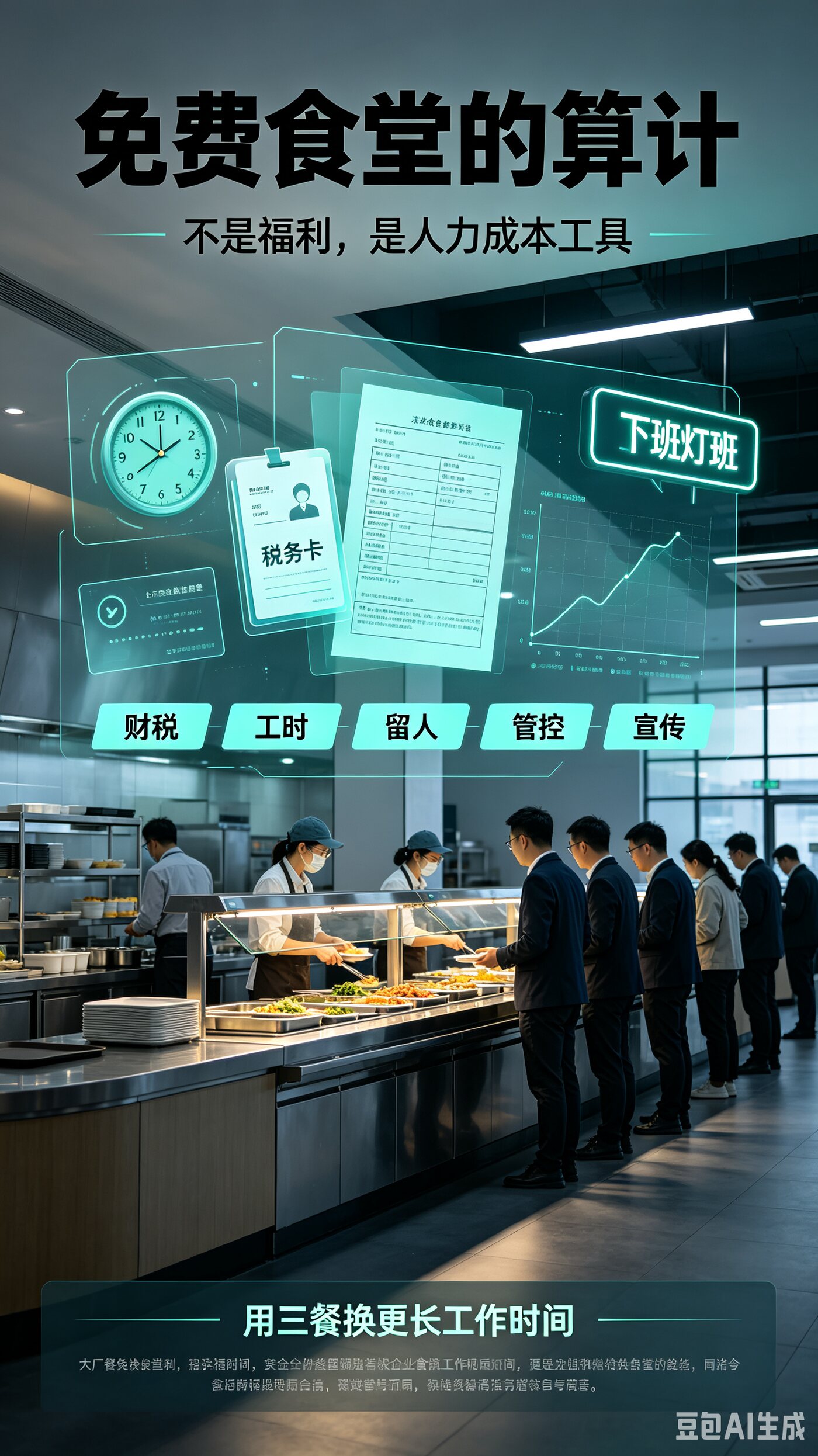
1. The Tax-and-Finance Calculation: The Same Money Goes Much Further as a Cafeteria Than as a Raise
1. Avoiding personal income tax, letting the company deduct costs
Giving employees a direct raise means the salary must pay personal income tax in full, shrinking what the employee takes home; a cafeteria meal subsidy counts as employee welfare expense, which the company can book in full as an operating cost to deduct against corporate income tax, without folding it into the employee’s taxable wages.
Simple math: spending 1,800 yuan a year on an employee’s meals, fully borne by the company with not a cent of tax deducted from the employee; switch to cash and the employee has a few hundred deducted in tax, while the company’s deduction quota is actually lower.
2. Compressing cash-compensation expectations
When recruiting, “free three meals” is packaged as an accompaniment to a high salary; under the same total package, the base salary can be pushed down. Employees default to “saving over 1,000 a month on meals = a raise in disguise,” accepting a lower fixed monthly salary, and the company’s long-term cash outlay on labor decreases.
2. The Time Calculation: Using One Meal to Lock Down Your Whole Workday
This is the most core trick.
1. Breakfast: forcing early arrival, stretching the daytime hours
Free breakfast mostly cuts off at 10 a.m.; to save on breakfast money, you must commute to the company early; many people get to their desk and casually turn on the computer, entering work mode early for free, and won’t go out to find food at lunch break either.
2. Dinner + late-night snacks: creating a strong motive to stay and work overtime
The vast majority of big companies set a threshold for free dinner/late-night snacks: only open after 19:00/20:00 in the evening.
- Leaving normally at 6 or 7, eating outside costs your own money; staying at the company to wait for the free meal equals “earning a meal’s worth”;
- After eating it’s already past eight, then waiting for the free taxi benefit, it naturally follows to work 1-2 more hours;
- It forms a group atmosphere: all your colleagues stay in the cafeteria to eat, and leaving on time makes it look like your workload isn’t full, forming implicit overtime pressure.
3. Eliminating the drain of going out, over-extracting efficiency per unit of time
Campuses are mostly in the suburbs, with few delivery options and restaurants nearby and far away. The free cafeteria saves the 40-60 minutes of round-trip commute to eat out; the whole block of lunch break is compressed inside the campus, ready to return to your desk to handle work at any time, directly increasing each person’s effective daily working hours by more than 1 hour.
The company’s calculation: investing one or two thousand per person per year in the cafeteria, in exchange for over a thousand hours of extra labor — an extremely high return on investment.
3. The Retention-and-Control Calculation: Creating Sunk Cost, Lowering the Willingness to Leave
1. Binding daily life, raising the cost of job-hopping
Employees who rely on the company for three meals, snacks, and afternoon tea over the long term form fixed life habits. Once they job-hop to a company without a free cafeteria, an extra 1,000-1,500 in dining expenses appears out of nowhere each month, and their standard of living noticeably drops, so they’ll proactively hesitate to leave.
2. Distinguishing full-time / outsourced, creating an identity barrier
At most big companies, outsourced and dispatched employees don’t enjoy the free three meals, and can only pay out of pocket or get a small subsidy. Using cafeteria benefits to divide identity reinforces full-time employees’ sense of superiority while pushing down outsourced workers’ bargaining power, indirectly lowering the overall employment cost.
3. Behavioral monitoring, drawing the boundary of company rules
Meal collection and spending are all bound to the work badge; the backend can record employees’ arrival, dining, and overtime periods; once behaviors like taking extra meals, taking snacks away, or carrying food out appear, they’re directly reported, punished, and entered into the integrity file — using small dining resources to constrain employee behavior and reinforce internal control.
4. The Cost-Operations Calculation: Seemingly Free, Actually Extreme Cost Control
1. Scale dilutes the unit price, waste is controllable
With over a thousand people dining together, the procurement cost of ingredients, labor, and consumables is far lower than at outside restaurants; even with a 28% waste rate under the free model, relying on the huge volume, the per-person daily meal cost is only a dozen-plus yuan.
2. Hidden cost-shifting
The cafeteria is outsourced to a third-party catering company, pushing down the contracting quote; cafeteria advertising, retail stalls, and peripheral brand partnerships can also generate extra revenue, offsetting part of the meal expenditure.
3. Monetizing and restricting the benefit
Meals and snacks can’t be cashed out, can’t be taken out, and expire if unused; the benefit can only be consumed inside the company and can’t be converted into cash the employee can freely dispose of — the initiative lies entirely in the company’s hands.
5. The Brand-and-Recruiting Calculation: Building an Industry Publicity Gimmick at Zero Cost
1. The core lead-generating selling point of recruiting
Internet job hunting is severely hyper-competitive; when salary gaps aren’t large, “free three meals, luxurious cafeteria” is the most intuitive publicity point, greatly lowering the cost of acquiring recruiting leads and attracting large numbers of fresh graduates and job seekers to apply proactively.
2. Spontaneous publicity on social media
Employees proactively show off cafeteria dishes and buffets, doing word-of-mouth marketing for the company for free, shaping the image of a “humane big company,” covering up negative issues like overtime and high-intensity work, and diverting public attention.
6. The Hidden Cost: Employees Seem to Save Money but Actually Pay a Hidden Drain
- Private time is continuously encroached upon. Forced to work overtime to catch the free meal, sacrificing dinner, companionship, and leisure time, exchanging personal time for a few hundred yuan of meal subsidy.
- Life space is completely swallowed by the company. Three meals, afternoon tea, and late-night snacks are all handled in the campus; the boundary between work and life completely disappears, leaving you in a “on call anytime” state for the long term.
- Bargaining power is weakened. After getting used to the free cafeteria, it’s hard to objectively assess your true salary level, and you easily underestimate your own compensation value when job-hopping.
- Diet is passively restricted. Cafeteria dishes are supplied uniformly; taste and healthy choices aren’t decided by you, and long-term dining there lacks the right to choose for yourself.
In Closing
Big tech’s free cafeteria is essentially a low-cost, high-return soft management tool: the company uses extremely low dining investment to exchange for longer working hours, lower cash outlay on labor, higher employee retention, and free brand publicity.
The so-called “free benefit” is essentially exchanging your private time and life boundaries for three meals a day.
It’s not that you can’t eat this meal, but you should see clearly the ledger behind it. Once you see it clearly, at least you’ll understand exactly what you’re exchanging for what.
评论
0 条评论