All the hustle and bustle under heaven comes for profit; all the coming and going under heaven goes for profit.
The Western Han historian Sima Qian wrote in the “Biographies of the Money-Makers” chapter of Records of the Grand Historian: “All the hustle and bustle under heaven comes for profit; all the coming and going under heaven goes for profit.” That sentence has traveled across a thousand years and still strikes the underlying logic of how the world actually runs. We spend our whole lives rushing about, struggling, making choices, apparently swept along by sentiment, morality and rules, when in fact everything we do circles around those two characters: “profit.” Today I’m going to take this eternal first principle — the word “profit” — and use it to unpack how so much of this world says one thing and does another.
From the construction of social order, to the trivia of everyday life, to the maneuvering inside workplace hierarchies, every seemingly complicated appearance, once you peel off the layers of packaging, hides the plainest survival truth of all: profit is the core that drives everything, while rules and slogans are merely tools for maintaining order and domesticating people’s hearts. In that chapter recording commercial activity, Sima Qian had already seen straight through human nature, holding that the pursuit of economic gain is an instinct of human activity, as natural and unstoppable as water flowing downhill.
Here are the conclusions I’ve reached after more than thirty years of observing and thinking:
Society: Two Sets of Rhetoric, One Set of Rules
Since ancient times we have run two parallel systems of discourse. The most typical example is the reign of Emperor Wu of Han — Emperor Wu appointed Dong Zhongshu to carry out reform, promoting “dismiss the hundred schools, revere Confucianism alone,” while in practice adopting the strategy of “Confucian on the outside, Legalist on the inside.” Outwardly, the Confucian “benevolence, righteousness, propriety, wisdom, trustworthiness” and “family, nation, world” served as the mainstream slogans, used to instruct the common people, unify their hearts, and make ordinary folks believe in this value system so they would willingly stay in their lane. Inwardly, however, harsh Legalist rules and the balancing of power politics were used to sustain the rule and distribute the benefits. That is the starkest double discourse of ancient times.
Bring it to the present day and the logic hasn’t changed. The safety nets the government talks about, the “raise children to support you in old age” guarantees, and the various small favors handed to people at the bottom — education fee reductions, tax breaks, medical insurance and social security, pension policies — are essentially just another form of interest exchange and domestication. The core hope is that people will feel “cared for,” so they willingly accept the rule of the regime, stay in their lane without harboring rebellious thoughts, and preserve the established social order and the established distribution of interests.
From childhood we are fed “fairness and justice,” “love of family and country,” “the right path in life.” These mainstream slogans, like the ancient “loyalty, filial piety, benevolence, righteousness,” are essentially spiritual symbols for unifying thought and rounding up hearts — no different from religious doctrine or the language of blessing prayers.
As the Israeli historian Yuval Noah Harari revealed in Sapiens, there is no god in the universe, no nation, no money, no human rights, no law, and no justice. These concepts, which seem indestructible, are essentially shared fictions invented by human beings, and their purpose is to bind groups together and regulate behavior, so that vested interests and decision-makers can better distribute benefits and maintain order. They draw the line between right and wrong for ordinary people, making us believe that if we follow this set of rules we can get the life we want, so that we willingly stay in our lane inside the given framework and quietly give of ourselves. Common folk are simply the objects being domesticated and ruled.
It’s like the healthy drinks on the low shelves at the entrance of a neighborhood convenience store: it looks like a convenience for residents, but it’s really about capturing children’s consumer instincts — simplifying choice, feeding desire, so kids can reach out and grab without having to think. That is a microcosm of modern society: using the cloak of “convenience,” “beauty” and “correctness” to dissolve people’s capacity for independent thought, letting the masses drift along a preset path in comfortable inertia. Behind this set of rules lie the merchants’ profit demands and the need for a stable social order — once everyone has been domesticated into obedience and passivity, no longer questioning, no longer overturning anything, the distribution of profit can proceed in an orderly fashion according to the established logic.
In our world, no matter which country or which regime, the rules of society have never been about absolute fairness; they are about maintaining the balance of interests. Exam-oriented education is the most typical example. What it cultivates is not the ability to think independently and critically, but the ability to quickly find the “correct answer” within a preset worldview — much like the eight-legged essay used to select officials in ancient times, which locked all the clever people under heaven into one uniform cage, ground down their edge, confined their thinking, and set everyone racing along the tracks of schooling and employment to compete for fame and gain. It both filters out people who fit the system and traps everyone in the obsession with “standard answers,” so nobody retains the ambition to break the rules. It’s just like the many parents who strain every nerve to squeeze their kids into key schools and high scores: essentially it’s not about letting the child truly grow, but about believing that “high score = good university = good job = stable income,” and that only by following this socially prescribed path of profit can you avoid detours. Japan back then was the extreme performance of this logic — the whole nation believed that “education changes destiny, hard work lets you rise,” and a generation was pushed into tutoring and problem-drilling from childhood, slogging through the exam hell, sleeping fewer than six hours, betting their entire lives on one diploma. Then the bubble burst, university enrollment expanded by forty percent right into an employment ice age, diplomas depreciated at breakneck speed, tuition at national and private universities became sky-high, students borrowed to attend school and spent a lifetime repaying, and the highly educated could only work as temporary teachers or convenience-store staff, with graduates of famous universities taking low-paid, futureless jobs. The government expanded master’s and doctoral enrollment to delay employment, and graduate school became a shelter — not out of love for academia, but to dodge unemployment. In the end it produced a million highly educated refugees: nobody wanted PhDs, and companies didn’t want to hire R&D talent. From “education decides everything” to a collapse in college entrance exam registrations and fewer than half of high school students going on to further study, the credential society fell from its altar. The so-called standard answers and formulas were ultimately smashed to pieces by the reality of the times. What’s more tragic is that a generation thought raising their credentials was seizing the era’s dividend, when in fact they were merely volunteering to extend the period during which they would be consumed. Those expanded master’s and doctoral quotas were never a gift to young people; they simply postponed the unemployment problem, turning the highly educated into cheaper, more obedient labor of better quality.
Behind this lies society’s profit demand for “order” — only a stable population makes the distribution of interests more controllable. Maintaining order, handing out livelihood benefits, rolling out preferential policies for the bottom tier — none of that is pure goodwill and compassion. There is only one core purpose: to stabilize the big picture at minimal cost, in exchange for one’s own long-lasting and secure interests.
Because once society is turbulent and people’s hearts scatter, the circulation of resources and the distribution of wealth are thrown into total chaos, and the existing structure of interests collapses outright. Only by firmly holding order steady — classes settled, common folk compliant — can those at the top calmly control resources, steer the flow of wealth, and reliably collect an endless stream of returns. This is the most basic precondition of long-term interest. Just like Japan’s post-bubble Heisei generation, the government’s core logic was identical: no courage to touch vested interests, no courage to lay off veteran employees, no courage to break the lifetime employment system, because forced reform would trigger mortgage defaults, corporate debt blow-ups and a financial system collapse. So it chose to sacrifice young people and college students, using delayed employment, expanded graduate enrollment and dispatched labor as buffers — essentially spending the least to keep order stable and preserve the upper tier’s structure of interests. The policies were all pie-in-the-sky, treating symptoms rather than causes; later on it basically gave up on helping college graduates find jobs, going years without a dedicated bill and relying only on excessive debt issuance to rescue companies, blind to the plight of the young. Handing over a portion of the profits as subsidies, guarantees and basic welfare looks like giving something up, but it’s actually the most cost-effective way to pacify people. Otherwise, just look at history — how many royal families at the end of a dynasty came to a good end?
- Hu Hai, the Second Emperor of Qin: the Qin dynasty’s harsh laws and excessive extraction from the people utterly ignored their suffering, and when order collapsed completely it triggered peasant uprisings. Hu Hai was ultimately forced to commit suicide by the powerful minister Zhao Gao at just twenty-four years old, buried hastily after death with the rites of a commoner. The imperial bloodline of Great Qin was nearly extinguished; he held all under heaven and ended up dead with his state destroyed.
- Liu Xie, Emperor Xian of Han: a puppet his whole life, adrift for half of it, never holding an ounce of real power from the day he was enthroned. For half his life he was held hostage and dragged around by various warlords, enduring every humiliation, watching with his own eyes as the Han realm crumbled piece by piece. Though he died peacefully, he lived his whole life without autonomy — a Son of Heaven reduced to a chess piece in someone else’s hand, a lifetime of pent-up frustration.
- Yang Guang, Emperor Yang of Sui: he squandered the people’s labor and wealth on a grand scale and pursued endless wars, exhausting both the people and the treasury until common folk were driven to a dead end and heroes rose on all sides. Trapped in Jiangdu and abandoned by everyone, Yang Guang was finally strangled to death by his own palace guards. After death he didn’t even have a decent coffin; Empress Xiao had to pry apart the bed boards to piece together a thin coffin for a hasty burial. The emperor who had once glared down the world died in misery and disgrace.
- Li Yu, the Last Ruler of Southern Tang: indulgent in pleasure and neglectful of governance, he watched his national strength decay until defeat and the loss of his kingdom reduced him to a prisoner of the Northern Song. From the pinnacle of imperial dignity to a captive of a fallen state, imprisoned deep in the palace and humiliated, powerless to resist even when his wife was violated, he lived every day in shame and grief. He was finally given poisoned wine by Emperor Taizong of Song and died horribly; a lifetime of talent destroyed, family and nation utterly wiped out.
- Emperor Huizong and Emperor Qinzong of Song (the Jingkang Humiliation): in the late Northern Song the court was corrupt, the people’s livelihood withered, and there was no ability to resist foreign invasion. The two emperors were captured together by the Jin troops and marched north, tortured and humiliated all the way, with imperial consorts, princes and ministers all taken. Emperor Huizong endured bitter cold and humiliation and died of illness in the wilderness; Emperor Qinzong was wantonly tortured and trampled, finally dying miserably in a foreign land. It was the most humiliating and brutal end of any ancient emperor. Once the old dynasty’s great edifice falls, even their bones cannot be preserved — the top tier’s dignity after death is crushed completely by the new regime. Right after the Southern Song fell, Yang Lianzhenjia, the Yuan dynasty’s Buddhist supervisor of Jiangnan (a Tibetan monk), with the support of the chancellor Sangge, openly looted the Southern Song imperial tombs. Yang Lianzhenjia led men in, split open Emperor Lizong’s coffin, hung Lizong’s body upside down from a tree to drain out the mercury in his abdomen, and pried the luminous pearl from his mouth. Because Lizong’s skull was especially large, Yang Lianzhenjia ordered it cut off, scraped clean of rotting flesh, and made into a drinking vessel, which he showed off among the Yuan aristocracy.
- Zhu Youjian, the Chongzhen Emperor: diligent in governance yet powerless to save a dynasty past the point of return, with endless infighting at court and constant natural and man-made disasters among the people, who were displaced and rose up in revolt. After Li Zicheng broke through the walls of Beijing, Chongzhen had nowhere to turn and hanged himself on Coal Hill — alone, on a crooked-neck tree, with only a single eunuch at his side. Before dying he personally killed his own flesh and blood. How desperate, how desolate.
- Puyi, the Xuantong Emperor: China’s last legitimate emperor, three rises and three falls in one lifetime. Enthroned as a child with no understanding of power, abdicated young and stripped of imperial authority, then for half his life reduced to a puppet used by every competing force, drifting and wandering until he lost every privilege and every shred of imperial dignity. The once-supreme glory of the royal house vanished completely into smoke.
Imperial power and the circle of vested interests form one gigantic edifice standing in the world. The foundation of the whole building is a stable social order, an obedient population at the bottom, and a rigid system of wealth distribution. The walls, beams and pillars are the law, ritual teachings, public opinion indoctrination and hierarchical rules. Every space inside the building, every resource, every fertile field and fortune, every position of power and status is firmly occupied and divided up by the top circle.
When the edifice is stable, those on the upper floors enjoy glory and pass the dividends down through generations. They only need to hand over a few scraps from the edges as grace and welfare to keep the foundation at the bottom steady and the whole structure standing for a long time.
But once extraction becomes excessive and popular sentiment is completely lost, the foundation loosens, the walls crack, and the building is on the verge of collapse — and the first to be smashed to pieces are always the power holders at the very top. The old dynasty crashes down, the old structure of interests is thoroughly shattered, and nothing the former royal family and nobility accumulated over generations — wealth, power, fiefs, privilege — can be preserved.
When a new force rises and knocks down the old building to construct a new one, every resource, every territory, every connection, every enterprise of the old ruling class is taken over wholesale and redivided by the new power holders.
The old elites are left with nothing — cast onto the streets, dying in foreign lands, humiliated to the end. The new elites move in on the tide, reap everything their predecessors accumulated, rebuild their own edifice of interests, and go on applying the same stability-maintenance logic, round after round. Take an example: at the end of the Ming, the court officials, imperial relatives and wealthy merchants of the capital squeezed the people dry on a daily basis and hoarded enormous quantities of silver, watching with their own eyes as the common folk of the realm were displaced, hungry and freezing — and still they clung to their wealth and refused to let go. Even so, the vested interests kept squeezing: they levied the massive “Liao military tax” and carried out layoffs, which finally brought social turmoil and peasant uprising. When Li Zicheng’s army broke into Beijing, they immediately turned on this upper-tier group with a campaign of “recovering stolen goods to fund the army”:
- Regardless of rank high or low, everyone was arrested and detained, with strict quotas set for the amount of silver to be handed over.
- Anyone unwilling to hand over their family property obediently, or who hid and concealed it, was subjected to various tortures to force payment.
- The once-lofty court officials and great families were instantly reduced to prisoners, their property confiscated, their lives at risk, and the wealth of a lifetime drained out completely.
These people had enjoyed glory thanks to a stable court order; once that order collapsed, they were the first to meet catastrophe, and their former privileges and riches were wiped out overnight.
Later, when the Qing army entered the pass, many old bureaucrats thought that driving out the Chuang King and letting the Manchus rule the Central Plains would return them to stability and to their former lavish lives. They were bitterly disappointed:
- After taking control, the Manchus first enclosed land, seizing huge amounts of the fields and property of northern gentry and landlords and dividing up the original prime resources.
- They imposed the queue hairstyle and Manchu dress along with harsh laws; those who did not comply were punished outright, and the gentry of the old dynasty lost all their former dignity.
- Court power was reshuffled, with nobles from beyond the pass and the Eight Banner sons occupying the core upper positions. The Ming-era civil officials and financial cliques were pushed to the sidelines — either kneeling in submission to scrape by, or gradually suppressed and eliminated.
- Most of their past wealth, connections and influence were nibbled away and swallowed by the new ruling class, and they still lost any independent voice.
Conversely, keeping the situation stable and using a few small material benefits to smooth over the resentment at the bottom, easing survival pressure and dissolving dissatisfaction, makes ordinary people feel that life still has something to look forward to — and then, naturally, no rebellion or restlessness will breed. Spending a little money to steady people’s hearts is far cheaper than the price paid after turmoil. On one hand, morality, sentiment and notions of legitimacy are used to unify thought; on the other, basic welfare underwrites daily life. With soft and hard combined, the masses more readily accept their current state of existence and follow the established rules. When everyone is content with their own position and doesn’t touch the vested interests’ cake, those interests — status, power, wealth — can be preserved for the long run. The vast majority of reforms are essentially pie in the sky. Deep change that actually touches the cake of the vested interest group has always been hard to carry through. For power holders and the circle of vested interests to protect their long-term gains, they will absolutely never touch their own core foundation, so reform only floats on the surface, adjusting trivial peripheral rules and putting on a show to pacify the public. Outwardly they loudly promote reform dividends, future prospects and benefits for people’s livelihood, constantly tossing out all kinds of beautiful plans and visions — that is simply drawing an unreachable cake for ordinary people. It keeps everyone working away with their heads down in expectation, patient and enduring, believing that life will slowly get better, willingly staying inside the established order and continuing to give.
What’s even more brutal is that these several loans are the sharpest sickle for harvesting ordinary people today, locking down a whole lifetime’s way out.
In ancient times the people were squeezed through taxes, corvée labor and land annexation. Today it wears a civilized cloak, and mortgages, car loans and all kinds of consumer credit have become the handiest harvesting tools of the new era — a gentle kidnapping, a precise grip.
Mortgage: locking down the foundation of half your life. You drain six wallets to scrape together a down payment, then carry enormous principal plus interest for decades, with most of half a lifetime’s income going to the monthly payment. Your whole life revolves around the house: you dare not lose your job, dare not get sick, dare not stop. It nails you firmly to your wage-labor post, strips away any leverage to turn things around, and empties out the savings of several generations in one go.
Car loan: overdrawing your daily slack. A car for getting around would be enough, but you follow the crowd in pursuit of face, buy on loan and pay monthly, while the costs of keeping a car pile up layer after layer, adding a burden to life for no reason, squeezing household spending and turning what was a comfortable existence into something tight and pinched.
Consumer credit: hollowing out your future’s foundation. Short videos and consumerism endlessly promote pleasure, keeping up appearances and an exquisite life, pushing ordinary people to spend beyond their means, with online loans, installments and credit loans everywhere. Spending tomorrow’s money to fulfill today’s dream, the debt keeps rolling and the interest keeps stacking, until in the end you are mired in a pit of debt you cannot climb out of.
Combined, these three amount to an uprooting harvest: borrow like crazy when young and mortgage your future, spend middle age repaying with no room to relax, and arrive at old age exhausted with nothing saved — a lifetime of toil, with most of your life’s effort going to debt repayment and not a single coin left in your hand. The upper tier uses the credit system to circulate wealth and collect interest while sitting still; the bottom tier works with its head down and becomes a debt-repayment machine. The class gap is thereby firmly fixed, and it is nearly impossible for ordinary people to break free. Household debt during Japan’s bubble economy was even more shocking — ordinary families at one point carried debt equal to 3.1 times their annual income, and young people signing a mortgage at thirty repaid it for life; it could fairly be called “the devil’s contract of life.” Three generations’ savings for one apartment, half a lifetime’s income poured into bank interest. Life looks glossy, but from the moment you sign the contract, the initiative over the next several decades of your life has been handed over. More ironic still: you think that holding property means sitting on an asset dividend, but in fact the heavy debt you carry and the stable monthly payments you make for decades are the ultimate dividend that the property market and the financial system steadily swallow. Ordinary people empty their family fortune and put on the shackles, never daring to lose a job or stop for a lifetime, forced into living as an instrument of debt repayment — from beginning to end, you are the one being consumed.
Look again at the rent subsidies and living allowances various cities give fresh graduates. On the surface it’s talent welfare; in essence it’s precision traffic-driving and the targeted cultivation of new chives. Every subsidy is low-cost bait.
Small subsidies in exchange for population inflow, to work through property inventory. Graduation rent subsidies are limited in amount — they can barely cover part of the rent and don’t count as genuinely universal welfare. The purpose is to bring in young people from other places in bulk, filling the city’s population gap, taking over vacant developments and second-hand apartments, holding up the floor of housing prices, and preserving the core interests of land finance. Once young people settle down, sooner or later they have to buy a house and take on a mortgage — that is where the real money is.
Filling in cheap labor and driving down the whole city’s wage level. A steady stream of fresh graduates floods in, labor supply surges, companies have no trouble hiring, and so they naturally depress starting salaries, lengthen working hours and entrench the atmosphere of the rat race. The city enjoys abundant cheap talent, industrial labor costs keep falling, and the beneficiaries are companies and the local economy — the newly arrived young people have no choice but to accept low pay and the rat race.
Driving consumption across the board and breeding long-term debt. Once young people enter the city they need food, clothing, housing, transport, socializing, entertainment, romance and marriage, boosting the local consumer market in every direction. First a meager subsidy gets them settled, then city resources, matchmaking pressure and the need to start a family push them to spend beyond their means and live on credit, step by step drawing them into the debt loop of car loans, consumer credit and mortgages, thoroughly rooting them as a group to be harvested long term.
Only driving traffic in, providing no guarantees — once used up, they are naturally diverted and eliminated. The policies only handle attracting people into the city; they don’t handle employment safety nets, wage guarantees, or the long-term welfare of settling and registering a household. Layoffs at 35, workplace elimination, unemployment from industry downturns — none of it is covered. Once young people’s youth and energy are spent and they lose their use value, unable to bear the cost of city life, they are naturally forced to return home and leave, and the next batch of fresh graduates is swapped in. Round after round.
Driving up the cost of city living, making the subsidy a drop in the bucket. A mass influx of young people directly pushes up rent, prices and living costs, and the rent subsidies handed out are quickly offset and canceled by the rising cost of living. It looks like giving money and giving up profit, but in reality it raises the overall threshold of survival in disguised form, and in the end all the pressure of living is still borne by the young people themselves.
At the end of the day, cities handing out graduate subsidies have never sincerely meant to support young people’s growth. It’s about completing a whole set of interest arrangements — population inflow, propping up the property market, labor supply, and debt cultivation — at minimal fiscal cost. Bring new people into the city, raise a new batch of indebted people, and keep the city’s profit machine running. That’s all.
I was born into a poor family, and I remember that thirty years ago life was very frugal — food and clothing were just barely enough, but we were quite content. There was no mortgage or car loan weighing on us, no layers upon layers of life’s burdens. As a child I had no cluttered thoughts in my head; being fed and warmly dressed was enough to live freely and at ease. Everyone’s desires were low, what we asked for was little, and passing the days in peace was complete fulfillment.
By contrast, now that I’ve grown up, society keeps pumping in consumer values, comparison values and the ideology of striving upward, endlessly inflating desire. Buying a house, raising children, supporting the elderly, social obligations — all kinds of consumption wrap layer after layer of shackles around the body, and everyone is pushed to run forward at full tilt. A lifetime of hard work, slogging away for most of your life, and in the end there’s nothing left in your hand; instead you carry a heavy mortgage and pay high interest year after year, with half a lifetime of toil spent running after debt. Then at 35 you get kicked out by the system, and even finding a job to feed the family is hard.
Living conditions look better, with food, clothing, housing and transport all in place, yet this abundance was entirely bought by mortgaging the future. Before, people lived a human life; now slaves live this life. Lao She’s Rickshaw Boy appears to write about the man-eating society of the old days, but isn’t it exactly the same if you put it in the present?
Lao She’s Rickshaw Boy writes about how cruel the old-era world was: a man at the bottom pulls with all his might, and in the end all his effort comes to nothing, his spirit ground down bit by bit by the world, his life’s blood exhausted, never able to escape the cage of fate — a lifetime of hardship ending with nothing. Set it in the present and the inner core is identical; only the skin has been changed.
Before, Xiangzi made a desperate living pulling a rickshaw and was squeezed layer after layer by the times, by social give-and-take and by the ways of the world. Today countless ordinary people struggle along on the strength of one job and are squeezed layer after layer by mortgage debt, the workplace rat race and living costs. Xiangzi pulled a rickshaw and sold his life for his whole existence, up before dawn and home after dark, giving it everything, saving every penny with the single aim of accumulating enough to buy a rickshaw of his own and live an honest life. Three rises and three falls: the rickshaw was lost, the money was gone, hope was utterly destroyed, and in the end he lived on as a walking corpse. Yet until the very end of his life he remained deeply fixated, convinced that his failure to get ahead was entirely because he hadn’t worked hard enough.
The suffering of the past was out in the open, clear for everyone to see. Today’s predicament hides beneath the prosperity, using striving, prospects and a beautiful life as its cloak, quietly trapping a generation. Everyone strives desperately, rushes forward desperately, burns through youth and energy, and in the end most are left with a body full of debt. Half a lifetime of toil doesn’t buy peace; the spirit of youth is ground flat by reality; the earliest hopes slowly come to nothing; and in the end one can only bow one’s head and compromise, carrying the load forward along the preset track.
The shell of the era has changed, the shape of life has changed, but the situation of people at the bottom struggling to survive, giving everything and still unable to break free of their predicament, has never truly changed. The old era ate people, and the world today still wears down ordinary people’s spirit and vitality, trapping the whole of an ordinary person’s life. Xiangzi’s tragedy has never fully gone away; it has only changed form and keeps being staged in the lives of ordinary people. And wasn’t Japan’s post-bubble generation exactly the same? Born in the baby boom of the seventies, they witnessed economic takeoff in childhood and saw seniors fought over by big companies. Full of longing, they studied desperately — and graduated straight into the employment ice age. Informal employment and low pay squeezed them layer upon layer; the former chosen ones of heaven became dispatched workers, still living with their parents past thirty, becoming “full-time children.” Seeing that no amount of effort could realize their life plans, the whole society was forced to lower its desires and abandon the rat race, and the low-desire society and otaku culture swept everything. And when that employment ice-age generation reached middle age, they were not renewed by dispatch companies, slid into temporary-worker households, were old without stable work, and faced bankruptcy in old age and generational sinking. Today’s young people lying flat, having low desires, and refusing romance, marriage and childbirth isn’t a lack of ambition — it’s because they see that the era’s dividends never reach the bottom, and effort can hardly change one’s fate.
Society keeps sketching blueprints of an ever-better life and preaching that effort can change your destiny, when in fact it has merely changed the way it binds ordinary people — trapped for a lifetime in the cycle of repaying debt, grinding away, and supporting a family.
I chased the era with everything I had, and only in the end did I wake up: the so-called dividends of progress mostly don’t fall on ordinary people at the bottom at all. Instead they have locked a generation firmly inside worldly pressure and monetary debt, and cost us the simplest, purest joys of before.
And Xiangzi’s most pitiable point isn’t just the three rises and three falls, the lost rickshaw, the lost money, the shattered hope, the living on as a walking corpse. What’s more pitiable is that until the very end of his life he remained deeply fixated, convinced that his failure to get ahead was entirely because he hadn’t worked hard enough.
From start to finish he could never see the real root: it was never that he was lazy or slack, never that his will was weak, but that he lived in a man-eating world where the rules themselves locked down the way out for people at the bottom completely. Heavy taxes squeezed him layer upon layer, the powerful bullied him at will, and a turbulent world set up checkpoints everywhere. No matter how hard ordinary people worked with their heads down, all their blood and sweat could not withstand the successive harvesting of the times and the system. He was thoroughly domesticated by his environment, attributing all suffering inward, blaming himself harshly, never daring to raise his head and see the injustice outside and the established structure of interests.
Put it in the present and it is exactly the same. Countless ordinary people carrying mortgages, mired in the rat race, unemployed in middle age also often fall into self-doubt, feeling that life is hard because they aren’t ambitious enough, capable enough, hardworking enough. Little do they know that today’s mortgage shackles, age discrimination, workplace over-extraction, debt bondage and the embrace of consumerism are no different from the world that trapped Xiangzi back then. Individual effort, facing a rigid structure of interests and rules of successive harvesting, is far too feeble. Many people spend their entire lives living as modern-day Xiangzi, busy with self-blame and self-examination, and never see that what traps them was never laziness but a game set up long ago.
Life: Social Give-and-Take Is Essentially an Exchange of Value
In life we are even more constantly swept along by “profit” — it’s just that most people don’t want to tear away that veil of warmth. The dealings between people look like social give-and-take, but most of them are really an exchange of value and a complementing of interests. The saying “the more friends you have, the easier the road” essentially means each side can provide the benefits the other needs — perhaps emotional comfort, perhaps resource support, perhaps practical help. For instance, some people rarely contact their friends, but the moment they need to borrow money or pull strings to get something done, they suddenly become warm and enthusiastic. Or take neighbors: you watch my kid, I collect your packages — that’s essentially a subtle exchange of interests too. When there’s no profit to be had, even the warmest relationship slowly drifts apart; when there is profit to be had, even complete strangers can quickly draw close.
Marriage can’t escape the essence of interest either. We always feel marriage is “true love above all,” but in reality demands like the bride price, the three gold pieces, the car and the apartment are essentially expressions of interest: the woman’s family uses these material demands to exchange for their daughter’s future security in life, and the man pays out these materials to obtain a stable relationship and a partner to live with — essentially another exchange of interests. There is no eternal warmth, only an eternal balance of interests; once that balance is broken, the so-called “true love” collapses at a touch.
Even the family affection we treasure most can hardly fully escape its undertone of interest. Even parents having children carries some measure of interest-driven motive. The so-called “raise children to support you in old age” and “carry on the family line” are essentially a long-term investment, corresponding to what economics calls “intertemporal exchange” — parents invest time, energy and money in raising a child now, essentially so that in old age they can receive companionship, care and security, exchanging present input for future life support. Japan’s post-bubble “drifting tribe” felt this especially keenly. Unable to stay in the city and unable to return home, with unstable work and no visible future, they simply gave up on marriage, childbirth and buying a house. After dispatched-worker families fell into poverty, the proportion of children resenting their parents and society was extremely high, and the current of blaming one’s family of origin for its mediocre class position spread widely. Under the pressure of survival, warmth fades fast, and family affection too can hardly escape its undertone of interest. When there’s no profit to be had, even the warmest relationship slowly drifts apart; when there is profit to be had, even complete strangers can quickly draw close.
The Workplace: Slogans Are the Sugar Coating, Interest Is the Core
And nowhere is this “logic of interest” better embodied than in the workplace. The workplace has never been a place for sentiment and ideals. Those slogans about “vision,” “dedication” and “long-term growth” are merely the polite talk the upper tier uses to soothe hearts and over-extract energy. It’s as blunt as the conversation between Chen Jinnan and Wei Xiaobao in The Deer and the Cauldron:
Chen Jinnan said to Wei Xiaobao, “Xiaobao, you’re a clever man, so I can talk to you the way one talks to a clever man, but with people out there you can’t. Those who have studied books and understand reason are mostly officials in the Qing court, so if we want to take on the Qing court we need to use some dumber people. And when dealing with those dumb people you absolutely must not tell them the truth; you have to hypnotize them in the form of religion, so they feel that what they’re doing is right. So ‘overthrow the Qing, restore the Ming’ is just a slogan — it’s really the same as ‘Amitabha.’ The Qing has always oppressed us Han, taking our silver and our women, so we must overthrow the Qing.” Wei Xiaobao asked back, “So we overthrow the Qing to grab back our money and our women, right? Whether or not the Ming is restored is basically farting with your pants off — what the hell does it have to do with anyone?” Chen Jinnan then went with the flow and made it plain: “In short, if we succeed, there will be countless silver and countless women.”
It’s clear that “overthrow the Qing, restore the Ming” was never some noble righteousness — it was only a tool for binding hearts together, and the core inside was always the distribution of interests.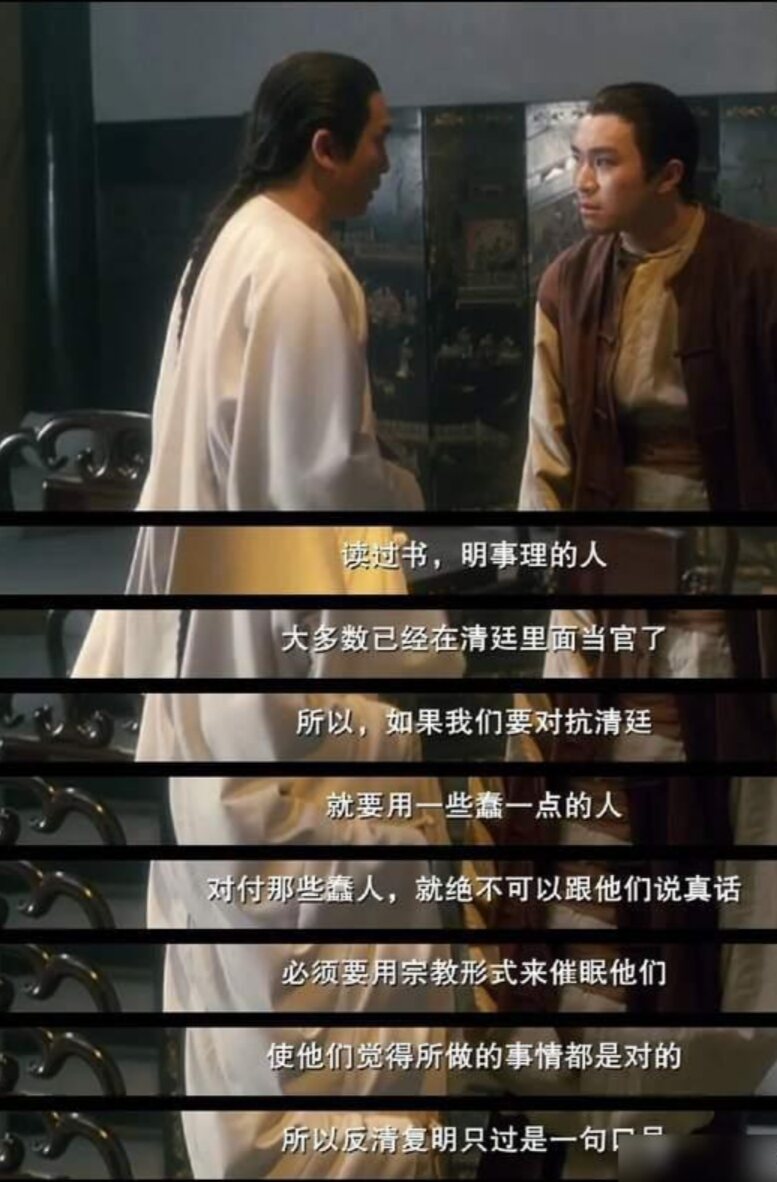
In the workplace, upper management complains out loud that subordinates are “hard to communicate with” and blames them for not cooperating, yet never proactively builds a communication mechanism or sets aside their own status to empathize. Essentially they want subordinates to adapt unconditionally to their rules, to lower management costs and control core resources. They talk about “team spirit,” yet are vague about salary, compensation and protection of rights — they simply want to buy the maximum effort from employees at the minimum cost. Just like some companies that at the annual party talk grandly about “family culture” and “growing together,” but when it comes to year-end bonuses and raises, find all kinds of excuses to dodge, and even make employees work overtime unpaid under the fine name of “building your abilities.” And employees’ “hard work and ambition,” though it looks like the pursuit of self-growth, is ultimately about earning a salary to support a family and seeking higher status and returns. We rely on the platform and obey the rules only because the platform can give us the benefits we need to survive. Once the interests become unbalanced, the so-called “loyalty” and “devotion” collapse at a touch.
The hierarchical maneuvering in the workplace is essentially a fight over interests. Clever people have long seen through this logic: they aren’t swept along by slogans, aren’t kidnapped by sentiment, don’t wear themselves out internally. Outwardly they go along with the rules; inwardly they focus on using the resources the platform grants to train their various abilities — communication and coordination, managing upward, technical skill and so on — preparing for the day when they can support themselves apart from the platform. But those deeply stuck in “standard answer” thinking are still wearing themselves out over the “ideal job” and “workplace recognition,” hoping upper management will change and the platform will catch them. In the end they can only become replaceable screws in the system, and once they lose the platform’s shelter they are at a total loss.
The reason labor law isn’t properly enforced, and the reason illegal overtime like 996 and 007 is so prevalent, isn’t fundamentally that companies run wild — it’s the interest calculus of local development. In Lan Xiaohuan’s Inside the System: The Chinese Government and Economic Development, he notes that one of the core tasks of local governments at every level is attracting investment, and the core of attracting investment is getting investors to land, driving local economic growth and increasing employment. That directly affects local fiscal revenue, and it is closely tied to the career prospects of local administrators.
If they strictly supervised and enforced labor law against companies’ employment practices — forced overtime, failure to pay overtime as required, ignoring labor law provisions — it would inevitably raise companies’ labor costs, and might even drive some profit-maximizing investors to withdraw capital and relocate. For a local government, investors leaving means slower economic growth, fewer jobs and shrinking fiscal revenue, which in turn affects its own performance assessment and career advancement.
So many localities tend to “turn a blind eye” to companies’ illegal employment practices. It looks like lax supervision, but it’s really a choice made after weighing pros and cons — compared with strictly enforcing labor law and protecting workers’ rights, localities care more about the short-term benefits and performance boost that attracting investment brings. That turns labor law’s constraints into “paper provisions,” makes 996 and 007 the “unspoken rule” in some industries, and sweeps workers along in the wave of overtime. Even knowing their rights are being violated, they often can only passively accept it, because the cost of defending their rights is high and the channels are limited. This is entirely of one piece with the core logic we discussed before — “rules serve interests.” After Japan amended its Worker Dispatch Act and opened dispatching to all industries, one in every two graduates became a temporary worker; the rate of temporary workers converted to permanent staff was only forty-seven percent. Companies didn’t keep permanent employees and laid people off at will; newcomers were expected to be combat-ready the day they graduated, with zero tolerance for mistakes. Science and engineering, once revered as the foundation of the nation, later saw industry move offshore and domestic positions shrink — engineers worked extreme overtime at an hourly wage only forty percent of America’s, carrying mortgages and stuck to death in middle age. Localities, to protect the economy, protect companies and protect their own performance records, turned a blind eye to employment chaos, and labor law became a paper rule — exactly like 996 becoming an unspoken rule today. Companies use sentiment and growth as slogans, unwilling to offer permanent positions or guarantee rights, buying maximum labor at minimum cost. The profit calculus behind this has never recognized national borders. It’s even more so in the workplace: companies loudly promote growth empowerment, platform opportunity and booming tracks, drawing every kind of bright-future cake, making young people willingly bow their heads into the rat race, work unpaid overtime and patiently endure over-extraction. Everyone thinks that joining a big company and entering a hot industry means sharing in the industry’s development dividend. Little do they know that what companies truly value has never been your ideals and ambitions, but your burning enthusiasm, your cheap time and your giving without counting the cost. Young people set aside their dignity and bow their heads to make a living, thinking that if they endure long enough they’ll get a share — and in the end they merely become the handiest tool for companies to compress costs and earn profit. You think you’re chasing the workplace dividend, when in fact your youth and energy are themselves the dividend being consumed by others.
At the micro level of the company, the nitpicking, suppression and psychological PUA in the workplace are never about your ability being inadequate or your work being poor. Essentially this system deliberately nails people down as standardized screws.
Deliberately narrowing the boundaries of your ability. The system only needs you to master this one small process, this single business, this fixed script. Any extra breadth of vision, thinking or cross-disciplinary skill is not needed at all — and may even be deliberately suppressed. Over the long run, all of your abilities fit only this one position and this one company’s internal rules; step outside that environment and your past experience is instantly worth far less.
Domesticating thought through the evaluation system. Leaders deliberately find fault, deny your contributions and instill “you’re still not good enough.” The purpose is to wear away your confidence, make you doubt yourself, and keep you willingly in your place — not daring to step outside the circle, not daring to conceive other ideas, thoroughly obedient to organizational rules.
Manufacturing dependence on the position. Working for years in reliance on the platform’s resources, the company’s name and the internal processes, you eventually can’t tell: was it the platform that made you, or do you actually have real, solid hard skills? Once you’re laid off or leave the organization, you instantly fall into confusion, feeling you have nothing and are good for nothing, and you lose the confidence to make a living independently.
The screw’s destiny is to be replaceable. The system produces countless identical screws, seeking only fit and function, not comprehensive growth. The more you fit the position, the more obedient and compliant you are, the more easily you are firmly trapped. When your energy declines and your cost-performance ratio drops, you can be swapped out for a new part at any time, with no irreplaceability whatsoever.
So real strength is being able to make a living without a business card. People trapped inside the system bind their life’s value to their position and organization. Only by stepping outside the framework do you realize that the denial and harsh criticism in the workplace were all meant to keep you in your place — not proof that you are truly mediocre. A person shouldn’t live as a screw that fits only one machine, but should preserve their own complete abilities and character, so that even after leaving any platform they still have the confidence to stand in the world.
Many companies also re-sign contracts every few years and keep adjusting the organizational structure. Every move is precise profit calculation.
Frequent contract re-signing plus restructuring — the core aim is only cost reduction. Re-signing contracts every few years, splitting entities, transferring departments: this directly cuts off continuous length of service, so that later layoffs and dismissals require no hefty economic compensation, shedding long-term labor costs entirely. Using restructuring to reshuffle, they depress base salaries, cut hidden benefits and tighten performance reviews. Veterans’ compensation quietly shrinks, newcomers are hired at lower standards, and overall labor costs drop sharply. With the environment constantly changing, people’s hearts are never settled; employees dare not coast along or make demands, and can only passively obey arrangements, letting the company handle and deploy them as it pleases.
High pay is itself a precision trap. Offering a salary above the industry average is an equal exchange for unlimited overtime, extreme performance pressure and harsh assessment targets — a total buyout of your personal time and energy. The monthly figure looks dazzling, but converted against excessively long daily hours, unpaid holiday overtime and sacrificed rest and health, the actual hourly rate is far below that of an ordinary stable position. Put plainly, it’s trading time and health for money. Taking that high salary means you must accept rat-race culture, workplace PUA and indiscriminate overtime, losing the confidence to refuse; the moment you can’t keep up with the pace, you’re eliminated and replaced.
So-called cost reduction and efficiency gains always over-extract from the front line only. Companies shout about improving quality and efficiency, but essentially they transfer all operating pressure onto employees. Headcount is cut, one person does several roles, responsibilities pile up, workload multiplies while salary growth can’t keep pace with the growth in load. Profits flow to shareholders and upper management; the hardship and the internal friction are all borne by the front line.
There is no high salary without reason in the workplace, and no benign restructuring behind frequent changes. Every rule change, salary design and atmosphere of the rat race starts from one point: maximizing corporate profit. The more a person clings to the halo of that high salary, the more easily they are trapped in endless consumption — exhausting body and mind, and then looking back to realize the loss outweighs the gain.
What’s even more deadly is layoffs at 35. From beginning to end it comes down to one word: profit. It has nothing whatsoever to do with ability, attitude or devotion.
The interest gap in labor costs. Above thirty-five, you have long service, high salary, high social security and housing fund costs, more family burdens, less energy than young people, and less overtime drive. In a company’s eyes: veterans’ cost-performance ratio keeps falling, while young labor is cheap, obedient, able to be over-extracted and willing to work overtime. Swap out the old, bring in the young, compress labor spending directly, and profit goes up immediately. That is the most blunt profit calculation.
Risk-avoidance interest. Once middle-aged employees get sick, run into problems, or have a strong sense of defending their rights, the hidden risks a company must bear grow larger. Cutting middle-aged people reduces employment hazards; the company doesn’t have to shoulder long-term retirement support or stable positions — those hidden responsibilities — and pursues only short-term profit. Shedding the burden is protecting its own interests.
The industry’s profit-chasing instinct. Capital and companies look only at cash flow, performance and expansion speed; they don’t speak of sentiment or length of service. When the market is good they keep people around to hold up appearances; when the market turns down, the first wave cut is the high-salary middle-aged group, prioritizing company profit, shareholder returns and executive dividends. The security of middle-aged people at the bottom is sacrificed first.
Deliberately creating an age filter to entrench the profit-squeezing model. Intentionally setting the 35 threshold is what forms the industry’s unspoken rule: sell yourself desperately and burn out your body when young, then be discarded the moment you pass the age line. Middle-aged people are never allowed to stand firm in senior positions and get a reasonable return, so workplace people stay permanently in anxious competition — convenient for companies to keep hiring labor cheaply and harvesting labor value over the long run.
Exactly the same as the ancient logic of exploitation. In old times able-bodied labor was used up and thrown away; today the workplace squeezes out young and middle-aged energy and then lays people off. All age discrimination, workplace elimination and midlife crisis are essentially capital selectively replacing labor with cheaper labor to maximize its own interests. There’s no such thing as middle age being worthless — it’s just that your age no longer fits the other side’s profit needs. When the profit runs out, you’re discarded. That’s all.
Widen the view a bit more, and the essence of state-owned enterprises, central enterprises and private companies using large numbers of outsourced temporary workers is the same — thoroughly the same logic from the same root, with the core still being those two characters: interest. It has nothing to do with sentiment, establishment status or responsibility.
Compressing labor costs to the extreme. A permanent position comes with salary, the five insurances and one fund, year-end bonuses, holiday benefits, seniority raises and retirement security — all of it, with costs staying high. Outsourced and temporary workers get only a basic base salary; social security is paid at the minimum standard or not at all, there are no extra benefits of any kind, and there’s no need to bear long-term salary growth. Labor spending is cut in half directly, savings are maximized, and the company’s own returns are thickened.
Flexibly shedding all responsibility. Permanent employees mean bearing labor relations, work-injury compensation, dismissal compensation and labor arbitration risk. For outsourced personnel, the labor relation belongs to a third-party company — when something goes wrong, accountability, work-injury claims, layoffs and dismissals are all handled by the outsourcing company. The entities within the system and the private companies escape perfectly, bearing no after-effects of employment, and can let anyone go at any time.
Circumventing establishment and headcount limits. State-owned and central enterprises have strict establishment controls, and permanent slots are scarce and insufficient. Large volumes of dirty work, hard work and basic chores are all dumped on outsourcing — neither occupying permanent establishment nor failing to fill the manpower gap, while protecting the compensation and status of internal permanent staff and forming the tiered structure of permanent positions enjoying comfort, outsourced positions selling their lives.
Deliberately manufacturing status gaps to make layer-by-layer over-extraction easier. Dividing people into permanent staff, contract staff, outsourced staff and temporary workers across multiple tiers, with compensation, voice and promotion differing as widely as heaven and earth. This keeps outsourced personnel at the bottom in a long-term state of insecurity — not daring to make demands, not daring to resist, only able to obey passively — further depressing the value of their labor and forming a stable low-cost system of profit squeezing.
Cutting at will whenever the market fluctuates. When the market is favorable they hire outsourced workers in bulk to chase performance; when the industry turns down and spending is cut, temporary and outsourced workers are the first to be let go across the board, reducing the burden at zero cost and prioritizing the interests and security of internal core permanent staff.
At bottom: splitting labor into tiers and using outsourcing to break up stable employment is essentially turning long-term employment obligations into short-term cheap labor services. Every measure exists to pay less, bear less responsibility and gain more profit. From beginning to end it’s all profit calculation, belonging to the same harvesting logic as layoffs at 35.
All of the above — I once thought it was far from me, until I lived through it myself and understood what a bloody reality means.
Back then I dove single-mindedly into Hangzhou’s flood of the rat race, pulling all-nighters and grinding desperately, thinking only of pushing a bit harder and earning a bit more. My young body could take it, so no matter how bitter or exhausting it got I gritted my teeth and endured, never giving a thought to the wear on my body. I figured I’d get through it if I just held on, and money in hand was the only real thing. But the body never lies. Years of overdrawing had long planted the seeds of illness: days and nights inverted, nerves stretched taut — the first damage went to my liver and kidneys, and I ground out IGA nephropathy, with persistent proteinuria and occult blood in the urine. For the rest of my life I can only keep the condition stable with long-term medication; my kidney function is already irreversibly damaged. Long hours of sitting still, meals thrown together, a preference for greasy, sugary, heavily seasoned food, and a schedule and diet in total disarray — next came ulcerative colitis, with inflammation covering the entire length of my bowel and digestion and absorption thoroughly wrecked. Heavy pressure plus a disordered diet and schedule then developed into chronic atrophic gastritis C3, already a fairly serious degree, one step away from further pathological change. In just a few short years I ground a good body into a body full of chronic, stubborn illness — all of it the price of workplace all-nighters, the rat race and a desperate chase after money.
When I was young I thought the body was bottomless capital that could be overdrafted without limit to exchange for salary and a foothold. Only when the health check reports came out one after another did I fully wake up: the extra high salary I had fought to death for back then ended up entirely poured into medical bills. Years of medication, dietary restriction and rest not only wiped out my savings but completely cost me a healthy, free life. Companies only calculate labor costs and calculate returns; they will never pay for the body you wrecked. When young you trade health for a few measly coins; after middle age you can only take those measly coins and desperately try to buy health back. But much of the damage, once done, can never be undone.
And even having gone that far, I still couldn’t escape the preset ending of this harvesting system. I ground myself into illness through desperate competition, and at the 35 threshold the company gave not a thought to my past contributions — cut whenever it said cut. In the workplace I endured years of nitpicking, suppression and psychological PUA, boxed firmly into a screw’s position and consuming myself. More helpless still: all that desperate striving not only failed to build up a family fortune, it left me carrying an enormous mortgage and all kinds of debt — needing to spend on medication and recovery year after year while repaying fixed monthly debts. Body broken, job gone, debt still pressing down: difficulty on every side.
I have already pushed as hard as an ordinary person can push — enduring hardship and exhaustion, overdrawing my body, taking it all — and still I can’t break free of this rigid harvesting system. It was never that I didn’t work hard enough or wasn’t good enough; it’s that these rules set the ending from the very start: squeeze dry young people’s time, energy and health, and then, once body and mind are exhausted and they’ve aged into losing their use value, discard them decisively, leaving them to bear a body full of illness and a lifetime of debt alone. Just as Xiangzi gave his whole life and still fell to the bottom, I poured half a lifetime’s effort into rushing toward life, and in the end got illness on every side, unemployment, pressure and debt moving forward. All the endurance and all the desperate striving could not, in the end, withstand capital’s cold rules of profit-seeking.
The most foolish thing a person can do in this life is trade priceless health for limited money, and only understand, once a hundred illnesses have taken hold, that being peaceful and free of illness is a thousand times more precious than a high salary and the rat race.
At the end of the day, I’ve merely lived as a modern-day Xiangzi.
Xiangzi wanted only to save up money by selling his strength and buy a rickshaw, to live an honest life, pulling desperately from before dawn until after dark, building up hope again and again only to have the world crush it again and again. He always felt it was because he wasn’t diligent enough, wasn’t desperate enough, and never once considered that the world itself simply doesn’t allow people at the bottom to get ahead.
I went alone to Hangzhou, pulled all-nighters and ground away in desperate competition, traded health for a high salary, endured the bitterness and carried the exhaustion, bent single-mindedly on stabilizing my life through honest work and shouldering my family’s heavy mortgage. I ground out nephropathy, colitis and stomach disease — a body full of chronic illness — wearing my flesh into riddled ruin, convinced I had already pushed to the extreme.
But when has reality ever shown mercy? My youth and energy were squeezed dry, my body broke down, and once past thirty-five I was discarded by the workplace outright. The credit for all those past all-nighters was wiped out with a single stroke, leaving only “insufficient cost-performance” and a merciless layoff. All those years I took workplace suppression and PUA, trapped in a screw’s position wearing down my mind. I strove for most of my life and had no stability in hand; instead I took on a body full of debt, with illness clinging to me every day.
The most desolate part is this: I too, like the young Xiangzi, didn’t believe in fate and refused to admit defeat, thinking that with enough effort I could break free of my predicament and change my destiny. All the way I worked with my head down, swallowed every grievance in silence, endured every over-extraction in silence. Only at the end did I suddenly wake up: an individual’s burning passion and head-down hard work are so feeble before these profit-seeking rules that they break at a touch. The era changed its cloak, but the man-eating essence never changed. What crushed Xiangzi in the past was a chaotic age and cruel governance; what traps me today is the workplace rat race, age discrimination, the shackles of debt and a survival system of layer upon layer of harvesting.
Xiangzi believed until his death that he hadn’t worked hard enough. Now I have walked this road to its end myself and finally see clearly: it was never that people aren’t diligent enough — it’s that from the moment you step onto this road, the ending has already been set. Half a lifetime of toil, a body full of illness, a heart full of exhaustion, a body full of debt. All I asked for was to pass the days in peace, and in the end I lived as Xiangzi, with nowhere to shelter in the wind and rain.
From now on, stop forcing yourself to charge ahead. Take good care of your body, hold gains and losses lightly, let yourself off the hook, and passing the days in peace is enough.
Back then they hyped and drummed up buying a home and settling down with everything they had — one side collecting full returns from land finance, the other side letting property companies earn hand over fist on the tailwind. Every dividend, every sweet bit was pocketed entirely by the upper tier and capital. Then, once ordinary people had drained their family fortunes and taken on decades of mortgages and fully entered the game, with the burden firmly settled on their shoulders, the market immediately turned downward. Housing prices fell and no one caught you; assets shrank and no one compensated you; the industry contracted and large numbers of people lost their jobs; the difficulty of unemployment and lost income went unnoticed by anyone. But the mortgage doesn’t drop by a cent, late-payment penalties don’t drop by a hair, and life’s shackles don’t loosen in the slightest. From beginning to end — from planning and hyping to harvesting and landing — it was all calculated crystal clear. They only ever took responsibility for coaxing people aboard, and never gave an ounce of security. When you’re useful they hold you up as a pillar of essential demand; once the market passes they abandon you without a thought. It’s exactly like raising chives to maturity and then cutting them hard — cut, then tossed aside, with not a shred of face preserved. The most chilling thing is this naked calculation: they took away real, solid gold and silver, and left ordinary people only unpayable debt, a burden so heavy you can’t breathe, and the desperation of hitting walls everywhere after losing your job in middle age.
Having stumbled through this once in my life, I’ve completely woken up. I’m exiting this man-eating worldly game entirely and never getting involved again. From now on I refuse all kinds of meaningless consumption and live with low desires. As for raising a child, I’ve come around completely: I will absolutely not force him down the old road of buying a house and carrying debt. I won’t pressure him to marry or to have children, and I won’t force him to cater to this system that harvests people. With no family fortune and no family enterprise, there’s no need to make the next generation jump into the pit and suffer too. I don’t seek great wealth or great honor — only to stay far from the shackles of debt, to live freely and at ease, not to be kidnapped by social convention, and not to be among those harvested by others. That’s enough.
Waking Up: See the Essence, Become Your Own Backing
Actually, understanding the truth that “all under heaven moves for profit” is never about becoming cold and mercenary; it’s about learning to live with clear eyes. Japan, with a whole generation’s low desires, otaku culture and bankruptcy in old age, proved one cold law: nothing in this world escapes profit. Rules are not for fairness — they are for maintaining the balance of interests. And when vested interests are locked down and reform forever avoids the hard parts, young people at the bottom remain forever trapped in the closed loop of dispatch work, low pay, poverty, singlehood and bankruptcy in old age. Seeing the era’s cycles and the essence of interest clearly, and not being swayed by slogans and ideas — that is the ordinary person’s clear-eyed way to survive. The crueler truth is that we are always busy chasing the latest boom, following the crowd into the game, grinding desperately in competition, single-mindedly hoping to hitch a ride and share the era’s dividend, while never soberly recognizing reality: inside a cycle like this, ordinary people have no qualification to enjoy dividends at all. Every boom you rush toward, every burst of enthusiasm you give, every inch of your bottom line you compromise will, in the end, only turn you into the highest-quality, most reliable, most willingly consumed dividend in someone else’s eyes. There has never been a dividend that descended out of thin air; every benefit that looks easily within reach has already had its full price tagged in the dark. The top tier sits firmly on the throne of rule-maker, holding in its hands the real dividend of the era; the middle tier leans on the rules and goes with the tide to get a share; only the ordinary people at the very bottom live forever inside the illusion of dividends, thinking that effort will let them hitch a ride — never knowing that from start to finish they are the ones being harvested, being consumed, being squeezed dry. We needn’t deny sentiment and morality, and we needn’t reject rules and order, but we must distinguish appearance from core: which things are the talk used to soothe the crowd and which are the true foundation of survival; which are the bottom lines worth holding and which are the formulas that can be bent.
Society’s rules may be followed, but needn’t be obeyed blindly. Workplace slogans may be listened to, but needn’t be taken seriously. Life’s relationships may be cherished, but needn’t be forced. A truly mature person lets go of the obsession that “everything must have a standard answer,” sheds the childish omnipotent narcissism, holds their own bottom line in the game of interests, and seeks their own survival within the framework of rules. When angry, they keep a part of themselves smiling and watching from the side, not fighting to the death with emotion. When relying on a platform, they quietly sharpen their own abilities, not pinning hope on others. When dealing with people, they see clearly the essence of value exchange — no internal friction, no blind following.
Every posture in this world ultimately cannot escape the one word “profit.” Strip off those empty cloaks, see the essence of worldly affairs clearly, don’t be swayed by rhetoric and ideas, don’t be swept along by emotion, and steadily pursue your own interests and walk your own road — only then can you live in this complicated world with clear eyes, at ease, and composed. After all, so-called growth is the journey from believing in “righteousness and ideals,” to understanding “interest and rules,” and finally to becoming your own backing.
评论
0 条评论