When we talk with ChatGPT, use autonomous-driving features, or enjoy algorithm-recommended short videos, few of us think about this: behind these dazzling AI technologies stands a group of anonymous “digital laborers.”
Recently I finished reading Feeding AI: A Documentary of the Global Underclass Workers of the Artificial Intelligence Industry (《投喂AI:人工智能产业的全球底层工人纪实》), and my heart couldn’t settle for a long time. The author team conducted in-depth visits to more than 200 data annotators, content moderators, and AI-industry practitioners around the world, unveiling this cruel world hidden behind the algorithms.
Data Annotators: AI’s “Invisible Teachers”
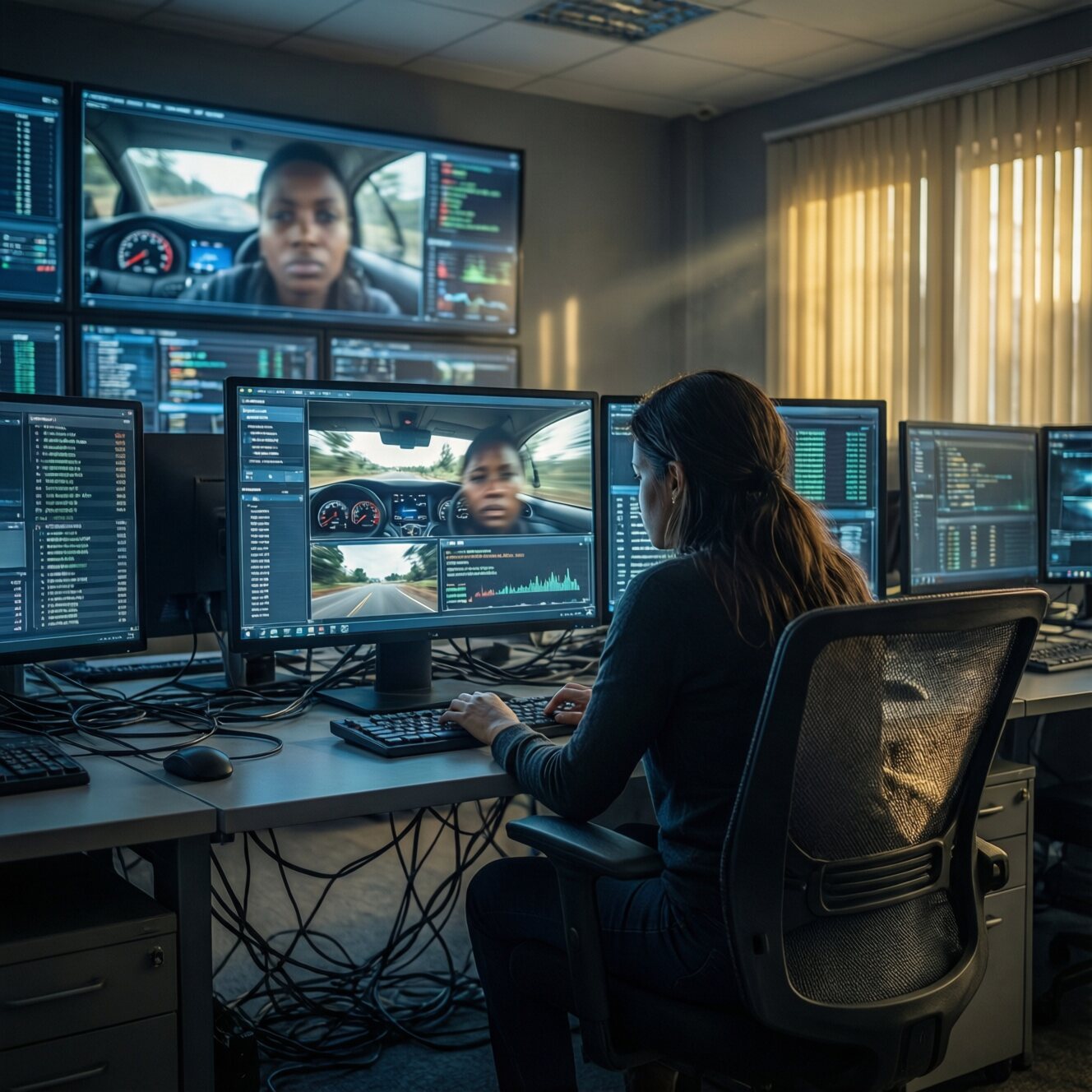
In an office building in Nairobi, Kenya, Anita starts work at 8 a.m. every day. Her task is to review drivers’ driving footage and observe changes in the drivers’ expressions—when a driver is distracted or drowsy, she must record the data. These data will help automakers build in-cabin behavior-monitoring systems.
“One report must be processed every 55 seconds”—that’s her KPI. She works 10 hours a day with only two short breaks in between. Her eyes stay fixed on the screen, her fingers flying over the keyboard. If her name turns red on the backend, it means she has to work unpaid overtime.
From the Plantation to the Data-Annotation Center
The book advances a striking point: the management model of modern data-annotation centers has a subtle and hidden connection to colonial-era cotton plantations.
On 19th-century cotton plantations in the American South, slaves were closely monitored, and overseers recorded each slave’s daily picking amount. One pound short earned a whip lash; the fastest picker got a reward. This “gang system” later evolved into the foundation of modern scientific management.
In 1878, Frederick Winslow Taylor established scientific management theory at the Midvale Steel Company in Philadelphia. Based on the basic plantation model, he systematically monitored labor. Although factories and plantations are fundamentally different—wage labor replaced slave labor, and violent corporal punishment gradually disappeared—the continuity between the two is undeniable.
“Every aspect of the annotators’ work is digitally monitored and recorded, with a rigor exceeding that of the harshest plantation owners and factory owners.”
Today’s data annotators:
- Use biometric scans to enter the office building
- Are surrounded by omnipresent CCTV cameras
- Are recorded every second by efficiency-monitoring software
- Generally believe that even talking about forming a union would cost them their jobs
The Human-Machine Closed Loop
Millions of workers worldwide do the dull work of data annotation, turning vast amounts of data into datasets AI can recognize. AI companies mainly find data-annotation suppliers in two ways:
The first is digital labor platforms, such as Amazon Mechanical Turk, Clickworker, Appen, and so on. This kind of outsourcing is called “microwork,” “clickwork,” or “crowdwork.”
Workers on these platforms are all freelancers, earning about $2 an hour, with no work benefits, no paid sick leave, and no pension. Research shows that as many as 30% of tasks fail to be paid properly—the client can simply refuse to pay as long as they’re unhappy with the result.
“Workers spend an average of 8.5 hours a week on unpaid labor such as looking for work.”
The second is business-process outsourcing companies, such as the company where Anita works. This model arose from the global outsourcing wave of the 1990s, as enterprises sought to lower operating costs by moving back-office work abroad. Outsourcing companies generally cluster in countries like India, Kenya, and the Philippines—countries characterized by abundant and cheap English-speaking labor and strict labor discipline.
It’s worth noting that China is also practicing a similar model. The Alipay Charity Foundation and Alibaba’s AI Labs jointly launched the “AI Bean Project,” distributing data-annotation work to rural areas such as Tongren City in Guizhou Province, and through free vocational training turning impoverished people into “AI cultivators.”
The Illusion of Synthetic Data
OpenAI CEO Sam Altman claims that “soon all data will become synthetic data.” Gartner predicts: “By 2030, the amount of synthetic data used by AI models will completely surpass real data.”
But can synthetic data really solve the problem?
In the widely circulated paper The Curse of Recursion, researchers found that large language models trained on data generated by chatbots have “irreversible defects,” and can even lead to model collapse. Because large language models are mainly trained on data scraped from the internet, the future web may be flooded with synthetic data—which will fundamentally threaten the quality of AI systems.
Developers may find technical solutions, but one thing is certain: in certain contexts, real data, because of its uniqueness, is hard to replicate with synthetic data, and thus becomes all the more precious.
“Many moderators have to process 500–1,000 pieces of violating content every day. Many admit they can never go back to the way they were—this job has left an indelible mark on their lives.”
Content Moderators: The “Scavengers” of the Digital World
If data annotators are AI’s teachers, then content moderators are the scavengers of the digital world. Their job is to review posts on social platforms, delete violating information, and flag harmful content.
But this job is far crueler than imagined. Every day, moderators bear the impact of large amounts of violent and pornographic imagery, with almost no time to stop to think and process. One detail in the book is heartbreaking: those moderators who fled their posts in terror over horrific content had their productivity scores docked because they hadn’t typed the “break” or “toilet” command into the computer.
The “health counselors” the company arranged for them are actually their own colleagues, with no formal psychological-counseling qualifications at all.
Neocolonialism in the Global South
What shocked me most about this book is the point the authors make: the production and operation of the AI industry is strikingly similar to the plundering methods of the colonial era.
The most stable, highest-paid jobs are in major American cities, while the most unstable, lowest-paid, and most dangerous work is outsourced to workers in the marginal regions of the “Global South.” Kenya, India, the Philippines… young people in these countries, earning meager wages, train the world’s most advanced AI systems for Silicon Valley’s tech giants.
“Although it is the world’s poorest populations who contribute the labor and create the value, it is mainly large European and American tech companies that profit. This is not an accidental error—it is precisely the original design intent of the AI mechanism.”
The authors call AI a “profit-squeezing machine”—it absorbs key inputs such as capital, electricity, natural resources, human labor, data, and collective intelligence, then converts them into statistical predictions, and ultimately into the profits of tech companies.
Why “Equal Connectivity” Is Not “Equal Bargaining Power”
Economist Milton Friedman believed that digital technology made the global labor market fairer—employers and employees could connect freely across borders for a win-win.
But Friedman’s view has a fatal flaw: equal connectivity does not equal equal bargaining power.
In countries like Kenya, unemployment is high; workers can’t find formal jobs, can’t earn money, and can’t enjoy employment protections. As a vulnerable group, they are not only forced to accept low wages, but because they know they can easily be replaced, they are also unlikely to raise demands for better working conditions.
Many large companies outsource work to the “Global South” not to raise local employment, but because they’re drawn to those places’ stricter labor discipline, higher work efficiency, and lower labor costs.
If Anita’s company greatly raised wages and reduced work intensity, it would soon be driven out of the market by high costs. In this relationship, the most powerful role is not the outsourcing company’s managers, but the tech companies that hire the outsourcing companies—it is they who set the various terms and conditions in the contracts.
The annual salary of one executive in a U.S. management team equals the sum of the monthly salaries of more than 1,000 African employees.
The Coloniality of Knowledge
AI not only perpetuates economic inequality, but also perpetuates colonialism at the level of knowledge.
The authors propose the concept of the “coloniality of knowledge”—a Eurocentrism that holds that the European worldview is universal and superior to the worldviews of other regions and peoples. AI takes the Western worldview as its standard, and both training datasets and common benchmarks are built on Western knowledge systems.
This means:
- AI reproduces the harmful stereotypes present in the data
- It shows bias against minority groups that are misunderstood or distorted in the data
- It habitually adopts the perspective of the privileged class to answer questions
“In the fields of online participation, dataset creation, training-data curation, trained-model decision-making, and AI policy-making, hegemony prevails. A tech elite dominated by white men, especially Americans, has an enormous say.”
The Evolution from the Platform Era to the AI Era
The book defines 2005 to 2022 as the “platform era,” and we have now entered the “AI era.”
The platform era is characterized by light assets—Airbnb owns no real estate, Uber owns no cars. But tech companies in the AI era pursue “infrastructure power”: more than half of the world’s large data centers belong to three big companies, and only a few companies can provide the hardware needed to train cutting-edge AI models.
This shift leads to a greater concentration of wealth and power. AI companies need millions of dollars just to get started, and later need hundreds of millions to keep cloud platforms running. Many startups have to establish strategic partnerships with existing cloud-service providers, and founders lose control of the business.
The Engineer’s Story: The Other Side Behind the Glamour
What’s interesting in the book is that the authors don’t just aim their criticism at the tech giants—they also interview engineers upstream in the AI industry chain, those well-paid AI practitioners living in Shoreditch, London.
ChatGPT Isn’t “Smart”
The authors remind us: if humans want to correctly understand large language models, they can’t treat them as humans. It has no intelligence, no creativity, and naturally no beliefs, spirit, or emotions.
During World War II, the mathematician Alan Turing worked at the codebreaking center at Bletchley Park. His chess friend Donald Michie built a “machine” out of a matchbox and colored beads that could play tic-tac-toe—the earliest prototype of machine learning.
Today’s ChatGPT is essentially no different from that matchbox machine: both learn patterns through massive trial and error, then generate output based on probability.
The Predicament of Machine-Learning Engineers
The book interviews an AI trainer named Li working in London. Her job is retrieval-augmented generation—combining knowledge retrieval and generative models, testing the output against external knowledge resources to improve the accuracy and reliability of large language models.
Li’s team enjoys respectable hourly pay, providing answer exemplars for the model, so that the model can apply these exemplars to generate its own text. Team members are all good writers, able to help the model create more literary and stylish content.
But she always feels that, to some extent, she is merely a gear in a giant machine.
“She suspects that the company’s existing models have enormous biases and limitations, but compared with safety and ethics, economic interest is always king.”
Will Machines Replace Your Job?
Some predictions say AI will eliminate a huge number of jobs: Goldman Sachs estimates that as many as 300 million positions could be replaced by automation or AI; McKinsey predicts 400 million to 800 million.
But the authors remind us: these figures can’t be fully trusted, because a consulting firm’s job is to hype the value of the industry its clients are in.
In 2013, researchers at Oxford University predicted that in the next 10–20 years, 47% of U.S. jobs would face a “high risk” of being replaced by computers. But so many years have passed, and the prediction didn’t come true—the researchers’ way of classifying jobs exaggerated the numbers.
In fact, AI’s impact on most occupations isn’t replacement, but rather changing the skills required for a job, the working hours, and the labor intensity.
Through analysis of large language models, research finds that they are better at handling standardized tasks with clear goals and substantial textual data support—for example, software developers and computer programmers who deal with code will be greatly affected.
“The biggest risk of using large language models is exaggerating their capabilities and productivity, leading people to apply them across many industries without careful thought. Models lack human understanding, social awareness, and empathy, so trying to simply replace humans with them is unrealistic.”
The models are like a political elite cultivated by private schools: “What they say sounds reasonable, but on reflection it’s full of that class’s biases about society, reflecting the fact that social power is unevenly distributed.”
Bias by Design
AI is packaged as superintelligence, able to transcend human limitations and biases. But the truth is exactly the opposite.
Things cannot be separated from the background of their design and manufacture. Fundamentally, the development of large language models depends heavily on training datasets. Many datasets contain unstructured data scraped from the internet, whose content often carries social bias.
After ChatGPT’s release, critics pointed out that its safety features are easily circumvented, causing the chatbot to generate content with racist, sexist, and negative comments—all learned by the machine-learning model from vast amounts of internet chat logs.
The perspective AI adopts is not only related to the source of the dataset—put plainly, it’s related to power: whoever has power can sway AI’s development.
In fields such as law enforcement, bank lending, resume screening, welfare distribution, and education, algorithmic decision-making actually aggravates long-standing problems of bias, discrimination, and erroneous decisions. Models lack human understanding, social awareness, and empathy, and trying to simply replace humans with them is unrealistic.
“AI’s authority makes people feel that its role is that of an observer—with no position, merely recording events, and without bias. But the fact is, AI companies often talk about developing this technology to better serve humanity, but their main motive is profit—monetizing through products.”
The Technician’s Story: The Data Center’s Silent Guardians
On a bright spring day, the data center was as busy as ever. Einar is the facility manager of a newly established data center in northern Iceland; the center has two other staff—electrician Jóhann and maintenance technician Halldór.
One of Europe’s largest banks wants to diversify its data storage and cut costs, and today it will move servers into the data-center building. Einar is busy supervising the preparations, rushing around the data center, directing workers to install the new server racks the client requested.
AI’s Physical Existence
This book reminds us: AI has a physical body.
In the energy-hungry data centers, servers hum on heavy racks, constantly releasing heat and generating white noise. Tendril-like submarine cables crisscross the globe, transmitting AI training data everywhere. AI exists within a body made of chips, servers, cables, and all kinds of accessories.
Like the human body, AI’s material structure also needs a steady “supply of nutrients”:
- It needs electricity to keep running
- It needs water to cool the servers
- It needs rare-earth minerals to make chips
“Whenever and wherever we ask ChatGPT a question or use the internet to search, AI is breathing and operating within its electronic shell.”
More than half of the world’s large data centers belong to three big companies. This “infrastructure power” means: only a few companies can provide the hardware needed to train cutting-edge AI models. This further intensifies the concentration of power—not only is wealth concentrated in a few hands, but even the “means of production” are monopolized.
Iceland’s Special Status
Because of its abundant geothermal resources and cold climate, Iceland has become a popular location for global data centers. Here, servers can use natural cooling, greatly reducing energy costs.
But this also means: the underlying infrastructure of the AI industry also follows the logic of “go wherever costs are low.” Just as data-annotation work is outsourced to Kenya, data centers are built in places like Iceland and Norway with cheap electricity and cold climates.
Behind the neutral appearance of technology hides a complex economic geography.
My Reflections
After reading this book, I have a clearer understanding of AI.
We’re often dazzled by the glossy image tech companies promote—believing that AI runs autonomously, intelligently, without human intervention. But the truth is: AI appears to run automatically, but behind it hides a great deal of human labor, making up for the limitations of the technology.
When Siri can’t recognize a voice command, or a facial-recognition system fails to work properly, these problems are fed back to human employees, who determine what went wrong and how to improve the algorithm.
What moved me even more is a contradiction described in the book: many data workers are actually proud of their work, because they feel they’re advancing cutting-edge technology for the benefit of humanity. But this pride can’t hide the cruel reality—their labor contracts are extremely short, usually 1–3 months; they dare not raise any question about the company’s management, because they could be replaced at any time.
“Rather than providing society with more opportunities for innovation and possibilities for diversity, AI further concentrates wealth and power in the hands of a small group.”
China Also Has Its “Ugandan Moderators”
The Ugandan content moderators described in the book work 10 hours a day, processing large amounts of violating content for meager wages—this reminds me of what I saw at my first company in Hangzhou.
It was an internet company with a dedicated content-moderation department. Dozens of employees sat in cubicles, their daily job being to stare at the screen and review all kinds of user-uploaded content. They had to face pornographic, violent, and politically sensitive images and videos, manually filtering out the violating information that machines couldn’t identify.
These moderators were paid very little, far less than programmers, yet they bore enormous psychological pressure. Worse, this was a dignity-less “second-class citizen” job—their desks were forever in the corner, their sense of presence was almost zero, and the company never mentioned their contributions in its external publicity.
Later, AI technology developed. The company introduced an image-recognition system, and the accuracy of moderation kept rising. And then? The entire department was cut wholesale. Those moderators who had once silently filtered massive volumes of junk content for the company were simply replaced by AI.
Ironically, they were first squeezed as cheap labor for profit, and then abandoned by the very AI they had trained.
Programmers’ “Superiority” Is an Illusion
Many programmers, when reading this kind of book, may have a kind of survivorship bias—“thank goodness I write code, not do data annotation.”
But this superiority is actually an illusion.
Think back: what did the programmer market look like a few years ago? High pay, a shortage of people, and a 30% raise for changing jobs was the norm. An engineer with two or three years of experience earning several hundred thousand a year was unremarkable. Back then, “learning to program changes your fate” was almost a consensus.
But what about now?
More and more programmers around me are starting to feel anxious. Big-tech layoffs come one round after another, and small and medium companies are getting more and more cautious about hiring. Internet practitioners who once had boundless glory now face salary inversions, difficulty getting promoted, and the age-35 crisis.
Technological development is never inclusive; it always tends to make a minority richer and the majority more embroiled in the rat race.
The appearance of AI coding assistants (like GitHub Copilot and Cursor) has greatly boosted coding efficiency. A single programmer can now accomplish the workload of two or three people in the past. But what’s the result? It’s not that everyone works less and earns more, but that the company thinks: “Since efficiency is up, we don’t need to hire so many people.”
Programmers’ labor is gradually being “deskilled.” In the past you needed to master algorithms, architecture, and design patterns; now you just need to know how to write prompts and AI can generate the code for you. When the barrier to an occupation gets lower and lower, its value gets lower and lower too.
Today’s content moderators and data annotators may be tomorrow’s programmers.
Technology Makes Profit-Squeezing More Hidden and More Efficient
A core point in the book is: AI is a “profit-squeezing machine.” I think this judgment is very accurate, and it needs further extension—technology is not only a profit-squeezing machine; it makes profit-squeezing more hidden, more efficient, and harder to resist.
The profit-squeezing of the industrial age was naked: workers repeated labor on the assembly line, and capitalists extracted surplus value. But this profit-squeezing was visible; workers could organize unions, could strike, could demand better treatment.
The profit-squeezing of the digital age is packaged more exquisitely. The platform economy tells us: “You’re not our employee—you’re a free partner.” So no social insurance, no housing fund, no paid vacation all become the price of “flexible employment.” Delivery riders, ride-hailing drivers, crowdwork annotators—they all create enormous profits for platforms, yet aren’t regarded as “employees” and enjoy no labor protections.
This is even more so in the AI era.
When algorithms decide your income (riders are controlled by the dispatch system), when data monitors your every move (a moderator’s name turning red means overtime), when AI gradually replaces your position (programmers replaced by code-generation tools)—you’ll find that you’re not being squeezed for profit by some specific person; you’re being squeezed for profit by a system. This system has no face, no emotions, won’t negotiate with you, and won’t respond to your appeals.
Marx said that workers sell their labor power, not labor itself. But in the AI era, even the concept of “labor power” is dissolved for laborers. You’re not “working”—you’re “training data”; you’re not “creating value”—you’re “optimizing algorithms.” The fruits of your labor are converted into the model’s parameters, and the ownership of the model belongs to the company.
This is a more thorough alienation than the traditional employment relationship.
No Job Is Safe
The biggest wake-up call from reading this book is: no job is absolutely safe.
We’re used to thinking that manual labor is easily replaced by machines and that mental labor is safe. But AI’s development is breaking this boundary.
- Content moderators have already been mostly replaced by AI
- Data annotators are teaching AI how to better annotate data, until AI no longer needs them
- “Creative work” like translation, design, and writing is being eroded by large models
- The coding ability programmers take pride in is also being gradually replaced by AI coding assistants
Technological progress has never been about liberating laborers, but about raising capital’s production efficiency. When AI can work 24 hours without pause, doesn’t get tired, doesn’t complain, and doesn’t demand a raise, the situation of human laborers only becomes harder and harder.
The Ugandan moderators in the book and the Hangzhou content moderators are essentially the same group of people—they’re all “digital sharecroppers” in the global division of labor. What they farm isn’t land, but data; what they harvest isn’t grain, but a wage barely enough to make ends meet.
And today’s programmers sitting in offices writing code may not escape this fate either. When AI can write good-enough code, the boundary between programmers and data annotators may not be as clear as we imagine.
“Use and Discard”: The Cold Logic of Corporate Hiring
Crueler than being replaced by AI is that many companies’ logic for treating employees is, from the start, “use and discard”—even without AI, they’d treat employees as disposable tools.
I’ve observed a phenomenon: companies today hire with a kind of “project thinking.” When a project starts, they frantically hire; when the project ends or enters a maintenance phase, they start laying people off. The employee’s career plan? The company doesn’t care. What it cares about is: can this person deliver results in the next 6 months?
The term “human resources” is itself very problematic. People are not resources; people are ends. But when a company calls employees “human resources,” people have already been objectified—like servers, desks, and chairs, just one of the factors of production, to be purchased, used, and scrapped as needed.
Look at today’s job market:
- Probation trap: a 3–6 month probation with a discounted salary; when you’re about to become a regular employee they find a reason to fire you, then hire the next probationary employee
- Outsourcing isolation: the core team sits at the main table, outsourced employees sit in the corner, doing the same or even harder work, but with no sense of belonging, no path to advancement, and replaceable at any time
- The age-35 threshold: job postings blatantly state “under 35,” as if work experience were a kind of original sin. Essentially, it’s a belief that young people can work more overtime, are easier to PUA, and demand lower pay
- Last-place elimination: no matter how hard you work, someone must be eliminated, creating constant anxiety and fear
Programmers often have the illusion that they’re “technical talent” with irreplaceability. But the reality is: China doesn’t lack people who can write code. If a programmer leaves, the company can find three replacements in no time. Your tech stack? It can be learned in a few months. Your business experience? A new hire can take over after half a year of getting familiar.
Under this logic, laborers are deprived of the possibility of any long-term planning.
- You want to buy a house? But you know this job may not last two years
- You want to marry and have children? But you know that once you have a child you’ll be marginalized in the workplace
- You want to go deep in a field and become an expert? But the company only wants you to produce quickly, and doesn’t want to invest in your growth
When a person is always in a state of “might be abandoned at any time,” they don’t dare to fight for their rights, don’t dare to refuse unreasonable demands, and don’t dare to stop and think about what they really want. This is exactly what capital wants—a docile workforce, on call at any time, that dares not resist.
The data annotators mentioned in the book have labor contracts of only 1–3 months. This isn’t just “flexible employment”—it’s a naked “use and discard.” A project comes, hire a batch of people; the project ends, lay them all off. No severance pay, no consideration for employees’ career development, and not even the need to regard them as human.
And ironically, these workers who are used and discarded are precisely the ones who understand the business best and are the most experienced. A newly hired annotator needs several weeks of training to get up to speed, while a skilled worker can produce high-quality results immediately. But the company would rather keep hiring new people, training, and eliminating them than give old employees long-term contracts—because the latter means cost, means commitment, means the company needs to treat people as people.
The arrival of AI merely makes this “use and discard” logic more efficient and more self-righteous.
Previously, companies needed a reason to lay people off; now they can say: “It’s not that we want to abandon you, it’s that AI replaced you.” As if technology had become a force majeure, and capital were merely the innocent victim. But the truth is, AI is only a tool; those who decide how to use the tool are always the people behind it.
When a company chooses to replace employees with AI, what it chooses isn’t “efficiency,” but “the freedom not to take responsibility.” Machines won’t demand raises, won’t sue the company for illegal layoffs, won’t become depressed from too much work pressure. Machines are the most perfect employees—obedient, efficient, never complaining, and can be shut off when done, requiring no emotional investment.
This is the most frightening picture of the AI era: not humans being ruled by machines, but humans being treated as machines.
What Can We Do?
At the end of the book, the authors offer several suggestions:
- Build and unite labor organizations: foster a truly transnational labor struggle, uniting both blue-collar and white-collar workers in the global AI production network
- Harness the power of consumers: by pressuring companies, force them to ensure that all laborers in the supply chain meet standards for pay and working conditions
- Promote government regulation: set minimum labor protection standards through global agreements such as International Labour Organization conventions
- Explore alternative forms of work organization: such as worker cooperatives, or changing corporate ownership structures to make companies more inclusive and broad-based
- Acknowledge the fundamental problem: the fundamental problem behind AI lies in the capitalist system
Reflection at the Individual Level
As a practitioner in the AI industry, the greatest revelation this book gave me is: we need to maintain clear self-awareness at all times.
When you use GitHub Copilot or Cursor to quickly generate code, why not think about—
- Where do these AI models’ training data come from?
- What kind of pay did the people who annotated the code data receive?
- As AI becomes “smarter and smarter,” where do you stand in this system?
When we marvel at ChatGPT’s fluent answers, we should also realize—
- Behind it there may be countless content moderators who have developed PTSD from long-term exposure to harmful content
- There may be data annotators ruthlessly laid off for failing to meet work-efficiency targets
- There may be laborers in developing countries paying the price of their health and dignity for our convenience
Technology itself is neutral, but the way technology is produced and used reflects society’s power structure.
Change won’t happen overnight, but awareness is the first step. When we enjoy the convenience AI brings, let’s not forget the underclass laborers who’ve paid with toil and even health for it. When we talk about “AI changing the world,” we should also ask: what is this world being changed into? Who benefits from it? Who is being sacrificed?
Only when more people become aware of these problems does change become possible.
Book title: 《投喂AI:人工智能产业的全球底层工人纪实》 (Feeding AI: A Documentary of the Global Underclass Workers of the Artificial Intelligence Industry)
Authors: [UK] James Muldoon, [UK] Mark Graham, [UK] Callum Cant
Recommendation rating: ⭐⭐⭐⭐⭐
This is a book everyone who cares about technology and social justice should read. It lets us see that, in this algorithm-defined era, what truly defines our lives may not be the glossy code, but the people hidden behind the code.
评论
0 条评论