On the morning of 22 November I finished the half marathon at the 2026 Jiaxing Marathon. My watch logged 21.54 km in 2:29; the official net time came in at 2:27. The gap between the two is GPS wiggle and how each side counts the start — not important. What matters is that I finished, in one piece. Pulling up the numbers afterwards: average pace 6:56 per km, average heart rate 167 with a peak of 190, north of 26,500 steps, training load 557. Put those together with how I felt that day and there is only one word for it — brutal.
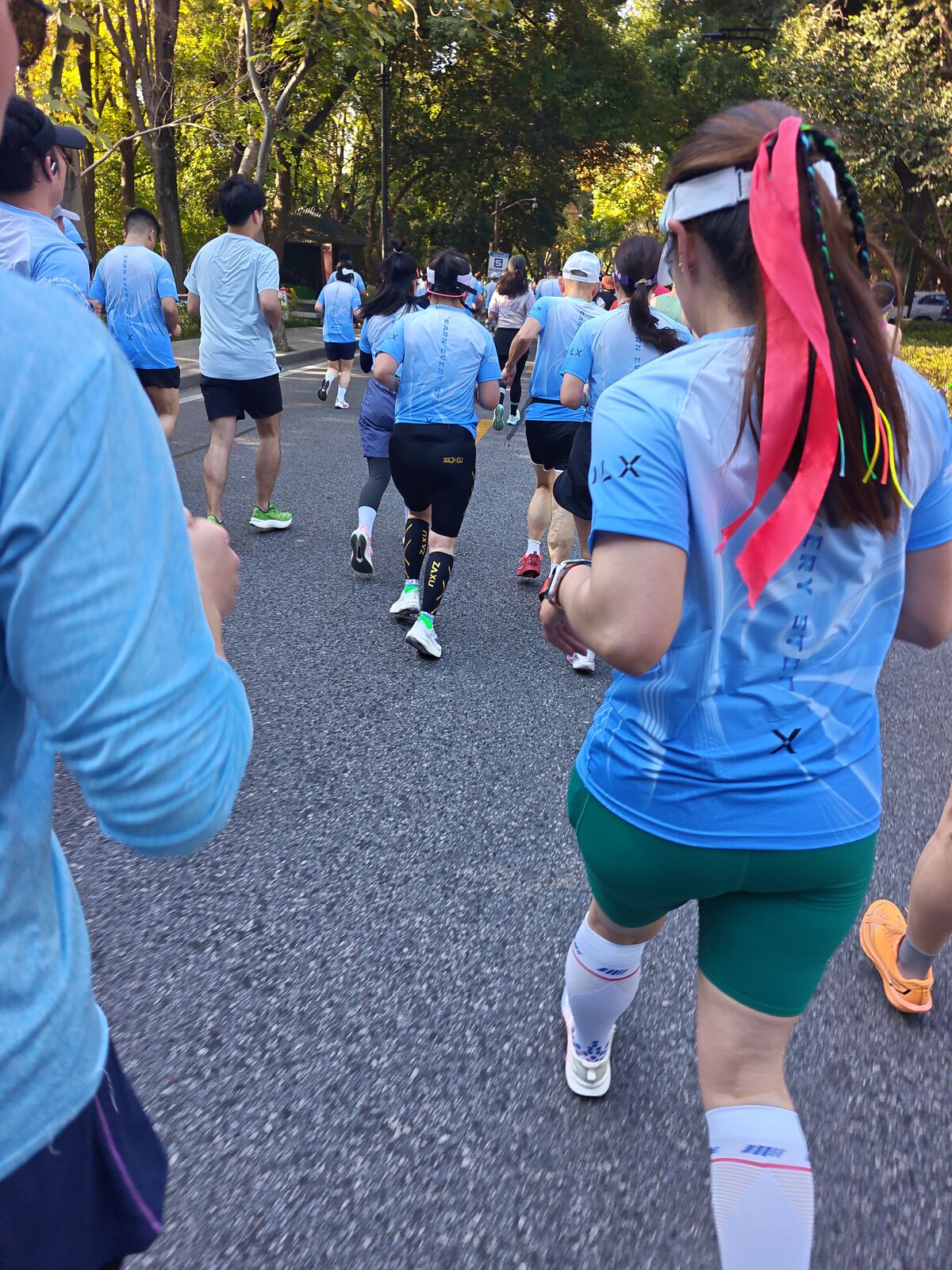
In fairness, Jiaxing is a genuinely good-looking city. The course unrolls around South Lake, autumn sun lying on the water, and this is the ground where the Red Boat once set out — running through it really is a pleasure. But scenery is scenery: the course gives your legs and your lungs no mercy at all. Uphill and downhill come in waves — bridges, interchanges, a dozen of them in total — and every climb takes a pace you had just settled into and wrecks it, while every descent makes you hold your legs back out of fear for your knees. The beautiful and the brutal are both true on this course, at the same time.
The bigger reason, though, is me. I was never good, and this year I barely ran at all — almost all of my training went to cycling, and my mileage broke off for months. Thin foundations on top of a course that loves to undulate: that 2:27 got ground out one kilometre at a time, teeth clenched. Somewhere in the middle a grey-haired old man passed me at an easy, unhurried pace. Asked his age — seventy-seven. I couldn’t hold his gear at all. He was running in his seventies with total composure while I, in the prime of my life, was gasping like a bellows. What this race beat down wasn’t just my legs; it was my pride.
On the “no water” complaints, I want to say a word for Jiaxing
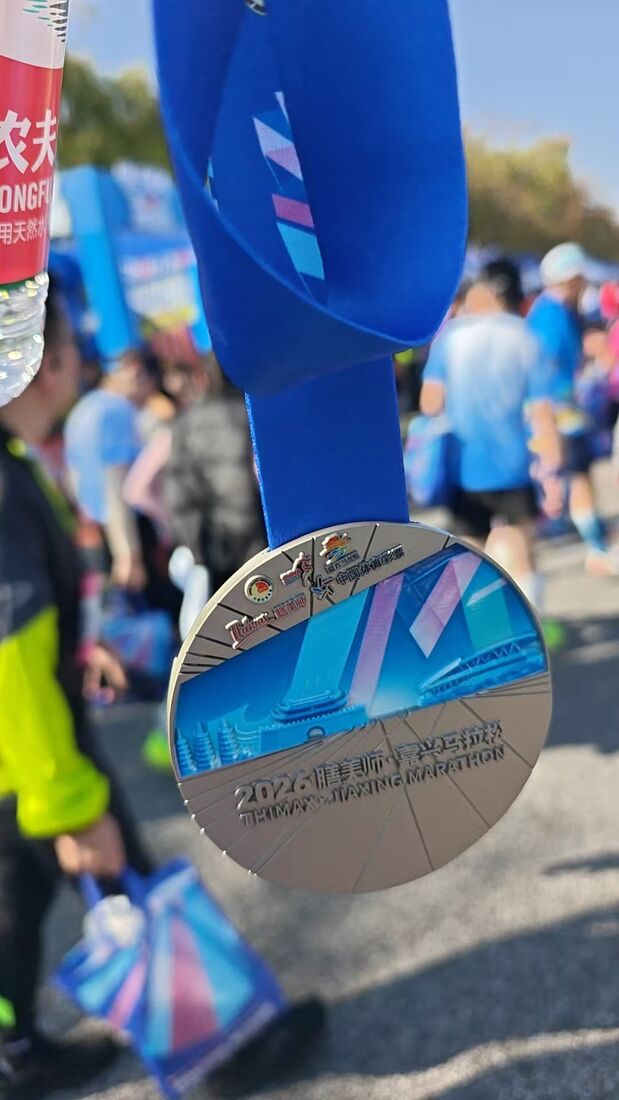
Before and after the race, the loudest complaint online was about the aid stations — that the race “lacked water”, that the 10 km station had “no cups”. Let me clarify: there was water. The tables were stacked with bottles of the sponsor’s mineral water, Nongfu Spring, row after row of whole bottles. What there were no paper cups for. To drink, you had to grab an entire bottle.
And that “entire bottle” is exactly the problem. For a single runner, a 500-ml bottle is more than you can finish at an aid station, and there’s no other option — either you keep running with half a bottle clutched in one hand, or you force down two gulps and dump the rest. So the real situation isn’t “no water”; it’s “the format of the hydration wasn’t designed for runners”. Laying out paper cups and then sending people to pick up thousands of crushed cups afterwards is genuinely a hassle — but the organisers saved themselves that hassle and handed the inconvenience and the waste to the runners. That is a failure of their work, and they should own it. It has nothing to do with whether the city is stingy, and the two shouldn’t be mixed together.
“You need water after ten kilometres? What kind of runner are you?” — that arithmetic is backwards
There’s also a nastier voice: “If you have to drink after ten kilometres, why bother running at all?” “Jiaxing doesn’t welcome you — closing roads made me detour half an hour to work, what’s the point of holding a race like this, it’s pure obstruction.”
Start with the roads. A marathon closes its main course in the early morning and reopens it within a morning at most. In exchange for a fraction of a day of localised inconvenience, the city gets a full day — sometimes several days — of real foot traffic and real spending.
Now to “what’s the point of holding it”. The reason isn’t complicated at all: it makes money and it moves the local economy. That is the fundamental engine behind how fast marathons have grown in China, to the point that nearly every first- and second-tier city runs one. By the Chinese Athletics Association’s road-running data, the country has settled at roughly six or seven hundred road races a year, with participation in the millions of runner-visits; a single city marathon draws twenty or thirty thousand registrants, a large share of them arriving with suitcases from other cities. Once they’re in your city they eat, they book hotels, they visit sights before and after the race, and they leave with two boxes of local specialties — and the entry fees alone are net revenue. The industry’s common estimate is that every yuan of direct race cost pulls in several times that in surrounding spending. Cities do this arithmetic very clearly.
Jiaxing sits well in this business: it’s exactly between Shanghai and Hangzhou — about half an hour by high-speed rail to Shanghai, a dozen-odd minutes to Hangzhou, with tens of millions of people inside its “one-hour circle”. South Lake’s revolutionary tourism, Yuehe historic streets, a box of Wu Fang Zai zongzi to carry home — eat, sleep, sightsee, shop, and the money stays local. So rather than a marathon “obstructing residents”, it’s a city opening its storefront to tens of thousands of outsiders for half a day, a cultural-tourism sales pitch.
Runners need water and need aid; that’s as normal as it gets, and organisers should be doing those details better. But turning “you actually need water” into a reason to drive runners away has the arithmetic completely inverted — the cities that can’t bear to hand out a bottle of water generously are the ones that can’t keep people.
In closing
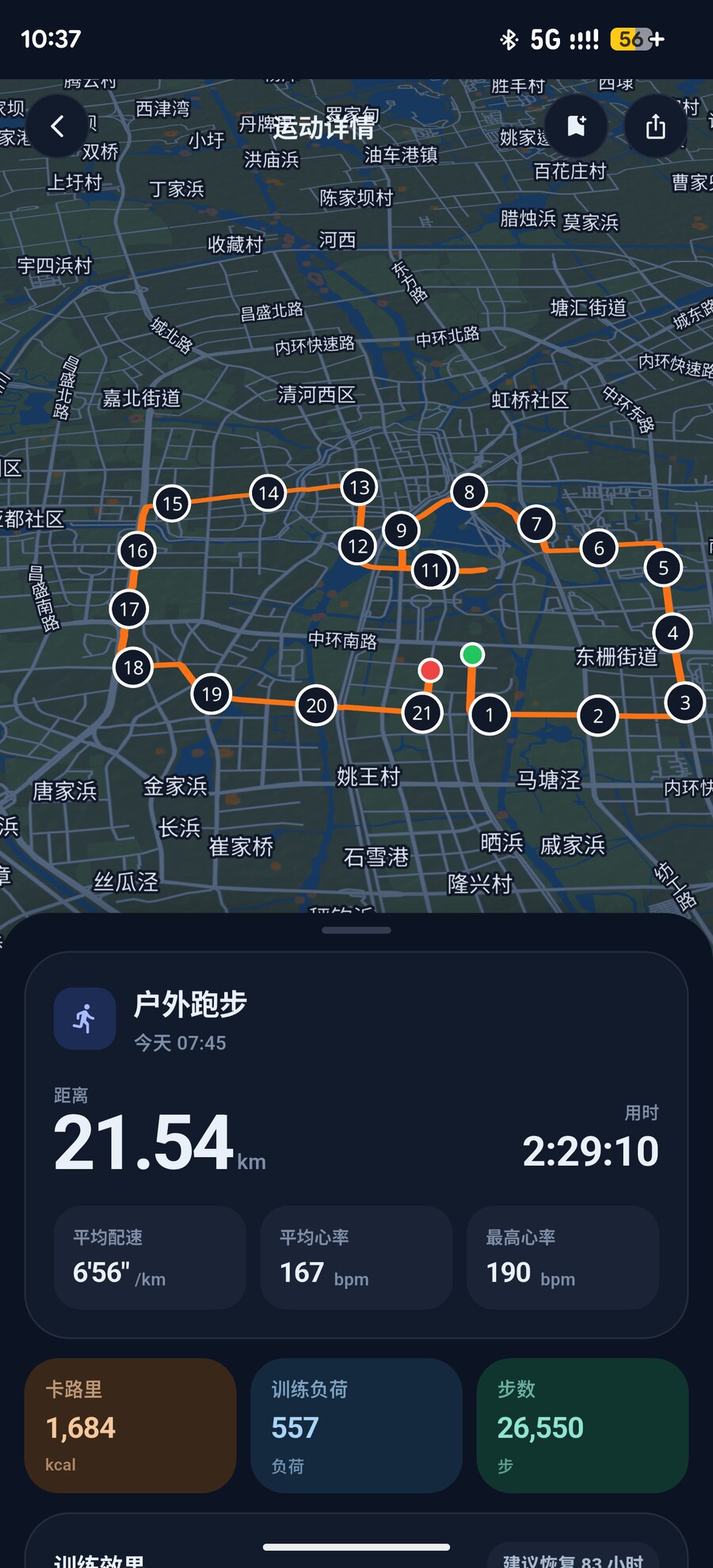
In the end, 2:27 is an honest result for a half-competent runner like me: brutal, but the medal is in hand and I finished safely. Slow pace, heart rate off the ceiling — all of it reminding me how little I trained this year. Before the next race, I’ll get the lost mileage back, a bit at a time.
Brutal as the Jiaxing course was, I still appreciate the city’s effort, the autumn sun on South Lake, and that box of zongzi I carried home.
评论
0 条评论