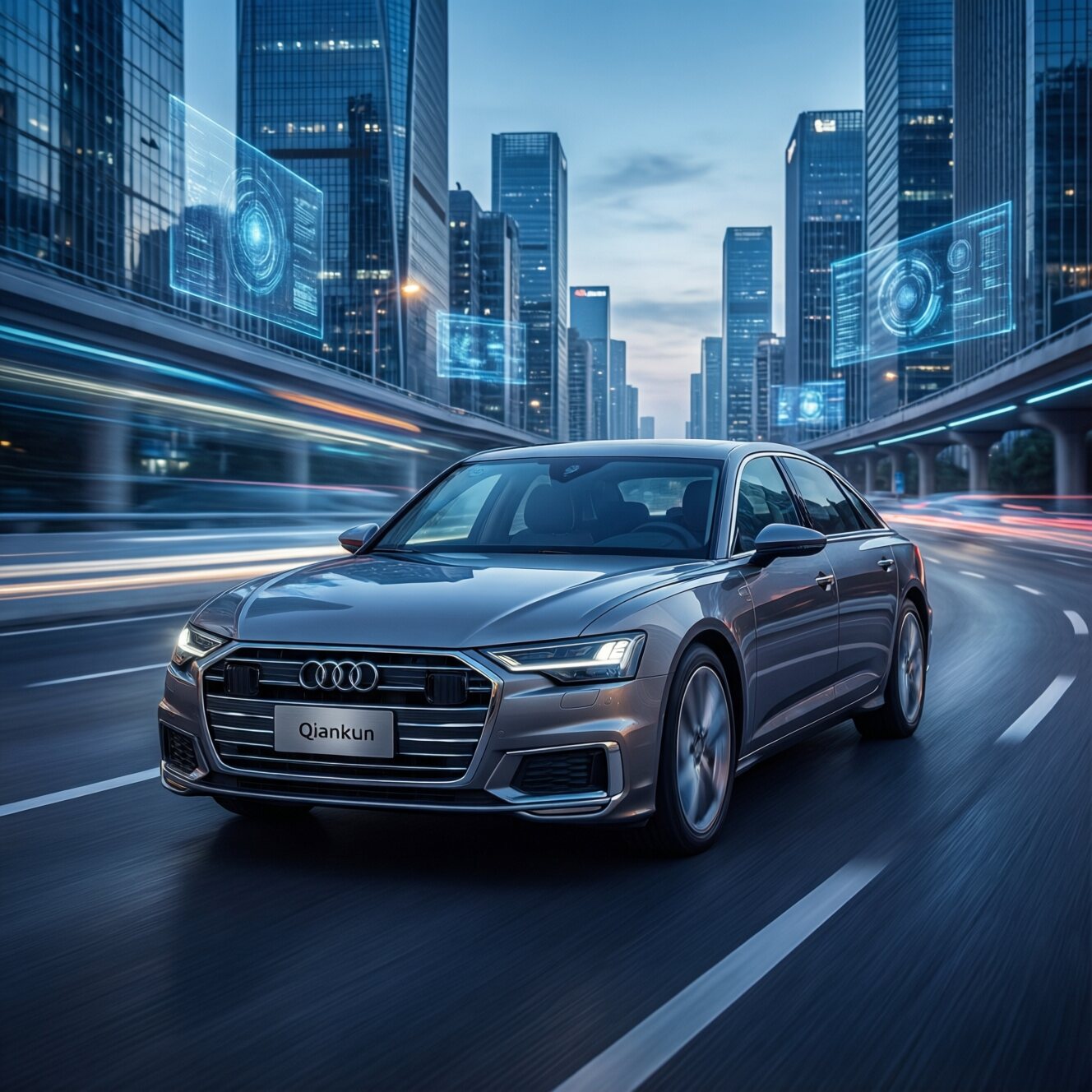
When an Audi A6L wearing the four-ring logo gets its core intelligent-driving system from a Chinese tech company, this is no longer just a product iteration but a footnote to an era. As a technologist, what I see isn’t the starting price of 322,900 yuan but a profound transfer of the power to define a car’s “soul.”
Background: Why Is the “Audi + Huawei” Combination So Intriguing?
The all-new Audi A6L launched with Huawei’s Qiankun ADS 3.0 intelligent driving, and this news sent ripples through both the tech and auto circles. On the surface, it’s just a routine supply-chain collaboration: a traditional carmaker needs intelligent capability, a tech company provides the solution. But if you know a little about the century-long history of the auto industry, you’ll understand things are far from that simple.
Cars—especially luxury brands like Audi—have long had their core competitiveness defined as the mechanical quality of the “three major components” (engine, transmission, chassis) plus brand heritage and design aesthetics. A car’s “soul” is the roar of a V6 engine, the grip of quattro all-wheel drive, the chassis tuning of German engineers. Yet in the era of smart electric vehicles, the focus of competition has abruptly shifted to the “new three major components”: battery, motor, electronic control, and the higher layers—smart cockpit and intelligent driving.
When a car’s core experience shifts from “driving pleasure” to “riding experience,” and from “human controlling the car” to “car assisting the human,” whoever controls the “brain” of intelligent driving holds the key to defining the next generation of car experiences. Audi choosing Huawei rather than fully self-developing or adopting another Tier 1 solution is a highly symbolic signal: on this brand-new track of intelligence, even a traditional luxury giant has no choice but to seek empowerment from an external “brain.” Behind this is a software-hardware integrated moat built of algorithms, data, and chips—now so high that it requires a professional tech company to crack.
Technical Breakdown: How Is the “God’s-Eye View” of Qiankun ADS 3.0 Achieved?
Let’s break down just what architecture the “Qiankun ADAS” Huawei installed in the Audi A6L actually is. Based on public information, the core of Qiankun ADS 3.0 is the “GOD (General Obstacle Detection) network 2.0 based on fused perception“ and the “Huawei self-developed ADS 3.0 architecture.” In plain terms, it tries to make the car understand the surrounding world like a human—or even more comprehensively.
1. A Paradigm Revolution from “Rule Recognition” to “Physical-World Understanding”
The traditional autonomous-driving perception scheme can be understood as “feature recognition + rule judgment.” The system uses lidar, cameras, and millimeter-wave radar to separately identify “this is a lane line,” “this is a cube (maybe a car),” “this is a moving point cloud,” then, through a late-fusion algorithm combined with a high-definition map, determines “oh, this is a car stopped in the lane, I need to go around it.”
|
Huawei’s Qiankun ADS 3.0 GOD 2.0 network, by contrast, targets end-to-end “physical-world modeling.” It doesn’t rush to classify objects but first, through early fusion of multiple sensors (especially lidar and cameras), builds a unified, real-time 3D scene representation. This model contains the road structure, drivable area, and the geometric shape, motion state, and physical attributes of all obstacles (is it hard or soft? will it move?).
|
The advantage of this approach is that it can recognize “odd-shaped obstacles” never seen in training data—like a sofa dropped on the road, an overturned truck, a strange engineering vehicle. The system doesn’t need to know “what it is,” only that “there’s an entity occupying space there that needs to be avoided.” This greatly improves Corner Case handling and is key to moving toward full-scenario intelligent driving.
2. The Architectural Picture: From Chimneys to a Platform
Another core of Huawei ADS 3.0 is the architecture upgrade. We can imagine it as an evolution from “chimney-style” to “platform-based.”
|
The core of this architecture is Huawei’s self-developed MDC (Mobile Data Center) computing platform, which provides powerful compute (the latest is the MDC 810, with 400+ TOPS), letting massive raw sensor data be fused within the same compute unit with low latency and high bandwidth. On the software side, Huawei’s “software-hardware co-optimization” capability is on full display here: the algorithm is optimized for its own or deeply customized chips, far more efficient than a “general-purpose chip + third-party algorithm” combination.
My View / Cool-Headed Reflections: After the Honeymoon, the Undercurrent Over Where the “Soul” Belongs
As anyone who’s done enterprise-grade system integration knows, this kind of “strong-strong alliance” starts beautifully, but in the long run, several deep-seated problems cannot be avoided:
1. The paradox of data sovereignty and the iteration loop
The core competitiveness of intelligent driving lies in data and iteration. The massive Corner Case data generated by cars on the road is the golden fuel for optimizing algorithms. In the “Audi + Huawei” model, who owns the data? How are ownership and usage rights of the processed data and newly trained models defined? Is Audi content to be merely a “data provider” and “hardware shell,” handing over to Huawei entirely the algorithmic-iteration capability that most produces user stickiness and experience differentiation? This involves the most fundamental business interests and future leadership.
2. The conflict between the “ceiling” and “customization”
As a solution, Huawei’s Qiankun must consider scaled delivery. Its optimal form is a “platform” general enough to fit most models. But for Audi, the A6L’s intelligent-driving experience must differ from the A3’s and Q5’s—it needs to reflect its brand character: perhaps a steadier, more predictive decision style, or unique features deeply coupled with Audi’s proprietary lighting system and chassis systems (like rear-wheel steering). This deep customization need is inherently contradictory to a solution provider’s nature of pursuing standardization and lowering marginal cost. How much low-level interface and customization space is Huawei willing to open to Audi?
3. Supply-chain security and the “second supplier” risk
Betting the core intelligent-driving system on a single external supplier is a strategic risk for any mainstream carmaker, especially under the current geopolitical and trade environment. Audi (or the VW Group) is surely advancing its own software platform (like VW.OS, CARIAD) in parallel. Is the cooperation with Huawei a “transitional plan” or a “long-term pillar”? Probably even Audi is fiercely debating this internally. For Huawei’s car BU, how to prove it’s not just a “spare tire” or “mentor” but an irreplaceable “brain” is key to continuously winning orders.
The conclusion of the cool-headed reflections is: This cooperation is the rational choice of a traditional auto giant under the anxiety of intelligent transformation, and also a milestone for a Chinese tech company to “get on board” in the core auto-technology field. But it’s far from the endgame—it’s the beginning of a new round of games. After the honeymoon, the covert battle over data, control, and brand differentiation will quietly unfold.
Takeaways for Building Products: Finding the Balance Between “Empowerment” and “Symbiosis”
What can we product and technical people learn from this cooperation?
1. Seize the empowerment opportunity during a “paradigm shift.” When an industry’s core tech stack undergoes a fundamental change (like mechanical -> electric -> intelligent), the incumbent giants necessarily have a brief capability vacuum. At that moment, entering with an entirely new tech stack and offering a “turnkey” solution is a golden window for quickly opening the market and building a moat. Huawei in the auto field seized precisely the paradigm shift from “distributed ECUs” to a “centralized computing platform.”
2. “Black-box” solutions won’t go far; you must move toward “white-box” or “gray-box” empowerment. If what you provide is a completely closed, unknowable, unmodifiable “black-box” system, then you’ll forever be just a supplier, never a partner. The future trend is to provide “base platform (white box) + core algorithm (gray box) + toolchain,” letting carmakers do a certain degree of custom development on your platform, preserving their brand’s personalization and ability to keep evolving. This requires the product architecture to have good openness and scalability.
3. Establishing a shared “data flywheel” mechanism is the key to long-term cooperation. At the start of cooperation, you need to design a clear, fair, and legally compliant data-governance scheme. The ideal model is a “joint data loop”: desensitized vehicle data is used for joint algorithm training, and the gains from the iterated model are shared by both sides. This requires strong data-security and privacy-computing technology and a relationship of mutual trust as the foundation.
4. Standardize hardware, differentiate software. For carmakers, the wise move may be to gradually standardize intelligent-driving hardware (sensors, computing platform) to cut costs, and focus competitiveness and R&D resources on the software layer’s user-experience design, scenario definition, and exclusive features deeply integrated with their own vehicle platform. For example, Audi could, based on Huawei’s base perception and planning capability, develop a comfort cruise mode exclusive to “Audi luxury sedans,” deeply fusing the intelligent-driving style with the brand DNA.
Conclusion
The image of the all-new Audi A6L launching with Huawei’s Qiankun ADAS is itself a strong metaphor. It declares that the car’s “soul” is being redefined. The roar of the internal combustion engine was once the cry of the soul; in the future, the soul may be the silent reliability of the car driving you home autonomously and smoothly after a late night of overtime; the superhuman perception of the system spotting danger earlier than you and handling it steadily on a rainstorm highway.
This is not just the story of Audi and Huawei but a microcosm of all traditional industries colliding with digital technology. As technical people, we live in an era where the old system is loosening and new rules are being established. What matters is not cheering for who “gets on board,” but seeing clearly the deep logic of technological convergence: true competitiveness no longer comes from a closed fortress but from the ability, within an open ecosystem, to define interfaces, integrate resources, and create unique user experiences.
Next time you sit in a smart car, perhaps you can think about whether what you’re experiencing is the lingering charm of a century-old brand or the thinking of a new “brain” of the digital age. And this competition-cooperation over the “soul” has only just begun.
评论
0 条评论