Null Overhead. Null Compromise. 100% Zig.
Introduction
In an age where AI infrastructure is growing ever more bloated, NullClaw shows up with an almost obsessive minimalist posture. It’s a fully autonomous AI assistant infrastructure written in Zig, with a binary size of just 678 KB, startup time of <2ms, and peak memory usage of ~1 MB—these numbers sound like a joke, but they’re real.
As a long-time OpenClaw user, when I first saw NullClaw’s numbers, I thought something was wrong. But after actual testing, those figures are indeed accurate. So today let me walk you through this project that might change the landscape of edge AI deployment.
What is NullClaw?
NullClaw is by far the smallest fully autonomous AI assistant infrastructure. It’s a static Zig binary that can run on any device with a CPU—from a $5 edge computing board to a high-end server—and its only dependency is libc.
Core figures
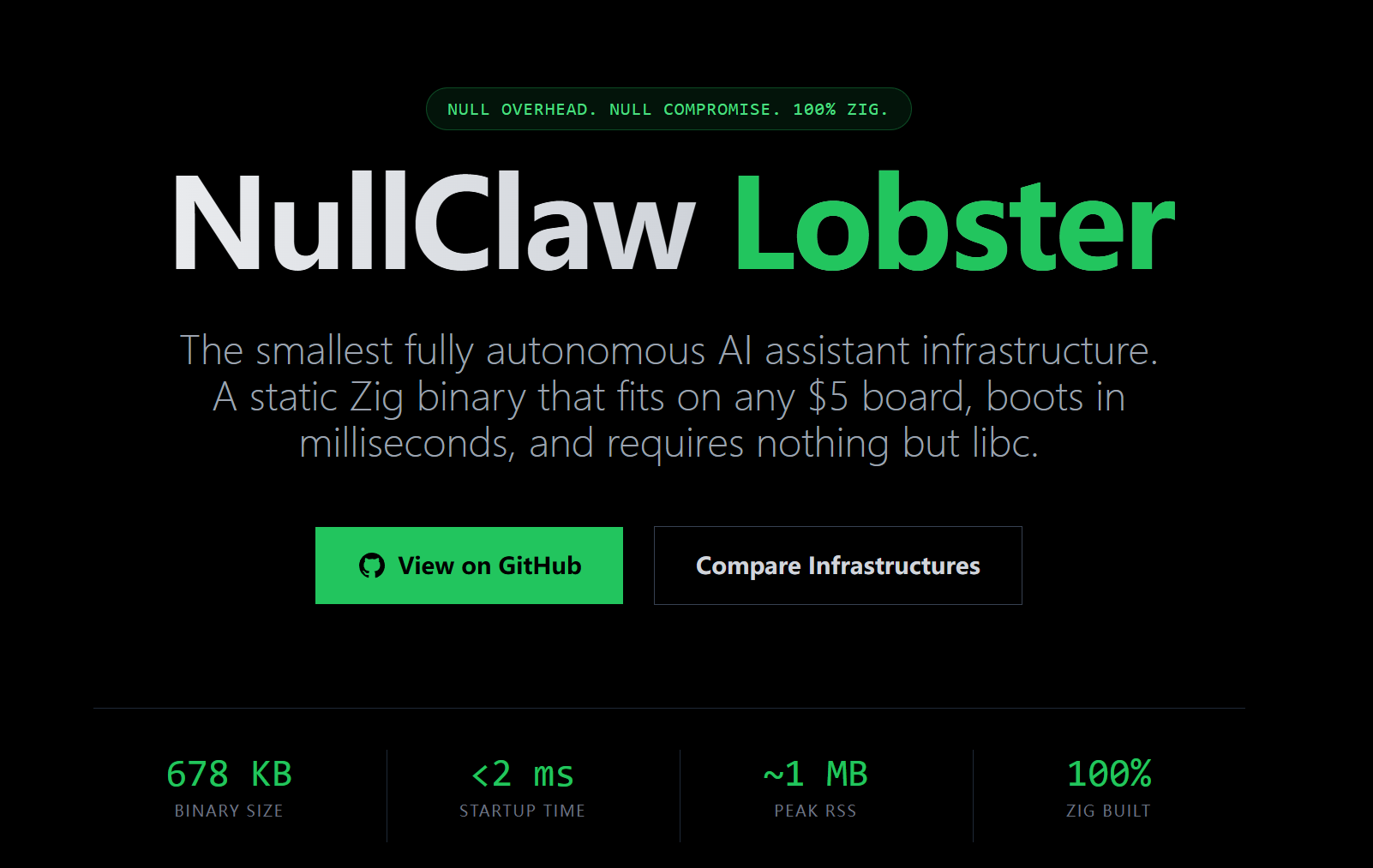
| Metric | Value |
|---|---|
| Binary size | 678 KB |
| Startup time | < 2 ms |
| Peak memory | ~1 MB |
| Test coverage | 3,230+ |
| Supported providers | 22+ |
| Communication channels | 18+ |
Comparison with OpenClaw and PicoClaw
The open-source AI assistant infrastructure ecosystem has developed rapidly in 2025-2026, and there are currently three major projects worth attention: OpenClaw, NullClaw, and PicoClaw. Each has a different positioning and suits different scenarios.
| Feature | OpenClaw 🤖 | NullClaw 🦞 | PicoClaw ⚡ |
|---|---|---|---|
| Language | TypeScript/Node.js | Zig | Go |
| Binary size | ~28 MB | 678 KB | ~8 MB |
| Memory usage | > 1 GB | ~1 MB | < 10 MB |
| Startup time (0.8 GHz) | > 500 s | < 8 ms | < 1 s |
| Hardware cost target | Mac Mini ($599) | Sub-$5 edge devices | $10 embedded boards |
| Use case | Desktop/complex workflows | Edge/efficient/secure | Embedded/minimalist |
In one sentence
- OpenClaw: The most feature-rich, suited to desktops and complex scenarios. Rich plugin ecosystem, persistent memory, complete autonomous service.
- NullClaw: Extreme efficiency and security, suited to edge computing. 678KB single binary, ~1MB memory, <2ms startup.
- PicoClaw: Ultra-minimal embedded, suited to IoT devices. Written in Go, ultra-low memory usage.
Core design philosophy
1. Lean by Default
NullClaw is written entirely in Zig and compiles into an extremely small static binary. No allocator overhead, no garbage-collection latency, no runtime dependencies.
2. Secure by Design
Security isn’t an afterthought; it’s built into the architecture from the start:
- ✅ Pairing mechanism: 6-digit one-time verification code
- ✅ Multi-layer sandboxing: Landlock, Firejail, Bubblewrap, Docker
- ✅ Explicit command allowlist: deny all commands by default
- ✅ Workspace scoping: strict filesystem isolation
- ✅ Encryption at rest: ChaCha20-Poly1305 encrypted storage
3. Fully Swappable
The core architecture is based on vtable interface abstraction. Every subsystem—providers, channels, tools, memory, tunnels—can be replaced or extended.
Feature details
🌐 Broad compatibility
Supports 22+ API providers: OpenRouter, Anthropic, OpenAI, Ollama, Venice, Groq, Mistral, xAI, DeepSeek, Together, Fireworks, Perplexity, Cohere, AWS Bedrock, and more.
📱 Omnichannel routing
11+ built-in communication channels: Telegram, Discord, Slack, iMessage, Matrix, WhatsApp, IRC, Feishu/Lark, DingTalk, QQ, Line, Webhook, Email, Nostr, MaixCam, and more.
🧠 Hybrid memory engine
A self-contained SQLite memory backend with zero external dependencies. It runs both vector cosine-similarity search and BM25 keyword search, merging the results with weights (by default 0.7 vector + 0.3 keyword).
|
🛠️ Comprehensive toolset
18+ tools: file operations, shell execution, memory operations, browser interaction, hardware diagnostics, Composio enterprise integration, and more.
🔌 Hardware peripheral support
Serial connections, Arduino, Raspberry Pi GPIO, STM32/Nucleo development boards.
Security architecture
| # | Security item | Implementation |
|---|---|---|
| 1 | Gateway not publicly exposed | binds to 127.0.0.1 by default |
| 2 | Pairing required | 6-digit one-time verification code |
| 3 | Filesystem restriction | workspace isolation, symlink escape detection |
| 4 | Access only via tunnel | Tailscale, Cloudflare, ngrok |
| 5 | Sandbox isolation | auto-detects the best backend |
| 6 | Encryption keys | ChaCha20-Poly1305 |
| 7 | Resource limits | configurable memory, CPU, disk limits |
| 8 | Audit logging | signed event tracking |
Quick deployment guide
Environment requirements
- Zig 0.15.2 (exact version)
- Linux/macOS + libc
Installation steps
|
Common commands
|
Use cases
| Scenario | Recommended choice | Reason |
|---|---|---|
| Desktop/complex workflows | OpenClaw | Most feature-rich |
| Edge server/VPS | NullClaw | Extreme efficiency |
| IoT/embedded | PicoClaw | Minimalism |
Conclusion
NullClaw represents the pure distillation of an autonomous assistant environment. In an era that chases “bigger and stronger,” NullClaw proves that “smaller and faster” can be just as valid an answer.
If you need AI infrastructure that runs on $5 hardware, starts in milliseconds, and uses memory measured in MB, NullClaw is your only choice.
Resource links:
- 🌐 Official site: https://nullclaw.org/
- 📊 Comparison: https://nullclaw.org/nullclaw-vs-openclaw-vs-picoclaw
- 💻 GitHub: https://github.com/nullclaw/nullclaw
NullClaw — Null overhead. Null compromise. Deploy anywhere. Swap anything.
评论
0 条评论