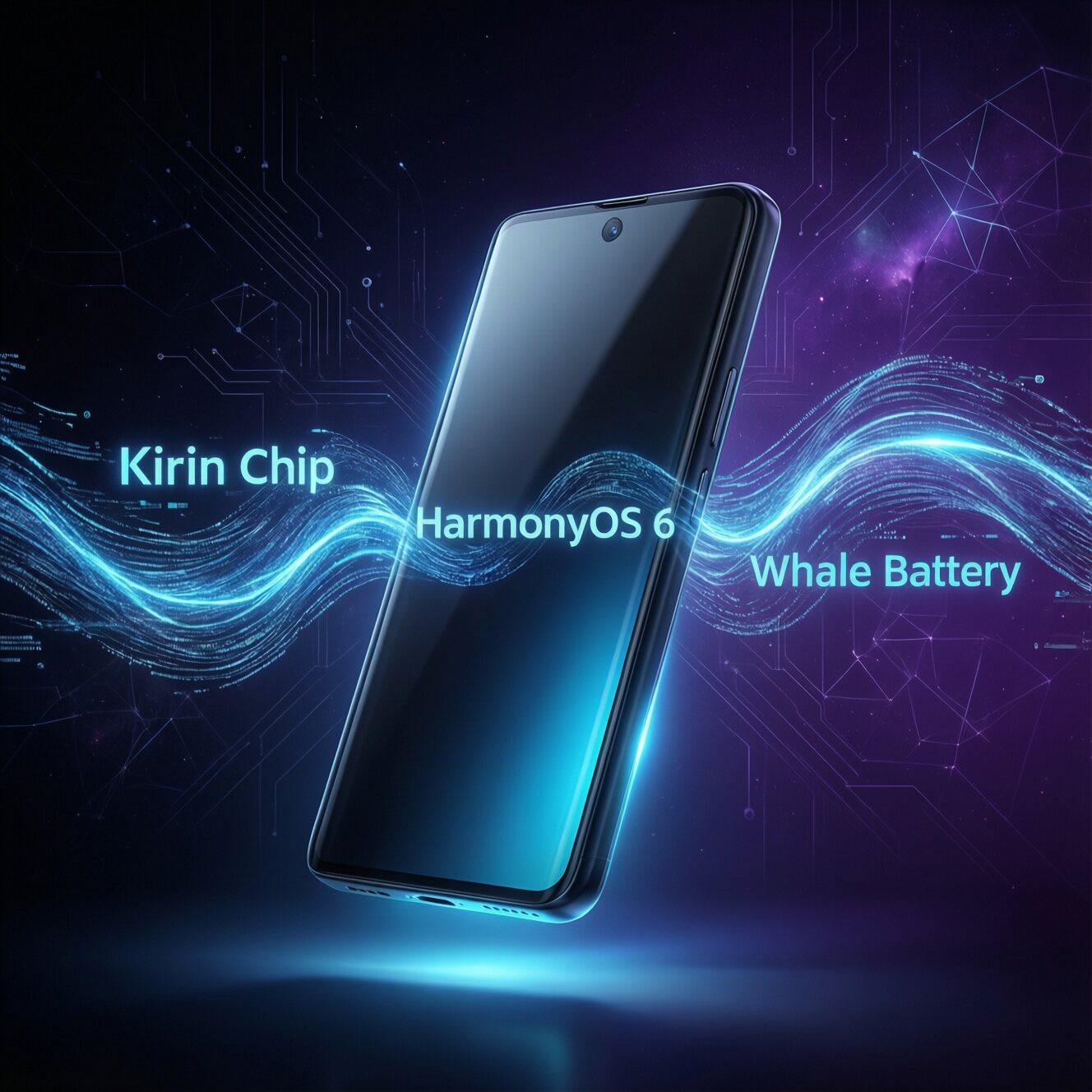
“Launching at the end of the month, with a Kirin chip, HarmonyOS 6 and a Whale battery.” Yu Chengdong casually showed off the real Huawei Enjoy 90 Pro Max on social media, yet the information was enough to make the whole tech world sit up and take notice again. This didn’t feel like the warm-up for a new phone in the thousand-yuan bracket; it felt more like a strategic show of firepower.
As someone in tech, the first thing I saw wasn’t “a new phone launch” but a highly self-consistent technical system, forged under extreme pressure, launching an assault on the broadest hinterland of the market. The Enjoy series has always been Huawei’s volume driver and base, and pushing its latest Kirin chip, HarmonyOS, and battery technology down to this tier means far more than the product itself. Behind it is a grand narrative about technological autonomy, a closed ecosystem loop, and market survival. Today we won’t talk specs or run benchmarks; we’ll take apart this “combo punch” and see what kind of game Huawei is really playing.
Background: Why the “Enjoy” Series?
Having secured its footing in the high-end market with the Mate and P series, why would Huawei deploy such heavyweight configuration in the “Enjoy” price bracket? This is by no means a simple trickle-down of technology.
The core contradiction lies in the scale and vitality of the ecosystem. The success or failure of HarmonyOS by no means depends only on how many flagship phones carry it. Anyone who has built enterprise-grade systems knows that an operating system’s vitality is rooted in its user base and developer ecosystem. High-end users matter, of course, but the vast mid-to-low-end market is the silt and sand that builds the ecosystem’s moat. Without massive device numbers, there’s no real “internet of everything,” let alone enough developers writing native apps for it — you risk falling into a vicious cycle of “few apps → users don’t want to use it → developers even less willing to build.”
So pushing self-developed chips and the latest system into the 2,000-yuan price bracket is a strategic “backfill.” The goal is to raise the device base of the HarmonyOS ecosystem as fast and as broadly as possible, injecting the most basic “mass” (matter) into the whole HarmonyOS universe. Huawei has to make this move, and it’s making it very resolutely.
Technical Breakdown: A Trinity “Inner-Circulation” Architecture
The brilliance of this “Kirin chip + HarmonyOS 6 + Whale battery” combination is that it’s not a stack of three independent pieces of hardware, but an “inner-circulation” architecture of deep synergy running from low-level hardware to the middle-layer system to top-layer user experience.
1. Kirin Chip: Not Just “Having It,” but “Matching It”
The Kirin chip used here (the exact model is unannounced; presumed mid-range or upper-mid-range) means far more than the “domestically self-developed” label.
From an engineering standpoint, the biggest advantage of a self-developed chip is the depth of “software-hardware co-optimization.” Apple’s perfect pairing of its A-series chips with iOS is the best example. Huawei is walking the same road.
|
This kind of deep customization can make the same hardware deliver 120% of the performance, or cut power consumption by 20% at the same performance. For the target users of the Enjoy series (price-sensitive, focused on battery life and basic experience), this “optimization dividend” is very perceptible: smoother everyday operation, longer battery life, better photos. The chip here is not merely a compute unit; it’s the “tone-setter” and “accelerator” of the entire system experience.
2. HarmonyOS 6: Distributed Capability Pushed Down and “Lightweight” Reconstruction
As the next-generation system, HarmonyOS 6’s core features must be a further strengthening of distributed capability and a full integration of AI. Putting it on the Enjoy series means Huawei is trying to democratize core experiences like “super device.”
The technical key lies in “lightweighting” and “elastic deployment.” HarmonyOS on a flagship can carry all the flashy all-scenario features, but a thousand-yuan phone has limited resources. HarmonyOS 6 needs the ability to deploy core services on demand and dynamically schedule distributed tasks.
|
Diagram: HarmonyOS 6’s elastic service architecture on resource-constrained devices
This means the system can intelligently judge the user’s scenario. When the user needs to collaborate with a tablet for work, it dynamically loads the full distributed module; when the user is just browsing the web or watching videos, the system stays minimal, saving resources for battery life and smoothness. This requires HarmonyOS 6’s microkernel architecture to be thorough enough and its service modularization to be high enough. If achieved, it would be a model in operating-system engineering.
3. Whale Battery: The “Ballast” of Experience
All the beautiful experiences (high-performance chip, smart system) rest on the basis of “having power.” The Whale battery technology (presumably a new material or structural solution to raise energy density) plays the role of “ballast” here.
From a technical standpoint, phone battery life is a systems engineering problem:Total battery life = battery energy density × battery volume / system power consumption
Huawei’s strategy works on three fronts at once:
- Battery side (Whale technology): raise the molecular formula to increase energy density within safety limits.
- Hardware side (Kirin chip): reduce baseline power consumption through process and architecture optimization.
- Software side (HarmonyOS 6): reduce wasted power through precise resource scheduling, sleep strategy, and AI power management.
Only when these three are deeply coordinated can the “Whale” slogan be shouted. Otherwise, a big battery just means a thicker body without achieving the user’s ultimate desire of “thin and light with long battery life.”
My Cool-Headed Thinking: Hidden Worries Under Prosperity and an “Atypical” Breakout
Reading this far, you might feel Huawei’s combo punch is flawless. But as a veteran who has lived through the ups and downs of technical cycles, I have a few cool-headed thoughts:
1. The ecosystem’s “lone heroism” and the cost of compatibility. Huawei is building an almost closed “inner-circulation” perfect system. But the other side of this double-edged sword is a drift away from the global mainstream Android ecosystem. Although HarmonyOS maintains app availability through a compatibility layer (AOSP), in the long run, what incentive do developers have to do extra adaptation and optimization for HarmonyOS? Unless Huawei can prove that HarmonyOS users are not only numerous but have very high willingness to pay and engagement. This requires a commercial loop and incentive system as powerful as Apple’s App Store was in its day, and it’s still climbing.
2. The supply chain’s “Achilles’ heel” hasn’t entirely vanished. The return of the Kirin chip is inspiring, but the sustainability of its advanced process remains a question mark. The international semiconductor landscape is volatile, and Huawei needs to build a more controllable domestic supply chain from design to manufacturing. Shipping the Enjoy series in large volumes is a stress test of that supply chain’s capacity and yield.
3. The balance between “technology trickle-down” and “brand positioning.” Pushing top-tier technology down can quickly expand the ecosystem in the short term, but will it blur the high-end brand image Huawei worked so hard to build? How to let Mate users still feel the exclusivity of “having it to themselves” while letting Enjoy users feel “great value” requires an extremely delicate art of marketing and product definition.
Huawei’s breakout is “atypical.” It doesn’t lead a single-dimension innovation like Apple (touch, Face ID), nor does it rely purely on the internet model and cost-effectiveness like early Xiaomi. It’s fighting a systematized mixed martial art on a restricted battlefield, relying on vertical integration (chip, system, cloud) and horizontal linkage (1+8+N all-scenario). The key to success or failure lies in whether the synergy efficiency of every link in this system can be high enough to offset the cost of external ecosystem isolation.
Implications for Product Builders: What Is a Real “Moat”?
Huawei’s move here teaches every technology product person a vivid lesson:
1. A moat is a “system,” not a “single point.” A standalone chip, a standalone system, a standalone battery technology can all be imitated or surpassed. But when they form a closed-loop experience through deep optimization, the difficulty of imitation rises exponentially. When building products, we should ask: are we offering a pile of features, or an “experience system” whose parts mesh tightly?
2. The user base is the oxygen of an ecosystem product. However grand your vision (internet of everything, metaverse), you must find the entry point that can quickly acquire a massive user base. Sometimes this entry point may not look very “high-end,” but it provides the soil for survival and evolution. Never disdain any market that can bring you scale.
3. Software-hardware co-optimization is the ultimate path to experience elevation. The ceiling for pure-software or pure-hardware innovation is getting lower and lower. Future product competitiveness must come from extreme exploitation of hardware characteristics plus precise scheduling by software intelligence. This demands that product managers, hardware engineers, and software engineers sit at the same table and co-design from day one.
4. In adversity, focus on the core value chain. Under restrictions, Huawei has instead focused more clearly on the core value chain of “chip-system-cloud services,” shedding secondary businesses. This tells us that when resources are limited, the best strategy isn’t to attack on all fronts, but to concentrate all force on the main track that best defines you and, once built, is extremely hard to replicate.
Conclusion
That Enjoy 90 Pro Max in Yu Chengdong’s hand is more than a phone. It’s a symbol, marking that Huawei, under extreme pressure, has completed a deep technological internalization and ecosystem reconstruction from strategy to execution. Kirin chip, HarmonyOS 6, Whale battery — behind each term lies a difficult but necessary road.
This breakout has no finish line; it’s a marathon. Just as I’ve felt deeply while running marathons: what matters most isn’t how fast the pace of any one kilometer is, but the stability of the rhythm throughout, the soundness of the fueling strategy, and the tenacious will when facing the “wall.” Huawei is running on a track it carved out itself, with cheers and thorns along the way. Its practice tells us that in the world of technology, true freedom comes from a deep understanding of core technology and a sustained climb.
And each of us practitioners may draw strength from it: focus on the essence, build the system, and then keep running resolutely.
评论
0 条评论