Reading Mr. Fei Xiaotong’s The Institutions for Reproduction (《生育制度》), what overturns my understanding most is the way it shatters the ingrained notion that “reproduction is a natural instinct.” With a calm sociological eye, the author reinterprets reproduction — from a mere physiological act — as a set of social institutions that exist to achieve “the continuity of the race.” There is no flowery language in the book, only a profound dissection of human nature, the family, and society. Combining the core fragments of the 32 notes in the book, we can see even more clearly the underlying logic and real significance of this institution, and it has given me a whole new way of thinking about marriage, family, and parent-child relationships.
I. The Core Thesis: The Essence of the Institutions for Reproduction Is to Guarantee the Continuity of the Race
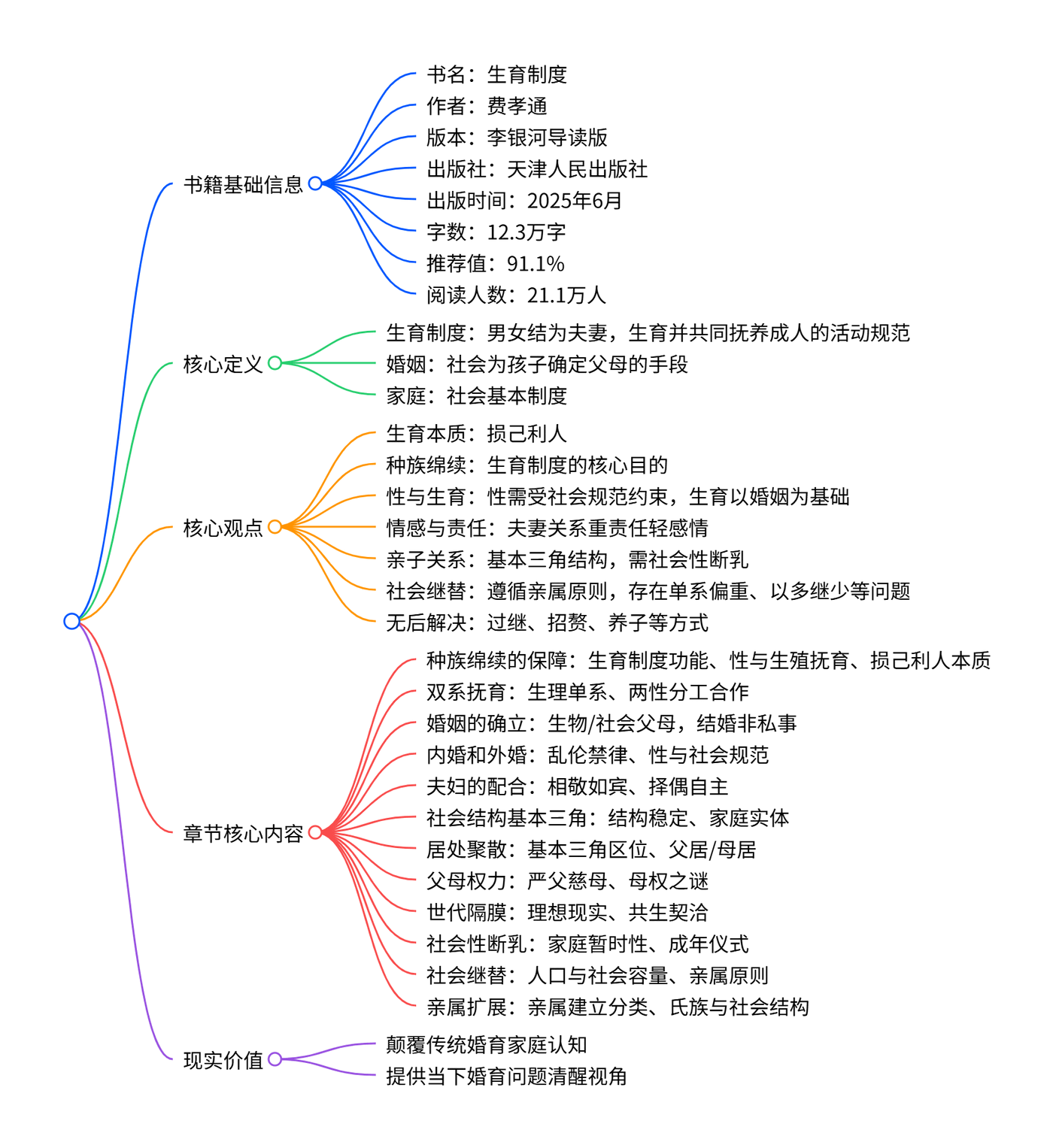
The book’s central thesis is: why do human beings need institutions for reproduction? The answer is simple — the human infant’s period of nurture is extremely long, and biological instinct alone cannot accomplish the continuation of the race, so society must establish a set of rules to fix the process of “reproduction–nurture” in place. This is the essence of the institutions for reproduction. It is not there to satisfy the individual’s emotional needs but to guarantee society’s normal operation and succession — it is “a system of activities arising from the need for the continuity of the race.” This core view runs through the entire book and explains many of the family and social phenomena that puzzle us.
II. Sex and Reproduction: The Underlying Logic of Social Constraint
The relationship between sex and reproduction is the starting point for understanding the institutions for reproduction. In his notes the author clearly points out that sexual relations can have a certain freedom, but once reproduction is involved, there must be strict norms, and the foundation of those norms is marriage. The logic behind this is that unconstrained sexual activity disrupts the social structure, undermines identity, and dismantles family order — “if sexual love were given completely unconstrained freedom, its destructive power would be considerable.” To maintain the stability of the social structure, society must control the force of sex, and so the incest taboo and exogamy come into being. The essence of exogamy is to have people seek partners among those with no close social ties to them, satisfying intimacy needs without destroying the existing social structure, while at the same time providing a stable environment for reproduction. This also made me understand that marriage is not a pure union of emotion; its core function is to establish the identity of the parents and to define clearly who is responsible for the child’s nurture — “but if you want to have a child, you have no choice but to marry, to sacrifice the freedom of your sex life, and to shoulder the heavy burden of raising the child.”
III. The Essence of Marriage: A Cooperative Nurturing Effort in Which Responsibility Comes Before Emotion
As for the husband-wife relationship in marriage, the author breaks it down into the two major elements of emotion and responsibility, and in traditional China the partnership was mostly one that “underweights feeling and overweights responsibility.” The husband-wife relationship falls mainly into two types: one leaning toward emotional attunement and shared interests, enjoying the pleasures of married life; the other setting aside emotional needs and leaning toward economic and career cooperation, jointly running family affairs. But whichever type it is, “the birth of a child is the condition for the completion of the couple’s relationship” — this once again confirms that the core purpose of marriage is reproduction and nurture; emotion is more of an accessory to marriage than its core. This understanding may run counter to modern views of love and marriage, but it precisely nails the essential function of marriage under the traditional institutions for reproduction.
IV. The Family Triangle: The Inevitable Dissolution of a Temporary Structure
“The family is a temporary triangle, and it will eventually break up” — this is a point we discussed in depth earlier, and it is one of the most illuminating arguments in the book. The “family triangle” the author speaks of is the structure of “father–mother–child,” a temporary unit of nurture whose only purpose is to raise the child to adulthood so he can enter society independently. The temporariness of this triangular structure stems from the staged nature of its function: the child goes from complete dependence on the parents to gradually learning society’s rules, to becoming an independent adult and forming his own new family. This process is “social weaning” — the parent-child bond must gradually be severed so that the individual can complete the transition of identity from “child” to “adult,” and the significance of the coming-of-age ceremony is precisely to help the individual complete this psychological passage. When the child forms a new family triangle, the original parent-child triangle naturally weakens and dissolves. This is not a tragedy but the inevitable law of social succession — the old structure yields and the new structure is born, and only thus can the continuity of the race and the stability of society be guaranteed.
V. The Essence of Reproduction: A Social Necessity That Benefits Others at One’s Own Expense
Reproduction itself, in the author’s view, is an act of “benefiting others at one’s own expense.” At the biological level, nutrition is self-interested at the expense of others, whereas reproduction is altruistic at one’s own expense — reproduction requires the individual to sacrifice time, energy, and resources, and even to harm his own health; a person who calculated his own interests thoroughly would tend to avoid reproduction. This also explains why society needs to push people to reproduce through culture, morality, family pressure, and the like — “if there were no social sanctions, then since human beings are able to break free from the chain of biological mechanisms, the continuity of their race would lose its natural guarantee.” The institutions for reproduction are, in essence, the use of social rules to bridge the gap between individual instinct and social need, so that the continuity of the race can be realized.
VI. Population and Inheritance: Social Structure Determines Reproductive Choices
In his discussion of population growth and family inheritance, the author also overturns the traditional notion that “food determines population,” proposing that population growth is not determined by the amount of material resources but by the needs of the social structure — “if a structure needs many people and has little material, the people in that structure can survive in a state of hunger and starvation; conversely, if a structure can be maintained with only a small population, then even with abundant food, people will not reproduce at a geometric rate.” And in traditional Chinese society, phenomena such as favoring sons over daughters, adoption of a heir, and uxorilocal marriage are not simply gender discrimination but the inevitable product of the institutions for reproduction in a patrilineal society. In a patrilineal society, a daughter cannot inherit the family estate or share the parents’ responsibilities, so the parents’ affection for their children naturally differs; and a family without a son continuing the estate through adoption or uxorilocal marriage is essentially fulfilling the institutional requirement of “carrying on the family line” and guaranteeing the family’s continuity.
VII. Takeaways: Step Beyond Emotion and Understand the Social Logic Behind the Institution
After finishing The Institutions for Reproduction, the biggest gain is stepping out of the personal-emotional perspective and viewing reproduction, marriage, and the family from the angle of social function. We often agonize over emotional gains and losses in marriage and over companionship and separation in parent-child relationships, yet overlook that behind these relationships all of them carry the mission of social succession. The institutions for reproduction are not a shackle but a set of cultural tools that human beings actively created for survival and continuity — they regulate reproduction through marriage, bear the burden of nurture through the family, and maintain order through ethics, so that humanity, amid the uncertainties of nature, found a stable path for the continuity of the race.
The author’s argument not only explains the logic of the institutions for reproduction in traditional society but also offers a way of thinking for us to understand the predicaments of love, marriage, and reproduction in modern society. Today, with changes in the social structure, people’s views on love, marriage, and reproduction have shifted enormously; “light responsibility, heavy emotion” has become mainstream, and reproduction is no longer an inevitable choice for everyone — behind this lies precisely the change in the function of the institutions for reproduction in modern society. But in any case, the core of these institutions — guaranteeing the continuity of the race and driving social succession — remains a fundamental need of human society.
The value of The Institutions for Reproduction lies not in offering specific solutions but in providing a clear-eyed perspective: it helps us understand that marriage, family, and reproduction have never been isolated personal choices but institutional arrangements embedded in the social structure. Only by understanding this institution can we view intimate relationships and parent-child relationships more rationally, make sense of many of life’s confusions, and recognize more deeply that the continuation of humanity has never been an individual fighting alone, but a mutual achievement of institution and individual, of society and family.
评论
0 条评论