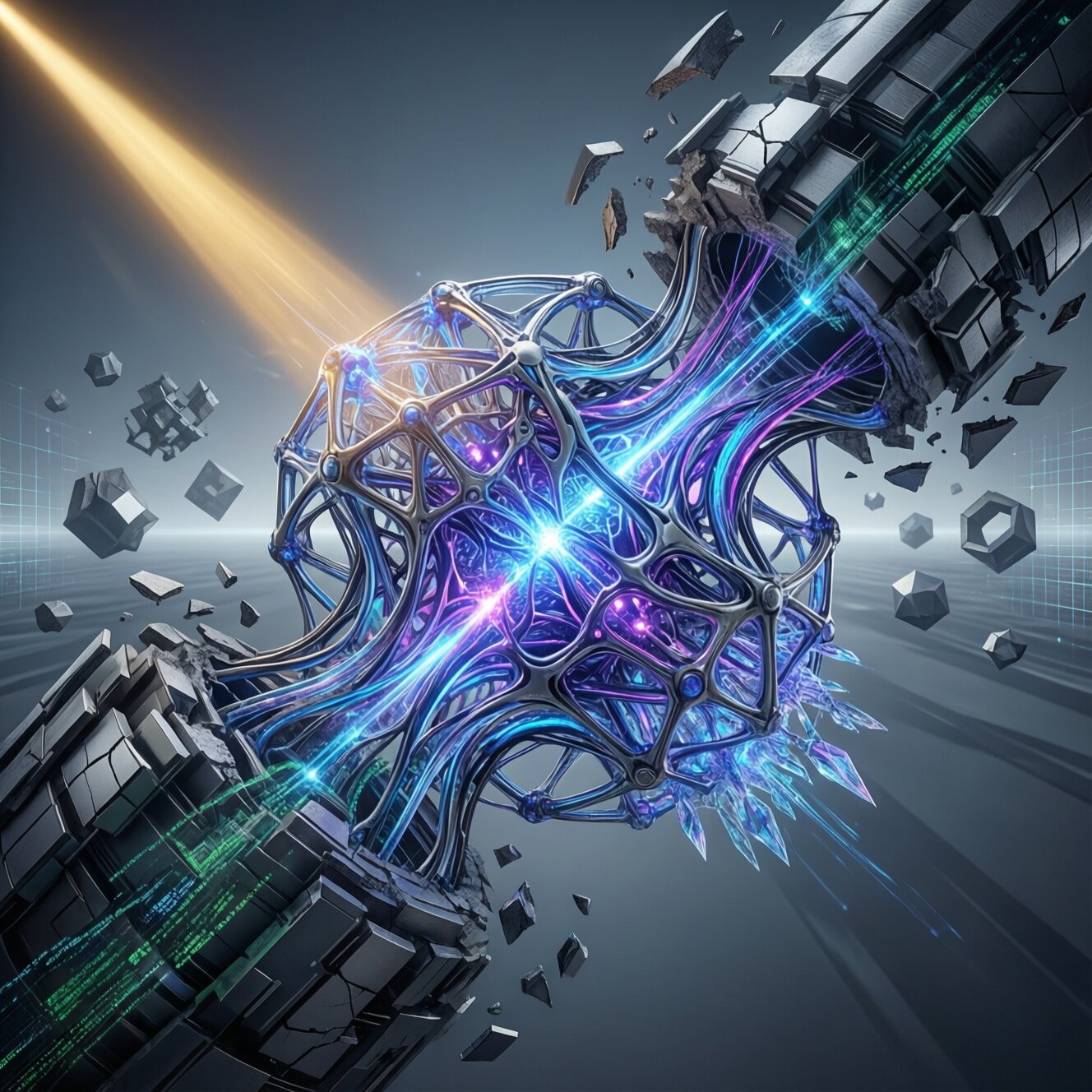
“The whole internet waited nine days, just to see how it would tear down its own load-bearing walls.”
As a technologist, when I saw the news that OpenClaw was touting its “most aggressive upgrade ever” and a “complete overhaul of its underlying architecture,” my first reaction wasn’t excitement but curiosity: what incurable disease forced it to swap out its organs? Was this nine-day “surgery” a successful organ transplant, or a dangerous “head swap”? Today, no fluff—let’s take it apart from an engineering angle and dig into the technical logic, costs, and lessons behind this upgrade.
Background: Why Can’t a “Frankenstein” Architecture Go Far?
Before dissecting the new architecture, we must first understand the “original sin” of the old one. Based on public information and industry conventions, OpenClaw’s initial version was likely a typical “agile development” product—in fierce market competition, to ship fast and validate the market, technical teams often choose the most “pragmatic” solution: “stitching” together existing mature components.
Picture this scenario: you need a powerful language-model foundation, so you plug in or fine-tune an open-source LLM; you need multimodal understanding, so you “glue” on an excellent vision model (VLM); you need web search, so you call Serper’s or SerpAPI’s interface; you need long context, so you perhaps introduce a RAG framework… Each module, viewed alone, is strong, but “stitch” them together with APIs, message queues, or a simple business-logic layer, and you get a “Frankenstein” architecture.
Such an architecture has huge early advantages:
- Fast development: no need to reinvent the wheel.
- Low technical risk: every component is battle-tested.
- Focused resources: the team can concentrate on business logic and innovative experience.
But once the user base grows and scenarios get complex, the drawbacks of “Frankenstein” surface menacingly like reefs revealed when the tide goes out:
- Performance bottleneck: Every user request may shuttle around several independent services, with huge network-I/O and serialization/deserialization overhead and persistently high latency. A complex multi-turn conversation can easily exceed 5–10 seconds of response time.
- Runaway costs: Each external component may charge per call; the call chain is long, and the per-request cost stacks up. User growth brings not economies of scale but a linearly growing cost nightmare.
- Stability nightmare: The “bucket effect” is amplified to the extreme. The whole system’s SLA (Service Level Agreement) equals that of the worst component. Jitter or failure in one downstream API renders the whole service unavailable.
- Fractured experience: Each component is optimized independently, and the “consciousness” across models is not unified. The language model might answer “draw a cat,” but the vision model generates dog-style output—this internal incoherence seriously hurts user experience.
- Iteration shackles: Want to optimize an end-to-end flow? Sorry—one move affects the whole body. Upgrading any module requires considering compatibility with the other “black box” components, and innovation crawls.
So OpenClaw’s “overhaul” is essentially not showing off tech but an inevitable choice under survival pressure. It signals the product moving from a “rapid validation period” into a “deep optimization and scaled operation period.” These nine days aren’t an upgrade; it’s a refactor, a “scraping the poison off the bone.”
Technical Breakdown: From “Microservice Frankenstein” to an “Integrated Deep Engine”
So what does the new underlying architecture actually look like? Though the company won’t disclose every detail, we can infer from the trends in AI agent (Agent) technology and engineering best practices that the core of this refactor is building an “integrated deep engine.”
The old “Frankenstein” architecture can be simplified as follows:
|
(Diagram: Old architecture - centralized coordinator + discrete services)
While the new “integrated deep engine” architecture is more likely to be closer to:
|
(Diagram: New architecture - unified compilation and deep integrated engine)
Key technical points of this transformation may include:
Unified intermediate representation (IR) and compute-graph scheduling
Rather than letting different models each do their own thing, the user task (whether text, image, search, or tool calling) is compiled into a unified, abstract intermediate representation. This IR defines the data flow and control flow of the task. Then a high-performance scheduler assigns this compute graph to the most suitable compute unit (possibly different parts of the same model, or dedicated hardware) for execution. This is similar to how deep-learning frameworks (like PyTorch, TensorFlow) optimize compute graphs, only it rises from single-model level to multimodal, multitask level.# Pseudocode illustration: from "if-else calls" to "unified description"
# Old mode (imperative, hardcoded):
if "draw" in user_query:
image_result = call_vlm_model(prompt=user_query)
return image_result
elif "search" in user_query:
search_result = call_search_api(query=user_query)
summary = call_llm(summarize, search_result)
return summary
# New mode (declarative, unified IR):
# 1. User query -> unified task description
task_ir = {
"type": "complex_creation",
"components": [
{"type": "text_understanding", "content": user_query},
{"type": "web_knowledge_retrieval", "key": extract_keywords(user_query)},
{"type": "image_generation", "style": infer_style(user_query), "elements": inferred_elements}
],
"dependencies": [("text_understanding", "web_knowledge"), ("web_knowledge", "image_generation")] # define dependencies
}
# 2. Engine receives IR, does global optimization (like merging similar ops, prefetching data), generates the optimal execution plan and runs it.Deep fusion and customization at the model level
This may be the most “hardcore” part. OpenClaw likely is no longer satisfied with just calling off-the-shelf LLMs and VLMs, but rather:- Performing deep customized training: based on open-source base models, using its own multimodal data and task-chain data for continued pretraining or instruction fine-tuning, so the model understands at the lowest level that “calling tools,” “analyzing images,” and “generating text” are different facets of the same class of task.
- Designing a shared attention mechanism: letting text tokens, image patches, and tool-calling symbols interact via attention in the same semantic space, achieving a true “one brain thinking” rather than “multiple experts in a meeting.”
- Building a unified memory system: storing dialogue history, tool-execution results, and retrieved knowledge in a unified format in the same memory network, so any module can quickly retrieve and use them later, avoiding redundant computation and queries.
Rebuilding the infrastructure: from “service mesh” to “compute platform”
An architecture overhaul is by no means just rewriting application-layer code. It’s inevitably accompanied by a transformation of the underlying infrastructure.- Change in communication mode: from lots of network RPC calls to efficient in-process or same-machine memory sharing and zero-copy data transfer.
- Upgraded resource scheduling: needs finer-grained GPU/CPU/memory scheduling strategies to handle the differentiated resource demands of different compute tasks within the integrated engine.
- Rebuilt monitoring and observability: the old per-service monitoring system fails; you need to establish brand-new monitoring metrics oriented around “task flows” and “compute-graph nodes,” to quickly locate which link inside the integrated engine suffers a performance regression or error.
My Cool-Headed Reflections: Hidden Worries Beneath the Feast and the “Impossible Triangle”
This upgrade is undoubtedly a huge technical advance, but as someone who’s built enterprise-grade systems, I see not just the halo but the challenges behind it and the industry’s pervasive “AI agent impossible triangle.”
Cool thought one: technical debt doesn’t vanish—it only migrates and upgrades.
The debt of a “Frankenstein” architecture is integration complexity. The debt of an integrated architecture becomes an extremely high technical barrier and deep coupling. The codebase becomes abnormally large and complex, and dependence on the core framework team reaches an extreme. Once this “deep engine” has a low-level design flaw, all upper-layer features may be affected, and the fix cost is extremely high. This shifts from the governance difficulty of “distributed microservices” to the governance difficulty of a “monolithic monster”—except this “monolith” is a super-intelligent agent of the AI era.
Cool thought two: the inherent contradiction between “integration” and “open ecosystem.”
OpenClaw moving toward deep integration is for extreme performance and experience. But the door this closes may be the window of “ecosystem openness.” When all capabilities are aggregated inside a black-box engine, how do third-party developers build plugins for it? Do they all have to learn your complex “unified IR” and internal APIs? Apple’s ecosystem success stems from software-hardware integration, but it also created a walled garden. Does OpenClaw want to be the “Apple” of the AI era, or the “Android”? That’s a strategic choice. For now, it chose the former.
Cool thought three: the AI agent “impossible triangle”—performance, cost, generality.
In my view, today’s AI agents face a constraint akin to the “CAP theorem” of distributed systems:
- Extreme performance and experience: requires integrated deep optimization.
- Controllable low cost: requires lean models, customization, and reduced external dependencies.
- Powerful generality and generalization: requires large models, massive data, and an open ecosystem.
These three are hard to optimize simultaneously. OpenClaw’s upgrade clearly sacrifices part of “generality” (relying more on its own data and tech stack) and “ecosystem openness” in exchange for optimizing “performance” and “cost.” This is a very pragmatic but also very risky engineering trade-off.
Cool thought four: nine days of “silence” is courage, and an enormous risk.
The whole internet waited nine days, indicating the upgrade wasn’t a hot update but a data migration and system switch that required downtime. This indirectly confirms how drastic the architecture change was—data formats and states may all be incompatible. For a product with a large number of online users, this is walking on thin ice. It succeeded, worthy of praise, but this model is not replicable. It also reminds us how important it is, in early architecture design, to leave good data interfaces and migration paths for “possible future refactors.”
Takeaways for Building Products: Architecture Is Grown, Not Designed
OpenClaw’s metamorphosis offers a vivid lesson to all technology-driven product people:
Respect the development stage and dare to refactor: Don’t expect the very first version to use the most perfect architecture. Good architecture is grown, not designed. An early “Frankenstein” is not shameful—it’s the shortcut that keeps the product alive. But when it becomes a shackle on growth, you must have the resolve to “cut off your own arm” and refactor. Seizing this decision point (after Product-Market Fit, at the start of scaling) is the core value of a CTO or technical lead.
Performance and experience are the entry ticket to the advanced stage: In competition where features are homogenized, when everyone can “build it,” “is it usable” and “is it fast” become the deciding factors. Deep optimization of the underlying architecture directly determines the ceiling of user experience. This is no longer optional but a survival necessity.
Adopt a “data-flow-centric” architectural perspective: Forget those isolated services, and think about architecture starting from the complete data flow from user request to final response. Where is the bottleneck? Where do unnecessary data conversions and copies occur? How can data flow faster and more directly? The essence of an integrated engine is letting the data flow run through internal high-speed channels.
Design observability for the “black box”: The more deeply integrated a system is, the more it needs powerful internal observability tools. You need to be able to see, like a CT scan of the human body, the activation state of every “neuron” in the compute graph and the flow of every piece of data. Otherwise, debugging and troubleshooting will be a nightmare.
Balance “closed” and “open” with strategic vision: The choice of technical architecture ultimately serves product strategy. Closed brings experience and efficiency; open brings ecosystem and breadth. What problem your product actually solves and which users it serves determine which end you should move toward. There is no best architecture, only the most suitable one.
Conclusion
OpenClaw’s nine-day “blood transplant” is not an isolated technical event. It’s a signal, marking AI applications formally entering the deep-water zone from the “toy” and “demo” stage into the “serious product” and “scaled operation” stage. What’s being compared is no longer whose PPT is flashier, but whose architecture can withstand the impact of real traffic and who can deliver a smoother experience at lower cost.
As a technologist, I admire this engineering spirit of confronting technical debt head-on and daring to refactor. At the same time, I stay calm: this road toward extreme integration is full of thorns and has no way back. It may create an immensely powerful “new species,” or it may create a lonely “super-monolith.”
The future AI application architecture may find a new balance between “integrated engine” and “modular federation.” But either way, OpenClaw’s upgrade tells us: in the AI era, deep technical integration and innovation remain the most solid brick for building a product moat. And the starting point of it all is daring to tear down the load-bearing wall you built with your own hands that has become outdated.
These nine days were worth the wait.
评论
0 条评论