An old saying goes: “Seek outwardly and you’ll seek in vain; seek inwardly and life will flourish endlessly.”
This line resonates strongly with the core idea of The 7 Habits of Highly Effective People (《高效能人士的七个习惯》). Covey does not teach you to grab money fast or play social power games; he tells you — true high effectiveness and lasting happiness come from the cultivation of inner character, from the alignment of knowing and doing, from the inside out. The essence of the seven habits is a system of self-cultivation that teaches people to “seek inwardly”: from dependence to independence, then to interdependence, ultimately building a stable core — one that is not shaken by the outside world’s judgments, nor confused by temporary gains and losses.
This reminds me of Adler’s views in The Courage to Be Disliked (《被讨厌的勇气》). The two books seem to come from different cultural backgrounds, yet they point to the same truth: happiness is not chased from the outside; it is built from within.
For a period in 2025, I too could not feel my own worth. The things I did every day seemed meaningless, just repeating day after day, with no future in sight, and my health was far worse than before. Covey says: “I am very busy, truly very busy, but sometimes I’m not even sure whether it’s worthwhile. I want to live meaningfully, to be able to contribute to the world.” This line hit home. It was only when I began shifting my attention from “how the outside world evaluates me” to “what kind of person I want to become” that the sense of powerlessness slowly faded.
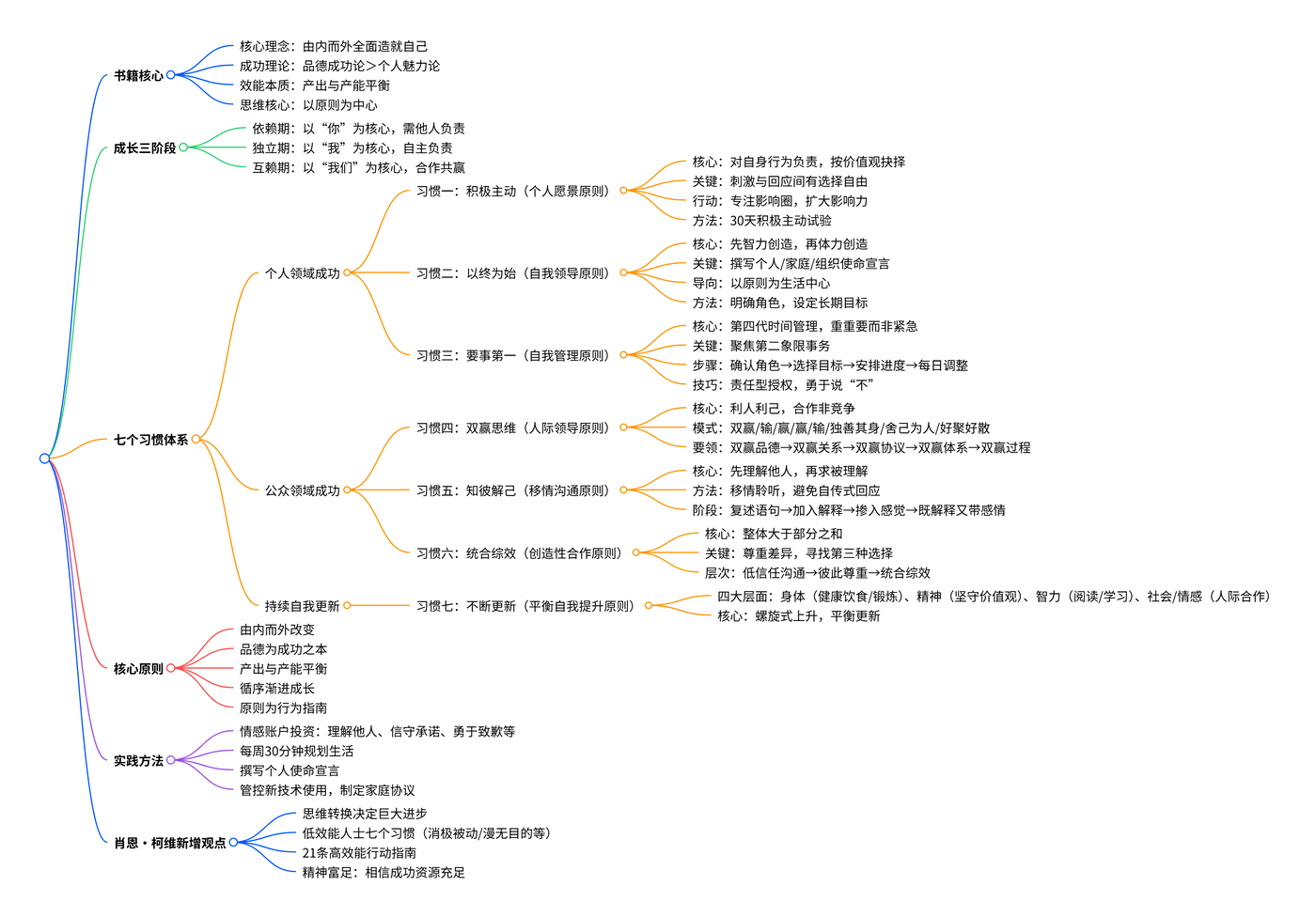
I. Core Idea: Build Yourself Comprehensively from the Inside Out
This is the most central overarching principle of the whole book, and the fundamental thing that distinguishes it from ordinary self-help books.
At the very beginning, Covey reminds us: “We must first understand the human way of thinking and how to achieve a shift in that way of thinking before we can truly understand these seven habits.”
The so-called way of thinking is the way we see the world, the map by which we understand reality. Covey says a map is not the territory itself; if our map is wrong, no amount of effort will get us to the destination.
The term “paradigm shift” was first proposed by Thomas Kuhn in his classic The Structure of Scientific Revolutions. Kuhn explains in that book: almost every major breakthrough in scientific research succeeded by first breaking with tradition, with the old thinking and the old model. Copernicus breaking the shackles of the “geocentric” model, Einstein stepping outside the framework of Newtonian physics — all are like this. Personal growth is the same — if you don’t break the old mode of thinking, even the best method is just a new route on an old map, and it won’t get you where you want to go.
This makes me think of a saying: shifting your thought shifts your fortune. When we view problems with a negative way of thinking, the world is full of obstacles; when we shift to a positive way of thinking, the same circumstances present different possibilities. The essence of the seven habits is to help us complete this kind of paradigm shift — from dependence to independence, from passive to proactive, from scarcity to abundance.
Ways of thinking come in positive and negative varieties:
- Negative thinking: “There’s nothing I can do,” “if only…,” “that’s just how they are, I can’t help it”
- Positive thinking: “I can choose a different way,” “I can control my own reactions,” “let me think about other possibilities”
The seven habits are precisely what guide us to cultivate a positive way of thinking, to shift from “I can’t do it” to “how can I do it,” from “the outside world controls me” to “I choose how to respond.” This shift of thought is the beginning of shifting your fortune.
The logic of change
Repair the inner first, then change the outer. It rejects the piling up of external techniques that “treat the symptoms but not the root,” and holds that success in the personal sphere must come before success in the public sphere — only by first managing yourself and perfecting the inner can you handle interpersonal relationships and achieve external success.
Covey notes that the “personality ethic” popular after World War I was like treating spiritual pain with “aspirin” and “Band-Aids,” treating the head when the head hurts and the foot when the foot hurts — treating the symptom, not the root. Many books on the market teach people how to succeed quickly and how to be smooth with everyone; they read satisfyingly but are like fast food — forgotten as soon as you finish, unable to solve fundamental problems. This makes me think of the screenful of “Learn XXX in 3 days” and “5 steps to the peak of life” — what they sell is an anxiety reliever, not a true path of growth.
Real change must begin with the way of thinking.
Covey says: “Human nature can be good or bad, influencing our lives in unseen ways, and always faithfully reflecting the true self — that cannot be faked.” This is precisely the root of seeking inwardly — we cannot deceive ourselves; external techniques can fake things for a while, but the true inner character will ultimately be laid bare in the details of life. Rather than working hard to fake it, it is better to face yourself sincerely and cultivate from the inside out.
This echoes Adler’s “separation of tasks”: seeking inwardly means clarifying what is your own task — my effort, my attitude, my choices are what I can control; how others evaluate me and whether the final outcome meets expectations are others’ tasks, and need not be forced. As Adler says: “You are not living to satisfy others’ expectations, and others are not living to satisfy yours.”
A passage in the book struck me deeply: only when we stop using a child’s performance to judge our own worth can we gain true inner security. Let a person give himself a sense of value from within, and not care excessively about external evaluation. A few months later, he gradually gained confidence and began to affirm his own worth, and finally brought out his potential at his own speed and pace. This “own speed and pace” is so important. Growth is not about comparing with others but about comparing with yesterday’s self.
The logic of growth
It is a continuous, spiraling upward process, not a one-time change. Through the reshaping of inner thinking, character, and habits, it drives the positive transformation of outer behavior, relationships, and results, rather than seeking short-term gain through rhetoric, personal image, and other surface tricks.
Core conclusion: attempting to manage interpersonal relationships through social skills before self-improvement is doomed to be futile.
Covey also discusses this logic in the parent-child relationship. When a child is unwilling to share a toy, if the parent merely uses status and authority to force compliance, the child will become increasingly dependent on external force, and the development of independent judgment and self-discipline will suffer. A better way is to let the child experience the feeling of “truly owning” — once a child experiences the feeling of true ownership, he will naturally be happy to share with others.
I have encountered this scene too. My solution is to let the child and his little friends work it out themselves: a child who wants to play must get my son’s consent before taking it. Sometimes other children will grab my son’s toy directly, and I will say rather sternly: you can’t do that; you need his consent. Similarly, when my child wants to play with someone else’s toy, I also tell him: you must get the other person’s consent, otherwise you’re not allowed to touch his things. When a relationship and atmosphere are tense, teaching will be seen as a judgment and a negation; when the relationship is harmonious, guiding a child gently in private is doubly effective. Perhaps only by truly experiencing ownership can one truly understand sharing.
II. The Essence of Success: The Character Ethic > The Personality Ethic
Covey thoroughly distinguishes two views of success, pointing directly at the misconceptions of popular success literature:
The character ethic (the foundation of lasting success)
The mainstream logic of success before World War I, holding that basic virtues such as integrity, humility, loyalty, justice, diligence, and temperance are the very source of success and happiness. Character is the core of interpersonal relationships; only with goodness in the heart and consistency between word and deed can one gain lasting trust and achievement.
The personality ethic (short-term, false success)
The utilitarian logic prevalent after World War I, attributing success to personality, social skills, external image, and polished rhetoric. This approach works only in the short term; once there is a flaw in character (disingenuousness, insincerity), it inevitably cannot sustain long-term success.
The book mentions the confusion of a manager: “I’ve been through countless training courses on effective management, and I have very high expectations of my employees. So I try to appear friendly and treat them well, but somehow I just don’t feel their loyalty.” Reading this I laughed — many bosses want not to pay employees more, yet want employees to be loyal and responsible. This is essentially a variant of the “personality ethic”: assuming that learning a few management techniques and putting on a friendly posture can buy employees’ genuine dedication. Covey puts it more bluntly: “Is it possible that the boss’s way of seeing his employees is the reason for the poor management?” If the source of power is only position, authority, or appearance, once these change, the influence instantly collapses.
Core view: As Emerson said, “What you are shouts so loudly in my ears I cannot hear what you say.” External techniques have true value only when attached to good character.
III. The Ultimate Definition of Effectiveness: The Balance of Production and Production Capability (P/PC Balance)
This is the whole book’s core definition of “high effectiveness,” overturning the misconception that “the busier you are, the more effective.”
| Concept | Meaning | Analogy |
|---|---|---|
| P (production) | The desired result, such as work performance, money | “The golden egg” |
| PC (production capability) | The asset that creates results, such as the body, ability, relationships | “The goose that lays the golden eggs” |
Core rule: high effectiveness ≠ chasing results only, but balancing results with the protection of the asset.
- Over-drawing on the asset with no regard for the result → draining the pond to catch all the fish
- Only raising the asset without chasing results → utterly worthless
Applicable scenarios: covering physical assets, financial capital, and human capital. For example, working frantically without maintaining your health, or using others without maintaining the relationship, are both low-effectiveness actions that violate the P/PC balance.
Covey’s fable of “the golden egg and the goose” is thought-provoking: in life, people who “value the egg over the goose” ultimately cannot keep even this golden-egg-laying asset; conversely, people who “value the goose over the egg” may in the end starve themselves to death. Reading this, I thought of Zhang Xuefeng and some programmers at big tech companies who died from overwork — they desperately produced golden eggs but forgot to maintain the goose that lays them: their own body, energy, and family relationships.
There is no shortcut. People often immediately ask: “How did you do it? Teach me some techniques.” In fact what they really want to ask is: “Is there a trick to quickly get me out of my current situation and out of my pain?” The answer is: no. Any practice that violates the laws of nature and seeks only quick results will ultimately be met with backlash.
IV. The Path of Growth: The Three Maturity Stages of Dependence → Independence → Interdependence
A person’s growth follows fixed natural laws; you cannot skip stages, and the seven habits fit this path perfectly:
| Stage | Core characteristic | Corresponding habit |
|---|---|---|
| Dependence | Centered on “you,” passively waiting for others to care, others responsible for one’s success or failure | None (the ineffective initial state) |
| Independence | Centered on “I,” taking responsibility, choosing proactively | Habits 1–3 (personal-sphere success) |
| Interdependence | Centered on “we,” cooperating for mutual benefit, merging each other’s wisdom | Habits 4–6 (public-sphere success) |
Core conclusion: independence is not the endpoint; interdependence — the ability to collaborate efficiently with others — is the ultimate state of mature effectiveness.
V. The Closed-Loop Logic of the Seven Habits
The seven habits are not scattered items but a complete closed loop from personal grounding to interpersonal cooperation to self-iteration:
Personal success (the foundation): Habits 1–3
Building an independent character, solving “how to be your own master”:
Habit One: Be Proactive (the principle of personal vision)
- Core: taking responsibility for your own behavior, choosing by your values
- Key: there is freedom of choice between stimulus and response
- Action: focus on the circle of influence, expand your influence
- Method: a 30-day proactivity experiment
Covey says: “Between stimulus and response there is a space. In that space is our power to choose our response. In our response lies our growth and our freedom.“ This space is the space of seeking inwardly.
Proactive people focus on the “circle of influence” — the things they can change through their own behavior; while reactive people stare all day at the “circle of concern,” anxious and complaining about things they cannot change. When we shift our focus from “how others see me” to “what I can do,” we move from “seeking outwardly” to “seeking inwardly.”
In the extreme environment of the Nazi concentration camps, Viktor Frankl discovered: although the Nazis could control his living environment and destroy his body, his self-awareness remained independent. Between the suffering and his response to it, he had the freedom to choose his response. This is the most striking proof of proactivity — even in dire straits, a person still has the ultimate freedom to choose his own attitude.
Covey reminds us: “It’s not the hurtful things that happen to us, but our being so deeply hurt that harms us most.” In fact, the more painful the experience, the more it tempers the will and develops potential. It is not the tragedy itself that harms us but our response to the tragedy.
The language of reactivity: “There’s nothing I can do,” “if only…,” “that’s just how they are, I can’t help it.” The language of proactivity: “I can choose a different way,” “I can control my own reactions.” Sean Covey also stresses in the new edition: no one can drive you crazy unless you let them. It is your own choice. The human instinct is to play the victim, and unless you are constantly on guard, this tendency will quietly creep in. “Office politics is terrifying,” “I’m already exhausted” — these seemingly objective statements are in fact putting oneself in the position of victim.
Being proactive is not recklessness or provocation but being more alert, valuing your values more, being able to get to the heart of the matter, and grasping the crux of the problem. Gandhi was a common man, yet with passion and courage, through hunger strikes and moral persuasion, he made the British yield and freed three hundred million people from colonial rule — this is precisely the power of expanding the circle of influence to the utmost.
Habit Two: Begin with the End in Mind (the principle of self-leadership)
- Core: first mental creation, then physical creation
- Key: writing a personal/family/organizational mission statement
- Orientation: centering your life on principles
- Method: clarifying roles, setting long-term goals
For those who seek inwardly, their sense of worth is not built on external feedback but comes from “did I do what I wanted to do,” “am I becoming the person I want to be.” When we stop living for others’ evaluations, we can truly find our own direction — this is the core of beginning with the end in mind.
Habit Three: Put First Things First (the principle of self-management)
- Core: fourth-generation time management, prioritizing the important over the urgent
- Key: focusing on Quadrant II matters
- Steps: confirm roles → choose goals → schedule → adjust daily
- Skills: responsible delegation, the courage to say “no”
Public success (the extension): Habits 4–6
Achieving effective interpersonal interaction, solving “how to win together with others”:
Habit Four: Think Win-Win (the principle of interpersonal leadership)
- Core: benefiting others and oneself, cooperation over competition
- Five paradigms: win-win / lose-win / win-lose / win / win-win or no deal
- Essentials: win-win character → win-win relationship → win-win agreement → win-win system → win-win process
Habit Five: Seek First to Understand, Then to Be Understood (the principle of empathic communication)
- Core: understand others first, then seek to be understood
- Method: empathic listening, avoiding autobiographical responses
- Four stages: restate the content → add your interpretation → add feeling → interpret with feeling
Habit Six: Synergize (the principle of creative cooperation)
- Core: the whole is greater than the sum of its parts
- Key: respecting differences, seeking the third alternative
- Levels: low-trust communication → mutual respect → synergy
Continuous iteration (the safeguard): Habit 7
Habit Seven: Sharpen the Saw (the principle of balanced self-renewal)
- Four dimensions:
- Body: healthy diet/exercise
- Spirit: holding to your values
- Mind: reading/learning
- Social/emotional: interpersonal cooperation
- Core: spiraling upward, balanced renewal
Purpose: to maintain self production capability, so the first six habits keep working and growth does not dry up.
VI. Summary of Core Principles
| Principle | Meaning |
|---|---|
| Change from the inside out | Repair the inner first, then change the outer |
| Character is the root of success | Basic virtues such as integrity, humility, loyalty |
| Balance of production and production capability | Give consideration to both results and asset protection |
| Gradual growth | Dependence → independence → interdependence |
| Principles as the guide to behavior | Take universal principles as life’s orientation |
VII. Practical Methods
Investing in the emotional bank account
- Understand others
- Keep promises
- Apologize sincerely
- Attend to small details
- Be honest and upright
Plan your life for 30 minutes a week
Regularly review your roles and goals, ensuring your time investment is consistent with your values.
Write a personal mission statement
Clarify your life direction and core values as the compass for decisions.
Manage the use of new technology
Set family agreements to avoid having your attention held hostage by social media and instant-messaging tools.
VIII. New Views Added by Sean Covey (the new edition)
- Paradigm shift determines great progress: changing the way you look at a problem matters more than solving the problem itself
- Seven habits of ineffective people: reactive, aimless, putting first things last, win-lose thinking, seeking first to be understood, compromising or fighting, exhausting oneself
- 21 guidelines for highly effective action: more concrete execution advice
- Spiritual abundance: believing success resources are abundant, abandoning a scarcity mindset
IX. The Core Thinking Anchor: Principle-Centered
The whole book ultimately points toward a “principle-centered” way of thinking, which is the core against anxiety and confusion:
- Principles are unchanging natural laws (such as integrity, fairness, growth, responsibility), like a lighthouse that does not waver with circumstances, emotion, or other people
- Abandon narrow thinking centered on money, work, fame and fortune, pleasure, others, or the self
- Following principles is the underlying guarantee of high effectiveness; violating principles does not break the law, it only leaves you bruised and battered
Core Summary of the Whole Book
The essence of this book is a set of anti-utilitarian, foundation-first life-growth rules:
It does not teach fast money-grabbing or social power games; it tells you — true high effectiveness and lasting happiness come from the cultivation of inner character, gradual growth, the balance of production and production capability, and the alignment of knowing and doing from the inside out.
Seeking outwardly is handing the remote control of your happiness to others — others praise me, so I’m happy; others criticize me, so I’m downcast. In this state, a person is forever passive, anxious, and full of gain-and-loss worries.
Seeking inwardly is building a stable core, cultivating inner drive, and becoming the master of your own life. When we truly achieve the separation of tasks, truly become proactive, and truly begin with the end in mind, we will discover: no matter how the external world changes, it cannot shake that inner certainty and peace.
The seven habits are only the tools for putting this into practice; the core is to make you a person who is:
- ✅ Independent
- ✅ Reliable
- ✅ Good at cooperation
- ✅ Able to keep growing
Perhaps this is what Covey and Adler both want to tell us: the direction of growth always points inward.
Reading time: April 2026
评论
0 条评论