
1. Core Notes on Chapter 4
(1) The Core Viewpoint
Once an industry enters maturity, there are three possible developments: being disrupted by substitutes and entering decline, finding a second growth curve and restarting the introduction stage, or successfully defending and entering “stable market cyclicalization” (a cyclical industry). The key to an industry avoiding decline is building a sufficiently wide moat to resist the impact of substitutes.
(2) The Core Logic and Classification of the Moat
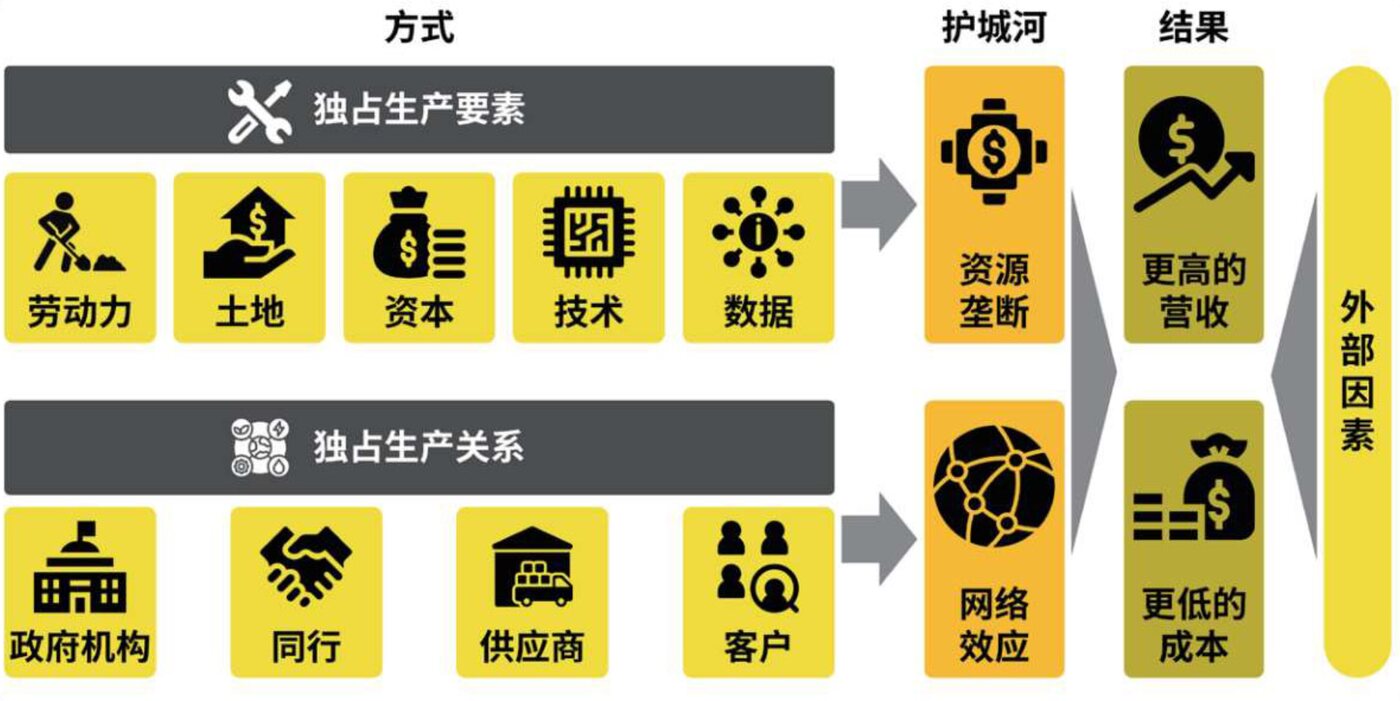
The “moat” proposed by Buffett essentially refers to an enterprise’s core advantage in resisting competition and avoiding replacement. The book breaks it down into two core types—forming a “resource monopoly moat” through exclusive control of factors of production and a “network effect moat” through exclusive control of production relations. Both ultimately achieve the competitive advantage of “higher revenue, lower cost.”
(3) The Resource Monopoly Moat (Exclusive Control of Factors of Production)
Factors of production are divided into five categories—labor, land, capital, technology, and data—each corresponding to a different form of moat:
Labor: Scarcity labor (stars, core entrepreneurs) can form a weak moat, easily breached by a high price or contract expiration;
Land: Includes resource endowment (the climate of Maotai Town, De Beers’s diamond mines) and location advantage (industrial clusters, core commercial districts), hard to replicate;
Capital: The capital threshold of asset-heavy industries (real estate, new-energy vehicles) creates a Matthew effect—only those with abundant capital can survive sustainably;
Technology: Patents, copyrights, secret formulas, and know-how are the core barriers of tech, pharma, and content industries (such as EDA software patents and the Coca-Cola formula);
Data: The core resource of the digital-economy era, especially in the AI industry. Algorithm advantages formed by data accumulation constitute a moat difficult to surpass.
(4) The Network Effect Moat (Exclusive Control of Production Relations)
Enterprises build barriers by establishing solid relationships with the government, peers, suppliers, and customers:
With the government: Obtaining concessionary licenses (finance, public utilities), forming a strong barrier;
With peers: Jointly setting industry standards (champagne, the metaverse), consolidating a first-mover advantage;
With suppliers: Exclusive supply agreements and strong bargaining power (Walmart), locking in scarce resources;
With customers: Building a brand (reducing decision cost), solidifying channels (reaching customers), and raising switching costs (data accumulation, membership systems), locking in users.
(5) Key Supplements
1. A moat is not set in stone; technological iteration can bring a dimensional strike (such as digital cameras replacing film cameras), so it needs dynamic maintenance;
2. The ultimate logic of industry defense: either build an irreplaceable barrier, or open up a second growth curve through innovation, avoiding disruption by substitutes.
2. Thoughts on a Personal Moat—Taking Programmers as an Example, Responding to the Impact of AI Coding
The core of Chapter 4 is “resisting replacement.” Applied to personal growth, that means building a “personal moat”—against the backdrop of AI coding (like Copilot, ChatGPT Code) continuously improving in efficiency and quality, programmers must avoid becoming “standardized labor replaceable by AI.” The core is to build a core advantage that AI finds hard to replicate, essentially “converting personal ability into irreplaceable ‘factors of production’ or ‘production relations’.” Specifically, you can focus on the following 4 dimensions:
(1) Build a “Technology Barrier”—Corresponding to an Enterprise’s “Technology-Type Resource Monopoly Moat”
The core advantage of AI coding is “efficiently completing standardized, repetitive coding work” (such as basic interface development and simple logic implementation), but its weak point is “a lack of deep thinking and capability for landing complex scenarios.” A programmer’s technology moat should jump beyond “mere coding” and extend toward “deep technical capability”:
Go deep in a niche technical field and build “technical know-how”: Give up “broad but shallow” general programming ability and focus on a certain vertical field (such as underlying development of industrial software, deployment optimization of AI models, or high-concurrency system architecture), accumulating industry-specific technical experience, debugging skills, and scenario solutions. This “tacit knowledge” cannot be easily learned by AI—it’s the core that AI finds hard to replace. Just like an enterprise’s “secret formula,” it’s the result of long-term practice, not mere “code logic.”
Master technical capabilities AI can’t complete independently: AI can write code, but it can’t independently complete “system design from 0 to 1,” “troubleshooting and optimization of complex problems,” or “the trade-offs of technology selection.” Programmers should focus on improving architecture design, system retrospectives, performance optimization, and fault troubleshooting—abilities that require combining business scenarios, technical accumulation, and logical judgment, which AI cannot break through in the short term.
Accumulate patents and technical achievements: Apply for patents on your technical innovations and solutions, or distill them into open-source projects and technical articles, forming a personal technical brand and building a “technology barrier.” Like an enterprise’s patent moat, it makes you a “technical benchmark” in a field rather than an ordinary “coding tool person.”
(2) Bind “Business Value”—Corresponding to an Enterprise’s “Customer-Relationship-Type Network Effect Moat”
AI coding doesn’t understand “business logic” and can’t grasp the commercial value and user needs behind the code. A programmer’s core advantage is “combining technology with business,” which is the core lever of a personal moat:
Go deep into business scenarios and become a “technology + business” composite talent: Break out of the limitation of “only knowing technology, not business,” proactively understand your industry’s business logic, business model, and user needs (such as the transaction flow of the e-commerce industry and the risk-control logic of the finance industry), and be able to translate business needs into technical solutions—even optimize business processes and create commercial value through technical innovation. AI can write code, but it can’t understand “why write this code” or “what business problem this code solves”—this is the irreplaceable core value of a programmer.
Accumulate industry resources and scenario experience: Business scenarios differ enormously across industries (such as healthcare, industry, and the internet). Deeply cultivating a single industry over the long term and accumulating its technical pain points, solutions, and upstream and downstream resources forms an “industry-specific advantage.” For example, the manufacturing-scenario experience a programmer of industrial software accumulates cannot be obtained by AI through short-term learning. This combination of “business + technology” makes the individual a scarce resource in the industry.
Improve “requirement interpretation and communication skills”: Programmers need to interface with product, operations, and customers, understand vague requirements, coordinate resources across parties, and translate requirements into actionable technical solutions. This ability to “communicate across roles and decompose requirements” cannot be replaced by AI—AI can only execute explicit instructions, not handle vague requirements or coordinate interpersonal relationships.
(3) Build a “Personal Brand and Network”—Corresponding to an Enterprise’s “Brand and Channel Moat”
In the AI era, the core of “replaceability” is “a lack of recognizability.” A personal brand and industry network let a programmer stand out from “homogenized labor” and build an “irreplaceable relationship barrier”:
Build a personal technical brand: Through open-source projects, technical blogs, and industry talks, make your technical experience and solutions public and build personal recognition—for example, maintaining a high-quality open-source project on GitHub and sharing troubleshooting experience in technical communities, making yourself an “opinion leader” in a field. This personal brand makes enterprises more willing to choose programmers “with reputation and experience” rather than relying on AI-generated code.
Accumulate industry contacts and a collaboration network: Proactively participate in industry conferences and technical exchanges, connect with peers, technical experts, and enterprise leaders, and build your own industry network. On one hand, the network brings more opportunities (such as referrals and project collaboration); on the other, through exchanges with peers, you can quickly grasp industry trends and technical developments, lay out core abilities in advance, and avoid being eliminated by technological iteration—just as an enterprise consolidates its advantage by joining peers to set industry standards.
(4) Maintain “Innovation and Iteration Capability”—Corresponding to an Enterprise’s “Second Growth Curve”
Chapter 4 mentions that an industry must open up a second growth curve to avoid decline; for programmers, to avoid being replaced by AI, they must continuously innovate and iterate their abilities, breaking out of the “comfort zone”:
Proactively embrace AI and treat it as a “tool” rather than an “opponent”: AI coding is a tool for improving efficiency. Programmers can use AI to complete repetitive coding work and invest their energy in more valuable work (such as architecture design and business innovation). For example, use AI to generate basic code while focusing yourself on code optimization, logic verification, and business landing—achieving efficient “AI + human” collaboration rather than competing with AI over “who writes code faster.”
Keep learning and lay out cutting-edge technology: Technology iterates fast, and AI’s abilities keep improving. Programmers must maintain their passion for learning, pay attention to cutting-edge technologies (such as AI large-model development, quantum computing, and Web3.0), and lay out core abilities in advance. For example, learn the fine-tuning and deployment of AI models, and combine AI technology with your own business, building a composite advantage of “AI + programming” and opening a “second growth curve” for personal ability.
Cultivate “cross-boundary ability”: Break out of the purely programming field and learn product thinking, operations thinking, and management thinking, and even understand related knowledge in law, finance, and so on. For example, a programmer with product thinking can better understand user needs and design technical solutions that fit the business better; a programmer with management thinking can lead a team, coordinate resources, and shift from “individual contributor” to “manager” or “technical lead,” further enhancing their irreplaceability.
3. Summary
An enterprise’s moat is “resisting industry replacement,” and an individual’s moat is “resisting AI replacement.” The core logic is the same—building an irreplicable, irreplaceable core advantage. For programmers, the impact of AI coding is essentially eliminating “standardized, repetitive” coding work, forcing programmers to shift toward “deep technology, business value, personal brand, and innovation and iteration.”
The core of a personal moat is not “coding better than AI,” but “understanding business better than AI, innovating better, and creating more value”—just as an enterprise’s moat is not “cheaper than rivals,” but “more fortified than rivals and better at meeting customer needs.” Only by building such a personal moat can you stand firm in the AI era and avoid being replaced.
评论
0 条评论