One weekend afternoon, idling in a café, I opened the book From Inner Friction to Flow: An Entropy-Reduction Action Guide for a Complex Era (《从内耗到心流:复杂时代下的熵减行动指南》). I expected just another psychology bestseller, but instead it hit me like a blow to the head and shook me awake from my long-term mental friction.

01 When “Overthinking” Becomes an Illness
The “Numbness Syndrome” of Adults
The line in the book that hit me hardest was: “Inner friction is the high-entropy result of always ‘overthinking’ yet ‘never thinking it through.’”
But before that, the author mentions a more universal phenomenon—the “numbness syndrome” of adults.
“The ‘unhappiness’ we talk about in everyday language is not an emotion, nor is it necessarily caused by anything; it’s a state called ‘numbness’: even when you’ve obtained material conditions and social status above what you need, it’s still hard to find pleasure and happiness in life.”
Rather than saying you can’t be happy, it’s better to say: you can no longer feel happiness. This isn’t the clear pain of depression but a vague, persistent, indescribable emptiness. Just as the author describes—“alive, but somehow missing something.”
This “numbness” state is often the prelude to inner friction. When too many unrelated goals and thoughts make consciousness more and more chaotic, the brain cannot gather cognitive energy to do work in one direction, and at some tipping point it triggers a temporary collapse of inner order—entropy death.
The Essence of Inner Friction
The author uses a vivid metaphor: when water is heated into steam, the molecules go from a stable, ordered state to a dynamic one of darting everywhere—that’s entropy increase. The brain of someone caught in inner friction is like water being continuously heated—thoughts run around like steam, unable to focus attention anywhere.
“Several typical commonalities of people with mental friction: perfectionism and obsessive tendencies, always focusing on uncontrollable outcomes, high sensitivity with low self-esteem, high pressure with low desire…”
Reading that passage, I was basically ticking every box. A single design review at work—I could rehearse a hundred possible questions and answers from start to finish; a joking remark from a friend—I could ruminate on it for three days, guessing whether there was some deeper meaning. This state of “overthinking” often makes me feel “exhausted even when lying still.”
02 The Survival Predicament of an Entropy-Increasing Society
The author proposes a very interesting concept—an entropy-increasing society: a world endlessly doing addition.
“On one hand, encouragement; on the other, suppression; too many temptations, more obstacles; longing for freedom yet hating risk… Slowly we fall into chaos, and even need others to set goals for us to avoid feeling lost.”
In this society:
- The work ethic tells us: hard work is a moral standard
- Consumerism tells us: buying more is being good to yourself
- Social media tells us: you must display a perfect life
We keep adding, adding, adding—adding material things, adding spiritually too. But when all external stimuli recede, what’s left is only a deeper emptiness and anxiety.
03 Life Feeds on Negative Entropy
The book quotes the physicist Schrödinger’s famous line: “Life feeds on negative entropy.”
The profound meaning of this line is: life needs to continuously offset the positive entropy it produces in life to keep itself at a stable, low entropy level.
Just like the body’s metabolism—taking in low-entropy nutrients and expelling high-entropy waste—our minds also need such a metabolic system. The author proposes three dimensions of “surgery”:
| Dimension | From | To |
|---|---|---|
| Thinking | Fixed mindset | Growth mindset |
| Consciousness | Comfort zone | Stretch zone |
| Action | Outcome-oriented | Process-oriented |
From Fixed Mindset to Growth Mindset
“Those with a fixed mindset believe intelligence and creativity are innately fixed; those with a growth mindset believe these qualities are dynamic and can be changed through time and effort.”
This shift made me realize that the things I used to say—“I’m not good at socializing,” “I have no artistic talent”—were actually self-imposed limits of a fixed mindset. People with a growth mindset don’t label themselves; they focus on the process of experience.
From the Comfort Zone into the Stretch Zone
The author divides growth space into three rings:
- Comfort zone: familiar things, psychologically comfortable, but no growth
- Stretch zone: challenging and novel, achievable with some effort—this is the key to growth
- High-pressure zone: far beyond one’s ability, prone to collapsing in anxiety
For a long time, I either lay in the comfort zone being zen, or plunged headlong into the high-pressure zone to torture myself. Real growth is finding a rhythm that suits you in the stretch zone.
From Outcome-Oriented to Process-Oriented
“As long as you keep looking at the outcome, you’ll keep wanting to control it; that’s why when we pursue outcome-oriented action, we mostly give up midway or change course.”
This shift is what I most need to cultivate. In the past, every time I started an action, I couldn’t help checking how far I was from the result—how many words memorized, how many kilometers run, how many characters written. This obsession with outcomes actually made me more likely to give up.
The tipping point of the compound effect: things like fitness, memorizing vocabulary, reading, and writing bring very gentle incremental gains for a long stretch, but once past the tipping point, they rise exponentially. In Chinese culture, this is called “thick accumulation, thin release” (厚积薄发).
The problem is—we don’t know when the tipping point will come. So the only thing to do is focus on the process and, on the premise of keeping the direction correct, keep the action going.
Temporary learners vs lifelong learners:
- Temporary learners: only think of trying hard when stimulated or nearing a deadline; can’t benefit from the compound effect, and have no power against entropy increase
- Lifelong learners: replace temporary learning with long-term learning, outcome-orientation with process-orientation, and no longer anxiously calculate returns
As the author says: “Those who only think of putting on running shoes and picking up books when stimulated or nearing a deadline can neither benefit from the compound effect nor fight entropy increase.”
Becoming a lifelong learner is the first step of entropy reduction.
There’s an easily overlooked detail about the compound effect: it has a tipping point. Fitness, memorizing vocabulary, reading… bring very gentle results for a long stretch, and only rise exponentially once past the tipping point. This idea is called “thick accumulation, thin release” in Chinese culture.
04 Doing Work Actively: Widening Sources, Cutting Costs, Boosting Efficiency
Before introducing the four growth entropy types, first understand the three directions of active work:
Widening Sources: Introducing Negative Entropy to Cognition
The brain never has “idle” time. Even lying in bed daydreaming, the brain is running at high speed—like a roaring but empty assembly line, burning energy for nothing.
Three energy sources for introducing negative entropy:
| Energy source | Description | Action suggestion |
|---|---|---|
| Information flow | The brain’s food | Build high-quality information sources, with a “few but fine” principle: for every new subscription you follow, you must delete two existing ones |
| Interpersonal flow | The average of the 5 people around you | Move closer to “low-entropy people”—those who always know what they’re doing and are rarely distracted by pointless trivia |
| Environment flow | Wherever you live, that’s the world you see | Actively choose your environment, rather than “the place that happens to be nearest to me” |
“A person’s quality of life is determined by the average quality of life of the 5 people they spend the most time with—including cognition, wealth, achievement, psychological qualities, and so on.”
Cutting Costs: Expelling High Entropy from Within
Expel three kinds of “emotional entropy”:
- Sorrow—entropy of the past: resentment over loss. Solution: degrade—write an emotion journal and bury the “entropy of the past”
- Depression—entropy of the present: psychological energy stagnation. Solution: clear out—focus only on the 3 most important tasks each day, and list everything else on the back
- Anxiety—entropy of the future: fear of the uncertain. Solution: act—turn the unbearable feeling into effective action, and the anxiety vanishes on the spot
Boosting Efficiency: Allocating Energy to Action
Use the AMC action-diagnosis model (introduced in detail later):
- Ability
- Motivation
- Challenge
When the challenge is slightly higher than ability and mainly driven by intrinsic motivation, action is the most sustainable and offers the most immediate feedback pleasure.
05 An Entropy-Reduction Guide to Urban-Age Illnesses
Modern people’s four major “age illnesses”: procrastination, obsessive-compulsive disorder, phone addiction, and choice paralysis.
Procrastination: Stepping on the Brake While Wanting to Drive Forward
The author quotes psychologist Karen Horney’s metaphor: the procrastinator is “like someone stepping on the brake while wanting to drive forward”—you only hear the tires spinning wildly in place, the car doesn’t move an inch, but the fuel runs out.
Key distinction:
- Laziness: at ease with oneself; being urged irritates but brings no anxiety
- Procrastination: both drive and resistance exist and oppose each other, accompanied by obvious anxiety
Three major motivational factors of procrastination (Piers Steel):
- Low expectancy: the less hope for a good outcome
- Low value: the more you hate the task
- Delayable time: the farther the deadline
Coping strategies:
- Cognitive shift: convert “loss cognition” into “gain cognition”
- Split the task: break big tasks into small ones, and big deadlines into multiple small deadlines
- Reduce resistance: make it possible for yourself to “start doing things” at any time, removing all excuses
- Zeigarnik effect: deliberately interrupt at 70% completion to use the “unfinished complex” to drive yourself to finish quickly
Phone Addiction: The Practice of Human-Machine Separation
“Leaving your phone doesn’t mean not using it, but not letting it become the sole source of your sense of control over life.”
Three coping methods:
- Deliberate practice: adapt to human-machine separation and control phone use
- Active replacement: introduce substitute activities and restore phone functions (recovering the natural activities humans had before the smartphone era)
- Set obstacles: use the AMC principle in reverse—lower ability (put the phone in your bag), raise the challenge (cancel Face ID/fingerprint, set a complex password written on paper and put it in a drawer)
Choice Paralysis: Maximizers vs Satisficers
| Type | Characteristics | Result |
|---|---|---|
| Maximizer | Exhausts all options, endlessly pursuing the optimal solution | Decision fatigue, frequent regret |
| Satisficer | Content with what one has, fine with a good-enough option | Quick decisions, high satisfaction |
The remedy for “maximizers”—the coin-flip method:
- Before choosing, only imagine in your head how to handle the worst case
- After executing, don’t immediately review
- A few calm days later, introspect objectively from a third-person perspective
- Finally accept and own the result, then turn the page—don’t reflect over and over
06 An Entropy-Reduction Guide for the Complex Mind
Theory of Mind: “I Know That You Know What I’m Thinking”
Theory of Mind—hailed as the ultimate ability that creates cognitive gaps between people.
Five levels of intentionality:
| Level | Definition | Example |
|---|---|---|
| Level 1 | Having self-awareness | A toddler sees a mirror and realizes the person in it is themselves |
| Level 2 | Inferring others’ thoughts about oneself | “I sense he finds me charming” |
| Level 3 | Inferring how one person thinks about another’s thoughts | “I suspect he also noticed that she likes him” |
| Level 4 | Inferring how one person guesses another thinks about a third party’s thoughts | “I guess you also think he believes she likes him” |
| Level 5 | Inferring how one person guesses another thinks about a third party’s thoughts about a fourth | “I think you’re hinting that she wants Xiao Li to believe Xiao Wang likes her” |
“Level-5 intentionality requires adding more abstract logical assumptions while inferring. Some writers of grand literature or screenwriters, such as The Three-Body Problem author Liu Cixin, can reach level 5 and above.”
Ways to improve theory-of-mind ability:
- Deconstruct literary works: draw a map of character relationships and grasp how characters interact
- Meditation: can increase the thickness of the prefrontal cortex and boost attention and perception
The Dopamine Nation: A Seesaw of Pleasure and Pain
Neurobiologists have found that the brain regions producing pleasure and pain actually overlap. Each time dopamine produces pleasure, we also feel a certain amount of pain.
This mechanism is like a seesaw:
- When scrolling short videos or drinking cola, pleasure comes too fast and too densely, and the pain is drowned out before it can be released
- The nervous system can only keep releasing pain, and in the end what we seek from dopamine is no longer pleasure but merely escaping pain
Using the dopamine principle in reverse:
- Pain first, then pleasure: cold showers, winter swimming, fitness—apply pressure on the pain side first, and the body will automatically balance with “pleasure”
- Do the hard thing first, then the easy one: with some dopamine still in stock, do the hard thing first; let the hard thing prompt the body to secrete more dopamine to sustain motivation
- Actively delay consuming dopamine: don’t be kidnapped by instant gratification
“Inner Speech” and “Earworms”: Two Different Voices in the Brain
- “Inner speech”: the entropy-reduction state of active learning and thinking—unconsciously using the way you communicate with others to “imagine” a voice talking to yourself
- “Earworms”: the entropy-increasing state of passivity, fatigue, and loss of focus—the phenomenon of being influenced by a notion after hearing a simple repeating melody
When you encounter an “earworm,” don’t force yourself to shake it off; just let yourself rest a bit and go outside for some air.
07 An Entropy-Reduction Guide for Complex Relationships
Lovesickness Brain: Your Imagination Is the Other Person’s Greatest Charm
A “lovesickness brain” is insufficient self-affirmation, so much so that one pins all self-worth on the other person—the mental entropy from inner friction in this state will surely surge.
Self-rescue methods:
- Build a mind map and list the other person’s pros and cons across dimensions like appearance, inner qualities, worldview, family, and life
- Remember: his greatest charm is your imagination
- Cry if you want to cry, but set an alarm—cry for just 5 minutes
- After 5 minutes, stand up and strike a “straight-guy pose” (hands on hips, legs apart, chin up, chest out), imagining you’re the CEO of a Fortune 500 company
Social Decluttering: Empathetic Socializing vs Mutually Beneficial Socializing
| Type | Characteristics | Value |
|---|---|---|
| Empathetic socializing | Provides emotional comfort, relieves boredom, based on shared interests | Not picky about people, but low value |
| Mutually beneficial socializing | Mutual appreciation of qualities or abilities, exchanging information, helping each other | Picky about people, but high value |
“When you meet someone you click with, talk a bit more, giving it your all and being fully sincere; when you meet someone you don’t click with or don’t like, you don’t want to force yourself to endure awkward small talk.”
Stay Away from the “Childish Social Darwinist”: The Mental-Entropy Producer in the Workplace
The “childish social Darwinist” the author mentions has the following characteristics:
- Firmly believes in “the weak are prey to the strong,” hates power yet worships it
- Opposes inequality yet rationalizes it
- Attributes others’ misfortune to “they brought it on themselves, you’re weak so you deserve it”
- Yet when injustice falls on themselves, complains about “class ossification”
“Getting too close to a ‘childish social Darwinist’ is like playing Tetris—once you try to ‘fit in’ with them, you’ll be ‘devoured’ and then ‘disappear.’”
Coping strategies:
- If circumstances allow, avoid entanglement and walk away immediately
- If you have to work with them, collect evidence of being manipulated, so you have leverage to say “no” when they cross a line
- If, unluckily, the person is your boss, seriously consider cutting your losses, even at the cost of finding another job
08 Four Growth Entropy Types: Which One Are You?
Based on a cross-analysis of growth/fixed mindset with efficiency-seeking/friction-prone work tendencies, the book proposes four interesting “growth entropy types,” using four animals as metaphors:
| Type | Mindset characteristics | Work tendency | Core traits |
|---|---|---|---|
| 🐬 Dolphin | Growth mindset | Efficiency-seeking | Full of curiosity, energetic, highly focused, clear goals, low neuroticism |
| 🦥 Sloth | Growth mindset | Friction-prone | Wise beneath an appearance of foolishness, sees the goal but acts slowly, emotionally sensitive, overthinking |
| 🦏 Rhino | Fixed mindset | Efficiency-seeking | Vigorous, strongly territorial, tactically diligent but strategically lazy |
| 🪸 Sea Squirt | Fixed mindset | Friction-prone | Comfort zone ossified, cognitive energy depleted, neural connections atrophied |
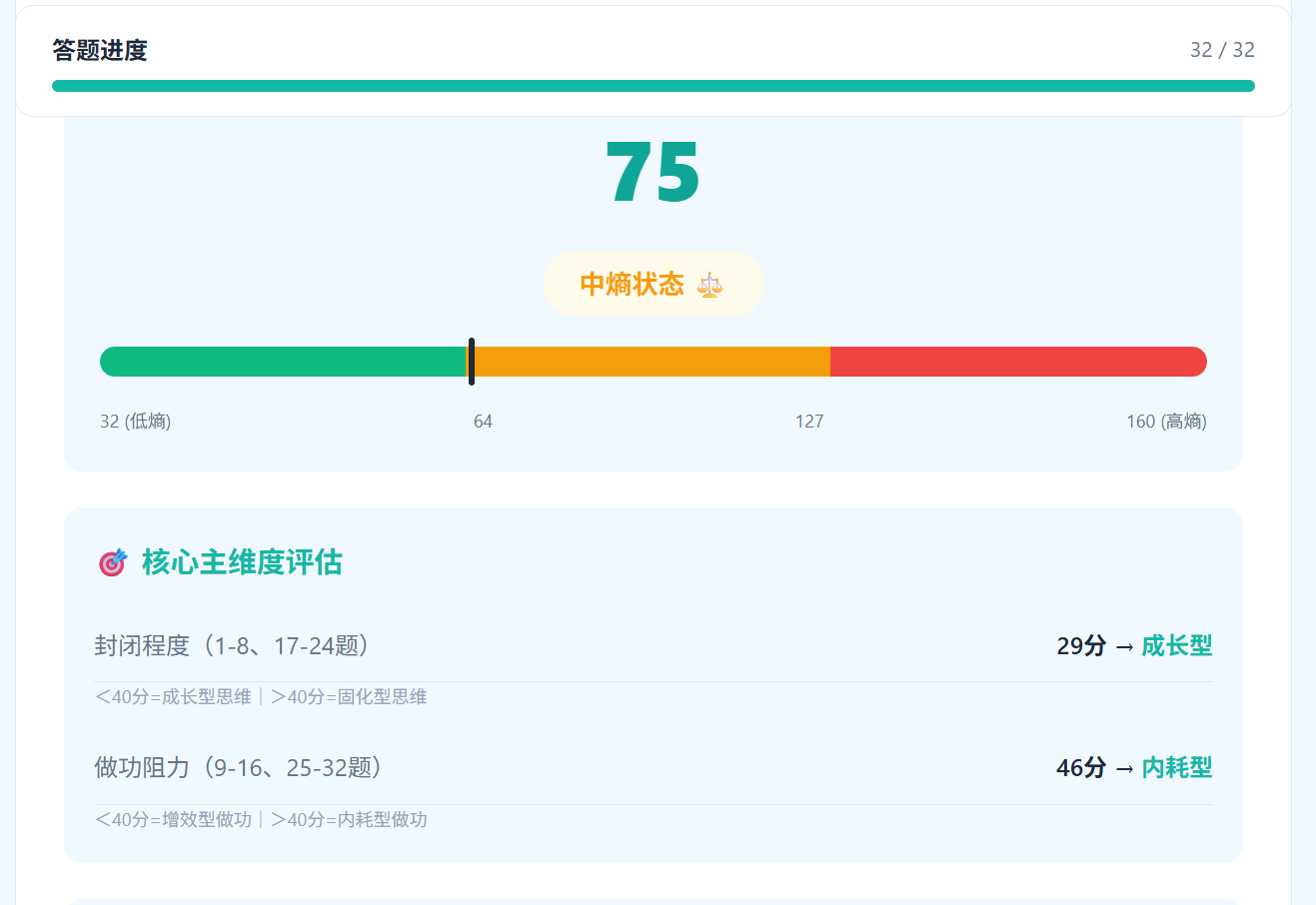

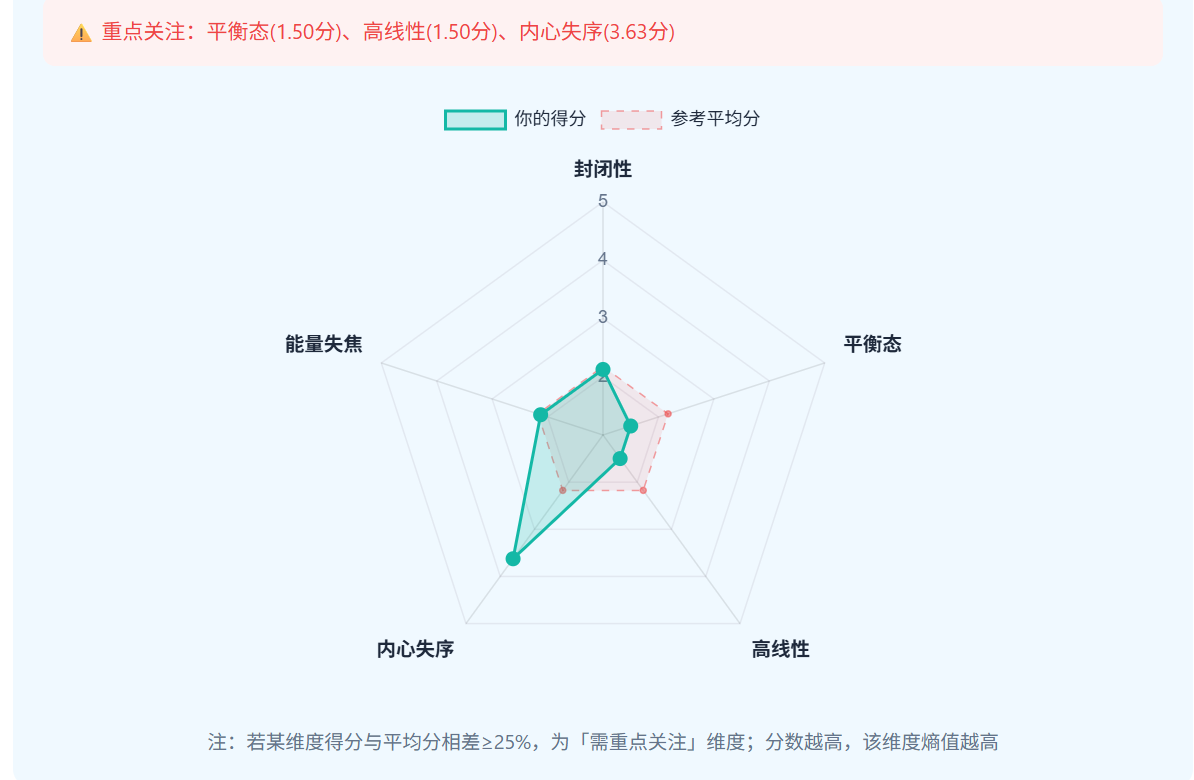
🐬 The Dolphin Type: The Flow Experiencer
Dolphin-type people are like bottlenose dolphins—full of curiosity, energetic, highly focused. They enjoy the pleasure of the process, are rarely entangled by pointless thoughts, and even in adversity don’t easily sink into negative cognition.
Strengths: Continuously achieving, a frequent flyer in flow experiences
Note: Maintain healthy motivation, and use these traits for goals that benefit self and others
Growth path: Further optimize yourself through flow, explore unknown new continents
🦥 The Sloth Type: The Great Wisdom of the Slow Lane
Sloth-type people are like “Flash” in Zootopia—seemingly slow, but actually wise beneath an appearance of foolishness. They see the goal clearly and don’t reject change, but they’re overly emotionally sensitive, and the habit of over-deliberation makes it hard for them to act.
Traits: Getting stuck in an infinite loop at the “think it through first” stage, gaining a sense of control by suppressing desire
Turning point: Belongs to the “thick accumulation, thin release” type—once they shed their inner burden and stop being a “dwarf in action,” they gain astonishing growth speed
🦏 The Rhino Type: The Guardian of the Comfort Zone
Rhino-type people are vigorous and handle their familiar domains with ease—a reliable person. But a fixed mindset makes them reserved about opening up to the outside, often using “tactical diligence” to cover “strategic laziness.”
Current situation: Personal pursuits align with social expectations; no need to change
Crisis: Be vigilant in peacetime; prepare for “the sky changing”
Turning point: No need to change careers or leave the environment—instead, first shift from a fixed mindset to a growth mindset
🪸 The Sea Squirt Type: The Latent Talent Eager to Be Awakened
Sea-squirt-type people see the comfort zone as their last habitat, and even tormented inside they find it hard to resolve to change, their cognitive energy dwindling day by day. They react dully to external stimuli but are emotionally sensitive, and their thinking ability drops greatly.
Hope: Sea squirts have super resilience—even if part of their body is eaten, it quickly regrows
Way out: As long as there’s a will to change (even a tiny bit), they can start by sweeping away mental garbage and gradually repair themselves through key actions
Online Entropy-Type Assessment
Want to know which type you are? Take the assessment:
👉 🧮 Entropy Calculator - Quantify your mental state
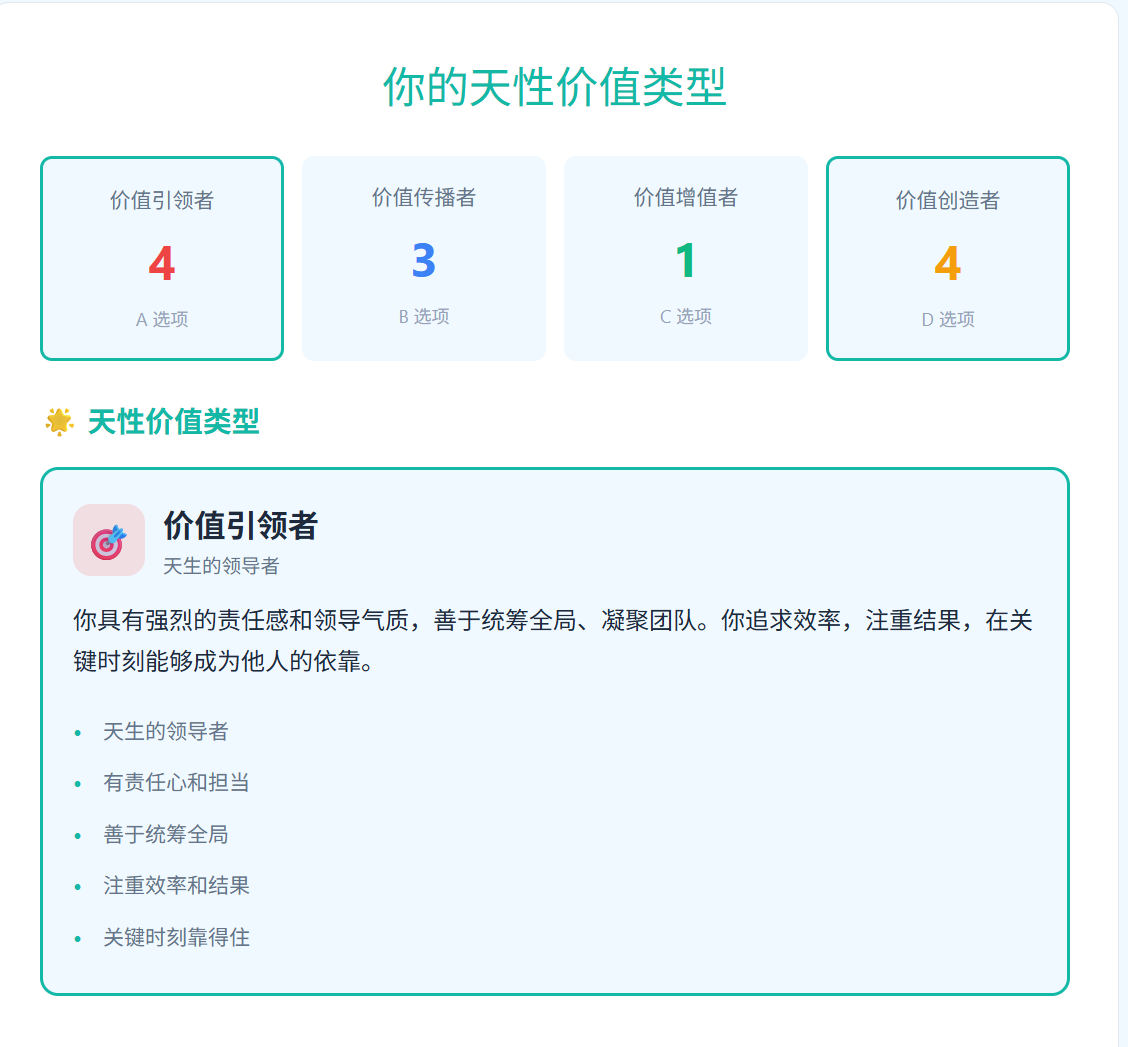
👉 🎯 Innate Value Type Assessment - Gain insight into your strengths and motivations
09 Flow: An Unmatched Negative-Entropy Experience
The Three Characteristics of Flow
To achieve a flow experience, three conditions must be met:
1. Clear goals
“Break down task goals; develop functional and meaningful goals from one big goal.”
Not a wishful goal like “I want to finish reading 10 psychology books,” but:
- Functional goal: “Understand my inner problems comprehensively by reading 10 psychology books”
- Meaningful goal: “Share the insights outward and help others”
- Action plan: “Read one to two chapters a day and take notes”
2. Immediate feedback
This is a certainty-enhancing mechanism:
- Lowers the probability of easily giving up due to being unable to tolerate the torment of an unknown future
- Points out the direction for improvement
Forms of feedback:
- Action feedback: distributing a tool to friends to test while developing it
- Weak but high-frequency feedback: frequently pressing Ctrl+S to save the document while writing
- Achievement feedback from a reward mechanism: going to a bar for a drink with a friend after finishing the plan
3. Matched difficulty
This is the most important link for continuously achieving flow.
Ability-challenge matrix:
| Low challenge | High challenge | |
|---|---|---|
| High ability | Complacency (boredom, regret over sunk cost) | Flow ✨ |
| Low ability | Easy but uninteresting | Anxiety → panic |
Ideal state: challenge is slightly higher than ability, in the stretch zone.
The Threshold of Flow: Control of Focus
Noticing Mind-Wandering
Cold-start dilemma: when switching from rest/entertainment mode to work mode, you can focus for only 30 seconds before wandering.
Solution—signal-micro-action-positive feedback:
When I receive (the signal) ___, I will immediately focus my attention (the micro-action) ___, and after finishing I will (give myself positive feedback) ___, because that means I’ve successfully entered work mode.
For example:
- Signal: taking the first sip of coffee
- Micro-action: immediately focus and write three lines of text
- Positive feedback: snap my fingers smugly, “I did it,” and take another sip of coffee
Sustained Focus
Time units:
- A single sustained focus: 12 seconds
- Deep thinking requires: 12×12 seconds = 2.5 minutes
- Medium-intensity flow: 12×12×12 seconds = at least 29 minutes
Reduce switching: follow the “input—processing—output” flow to avoid redundant cognitive process switching.
Body-Mind Unity: Everyday Flow
People who frequently enter flow: a shower is a shower, a walk is a walk, a meal is a meal, a conversation is a conversation—they know how to let the inertia of body-mind unity cover every aspect of life.
“Highly complex in what they do, extremely simple in how they live.”
10 The Overall Framework of the Entropy-Reduction Practice Toolkit
The book provides a complete entropy-reduction practice toolkit to help readers systematically reduce mental entropy from assessment to practice. Below is the complete practice flow:
|
Quick-Reference Table of the 8 Major Tools
| Stage | Tool name | Core role |
|---|---|---|
| Entropy assessment | Multi-dimensional entropy value/type assessment scale | Establish a baseline, quantify the current mental state |
| Practice preparation | Emotion journal | Sense emotion sources, discharge mental garbage |
| Practice step one | Innate value type assessment form | Discover strengths and motivations |
| Practice step two | Growth/controllability assessment form | Screen the things worth investing in |
| Practice step three | Action goal development map | Clearly define goals |
| Practice step four | AMC action diagnosis model | Diagnose action barriers |
| Practice step five | Entropy-reduction action chain map | Extend action influence |
| Entropy retest | Multi-dimensional entropy value/type assessment scale | Evaluate results, iterate in cycles |
Online Assessment Tools
Based on the concepts in the book, I developed two online assessment tools:
👉 🧮 Entropy Calculator - Quantify your mental state
👉 🎯 Innate Value Type Assessment - Gain insight into your strengths and motivations, and find the fields suited to your growth
11 My Entropy-Reduction Practice Checklist
Combining the book’s suggestions with my own situation, I put together a personal entropy-reduction checklist:
Information Level
- ✅ Mute all WeChat groups; check them only at fixed times (morning, noon, evening, and before bed)
- ✅ Turn off the red-dot notification for WeChat Moments, or even turn off Moments entirely
- ✅ Limit short-video scrolling to no more than 20 minutes a day
- ✅ Unfollow all anxiety-inducing bloggers, using the “1+2 principle”: for every 1 new follow, unfollow 2 old ones
- ✅ Uninstall Douyin to reduce passive information intake from algorithmic pushes
Action Level
- ✅ Make the first thing every morning the most important thing (instead of scrolling the phone)
- ✅ Use the Pomodoro technique at work to force myself into a focused state
- ✅ Do a “digital decluttering” once a week
- ✅ Start with a 2-kilometer run and gradually increase to 5 kilometers, replacing outcome-orientation with process-orientation
- ✅ Write an emotion journal, recording the three kinds of “emotional entropy”: sorrow, depression, and anxiety
Thinking Level
- ✅ When facing a difficult problem, first ask: is this within my control? (Is it any of your business / is it any of my business)
- ✅ Replace “I can’t” with “I haven’t learned yet”
- ✅ Record 3 small things done well each day (to cultivate a growth mindset)
- ✅ When “inner speech” appears, listen to its timbre and quality, to understand the voice of my ideal self
- ✅ Use the “coin-flip method” for choice paralysis, then accept the result without agonizing repeatedly
Interpersonal Level
- ✅ Identify and stay away from “childish social Darwinist” personalities
- ✅ Reduce “empathetic socializing” and increase “mutually beneficial socializing”
- ✅ Build a “5-person core circle” awareness and actively move closer to low-entropy people
Flow-Cultivation Level
- ✅ Set up a “coffee—writing—finger snap” signal-micro-action-positive feedback chain
- ✅ Strive for at least 29 minutes of sustained focus each day
- ✅ Do the hard things first, then the easy ones
- ✅ Deliberately practice “washing face with cold water”—pain first, then pleasure
12 A Final Word
“Those who can frequently enter flow must be insulated from inner friction.”
Having read this book, I understand: fighting inner friction isn’t about thinking harder, but about acting more effectively.
The opposite of flow isn’t boredom—it’s chaos. When we concentrate cognitive energy on goals of “investment” and “meaning,” we can reduce entropy in every aspect of life and regain control of our lives.
Reflections on the Control of Life
The book quotes a passage from Freud:
“The days of youth are still long, yet today passes idly by, and then one day you find ten years have gone. No one told you when to start running—oh, you missed the starting gun. Plans always end up becoming zero, or that hastily scrawled half-page. Living in quiet desperation—that is the English way.”
This passage reveals a cruel truth about life: only when life is near its end do people know whether they were truly the master of this life.
Too many people “die” at thirty and are buried at eighty. Kidnapped by inertial cognition, they spend a lifetime in “quiet desperation.”
Try Your Best to Be a Simple Person
In this entropy-increasing society, being a simple person means:
- Refusing the endless adding-up life
- Concentrating cognitive energy only on goals of “investment” and “meaning”
- Reconstructing a more refined, simpler, more energy-efficient thinking-and-action framework
- Not thinking less and doing less, but clarifying chaotic thoughts and simplifying complex actions
As the author says: “Entropy reduction, by definition, means doing ‘subtraction’ from thinking to action.“
The Paradox of Self-Knowledge
One of the most mind-overturning views in the book:
“The more you force yourself to pry into your heart and the more you yearn to understand yourself, the harder it is to form an identity of yourself, and the more you waver when making decisions. To break out of this paradox of self-knowledge, you rely not on thinking but on doing. What truly answers ‘who am I’ is not repeated self-dissection, but the ‘current me’ naturally formed in the process of moving in a certain direction, and then a ‘better me’ formed when correcting action—in other words, a person defines themselves through results and discovers themselves through action.”
Stop excessive self-reflection and start acting.
If you, too, often feel “mentally exhausted,” “overthinking,” “can’t lie flat yet can’t keep up the grind,” I recommend reading this book. Perhaps it will, as it did for me, become a turning point in your life.
Fighting entropy is a lifelong course of study, and all of us can start from this very moment.
Further reading:
- 📖 Original book: From Inner Friction to Flow: An Entropy-Reduction Action Guide for a Complex Era, author: Yang Ming
- 🧮 Tool: Entropy Calculator (quantify your mental state, understand your entropy type)
- 🎯 Assessment: Innate Value Type Assessment (gain insight into strengths and motivations)
- 🧠 Related concepts: Flow, Psychic Entropy, Compound Effect, Dissipative Structure Theory
- 📚 Related books: Flow: The Psychology of Optimal Experience by Mihaly Csikszentmihalyi, Thinking, Fast and Slow by Daniel Kahneman
评论
0 条评论