“The future is already here — it’s just not evenly distributed.”
— William Gibson
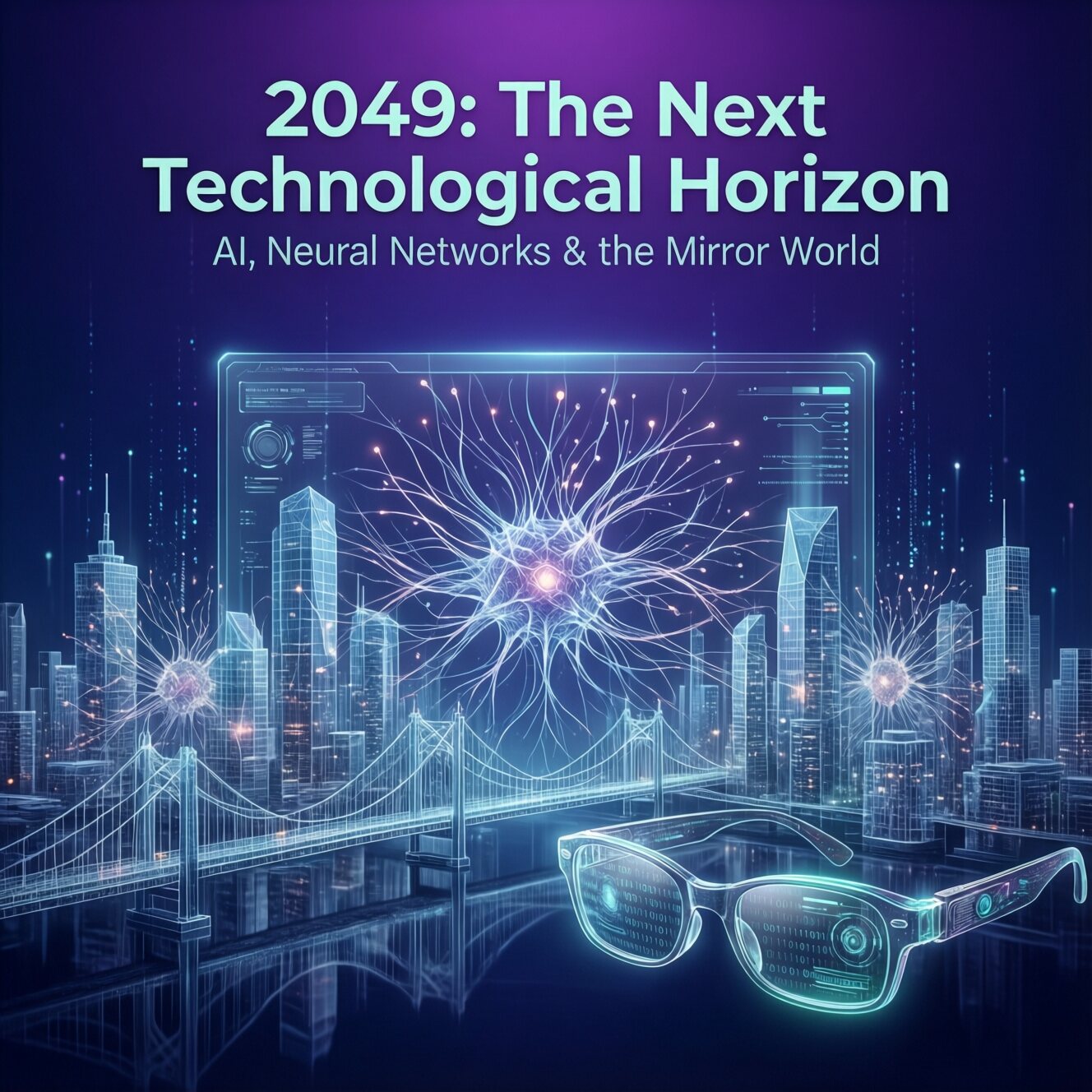
On a weekend afternoon, I finished reading Kevin Kelly’s new book 2049: The Next 10,000 Days (《2049:未来10000天的可能》) in a café. The book is compiled from conversations between KK and Chinese scholars, exploring the changes technology may bring over the next 25 years (from 2024 to 2049).
As the founding editor-in-chief of Wired magazine, over the past few decades KK has been fairly accurate in his predictions about the development of the internet. But this time, he faces a more complex question: when AI becomes infrastructure, when the physical world and the digital world merge deeply, what will human society become?
1. The Mirrorworld: The Next-Generation Internet After Smartphones
In the book KK proposes a core concept: the Mirrorworld.
By 2049, most smartphones will be replaced by smart glasses. This isn’t a simple device swap, but a fundamental shift in the interaction paradigm. The Mirrorworld is an AI-empowered digital twin of the real world — every object and every scene in the physical world will have a corresponding mapping in digital space.
Imagine a scene: you put on smart glasses and walk down the street; you see a restaurant, and the glasses automatically show its rating, menu, and friends’ reviews; you see an old building, and historical footage overlays reality, the scene of life a hundred years ago reappearing before your eyes; you have a remote call with a friend, and their hologram sits in front of you, as if you were really chatting together.
What does this require?
- Ubiquitous cameras and sensors: to collect massive real-time data
- Powerful AI processing: to understand the operating laws of the physical world
- A physics engine: to simulate the physical properties of the real world
- Extremely low computing cost: to make it affordable for everyone
KK believes the biggest bottleneck supporting the Mirrorworld isn’t hardware, but how universal AI is. Only when AI is cheap and abundant enough can the Mirrorworld truly become widespread.
An interesting prediction: the world’s largest company in the future will be the one that provides data support for the Mirrorworld.
2. AI Is Not a Copy of Humans
The part of the book that inspired me most is KK’s repositioning of the nature of AI.
We’re always discussing when “AGI (artificial general intelligence)” will arrive, as if AI’s goal were to become like a human. But KK believes AI shouldn’t, and won’t, become a copy of humans.
Distinguishing Three Kinds of AI
| Type | English | Traits | Likelihood |
|---|---|---|---|
| Artificial general intelligence | AGI | Thinks and solves problems like a human | Low |
| AI with specific capabilities | ACI | Surpasses humans in a specific field | High |
| Superintelligence | ASI | Comprehensively surpasses human intelligence | Uncertain |
KK is more bullish on ACI (Artificial Capable Intelligence) — AI that is pushed to the extreme within a specialized field, rather than an all-purpose AGI.
The Essential Difference Between AI and Humans
Different creativity. AI can combine, optimize, and extrapolate, but it’s hard for it to produce a true “breakthrough.” The theories in the history of science that opened up new fields — relativity, quantum mechanics, the DNA double helix — are hard to imagine being proposed by AI independently.
Different ways of making mistakes. Human errors are chaotic and unpredictable; AI errors are regular and systematic. This difference means AI is better suited as a tool than a replacement.
“The first principle of interacting with AI is to always remind yourself: don’t imagine them as human.”
3. From the CEO’s Private Secretary to an AI Assistant for Everyone
KK predicts that by 2049 everyone will have a private secretary like a Fortune 500 CEO — an AI assistant.
The Evolution Path of AI Assistants
|
Within the next 5 years, we’ll first see AI assistants in specialized fields — say, a retail assistant that helps you compare prices and shop, or a travel assistant that arranges your itinerary. Only after that will a true general AI assistant appear.
The B2B era: collaboration between AI assistants
An interesting imagination: when your AI assistant runs into something that needs coordinating, it won’t contact the other person’s owner directly — it’ll communicate directly with that person’s AI assistant. The two “digital butlers” complete all the negotiation in the background, and finally present the result to their respective owners.
This raises a question: who owns the loyalty of an AI assistant? The user who pays for it, or the company that develops it? This may become a core issue of future digital ethics.
4. How AI Disrupts Education
As a father, the education section especially caught my attention.
The Realization of Personalized Learning
The greatest value of an AI teaching assistant is making “teaching according to aptitude” possible. One teacher can’t pay attention to the learning pace of 40 students in a class at once, but AI can.
KK uses Khan Academy as an example: an AI teaching assistant can not only tutor students one-on-one, but also help teachers grade assignments and customize lesson plans. Some teachers say that thanks to the AI teaching assistant, they save several hours of work every night.
The Core Skill of Future Education
KK offers a bold view:
“25 years from now, I hope the main skill a high school student masters by graduation isn’t math, Chinese, or English, but being able to find the best learning method that suits them.”
In an era where lifelong learning has become the norm, learning how to learn matters more than learning specific knowledge.
Will the Gaokao Disappear?
KK suggests running a 25-year experiment: study the correlation between Gaokao scores and future success in the workplace and life. If the correlation keeps dropping, the content and form of exams will need to change drastically — from assessing memory and standard answers to assessing ability.
Three Elements for Cultivating a Culture of Innovation
- More tolerance for failure: treat failure as a means to success, not a disgrace
- Question authority: encourage independent thinking, don’t follow blindly
- Embrace diversity: homogenization stifles innovation
5. Customized Medicine and the Quantified Self
From Big Data to a Personal Health Baseline
The core of future medicine is the Quantified Self — continuously tracking personal health metrics through various wearables and sensors.
What does this mean?
- No longer a once-a-year physical, but continuous monitoring
- No longer a “normal range,” but a personal health baseline
- No longer one prescription for everyone, but personalized medicine
KK predicts that within the next 25 years a 3D pill machine will appear: formulating personalized medicine on the spot based on each person’s genetic data and real-time health metrics.
China’s Opportunity in the Life Sciences
KK believes that gene sequencing for everyone is an important field where China can lead. Through large-scale accumulation of genetic data, China can achieve breakthroughs in precision medicine and drug development.
“In the next 25 years, humans won’t cure cancer, because cancer is a ‘verb’.”
That line is interesting — cancer isn’t a static disease, but a continuously evolving process during cell division.
6. Robots, Autonomous Driving, and Space Exploration
The Reality and the Dream of Humanoid Robots
KK is cautiously optimistic about humanoid robots. He thinks there will be 200 million robots in the next 10 years, but most won’t be humanoid.
Humanoid robots face two big challenges:
- The energy problem: moving a human needs 0.25 horsepower, a robot needs 6.8 horsepower, and that’s not even counting the energy for AI computation
- The wear problem: the wear on robots in the real world far exceeds expectations
Blue-Collar Work Will Become More Valuable
A counterintuitive prediction:
“In the next 25 years, in developed countries in Europe and America, blue-collar, low-skill jobs will, in turn, become high-paying jobs.”
Machinists, masons, carpenters, power-line installers — jobs that require fine manual work and the ability to adapt in complex physical environments will be hard for robots to replace in the short term.
The Real Landing of Autonomous Driving
KK believes the real explosion point comes after L4-level and above autonomous driving is realized. By then, a large number of “autonomous driving cabins” will appear in cities, forming a mixed transportation model with the subway and buses.
This reminds me of the explosive growth of China’s bike-sharing after 2016 — when the technology matures and the cost drops, the speed of popularization may be faster than we imagine.
7. Three Possibilities for China-US Relations
As an American observer, KK proposes three possibilities for China-US relations over the next 25 years:
Scenario One: Frenemies
The world stays as it is; China and the US maintain cooperation amid competition; the globalization process continues. This is the most likely scenario.
Scenario Two: China’s Rapid Rise
China surpasses the US in the field of innovation and is the first to achieve a crewed Moon landing and a Mars landing. This would deal a huge psychological blow to the US.
Scenario Three: Complete Decoupling
Technology embargoes, parallel digital worlds, two independent systems. Multinationals withdraw from China, and the world’s factory relocates to Southeast Asia, India, and Mexico.
KK thinks the first is most likely, but also warns: the “Trump phenomenon” is a sign of American self-doubt; if China really leads in some areas, a similar reaction could be even more extreme.
8. The Ultimate Informationized Nation: China’s Possible Path
KK has a special expectation for China: to become the ultimate informationized nation.
This isn’t simple digitalization, but change on three levels:
Level One: A Transparent Society Based on Mutual Visibility
Almost everything will be recorded, but an individual can decide who uses their data and how. This is a two-way transparency — not only is the individual transparent, but the watchers must be transparent too.
Level Two: AI as the Ultimate Technocrat
AI-empowered bureaucracy will become flatter and more efficient. Real-time information aggregation and analysis will make policymaking rely more on data than on leaders’ intuition.
Level Three: Manufacturing 4.0
Transition from “the world’s factory” to a “global provider of solutions for local factories.” By exporting AI-based super-factories, it makes manufacturing localization and customization possible.
9. My Thoughts: Which Predictions Might Fall Flat?
After finishing the whole book, I kept thinking: which of KK’s predictions might be too optimistic?
1. About “AI won’t cause mass unemployment”
KK believes AI will create enough new jobs. But from my recent job-hunting experience, the pain of the transition period may be more intense than we imagine. When old jobs disappear and new jobs haven’t fully formed, the gap in between is a real hell-level difficulty for ordinary people.
2. About “the Mirrorworld becoming widespread within 25 years”
Smart glasses replacing phones requires simultaneous breakthroughs in battery technology, display technology, and AI computing power. Each one is a hard bone. 25 years might still be too optimistic.
3. About “China and the US not decoupling”
Technological decoupling is already happening; it’s just a matter of degree. Complete decoupling is indeed unlikely, but “selective decoupling” may become the norm.
10. In Closing: Cool China 2049
At the end of the book, KK offers 10 keywords summarizing the tech trends of the next 25 years:
- Invisible — the shift from an industrial economy to a digital economy
- Transparent — digitalization brings unprecedented visibility
- Mutually visible — two-way supervision, two-way transparency
- Simulated — a digital twin of the physical world
- Disintermediated — removing the middle links
- Trust — the foundation of the digital age
- Open source — openness and cooperation
- Customized — personalization becomes standard
- Abundant — from scarcity to surplus
- Cool — technology makes life more exciting
In 2049, I’ll be 63.
If KK’s prophecy comes true, what will the world be like then? I might be wearing smart glasses, talking with an AI assistant, monitoring my health through telemedicine, and watching the kids learn and work in a completely different way.
Technology won’t automatically bring a beautiful future, but it offers possibilities. How far we can ultimately go depends on the choices we make today.
Further reading:
- 2049: The Next 10,000 Days, by Kevin Kelly (US), translated by Wu Chen
- KK’s trilogy: Out of Control, The Inevitable, What Technology Wants
评论
0 条评论