After finishing Dr. Jiang Zhenyu’s Nine Stages of Reading People (《识人九段》), my biggest takeaway was not a shortcut to “learning to see through people’s hearts,” but a systematic, rational, and actionable guide to the logic of reading people and to self-cultivation. This book steps outside hollow psychological preaching, condensing the author’s twenty years of hands-on experience spanning criminal-investigation lie detection, university teaching, and venture capital into a “nine-stage progression, four-phase advance” system for reading people. It not only teaches us how to precisely perceive others but also guides us to reflect on ourselves in the process of reading people, to understand the complexity and reality of human nature, to avoid the traps of interpersonal dealings, and to find the people worth walking alongside.

The credentials of the author, Dr. Jiang Zhenyu, carry their own persuasive power—from head of the microexpression research group at China University of Political Science and Law, to an investor in the venture-capital field responsible for analyzing founders, to a resident psychological mentor. Interviewing nearly a thousand criminal suspects and studying over a thousand startup projects freed his method for reading people from empty theory: every viewpoint is supported by real cases, and every technique can be applied directly to real scenarios. In his preface he admits candidly that the “nine stages of reading people” system is the crystallization of twenty years of scientific research and practice, not a “quick-study secret manual,” and this is precisely what makes the book most rare: it does not promise to “see through people’s hearts at a glance,” yet it helps us build a clear judgment framework, turning reading people from “going by feel” into a technical skill that “has a method.”
The core of Nine Stages of Reading People is a layer-by-layer dismantling “from the surface inward, from the past to the future,” dividing the process of reading people into four core phases and nine progressive stages—like peeling an onion, gradually penetrating the surface to touch the essence of the human heart. These four phases interlock, from the basic defense against deception to the deep prediction of potential, forming a complete chain of logic for reading people.
The first phase is “preventing deception,” corresponding to stage one, “cracking the persona,” and stage two, “getting close to the truth.” This is the baseline of reading people. Too many people around us sit somewhere between “the true self” and “total disguise”; deliberately crafted personas are often nine parts true and one part false, extremely deceptive. The author points out that persona disguise mainly concentrates in three dimensions: showing off economic strength, flaunting status and position, and deliberately embellishing speech and behavior. Its core purpose is either to attract others or to intimidate them. The key to cracking this disguise is not “exposing” but “verifying”—through chatting about five types of topics, magnifying what the other party is willing to show off, touching on their interests and hobbies, exchanging common topics, and even talking about emotional feelings, to observe their excitement points and hidden points. Excitement points are physiological and emotional reactions that cannot be hidden; the common human excitement points fall into seven categories, each corresponding to different psychological demands and behavioral expressions:
(1) Money: from ordinary earning, spending, and saving to attention to the rise and fall of financial products, to theft, robbery, and embezzlement—all belong to excitement about money.
(2) Power: some people want power in order to command others’ awe; some want power in order to organize people to do bigger things. Both desires for power excite a person, and one must distinguish carefully when encountered.
(3) Lust: from physiological desire to appreciation, pursuit, and possession, as well as pure aesthetics and attachment—all belong to excitement about lust.
(4) Fame: some people make money through fame, so “haters are still fans, and infamy is still fame”; some cherish their reputation, hoping to build a good name to gain more people’s recognition and respect. Either way, one is easily excited by fame.
(5) Task: some people love doing things, paying more attention to the process of planning, organizing, and implementing, and to the sense of achievement from getting results. Money, power, and lust may be involved along the way, but to them these are merely tools for pushing things forward.
(6) Enemy: some people’s minds are always on enemies (rivals). Some are in a state of being oppressed by enemies, some in a state of actively attacking. In either case, anything about the enemy easily stirs their excitement.
(7) Friend: two types of people seem to champion friends, but their essence is very different. One type actively proclaims “so-and-so is my friend,” when in fact they’re promoting themselves, and what they really want may be money, power, lust, or fame—such people are numerous.
The other type actively introduces “(so-and-so and) we are friends,” with no specific purpose—simply because they appreciate each other in character, morals, and learning. Such people tend to act with purity and pursue far-reaching goals, beyond ordinary money, power, lust, and fame, and they don’t need to bind things or distinguish friends from enemies through friend relationships. Such people are rare, but because they are rare they are precious, and once a friend is mentioned you can awaken their excitement. Whatever the excitement point, it leaks through details like eye contact, speech rate, and movements; and hiding shows as avoidance, changing the subject, and downplaying details. These signals all remind us that behind the other’s persona there may be a truth unknown to us. This stage taught me that reading people starts with preventing deception—not becoming paranoid, but learning to stay rational, not misled by surface halos; seeing through without exposing is both respect and self-protection.
Suppose both sides chat for 60 minutes total, and the other person spends 40 minutes talking about his new startup project, including strategic direction and various details, with full emotion throughout. Then we can conclude that what occupies the other’s mind most is this startup project, and this is also what he most wants to discuss with you. Conversely, if the other spends 40 minutes talking about past credentials, previous achievements, and current lifestyle, we can equally draw a clear conclusion: the other’s mind is focused on the past and life, not on career and the future.
The longer the eyes focus (or the greater the attention), the more the person cares about what is being focused on; the shorter the eyes focus (or the lesser the attention), the more indifferent the person is mentally.
The excitement of confidence and certainty is a positive excitation of the nervous system, and the body increases its movement expression to reap more gains. The tension of insecurity without confidence is a fear state of the nervous system, and the body reduces movement and automatically contracts for self-protection.
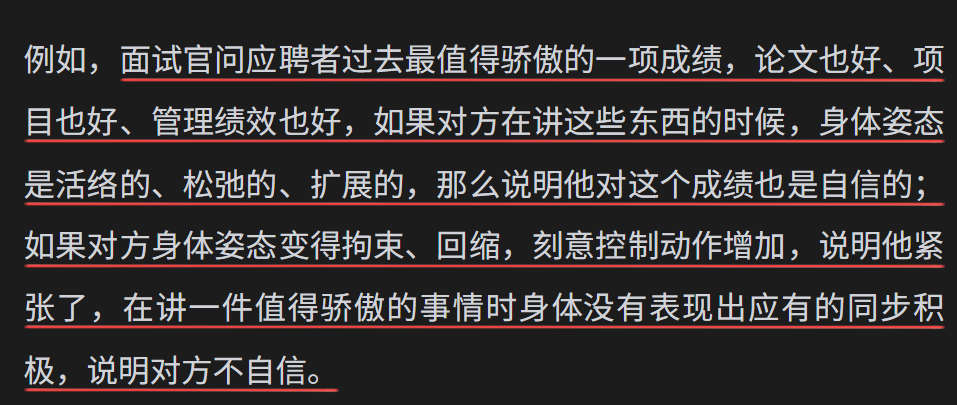
The human body has two nervous systems: one is called the sympathetic nervous system, the other the parasympathetic nervous system. The sympathetic nervous system governs excitation, getting all the body’s organs—heart, blood vessels, brain, muscles, sweat glands, and more—into an active state together. Positive excitement produces the performances above, all typical features of the sympathetic nervous system governing the body. Suppressed tension, by contrast, may cause pupil constriction, a drop in local body temperature (such as cold hands and feet), and muscles that are tense but not active (such as a stiff expression and rigid movements).
The parasympathetic nervous system makes a person slower, softer, and quieter, soothing most organs throughout the body; the person feels relaxed and weary, wanting more to rest and eat, not to fuss. Only in a state of complete despair and giving up, or of particular safety and comfort, does the parasympathetic nervous system take control of the body’s changes. For example, sleep: only after switching the body’s master control to the parasympathetic nervous system can a person fall asleep calmly.
After seeing through a persona disguise, what should you do—see through without exposing. Everyday social behavior is not interrogation or lie detection, not a one-way scrutiny and unmasking of others by a clever person, so there’s no need to point out every flaw you see as the other’s mistake; just quietly note it in your own mind.
The second phase is “examining the past,” corresponding to stage three, “the underlying reserve.” This is the core of judging a person’s real ability. The author likens the underlying reserve to a person’s “core engine”—it is the thinking, knowledge, experience, and skills stored in a person’s mind, directly determining the probability of getting things done. Many people seem to have a glossy persona, yet in fact their underlying reserve is badly out of step with what they’re currently seeking. To see through this “all show, no substance,” the author gives three golden questions: What was your best past record, what level were you at among your peers, and what role did you play yourself? What was the biggest difficulty you overcame in achieving that record, and how strong was the opponent? What regrets and shortcomings do you have now? These three questions interlock and quickly reveal the other’s real ability—those of genuine strength can clearly review their past and talk frankly about difficulties and regrets, while those of mere empty fame only talk big and dodge the essential. This also makes me reflect on whether my own underlying reserve is solid, whether it can withstand such questioning. Reading people is also reading oneself; while examining others, we are also sorting out our own growth trajectory.
The third phase is “assessing the present,” corresponding to stages four through six: “efficient knowing and doing,” “higher-dimensional thinking,” and “tolerance in treating people.” This is the key to judging whether a person is worth deep friendship and cooperation. Stage four, “efficient knowing and doing,” is fundamentally about whether a person unites knowledge and action: knowing what to do, knowing how to do it, and being able to actually carry it out. Efficient people tend to have clear goals, appropriate methods, and strong resistance to interference; they don’t stop at the level of “thinking” but can “put knowing into doing.” Stage five, “higher-dimensional thinking,” looks at a person’s intellectual height, embodied in retrospective reasoning (seeing through the motives and causes behind things), strategic foresight (predicting future trends), and overlooking the whole (not confined to immediate gains and losses). People with this kind of thinking don’t fall into petty internal churn and can solve problems by stepping out of fixed patterns. Stage six, “tolerance in treating people,” conceals a person’s breadth of vision—how far a person can go depends on how many people he can accommodate. To assess tolerance, you need only look at three questions: whom does he quibble with, whom does he ignore, and whom does he put in important positions. The narrow-minded quibble over small matters, while the broad-minded can accommodate others’ imperfections, put capable people in important positions, and ignore trivial disputes. These three stages taught me that true excellence lies not in how strong your ability is but in being able to both work down-to-earth and possess high-dimensional thinking, and treat others with a tolerant heart.
The fourth phase is “predicting the future,” corresponding to stages seven through nine: “emotional stability,” “an open mindset,” and “mission and vision.” This is the core of judging a person’s future room for growth and long-term value. Stage seven, “emotional stability,” is a person’s most precious underlying quality. The author points out that emotions cannot be fully controlled but can be reasonably channeled; true emotional stability is not the absence of emotion but keeping reason when facing gains and losses and setbacks, not letting emotion sway decisions. People of erratic emotion easily err in impulse, while the emotionally stable can steady the position under high pressure and go far steadily. Stage eight, “an open mindset,” determines a person’s speed of growth—the open-minded can take advice, admit mistakes, actively learn, stay curious about the unknown, and quickly iterate themselves; the closed-minded are stubborn, unwilling to admit mistakes, and afraid of change, and are ultimately eliminated by the times. Stage nine, “mission and vision,” is the highest realm of reading people and also a person’s ultimate driving force to move forward. A true mission and vision is not flowery rhetoric but is reflected in long-term action: how much energy he’s willing to invest, what he’ll stubbornly dedicate himself to, what he can endure, and whether he can always keep a positive and enterprising mindset. Those who shout “I have a vision” yet never put it into action—their so-called vision is nothing but a tool for self-promotion; while those truly with a sense of mission will, for the goal in their heart, persist tenaciously and go all out.
After finishing this book, I deeply realized that Nine Stages of Reading People is not only a guide to reading people but a manual for self-cultivation. What it teaches us is not only how to judge others but how to polish ourselves: polish our underlying reserve, so ability matches ambition; cultivate our unity of knowledge and action, so action keeps up with thought; elevate our intellectual breadth, so vision goes beyond the immediate; stabilize our emotions, so mindset supports growth; keep an open mindset, so we keep progressing; and establish a clear vision, so life has direction and strength. One line in the book left a deep impression on me: “Those who use their brains hold the means of production; those who don’t easily become means of production. All the calculating in the brain is, in essence, the brain’s computing power focusing.” Reading people is learning to reasonably allocate your “people-reading computing power,” putting time and energy into people who are worth it; reading yourself is constantly raising your “thinking computing power,” making yourself more reliable, broader in vision, and more valuable.
I used to always believe that “time reveals the heart,” but Nine Stages of Reading People made me understand that time revealing the heart is the bottom line, while scientific methods of reading people let us reduce trial-and-error costs and more quickly understand the heart and recognize ourselves. Reading people is not about scheming against others but about protecting yourself and finding partners truly worth walking with; not about being harsh on others but about better understanding human nature and learning to get along with different people.
评论
0 条评论