Book title: First Principles Explained in Half an Hour (Light Thinking) (《半小时讲透第一性原理(轻思维)》)
Author: Fan Zhongkai
Core thesis: In plain, accessible language, this book breaks down the essence, the methods of application, and the boundaries of first-principles thinking. Backed by a wealth of real-world cases, it helps readers escape the limits of analogical thinking and learn to reason and solve problems from the underlying logic up. It is especially well suited to the core needs of everyday life, work, and the AI era, making it a practical guide to leveling up the way you think.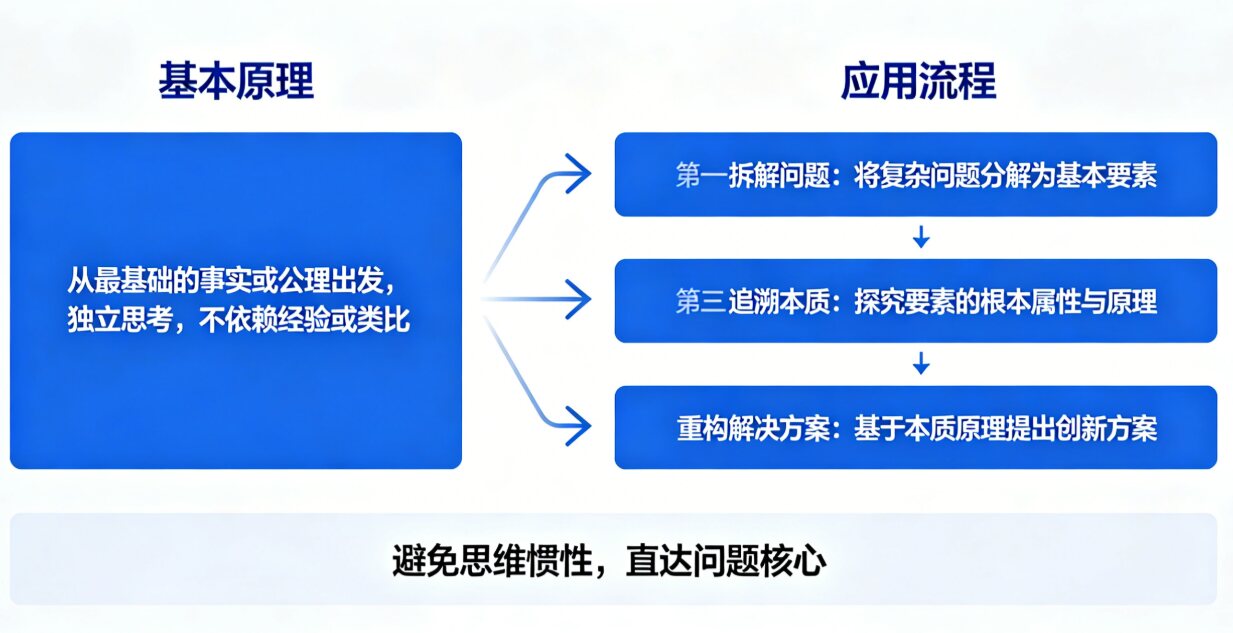
1. The Core Idea: What Are First Principles?
Most of the time in daily life we rely on “analogical thinking”—imitating others, following convention. This kind of thinking is efficient and low-risk, but it can only produce incremental improvement; it can never deliver a genuine breakthrough. First-principles thinking, by contrast, is an anti-inertial way of reasoning from the bottom up. Its core comes down to three steps:
Strip away every assumption: set aside other people’s experience, industry convention, and the entrenched belief that “everyone does it this way,” refusing to be bound by existing frameworks;
Question your way down to the basic facts: return to what cannot be divided any further—physical laws, mathematical rules, fundamental human needs;
Reconstruct the solution: starting from those basic facts, redesign the path and achieve breakthrough innovation.
2. Classic Cases: The Disruptive Innovations Built on First Principles
First-principles thinking is not Elon Musk’s exclusive property. Look across the history of technology and business, and behind every disruptive innovation you will find its shadow:
Elon Musk: refusing to be trapped by the assumption that “rockets are expensive to build,” he returned to the basic material cost of rocket manufacturing and rebuilt the model for rocket development and recovery; at the same time, he went back to the core composition of the battery to drive down the cost of electric-vehicle batteries;
Henry Ford: stepping out of the inertia of “making the horse run faster,” he returned to the basic need—“people need to get from point A to point B quickly”—and invented the assembly-line automobile;
Steve Jobs: shattering the notion that “phones need more buttons,” he returned to the truth that “the essence of how people interact with information is touch,” and created the iPhone with no physical keyboard;
Other cases: Dyson went back to the principle of centrifugal force to invent the bagless vacuum cleaner; DoorDash returned to the unmet demand for food delivery in the suburbs to overtake the market. At the core of each is the same move—leaping out of analogical thinking to strike directly at the underlying essence.
3. Practical Tools and Thinking Frameworks
Mastering first principles requires no complex tools; you can put it into practice starting with the basic methods:
The Five Whys: invented by Taiichi Ohno of Toyota, it strips away surface problems by asking “why” five times in a row to find the underlying root cause—simple, yet remarkably effective;
A core set of questions: when facing a problem, ask yourself again and again—“What is the fundamental purpose of this thing?” “If I were starting from scratch, how would I do it?” “Which limits are physical, and which are man-made?”—forcing yourself back to essential thinking.
4. Applying It Across Scenarios: Bringing First Principles into Daily Life and Work
(1) Everyday-Life Scenarios
Buying a home: strip away the inertia of “everyone buys a house,” and, taking into account your own income, debt, career stability, and other real circumstances, make a rational choice rather than blindly following the crowd;
How you learn: discard the misconception that “watching videos and taking notes = having learned,” and return to the basic fact that “the human brain is good at building connections between information,” letting new knowledge link up with your existing network of knowledge to achieve long-term memory;
An exercise plan: step out of the assumption that “exercise must mean running or hitting the gym,” return to the core truth that “the human body needs regular stress stimulation,” and design a program with the intensity and frequency that suit your own situation;
Interpersonal conflict: see through the surface dispute and strike directly at “the unmet underlying need,” responding to the need rather than fixating on the event itself—most conflicts then resolve themselves;
Parenting and education: return to the core needs of a child’s growth—a secure attachment relationship, room to explore autonomously, experience recovering from setbacks, and the ability to cooperate socially—refusing to be “driven by anxiety” and valuing the child’s curiosity and desire to explore;
Rational consumption: be clear that the essence of consumption is “exchanging money for value” (functional, emotional, and social value), reject the trap of “if it’s on sale, I must buy it,” judge whether the value matches the price, and stay alert to the underlying motives behind overspending.
(2) Application in the AI Era
AI excels at pattern matching and analogical reasoning, but it is not good at original reasoning that starts from zero—and that is precisely the core advantage of human beings. The right way to work alongside AI in this era: humans take charge of defining the boundaries of the problem and breaking down the underlying logic (acting as the “steering wheel”), while AI takes charge of exhausting every possible way to execute (acting as the “engine”).
The mistake: tossing a problem straight at AI is, in essence, just an extension of analogical thinking. The right approach: first think clearly about the basic facts and the core needs, then let AI execute within the framework you have set. At the same time, in an AI era flooded with information, the ability to “return to the basic facts and independently judge the quality of information” will become the scarcest core competency of all.
(3) In Practice at Work
The core logic: build your strategy around “the unchanging basic facts,” break the big problem into smaller ones, then break those down into basic facts, and tackle them one by one.
Case: faced with the vague problem of “declining user retention,” you can break it into four concrete problems—the users’ core needs are not being met, the product experience has weak spots, there is no switching cost, and a habit of use has not formed—and then address each one specifically, turning the problem from “vague” into “actionable.” Jeff Bezos’s idea of “focusing on what will not change over the next ten years” is exactly the core application of first principles in business strategy.
5. How to Practice: Five Habits for Training First-Principles Thinking
Question something every day: pick one thing you take for granted and question its underlying cause (for example, “why must a résumé be one page?”), breaking inertial thinking;
Learn across fields: build “multiple mental models,” drawing on principles from different disciplines (evolutionary biology, physics, economics) to spark underlying thinking—starting with just two or three disciplines is enough;
Keep a “Day 1 mindset”: re-examine your work and study as if you were encountering the role, the skill, and the team for the very first time, avoiding rigidity;
Actively break things down: when you meet a complex problem, first break it into basic facts, then reconstruct the solution, refusing to be fooled by surface appearances;
Reflect continuously: regularly review your own decisions and check whether you were swept along by assumptions and whether you truly returned to the basic facts.
6. A Rational View: The Boundaries and Pitfalls of First Principles
(1) The Core Boundaries
It costs time: there is no need to apply first principles to everything (what to wear, what to eat); reserve it for important decisions;
It requires a knowledge base: if you know nothing at all about a field, you cannot tell assumptions apart from basic facts—continuous learning is the prerequisite;
It cannot replace experiment: a solution built from basic facts is only a hypothesis that must be tested in reality (SpaceX’s first three launches all failed);
It demands humility: avoid falling into the arrogance of “I reasoned from first principles, so I must be right”; accept the limits of your own understanding and be willing to be proven wrong.
(2) Complementary Thinking Models
First principles is not omnipotent; it needs to be combined with other thinking models: systems thinking (seeing the connections and feedback between things), probabilistic thinking (handling uncertainty), and inversion thinking (avoiding disaster)—together forming a complete system of thought.
(3) Common Pitfalls
Pitfall one: treating “opposing the mainstream” as first principles, with no support from basic facts—just a rebellious streak;
Pitfall two: ignoring tacit knowledge and carelessly overturning industry convention without understanding the hard-won trial-and-error wisdom behind it;
Pitfall three: over-analysis leading to paralysis, chasing “perfect thinking” while neglecting to “act fast and iterate step by step”;
Pitfall four: working in isolation and refusing to talk with others, missing the chance to discover the basic facts.
7. Conclusion and Takeaways
The core of first principles is not “finding absolute truth,” but “getting as close as you can to the truest essence based on your current understanding, while staying ready to be persuaded by better facts.” This attitude of “strong opinions, weakly held” is precisely its most precious teaching.
There is no need to try to become Elon Musk overnight. Start with the small things of daily life: when facing an important problem, spend two extra minutes asking three questions—What are my assumptions? What are the underlying facts? What is the best solution? Do this over the long run, and you will escape the pull of inertia, gain the ability to think independently, and hold on to an irreplaceable core competency in the AI era.
8. Recommended Further Resources
Books: Feynman’s Rainbow, Antifragile, and Principles;
Methods: the Feynman Technique (explaining new knowledge in simple language), the Five Whys, and a premise-audit checklist (examining every assumption before making a decision).
评论
0 条评论