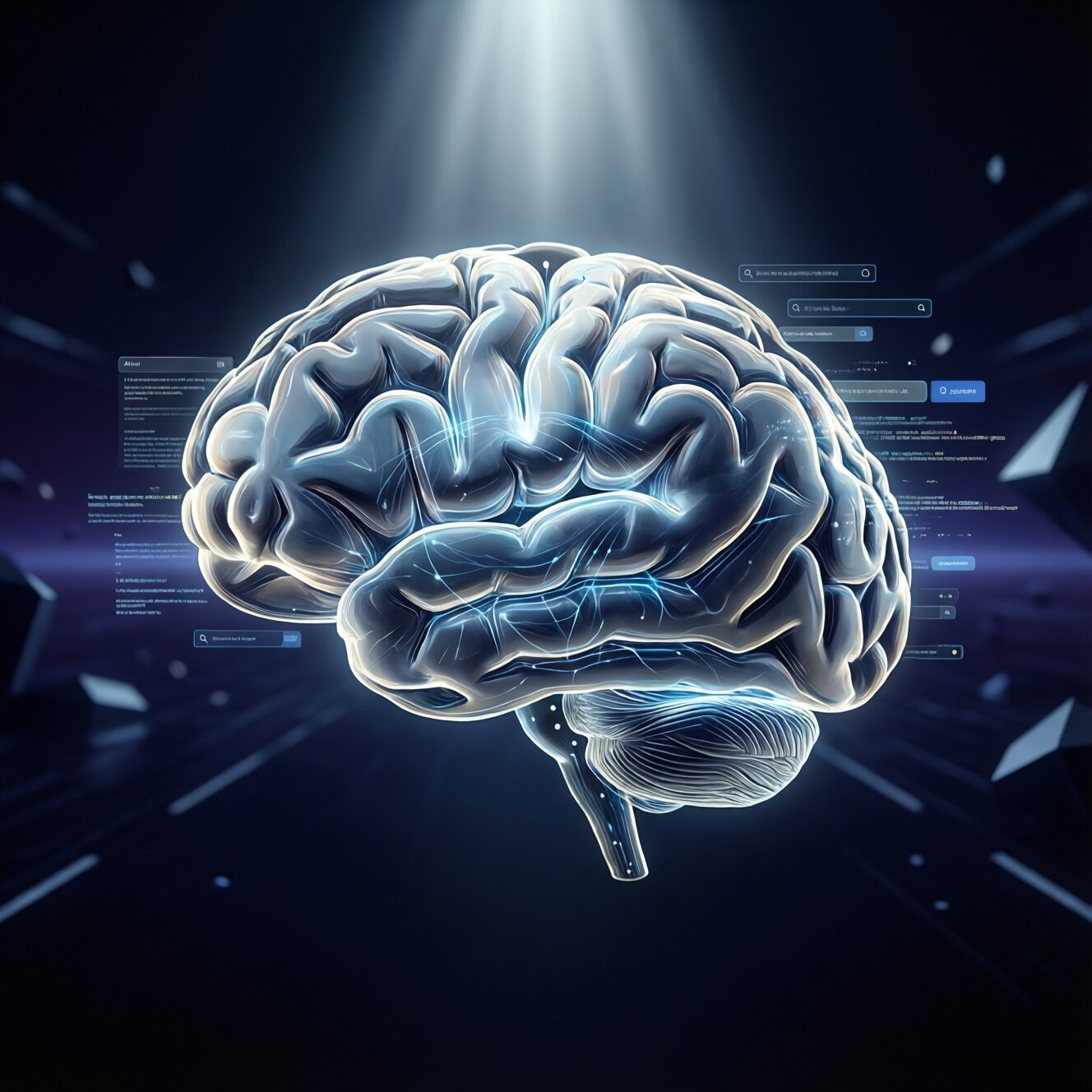
The evolutionary law of “use it or lose it” is playing out in the digital age in another form.
Introduction: An Unsettling Experiment
In early 2025, MIT Media Lab and Wellesley College jointly published a study that shocked academia. Fifty-four subjects were divided into three groups:
- Group A: Used ChatGPT to assist their writing throughout
- Group B: Used Google Search to assist their writing
- Group C (control group): Wrote completely independently
Four months later, the EEG (electroencephalogram) monitoring results left everyone stunned — in the group that over-relied on AI, the brain was “degenerating.”
This is not the plot of a science fiction novel, but a reality that is happening.
Core Findings of the Experiment
1. Neural Connectivity Strength Plummets 55%
The data shows that the ChatGPT group’s temporal-frontal pathway (a key brain region responsible for memory retrieval and logical thinking) dropped 55% in connectivity strength.
- Control group: About 79 active neural connections
- ChatGPT group: Active neural connections dropped to 42
The researchers vividly called it the brain’s “power-saving mode“ — the efficiency with which neural networks work together is systematically reduced; there’s no physical atrophy, but function is clearly weakened.
2. Key Brainwave Activity Weakens
| Brainwave type | Function | Change |
|---|---|---|
| Beta waves | Logical thinking, problem-solving | Significantly weakened |
| Alpha waves | Attention, deep information integration | Activity declined |
What does this mean? Our brains are giving up deep thinking.
3. The Proposal of the “Cognitive Debt” Concept
The research team coined the concept of “cognitive debt”:
Outsourcing thinking to AI boosts short-term efficiency, but in the long term it causes the brain’s “thinking muscles” to atrophy, just as long-term inactivity leads to muscle degeneration.
4. Memory and Creativity Both Impaired
- Memory test: 83.3% of the ChatGPT group couldn’t accurately quote their own writing, versus only 11.1% in the control group
- Creativity decay: Users were more inclined to copy AI output; the writing lacked personal character, showing “homogenization of thought“
Deeper Reflection: This Is Not AI’s Fault
Importantly, this study does not deny the value of AI — it warns us about how we use it.
The Essence of the Problem: “Stand-in” vs. “Assistant”
| Usage | Result |
|---|---|
| AI as a stand-in | Brain slacks off → cognitive ability degenerates |
| AI as an assistant | Brain participates → ability strengthens |
The key difference is: are you still actively thinking?
The Double-Edged Sword of Cognitive Offloading
Psychologist Daniel Wegner proposed the concept of “cognitive offloading” as early as 1986:
- Short-term benefit: Frees up working memory, improves efficiency
- Long-term risk: Over-reliance leads to core ability degeneration
Just as calculators made us forget mental math and GPS made us lose our sense of direction — AI is taking over even higher-level cognitive functions.
The Solution: How to Use AI Smartly
1. Establish an “AI Boundary” Principle
|
2. Practice the “Feynman Technique” + AI
- Think independently first: Don’t look at any AI output; write/think on your own first
- Then compare with AI: Look at AI’s view and find the differences
- Finally integrate: Combine the strengths of both into the final output
3. Deliberately Exercise Your “Cognitive Muscles”
- Set a weekly “no-AI day”: Complete tasks entirely independently
- Read paper books deeply: Train concentration
- Take handwritten notes: Activate the brain’s motor cortex
- Debate and write: Force yourself to organize logic
4. The Right Way to Use AI
| Scenario | Recommended approach |
|---|---|
| Writing | AI generates the outline → you fill in the content → AI polishes |
| Coding | You write the core logic → AI completes the boilerplate code |
| Learning | Think on your own first → use AI to verify → summarize the differences |
| Decisions | AI provides data → you analyze → judge independently |
Good News: The Brain Is Plastic
Neuroscience research shows that neuroplasticity lasts a lifetime. This means:
If you start reducing your AI dependence and increasing independent thinking now, your cognitive ability can be restored.
Like a muscle that starts exercising again, the brain will gradually find its strength back.
Conclusion: Be an AI User With Your Own Judgment
MIT’s study sounded a warning, but there’s no need to panic.
AI is a tool, not a master. The key is: maintain a clear, autonomous awareness.
Every time you want to directly copy an AI answer, stop and ask yourself:
“If I didn’t use AI, how would I think about this problem?”
This simple question may just be the first step toward avoiding “cognitive debt.”
Source: Joint research report by MIT Media Lab & Wellesley College
Disclaimer: This article is compiled from public research; the experimental results are for reference only and do not represent personal medical advice.
评论
0 条评论