Recently I was flipping through Design Patterns Made Easy and saw author Liu Tao’s (pen name Tu’ao) résumé: Xidian University, then an Australian school, followed by stints at iSoftStone, Chinasoft International, HSBC Software, Emerson Technology Resources, and more — fifteen years in the game. Coincidentally, “Programmer Xiao Hui,” author of Algorithms in Comics, also spent time at Beyondsoft. In today’s public discourse, these backgrounds would most likely get slapped with the “outsourcing” label — yet neither author was trapped by the label; instead they wrote bestsellers and built personal brands.
This made me rethink a question: is outsourcing scary? To some extent, the size of the platform certainly matters, but what’s scarier is a person who stops growing on a platform. If you treat every stretch of experience as a springboard rather than an end point, your life won’t be defined by any single contract.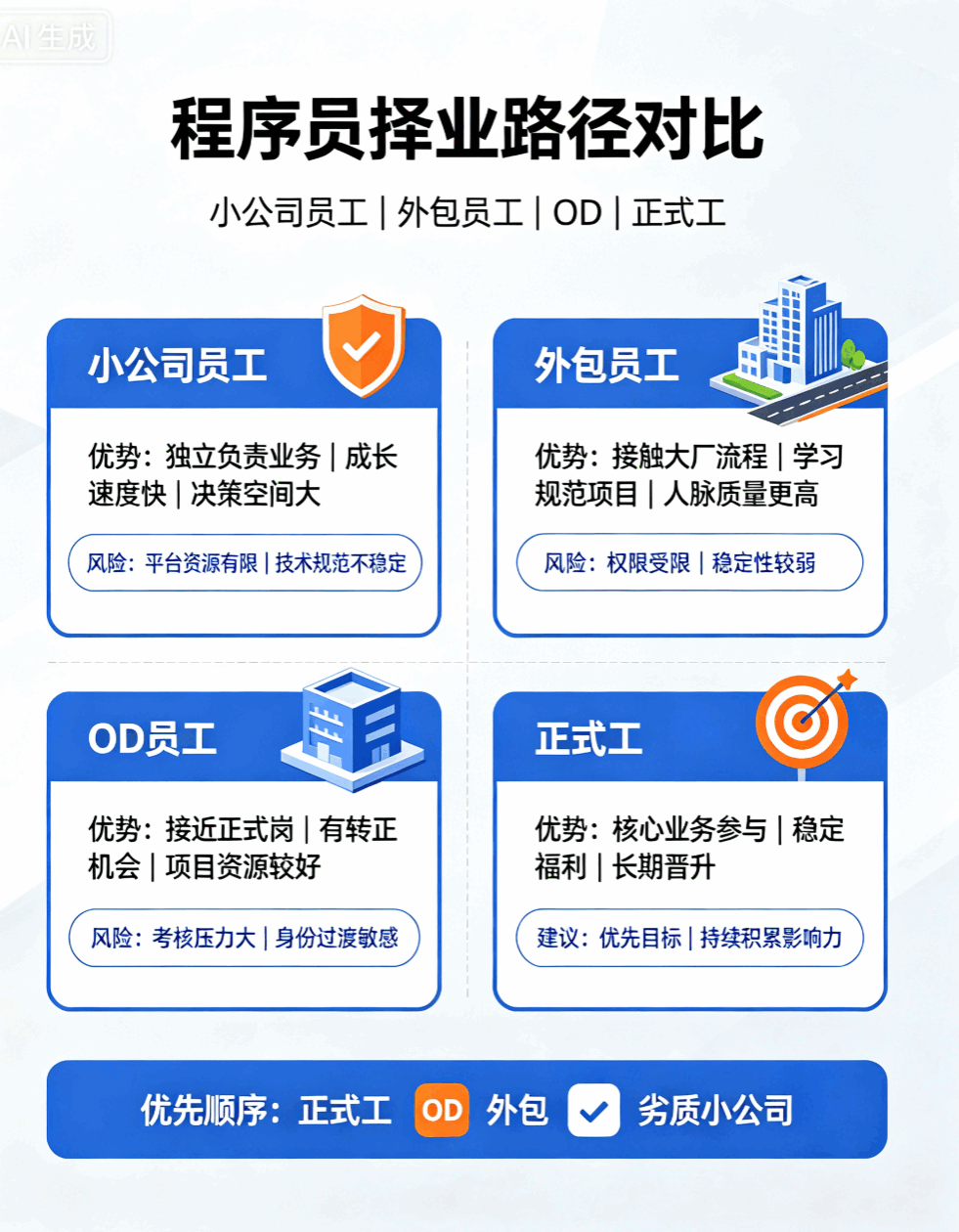
The “growth guide for before 30” below is a complete methodology built around “how to make yourself go further and further.” It’s not something I summarized out of thin air — it’s a structured breakdown of a veteran programmer’s experience, meant as a reference for young practitioners still feeling their way.
1. Pick the Right Track: Get a Head Start Inside the Information Gap
For kids from ordinary families, the biggest disadvantage is often not money but the information gap. During college nobody tells you which industries are rising and which roles are depreciating, so after graduation it’s easy to end up “major-mismatched” — what you studied doesn’t line up with market demand.
The only way to break this is proactive research. Open a job app, filter for positions paying 300K+ yuan a year, and read their common skill requirements in bulk; use RPA or AI tools to scrape job data and turn “what high-paying jobs require” into a quantifiable checklist. Don’t wait until graduation to think about this — start in your junior year or first year of grad school.
Industry cycles are crueler than individual effort. Windfalls like computer science, AI, and cloud computing won’t stay open forever, but catching one wave is enough to open a five-year gap over your peers.
2. Sharpen Two Lines: General Skills + Professional Expertise
Many people think workplace competition is a “tech-stack showdown,” but it’s actually your underlying abilities that determine how far you can go.
General skills are lifetime assets: communication, time management, goal decomposition, problem decomposition. These aren’t limited by industry — they’re useful for job-hopping, career changes, and entrepreneurship alike.
Professional skills, on the other hand, must track the market. Two tracks currently worth investing in:
- AI-related: application development, algorithm engineering — starting salaries are commonly 20K+, but beware of small companies inflating pay and never shipping projects. I once interviewed at a company where the boss wanted to do both AI agents and AI digital humans; a little digging revealed the entire company had two developers. Even at 20K, that kind of role is very likely pie in the sky — once you’re in, you won’t be building product; you’ll be helping the boss validate a fantasy that can’t be realized.
- Ops/SRE: Linux, virtualization, Docker, K8s, middleware, log monitoring — the more complex the system, the more it needs people to backstop it. If you want to develop in this direction, prioritize internet companies of some scale or enterprises with self-built infrastructure. Many small companies just buy a few cloud servers from Alibaba Cloud or Tencent Cloud — no IDC facility, no data center, no network switches or routers, one or two machines in total. High availability, capacity planning, and failure drills are simply out of the question; stay long enough and you’ll struggle to learn anything real.
General skills keep you “standing firm”; professional skills let you “sell high.” You can’t do without either.
3. Output Is Leverage: Turn Learning Into Influence
There are too many people who work with their heads down and too few willing to write their experience up and speak it out. The latter usually enjoy more passive opportunities.
- Build a personal tech blog and distill study notes into a searchable knowledge base.
- Make tutorial videos on Bilibili — teaching others is the most effective way to learn.
- Be active in tech communities: voice opinions, share project experience, and let company HR and headhunters come find you.
- If you have spare capacity, become a training-institute instructor or tech evangelist to sharpen your expression and organization skills while building industry reputation.
Knowledge output isn’t showing off — it’s building yourself a “passive job-search” pipeline. When interview invitations arrive without you sending out a single résumé, bargaining power truly returns to your hands. Early in my career I got into NetEase largely because I had been working as an instructor and had taught related courses; I was fairly familiar with cloud computing, and those experiences directly led to the full-time NetEase opportunity. Without that stretch of output and teaching, I might not even have cleared the interview threshold.
4. Go Deep in One Domain, Become an Irreplaceable Expert
You can never catch up with every hot topic. Learn this framework today, chase that language tomorrow, and you’ll end up knowing a little of everything and doing nothing deeply.
The truly safe position is “niche expert” — SRE, database kernels, performance tuning, distributed-system design. These roles are hard for AI to fully replace, because their complexity and scenario judgment far exceed the current capability boundary of the tools. AI can assist with efficiency, but it can’t take responsibility for the system after it goes down.
At the same time, your direct leader determines 80%-90% of your performance rating and growth space. Learning to manage up isn’t flattery — it’s making sure your leader sees your value and that you get the key resources.
But stay clear-headed too: not every leader is your patron. Some leaders got where they are not through technical ability but through managing up. If you find you can’t learn anything under them, can’t get growth space, and even have to take the blame for their shortcomings, don’t doubt yourself, and don’t expect that “hanging in there will make it better.” Your career’s golden window is short; when you hit this situation, looking at outside opportunities as soon as possible is the rational choice.
5. Treat Job Hunting Like a Regular Physical Exam
Many people only update their résumés when they’re laid off or can’t stand it anymore — that’s very passive. The smarter approach:
- Update your résumé and do a round of applications every year, to know your real market price.
- Loosen your application threshold: if a posting says “bachelor’s or above,” an associate degree can still try; if your skills don’t fully match, apply anyway — the interview itself is feedback.
- Prioritize referrals: maintain relationships with dev and product colleagues day to day; at critical moments one referral screenshot can skip three or four interview rounds.
- Stay visible in the community: keep publishing and teaching; big-tech headhunters reaching out to you is far more likely than mass applications working.
If your current company offers no growth space, put long-term development first even at the cost of a short-term pay cut. Salary is a result, not a goal.
6. Training Can Be Leveraged — Just Don’t Get Harvested
Training institutes aren’t entirely useless: for people without direction or self-discipline, they can provide a learning path and a collective atmosphere, and a few genuinely help you solidify fundamentals.
But the traps are obvious too:
- Sky-high tuition + fabricated employment success stories;
- Instructors whose own employability is weak, teaching outdated content;
- Selling anxiety to induce impulsive payment.
The judgment standard is simple: if you’re self-disciplined, prioritize self-study; if you genuinely need the atmosphere, then screen institutes carefully — focus on instructors’ real résumés and students’ real feedback, not the “average salary” on the promotional poster.
I once studied Java at Tarena; only later did I learn that their so-called “project managers” were actually people who finished the training and couldn’t find jobs. The constant bragging — “train with us and many graduates go on to become project managers” — is the kind of talk you listen to and forget. Don’t believe a word.
Two classic training-institute schemes deserve special vigilance:
- “Job guaranteed” and grandiose promises: pie in the sky — finish the course and you’ll land at a big-tech firm with a high salary — usually just sales talk to get you to pay. You’re spending money to learn technology, not to buy a job;
- Pushing certificates: some institutes steer you toward “so-and-so certifications” issued by HR departments, which are basically useless in the programmer industry. Don’t spend extra money on them.
Before enrolling, search for real graduates’ employment destinations, whether the course content is outdated, and whether the instructors still write code on the front line. The “average salary” on the poster usually has nothing to do with you.
7. Outsourcing: Not an Abyss, but a Springboard
Mention outsourcing and many people’s first reaction is “second-class citizen.” But setting emotion aside, outsourcing is essentially an employment strategy for companies: lower labor costs, avoid employment risk, fill headcount gaps, and let in-house staff focus more on core business. It’s neither a flood nor a beast — just a business model.
Common outsourcing falls into roughly three types:
- Staffing outsourcing (labor dispatch): you sign with the outsourcing firm, work on-site at the client, and do the work alongside full-time employees;
- Project outsourcing: the client hands a complete project to the outsourcing firm, and you deliver inside the outsourcing firm;
- OD model: specific to big firms like Huawei, sitting between full-time staff and ordinary outsourcing, usually with a conversion track.
From my own interview experience, the environment, compensation, and growth space at many small and mid-sized companies are actually worse than big-tech outsourcing. So if you have a choice, prioritize on-site staffing outsourcing over project-based outsourcing. On-site means you genuinely enter the client’s team and touch real business and technical processes; project-based outsourcing often just means delivering a closed module inside the outsourcing firm, with an even lower ceiling.
On “will an outsourcing résumé be discriminated against,” the answer is: it depends on the company, not the whole. Some people in outsourcing teams meet friendly full-time colleagues and well-run code processes, gaining far more than they would at a small company; other individual HRs do hold résumé biases. But overall, an outsourcing background doesn’t seal off your road to foreign firms or big internet companies — what matters is what you got out of the experience.
If you must choose outsourcing, use this priority:
Big-tech full-time > OD > staffing outsourcing > project outsourcing
More than the outsourcing company itself, the client platform matters more. Being on-site at a big firm — even with an outsourcing title — you get exposure to advanced tech stacks, standardized processes, and excellent colleagues; the growth value far exceeds coasting in a full-time seat at a small company.
Also see today’s workplace reality clearly: many companies’ cost-cutting playbook is to lay off high-paid, high-benefit, long-tenured senior employees and keep supervisors in their early 30s running a crew of outsourced staff, interns, and recent-grad full-timers. Cycle after cycle, this makes job-hunting harder for people over 35 with decent résumés. It’s not a personal-ability problem — companies are doing the economic math. Understand this background and you won’t equate “entering outsourcing” with “life failure,” and you certainly won’t blindly chase a “full-time seat” at the cost of growth space while you still have choices.
From day-to-day experience, at many companies on-site outsourced staff share the canteen and public facilities with full-time employees, and badge colors look no different — there’s no obvious discrimination in the overall atmosphere. But there are indeed companies that treat outsourced staff differently — such as the previously exposed incidents of “you’re not our company’s employee, you’re outsourced, you’re not allowed to eat here.” So the on-site outsourcing experience depends heavily on the client company’s culture and policies; before joining, ask around and observe more — that matters more than the title.
After joining, get your mindset right: you’re not there to “coast toward retirement,” you’re there to “borrow the hen to lay eggs.” Fully exploit the client’s resources to learn, keep practicing interview problems, stay interview-ready, and treat outsourcing as a springboard, not an end point. When the right opportunity comes, jump decisively to a better platform.
On conversion to full-time, be realistic. I’ve had former colleagues say that someone in their NetEase team converted from outsourcing later — that probability does exist, but it depends heavily on business gaps, leader approval, and timing; it’s the minority case. The vast majority of outsourced staff have no way to convert, so never go to work with a “I’m going to convert” mindset — go with a “I’m going to learn” mindset. Once you’ve absorbed the client’s processes, technology, and project experience and your wings are full, look directly at outside opportunities. Holding your fate in your own hands is far more reliable than waiting for an uncertain conversion slot.
8. Outsourcing vs. Small Company: How to Choose Between Platform, Network, and Technology
Many people agonize: big-tech outsourcing, or full-time at a small company? There’s no standard answer, but you can break it down clearly along three dimensions.
1. Talent circles and engineering systems
Big-tech outsourcing’s advantage is the “environment.” The client’s full-time staff around you are often senior engineers and architects who survived round after round of screening; daily collaboration, code reviews, and requirement handoffs all let you learn mature thinking up close. Add big-tech’s standardized R&D processes — code review, unit testing, CI/CD, log monitoring, capacity stress testing, microservice conventions — and you quickly build engineering-minded thinking.
Small companies, by contrast, usually center on shipping fast, lack standardized processes, have weak testing and ops systems, and easily fall into crude “pile on features, pile on servers” development. Teams are small with high turnover and few senior technical leaders; stay long and you’ll ossify bad coding habits.
2. Platform resources and tech stack
Big firms offer a unified tech stack, open-sourced internal components, and regular tech talks and training — outsourced staff can mostly participate too. These experiences, written into a résumé, are powerful endorsements.
Small companies pick technology at will, often using aging frameworks or private niche tools, leaving the tech stack fragmented. If the company’s traffic is low, you’ll barely touch advanced scenarios like high concurrency, distribution, or performance optimization, and your technical horizon will be limited.
3. Outsourcing’s hidden shortcomings
But big-tech outsourcing doesn’t dominate across the board — its weaknesses are obvious too:
- Identity limits: no access to core business data, no participation in core architecture decisions, extremely high thresholds for promotion, awards, and internal transfers;
- Benefit gap: at the same technical level, social-insurance and housing-fund contribution bases are generally lower, and most lack year-end bonuses, stock, and supplemental medical insurance;
- Résumé bias: some mid-to-large companies have reservations about long outsourcing histories when screening résumés;
- Instability risk: if the client’s business contracts, the outsourcing team can be cut directly — the layoff cost is extremely low.
By comparison, full-time employees at quality small companies can participate deeply in the full business process, get the chance to own an entire business line independently, hold complete project decision-making power, and enjoy better-protected benefits and stability.
Recommendations by group
Big-tech outsourcing suits you if:
- You have 0-3 years of experience, lack big-tech project history, and want to quickly fill in standardized engineering experience;
- Your goal is a later jump to a big-tech full-time role and you need big-tech experience as résumé backing;
- You currently have no better offer, and the small company’s business is messy with aging technology and no growth space.
A quality small company suits you if:
- You have 3+ years of experience and a mature big-tech résumé, and want to independently own complete business and accumulate hands-on architecture experience;
- You pursue long-term stability and complete compensation and benefits, planning to go deep in the same track;
- You aim to start a business or do independent development and need full-chain 0-to-1 authority.
How to maximize the value of big-tech outsourcing
If you end up choosing big-tech outsourcing, remember these:
- Actively participate in code reviews; record senior engineers’ coding standards and optimization thinking;
- Organize the big firm’s standardized processes and middleware usage patterns into tech blog posts;
- Maintain connections with the client’s full-time staff, aiming for future referrals or conversion chances;
- Keep practicing interview problems and updating your résumé; write the big-tech projects into your history, and look for full-time opportunities within 1-2 years to avoid being stuck in the outsourcing system long term.
On short-term growth: big-tech outsourcing > low-quality small company; on long-term development: quality small-company full-time role > outsourcing. The role outsourcing suits best is the short-term springboard.
Final Thoughts: People Who Go Far All Have a Growth System
One line stuck with me: you make money desperately to buy your freedom, not to stay and become the headliner. The same goes for the workplace — we work hard to improve our abilities, accumulate resources, and build influence not to become “the most indispensable employee” at some one company, but so that one day we can freely choose a better platform, or even define our own next stage.
I was my team’s outstanding employee three years running, arguably one of the “most indispensable” people. I built the second-line technical support system from scratch, and did RPA automation from scratch too. But once you finish building that infrastructure, the company’s projects aren’t so numerous anymore, and the space for your value shrinks accordingly. After 35, the way the company does its accounting changes again, and your value gets heavily discounted.
That was the moment I realized: if you get your core focus wrong and hand the measuring stick for yourself to others, you’ll suffer terribly. Outstanding employee, core backbone, indispensable — these labels were given to you by the company, and the company can take them back at any time. What truly belongs to you is transferable ability, monetizable experience, and the courage to leave at any moment.
Back to the opening question: is outsourcing scary? No. What’s truly scary is turning any stretch of experience into treading water.
iSoftStone, Chinasoft International, Beyondsoft, Pactera… these companies churn out huge numbers of engineers every year. Some people treat them as safe harbors and stay for ten years; others treat them as training halls and jump to better platforms in two or three. The difference isn’t the starting point — it’s whether you turn every experience into transferable ability.
Before 30, the most important thing isn’t finding a “perfect job” but building a system of continuous evolution: pick the right track, sharpen your abilities, output your brand, go deep in a specialty, job-hunt flexibly, leverage help rationally. Once this system runs smoothly, whether you start from outsourcing or from a big firm, your life enters the positive cycle of “getting broader and broader.”
评论
0 条评论